
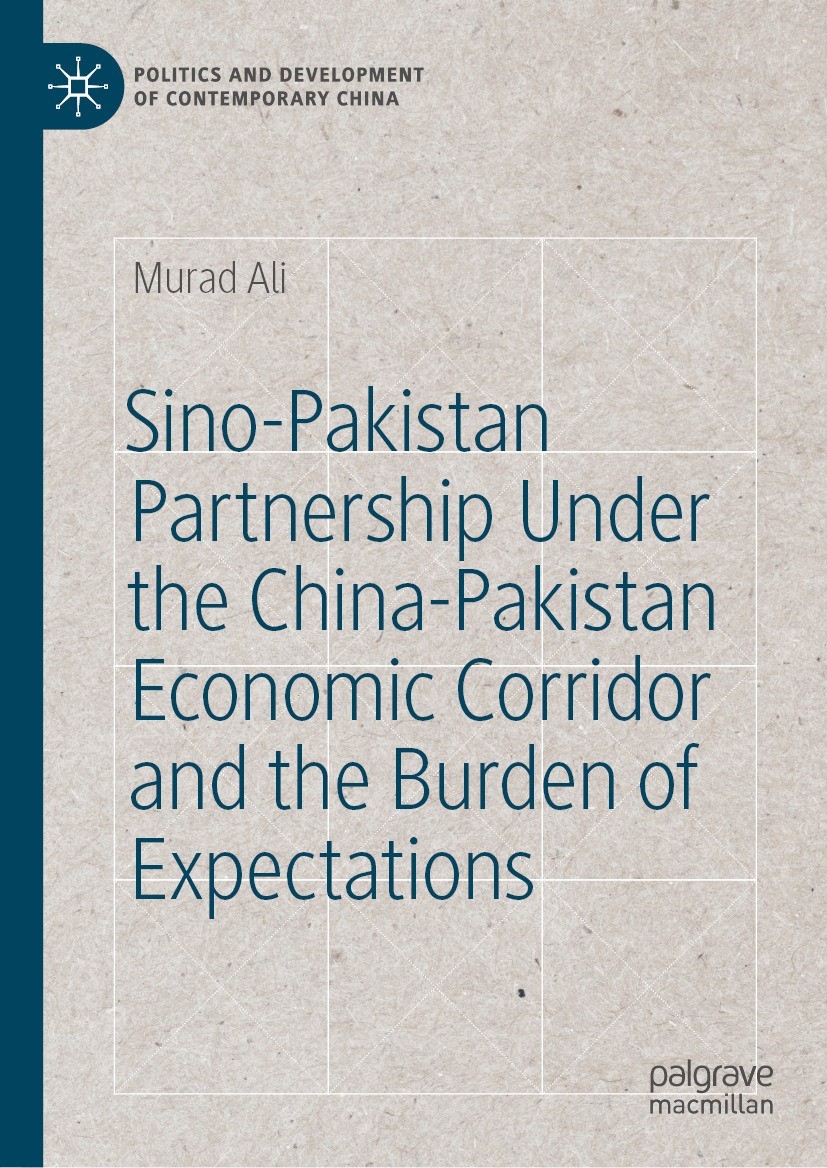
(Cham: Palgrave Macmillan, 2025), ISBN: 978-3-031-91519-2 (Pages: XXI-285).
Murad Ali’s scholarly contribution in the ongoing academic debate concerning the evolving Sino-Pakistan cooperative bilateral ties is an attempt to provide a different picture of the signed corridor project between the two countries. It is a timely study that places the corridor project (China-Pakistan Economic Corridor- CPEC) at the centre of historically evolved multilayered cooperation between two neighbouring states, China and Pakistan. The territorially adjoining characteristics of both states have led them to enhance their bilateral relations while focusing on the unexplored dimension of their trading collaboration. The book, written by a Pakistan-based author, Murad Ali, is a comprehensive account of varying arguments explaining the positions of Beijing and Islamabad on the evolving China-centric world order. Ali is formally associated with the Pakistani academic community and holds a position of Head of the Political Science Department at the University of Malakand, Pakistan. He earned his Doctorate from Massey University, New Zealand, and proved his intellectual strength at various international research forums. The book under review is a glimpse of Ali’s intellectual properties regarding the changing patterns of great power politics and their impacts on the South Asian regional political order. While examining the position of Pakistan in the continuing interconnection between South Asian regional politics and global power politics, Ali has explained the Washington-Islamabad bilateral relations in his book The Politics of US Aid to Pakistan: Aid Allocation and Delivery from Truman to Trump (2019). Akin to describing the role of financial aid in the United States-Pakistan relations, the recent study of Ali has explained the Washington-Islamabad bilateral relations in his book.
The Politics of US Aid to Pakistan:
Aid Allocation and Delivery from Truman to Trump (2019). Akin to describing the role of financial aid in the United States-Pakistan relations, the recent study of Ali concentrates on the role of CPEC in China-Pakistan bilateral ties. The book’s six chapters talk about CPEC under the Chinese intercontinental trading designs in the form of the Belt and Road Initiative (BRI), which intends to alter the conventional outlook of the international economic system. The BRI’s launching in the international system and CPEC’s integration with the South Asian regional politics have raised several critical viewpoints around the world. While slightly explaining the BRI envisioned by President Xi in 2013, the book’s debate marked CPEC as the landmark development of the South-South Cooperation (SSC).
It is dubbed scholastically as the significant change, creating an endless debate generalising CPEC as the game changer or fate changer. In this way, the first chapter formally introduced the central point of Ali’s study, the rationale behind selecting China-Pakistan relations, and the specific questions which are addressed through applying a six-step model of Braun and Clarke. The validations of the author’s arguments describing the complexities of Sino-Pak relations under the CPEC were acquired from the collection of selected qualitative data. The thematic analysis applied in the study further included the interviews of leading Pakistani and Chinese officials in the primary analysis of the book. The formal introduction in the first chapter shifted the debate towards the nature of CPEC and its considerable role in Pakistan’s economic development, which is mainly centred on the construction of Gwadar Port. The aspired functions of the Gwadar Port are compared with the other active ports of the region, are analysed in the second chapter.
The theoretical understanding of the book’s main idea is established in the third chapter with the support of the SWOT (Strengths, Weaknesses, Opportunities, and Threats) framework. The SWOT analysis shed light on Pakistan’s internal and external security challenges and opportunities after signing the CPEC. The fourth chapter’s emphasis on the significance of the Chinese transcontinental trading model is dubbed as Beijing’s approach of global transformation. The established arguments enlightened the geoeconomic benefits of China, pushing the Gwadar Port towards international oceanic politics.
These rising patterns of such oceanic politics have generated an intense environment of multifaceted security challenges for Pakistan, according to the fifth chapter’s examinations. The conversation on the weird political and security challenges mainly consists of the problems of extremism, terrorism, and the Taliban’s revival in Pakistan.
In the end, the last chapter’s concentration called China’s BRI as an undeniable part of global power politics in which the Western financial institutions have started responding to this new great game. It updated the existing characteristics of geostrategic power contestation between China and the West, where Pakistan has immense opportunities, fastened with severe security issues. So, an analytical overview of all chapters offers a multilayered narrative from domestic expectations and economic realities, through conceptual framing, to China’s global ambitions and its geoeconomic interests reshaping the regional political outlook of South Asia. The book’s most interesting feature emerges from the author’s non-traditional way of presenting a well-structured and well-organised analytical framework, refusing the conventional way of romanticising the China-Pakistan trading cooperation. The author gives credit to China for its heavy investment plans in Pakistan, which could not be separated from Beijing’s geostrategic interests. On similar lines, the author’s deliberations on Islamabad highlighted the problems of institutional reforms, lack of good governance, and financial irregularities within Pakistan. The critical appreciation maintained in the book depicts the author’s impartial and independent research method, increasing the arguments’ rationality and findings’ validity in the book.
It has made this book an exceptional study carrying a logically structured understanding of CPEC while recognising it as a turning point in Sino-Pakistan relations. Thus, the book is not just an academic contribution but also a policy guide reflecting the latest challenges faced by Pakistan after signing CPEC with its historical friend. Therefore, it could be treated as an appropriate study for the policy practitioners, diplomats, and academicians from Pakistan, China, and other countries interest in the BRI and its South Asian directions.