



Context
The Middle East’s contemporary realignment did not begin with the war between Iran and Israel, nor with Iranian strikes on U.S. bases across the Gulf. It began earlier, with the slow erosion of faith in a security order built on American primacy, Israeli military overmatch, and the assumption of Arab strategic compliance. The Israeli strike on Doha in September 2025 merely stripped away the last illusions. What followed was not unity, but fragmentation. Instead, the Islamic world entered a phase of deliberate Middle Power alliance building, driven by layered threat perceptions and an urgent desire for strategic autonomy.
At the center of this transformation is a paradox. The region is witnessing the rise of new alliances, yet these alliances are not designed to fight a single enemy. They are instead meant to buffer against multiple threats simultaneously: Iranian asymmetry, Israeli unilateralism, and U.S. unpredictability. Complicating this further is the re emergence of the “Greater Israel” narrative, which has amplified regional fears that Israeli military power is no longer bounded by defensive logic alone.
From Gulf Unity to Gulf Divergence
For much of the post Arab Spring period, Saudi Arabia and the United Arab Emirates were viewed as the twin pillars of Arab order. They coordinated in Yemen, aligned against political Islam, and worked closely with Washington. That partnership now seems to have fractured into a structural rivalry rooted in fundamentally different understandings of power and risk.
Saudi Arabia has increasingly embraced a state centric, formalized security approach. Scarred by years of proxy warfare and conscious of the vulnerability of its economic transformation under Vision
2030, Riyadh has grown wary of open ended confrontation—particularly wars triggered by actors outside its control. Iranian attacks on energy infrastructure, U.S. bases, and shipping lanes reinforced Saudi fears not just of Tehran, but of being caught between Washington and Tehran. This explains Riyadh’s pivot toward formal defense guarantees, most notably with Pakistan, and its growing strategic convergence with Turkey.
The UAE, by contrast, has doubled down on a networked, maritime, and technology driven security model. Abu Dhabi prefers flexible alignments, proxy leverage, and intelligence dominance over rigid alliance hierarchies. Its deepening ties with Israel and India reflect a desire to hedge not only against Iran, but also against Saudi Arabia’s ambition to re centralize Arab leadership. This divergence—well captured in PoliTact’s analysis of Saudi UAE power tussles with Turkey and Iran—has become one of the most important drivers of bloc formation in the region. The result is not a split over ideology, but over risk management. Riyadh fears escalation without control; Abu Dhabi fears marginalization within a Saudi led order.
As Middle Power alliances harden across the Middle East, the other Gulf states—Qatar, Bahrain, Oman, and Kuwait—illustrate divergent strategies for managing exposure, autonomy, and survival amid the erosion of the U.S.-centric security order. Unlike Saudi Arabia and the UAE which seek to shape regional outcomes through competing alliance architectures, these states operate primarily as system navigators, each responding differently to rising unilateralism and unmanaged escalation. Qatar occupies the most exposed position. Its foreign policy has emphasized mediation, diplomatic connectivity, and hosting high level in terlocutors, allowing Doha to play a central role in ceasefire negotiations and crisis diplomacy. This strategy, however, has carried increasing risk.
The Israeli airstrike in Doha in September 2025— widely analyzed as a stress test for Gulf mediation and U.S. security guarantees—demonstrated the limits of protection derived from connectivity alone and raised questions about the durability of mediator immunity in a more permissive strike environment. Mediation provides access and relevance, but as escalation becomes kinetic, it offers diminishing insulation. Bahrain represents the opposite strategy. Rather than seeking autonomy through flexibility, Manama has embedded itself deeply within Saudi led and U.S. aligned security structures.
Hosting the U.S. Fifth Fleet and relying on external guarantees for regime stability, Bahrain externalizes risk upward to larger patrons, trading strategic maneuverability for protection. This approach offers short term stability but reduces Bahrain’s ability to hedge as the regional order fragments.
Oman occupies a quieter middle ground. Like Qatar, Muscat prioritizes mediation, but it does so through deliberate low visibility and strategic restraint. Omani diplomacy is characterized by neutrality, confidentiality, and avoidance of high profile military entanglements, allowing it to act as an intermediary without becoming a primary target. This combination has enabled Oman to preserve autonomy with comparatively lower exposure. Kuwait, meanwhile, adopts a strategy of institutional caution. Its foreign policy emphasizes international law, neutrality, and multilateral legitimacy, shaped in part by domestic constitutional constraints and a historically empowered legislature. Kuwait avoids both alliance leadership and high risk mediation, focusing instead on predictability and restraint as a means of survival. Taken together, these cases highlight the narrowing options available to small states in a region increasingly defined by unilateral force and competitive alignment. Flexibility, dependence, invisibility, and restraint each offer partial protection—but none fully insulate against a security environment in which traditional guarantees no longer reliably constrain escalation.
The Emergence of an “Islamic NATO” and Hexagon Alignment
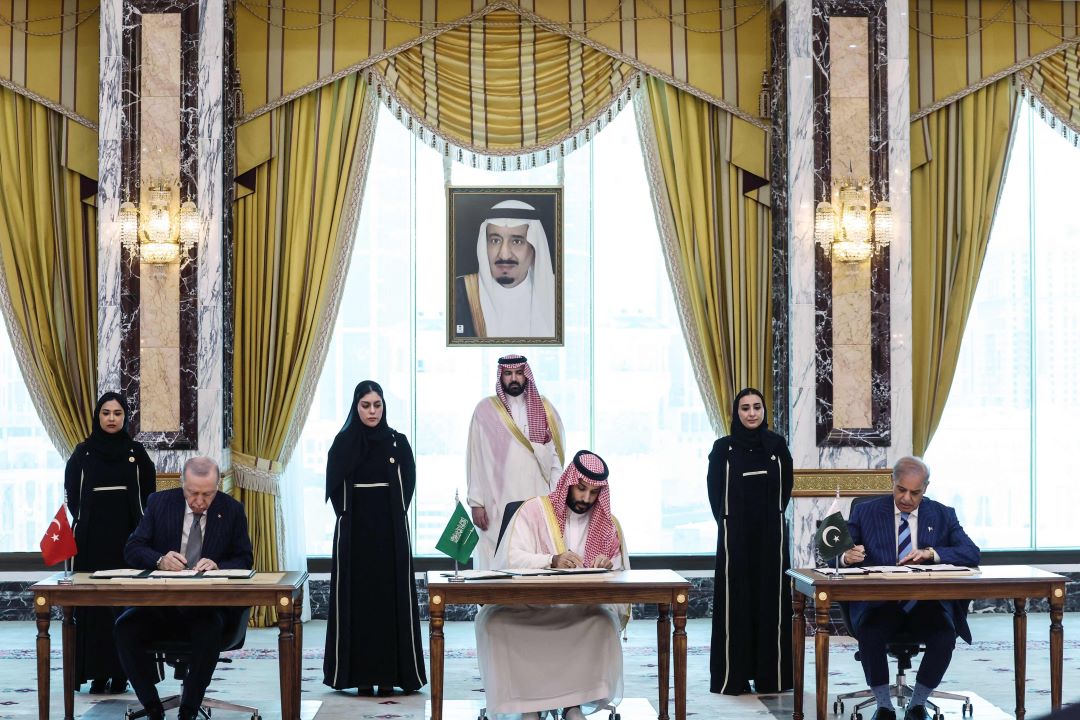
Out of this environment has emerged what is increasingly described as an Islamic NATO style alignment, anchored by Saudi Arabia and Pakistan, with Turkey as a central pillar. This bloc is often misunderstood as a purely anti Iran coalition. In reality, it is built on three overlapping threat perceptions.
First is Iranian asymmetry: missile forces, drones, and proxies that threaten energy infrastructure and regime stability. Second is U.S. unpredictability—the fear that American military decisions, often aligned closely with Israeli objectives, could entangle Muslim states in wars they neither seek nor control. Third is Israeli strategic autonomy, particularly as Israel demonstrates a willingness to strike across borders without regard for Arab diplomatic calculations.
The Pakistan–Saudi defense agreement reflects this logic. Pakistan offers nuclear credibility and conventional depth; Turkey provides expeditionary experience, NATO interoperability, and drone warfare expertise; Saudi Arabia contributes financial resources and diplomatic weight. Together, they form a deterrence architecture designed less to confront Israel directly than to prevent Muslim states from being involuntary participants in U.S.–Israeli campaigns. This bloc is therefore as much about autonomy as opposition.
Parallel to the perceived Islamic NATO is a looser but influential alignment in infancy, centered on Israel, India, and potentially UAE—often described as a Hexagon Alliance when extended to include additional partners. This bloc is driven by a different hierarchy of threats.
For Israel, the priority remains Iran, but also the risk of regional isolation should Sunni states consolidate into a unified security framework. India views the Gulf through the lens of maritime security, energy flows, and competition with China. The UAE sees in this alignment a way to offset Saudi leadership ambitions while retaining access to Israeli technology and U.S. strategic networks.
This bloc is not primarily anti Islamic. It is anti consolidation. Its purpose is to ensure that no single Sunni led alliance can dominate the region’s security architecture.
Greater Israel as a Strategic Disruptor
One of the most destabilizing factors shaping alliance behavior today is not a military doctrine, but a narrative: the re emergence of the idea of Greater Israel. While not an official policy of the Israeli state, the concept—rooted in religious nationalist ideology and echoed by influential political figures—has gained unprecedented visibility during and after the Gaza war.
Regional actors interpret this discourse as signaling a rejection of territorial finality and Palestinian sovereignty. Al Jazeera and Middle East Eye have documented how references to biblical borders and permanent Israeli control “from the river to the sea” have triggered alarm across Arab and Muslim capitals.
The destabilizing effect of the Greater Israel narrative is threefold. First, it reframes Israeli military action as potentially expansionist rather than defensive. Second, it undermines the political sustainability of normalization agreements by making it harder for Arab leaders to justify cooperation without a Palestinian resolution. Third, it reinforces the perception that U.S. power in the region is structurally aligned with Israeli territorial objectives rather than regional stability. Even states aligned with Israel, such as the UAE, hedge against this uncertainty. Others respond by accelerating independent deterrence mechanisms.
Great Power Rivalry and the Turn to Hedging
The Islamic world is no longer a passive theater of Great Power rivalry. It is actively shaping a multipolar order in which Middle Powers hedge against everyone—including their allies. The Saudi–UAE split, the rise of Islamic NATO and Hexagon formations, the disruptive force of the Greater Israel narrative, and the quiet advance of China and Russia all point to the same conclusion: the era of uncontested security hierarchies in the Middle East is over. What replaces it is not stability, but agency. And in a region long defined by external control, that may be the most consequential shift of all. As regional blocs multiply, China and Russia benefit not by conquest but by optionality. China’s deepening involvement in South Asia and the Gulf—through infrastructure, security arrangements, energy, and industrial investment—positions Beijing as an indispensable economic partner to all sides without entanglement in regional wars. Russia, meanwhile, offers selective military alternatives, reinforcing a multipolar security environment in which no single actor dominates. Neither power demands ideological alignment; both profit from fragmentation.
Who Are These Alliances Really Meant to Counter?
The central question—who are these alliances meant to counter—has no single answer. They are not aimed solely at Iran, Israel, or the United States. They seemed designed to manage uncertainty in a system where all three generate risk. Iran threatens through asymmetry. Israel threatens through unilateral escalation and expansionist rhetoric. The United States threatens—not intentionally, but structurally—through unpredictability and alignment choices that subordinate regional interests to global strategy and balance of power calculations.
For Saudi Arabia, Iran is dangerous not only because of missiles and proxies, but because Iranian escalation reliably draws in U.S. and Israeli responses that Riyadh does not command. For the UAE, Iran is disruptive but manageable through deterrence, diversification, and diplomacy. For Israel, Iran is framed as an existential threat demanding pre emptive action. For Turkey and Pakistan, Iran is a competitor to be balanced, not annihilated. Iran’s retaliatory attacks on U.S. bases in GCC states did not unify the region. Instead, they exposed the costs of hosting American power Gulf monarchies found themselves targeted not for their own actions, but for decisions made in Washington and Tel Aviv. As the Carnegie Endowment has noted, this dynamic has pushed Gulf states toward independent security thinking rather than deeper reliance on U.S. guarantees. In this sense, Iran functions less as the architect of regional order than as its accelerator—forcing others to adapt. The alliances forming across the Islamic world appear to be alliances of insulation, not crusades. They seek to preserve autonomy, reduce exposure, and prevent any single power from dictating outcomes.