



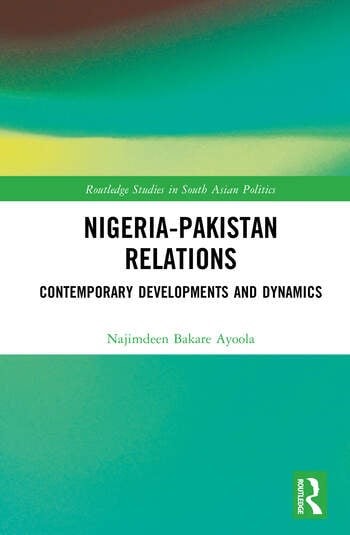
Contemporary Developments and Dynamics
Najimdeen Ayoola Bakare (New York: Routledge, 2026)
ISBN: 9781032956145 (Pages. 236)
Pakistan’s Look Africa Policy, launched in 2017, was primarily aimed at exploring the untapped potential of African nations, which possess significant trade strengths. However, the inadequate growth of people-to-people contacts remained a serious challenge in this context. The prevailing disconnects within intellectual communities between Pakistan and African states hinder the scope of effective academic collaboration to overcome the mainstream issues undermining two-way cooperative trading connections in diverse directions. Responding to this challenge, a brief body of literature emerged on bilateral relations between African nations and Pakistan, and on the desire of the African governments to expand their multifaceted collaboration with Pakistan beyond fixed conventional domains.
In this regard, the book under review is written by an African-origin university professor currently serving in the Department of International and Strategic Studies at the University of Malaya,
Kuala Lumpur.
He is a renowned intellectual figure with commendable intellectual expertise in European and African regional politics, while conceptually emphasising the politics of globalisation, regionalism, and development. With his two decades of teaching experience, Najimdeen Ayoola Bakare has made considerable contributions in his specialised areas through a wide range of international publications from different academic platforms. In his quest to explore prevailing trends in,
Nigeria-Pakistan relations within the contemporary regional interconnectedness between
South Asia and Africa,
Bakare sought to provide an interesting account of the varying arguments surrounding bilateral cooperation between Abuja and Islamabad. He divided his book’s main debate into brief eight thematic chapters while covering eight different dimensions of Nigeria-Pakistan relations.
After providing a brief overview of Abuja’s growing pleasant interaction with Islamabad in the introductory part, the book’s first chapter begins the discussion of Pakistan-Africa relations and the growing diplomatic connections between the two sides. It explains the role of post-colonial solidarities and shared development aspirations of Pakistani and different leaders of African nations in forming their cooperative political coordination.
The governmental-level communication further played an important role in rationalising the vision of Islamabad-based political authorities for exploring African potential, where
Nigeria holds an incomparable standing,
as the comparative analysis of the second and third chapters shows. The fourth chapter exclusively sheds light on the mainstream collaborative areas of Nigeria-Pakistan bilateral ties revolving around the high-level military-to-military contact. The fifth chapter covers the economic dimensions of cooperation between two states, providing details on the growing trade connectivity between them to deepen their economic ties.
The debate on the Sustainable Development Goals and the performance of Abuja and Islamabad in rationalising their efforts to align with the global developmental agenda is presented in the
sixth chapter.
The second-to-last chapter attempts to cover contemporary societal issues, whereas the role of China in forming a tripartite cooperation with the support of Nigeria and Pakistan is unfolded in the last chapter.
In this way, the book’s core argument seeks to offer a comprehensive account of an interesting viewpoint on the structural similarities between Nigeria and Pakistan, which can be measured through the colonial legacies of the two nations. The post-colonial state structure is suffering from complex civil-military dynamics, financial irregularities, and developmental challenges, all of which are significant factors shaping the present status of the two states in their respective regions.
These commonalities significantly shape the trajectories of their interstate contacts, which could be symbolised as the empowerment of South-South cooperation, as the author views. He seeks to academically prove the emerging transregional diplomacy between South Asian and African nations.
He adopts a comparative analytical approach to examine the ongoing patterns of Nigeria-Pakistan relations and their multidirectional growth. Several internal factors support these cooperative developments in the two states’ mainstream foreign relations, as the book demonstrates. In this way, Bakare’s analytical lens, which justifies the rise of South-South international relations scholarship, enhances the novelty of his study, which is predominantly overshadowed in contemporary literary debates.
The overwhelming influence of these debates on existing academic discussions underestimates the Asia-Africa transregional trading connections, compromising substantial potential to alter their conventional economic structures.
Based on these descriptions, Bakare’s academic investigation is a valuable intellectual contribution to the emerging studies of the growing South Asia-Africa interconnectedness and the continually improving their economic patterns under bilateral state interactions. The most notable feature of the book is its comparative analysis, laced with conceptually sound and numerous empirically convincing evidences, which strengthens the author’s arguments.
Thus, the book deserves explicit appreciation for highlighting an area of academic attention that has been marginalised and could be conceptualised as an essential component of global South diplomacy.
The author’s focus on Nigeria-Pakistan cooperative relations and its inevitable association with contemporary geopolitical developments exhibits his appreciable scholarly insight in discussing the demoted literary dimensions of the world’s academic communities.
Thus, this book is suitable for scholars of Area Studies, world politics, international relations, comparative politics, economic development, and Global South Studies. Movere, the political, diplomatic, legislative, and business communities could find this book a useful academic account capable of enriching their existing visualisation of the African continent and the untapped potential of African nations.