


General
The state of Jammu and Kashmir is located at the extreme western section of the Great Himalayan range where it merges with the Hindu Kush, the Karakorum and Central Asia. Kashmir has been described as a “garden of eternal spring or an iron fort to a palace of Kings” by Mughal Emperor Jehangir. Kashyap-pur, Kashir, Kashmira and Kashmir (Cashmere), are various names through which the State of Jammu and Kashmir have been known in different phases of its history. Kashmir has a long and chequered history of 5000 years B.C, though details of this very period are not fully known. However, according to renowned Kashmiri Historian Pandit Khalana, the recorded civilized human history in Kashmir can be recounted from 2450 years B.C, when Gonda-1 took over as Ruler of Kashmir. Since then people of the state have lived through various civilizations and professed religions.
Although, the heavenly land remained under occupation of various dynasties and empires, yet the misfortune of its inhabitants started from 1846, resulted from the infamous Kashmir Sale Deed. This can be imagined from a verse of the great poet and philosopher, Dr. Allama Muhammad Iqbal, who while describing their helplessness said; “each hill, each garden, field, each farmer too they sold, a nation for a price that makes my blood ice cold”. Thereafter, the repressive Dogra Rule continued over Kashmiris unabated until 1947. In 1919, from the platform of the Reading Room Party Kashmiris tried to wakeup but had to face 1931 massacre. While the dream was converting into the reality for the formation of first ideological Muslim state in the world, Kashmiris too thought to become its part. However, the misfortune had them once again. While they were preparing to celebrate the independence with rest of Pakistan, it was revealed that against their wishes, the Maharaja of Kashmir has not acceded with Pakistan.
However, this time they did not sit back, rather revolted for their rightful cause without even having arms to fight the Dogra Army. Kashmiris established their own Government with the name of Azad (Free) Kashmir Government on October 24, 1947, after forcing the Dogra ruler Mahraja Hari Singh and his Army to retreat. The retreating Mahraja requested the India for the military assistance to fight back the revolting masses. Indian forces invaded the Kashmir on October 27, 1947 and thereafter a full-fledged war broken out between India and Pakistan until UN sponsored ceasefire on January 1, 1949. Through its twenty-three resolutions, which also include two UNCIP resolutions of 13 August 1948 and 5 January 1949, United Nations promised right of self-determination for the people of the Kashmir, but Indian rigid attitude and high stakes became an obstacle and the issue is still unresolved after the passage of sixty-four years. Failure to win the popular Kashmiri support in mid 1950s, India started claiming Kashmir as its integral part.
Quaid’s Resolute Commitment with Kashmiris
It is worth mentioning that starting from 1920s, Quaid-e-Azam, visited Kashmir at least four times. His initial private visit to Kashmir was in 1926. This was followed by another visit in 1929. During these visits, what all Quaid could comprehend that, there was a massive socio-economic and socio-political exploitation of the Kashmiri Muslims under the Dogra Rule. Until then, there was no political awakening in the State, nor were Kashmiris allowed to form political parties. On return, Quaid got a special resolution passed in the All India Muslim League Working Committee session, emphasizing Maharajah to improve the living standards of the Muslims with special attention on educational and economic development.
As the President of All India Muslim League, in 1936, Quaid was given a landmark reception by the united Kashmiri leadership of Muslim Conference, with Sheikh Abdullah and Chudhary Ghlum Abbas in the forefront. During the visit, the Quaid, told the Kashmiris: “Oh yes Muslim! Our Allah is one, our Prophet is one, our Quran is one, and therefore our Voice must also be one”. Unfortunately, with the raising of a new political party; National Conference in 1939, Kashmiri cause was seriously hurt. This in fact was a dreadful development in the history of the Kashmiri Muslims. Had National Conference not acted as an unofficial offshoot of the Indian national Congress, Kashmiris would not have suffered these miseries in their 64 years of post partition life.
In 1944, on the invitation of both Kashmiri political parties, Quaid visited Kashmir, for the last time. During this visit, apart from addressing the vast gathering of both political parties, Quaid met a cross-section of the people from all walks of life. Quaid stressed the people and political parties for adopting a united stance on Kashmir. Sheikh Abdullah, of national Conference, however, could not be convinced for his hard stance. Quaid’s love for the people of Kashmir can be imagined from the fact that, during this visit, he picked up a newly graduate Kashmiri youth, K.H. Khurshid as his personnel secretary, who remained on this position from 1944 to 1947.
With the growing popularity of the All-India Muslim League in British India and its demand for Pakistan, the Muslim Conference in the Jammu and Kashmir State also grew in popularity and became the principal mouth-piece of its Muslim population. In the elections of 1945 the Muslim Conference secured 80 percent of the Muslim elective seats in the State Assembly. Owing to overwhelming population of Muslims (80%) in the state, they were all set to join the new Muslims state (Pakistan) with whom, they had ties of religion, kinship, culture and social customs. The geographical situation of the State was also such that it had a common boundary with Pakistan for about 600 miles. Its access to the outside world was through Pakistan. Similarly, all its motor able roads linked the state with Pakistan. The State was dependant for all its necessities of life on their transit through Pakistan.
Pre-Partition Manipulation by Indian Leadership
Fearing these sentiments and linkages between Kashmiri Muslims and Quaid-i-Azam Muhammad Ali Jinnah, the leadership of Indian National Congress started an organized campaign to stop Kashmiris from joining Pakistan. Following the announcement of the partition Plan of 3rd June 1947, two of the top-most leaders of the Indian National Congress- Mr J.B Kriplani (then President of the Congress) and Mr. Gandhi visited Srinagar during the summer of 1947 and had talks with the Maharaja. They all felt serious practical difficulties in the way of the accession of Kashmir to India, as geographical contiguity and economic and administrative linkage of the state was with the territory that was going to become Pakistan. Moreover, with a just division of Punjab, this could not have been possible that India would have any geographical contiguity with Kashmir.
For India Kashmir attained such a significance that, Hindu Congress leaders of such eminence as the Congress President and the super-leader of Hindu nationalism Mr. Gandhi were conniving with the Maharaja even before the Boundary Commission’s decision was known. Evidences, which became known subsequently, clearly reveal that they had received assurances for a manipulation on Kashmir even before the Boundary Commission was appointed. As per the manipulated scheme, the Gurdaspur district of the British Punjab that had an over-all Muslim majority but included a Hindu-majority Tehsil of Pathankot, could be, and would be, so divided between the two prospective Dominions as to give India at least a limited and technical contiguity with Kashmir in the shape of a few miles of common border. British historian like Alastair Lamb and Victoria Schofield strongly believe that Lord Mountbatten, the last British Viceroy, who presided over the proceedings to transfer of power to the two successor dominions, influence the chairman of the Boundary Commission, Sir Cyril Radcliff. Radcliff was staying at Delhi to change his original answer in favour of India by giving it three tehsils of Gurdaspur district.
These understandings arrived at in the secret talks between the Maharaja and the leaders and emissaries of the Indian Congress, which became the ruling party of the Indian Dominion, were most significant, as is manifested by the chain of events took place thereafter. A few days before the date fixed for the independence of India and Pakistan the Maharaja of Kashmir entered into a “Standstill Agreement” and temporized his position with the prospective Government of Pakistan. The agreement was to come into effect on August 14, 1947 i.e on the date of formal assumption of Dominion status by Pakistan. It provided that for the time being all facilities of trade and departmental services (Postals, Telegraph etc), previously available to Kashmir would be continued. With the Government of India, the pretext made was that India wanted more time to examine its implications. This was, however, eyewash, intended to gain time. The Maharaja was acting in collusion with the Indian leaders. The Agreement was undoubtedly designed to sway Pakistan that no action was immediately anticipated.
The Legal Status of State’s Accession with India
On the legal aspects, there are many issues on the status of the Kashmir. As per Article-I of the Indian Independence Act, passed on July 17, 1947 by British Parliament, India was to be partitioned into two Dominions namely “India” and “Pakistan” from 15th day of August 1947. However, Article 7 of the Indian Independence Act very clearly states that from 15th August 1947, “the suzerainty of His Majesty over the Indian states lapse and with it lapses all treaties and agreements enforce at the date of the passing of this Act between His Majesty and the rulers of Indian states”. Consequent upon this, all powers and functions, which were exercisable by the British Government in relation to the Princely States, also ceased. All agreements of British governments with either rulers or states also lapsed on 15th of August 1947. Since the state of Jammu and Kashmir was a Princely State with a special autonomous status, therefore, it can be very conveniently said, that on 15th day of August 1947, the Maharaja Sir Hari Singh was not the permissible ruler of the state of Jammu and Kashmir as all his treaties with British India lapsed on that day. Once he was not a ruler of the state, he had no right to sign the instrument of accession (if at all he has signed that) with the new Indian dominion.
Besides, on July 25, 1947 in his address to special full meetings of the Chamber of Princes held in New Delhi, Lord Mountbatten categorically told all princes of Princely States that they were practically free to join any one of dominions; India or Pakistan. He however clarified that, while acceding to any dominion they could take into account geographical contiguity and wishes of the people. In case of the State of Jammu and Kashmir, either of the above factors was favouring state’s accession to Pakistan, but Maharaja Hari Singh did not accept this basic precondition of accession. Indian claim that its forces landed Srinagar Airport on October 27, 1947, only after signatures on Instrument of Accession by Maharaja and the Indian government is also fallacious. Indeed, a heavy contingent of Patiala State was found fighting against the Kashmiri fighters in Uri Sector on 18 October 1947.
On 24 October 1947, Maharaja Hari Singh sent his deputy Prime Minister Mr. R.L. Batra to New Delhi for Indian military assistance. The Indian government instead sent its special representative Mr. V.P Menon to Kashmir to assess the situation, who flew back to New Delhi on 26 October 1947, together with Kashmiri Prime Minster Mr. Mahajan, who met top Indian leadership, seeking military assistance. As stated by Mahajan, the Kashmiri Prime Minister, that V.P. Menon accompanied him to convince Hari Singh for accession of the State with India on October 27, 1947. Under the compulsion, Hari Singh signed the instrument of accession on the same day i.e. 27 October 1947, which was later taken to Lord Mountbatten (Indian Governor General), who also signed that on the same day (27 October), which was practically not possible. V.P. Menon, however, states that all these formalities of signatures were completed on 26 October 1947, which too is impracticable. This version, however, seems concocted as even contradicted by pro Indian Kashmiri Prime Ministar of Kashmir. Both however are unanimous on one point that Indian state forces landed at Srinagar airfield in the morning of 27 October 1947 and a battalion of Patiala State received them there, which was already there.
There is yet another version that; Maharaja Hari Singh was not in favour of State’s accession to Indian Union therefore, he only requested the Indian government for military assistance without any pre-condition of accession. Indeed, the accession documents and letters to Lord Mountbatten were initiated through the Joint efforts of V.P Menon and pro India Kashmiri Prime Minister Mr. Mahajan, as wished by Indian Government and Hari Singh was forced to sign those after October 27, 1947, whereas, Indian forces landed on Srinagar airport on the early hours of 27 October 1947. The time calculation of Mr. V.P Menon’s visit to Srinagar, Delhi, Jammu and vice versa does not fit in with the concocted story of the signing of the Instrument of Accession, as clearly contradicted by British Historian Alastair Lamb.
Another significant fact is that, had there been any accession treaty between the state of Jammu and Kashmir and the Indian government, why it could not be published in the Indian White Paper of 1948? This has left a great disbelief regarding the conclusion of any such agreement. Yet another very serious reservation arises, had Kashmir been part of the Indian Union, why it was given a special status under the provision of internal autonomy through Article 370 of the Indian constitution? It is momentous to mention that the Indian government did not accord a similar status to any other princely state under this provision.
The Indian Occupied Kashmir Assembly resolution calling for the accession of the state with Indian Union has been rejected by two UN resolutions (No.2017 of 30 March 1951 and S.3779 of January 24, 1957). Both resolutions says that; any action which Kashmir Constituent Assembly may have taken or might attempt to take to determine the future shape of state or any of its part would not constitute the disposition of the state and that election of State’s Constituent Assembly cannot be a substitute for plebiscite. Indeed, through its antagonistic approach, India did not accept the Standstill Agreement with Kashmir and instead forced Mahraja to change anti-India Prime Minister, Pandit Kak, who was replaced by a none Kashmiri, Justice Mahajan, former Judge of East Punjab and member of Radcliff Award that gave away the Muslim majority areas of Gurdaspur to India. The scrupulous and level-headed analysis of the Indian manipulations, UN mandate, the Indian Independence Act and ground realities clearly indicate that the Indian claim over the state of Jammu and Kashmir is completely illegitimate and unsubstantiated. India is negating its own commitment with Kashmiris, Pakistan and world community. It is high time that Indian leadership should realize its global and regional obligations and adopt a realistic approach for the solution of this outstanding issue to give Kashmiris their right. The world community does have a role to persuade India for the implementation of UN resolutions on Kashmir.
Discriminatory Indian Approach towards Kashmiris
The first formal exposure of the struggle came into the glare of publicity in July 13, 1931, once Dogra Army killed dozens of innocent Kashmiris during a peaceful protest. The seething struggle continued thereafter, and in 1947, Kashmiri revolted against a fraudulent accession by Maharaja Hari Singh, which led to the physical occupation of the state by India Army, against the wishes of Kashmiris. Thereafter, there has been phased revival of the struggle against the Indian occupation of the state; the major armed resistance against Indian repressive security forces started in 1990. From 1990 to date, Indian security forces have killed over 90,000 Kashmiris, besides many are still languishing in Indian jails and torture centres.
The feelings of the Kashmiris, even its leadership regarding Indian rule throughout during the occupied history of the state, can be imagined from a statement of former Kashmiri leader Sheikh Abdullah, who once said, that Indian authorities “Treated me like a chaprasi (peon).” This is despite concluding a formal agreement with India, through Kashmir Accord of November-1974, by Sheikh Muhammad Abdullah himself. Many a time he expressed that, he is totally a feeble and a hostage at the hands of the Indian intelligence agencies and the strong Indian bureaucracy. This was the most commonly used phrase of the Sheikh Abdullah, who was jailed many a times for demanding the Kashmiri rights from Indian leaders like Pandit Jawaharlal Nehru, once a close associate of Sheikh Abdullah. So was the authority of Farooq Abdullah, son of Sheikh Abdullah and father of the incumbent Chief Minister. Thirty-five years later, once his grandson, Omer Abdullah is the Chief Minister of IHK, the situation has rather worsened. The famous writer and former Indian ambassador to UK, Mr. Kuldip Nayar, has suggested a strategy for the masses and the ruler of Kashmiri. He suggested that the ruler class of Kashmir, otherwise traditionally loyal to New Delhi should keep bulldozing the Indian governments for the public consumption, but practically be loyal to the Tahat-e-Delhi. He envisioned that this would keep everyone at a state of satisfaction. This scholarly advice is somehow being followed by rulers of Kashmir in one or another form.
Lacking a Requisite Global Response on Kashmir
Throughout during the cold war and in the decade of 1990, international community has been very forthcoming to Kashmir cause, stressing India to end the human rights violations of the Kashmiris and resolve the issue as per UN resolutions and the desires of the Kashmiris. However, astoundingly, despite having a clear picture of the Indian atrocities in IHK, this time there is a mysterious silence of the international community over the blatant human rights violations by Indian occupation forces. By killing the innocent Kashmiris, India has no doubt violated the international law, but, through its baffling silence, the international community is also yielding to the Indian acts of barbarism on the peaceful demonstrators. There is no substantial logic for such a slipshod response of the global community. Nevertheless, one aspect is very clear that by doing so, international community is defying the UN Charter and UN resolutions on Kashmir issue. It is worth mentioning that, except, former Soviet Union, all UN resolutions on Kashmir were initiated and supported by today’s major powers, now keeping quite on the miseries of Kashmiris. Whereas, Article 1 and 2 of UN Charter guarantee the principle of equal rights, self-determination and respect for human rights and fundamental freedoms of everyone. Therefore, there is no reason for the quietness of the international community on the acts of Indian brutalities on Kashmiris.
There are two salient aspects of this renewed Kashmiri struggle, popularly known as the ‘Youth’s Movement for Freedom’ which international community must keep in its consideration, while deciding to support or otherwise, the Kashmiri cause. The first is that, the movement is indigenous in nature without having an iota of foreign backing and second; the demonstrators are unarmed. There has been no incident of violence from the Kashmiri demonstrators since past two years. With these two characteristics, there should be no doubt that it is an act neither of extremism nor of terrorism as previously portrayed by India to gain the global commiseration. Over and above, India is blatantly violating the UN Charter, International Law, the Universal Declaration of Human Rights.
In spite of strong Indian lobbies, present everywhere in the world and its deep-rooted diplomatic relations with all global stakeholders, after all international community must have a neutral mechanism to assess as to what all is happening in the IHK. Is the human rights violation of Kashmiris committed by Indian security forces since 1990′ in the form of killing of over 90,000 people, raping thousands of women, destruction of properties and houses of victims still insufficient to awake the international conscious? The need of hour is that the international community must end its tenuous silence over the human rights violations of innocent Kashmiris by India. It is moral duty of international community to emphasize India to stop HR violations in IHK and make efforts to resolve the issue in the light of UN resolutions and international law.
United States Role on Kashmir
It would be perhaps unfair to presuppose that U.S authorities are either oblivious or lax on the human rights violations in Indian Occupied Kashmir. Rather, U.S is well aware of the Indian denial of the right of self-determination to Kashmiris. Indeed, US has initiated and supported most of the resolutions passed by United Nations Organization, pledging Kashmiris right of self-determination. In the initial years, it was rather the former Soviet Union, which vetoed, quite a number of the UNSC resolutions. U.S support was not limited to the period of cold war, rather after attaining the status of a sole super power; it has reaffirmed its support to the Kashmir cause. Declaring the issue as the cause of nuclearization in South Asia, U.S sponsored resolution number 1172, passed on June 6, 1998, after the nuclear explosion of India and Pakistan, which emphasized both countries to resolve the issue of Kashmir as per the wishes of Kashmiri people. To end the Kargil conflict, then U.S President, Bill Clinton, assured the former Pakistani Prime Minister, Nawaz Sharif that, “he will take personal interest to resolve the Kashmir issue.” The former US President even declared Kashmir as the most dangerous place in the world.
Upon his election as the President of U.S in November 2008, President Obama also identified Kashmir as the root cause of all the problems and expressed his desire to settle it on priority. In an interview with MSNBC President Obama said that, “We should probably try to facilitate a better understanding between Pakistan and India and try to resolve the Kashmir crisis so that they can stay focussed not on India, but on the situation with those militants.” The question arises as to why US has now adopted the policy of dilly-dallying, rather making serious efforts for the resolution of this issue. There are diverse opinions on this issue. Some analysts consider Indian lobby in U.S as so strong that it manipulate U.S opinion makers and strategic planners at the Whitehouse on the issue of Kashmir. However, a dominant group of the analysts believe that, this change in the U.S attitude is because that it has developed strategic relationship with India. Indirectly, this relationship aims at neutralizing or at least containing the rising power of China, which it sees as its peer competitor. Under this relationship, U.S has given India the unprecedented support through Indo-U.S Nuclear Deal, in violation of the NPT and international norms. Moreover, along with its Western allies, U.S has provided massive weaponry and war munitions to enhance Indian military capabilities.
For the promotion of its long-term interests of containing China through India, U.S has to move in conformity with Indian wish list. It has to respect the Indian sensitivities, how much irrational these may be. Kashmir is such an issue, which India would never like to discuss, what to talk of agreeing on its rational resolution. India knows that given an opportunity, the people of Kashmir would opt for a solution against Indian wishes. Therefore, India is exploiting the U.S strategic needs for its own interests. Nevertheless, for an enduring peace in South Asia, it would be a rather pragmatic option for the U.S to convince India for the grant of the right of self-determination to Kashmiris and avoid making South Asia as the warehouse of modern armoury.
A New perception on Kashmir
On the eve of the 11th International Kashmir Peace Conference, held in Capital Hill, Washington, in July 2010, the participants emphasized India and Pakistan to find out a political solution of the Kashmir dispute. The conference was attended by large number of delegates from India, Pakistan, both the sides of Jammu and Kashmir, Kashmiri Diaspora from all over the world, United State’s think tanks, Congressmen, diplomats from various countries stationed in Washington D.C., prominent US columnists and opinion makers. The participants felt that to end the “perennial sufferings of the people of Jammu and Kashmir expeditious resolution of Jammu and Kashmir dispute on permanent basis has become urgent and essential.”
The conference was jointly organised by the American Kashmir Council and Association of Humanitarian Lawyer’s Forum. Dr. Ghlum Nabi Fai, the Executive Director of the American Kashmir Council said in his opening remarks that, “United Nations to lead the effort to achieve a fair and lasting settlement of the Kashmir dispute.” The participating US Congressmen expressed their deep anguish over the continued human rights violations in the IHK. They called upon India for ending the “persecution of people in the state and respecting human rights in the state.” The US think tanks and MPs were of the opinion that, “for bringing peace in South Asia, the resolution of Kashmir dispute has become imperative.” Participants of the conference were pinning a lot of hopes on President Obama and UNO to play a part towards the resolution of the issues politically. While the proceedings of the conference were underway in Washington, the Indian security forces were busy in killing the innocent Kashmiri masses especially the youth in its occupied portion of the state. The participants condemned the Indian acts and prayed for all those martyred in Kashmir at the hands of the Indian forces.
During his visit to India in mid January 2009, David Miliband, the former British Foreign Secretary, emphatically accentuated on resolution of the longstanding issue of Kashmir, which essentially is the unfinished agenda of the partition of subcontinent at the end of colonial rule in 1947. David Miliband while reiterating his earlier statement in his article entitled, ‘war on terror was wrong’, published in ‘The Guardian’ on January 15, 2009, particularly stated that, “On my visit to South Asia this week, I am arguing that the best antidote to the terrorist threat in the long term is cooperation. Although I understand the current difficulties, resolution of the dispute over Kashmir would help deny extremists in the region one of their main call to arms, and allow Pakistani authorities to focus more effectively on tackling the threat on their western borders.” British Government later fully owned the statement of its Foreign Secretary, once Indian leadership took exception of it. British Foreign Office spokesperson clarified that this statement indeed is the official stance of the UK Government.
Kashmiris While Continuing a Peaceful Struggle
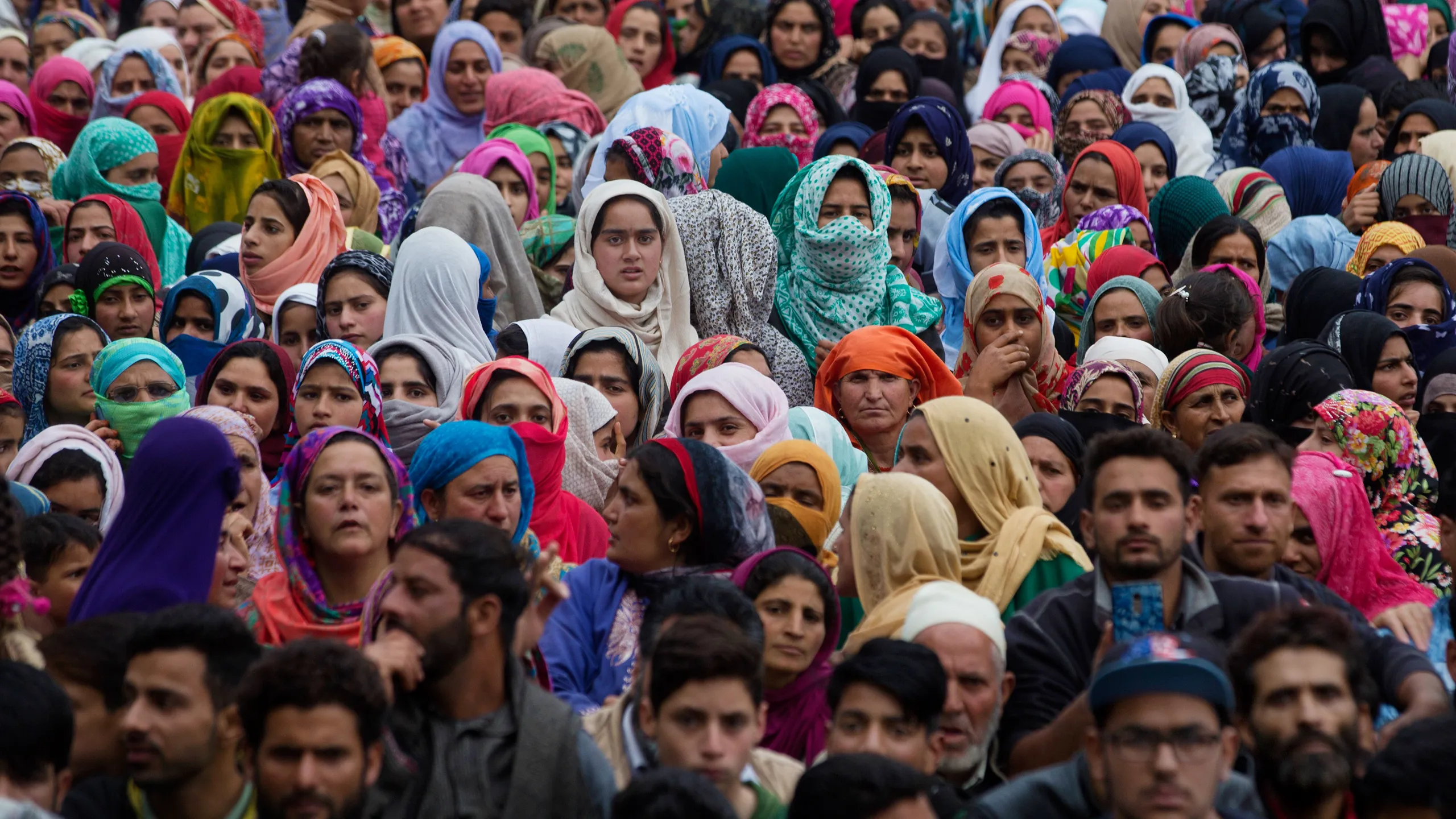
The current lot of the Kashmiri youth has resorted to adopt a peaceful way to attain their right of self-determination. Indeed, the prolonged armed struggle by their antecedents has taught them that, initially, they too were peacefully pursuing their demands, but compelled to take arms, which was not the solution, but certainly had an impact. They did not let the freedom movement to die for which they paid a heavy price. This cost of revolting against Indian occupation by Kashmiris surely remained unmatchable. Over 90,000 people have lost their lives, thousands still languishing in prisons and torture cells and there has been brutal rapes and burning of houses and properties by the occupation forces. To the desire of international community, Kashmiri people suspended their armed resistance in 2002-03, thus giving way to peaceful political solution to the issue. They waited for some positive outcome until 2008. Seeing no positive outcome, Kashmir masses once again started their peaceful protests in 2008. This time the peaceful protestors were responded by economic strangulation and brutal massacres like the early 1990s. It is worth mentioning that unless pushed to the walls, Kashmiris are a peaceful nation. This is evident from the prolonged foreign subjugation, spreading over to centuries. Pelting stone is the maximum violence by Kashmiri youth, being practised even today. This too is done once they receive bullets from the Indian Army soldiers and paramilitary personnel.
As stated in one of his article, Mr Kuldip Nayar said that Kashmiri youth, “do not agree to the various formulas which have been presented for the solution of the Kashmir issue.” However, they too do not accept the Indian rule over their motherland, which is the essence of the dispute. This indeed is the real cause of the anger in the youth against the establishment in New Delhi and Srinagar. In fact, it is the Indian establishment; a combination of Indian bureaucracy and strong Military power, the real power centre in India that denies Kashmiris to exercise their right of self-determination in the light of UN resolutions. What to talk of Manmohan Singh or Omer Abdullah, no Indian, and puppet Kashmiri leader has ever tried to understand the ‘ethos of Kashmiri movement.’ Throwing of shoe on the Chief Minister by a Kashmiri policeman in 2010 was a clear indication that Kashmiris should no more celebrate the independence day of their occupying power (India). This was an open revolt against the regimes and the systems, ruling them against their wishes since 1947.
The youth’s rising has surely no economic agenda; therefore, can be lured in neither through job offers of Omer Abdullah for 75,000 people, nor Indian Army’s illusory mode of good will gesture, put into practice through Operation Sadbahwana. They have only one agenda, “allow us to exercise our right of self determination,” as given to them by international community through over twenty-three UN resolutions. In this regard, they do not take a lead from the puppet leadership of the state that has been betraying their confidence for years and years, through the lollypops of the autonomy and self- rule. Over the years, Indian establishment and pseudo scholars are making assertion that the growing unrest in IHK has the element of radicalism and Islamist fundamentalism. Some of them even compare it with the Naxalism, with a pronounced religious slant. However, the reality is that, Kashmiri movement is a peaceful political struggle for the right of self-determination, rather than a religiously motivated radical and Islamist movement. Dubbing the movement as the terrorism is indeed to betray the international community, which take this hazy term as a threat to the global peace. If at all there is terrorism in Kashmir, it is committed by Indian security forces on the innocent Kashmiri masses.
There is a harmonized society in Kashmir comprises of Muslims, Hindus, Sikhs, Christians and others. However, being in majority, the Muslim is the dominating community in Kashmir. But this is not like the India, where the dominant class; the Hindu majority, openly proclaim through its radical parties like RSS, BJP and other Hindu nationalist parties, that all non Hindu population have two options; either to convert into Hinduism or leave India. There has never been an infighting among Kashmiris of different believes. After partition of the Subcontinent into India and Pakistan, the then Kashmiri Prime Minister, Pandit Kak, a Hindu by religion, advised the Mahraja Hari Singh not to join the Indian Union, rather preferred to be part of Pakistan or Kashmir remaining independent. Besides, Kashmiris cannot be called as separatist or secessionist, as they are not the Indian nationals. Historically, except the period of forced occupation, Kashmir has never been part of India. Practically Kashmiris are a different nation, then how can they be called as the separatists or the secessionists. Correspondingly, their political struggle cannot be equated with radicalism or the so-called terrorism, taking place elsewhere in India like Naxalism or Maoism. Terrorism was labelled to defame the Kashmiris struggle after 9/11. Kashmiris are peace-loving people and the current phase of the youth’s uprising is a peaceful political movement, cannot be mislead as radicalism or the religious fundamentalism. What all Kashmiris desire is the authority to exercise their right of self-determination as per UN resolutions? International community must fulfil its promise with the Kashmiris for giving them their basic right to live as per their wishes and should compel India to stop killing the Kashmiri people through gruesome human rights violations.
In his recent article entitled as ‘A Different Voice in Kashmir’, the former ambassador, writer and eminent Indian scholar, Kuldip Nayar, has pointed out that, situation Kashmir has changed altogether, and Kashmiri youth of post 1990, has taken over the charge of the renewed uprisings. Two aspects could be observed as quite obvious throughout during this new phase of uprisings; “one, there is no Pakistani hand, and two, the movement has nothing to do with the militants.” This is an extraordinary acceptance of the reality by an Indian scholar, as the people of Kashmir and Pakistan have repeatedly saying this. Indeed, Pakistan has never been behind the Kashmiri’s freedom movement. The movement has been and is an indigenous struggle of the people of Kashmir. It started in the first quarter of 20th century, against the cruelties of the repressive Dogra regime, once there was no existence of Pakistan on the world map.
The renewed uprisings started in 2008, has taken a new momentum. The people of Kashmir are agreeing on nothing less than the freedom from India. Starting from Governor Rule to the Governments of various political parties of the state, the Indian Government have used all methods to control the masses, following the 1990 Kashmiri freedom movement. Even its heart and mind winning technique through Operation Sadbahwana (good will) could not be succeeded. Now India must understand that, Kashmiris would be agreeing on not less than the freedom from its illegitimate rule. India should be clear of this aspect, as she has used all methods to control the Kashmiri masses ever since 1947. India has indeed used the military option as the pre-dominant one.
Future Indian Designs for Kashmir
In a recent statement, the Indian Prime Minister, Dr. Manmohan Singh has revealed the future Indian designs on the issue of Kashmir. While talking to the editors of the news papers, the Indian Premier said that, he hoped that, Pakistan “will leave Kashmir alone,” because “they have their own share of internal problems.” Harping on to the old mantra of terrorism, Dr. Singh categorically said that, Pakistan has “not done enough on terror. I still feel they need to do more.” By giving this statement, India tried to equate itself with United States. The way US has been putting pressure on Pakistan to do more; India is now behaving in the same manner in South Asia. More than anything, the statement means a lot for Pakistan at least on three aspects. First; India feels that, under current environment, Pakistan can do nothing to change the Indian position on Kashmir. This means that internally Pakistan has been made so weak to stand in front of India. Second; Pakistan should think for its own survival under the prevalent domestic crisis in the country, rather asking for a solution of Kashmir, a global issue. Its internal dissent would compel Pakistan to look inwards, rather outwards. Third; the factors responsible for bringing Pakistan to the current status of internal disturbances, so that it is unable resist on other issues of national interests.
Realistically analyzing, what appeared from the statement is that India has a major role in bringing Pakistan to the current situation of domestic instability, so that Pakistan stops demanding a just solution of Kashmir issue. This statement of Indian Premier is indicative of the fact that Indian top political leadership is in line with its spying network involved in destabilizing Pakistan, especially Balochistan and FATA. This statement speaks of a conspiring mindset, which lacks sincerity to bring peace and stability in the region. It is amounting to sabotaging the ongoing peace process between India and Pakistan. For Pakistan and Kashmiris, the Kashmir issue needs an immediate resolution. It is the only core issue between India and Pakistan. As stated very clearly by Ms. Hinna Rabbani Khar, the Minister of State for Foreign Affairs, “If Kashmir is not core concern, then what is core concern?” Pakistan feels that, through forward movements and engagements at diplomatic level, India Pakistan and Kashmiris should find an amicable solution of the Kashmir issue. She further said that, “It is better to resolve long-standing issues rather than let those issues fester and become larger than life and affect development and peace of the region.”
At the bi-lateral level, Pakistan considers that all other issues can be dealt with side by side; however, the main focus should remain on Kashmir, the only core issue between India and Pakistan, since independence of both countries. This is a reality that, for Pakistan resolution of the Kashmir issue is very important, hence, it would like that the issue to form part of the agenda of all the Indo-Pak talks. To counter this demand, India is emphasizing to make terrorism as part of all the bi-lateral talks. Keeping terrorism at the centre point, India believes on the blame game. Indeed, the biggest problem hounding the Indo-Pak bi-lateral relationship is the trust deficit. By no way, India desires the resolution of Kashmir issue as per the wishes of Kashmiri people in the light of UN resolutions. India feels that, in such a scenario, it would lose its occupied portion of Kashmir; therefore, a status quo would be a better option, one; to starve Pakistan and two; to further maltreat Kashmiris for their non acceptance of Indian rule. Indeed, all the mistrust between Pakistan and India or in South Asia in general is the product of one issue; the disputed nature of the Jammu and Kashmir. If today India agrees to the solution of Kashmir, there would be no worthwhile issue left between India and Pakistan and peace would prevail in the region, giving way to the regional prosperity. Why cannot India buy this reality is a big question mark?
As proved historically, wars, conflicts and promotions of insurgencies, could not solve the issues, rather further complicate them. Negotiations and talks are the only way forward. This is a positive step that India and Pakistan are resorting to the bi-lateral talks for the resolutions of their issues and differences. However, issuing distressing statements by Indian leadership would enhance the trust deficit, rather reducing the gap. The current uncertain situation in South Asia calls for a very mature and dedicated leadership and a positive approach to resolve the basic cause of distrust (issue of Jammu and Kashmir), rather maintaining the status quo. Let there be a consensus resolution of Kashmir issue as per the wishes of its people to bring stability, peace and economic prosperity in South Asia.
This new Indian mindset is a point of concern for International community, who should take a note of it. Pakistan and people of Kashmir consider that the mindset itself is indicative of the facts that, India has been behind the current instability in Pakistan. By creating instability, India desires to entangle Pakistan in a situation where it is unable to concentrate on issue like Kashmir. Provoking armed conflict within Pakistan by its neighbour (India) would mean promoting terrorism. Should not international community question India for such an act of global concern? After all dozens of resolutions have been passed by UNO, having the backing from international community, all assuring right of self determination to Kashmiris. Therefore, let there be a consensus resolution of Kashmir issue as per the wishes of its people. A just resolution of the issue would bring stability, peace and economic prosperity in the region. It should be clear to India that, neither Kashmiris nor people of Pakistan would ever accept the status quo on Kashmir. India should accept the reality that, Kashmir belongs to Kashmiris, who did not accept its forced rule over the state’s territory, even after sixty-four years of Indian occupation.
Conclusion
In all eventualities, the road to a durable peace in South Asia lies in the final settlement of the Kashmir dispute, the longest unresolved issue on the agenda of the United Nations Security Council. Upon growth of enough confidence between two nuclear rivals, Pakistan proposed a number of measures and a framework for the resolution of Kashmir dispute; without having compromised the principle stand of right of self-determination as given in the United Nations resolutions. Unfortunately, except for initial and a few occasional affirmative statements, there has been no significant forward movement towards the resolution of the dispute from Indian side in tangible terms as yet. The peace overture started with the unilateral ceasefire by Pakistan in November 2003, was quite efficiently utilized by India to fence its border all along the LoC in a record period of two years; which otherwise could not have been possible owing to Kashmiris insurgency. In order to give peace a chance, Kashmiris too ceased their armed struggle along with the Pakistani ceasefire. Indeed to gain time, India has been wavering a formal response to Pakistani flexibility ever since the start of the peace process. The time so gained was made use of by India for fictitious therapy to the wounds of Kashmiris through adherent campaigns like Operations Sadebhavana, which failed miserably.
Like other Indian Muslims, the real base of the Kashmiri struggle too was two-nation theory. Even today, the APHC, which is leading the people of Kashmir, follows the principles of Quaid, and true basis of Pakistan. From the prospect of geo-strategy and geo-economics, the State of Jammu and Kashmir and Pakistan are interlinked. Pakistan’s principal economy is agrarian based, for which Kashmiri Rivers provide water, and in return, both consume the agricultural products; a relationship of interdependence. Indeed, there existed a historical mutuality between the Kashmir and the areas forming part of Pakistan. This relationship of interdependence is pre-partition of the sub-continent and even pre-canal system, hence everlasting in nature. It was indeed, in the same context that sixty four years ago, Quaid-e-Azam Muhammad Ali Jinnah through his visionary statement declared Kashmir as the “jugular vein of Pakistan.”