

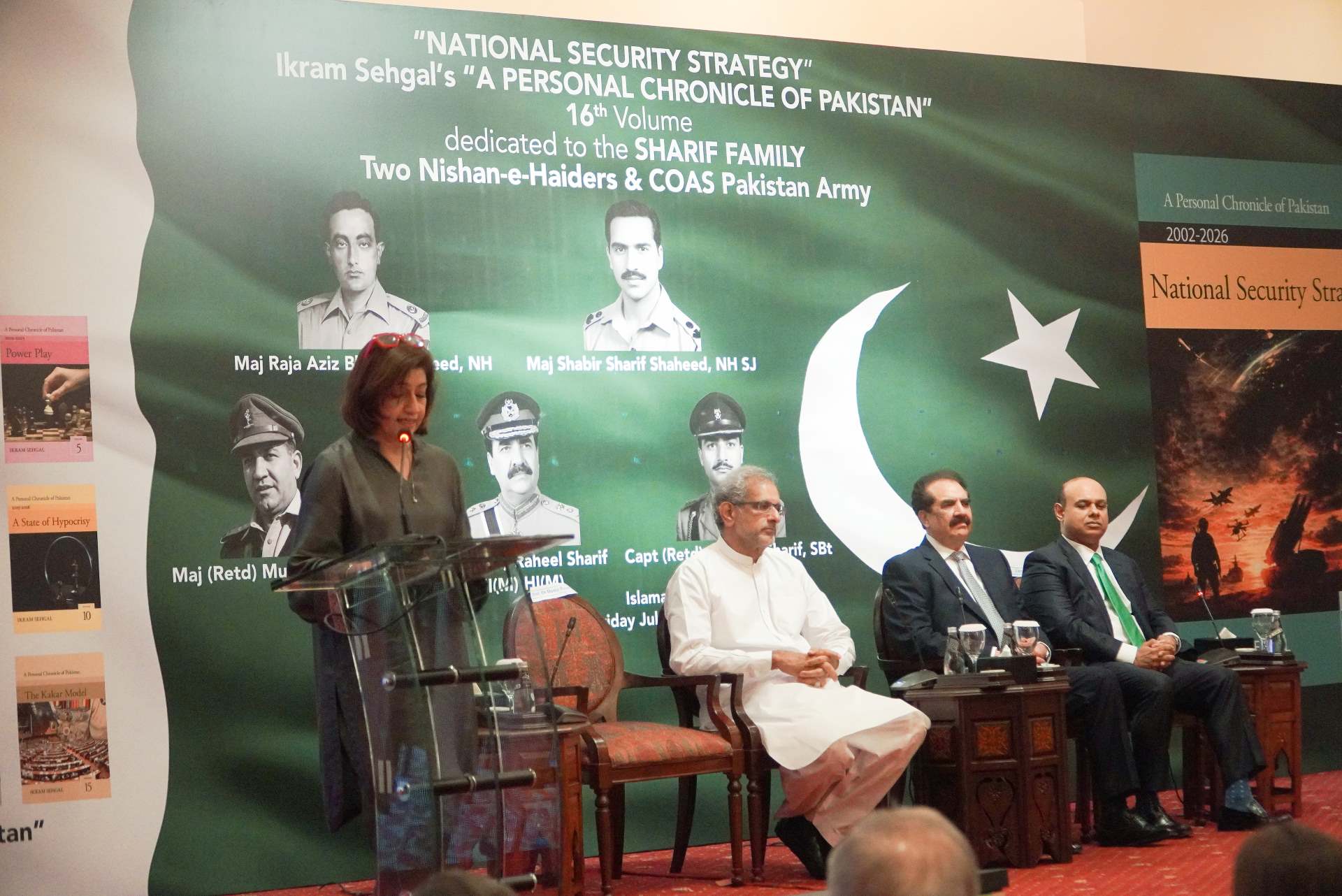
Chairman Pathfinder Group Zarrar Sehgal and Co-Chairman Ikram Sehgal hosted the launch of “National Security Strategy”, the 16th volume in Ikram Sehgal’s “A Personal Chronicle of Pakistan” series, at the Serena Hotel, Islamabad, on Friday, July 17, 2026. The event brought together senior civil and military leaders, policymakers, diplomats, academics, and members of the strategic community to discuss Pakistan’s evolving national security landscape and the political, economic, and geopolitical developments that have shaped the country between 2002 and 2026. The Chief Guest was Gen (Retd) Raheel Sharif, former Chief of Army Staff and Commander of the Islamic Military Counter Terrorism Coalition (IMCTC). The ceremony featured addresses by Prof Dr Huma Baqai, Air Marshal (Retd) Masood Akhtar, Ms Gulmina Bilal, Dr Salma Malik, former Prime Minister of Pakistan Shahid Khaqan Abbasi, and the author, Ikram Sehgal, who shared their perspectives on the book and Pakistan’s contemporary national security challenges.
Sehrish Mustafa (Moderator):
Good evening, everyone and Assalam-o-Alaikum. To start this auspicious occasion, I would like to introduce you to the Maulvi Sahib who has been working at the mosque at the Abdullah Shah Ghazi Mazar. He has been associated with the Sehgal family for the last 36 years, and he just retired in June 2026. It is an honour to have him here with us. Please welcome Muhammad Miskin Naqshbandi Sahib for the Tilawat-e-Quran Pak (Recitation of the Holy Quran).
Muhammad Miskin Naqshbandi:
I would like to say a few words. My association with Ikram Sehgal goes back to 1990, and over the years I have come to know him closely. There are a few things about him that I would especially like to mention. First and foremost, he has an extraordinary love and respect for his parents. His parents are buried in the sacred graveyard of the revered Shrine of Abdullah Shah Ghazi in Clifton, Karachi. Before he goes to office he comes to the vicinity of the graveyard every morning. Before leaving the city and after coming back he does the same. On Saturday mornings he visits the grave. This is a rare and beautiful example of devotion to one’s parents. May Allah grant all of us the same love, respect and sense of duty toward our parents that Ikram Sehgal has always demonstrated toward his own.
My elders have always taught me never to question the men of authority and influence who come to our mosque. Over the years, former Presidents, Prime Ministers, Governors and many other distinguished personalities have visited our mosque and the Shrine of Abdullah Shah Ghazi, where I personally offer prayers and supplications. Despite meeting such eminent individuals, I have never asked any of them for anything, nor have I questioned them, because that is what my elders taught me. However, in the case of Ikram Sehgal Sahib, I sought special permission from my elders, and they told me, “This is a person from whom you may ask for help.” Ever since then, whenever I have been in need, I have approached Ikram Sehgal Sahib, and he has always extended his support. May Allah bless him with even more, increase him in every good, and reward him abundantly for his generosity.
He works tirelessly for humanity and, in many ways, is truly a custodian of humanity. If you ask his staff and employees about him, they will all tell you the same thing. Whenever they are in need, whether they are ill, arranging a marriage in the family, facing grief, celebrating moments of happiness, or dealing with any other difficulty in life, he always stands by them. He takes care of them as though they are members of his own family, offering not only financial assistance when needed but also personal care, compassion, and emotional support. This is a rare quality that reflects his character and his commitment to serving others.
May Allah Almighty grant Ikram Sehgal Sahib a long, healthy, and blessed life. May He continue to strengthen him and enable him to carry on the remarkable humanitarian work that he has dedicated himself to throughout his life. May Allah bless all of you as well. Thank you very much
Sehrish Mustafa:
Please rise for the National Anthem of Pakistan.
It is my distinct privilege to introduce you to the first speaker. She is a distinguished scholar, an inspiring leader, and a role model for countless young women aspiring to break barriers in academia, public policy, and national discourse. She has more than three decades of experience as an international relations scholar, political analyst, educator, and certified corporate trainer. A prolific author, she has three books to her credit, with a fourth coming up. She has published 30-plus research articles in national and international journals and contributes extensively to electronic and print media. It is therefore most fitting that she guides us through the launch of a book that seeks to redefine Pakistan’s understanding of national security, a subject that demands wisdom, balance, and strategic insight.
Ladies and gentlemen, please join me in warmly welcoming the Vice Chairperson of the Karachi Council on Foreign Relations and the Rector of the Millennium Institute of Technology and Entrepreneurship MiTE, Karachi, Prof Dr Huma Baqai.
Prof Dr Huma Baqai, Vice Chairperson KCFR:
Thank you for that kind introduction, Ladies and gentlemen, I often engage in public speaking, but I must admit that I feel a bit nervous today. It has been a long time since I’ve seen such an impressive gathering of people. It’s heartening to have so many good individuals under one roof. I am delighted to once again speak about Ikram Sehgal’s remarkable contributions. Tomorrow, we will celebrate his 80th birthday, Mashallah! Happy birthday, Ikram Sehgal.
However, there is something else you might not know. Today also marks the birthday of his late father, Lt Col Abdul Majid Sahib. I had a conversation with Ikram Sehgal before the ceremony, and he shared that he chose to honour his father today because his father endured a lot due to him. Many of you may know that Ikram Sehgal has been labelled a defector, and his father had to bear the consequences of that. So, ladies and gentlemen, please join me in honouring him with a round of applause.
Now, I would like to introduce the National Security Strategy 2002–2026. It consists of more than 1,100 pages and 31 chapters, making it quite extensive. This is a significant work. The book opens with heartfelt gratitude toward his loved ones sitting in both the front and third rows, and he especially acknowledges Zarrar, who is here with us today. Above all, he expresses his thanks to Allah. Following this, the acknowledgements reflect humility, care, sensitivity, and consideration, including warm thanks to those whom many often forget to mention. I know some of these individuals personally, and I can attest that this acknowledgement made their day, even though they had no sense of entitlement. Ikram Sehgal genuinely remembers people; that’s simply who he is. The book also features a warm dedication, transitioning from brief statements to a heartfelt tribute to the Sharif family. As our chief guest today, I won’t elaborate further; you’ll need to read it for yourself, as it provides insight into the military, who these individuals are, and how they continue to sacrifice for our country. Their unwavering commitment has strengthened our nation’s defence, as was proven beyond a doubt on 25 May 2025. I have known Ikram Sehgal Sahib for nearly 20 years and have always respected him for his great intellect, but even more so for his consistent purpose. That is why it was a tremendous pleasure and honour to write the foreword for this book. You should definitely read it. I particularly enjoyed his remarks about me, which truly made my day. He expressed hope that one day this country will recognise my capabilities and make me the Foreign Minister of Pakistan. Yes! So, Ikram Sehgal Sahib, if your security strategies from this book are adopted, I just might become the Foreign Minister of Pakistan. Until then, I’m happy to be your multiplier.
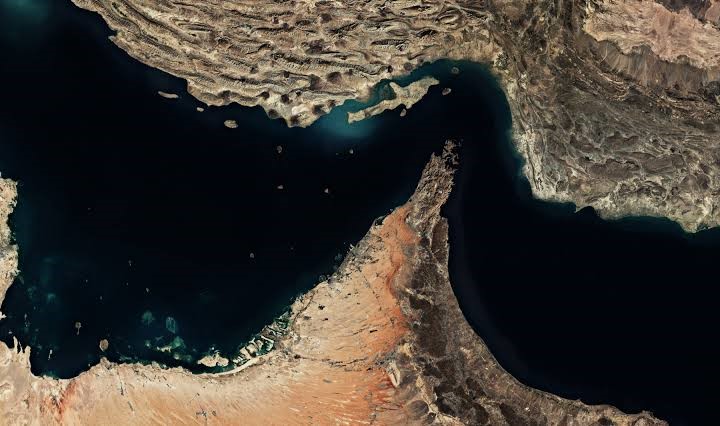
The period from 2002 to 2026 is one of the most significant in Pakistan’s history, marked by profound transformation. During this time, Pakistan shifted from being a frontline state in the War on Terror to aspiring to become a geo-economic connector, a “zipper state.” This represents a major paradigm shift, transitioning from military-led governance to repeated democratic transitions. Furthermore, the nation has grappled with the challenge of rapid growth while also facing recurring economic slowdowns. An important point that needs to be emphasised is that geography presents an economic opportunity. Pakistan must recognise this potential. Consider Iran, where the focus is on the Strait of Hormuz, an area everyone wants to capitalise on economically. This narrative begins with Sehgal Sahib’s development of the national security concept in his first-ever lecture at the National Defence College (NDC), which later became the National Defence University (NDU) in 2002. His inquiry continues through to 2026, where we are today. This ambitious work reflects the author’s deep conviction. Mr Sehgal argues that a solid strategy involves more than just aspirations and slogans. He raises essential questions: What does Pakistan want? What instruments and resources does it currently have, or can realistically develop? How can these tools be used to achieve clearly prioritised national objectives? This approach is focused on finding solutions. As a nation, we often fall into the blame game and point out what is wrong, but very few people offer tangible solutions. The book resonates with me personally because it centres on people. While it discusses national security, it does so with a people-centric approach.
My PhD research concentrated on non-traditional sources of conflict in South Asia, with my first chapter addressing state-society relations. Ikram Sehgal’s emphasis on Pakistan’s dysfunctional state-society relations is particularly insightful. This is evident in his assertion that the 26 million children who are out of school represent a national emergency. We continue to allocate minimal resources to education, which remains a persistent dilemma for Pakistan.
Furthermore, the book covers critical issues such as food security, climate resilience, water, energy, population growth, inequality, and education. These are significant security issues that rarely enter our everyday conversations or discussions in drawing rooms. However, this is what true security looks like, ladies and gentlemen.
Ikram Sehgal is a remarkable success story from Pakistan. As he himself puts it,
“I became this from zero.”
I heard him say this personally. From those humble beginnings to who he is today, he has become a force to be reckoned with, dedicated to providing security for Pakistan while constantly considering the country’s future. Ladies and gentlemen, two books are often discussed: “Why Nations Fail,” which explores the reasons behind national prosperity, and “The Rise and Fall of Nations,” which examines the factors that contribute to stagnation. These works illustrate how a developing nation can build its strength through an integrated strategy encompassing governance, security, and economic resilience. Security must always be assessed in terms of prosperity, opportunity, justice, participation, and social trust. Currently, we have neither equality nor equity. This is more than just a book on national strategy; it represents a theory of national development. It offers a comprehensive framework for building resilient and prosperous states in the 21st century. Importantly, it is forward-looking. Pakistan has spent decades reacting to one crisis after another. The book’s greatest contribution is that it challenges us to think beyond today’s headlines. Instead of fixating on immediate reactions, we should be discussing our aspirations and milestones for the next 25 years.
What kind of Pakistan do we envision building? Strategy should not be about merely reacting; it should focus on anticipating future challenges. We must move away from fire-fighting and short-term fixes, replacing reactive crisis management with proactive strategic planning. This is precisely the message Ikram Sehgal conveys. Nations that only respond to crises rarely shape history; they merely survive it. Pakistan has the capacity to shape history and can do so again, not only in South Asia but also in West Asia.
The book also emphasises the importance of prioritising economic prosperity as a cornerstone of our security policy. Your sovereignty will always be at risk unless you achieve economic security. We need a more formal national security framework. The fact that we are still discussing this, despite recently releasing a document without an implementation strategy, indicates that strategy should emerge through consultation and consensus, rather than being imposed from above. As the author noted,
“Too often, after a crisis has occurred, it becomes evident that there was little prior coordination or integration of policy instruments.”
This highlights our current dilemma.
Ladies and gentlemen, it is my profound honour to invite the next speaker, Air Marshal Masood Akhtar. He is highly respected throughout Pakistan and needs no introduction, having had a distinguished career in the Pakistan Air Force and significantly contributing to our national policy discourse. Please join me in welcoming Air Marshal (Retd) Masood Akhtar.
Air Marshal (Retd) Masood Akhtar:
Bismillah-ir-Rahman-ir-Rahim. Honourable panelists, guests, Ikram Sehgal and family, respected elders, colleagues, and friends. Public school boys, I am a Topian and a Sarghodian, Aitchisonians, and Gallians.
Ladies and gentlemen, Dr Baqai has addressed the book at length. I will not go into the details because Ikram Sehgal and I have talked about these things over and over again. First of all, I feel absolutely humbled by what Ikram Sehgal has said about me in the book. When we called him in 2002, please believe there was no national security policy being written in Pakistan. There was not even a single format for how we process national security, or how we put together the nuts and bolts of a national security policy. One day, the Commandant called me and said, “Masood, come. We have found one format.” A senior Army officer who had attended the Army War Course in America brought back a folder on national security. Ambassador Blackwell, who was the American ambassador, had written that format. I was absolutely delighted. I wish I had brought that back. But there was another DS (Directing Staff) with me who was even keener than I was. I was the Chief Instructor at that time, and he borrowed that book from me, tore the page off, and walked away with it. The Commandant was furious that the only format we had ever got had gone missing. I was so embarrassed. But then, of course, at that time Google was not there, and the internet wasn’t very good; I worked day in and day out, found the format, took a printout, and went to the Commandant. He was delighted; he said, “You’ve just saved your neck.” We began our work on the issue, and I can confirm that Ikram Sehgal Sahib is correct: there was no national security policy or strategy in place.
It’s important to note that formulating such policies is the responsibility of the Government of Pakistan. They have a National Security Division and a National Security Committee within the Cabinet working on these matters. The only document that has been released was during Imran Khan’s tenure as Prime Minister, with Moeed Yusuf serving as the National Security Adviser. I will elaborate on what transpired during that time. The good news is that what was established has endured and been built upon. It was heartening to see their definitions of policy as a long-term direction and of national interest, as the enduring goals of a nation. They define identity in terms of our past, present, and future, and the methods we employ to achieve that. The strategy indicates that national interests must be pursued by all institutions and ministries, and it outlines the means of accomplishing that. This is indeed encouraging. However, the less favourable aspect is that although these concepts exist on paper, they have not become an intrinsic belief among the graduates. The proof, as they say, is in the eating. When I observe my colleagues, friends, students, and fellow Directing Staff on television, not one can clearly define the four core national interests of Pakistan. Instead, the discussion often revolves around tactics and operational strategy. I firmly believe that one factor contributing to this situation is the structure of the Armed Forces war courses. Gen Ali Kulli Khattak, who is present here, recalls our discussions in the veterans’ group; he granted me considerable leeway in those conversations. I remarked, “Sir, the day you people decided that you had to make all the Generals from the War Course, the die was cast.” Although the two courses have since been merged, the curriculum remains heavily focused on operational strategy. As a result, we are somewhat at a loss, and the country is not faring well.
Where is the problem? Ikram Sehgal Sahib stated that our identity must be correct. Who are we as a nation? If we choose to become an ideological state, something our founders did not necessarily intend, but those who drafted the constitution decided, we will be governed as an ideological state. I was in Lower Topa, where we used to read Naseem Hijazi, who asserted that one Muslim is equivalent to ten Hindus. We believed this, and as a result, we became an ideological state, as articulated in the Objectives Resolution.
Ultimately, an ideological state cannot function as a democracy because its citizens do not openly discuss religion among themselves. For instance, in England, individuals from all religions and backgrounds engage in dialogue; they go to Parliament, debate issues, and establish the laws and conventions that govern the country. In Pakistan, however, such interaction does not occur. We are facing structural tensions that reveal themselves in various symptoms. Two incidents occurred last week, one in America and another in Pakistan. The latter happened only three days ago. An individual, while speaking about the Shuhada (Martyrs), made statements that are simply unacceptable to all of us, especially the military. Targeting the Shuhada is intolerable. However, it is important to note that this person is considered a leading ideologue in this country, which creates a hesitation to challenge such narratives. As a result, his followers feel emboldened to stand by those statements. This reflects a troubling reality. The second incident took place in America involving a medical association.
Dr Moeed Yusuf made a statement on national security policy. I have a connection to this as I previously presented a national security policy at Punjab House with the Veterans of Pakistan to former Prime Minister Nawaz Sharif. An Air Chief asked me to connect with Yusuf for guidance
After discussing over the phone, I met him in person and emphasized that we have numerous conflicting groups based on language, sect, religion, province, and ethnicity. Please advise on how we can unite these groups.” Unfortunately, there was no guidance provided on that. I then asked, “How do we structurally address these internal insurgencies? When it came time to implement the policy, I followed up with him but received no response. Just today, I spoke with his senior secretary, and the sentiment expressed was that people are unwilling to allow us to address what Ikram Sehgal said about Pakistan’s identity. If we get the identity wrong, everything falters. Believe me, the army teaches this very well at the National Defence University (NDU). We learn that war is an extension of policy and that, by extension, peace is also an extension of policy. If the policy is flawed, everything built upon it will also fail. Yet, we are cautioned not to touch the issue of identity in Pakistan. Because of this, certain elements remain untouchable. You may recall one head of a religious party who publicly claimed that our fallen soldiers are not Shuhada. How could they say that? Today, as these events unfold, there are incidents we cannot even discuss openly. But please understand that, in this country, what constitutes morality is questioned, particularly among lieutenants and young soldiers who are sacrificing their lives. I have spoken with my colleagues and fellow veterans, and I can assure you that today’s Generals are trained just as well as the young lieutenants and jawans; yet, they are facing tremendous challenges.
If we are indeed an ideological state, friction is inevitable, and it will eventually boil over. Just as it did during the 1971 crisis in East Pakistan, we are seeing similar challenges today in KPK, Balochistan, and the ongoing situation in Kashmir. As Dr Huma Baqai mentioned, our goal is not to blame one another but to seek solutions.
I would like to pose two or three important questions, especially for Shahid Khaqan Abbasi Sahib and General Raheel Sharif: Firstly, if the framework of the ideological state is contributing to this structural problem, what steps can we take to address and reverse it?
Secondly, during my visit to Ghora Galli, I saw a picture of Wing Commander Middle Court, who is recognised as a Gallian. Article 5 of the Objectives Resolution states that he is considered a number two citizen. The clause for Muslims indicates that an enabling environment should be created, while for minorities, it merely states that adequate arrangements should be made for them to practice their faith freely. This distinction establishes different layers of citizenship. Lastly, the National Defence University (NDU) should not be responsible for formally dictating national security policy. Its role is to foster intellectual and strategic frameworks, but the ultimate national security policy should be developed by the National Security Division under the civilian government.
Why has there been a failure to produce a consistent policy, and why is this still the case today?
Dr Moeed Yusuf recently commented that Pakistan is like a luxury car with a broken engine. So, I pose the question: should we attempt to repair the existing engine, or should we replace it entirely with a new one? And if so, how do we execute that change? It is certainly a challenging task. Ladies and gentlemen, once again, I am humbled by the insights shared here. Ikram Sehgal Sahib has left a legacy of ideas, and the good news is that these ideas are still being explored. However, as the Secretary of the National Security Division told me just today,
“Sir, they said don’t touch the identity of Pakistan.”
Until we are willing to confront this issue, I fear we may face a tumultuous journey ahead.
Dr Huma Baqai:
There is no one more significant than Pakistan, so there is no question of whether to engage with it or not. Now, it is my profound honour to invite a very good friend to speak to us: Gulmina Bilal. I have known Gulmina for over 20 years. If I say that she has grown up in front of me, it wouldn’t be an exaggeration. What makes me especially proud is that she became the first woman to lead Pakistan’s premier skill development institute, and she completely transformed it. Unfortunately, she eventually had to resign from that position. Gulmina, the floor is yours.
Gulmina Bilal (Former Chairperson NAVTTC):
If you keep telling people that we’ve known each other for over 20 years, they might think you’re old, and you certainly don’t look it. Let me begin by acknowledging the distinguished gathering here on the panel as well as in the audience. I truly appreciate the opportunity to be with you today and to speak, hopefully for just a brief moment. I must say, I was very excited when I learned I would have the chance to speak at today’s book launch. I even shared my excitement with Ikram Sehgal Sahib, that is, until I saw the book and realised its weight. I wasn’t sure if Sehgal Sahib was launching a book or establishing yet another national institute. I found myself confused: Is this a launch for a book or an institute? Like any sensible speaker in a panic, knowing there was no way I could read a thousand pages in two days, I opted to look at the table of contents. I am so glad I did, as it revealed the core idea of his work.
Ladies and gentlemen, this book is not just about defence or conventional national security; it discusses the national core. It begins, as many such books do, with defence, the armed forces, hybrid warfare, cyber security, and UAVs However, the core content expands to cover crucial topics such as food security, water scarcity, climate resilience, taxation, finance, investment, cryptocurrency, and, my personal favourite, education security. This book boldly emphasises- it doesn’t just speak; it screams at a deafening pitch- what today’s reality is. The reality is that while borders represent our first line of defence, the heart and ultimate strength of a nation lie in its people. One of my personal favourites is that Ikram Sehgal clearly articulates what I believe to be a vital pathway for our progress: Technical and Vocational Education and Training (TVET). This field needs to be mainstreamed and modernised, with industrial pathways linked to international certification. Thank you, Sehgal Sahib, for highlighting this.
In terms of education, as Dr Huma also mentioned, Sehgal Sahib has noted that there is an emergency with 26 million Pakistani children out of school. This means that the promise the state made to those children, the promise of education, is being broken. As I stand before you, it is evident that we are experiencing a national emergency in education. Yet, when it comes to emergencies, we tend to remain a bit relaxed. By the way, this happens to be the third time we have declared a national education emergency, but let’s not dwell on that. Ultimately, this book is about people, and I am grateful that Ikram Sehgal has emphasised the vital importance of investing in them. For every child we educate, for every young person we skill, for every middle-aged individual we upskill, and for every entrepreneur we support, we strengthen our national resilience. From children’s education to entrepreneurship, these are the initiatives that Sehgal Sahib personally oversees.
In addition to writing about these concepts, he also implements them. This is the way forward. I would like to offer a few recommendations with all due respect, Sehgal Sahib, on which I slightly disagree, but of course, that can lead to an interesting conversation. This marks Ikram Sehgal Sahib’s 16th book. So, Sehgal Sahib, in terms of your journey as an author, you are now “sweet 16.” You might be turning 80 tomorrow, but today, you are sweet 16. I eagerly await the launch of your 40th book because then, Sehgal Sahib, you will be “naughty at 40.” Thank you so much.
Dr Huma Baqai:
I am going to invite somebody from the public sector. Dr Salma Malik, Associate Professor at Quaid-i-Azam University and specializes in defence and strategic studies.
Dr Salma Malik:
Distinguished guests, Excellencies, ladies and gentlemen, and above all, the man of the hour, Mr Ikram Sehgal. A book launch is usually about a book, but when the author is Ikram Sehgal, the launch becomes something much more. It becomes a celebration of a life lived in full service to an idea, and that idea is Pakistan.
Before I come to the substance of this book, it is only fitting that we understand the spirit that led to this labour of love, something that the speakers before me, including Madam Huma, have also highlighted.
The man himself, Ikram Sehgal, is, in the truest sense, a son of Pakistan, and I mean that quite literally.
Born to a Bengali mother and a Punjabi father, he carries within him the founding promises of this nation: that Pakistan was never meant to be a country of one region, one language, or one people, but a federation of shared purpose.
His very lineage is a reminder of what we were meant to be, something that Air Marshal Masood Akhtar also pointed towards, and what we must never forget we can still become. He began his journey in uniform as a military aviator and a soldier, and that association with the Pakistan Army has never left him. He may no longer wear the khaki, but you can never take the soldier out of him. From the cockpit, he moved into the world of enterprise, and there too he excelled. Today, he heads the Pathfinder Group, a name that is itself a metaphor for the man. A pathfinder is someone who goes ahead, charts the route, and enables others to follow. His group works across security, fintech, innovation, entrepreneurship, education, corporate social responsibility, and leadership, precisely the domains that will determine whether nations thrive or fall behind in the twenty-first century.
Consider his intellectual contribution as a citizen of Pakistan. As the publisher and Chief Editor of the Defence Journal, he has, for decades, provided this country with a platform for strategic thought. Many novices, including myself, earned our first recognition through the Defence Journal, often at a time when serious thought was the first casualty of noise. He has already authored seventeen books. Today, we are talking about the sixteenth in this series, in addition to the other books that have been published by Oxford University Press. His writing appears consistently across Pakistan’s print and electronic media, with a consistency that speaks not of vanity but of conviction.
Here is a man who genuinely believes that ideas matter and that a nation which stops thinking about itself will soon find itself being thought about by others.
And then there is DAVOS. For twenty-two consecutive years, Ikram Sehgal has hosted the Pakistan Pavilion at the World Economic Forum. Twenty-three years.
In a world that too often reduces Pakistan to headlines of crisis, he has quietly and persistently presented a different narrative, a platform where Pakistan’s political leadership, military leadership, business community, and distinguished citizens could speak to the world in their own authentic Pakistani voice. That is not merely networking; that is national service conducted on the global stage at Ikram Sehgal’s own initiative, year after year after year. Ladies and gentlemen, this is a man who did not wait to be asked to serve his country. He simply did.
Let me now turn to National Security Strategy 2002–2026: “A Personal Chronicle of Pakistan,” his sixteenth book in this series.
The subtitle is important. Notice that it describes itself as A Personal Chronicle. This is not a dry academic treatise handed down from an ivory tower. It is a chronicle, a firsthand account by a man who did not merely observe Pakistan’s journey over the past quarter of a century, but lived it, engaged with it, and, in his own way, helped shape it. What makes this book significant, and what I hope every reader will appreciate, is its central and, I believe, correct premise: that national security is not solely a military matter. For too long, and in too many places, national security has been understood narrowly as a question of borders, weapons, and armies. Ikram Sehgal broadens that perspective, perhaps because he has seen Pakistan from so many different vantage points: from the cockpit, from the boardroom, from the editor’s desk, as a patron of education, and from the global stage. Accordingly, his book treats national security as it truly is, a fabric woven from many interconnected threads.
One thread is foreign policy, how we position ourselves in a world of shifting geopolitical realities. Another is the economy and finance, because no nation can be secure if it is not economically solvent. A weak economy ultimately means weak defence. Another thread is education, because the ultimate security of any nation lies in the minds of its young people.
There is, of course, defence, the traditional pillar of national security, treated here with the authority of a man who himself wore the uniform. More importantly, however, this book does not stop at yesterday’s concerns. It reaches forward to the challenges that will define our tomorrow: emerging technologies, artificial intelligence, cyber capability, quantum technologies, the digital battlespace, and climate change, perhaps the single greatest long-term threat to a country whose water resources, agriculture, and coastlines all remain vulnerable. In doing so, he successfully weaves together both traditional and non-traditional dimensions of security into a comprehensive framework of nation-building.
This is the vision of national security that Pakistan urgently needs: a comprehensive and integrated vision. It is a vision that understands that a child denied an education, a hungry family, a flooded village, a weakened economy, and a cyberattack are all, in their own ways, threats to national security. Why does this book matter for Pakistan’s future? It matters because it is not merely a document about the past; it is a compass for the future. Every serious nation possesses a national security doctrine, a shared understanding of who it is, what threatens it, and how it intends to secure its future.
One of the enduring challenges of Pakistan’s national life is that such thinking has too often existed in fragments, in individual ministries, in institutional silos, and in the minds of individuals rather than as part of a coherent national conversation.
What Ikram Sehgal has done with this book is provide us with a starting point for that conversation. He has given us a chronicle that connects the dots, demonstrating how foreign policy, the economy, education, defence, food security, technology, and climate are not separate policy files but parts of one interconnected whole.
For our young people, and especially for the students, scholars, and future policymakers present here and beyond, this book is a gift. It offers them the accumulated wisdom and judgment of a man who has spent an entire lifetime thinking about Pakistan, so that they do not have to begin from zero. In effect, it says to them: Here is what I have seen. Here is what I have learned. Now take it forward, and do even better. That, ultimately, is the mark of true patriotism, not the desire to be remembered, but the desire to remain useful to those who come after you.
In conclusion, ladies and gentlemen, today we celebrate a man whose footprints will remain in the history of this country. Ikram Sehgal is such a person: the aviator who became an author, the businessman who became a bridge between Pakistan and the world, and the soldier whose name continues to be remembered with pride in the ranks of his former unit. Ikram Sehgal Sahib, this book is clearly a labour of love, and it shows. You have given Pakistan yet another gift, perhaps the most enduring one. May it be widely read, thoughtfully debated, and faithfully acted upon. Before I conclude, I would be remiss if I did not acknowledge the distinguished team, indeed, the entire Pathfinder family and all those beyond it, whose invaluable contributions have been duly recognised in this volume. To Ikram Sehgal Sahib and his entire team, I offer my warmest congratulations, not only on this remarkable book but also on a life that has genuinely mattered to this country. May Pakistan continue to be blessed with more citizens who love it as deeply and selflessly as he does. Pakistan Zindabad.
Dr Huma Baqai:
That was so nicely put. I’m now going to invite Brig (Retd) Mujahid Alam. He has a very illustrious career in the military. He’s also worked with the United Nations Peacekeeping Forces, so on and so forth. But you need to understand where this people-centric approach in the book comes from. He’s the CEO of the Sehgal Family’s Initiative on Enhanced Harmony, overseeing education, interfaith harmony, and social welfare initiatives through Providentia Books Foundation, Pathfinder Interfaith Harmony Initiative, and Kashmala Welfare Centre. I was in DAVOS, and I’m a regular visitor there. Thank you, Ikram Sehgal, for that. We had flown over people who were from small places. And through their entrepreneurial initiatives and the support Ikram Sehgal provided, were able to emerge as community leaders. One of them was a woman. And this is the kind of work he’s already been doing. So, I completely understand where this book is coming from, where this people-centric National Security Strategy is coming from. And with that, I will invite Brig Mujahid Alam.
Brigadier (Retd) Mujahid Alam (CEO, Enhanced Harmony Division, Pathfinder Group):
Bismillah-ir-Rahman-ir-Rahim. At certain moments in history, we are reminded that the true measure of a life is not found in wealth accumulated or titles earned, but in the quiet legacy of goodness we leave behind. Every once in a while, a leader emerges whose vision goes far beyond boardrooms and balance sheets. A leader whose heart beats for people, for dignity, and for humanity itself. Today, as we speak about the CSR journey of the Pathfinder Group, we are really recognizing the compassion and moral courage of one man, Ikram Sehgal, co-chairman of the Pathfinder Group. His vision has not only shaped organizations. It has touched lives, opened doors, and given hope where hope was fading. At Pathfinder Group, corporate social responsibility is not merely a public obligation. It is a core organizational philosophy that begins with our own people. Through its enhanced harmony division, the group has established a workplace culture founded on dignity, fairness, opportunity, and mutual respect. Of all the initiatives and endeavors undertaken by Ikram Sehgal over the last many years and decades, these CSR initiatives of Pathfinder Group are one of the most important and gratifying because of their direct impact and benefits towards nation building. Enhanced Harmony Division (EHD) brings together four transformative initiatives, each addressing a different aspect of societal well-being. The ElenaCare welfare scheme is a comprehensive internal welfare scheme providing market-leading salaries and remunerations, comprehensive health coverage, and an exceptional welfare program. I just want to point out that the health insurance provided is for all employees of Pathfinder Group, including their spouses and their children. There is an education scholarship program for children of junior staff at Jajja Cadet College also. More than 70 students have completed their studies and have gone on to colleges and universities. And more than 30 have graduated from colleges and universities and entered the professional practical field. At present, 42 students are studying at the college. They are fully funded by the Pathfinder Group, and most of them are dependents, sons and daughters of the junior staff. A unique welfare support is provided in the event of the death of any employee of Pathfinder Group, unmatched by any other company or organization within Pakistan or any other country in the world. If a person, an employee, dies on duty, 300,000 aid is instantly given to the widow. This is in addition to Provident Fund and EOBI. Full salary is paid to the widow for two years, and half salary is paid until the eldest child becomes 18 years of age. And as soon as the eldest son becomes 18, he is guaranteed employment in the company. In case of natural death, again, full salary is paid for six months to the widow and half salary for 18 months, and the eldest son again is guaranteed a job when he turns 18. I don’t know of any other organization in Pakistan or abroad that gives this kind of welfare to their employees.
Providentia Books Foundation is nurturing minds and igniting curiosity and advancing literacy, educational access, and a culture of learning. We have already collected more than 132,000 books, and we have distributed 108,000 books to underprivileged, deserving schools all over Pakistan. We are active in 15 cities of Pakistan. We have signed more than 150 MOUs with various colleges, schools, universities and NGOs.
Pathfinder Interfaith Harmony Initiative (PIFHI) is building bridges of understanding, tolerance and peace and promoting dialogue and peaceful coexistence among diverse faith communities. Pakistan’s true strength lies in its diversity of faiths, cultures and traditions, a diversity that must be protected through understanding and respect. Pathfinder Group has a proud legacy of more than 30 years of guarding and protecting 135 churches across Pakistan completely free of cost. We have also established an Advisory Council of highly distinguished leaders and activists from the Christian community, Hindu, Sikh, Parsi, Jewish and of course Muslim communities.
The Kashmala Welfare Centre stands as a sanctuary of care for families facing hardship, offering them dignity, support and the warmth of human kindness and providing women, families and local communities welfare, skills development and empowerment services. Two new welfare centers are coming up at Bhakhar and Abbottabad also.
For over 22 years now, Pathfinder Group has been at the forefront of promoting Pakistan’s presence at the World Economic Forum (WEF) annual meeting in DAVOS, transforming what began as a private sector initiative into one of the country’s most enduring and influential platforms for international engagement. At the heart of this endeavor has been the establishment and stewardship of the Pakistan Pavilion at DAVOS. Over the years, the pavilion has evolved into Pakistan’s premier platform at the WEF, welcoming heads of state, ministers, global business leaders, investors, academics, development partners, and members of the international media. Equally distinguished has been the annual Pakistan breakfast, which has become one of the signature events on the sidelines of the WEF, bringing together influential decision-makers from across the world. The breakfast has fostered meaningful dialogue on investment, trade, technological innovation and the future of Pakistan’s economy. The WEF marked a historic milestone this year when Pathfinder Group sponsored the participation of eight Pakistani technology startups. The first initiative of its kind ever at DAVOS. This landmark effort provided emerging Pakistani innovators with direct access to international investors, venture capital funds, technology companies, and global innovation networks. For more than two decades now, Pathfinder Group has carried Pakistan’s story to DAVOS, and today it continues the same mission with the same conviction.
Ikram Sehgal gifted an all-weather swimming pool complex at Lawrence College Murree, which is a unique facility, a tribute to his alma mater. It is a unique facility at an altitude of 6,000 feet, providing essential life skills, physical fitness and mental well-being, leadership in character building and community recreation and wellness. It is now fully functional and, InshAllah, tomorrow we are having the soft opening of the swimming pool at Lawrence College.
In conclusion, I will just say that together all the above initiatives form a unified ecosystem of hope and opportunity, working to strengthen communities through education, harmony and welfare. These initiatives are more than structures or programs. They represent a worldview, one that sees humanity as interconnected, where uplifting another is not an act of charity but an act of justice and where compassion becomes a form of wisdom.
Dr Huma Baqai:
It’s actually my distinct pleasure to invite a man who introduced me to private education. I was very set in my comfort zone in a public sector university, and then we had a meeting, and I became a part of an education group that is doing tremendous work in Pakistan. And it is only when I became associated with him that I realized that it’s not just a private entity. This group has transformed 200 government schools. This group introduced Chinese education in Pakistan. This group invests in the development and capacity building of teachers and has now become the third largest group in Pakistan. I am a part of their small entity, a chartered university in Karachi, Sindh. I am the head of that university. But the more I get to know them, the more I am in awe of the man. Because he just continues to do more. Age is on his side. And I wish there were more like him. Please put your hands together for Chaudhary Faisal Mushtaq.
Dr Chaudhary Faisal Mushtaq:
Bismillah-ir-Rahman-ir-Rahim. Ladies and gentlemen, it is a distinct honour to share this stage and this afternoon with the very distinguished and honourable former Prime Minister, Shahid Khaqan Abbasi Sahib; the honourable national hero and legend, Gen Raheel Sharif Sahib. It is a great honour to see you back here in Islamabad. Ikram Sehgal Sahib, Sir, thank you for this opportunity, and Zarrar Sehgal, thank you very much. Ladies and gentlemen, I am not going to comment on the book, but I have been associated with the mentorship, leadership, passion, and patriotism that come from the influence and legacy of Ikram Sehgal Sahib.
I have always said that, across this country, the 250 million Pakistanis, when they are born, are not born as citizens. People are born as individuals. It is education, literacy, and the social contract that transform individuals into citizens. Therefore, when we talk about national security, the single common denominator of any national security strategy is human security. And when we talk about human security, education, the knowledge economy, and literacy are fundamental to placing our country among the nations that enjoy strong national security.
I am truly inspired because, Ikram Sehgal Sahib, sir, not only have you been a great mentor, but I would also say that you are an inclusive practitioner of national security. You are empathetic and compassionate. As strategic as you are, and as technical and functional as your approach may be through the institutions that you have built, at the very heart of everything you do, Ikram Sehgal Sahib, is a commitment to young people. It is about women and children. It is about youth. It is about the social contract.
Ever since I have known you, you have always given me opportunities and inspired me to attend the World Economic Forum and be part of the famous Pakistan Pavilion.
You also helped me shape the Institute of Technology and Entrepreneurship in Karachi, where I met the honourable Vice-Chancellor and Rector, Dr Huma Baqai, who serves on the board. You have also supported the Providentia Book Foundation, reaching out to children and helping build an empathy project in Pakistan.
Today, all the children in Roots Millennium Schools place their old books into collection boxes provided by the Providentia Book Foundation under the leadership of Brig Mujahid. The students recycle those books for out-of-school children and for children who have otherwise not had the opportunity to benefit from them.
Having said that, much of the world today revolves around three things: the planet we live on, the people who define this world, and the profit that we all make. But, ladies and gentlemen, I always say: what good is profit if it does not profit society? Inspirational leaders and legends like Ikram Sehgal derive their passion and sense of purpose from national identity, patriotism, and a deep commitment to Pakistan. His approach to forging collaborations across all segments of society and among all stakeholders helps build an inclusive national sentiment for national security.
I am deeply obliged, both personally and professionally, to have had the opportunity to be mentored by and inspired by Ikram Sehgal. I can tell you that I have had many breakfast meetings with him at his home in Karachi, and every single time I met him, trust me, every minute of our conversation was about one thing: how to make a difference the very next day.
I would also like to use this forum to recognise and appreciate the leadership of Gen Raheel Sharif, sir. We miss you here in Pakistan, and you have been an inspiration to me. I first met you when you were the Commandant of PMA, and ever since then, you have continued to inspire me in my journey. Through your inspiration and leadership, I have been able to support and sponsor the university. Shahid Khaqan Abbasi Sahib, you have also been a tremendous source of support. I think I am very fortunate to have benefited from this triangulation of national leadership.
Dr Huma Baqai, you are rubbing shoulders with the very best, and I am sure we can continue to open up new opportunities together. Finally, Zarrar, I am very privileged to be associated with the Sehgal family. And trust me, at the very heart of everything that Ikram Sehgal does is Pakistan.
Dr Huma Baqai:
Shahid Khaqan Abbasi is a former Prime Minister. He has graced DAVOS, the Pakistan Breakfast twice. Once he came there as a Prime Minister. But he’s a man a lot of people are looking up to. He’s seen as perhaps an alternative voice in Pakistan. Let’s hear from him directly.
Shahid Khaqan Abbasi, Former Prime Minister of Pakistan:
Bismillah-ir-Rahman-ir-Rahim. I am grateful to Dr Huma Baqai for her kind words. However, I think she has painted a rather large target on my back. Things are difficult in Pakistan. We all acknowledge that. Pakistan needs solutions, and I am grateful to Ikram Sehgal for providing this opportunity to talk about his book, his thoughts about Pakistan, and what we believe the solutions should be.
Ikram Sehgal Sahib sent me his book, but I did not read it because I did not have to. Since I was a very young boy, we used to hear his name in our family gatherings. Several years ago, he invited me to DAVOS, and he said, “I am not inviting you as a political office holder. I am inviting you as the nephew of my Commanding Officer.” So, I am here as the nephew of his Commanding Officer, not as somebody else. There are many stories that Ikram Sehgal Sahib has written about in his columns and books, but he has also left many stories untold. I would request him to write about those as well because the personal stories are equally important. We also have with us Brig Mehmood, whom most of you probably do not know. He is one of only three surviving members of the first PMA course. The winner of the Sword of Honour in that first PMA course was Aziz Bhatti Shaheed. We are, therefore, very privileged to have Brig (Retd) Mehmud with us today.
We are talking about national security, and these are the people who have defined national security for Pakistan over the years through their hard work in building a military that is second to none and has always delivered. We have the capacity to contain our enemies and to respond in kind. Therefore, that aspect of national security, in my opinion, is resolved. Gen Raheel Sharif Sahib may disagree, but I believe that, militarily, we really do not have a problem. We must certainly maintain our capacity, but I do not see a serious issue there.
The real issue lies in the broader aspects of governance, the political system, and how we are managing the country. It is an unfortunate fact that, historically, Pakistan’s military leadership and political leadership have not fully understood each other. That is where the real problem arises. Unfortunately, there has also been very little effort to genuinely understand one another. I chaired the National Security Committee. We held very long meetings. We broke the tradition of not convening National Security Committee meetings. I even tried to create a more collegial physical seating arrangement, but we could not agree on that either. It is therefore very important that these two pillars of the Constitution, these two institutions, understand one another. Because, as I have already said, militarily, I do not foresee a significant problem.
I have never read the National Security Policy document. In fact, I have never even seen it. But regardless of what it contains, it will remain only a document unless we understand what national security truly means. To me, national security is about the people of the country. If they are secure, if we care about their welfare, if the country is growing, if we are creating jobs, if our economy is expanding, if our institutions function properly, and if people remain optimistic about the future of Pakistan, then we have national security. If we do not have these things, then we have a real problem. Today, we do have a real problem. Yet somehow, we do not want to acknowledge it.
Wherever I go, people ask questions: young people, older people like myself, and every segment of society. The question is always the same: What will happen to us? What is our future? What will happen to this country? These are very critical questions, and this is what national security is really about. People also ask about solutions. Whether you go to a television programme, an academic setting, or speak to students, they all ask the same question: What is the solution? There is no miraculous solution. No miracle will suddenly fix Pakistan’s problems. People ask me this question repeatedly, and I always give the same answer. The solution is actually very ordinary. It appears mundane. That solution is the rule of law. If you do not have the rule of law, Pakistan will not prosper. It is as simple as that.
As Gen Ali Kuli and Gen Raheel Sharif know very well, complex problems generally have simple solutions. The real challenge is identifying those solutions and then implementing them. I have met Gen Raheel Sharif only a few times on formal occasions. Yet he inherited an enormous security challenge. It is neither widely acknowledged nor widely known what he accomplished for Pakistan. It was no ordinary achievement. I had no intention of speaking about this today, but since the discussion has moved in this direction, let me say that, if I am not mistaken, under his command we lost more young men, we had more martyrs, than in any other conflict Pakistan has fought. Yet we won that war. We won that war against the very people whom much of the world could not defeat. It was a brutal war. It was an extremely difficult war. General Sahib’s leadership withstood that challenge, and Pakistan emerged victorious. However, we also lost many brave men.
When Air Marshal Sahib raised the issue concerning Maulana Fazlur Rehman, I reflected on it. I have worked with Maulana Sahib for nearly thirty years. I have always found him to be a very rational individual. That is why I could not understand those particular statements. I have written to him, and I sincerely hope he will clarify what he meant by those remarks, as such remarks are not acceptable. All of us have relatives serving in the military. All of us know families who have given martyrs (Shaheeds) for this country. I do not know a single person who joins the armed forces for the salary. They join because of commitment. They join because of passion.
As I said earlier, Pakistan’s solution is actually simple, although it appears difficult. Both the military and the civilian leadership have important roles to play. Without the rule of law, Pakistan will not move forward. The economy will not grow. Young people will not find employment, and they will continue to leave the country. This is something all of us need to understand. Yet somehow, we still fail to appreciate it.
Today, almost every institution in Pakistan is failing or has already failed, and yet we make no serious attempt at reform. Even if you look at the budget speech, there is no meaningful discussion about reform. There is no reform agenda. Without reform, Pakistan will never emerge from the IMF programme. The IMF programme essentially injects discipline into the system. That discipline is something we should be able to impose upon ourselves. Unfortunately, we have been unable to do so. As a result, the IMF imposes that discipline because it is accountable for the money it lends us. It is also accountable to other lenders who rely upon the IMF to supervise what we are doing. It takes discipline. It takes a great deal of hard work. It will also require considerable sacrifice before Pakistan turns the corner. This is something every Pakistani must understand.
There are not two kinds of Pakistanis. One citizen wears a uniform, while another does not. But they are both citizens. The responsibility belongs to all of us. It does not rest solely with the military, nor solely with politicians. Their relationship is already defined by the Constitution. While we read the sixteen books that Ikram Sehgal Sahib has written, and unfortunately for him, although he is a prolific writer, we are not prolific readers, there is another book that all of us must read. That book is the Constitution.
If I may say so, that is one shortcoming in all of Ikram Sehgal Sahib’s writings. He does refer to the Constitution, but only peripherally, almost in passing. Yet the Constitution is the document that defines everything in Pakistan. If you do not follow the Constitution, then you do not truly have a system. It is therefore essential that we understand it, very one of us should read the Constitution. We actually have a very explicit Constitution, a very good Constitution, except perhaps for those parts that we keep amending. If you remove many of those amendments, it is a remarkably good Constitution. The first part explains what Pakistan stands for, and Part II, Chapter 1, deals with Fundamental Rights. It contains twenty-one Articles, from Article 8 to Article 28. Today, however, we enjoy virtually none of those rights. The people of Pakistan do not enjoy the fundamental rights guaranteed by the Constitution. That is why we have problems in Pakistan. That is why we face a serious situation in Balochistan. That is why we face a serious situation in Khyber Pakhtunkhwa. That is why we face a serious situation in Azad Jammu and Kashmir. We may choose not to acknowledge the seriousness of these situations, but they exist. Therefore, we must read the Constitution, and we must abide by it. No country can function without constitutional governance. If you do not like the Constitution, then change it for the better. But we cannot continue like this. Today, I worry about my country. All of us are worried. Wherever you go, people are worried, especially young people. They constitute nearly two-thirds of Pakistan’s population. What answer do we give them? It is the responsibility of the country’s leadership, both military and political, to provide those answers. We must create dialogue. We must iron out our differences. Ultimately, we are all on the same page. There are not two pages. There is only one page, and that page is the Constitution.
That is my small contribution to today’s discussion. Once again, I am grateful to everyone who came here today. I am grateful to Ikram Sehgal Sahib. May Allah grant you, Insha’Allah, another eighty years of good health and service. The institutions you have built and the contributions you have made are, for the most part, unknown to the public. Perhaps that is exactly how it should be because that is who you are.
Dr Huma Baqai:
Now, I would like to invite our Chief Guest, Gen Raheel Sharif. He is currently serving as the military commander of the Islamic Military Counter Terrorism Coalition (IMCTC), comprising 43 nations. More proudly, however, he is our former Chief of the Army Staff of Pakistan. During his tenure, he led the landmark Operation Zarb-e-Azb and introduced new concepts in warfighting and military training. And yes, Dr Faisal Mushtaq is absolutely right—we truly miss you here in Pakistan. Gen Raheel Sharif has, of course, been honored with Pakistan’s Nishan-e-Imtiaz, in addition to receiving prestigious military awards from Saudi Arabia, the United States, Turkey, Jordan, and Brazil.
Ladies and gentlemen, please put your hands together and give a warm welcome to our Chief Guest, Gen Raheel Sharif.
Gen (Retd) Raheel Sharif, Former COAS (Chief Guest):
Bismillah-hir-Rahman-nir-Raheem, Mr Ikram Sehgal, distinguished guests, ladies and gentlemen, Assalam-o-alaikum. It is indeed a great pleasure to be here today.
Ikram Bhai, on behalf of my family, I would like to sincerely thank you for dedicating this remarkable book to us. Your narration of the events surrounding my family’s gallantry actions, achievements, and sacrifices for our motherland is both thoughtful and deeply moving. It is a tribute that humbles us, and we are truly grateful for this honor.
Ladies and gentlemen, national security is a complex subject, particularly in the context of Pakistan. For us, it has always been about sovereignty, sacrifice, and survival. During my tenure, we found that a whole-of-nation approach backed by the government proved instrumental in neutralizing multiple threats and turning the tide of terrorism. I had the privilege of commanding brave men and serving alongside an exceptional team, and above all, Almighty Allah was immensely kind to us. Based on that experience, I can say with confidence that Mr Sehgal’s book addresses the modern paradigm of national security in an insightful and commendable manner. He rightly argues that security can no longer be viewed solely through the lens of territorial defense. Today, it also encompasses economic resilience, cyber security, institutional strength, and national cohesion. What distinguishes this book is its practical perspective. It combines thoughtful analysis with battle-tested experience and offers meaningful recommendations for addressing the hybrid threats of our time. I do not doubt that it will become an important reference for the students of national security.
Ladies and gentlemen, if I may, I would now like to share a few personal reflections. My association with Ikram Bhai goes back to my school days. In fact, I have brought a photograph that captures my earliest memories of him. I vividly remember his Consul 315, his smart appearance, and his warm, approachable personality. I had the privilege of accompanying him and my brothers on many drives through Gulberg, Mall Road, and the Services Club.
As young boys, we looked up to personalities such as Shabbir Sharif, Nader Parvez, Ikram Sehgal, Farooq Nawaz Janjua, and many others. They inspired us not only through their military service, but also through their achievements in sports, education, and social events. I consider myself truly fortunate to have grown up in the company of such remarkable individuals.
Ladies and gentlemen, allow me to briefly reflect on Ikram Bhai’s extraordinary achievements. He was a distinguished aviator who flew some of the most challenging missions in Pakistan’s Northern Areas and earned recognition as one of the finest pilots of his generation. His services during the surveying of the Karakoram Highway were especially appreciated by our Chinese friends. His memoir, ‘Escape from Oblivion’, is a compelling account of courage, resilience, and determination, recounting his remarkable escape from Indian captivity. It is truly a book worth reading. His services in the Army, particularly with his own battalion, are well-recognized. Few Army officers receive the rare honor of having an infantry company named after them. Sehgal Company remains a lasting tribute that will continue to inspire generations in the Sarmast Battalion of the Sindh Regiment.
Beyond his military career, Ikram Bhai has made invaluable contributions as a defense analyst. Through both print and electronic media, his thoughtful analysis has earned him widespread respect not only in Pakistan but internationally as well. His views carry credibility and have consistently enriched the national discourse. Another remarkable chapter of his life has been his long-standing association with the World Economic Forum at DAVOS. Since 1992, he has represented Pakistan with distinction and has hosted the now well-known Pakistan Breakfast, bringing together Presidents, Prime Ministers, business leaders, and distinguished international personalities. His unwavering commitment reflects both his patriotism and his enduring love for Pakistan. In 2017, following the completion of one of our most significant counterterrorism operations, Zarb-e-Azab, Ikram Bhai enabled me to address and participate in various forums at DAVOS to share Pakistan’s monumental success. Wherever I went, people spoke of him with admiration and respect. Ikram Bhai, you have indeed made us proud.
Ladies and gentlemen, his success as a businessman is well known. What many people may not know is that he built it all through sheer hard work, dedication, and perseverance. He is a visionary, focused, decisive, and disciplined. Yet perhaps his greatest quality is his character and compassion. He is a true gentleman who genuinely cares for those around him. He personally looks after his colleagues and takes a sincere interest in the welfare of those who work with him. It is this humility and love that has earned him such deep respect and affection. Tomorrow is Ikram Bhai’s 80th birthday. Happy Birthday, Bhai. May you have many more returns of the day. Ladies and gentlemen, no tribute to Ikram Bhai would be complete without acknowledging Mrs Ikram Sehgal. Throughout this remarkable journey, she has been a constant source of strength, wisdom, and unwavering support. She is a lady of exceptional grace, dignity, and kindness. Their son, Zarrar, is a refined and promising young man who is steadily carrying forward his father’s legacy. I am confident that he will continue to uphold the distinguished traditions and values of his family. Ikram Bhai, my prayers and best wishes will always remain with you and your family. Once again, thank you for this great honor that you have given to the Sharif family. Ladies and gentlemen, may God Almighty bless you all with continued success and help you in your endeavors. Thank you. Pakistan Zindabad.
Dr Huma Baqai:
Before I invite the author himself, we have Bishop Nadeem Kamran. He’s sitting here, and he’d like to present something to Ikram Sehgal.
Bishop Nadeem Kamran:
On behalf of the church, I presented a token of appreciation for his many years of service in providing security to the churches.
Captain Babar Messey:
We are thankful on behalf of the entire Christian community to Mr Ikram Sehgal, his team, and I think it has been three decades that wherever the Christian community needed support, free guards, at any point, any church, he provided us with that. God bless you Sir.
Dr Huma Baqai:
Now, I would like to invite Ikram Sehgal Sahib to the stage. He is, of course, the Co-Chairman of the Pathfinder Group. There is just one sentence I would like to say about him, and I know many Pathfinders are sitting here today: “Once a Pathfinder, always a Pathfinder.” And let me add one more thing. There is an area of his work that very few people know about, and that is his contribution to financial inclusion. It is an initiative that he pursued very quietly, yet its impact has been significant in transforming Pakistan’s banking landscape, particularly by expanding financial access and opportunities for women. In recognition of these efforts, he was acknowledged by the World Economic Forum’s Edison Alliance for Advancing Digital Financial Inclusion. It was a remarkable initiative carried out with humility and dedication, but one that has made a meaningful difference. Ladies and gentlemen, please put your hands together for Ikram Sehgal Sahib.
Ikram Sehgal (Co-Chairman, Pathfinder Group):
Bismillah-ir-Rahman-ir-Rahim. First of all, General Raheel Sharif, thank you for being here. My commanding officer, Brigadier Mahmud, who is now 96 years old, is here with us today. Sir, I am truly humbled by your presence. Along with him, I am fortunate to have one of my closest friends, Lt Gen Ali Kuli Khan Khattak, and his wife, who is like my sister, Nelofar, with us. Later on, I may say something that may not be very palatable to many; still, I would also like to acknowledge Gen Shakeel Hussain, whose father was my commanding officer and served with us. I would also like to congratulate a young man from ROZ TV, Rafay Khan Niazi. His grandfather was one of the bravest men who ever served, Maj Gen Hidayatullah Khan Niazi. Likewise, there are many others in this audience with whom I have had the privilege of serving. I want to thank every one of you. I could acknowledge each individual personally, but that would take far too much time. Nevertheless, I consider myself extremely fortunate to have such distinguished people present on this occasion. I will begin with my father. Had he been alive today, he would have been 105 years old. I am especially grateful to Gen Raheel Sharif and his family for allowing me to dedicate this book to them on this very special day.
My father was from Sialkot, a Punjabi, while my mother was from Bogura (formerly Bogra), a Bengali. It was not an easy time in 1971 to be a Punjabi in what was then East Pakistan, nor was it comfortable to be a Bengali in what was then West Pakistan. Yet the fact remains that my younger sister passed away only 28 years ago and is buried in what is now Bangladesh. We always considered ourselves fortunate to be Pakistanis because we believed we were one nation, and we carried ourselves with that belief throughout our lives. However, I want to speak about something I experienced after escaping from India and making my way back to Pakistan. Along the way, I was repeatedly told not to return because I would be shot. I simply could not believe it. I kept asking myself, “Why should I be shot? I am a Pakistani.” But when I landed in Dhaka, I realized that the world had changed. The Pakistan I had known no longer existed. It was only a matter of time before East Pakistan became Bangladesh. The situation had become unmistakably clear. My father was sent to meet me because I had been saying things that many people did not want to hear. When I was asked about the situation, I openly said that what was happening was absolutely wrong and that I could not bear to see my mother’s people being killed in the way they were. My father met me and said, “Chand,” that was my nickname, “what are you doing? You are a hero. You are the first Pakistani prisoner of war ever to escape from India.
Why are you saying these things?” I took him outside because I knew our conversation was being monitored. I told him, “Daddy, there is one difference between you and me.” He replied, “There is no difference. You look like me. You are a Punjabi.” I said, “No, Daddy. Your mother was Punjabi. My mother is Bengali.” That was the difference, and I lived through that suffering
Even then, I considered myself fortunate in one respect. I returned to Pakistan frightened, and for the first time in my life, I experienced humiliation. At the Aviation Mess, which I had helped establish, I was refused food. I only discovered this when my sister sent a tray full of food to my room. I have never forgotten that incident, and I have never entered that mess again. When I was later asked to continue serving in Army Aviation, I refused. I said that I would never serve in Aviation again. I began to ask myself,
“What kind of Pakistan is this?”
Soon afterwards, I was posted to the battalion of a man who was regarded as one of the bravest officers in the Pakistan Army. It was 44 Punjab, now known as 4 Sindh. I reported there on 27 November 1971. The very first thing he told me was,
“I don’t like Bengalis, and I will never promote you. Even if you survive the war, you will return as a captain.”
Yet, for reasons known only to him, just sixteen days later, on 13 December 1971, he removed his own rank of major and placed it on my shoulders, giving me a battlefield promotion. He even renamed my company “Sehgal Company.” Today, I have the proud privilege of having the Commanding Officer of that battalion, 4 Sindh, here with us, along with several of its officers. They have even established an award in my name called the Pride of the Sarmast Battalion. For that, I thank them from the bottom of my heart.
At one point, I had decided that even after the war I would leave the Army because I believed this was no longer my Pakistan. But when I returned home, my father told me, “You have vindicated me.” The very people who used to come to him and say, “Your son is a traitor,” had fallen silent. My mother had been socially isolated because of those accusations. There were only two reasons I decided to remain in Pakistan. The first was my father. I told myself that this was my father’s land, and I would stay here. The second reason was 4 Sindh. The love and acceptance I received from that battalion during those two years were beyond anything I could have imagined. Today, fifty-two years later, to have an award named after me by the Sarmast Battalion is a complete vindication. This is our Pakistan. This is the Pakistan we always believed in and spoke about.
Now I would like to talk about the Sharif family. When there was no one to comfort my mother, Gen Raheel Sharif’s mother, who lived nearby, would visit her and reassure her, saying in Punjabi,
“Bhanu, don’t worry, I am here for you.”
Gen Raheel’s elder brother, Mumtaz Sharif, was my roommate at the Pakistan Military Academy. His brother, Shabbir Sharif, had just graduated, having won the Sword of Honour, and had already returned as a hero. We were first-term cadets then, constantly worried because every day someone would leave the Academy after failing to cope with its demands. You begin with around forty cadets, and by the end of the first term, eight or ten are gone. One day, Shabbir took us to the café. As we returned, he looked at me and said, “Sehgal, you can win the Sword of Honour.” I thought he must be out of his mind. I was simply trying to survive PMA, and he was talking about the Sword of Honour. Let me tell you something about Mumtaz Sharif. During a nine-mile run, he was leading the entire field. We reached the famous Ilyasi Mosque for a water break, where I stumbled and badly sprained my ankle. Ehsaan was with me and shouted, “Mumtaz, Sehgal has fallen!” Mumtaz immediately abandoned his lead, came back and helped Ehsaan carry me across the finish line. He willingly sacrificed first place for a fellow cadet. That is the character of the Sharif family.
I could go on with many more stories, but I particularly want to speak about Shabbir Sharif. For many years, I never understood why he befriended me. He projected the image of a tough, fearless soldier, a motorcycle-riding, larger-than-life personality, and he wanted everyone to see him that way. Yet he deliberately concealed the depth of his intellect. Just the other day, I was discussing with Gen Shakeel that one of the most complex military battles ever fought was the Battle of Austerlitz. It is extraordinarily difficult to understand, yet Shabbir Sharif was an acknowledged authority on Austerlitz. He hid that brilliance behind his rugged image. I once asked him why he did that. About ten days after I returned from East Pakistan, he came to visit me with his mother after returning from the Fazilka sector. While our mothers were talking, he said to me, “Sehgal, if I am martyred this time, I will receive the Nishan-e-Haider. But promise me one thing. Make sure I am buried beside my friend who committed suicide and is buried in Mian Mir Cemetery. I want to lie beside him so that we may both go to heaven together. I do not want to be buried in the Sharif family graveyard in Gujrat.” That wish was fulfilled. Before leaving, he also told me, “Take care of my younger brother, Raheel. He is tough and a little unruly, but he will do just fine.” Although I never truly had the opportunity to mentor Raheel, I have always been immensely proud of him because he represents the very best traditions of the Pakistan Army, just as the Sharif family represents the finest values of our military.
We are blessed to have so many distinguished people with us today. Lt Gen Naseem Rana is here, and I sincerely thank you, Sir, for coming. He, Gen Ali Kuli Khan, and Gen Khalid are all course mates. Throughout my career, I have been fortunate to enjoy the confidence and friendship of many Chiefs of Army Staff, including Gen Aslam Beg, Gen Asif Nawaz Janjua, and Gen Pervez Musharraf. During one period, Gen Musharraf led the Pathfinder team, and I served as his pilot.
That is where I earned the nickname “Pathfinder.” I have indeed been very fortunate, and I was especially proud when Raheel Sharif became the Chief of Army Staff. Yet I made a conscious decision never to visit him in his official capacity. I told myself that if I did, people would inevitably claim that I had received a plot of land, a contract, or some personal favor.
In the age of social media, I knew I would never be able to defend myself against such accusations. The only time I met him officially was when he was leaving Army House. The first person he called was me.
He said, “Bhai, I’m standing outside the gate, are you coming or not?” I flew to Lahore the very next day. We spoke at length about DAVOS, where he had been an extraordinary success. Participants their rank speakers among themselves, and out of around one hundred speakers, they voted him the best speaker at the event. It was truly remarkable, although I must admit I had been anxious beforehand.
Before I conclude by speaking about my family, I would like to pay tribute to my staff. They are extraordinary human beings, loyal, dedicated, and committed. Many have worked with me for decades. Bilal Qamar is here today. His father, Captain Qamar, served with me and now his son continues that legacy. Many others have done the same. Their dedication impressed even the World Economic Forum (WEF). Many people there told me that they had never seen senior executives personally arranging tables, chairs, and logistics for an event. They watched Salman, Samad and others working tirelessly and asked why they did it. The answer was simple: because we are Pathfinders, and because we are Pakistanis.
I am grateful to Almighty God. I honor my father, and I honor the SARMAST BATTALION. Finally, I turn to my own family. Like Gen Raheel Sharif rightly acknowledged my wife Shehnaz, I must pay tribute to her. Very few wives would tolerate as much nonsense from their husbands as she has tolerated from me. Yet she has stood beside me through every hardship, and for that I thank her. I still remember the day I came home after being dismissed from service. I did not have a single rupee in my pocket. My canteen contractor, Hayat Khan, lent me six hundred rupees. I told him I would probably never be able to repay him. He simply smiled and said, “Sir, you will earn again, and one day you will return it.”
I have brought him here today all the way from Nowshera because of what those six hundred rupees meant to me. Without them, I could not even buy milk for my son, whom I had not seen for twenty-seven days. God is indeed most merciful.
Many people are sitting in this audience whom I would love to mention by name. I am deeply grateful to my son, Zarrar. As I often tell his children, he is far better educated than I ever was, far more brilliant than I am, and a much better human being than I could hope to be. Thank you, Zarrar, for being the person you are. Then there is Kashmala. We seem to quarrel every day, or at least every other day, but our affection for one another has never diminished. I also want to acknowledge my daughter, Nefer, who has always stood by me. Among all of us, I believe she is the most brilliant, although life never truly allowed her to fully demonstrate that brilliance.
Then I come to my grandchildren. You have already heard about Amaani. At the age of twelve, after returning from the United States, she visited a The Citizen Foundation (TCF) school, which was supported through TCF USA under Zarrar’s leadership. She came back and said, “Dada (Grandpa), these poor children don’t even have books.” I asked her, “What are you going to do about it?” That conversation led to the creation of the Providentia Books Foundation, which Brig Mujahid has already mentioned. It has become a wonderful initiative. Then there is Elena, who, two or three years ago, started the Agape Project in New York. She brought together a Jewish girl, a Christian girl and a Muslim girl, and together they began preparing sandwiches and snacks for elderly people. Today, the project has grown substantially, with many young girls participating, and I believe it now receives support from the City of New York. That initiative also became the inspiration for our Interfaith Harmony Initiative because I wanted to leave behind a legacy for my grandchildren. Finally, there is my grandson, who is developing into a remarkable athlete in both football and basketball. More importantly, he is now working alongside his sisters in these interfaith projects. What more could any grandfather wish for than to see his children and grandchildren carrying forward the legacy he has always dreamed of?
I never imagined that my life would unfold as it has. It is beyond anything I could ever have dreamed. Whatever I have achieved has been possible because of loyal people who stood beside me through every trial and hardship. Col Ashiq is here, our Deputy Chairman; Brig Mujahid is here; Gen Shakeel is here. Together with the outstanding team at the CITADEL Pathfinder Group, and colleagues such as Jahangir and Salman, we made a simple commitment: let us quietly change the destiny of ordinary people. When some people asked why we insisted on working quietly, I replied that if anyone discovered what we were doing before we reached four million Asaan Mobile Account (AMA) users, they might shut us down. Today, we have over fourteen million accounts, and thirty eight percent of them belong to women, compared to the national average of around eighteen percent. Unless women become fully integrated into Pakistan’s economy, Pakistan cannot move forward. Their economic inclusion is not an option; it is a necessity.
So, I thank all my colleagues. I wish I could acknowledge every one of them by name, but there are simply too many, including those seated at the back, members of the Pathfinder Group, and many of my relatives who have traveled all the way from Gujranwala, Lahore, and Sialkot. I am sincerely grateful that you are all here today. If I have unintentionally missed anyone, I ask for your forgiveness. Above all, let me once again thank Gen Raheel Sharif, Shahid Khaqan Abbasi, and Dr Huma Baqai. Dr Huma, what can one say about you? You are practically a Sehgal yourself. Finally, Brig Mehmud, Sir, throughout your life you have been a man of absolute integrity. You have set a standard that is extraordinarily difficult for others to match. We have always looked up to you, and we always will. At ninety-six years of age, you continue to inspire all of us. You told me only yesterday that you still have another sixteen years ahead of you. Thank you, Sir, for being here today.
As I conclude, I return once again to my father. He was a man of extraordinary brilliance who endured the pain of hearing his own son called a traitor. Yet he lived long enough to see the truth prevail. I deliberately chose this day because today would have been his 105th birthday. There is another reason I chose it. On 16 July, I escaped from the prisoner-of-war camp. On 17 July, I entered the American Consulate General. On 18 July, the Americans themselves did not know what to do with me. Some wanted to throw me out, while others believed they could not. But the U.S. Marines had a different view. They said,
“The code of honor demands that a soldier who escapes captivity deserves respect. If others refuse to help you, we will help you leave safely.”
I have never forgotten that act of honor. So, to everyone who has helped me throughout this remarkable journey, I offer my deepest gratitude. Thank you all for being here today. I can only end by expressing my heartfelt appreciation to every one of you. Thank you.
Contributed by: