
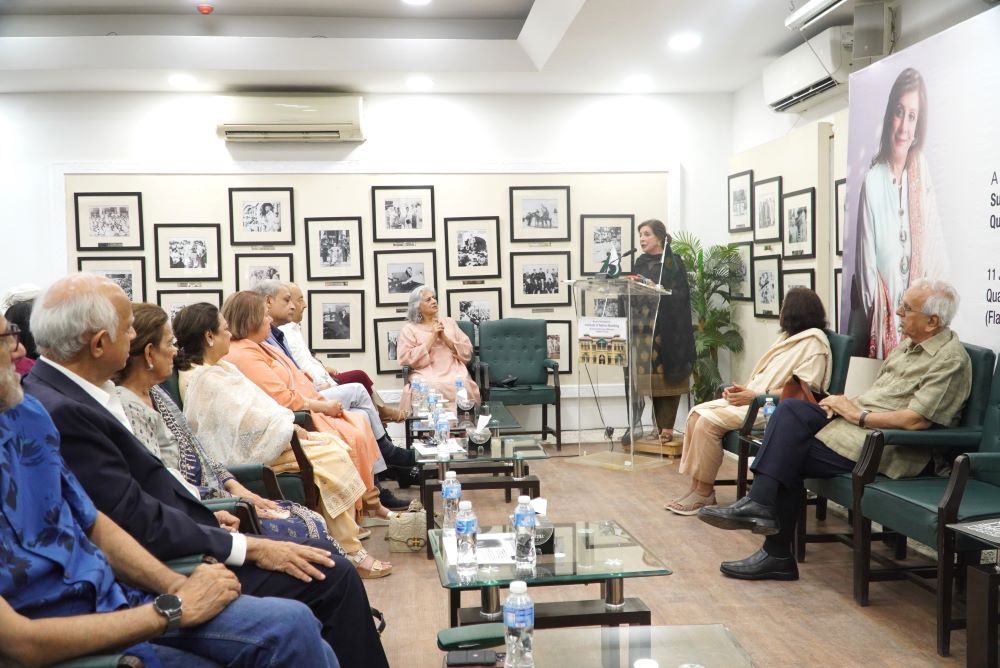
Liaquat Merchant, Senior Vice Chairman of the Board of Management, Quaid-e-Azam House Museum:
Our esteemed Chief Guest and keynote speaker for this evening, Ms Sultana Siddiqui, Mr Ikram Sehgal, Member of the Board of Management, Quaid-e-Azam House Museum; Ms Ameena Saiyid, Member of the Board, Quaid-e-Azam House Museum; distinguished guests, ladies and gentlemen, Assalam-o-Alaikum. You are presently seated in Mr Jinnah’s house, and I would like to begin by sharing a few words about this historic place. Every time we visit, we are deeply conscious of the sanctity and dignity associated with the home of Quaid-e-Azam Muhammad Ali Jinnah.
Mr Jinnah purchased this property in 1943 as his personal residence, intending to live here after retiring from politics in Bombay. However, that stage of his life never arrived. Following Pakistan’s creation, he became the country’s first Governor General and moved into the Government House. After his passing, his sister, Mohtarma Fatima Jinnah took up residence here and stayed until 1964.
The property has a chequered history. Quaid-e-Azam executed his will in 1939, four years before purchasing the house; therefore, it was not specifically mentioned in the document. Instead, it formed part of his residuary estate, along with other assets not expressly identified in the will. The estate subsequently vested in executors and administrators appointed by the High Court. The original appointees included Mohtarma Fatima Jinnah and Liaquat Ali Khan, while several others assumed these responsibilities over the years. By 1980, Syed Hashim Raza and I were serving in that capacity, and the responsibility for this property consequently fell to us.
During that period, Gen Zia-ul-Haq, then President of Pakistan conveyed the Government’s interest in acquiring the house. We referred the matter to the High Court, which approved the proposal on the condition that the property be restored to its original state and converted into a museum to preserve objects of historical significance.
Following the Court’s approval, Syed Hashim Raza and I signed the sale deed, transferring the property to the Government of Pakistan. I am pleased to say that the Government subsequently restored the property and established a museum in the adjoining building. The museum houses artefacts and objects of immense historical importance relating to Mr Jinnah and the creation of Pakistan, and it is certainly well worth visiting.
Following the 18th Amendment, responsibility for the property was devolved to the Government of Sindh. At that time, Corps Commander Lt Gen Humayun Aziz and Chief Minister Syed Murad Ali Shah engaged Ikram Sehgal and me in discussions regarding its future. During meetings held at the Corps Commander’s residence it was proposed that in addition to serving as a museum, the building should be utilized for broader public and educational purposes.
Ikram Sehgal and I considered the proposal in our respective institutional capacities and subsequently prepared a Memorandum of Understanding, which was signed by the Government of Sindh. This was followed by an official notification establishing the Board of Management of Quaid-e-Azam House Museum.
The Board comprised several distinguished members and three public functionaries, including Mr Sehgal, Cdre (Retd) Sadeed Malik, and myself. Significantly, the notification included the phrase Institute of Nation Building. Its founders recognized Pakistan’s urgent need for a structured platform to guide and educate young people, who constitute more than half of the country’s population.
Many young Pakistanis have limited knowledge of Mr Jinnah, the struggle for independence, the reasons behind the creation of Pakistan, and the objectives the country was intended to achieve. The Institute was therefore envisioned as a platform for nation-building through knowledge, education, and meaningful dialogue.
Although the institute was not established through a separate statute, its name and mandate were formally recognized by the Government of Sindh. We regularly organize programs focusing on Quaid-e-Azam, various aspects of his life, and the history and purpose of Pakistan.
Through these initiatives we seek to help the younger generation understand who founded this country, the ideals upon which it was established, where we succeeded, where we fell short, and how those shortcomings may be addressed.
Muhammad Ali Jinnah himself was deeply committed to education, particularly the education of Muslim youth. In 1946, he established the Dawn Trust to disseminate news and information of national and historical significance. His example reinforces our conviction that educating young people about Pakistan’s history, its founding principles, and national ideals is both essential and enduring work. Our nation-building initiatives include publications, lectures, and educational activities for students.
Among these is a children’s book titled Our Quaid, developed for readers between the ages of six and twelve. Thousands of copies have been printed and distributed free of cost to schools across Pakistan, while children visiting the Museum also receive a complimentary copy.
A second volume of Our Quaid intended for students aged twelve to eighteen, was commissioned from the renowned historian Dr Ayesha Jalal. We also planned a third publication, Quaid-e-Azam and Education, specifically for young readers. Through these works, we aim to present the life, principles, and national vision of Quaid-e-Azam clearly and engagingly so that younger generations can readily understand. The Institute also organizes an annual declamation competition for school students in Karachi, along with essay competitions and painting exhibitions centred on Quaid-e-Azam Muhammad Ali Jinnah. These activities encourage students to engage meaningfully with his life, ideals, and contributions to the creation of Pakistan. With these brief remarks on Quaid-e-Azam, this historic house, and our nation-building efforts, I now invite Ms Ameena Saiyid to introduce today’s distinguished guest speaker.
Ameena Saiyid, Member of the Board, Quaid-e-Azam House Museum:
Distinguished guests, ladies and gentlemen, Assalam-o-Alaikum, and thank you all for joining us. It is my great pleasure to introduce Ms Sultana Siddiqui. She is a transformative force in Pakistan’s media landscape and a true pioneer. As the first woman in South Asia to own and lead a television network, she redefined leadership in an industry traditionally dominated by men.
She began her career at Pakistan Television in 1974, distinguishing herself across a wide range of programming formats. She later entered private production and founded HUM Network Limited. Under her visionary leadership, the organization evolved into a dynamic media group comprising HUM TV, HUM News, HUM Masala, HUM Sitaray, Style 360, and Ten Sports. Her work played a pivotal role in revitalizing Pakistani television drama through landmark productions such as Humsafar, Zindagi Gulzar HaiandUdaari. She has also mentored a new generation of writers, actors, directors, and other creative professionals. Today, HUM’s content reaches audiences in more than 30 countries, while the HUM Awards have provided an international platform for showcasing Pakistan’s culture and creative talent.
In 2017, Ms Siddiqui established the Karachi Film Society, the parent body of the Pakistan International Film Festival, to strengthen Pakistan’s cinematic presence. She also leads awards that recognize Pakistani women, both at home and abroad, whose achievements and contributions are creating a positive impact on society. She has also represented Pakistan at prominent international forums and contributed significantly to media policy, journalism, women’s leadership, and entrepreneurship. Her numerous honors include the Sitara-e-Imtiaz, the PTV Icon Award, and honorary academic distinctions. Beyond her contributions to media, she remains deeply committed to social development. Her initiatives support education, healthcare, schools, and underserved communities. She is now working towards establishing a dedicated media university to educate, train, and prepare Pakistan’s next generation of media professionals.
Sultana Siddiqui, President Hum Network Limited: Bismillah-ir-Rahman-ir-Rahim. Assalam-o-Alaikum. First of all, I would like to express my sincere gratitude to Liaquat Merchant Sahib and the members of the management. It is a great privilege to speak at a place of such profound historical significance and on such an important occasion.
I have devoted my life to the media, yet whenever we speak of Quaid-e-Azam, I remain deeply inspired by the extraordinary scale of his vision. He envisioned and created a homeland for the Muslims of the subcontinent, a country founded on justice, where no one would face discrimination based on color, religion, or gender. The courage, determination, and foresight required to transform that vision into reality reflect the exceptional leader he was.
I would also like to commend the remarkable work being carried out at Quaid-e-Azam House. The careful preservation and systematic display of these photographs, personal possessions, and memories constitute an invaluable national service. While institutions such as this bear an important responsibility to safeguard our history, the media shares that responsibility as well.
During Quaid-e-Azam’s time, radio and newspapers were the principal forms of media. Today, media exists across numerous platforms, but its fundamental power remains unchanged: it carries our voices, ideas, and values to wider audiences. We must therefore use that power with courage and responsibility. A true visionary does not think solely in terms of personal interest or individual gain; genuine vision serves humanity and the nation. A leader must provide young people with truthful guidance and a clear sense of direction, as Quaid-e-Azam did. True leadership does not spread rumors or compromise the national interest for personal benefit. The same principle applies to the media. People place immense trust in what they see and hear; therefore media organizations have a profound responsibility to report truthfully, accurately, and constructively.
I would now like to share a part of my own journey and explain what led me to enter the media. At the time, even for men, a career in media was not widely regarded as a respectable profession. For women, the idea was almost inconceivable. Teaching and medicine were considered the two respectable career choices available to women, while banking gained acceptance somewhat later.
I would not describe myself as a rebel, but from an early age, I tended to think differently. When I was in class seven, our teacher asked us to write about our purpose in life. While most students expressed a desire to become doctors or pursue other conventional professions, I wrote that I wanted to buy a ship, travel around the world, and meet people from different countries. I had always loved stories and novels and often became absorbed in the world of imagination. Over time, I also developed an interest in writing and teaching. Life eventually required me to care for my children while considering employment. However, I would not describe my decision to work merely as a matter of compulsion. I have always believed that women should be independent and demonstrate their ability to achieve great things. Although I had never travelled by air as a child, I would look at airplanes and dream of flying. Perhaps that desire to look beyond the life immediately around me influenced the choices I made later.
I entered television in 1973–74, initially through an opportunity to work as a compere. When permanent positions were subsequently advertised, I applied. Although other career options were available, I had already decided to work in media because it offered a powerful means of communicating ideas, shaping attitudes, and encouraging society to think differently, particularly about women. Quaid-e-Azam did not address his message only to young men. He strongly advocated women’s education and encouraged their active participation in the Pakistan Movement, recognizing that no nation could progress without their contribution. Mohtarma Fatima Jinnah stood firmly beside him, while many other women, including Begum Shahnawaz and Begum Hidayatullah, played significant roles in the struggle.
Women from my family also participated in the movement. My grandmother recalled that they had initially worn khaki and supported Congress but later joined the Muslim League’s campaign and proudly raised its flags. Quaid-e-Azam’s vision was, of course, far greater than anything I could claim for myself. Nevertheless, I had a clear purpose: to use television as a platform for conveying ideas that could benefit individuals and society. Media carries a profound responsibility. It must provide accurate information, encourage constructive thinking, and contribute meaningfully to the progress of the community.
When General Zia-ul-Haq came to power, television entered a period of severe restrictions. Creative expression suffered because people cannot produce their best work when they are constantly constrained or intimidated. At the time, I was producing a pop music program featuring artists such as Alamgir. Shortly after the change of government, the Secretary of Information visited the station with our General Manager and asked what my program was doing for the Government. I found it difficult to understand what political service a music program was expected to provide. The restrictions soon became highly prescriptive. Women were required to cover their heads on screen.
I have no objection to a woman wearing a dupatta by choice; the concern arises when it is made compulsory, irrespective of the character, setting, or storyline. A drama might portray a young woman returning from London, yet she would still be required to wear a dupatta in every scene even where it was inconsistent with the character or context.
Performers were also instructed on how to dress and the extent to which they could move. Creative professionals were no longer being allowed to express ideas freely; instead, directions were imposed upon them by those outside the creative process. Governments came and went, but many of us remained determined to continue producing meaningful work in our own way.
Whether through music or drama, I did everything within my capacity to uphold my purpose without compromising the values that had brought me into media.
One of my earliest major dramas was Marvi, which addressed issues that were rarely discussed on television at the time. I was warned that these themes would attract criticism, but I believed that women could address difficult subjects with education, balance, and sensitivity. I continued despite allegations that I was undermining tradition and personal warnings that I was being watched. I did not share these threats with my family or colleagues because I refused to allow fear to hinder the work.
I later established my own production company while my children were still young. Motherhood carries immense responsibility, and for a single mother, that responsibility is even greater. She must build a career while ensuring that her children receive the attention, care, and guidance they need. I remained convinced that a woman could fulfill both roles, even if it meant working twice as hard.
As my children grew, I gradually expanded the scope of my work beginning with shorter programs before progressing to larger productions. When private production gained momentum, I considered leaving PTV to establish my own business. During Benazir Bhutto’s government, however, senior management encouraged me to not leave, emphasizing the importance of supporting women and advancing them into leadership positions. I was appointed Program Manager and continued producing major programs.
Following another change of government, creative professionals once again came under pressure. At one point, I was asked to make a statement against senior colleagues and suggest that they had instigated unrest. I refused because the allegation was untrue. When asked why I was still sitting there, I replied that: “I believed I had been appointed to produce programs, not to make false accusations.” I was removed from my position the following day. Soon afterwards, I resigned and returned to private production, creating content for PTV and other broadcasters. My son later returned after completing his studies in business. While I understood the creative side of the profession, marketing and sales were not my areas of expertise; those were his strengths.
Around 2002–03, as private television channels began to emerge, he suggested that we establish our own channel. Initially, I did not fully appreciate the scale of the undertaking. He reminded me that I was already accustomed to working exceptionally long hours and assured me that he would manage the business operations.
As I began pursuing the idea, I discovered that others regarded me as a threat. I was repeatedly warned against launching a channel. The industry was described as a forest of wolves, and I was told that a woman would not survive in it. Friends and acquaintances were approached and asked to persuade me to abandon the venture.
One established channel even offered me a long-term production agreement on the condition that I give up the idea of launching my own network. We declined the offer. We established the channel with a much broader vision: to take Pakistani stories and culture to audiences around the world. My son also believed that the company should be publicly listed to promote wider ownership, transparency, and international recognition. Although many respected professionals supported us, the financial risk remained entirely our own. I did not build the organization through inherited wealth or financial support from my parents, husband, or extended family. Whatever I have achieved has been the result of my own work, determination, and perseverance. At the time, imported Indian serials dominated television, often featuring highly embellished settings and repetitive domestic conflicts. I believed that Pakistan possessed its own beautiful landscapes, compelling stories, and immensely talented artists; we did not need to rely on another country’s cultural narrative. Despite doubts about whether Pakistani dramas could attract audiences, we remained committed to producing our own content and presenting it to the world.
Our dramas explored India–Pakistan relations, women’s empowerment, education, rights, and other social issues without compromising their entertainment value. A message is most effective when it emerges naturally from a powerful story. By the grace of Allah, Pakistani drama eventually gained recognition and appreciation worldwide. We also invested extensively in developing talent. Many gifted writers possessed strong literary abilities but were unfamiliar with the specific techniques required for television. During our early years, I invited writers to my home and worked with them on the craft of screenwriting. This commitment extended to actors, technicians, and other creative professionals, many of whom later became prominent figures in the industry.
When we launched our news operation, we adopted a clear editorial principle: it would not be driven by sensationalism. News must be truthful and accurate, and it should neither deepen social divisions nor damage the country’s reputation. Pakistan now communicates with the world through television, digital platforms, and social media, making responsible journalism more important than ever.
Quaid-e-Azam gave us the guiding principles of Unity, Faith, and Discipline. These may be simple words, but putting them into practice requires sustained effort. Pakistan cannot progress unless women are empowered, young people receive proper guidance, national issues are discussed constructively, and decisions are translated into meaningful action. We must also teach our children to use social media responsibly. Online platforms are frequently used to insult and demean others, particularly women and girls. A woman’s appearance or personal life is often treated as justification for questioning her character, even when she has done nothing wrong. Parents, educational institutions, and media organizations share a responsibility to challenge such behavior and promote dignity and respect.
Our international events have also been linked to social causes. When Pakistan was affected by devastating floods, we announced that a portion of the proceeds from our activities would be directed towards relief efforts. Our Board has similarly approved commitments to education and other welfare initiatives. Vision must never remain confined to personal success; it should create structured, sustainable, and lasting benefits for society. We are now placing greater emphasis on education, particularly women’s education. I take immense pride in the fact that many of the most capable professionals in our organization are women. When I entered television, even men were hesitant to join the profession. My ambition was to help build an industry that women could enter with dignity and pride as actors, writers, technicians, journalists, and managers.
Media is neither inherently good nor bad; its value depends on how responsibly it is used. We must employ it to disseminate knowledge, uphold dignity, and promote constructive ideas. One of my remaining ambitions is to establish a media university in Pakistan. The need for such an institution is urgent because media is no longer confined to acting or the performing arts. It now encompasses artificial intelligence, digital platforms, television, journalism, technology, and management. We must equip young people with the knowledge and skills required to succeed in this rapidly evolving field.
Ikram Sehgal, Member of the Board of Management, Quaid-e-Azam House
Museum: Bismillah-ir-Rahman-ir-Rahim. Ladies and gentlemen, Sultana Siddiqui has established an extraordinary standard in television, entertainment, and media. Her achievements exemplify the kind of meaningful national contribution that institutions such as ours seek to recognize and encourage. There are also important historical decisions that deserve greater attention. During the Second World War, when Congress launched the Quit India Movement and opposed India’s participation in Britain’s war effort, Quaid-e-Azam made the strategic decision that Muslims would continue to serve. Consequently, Muslim representation in the British Indian Armed Forces increased substantially. Later, when many argued that British India should remain united and that Pakistan should not be created, British officers remembered that Muslims had supported them during a critical period and could not simply be abandoned to majority rule. This proved to be a significant strategic decision in the struggle for Pakistan.
Another lesser-known historical episode involved proposals advanced by leaders such as A. K. Fazlul Huq, Abul Hashim, and Huseyn Shaheed Suhrawardy to prevent the division of Bengal. They recognized that partitioning Bengal would weaken its economic and strategic resources. These debates also extended to the future of Assam and the north-eastern region. Whether or not one agrees with every proposal, they illustrate the complexity and far-reaching consequences of the political choices surrounding Partition.
Returning to Sultana Siddiqui’s central message, no country can progress unless women participate fully in its economic and political life. This is evident across South-East Asia, Africa, and South America. Pakistan continues to lag, particularly in women’s financial inclusion. A significant proportion of adults remain outside the formal banking system, while women represent only a small proportion of account holders. Without adequate access to financial services, they cannot contribute to the economy to their full potential.
If we seek credible role models, we should look to individuals such as Sultana Siddiqui. The impact of her achievements extends well beyond her own career to the next generation of her family and the numerous professionals she has mentored and nurtured. Her organization has also attracted the attention of the World Economic Forum as an inspiring model worthy of international recognition.
I would also like to acknowledge Liaquat Merchant. This institution has been an extraordinary journey for both of us. We have faced numerous practical challenges, including the ongoing difficulty of securing an adequate water supply for this historic property, but we have confronted them together. Today, the Quaid-e-Azam House Museum hosts activities almost every week, particularly in education and the promotion of knowledge. Liaquat, you have done a remarkable job.