


Recent Elections and the Result
“Most remarkably, Rafsanjani’s son told a visiting American reporter before the June 2005 presidential election that, if elected, his father would change Iran’s Constitution to reduce Khamenei’s power by making the position of the Supreme Leader a ceremonial role akin to the King of England” (Karim Sadjadpour -‘Reading Khamenei: The World View of Iran’s Most Powerful Leader”- Carnegie Endowment monograph -2008)
The recent elections in Iran and the street protests that followed caught my eye and I spent quite some time trying to understand what the protest was about. Was it really a “Where is my Vote”, demand and a common slogan that was used during the early days of the protest or was there something else? Did the people of Iran want a more liberal lifestyle or was it just the University students with a sprinkling of political agitators? The NRI (National Resistance of Iran), an overall umbrella organization of resistance parties and the PMOI/MKO (Peoples Mujahidin of Iran aka Mujahidin e Khalq) were conspicuous by their absence though you can see the photograph of Neda, the young woman who was shot during the most recent protest on their webpage.
The more liberal segment who took to the streets continued to do so until they were battered into submission by the Basij and the police and the fact is, they were not really the sort of material you could launch a revolution with. They were or seemed to be noise makers and not revolutionaries. Most of all they were not really inspired by the need for reforms. But then without an agenda of how they would achieve these reforms, they were agitators. The liberals were in power for 8 years (1997-2004) and their attempts to bring about reforms in that duration of time did not meet with any great success. This time around, the fact they had rallied behind an ex-Prime Minister who was not a clergy didn’t meet with much success either.
So what was all the noise about? Perhaps they really liked and wanted the more progressive leadership like that of the ex President Khatemi (1997-2004) who was at some odds with the Constitutional setup of power holders to which he belonged and they were more conservative than the President was. In his 1997 election manifesto, the then President Khatemi had promised to curb the power of the clergy. It seems that in the course of time, the clergy turned the tables on him were able to stop the reforms President Khatemi wanted to carry out during his two tenures of office. A disappointed Iranian public didn’t turn out in their numbers to vote for him in 2004/2005 elections because they felt that in the end he was a Mullah too and could not deliver on his promises.
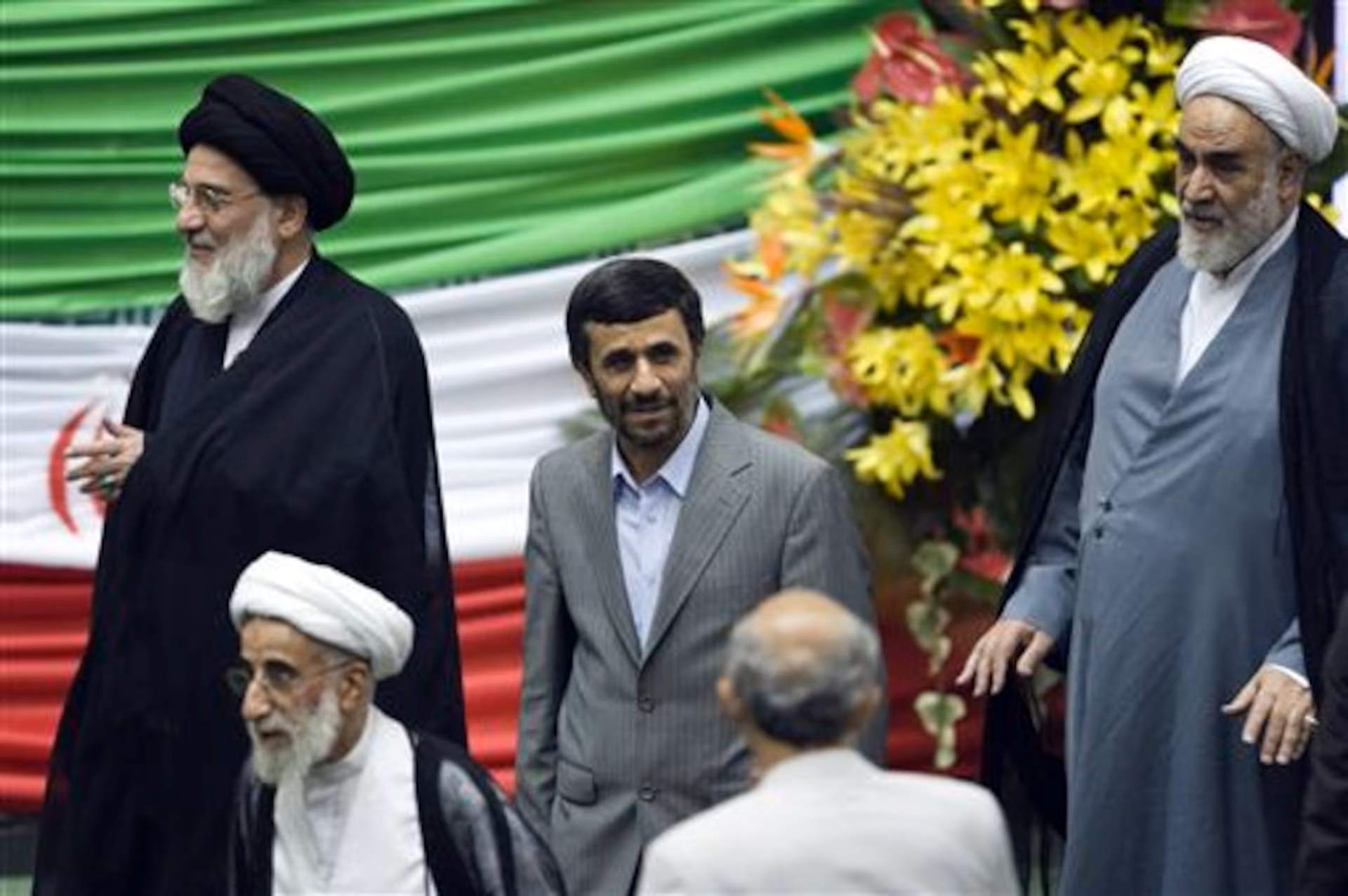
But in 2004/2005, it seems the Reformists were outnumbered by the more conservative Iranians. Most reform minded Iranians stayed away from the polls as they were disenchanted with the Reformers and this in turn brought into power the ultra right Government of President Ahmadinejad, who was incidentally the leader of the “Abadgaran” or the “Developers,” an ultra right wing group drawn up from young conservatives from many right wing parties that was set up during Ahmadinejad’s tenure of Mayor of Tehran group. This ultra right wing group was to provide a second generation of leaders who more than reaffirmed the Revolution. Firstly it had frustrated president Khatemi’s reform moves, then it was an ultra right group that the Majlis e Kubragan and the clergy could happily back as Ahmadinejad did not want to curb the powers of the clergy in Iranian politics. In the 2004/2005 elections, President Ahmadinejad had not only out maneuvered the clergy but had won them over, won the Presidency and had consigned the reformist movement to history. The torch of Revolution had passed to a second generation of right wing leadership who stood by what Ayatollah Khomeini had brought about. The so-called Thermidor stage of the Iran Revolution was over. The ultra right wingers under Ahmadinejad were in power and this meant that the liberalism that Khatemi had tried to bring about was at an end.
The Reform Group still had a fairly substantial following and tried their hand at gaining power in 2009 and contested the elections. This time they were led by Mir Hussein Moussavi who was the Prime Minister of Iran from 1981 to 1989 or up to the time the Iranian Constitution was redrafted to accommodate the elevation of a junior cleric the then Hojjat ul Islam Khamenei to the post of the Vilayet e Faqih. The post of Prime Minister was done away with in the 1989 Constitutional revision as it was seen to be concentrating too much power in the elected members of the Majlis at the cost of the clergy. This scheme of things had worked under Ayatollah Khomeini because he was the Revolution. His first successor Ayatollah Montazari fell out with him in 1985 and the concept of the Vilayet e Faqih was redefined by Ayatollah Khomeini to enable his successor to be elected. It seems, and here I am conjecturing that Mir Hussein Moussavi still entertained, or had an idea of both a President and Prime Minister being there as they were under Ayatollah Khomeini, curbing the power of the clergy. In the end, the Reformists wanted to end or curb the power of the clergy and put it in the hands of the elected representatives of the people.
Very little of the ideological motives for the recent flare up has come out of Iran because the very fact that the protest details were only made known to the world came from those who had mobile phones, photographs and short videos indicated, along with the content of their messages, that they were University students or well to do folk who spoke English or had passable knowledge of English and began communicating with the Western media and drew attention to what they were doing. The foreign media and press were banned from covering this protest after the initial few days. So what the world knew about the protests and deaths was the brutality of the State machinery because that is what was passed on by the many who were involved in the street turmoil. The streets were taken over by the police and the Basij who went into action after the Vilayet e Faqih warned the protesters to stop their protesting during a sermon/Khutba on a Friday. All the reports of rioting and police brutality are, and were, essentially unconfirmed or could not be confirmed or verified.
What we do know is that the protesters wanted to create conditions that could lead to a cancellation of the poll results, alternatively start a “happening” by throwing stones and burning garbage containers and tried to show the Western media that there was a massive unrest. How many messages were sent to the Western media and television stations to try and show that here was another Tiananmen Square affair in the making? But the information from Iran again, was unverifiable. The United States has no Embassy in Tehran but I believe Her Majesty’s Embassy in Tehran looks to the affairs of the USA in Iran. There are no diplomatic reports to suggest that President Ahmadinejad came into power through massive vote rigging as had been alleged by Mir Hussein Moussavi who alleged an 11 million vote discrepancy. There are no diplomatic reports that have come to light or have been leaked out to the media in this connection and this probably is because there wasn’t too much to report about in the first place. I have not come across any Report, other than the paper published by Chatham House and the Institute of Iranian Studies, University of St Andrews, titled ‘Preliminary Analysis of the Voting Figures in Iran’s 2009 Presidential.” This paper is dated June 21, 2009. The Executive Summary of this paper states the following, and I quote:
“Working from the province by province breakdowns of the 2009 and 2005 results, released by the Iranian Ministry of Interior on the Farsi pages of their website shortly after the election, and from the 2006 census as published by the official Statistical Centre of Iran, the following observations about the official data and the debates surrounding it can be made.
· In two conservative provinces, Mazandaran and Yazd, a turnout of more than 100% was recorded.
· If Mahmoud Ahmadinejad’s victory was primarily caused by the increase in voter turnout, one would expect the data to show that the provinces with the greatest increase in voter turnout would also show the greatest ‘swing’ in support towards Ahmadinejad. This is not the case.
· In a third of all provinces, the official results would require that reformist voters, despite a decade of conflict between these two, Ahmadinejad took not only all former conservative voters, all former centrist voters, and all new voters, but also up to 44% of former groups.
· In 2005, as in 2001 and 1997, conservative candidates, and Ahmadinejad in particular, were markedly unpopular in rural areas. That the countryside always votes conservative is a myth. The claim that this year Ahmadinejad swept the board in more rural provinces flies in the face of these trends.” Unquote
Other than the doubts raised, there is nothing more to go by. It is easy to raise doubts but it is another thing trying to disprove what the Iranian Government has said about the election results more so because the figures used in the Chatham House Report are the Iranian Government’s figures. If Chatham House felt the Iranian elections were out of order, then they have to demonstrate what is in order but they haven’t been able to do that. Otherwise, here was a God sent opportunity for the West to rub Iran’s nose in the dirt that was missed.
To explain the USA’s muted response, it would be worthwhile to keep in mind here that in the Algiers Accords of January 19, 1981 the United States had agreed to and pledged that it would “not intervene, directly or indirectly, politically or militarily, in Iran’s internal affairs.” So this time all blame fell on the BBC who became the prime scapegoat and had 9 of its local staff arrested. The CNN escaped with comparatively minor injuries. Whilst a segment of the media in the USA wondered aloud about why President Obama was not vociferous in denouncing the Iranian Government especially after the Vilayet e Faqih, Ayatollah Khamenei, had warned the protesters that the wrath and the ire of the Government would fall on the protesters? The American media had to rest content with whatever President Obama said in his second addressing of the street protest in Iran and that too under the preferred cover of, or hiding behind Human Rights.
Let me give you an example below of how vicious Western propaganda is below. Today the world is fooled by the barrage of constant propaganda that Iran is on the verge of going nuclear inasmuch as they are developing nuclear weapons. Ironically, the IAEA who is monitoring Iran’s nuclear program has seen no evidence of Iran trying to enrich Uranium to a greater purity than the 3% or 3.5% content of Uranium’s fissile isotope that the West claims the Iranians are doing at Natanz. All this took place, and is taking place to a lesser extent today just because President Bush included Iran in the Axis of Evil in his January 2002 speech. So it really doesn’t really mean that the Iranians are evil or are on the verge of annihilating Israel. At this time it doesn’t seem like they have the means to do so. So are we, the citizens of this world being told the truth or are we getting a stilted version of the truth? We have to decide about that point. The so called free press is in all probability, no more than an over grown propaganda machine.
Was this protest a class based protest where a better educated or a class of people who had access to means of communications and were more liberal, wanted a more liberal Government under the ex-Prime Minister Mir Hussein Moussavi? Let me define here what I mean by liberalism. By liberal I mean those who espoused a modicum of western values of individual’s right to do as they please within certain limits of course. Now wait and don’t get wild about what I am saying and let me explain in some depth about what I mean. Liberalism invariably means the right to do as one pleases and deals with individual rights. The emphasis is on the individual here. We must also be aware of the point where liberalism begins to become Hedonism. In a social context, liberalism always exists to a lesser extent than what an individual wants or wanted because of the other members of society and the rights that society has given them and those rights are as good and as valid as yours. Should you wish to practice your brand of liberalism, you are welcome to do so in the privacy of your room or your house if you live alone. Is liberalism enshrined in the Charter of Human Rights? For most of the people the answer is yes. But that is a wrong answer. The right answer is Human rights are guaranteed by a country’s Constitution. This is how the Charter of Human Right defines a citizen’s rights and freedom after laying down the basic rights that should belong to the people who inhabit the Globe but the extent of those rights are defined by the country’s Constitution.. You could refer to Article 8 of the Charter of Human Rights to understand how this has been phrased.
This is all very well theoretically but did these so called Human Rights exist in the real world that was caught up in fighting the Cold War? Did these rights exist when Governments of newly independent states existed on the whims of either of the two Superpowers? Consider if you will, the Charter of Human Rights came about much after the end of the Second World War and when the colonial empires were in the process of breaking up or some countries had already obtained their freedom. This Charter of Human Rights didn’t enshrine the Rights that were enforced in the colonies by the colonizing powers but probably did depict what may have existed in the colonizing country. In reality the Charter of Human Rights is utopian and enshrines at best a vision of what the World should be. No more and no less. Therefore those who believed in Western Liberalism or Socialist idealism, especially in Muslim countries today, are living in a world that existed prior to the 1970s.
It was probably after the Cuban Revolution and the war for Algeria’s freedom followed by Ernetso “Che” Guevara’s message that ran something like this. “Don’t accept Russia’s supremacy just because you have rejected America’s Be free.” All this was followed by Che’s meetings with the newly freed African leaders, including Ahmed ben Bella of Algeria but most of the newly freed third world countries were overawed by the might of the superpowers and saw only their weaknesses even as members of the NAM or the Non Aligned Nations movement and couldn’t really influence the world.
The eyes of the Islamic world really opened wide with the 1967 war between the Arabs and the Jews that ended in an unmitigated disaster for the Arabs, that a new direction was diligently sought by the Islamic world. In Iran, Jalal Ale Ahmed had already written his “Gharbzadegi” or “Occidentosis-Plague from the West.” (English Translation was published by the Berkeley University much later after the Iranian Revolution along with a lot of Dr. Ali Shariati’s works) and Gharbzadegi had been published clandestinely in Iran in 1962. Allama Iqbal had delivered his lectures, now better known as “Reconstruction of Religious Thought in Islam” in book form a few decades earlier. In 1943, Ayatollah Khomeini had made his entry into politics with his “Kashf-al Asrar” It seems there was a search for an identity going on in the colonial world and in Iran under the Shahenshah. This search was carried forward in earnest. The post colonial world did not provide for an identity and also an ideology that the newly independent Islamic states that they could live by. I remember being born as a British subject in 1939. Was this sufficient to live a life by? This quest for an identity that colonization had so successfully destroyed and an ideology to live by, was to take shape as an Islamic re-awakening in the 1970s because Islam was something that was ours and no one could teach us Islam. Unhappily, this quest that the Islamic world set out on was never seen for what it was and ultimately it has been seen to replace the Red Menace with the Green Menace simply because the Islamic states chose to be different from the West in terms of the source for the social contract was not secular but religious. Most of all it was Islamic.
An interested reader should spend time over Bernard Lewis’s book “The Political Language of Islam” published by the Oxford University Press – Karachi in 2002. It is important that a serious reader spends time understanding how insufficiently translated Islamic political concepts are in English and what they lose in translation and therefore bring about misunderstandings in the minds of both the West and the English speaking elite in the Muslim countries. Similarly, the interested reader should read Ervand Abrahamian’s “Khomeinism-Essays on the Islamic Republic.” You will see how insufficient English terms like “Fundamentalism” are when used to describe what the Iranian Revolution stood for and achieved. Another reference to thinking along these lines comes from Dr. Abol Fazal Ezzati’s “The Revolutionary Islam and The Islamic Revolution.” (Published by the Ministry of Islamic Guidance-Tehran in 1981) who says the following in the opening paragraph of the first chapter of his book, and I quote:
“It is fashionable in the Western traditional academic circles whenever they discuss social, political, historical and other theoretical subjects to trace the concepts and the terms applied for them to its Greek or Roman origin. This is because for the Western minds everything emanates from Western culture and history. Studies of Islamic topics are not exempted from this general rule. In fact Western scholars study Islam in the Western framework. They have no Islamic approach for studying Islamic topics. This is partly responsible, next to missionaries’ vindictive misinterpretations of Islam, for the miscomprehension of Islam in the West after 14 centuries. However, the terms and concepts of revolution and evolution in Western Society have their own history. Some classical writers had some notion of the concept of Revolution and evolution, though they were not sure of what words they should use for them. The reason, perhaps, why classical writers had neither one concept of nor the word for Revolution is that there was no epoch-making or classical revolution in their history like the French Revolution of 1789.”
The fact that the Islamic World was seeking another way because Democracy and capitalism on the one hand and Communism and Socialism on the other had both failed to live up to their expectations and the newly freed Islamic states were still very close to where they stood when they were freed. Parliamentary democracy was a catchword that was to be worked towards and could not be transplanted, and for sure, it just didn’t bring about wealth and reduce poverty. To have a country of your own is half freedom. When you can live by the ideology and the set of rules you choose to live by and possess an identity, then freedom is complete. A nation can never be completely free by trying to live in accordance with an imported ideology. You cannot purchase freedom from the bazaar or a supermarket or a shopping mall and least of all cannot be given to you by someone else because freedom is essentially an idea and exists in the mind and this idea has to be defined and put into practice. This is the reason I have emphasized and beleaguered this point as an insufficiency of the English language and lexicon compounded by twisted reporting, by quoting the two scholarly works above. In fact, so complete was the devastation of the pre-colonial way of life and what the Government and rulers stood for was lost and, that on Independence, most states were akin to rudderless ships. They were no more than cheap imitations of the State that had colonized them. This meant radical steps had to be taken to reinterpret Islam in a modern context because it was their lost legacy, had to happen and it did.
Looking backward and trying to transplant past onto the modern idiom became a source of conflict within Islam, but it was one that is slowly but surely being overcome. An example of what I am saying is once again to be had from Ervand Abrahamian’s book and is attributed to the Hojjat-ul-Islam Ali Akbar Hashemi Rafsanjani, who was to become the President of Iran in the not too distant future. This remark is regarding the structure of the new Islamic Republic in Iran when he replied to a question by asking “Where in Islamic History do you find Parliament, President, Prime Minister, and Cabinet Ministers? In fact eighty percent of what we now do has no precedent in Islamic History.” (Abrahamian op cit. page15). A new State brought its own challenges and reinterpretation of Islamic Laws. To understand the Iranian experience, one has to refer once again to Dr. Abol Fazal Ezzati’s “The Revolutionary Islam and The Islamic Revolution.” (Published by the Ministry of Islamic Guidance-Tehran in 1981) This is a rare and obscure reference and the Preface of this work starts as under:
“The success of the Revolution in Iran in 1978 has been one of the most important events in the modern history and the most significant in the history of Islam and the Muslim Community. Yet a Revolution of such magnitude has met with unprecedented prejudice and injustice. (For the purists, the Iranian Revolution began in 1978 and ended in 1979.) It has been misinterpreted, ignored, mistreated and accused on purpose.”
The fact is, Dr. Ezzati is correct in what he is saying. Consider if you will, the French Revolution was aimed at restoring rights and freedoms from a tyrannical monarchy. The same is the case of the Russian Revolution that brought the Communists into power. The American Revolution was to gain freedom from England. The Iranian Revolution was not for any of the two reasons the previous revolutions followed. It was an Islamic Revolution and was based on religion and not the secular world view that Democracy and capitalism espoused nor was it like the Communist Revolution which did away with religion. So the revolution in Iran was a bogeyman – misunderstood because it moved Iran away from being one of America’s greatest ally and most of all, a new way of doing things had come around. It took place to reestablish their identity as a people and define a way of life. Such a revolution has to be re-affirmed by every generation and this has been done in both 2004 and 2009.
The Islamic aspect law as another Ideological basis for the existence of a state is lost on the West. They are too insular and self seeking to really understand what took place. They have set models for revolutions, overthrowing of Governments and so on. The Iranian Revolution was something they couldn’t fit into their neatly compartmentalized worldview. A first shaky step towards reconciliation with the hitherto Green Menace has been taken by President Obama when he spoke to the Muslim world from Cairo on the 27th of March 2009. His message was insufficient in content but it was a first step. The Islamic world is in fact waiting for a meatier second step from the USA before they respond because as at today’s date, the USA has successfully alienated the Islamic world and this time the world needs proof of what is being said.
Everything the protesters in Iran did and what was shown on television was wrong. It didn’t make sense because they had chosen to involve states whose ideological premises were very different. I am not surprised to read that the Iranian Government plans to prosecute those who had sent the messages, photographs and videos to the West. At least that is what I would do if I was in power. I would do it for no other reason than they chose to seek help from those who were not entirely friendly to the state or have the same sense of values that exist in Iran or the reason for the existence of the type of Government they have in Iran. In other words the revolutionaries wanted what they needed at any cost and not necessarily what the country wanted. They were out of touch with their country and its needs. This is something that is close to being a cardinal sin.
A Revolution has to be reaffirmed by every generation or else the revolution will mutate and possibly die out. Proof of this is what Chairman Mao Zedong did with his Cultural Revolutions. It took the wisdom of Premier Deng Xiao Peng to do what he did and abandon what he had to in China after Tiananmen Square and still retain the Communist identity in China. Is this necessary in the case of Iran? I don’t think so. All the countries linked to the Global economy are undergoing a bad time economically so economic problems are there and shall remain there for some time to come. Iran is under sanctions of sorts by the West and President Sarkozy of France has threatened Iran with more sanctions if Iran doesn’t change its tune by September 2009 when the G-5 +1 are supposed to meet Iran. If, and there is a very small off chance that the West needed to weaken Iran’s Government by encouraging the protest to make it more pliable, then their attempt was a damp squib. Therefore the only answer I have is that the Iranian protesters wanted the country to become more liberal whilst forgetting that the country had swung to the right represented by President Mahmoud Ahmadinejad and reconfirmed what those who voted him in did in the preceding election of 2004/2005. To forget this again is a cardinal sin because it casts doubt on your credentials.
Postscript: An interested reader may also refer to two books over and above those indicated in the text. The two books are
Mohsen M. Milani – ‘The Making of Iran’s Islamic Revolution- From Monarchy to Islamic Republic. -2nd edition-Westview press Boulder Colorado.
Kasra Naji – Ahmadinejad- The Secret History of Iran’s Radical Leader.-I.B. Tauris & Company -London – 2008.