


Chillianwallah, Chillianwallah!
Thou wilt be a doleful chord,
And a mystic note of mourning
That will need no chiming word;
And that heart will leap with anguish
Who may understand thee best;
But the hopes of all will languish
Till thy memory is at rest.
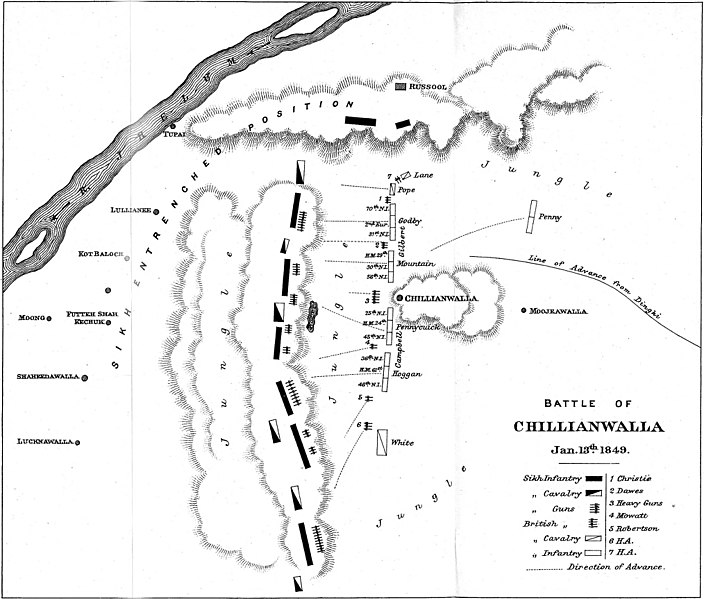
Battle of Chillianwala was fought on January 13, 1849 between Sikhs and English East India Company forces. This was one the most sanguine battle fought by East India Company forces in India and one of the last episodes before company took formal control of Punjab. Chillianwala was part of a long series of battles between the fragmenting Sikh power and rising star of East India Company that started at Mudki in 1845 and ended at Gujarat in 1849.
Sikh and company forces fought well though company forces saw many tactical reverses and battle at Chillianwala could be counted as draw. Cavalry brigade consisting of fine British and native regiments (14th Light Dragoons, 9th Lancers, First Light Cavalry and 6th Light Cavalry) panicked after wounding of brigade commander Brigadier Alexander Pope. In the stamped towards rear, they overran their own artillery. Small groups of Sikh horsemen followed the panicked brigade and carried off four guns and two wagons of ammunition. The losses suffered by the whole cavalry brigade suggest that there was no large scale engagement and most of the soldiers turned back. The number of killed included two British officers, two native officers and eleven men while two officers and 30 men were wounded. Some explanation of this set back could be traced to an ambush of East India Company forces at Ramnagar two months earlier. Enterprising Sikh officers surprised British forces and 14th Dragoons (nick named paggri wallahs as they used turbans in India) and 5th Light Cavalry suffered casualties. Casualties of 14th Dragoons at Ramnagar were 15 including one officer killed and 27 wounded including five officers. 14th Light Dragoons also lost their Commanding Officer (CO) Lieutenant Colonel William Havelock at Ramnagar. He was brother of famous General Sir Henry Havelock. A fellow officer of 14th Dragoons Captain John Foster Fitzgerald also died from mortal wounds in this engagement. His father was Field Marshal Sir John Foster Fitzgerald. 5th Light Cavalry commanded by brevet Lieutenant Colonel Alexander suffered 30 casualties at Ramnagar including three officers. Alexander lost his arm to a round shot.
Lieutenant Colonel J. W. King took command of 14th Dragoons after the death of Havelock. At Chillianwala, 14th Dragoons suffered only two killed (one officer and one trooper) and 14 wounded. 14th Light Dragoons lost Lieutenant Augustus John Cureton at Chillianwala (The memorial stone at the battle site with officers name wrongly identifies Cureton with 6th Light Cavalry. It also identifies Lieutenant James Alexander Manson with 14th Light Dragoons which is also wrong. Manson was from Bengal Artillery and son of Major General James Manson). Lieutenant Cureton’s father Brigadier Charles Robert Cureton (1789-1848) also of 14th Light Dragoons was killed two months earlier at an engagement with Sikhs at Ramnagar. As a young man, Brigadier Cureton ran away from his creditors disguised as a sailor and joined 14th Light Dragoons as a trooper. Later he rose to become officer and transferred to 16th Light Dragoons. He fought in Peninsular War and after his arrival in India he participated in all major conflicts including Bharatpur, First Anglo-Afghan War, Maharajpur, Sutlej campaign, Aliwal and Sobraon. Brigadier Cureton’s two other sons also fought in India. General Charles Cureton (1826-1891) was his father’s ADC at Ramnagar and was slightly wounded. He raised and led famous Cureton’s Multanis cavalry (later 15th Lancers) in 1857 from six Rissalahs (squadrons) brought by Ghulam Hassan Khan; a Multani Pathan to help the British regain the control from rebellious native Bengal army. Cureton was with his father at Aliwal. He rose to become a General. Brigadier Cureton’s other son Edward Burgoyne Cureton (1822-1894) was with his father at Maharajpur and Sobraon. He was commissioned in 13th Foot but later served with 16th Lancers. He retired as Lieutenant General.
The brunt of the casualties at Chillianwala was suffered by 24th Foot. 24th Foot entered the Chillianwala battle with twenty nine officers and 960 other ranks. An hour after the battle, thirteen officers were killed and ten wounded. More than half of the other ranks were either killed or wounded. The dead included CO of 24th Foot Lieutenant Colonel Robert Brookes. Brookes was originally from 69th Foot (this regiment was part of Brigadier Mountain’s Brigade in the same battle) and had just arrived after getting married in England to take command of 24th Foot. Several of the slain officers were from military families and fathers of some officers served in the same regiment. Ensign Hector Collis’s father Captain Charles Collis was also from 24th Foot as well as Captain Charles Harris’s father Lieutenant Colonel John Harris. The fathers of two slain officers: Lieutenant James Manson and Captain Robert Travers were major generals.
Brigadier John Pennycuick was from 24th Foot and fell on the battlefield. His son Alexander Pennycuick aged seventeen had just arrived from Sandhurst to join 24th Foot. He rushed towards his father’s body and stood there to protect it and in the process was killed. Native regiments fought well and also suffered heavily. 25th BNI lost three officers and 200 men while 45th BNI lost four officers and 75 men. The casualty count for 29th BNI was 241. 56th BNI lost eight officers and over three hundred men killed or wounded while 30th BNI had eleven officers and 285 men killed or wounded. CO of 56th BNI Lieutenant Colonel Bamfield was mortally wounded and breathed his last in the arms of his son. Many native officers of East India Company army also laid down their lives. Like their British counterparts, senior native officers were quite old and had over forty year’s service before they fell on the battlefield. Subedar Kasiram Singh of 36th Bengal Native Infantry was 65 and Subedar Sewa Upadhya was 70 years of age. Two months earlier at Ramnagar, Subedar Major Mir Sher Ali of 8th Light Cavalry was killed in action at the age of 78 with over sixty years of service.
Sikh army gave first rate performance at Chillianwala. Sikh officers used the ground to their advantage and outsmarted British officers. They recognized opponent’s weaknesses on the battlefield quickly and took advantage of it. All branches of Sikh army, i.e. infantry, cavalry, irregular cavalry and artillery were on top of their game. Sikh soldiers fought bravely and Anglo-Sikh wars were quite costly to East India Company army. Total losses on East India Company side (British and natives) at Chillianwala were two thousand three hundred men killed or wounded including 89 officers. British casualties were 586 killed and 164 wounded. 24th Foot took most of the share of British casualties with total number of 518 killed or wounded (compare that to casualties suffered by company forces at the battle of Plassey in 1757 that included less than 30 killed including only 5 Europeans and less than sixty wounded including only 15 European). At Chillianwala, British and Indian regiments of East India Company suffered heavily. 24th Foot lost Queen’s colors while 25th BNI and 45th BNI lost all their standards to indomitable Sikh soldiers. 56th BNI and 30th BNI also lost their standards to Sikhs. In Britain, official circles considered battle of Chillianwala as disaster and it was decided to send General Sir Charles Napier to India. Dalhousie wrote that ‘the conduct of the action was beneath the criticism of a militiaman like himself’. However, Gough routed Sikhs at Gujerat next month before the arrival of Napier.
In the usual acrimonious debate among military historian after the battle, there was plenty of blame to share. Some criticized General Hugh Gough while others put the blame on Brigadier Pope. Those who criticized Gough used three weaknesses of the officer. First, though meticulous in planning, when faced with the enemy Gough could not control himself and rushed to engagement, second he was reluctant to relegate authority not hesitating to take personal command of small detachments and third he was not known for finesse but relied on wholesale slaughter little caring about casualties even of his own soldiers (Chillianwala had a sobering effect and a month later at Gujarat, Gough won victory with special attention to all three weaknesses). Gough’s order to his soldiers to take some Sikh positions on the point of bayonets was also criticized. Those who criticized Pope for the debacle include famous military historian John Fortescue and Charles Gough who was related to Hugh Gough. The friction between Queens’s officers and Indian army officers is a fact and was ever present even up to the end of the Raj; a good example is mutual dislike between Field Marshal Claude Auchinleck (Indian army officer of 62nd Punjabis; now 1 Punjab of Pakistan army) and Field Marshal Montgomery (Queen Officer of Ist Royal Warwickshire). This fact may be held against Pope by some officers; however opinions against him have some valid reasons. First, like many other senior officers he was old and may not be fit enough to command a cavalry brigade requiring a certain amount of vigor and agility required for a nineteenth century battlefield. Second and more important criticism of Pope is on professional grounds questioning his decision to employ all nine cavalry squadrons (Four from 14th Dragoons, two from 9th Lancers and one and a half each from First and 6th Bengal Light Cavalry) without any reserves or other support. In addition, cavalry in its move forward came in front of their own guns thus preventing the use of artillery. Regardless of the opinion of military historians, the debate is quite familiar. If an officer goes for a risky maneuver and is successful, he is praised for his dash and élan. If the same maneuver fails, then he is castigated as reckless. It is not a particular move that is good or bad but the result which determines how that maneuver will be viewed. Nothing succeeds like success and nothing fails like a failure.
In early 1970s, a Pakistani army officer Major Moin Bari narrated a very bizarre incident in his book on Chillianwala. He visited the war cemetery at Chillianwala and talked to local Christian care takers of the cemetery. He saw that two boys took their shoes off and started to beat one of the graves with their shoes. Bari asked the old keeper what this was all about. The old keeper told him that his grandfather narrated to him the story that after the battle, Lord Gough came to the graveyard. He stopped near this grave, got down from his horse and kicked the grave stating that ‘whosoever comes to this grave should kick it, because he deserves it’. Since that time, the old keeper told Bari, sometimes local native grave keepers beat the grave with their shoes. Bari states that grave was cemented but in a dilapidated state with no head stone. On questioning, the old grave keeper said that an old headstone was fond near the grave a while ago and it was now in their quarters. He brought the headstone to Bari that was inscribed with Brigadier Pope’s name. Bari met Lieutenant General Atiq ur Rahman who was then Adjutant General of Pakistan army and asked him to stop this practice. Bari states that next time when he visited the graveyard, the grave was repaired. This narrative is strange and there is no reason to doubt its veracity especially knowing the fact that the foreword of Bari’s book was written by Lieutenant General Atiq ur Rahman. There seems to be confusion regarding the identity of the grave. According to records of British graves, Brigadier Alexander Pope was severely wounded from a sword cut to his head at Chillianwala but he died three months later at Kussowlie and buried there. His grave tablet stating, ‘Sacred to the memory of Alexander Pope, C.B. Lieutenant Colonel of the Bengal Cavalry who died at Kussowlie on the 20th day of April 1849 from the effects of a wound received at the Battle of Chillianwalla’. The memorial tablet listing the names of officers killed or died of wounds placed at Chillianwala also clearly stated that Brigadier Pope died of his wounds received at Chillianwala on April 20, 1849. It is unlikely that Pope was buried at Chillianwala as he died three months after the battle. The story told by the grave keeper to Major Moin was probably a local folklore.
Another incident relating to Chillianwala occurred in 1850. The story goes that General Sir Charles Napier on inspecting 14th Dragoons praised their performance at Chillianwala. A trumpeter of 14th came forward and said, ‘Sir; our Colonel is a coward’. This was too much for the proud CO of 14th Dragoons Lieutenant Colonel King who committed suicide. According to regimental records of 14th Dragoons, in 1850 regiment was stationed at Lahore. General Napier inspected the whole garrison on March 25th and 14th was part of the garrison. Regimental record notes that Colonel King died on July 06 but gives no details of how he died. He was succeeded by Lieutenant Colonel H. E. Doherty. If the slight of the trooper was the cause of King’s suicide then the delay of over three months does not explain King’s action.
The storm of 1857, eight years after the battle of Chillianwala destroyed the old Bengal army. Several regiments with long traditions and splendid performance at Chillianwala didn’t survive the rebellion of 1857. 5th Light Cavalry was disarmed at Peshawar and 8th Light Cavalry was disarmed at Lahore. 25th BNI was disarmed at Banaras and 70th BNI was disarmed at Barrackpur. Two regiments; 6th Light Cavalry and 36th Bengal Native Infantry fought together at Chillianwala and were stationed at Jullundhar in 1857 where both regiments mutinied (only partial mutiny among 6th Light Cavalry ranks). Companies of 30th BNI were stationed at Nasirabad, Ajmer and Jaipur and all of them mutinied. 45th mutinied at Ferozpur, 46th BNI mutinied at Sialkot and 56th mutinied at Cawnpore.
Two battalions of Bengal infantry; 31st and 70th survived the mutiny. 31st BNI changed several titles over the next hundred years including 2nd Bengal Light Infantry, 2nd Rajput Light Infantry, Ist Battalion of 7th Rajput to finally become the 4th Battalion of the Guards of Indian army after independence. 70th BNI also went through the various reorganizations under different names including 11th BNI, 11 Rajputs, 5th Battalion of 7th Rajput to finally become the 5th Rajput of Indian army. First Indian Commander in Chief General K. Cariappa and current Indian army chief General Vijay Kumar Singh as well as two generals of Pakistan army; Lieutenant General Nasir Ali Khan and Major General Tajammal Hussain all belong to the proud Rajput Regiment. Charles Cureton (not to be confused with his father Brigadier Charles Cureton who died at Ramnagar) who fought alongside 46th BNI against Sikhs in Anglo-Sikh wars also participated in the destruction of his former comrades of 46th BNI at Trimu Ghat in 1857 when this battalion rebelled.
In an ironic twist, Sikhs who were defeated by the native soldiers of Bengal army had their revenge eight years later when they joined hands with British to punish the rebellious soldiers of Bengal army. India was saved for the British by Hindus, Muslims and Sikhs of Punjab and Pushtuns, therefore it was no surprise that they emerged as dominant groups in the new Indian army. One century was dominated by Bengal army conquering India for East India company and the other century by a new army consisting of new groups that not only kept India tranquil but offered enormous sacrifices in two world wars in far off lands. The most fitting tribute to the brave Sikh, British and Indian soldiers who fought at Chillianwala is the writing on the memorial; ‘Around this tomb was fought the sanguinary battle of Chillianwallah, 13th January 1849 between the British forces under Lord Gough and the Sikhs under Rajah Sher Singh. On both sides did innumerable warriors pass from this life dying in mortal combat. Honored Be The Graves of These Heroic Soldiers’.
End Notes
1. John W. Fortescue. History of the British Army (London: McMillan & Co.)
2. General Sir Charles Gough. The Sikhs and Sikh Wars (London: Innes & Co, 1897)
Captain J. H. Lawrence-Archer. Commentaries on the Punjab Campaign 1848-1849 (London: Wm H. Allen & Co, 1878)
3. Colonel Malleson. Decisive Battles of India
4. Colonel Henry B. Hamilton. Historical Record of the 14th King’s Hussars (London: Longmans, Green & Co., 1901)
5. Robert Henry Wallace Dunlop. The Khakee Ressalah (Original publication 1858, reprint Leonaur Ltd, 2005)
6. Major Moin. Chillianwala (Lahore: National Publishing House, Not dated)
7. Colonel H. G. Hart. Annual Army List (London: John and Murray, 1874)