


A Histrocial Perspective
Balloons at War
Wars fought over land and sea predates the recorded history of human civilization. The use of air, the third medium, for warfare however, is a comparatively recent phenomenon. While the maiden flight of a heavier than air (HVA) platform by the Wright brothers in 1903 has rightly been credited with the unprecedented growth of military aviation, historians believe that the ancient Inca, Mayan and Egyptian civilizations had learnt the art of making primitive hot air balloons and these were likely to have been employed during conflicts. They are reasonably certain that over two thousand years ago the Chinese had constructed and flown balloons and large kites that served admirably well as platforms for over the horizon observation of the enemy disposition of forces.
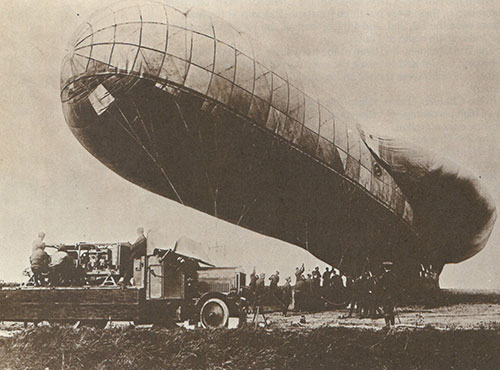
Development of balloons – (hot air and hydrogen/helium filled) got a boost in the sixteenth century in Europe and before the turn of the century they had become large, sophisticated and maneuverable aerial platforms that could lift and transport military personnel and equipment. Also know as dirigibles, their first recorded military employment occurred in the Battle of Fleurus between France and Austria in 1794. During the battle the dirigible ‘Enterprenant’ surveyed the battlefield from a lofty height of 1300 feet and provided valuable information above the Austrian forces to the French commander. The Austrian commander, General Cobourg had reportedly cursed the balloons copiously commenting ‘there’s nothing those scoundrels don’t invent; there is a spy in that thing and I can’t get to him to have him hanged”.
By the time WW I erupted in 1914, heavier than air (HVA) aircraft performance and versatility had eclipsed those of the dirigibles but they (dirigibles) continued to play an important role during the war. The famous German dirigible Zeppelin was used for reconnaissance and ‘strategic’ bombing of London. During the conflict the dictates of trench warfare made balloon observations indispensable. However, slow speed and lack of maneuverability made the Zeppelins very vulnerable to the Allied fighters working in tandem with the nascent air defence network. They inflicted heavy attrition on the raiding Zeppelin fleet. By the end of WW I aircraft performance had dramatically increased, rendering the dirigibles virtually obsolete from the military viewpoint. Their development as commercial platforms continued during the inter war years for aerial travel until the tragic explosion of airship Hindenburg in 1937 in USA. As a result, dirigibles as viable means for commercial air travel came to an abrupt end.
Hot air and hydrogen/helium filled balloons are still popular as a sport and they are also used in the entertainment business generally to provide a bird’s eye view TV coverage of sports or other newsworthy events. The military employment of balloons currently is limited to two specific areas – balloon mounted radars that enhance the low level coverage of ground based ones and balloon barrages deployed over a target as a part of passive air defence measures.
Evolution of Air Power Strategy during World War I
Air Power in Support of Surface Forces
The first aircraft to enter military service was the Military Flyer, purchased by the US Government in 1909. The first recorded history of combat flight took place in 1912 in Libya by the Italians. The First Balkan War of 1912-1913 witnessed the use of aircraft for reconnaissance and bombing by both the antagonists, Turkey and Bulgaria. Although the air efforts during the conflict were small, they were a harbinger of what might develop on large scale in war between two major powers. It also had a profound impact on the thinking of military leaders in Europe and Russia.
At the outbreak of WW I in 1914, military aviation consisted of light wooden bi/tri planes with maximum speeds of less than 100 mph and very limited load carrying capacity. Their roles were initially restricted to reconnaissance and artillery observations. While there may not have been any air power doctrine on the eve of WW I, there was no shortage of alarming speculations about strikes from the sky. Within seven weeks of WW I, Sopwith Tabloid of RNAS conducted an air raid on the Zeppelin sheds in Germany. A year later Germany retaliated when Zeppelins (airship) in turn bombed the English cities. The actual damage in all these raids may have been minimal but the psychological impact on civilian population was profound. With both sides using increasing number of aircraft for reconnaissance, artillery observations and occasional bombing raids, the inevitable happened and aircraft started to shoot at each other to prevent the adversary from taking military advantage of the new medium. It marked the birth of fighter aircraft whose numbers proliferated and their performance took a quantum leap. The battle for ‘control of the air’ had truly begun. The first air power doctrine of gaining control of the air had been established.
July 1917 marked a watershed in air power’s history when German Gotha bombers raided London. The damage again was more psychological than real as the images of HG Wells’s destruction from the skies appeared to become a reality. As a direct result of these attacks, Britain had established what amounted to a strategic bombing unit in France, known as the independent force, to conduct reprisal raids against the German homeland. The concept of strategic bombing whose mission was made independent of support to surface forces was born. This action sowed the seeds of a new service. The Royal Air Force, independent of the Royal Army was established in April 1918.
The greatest contribution to the war effort by military aviation during the war was in the field of aerial reconnaissance. The German offensive in France was based on the Schlieffen plan of ‘the revolving door’ concept. The weakening of the right flanks contrary to the original Schlieffen concept is considered to be one of the factors for its eventual failure. Not so well known is the role air reconnaissance played in stalling the German offensive at Marne that grinded the revolving door to halt.
As the German offensive against France unfolded, despite the modifications carried out by Moltke, the British and French forces were on the retreat. The German First Army under General von Kluck was making steady progress advancing eastward, a move that would have carried his First Army North of Paris. Earlier, unexpected resistance by Belgium had delayed the German advance, which allowed the Allied forces to take up a very strong defensive position at Mons, the projected route of the offensive. General Kluck was ordered to change course to south and southeast instead. Success along that route would have enveloped Paris. Marne, instead of Mons now became the pivotal battle ground.
Seventy-two French divisions under Marshal Joseph Joffre along with four infantry and one cavalry division of the British Expeditionary forces had been positioned at Mons awaiting the German onslaught; Marne by comparison was inadequately manned and was not in a position to halt the German First Army. The change in orientation of von Kluck’s formation towards the new axis was spotted by the French and British air reconnaissance units. An immediate reinforcement of the forces of General French at Marne became absolutely imperative to counter the new threat. Marshal Joseph Joffre, the French Commander in Chief was persuaded to join his forces with those of General French at Marne, reinforcing the newly created French Sixth Army. As a result of the Battle of Marne, Paris was saved and the war shifted from the thrust of the Schlieffen plan to the bloody trench warfare and all hopes of a quick German victory disappeared. Without the crucial input of aerial reconnaissance the Schlieffen plan, despite its distortions, could have succeeded and changed the entire course of war and perhaps European and World history.
In the eastern front against Russia, it was Germany which benefited from the exploits of its aerial reconnaissance fleet. The combined result of German radio intelligence and aerial reconnaissance by both aircraft and Zeppelin dirigibles enabled General von Hindenburg to score a stunning victory over the Russian forces at Tannenburg. Hindenburg lavishly heaped praises on the role of reconnaissance and was quoted as stating, ‘Without airmen, no Tannenburg’ . In an interview with an Italian newspaper later on, he went on to say, ‘However the most remarkable people are my airmen. I cannot begin to tell you the remarkable things they have done on their reconnaissance missions’.
During the war aircraft were far too primitive to be decisive in battle but they were very influential on both the western and eastern fronts. In the battles of Marne and Tannenburg, the high commands of the Allied Forces and Germany respectively benefited immensely from the reconnaissance capability the third dimension provided. They became aware that a significant new medium had been added to warfare.
Offence/ Defence Controversy
Air reconnaissance was by far the most effective employment of air power during the war. Assuming this role to be offensive in nature, it was just a matter of time before defensive measures to safeguard the disposition of friendly forces from enemy aerial observation were adopted. In fact, the military potential of enemy observation aircraft was so great that an entire new combat arm, fighter aviation, grew up to defeat them. Fighters were assigned dual roles: first to prevent enemy reconnaissance platforms from operating over or near the friendly forces and second, to enable own ones to freely operate and gather intelligence of the adversary’s troop deployment over the battlefield; and position and movement of reserve forces. The original fighters had a singular task: to seek out, engage and shoot down enemy air platforms in the air. They were equipped with guns/canons only and did not carry bombs. They could, however, provide limited intelligence about enemy forces based on visual observations but that was not their primary mission.
Swirling dogfights between opposing fighters became common in a bid to establish air superiority over specific fronts so that observation and bombing planes could accomplish their objective and to prevent the other side from doing so. The concept of control of the air was established. It became apparent that a degree of control of the air was a prerequisite for successful conduct of all other air power roles and fighters were the primary instrument for achieving it. Aerial reconnaissance and air bombardment may have contributed far more to the war effort than air combat duels but it was the latter which caught the imagination of the public.
Success in air combat was the quickest route to fame and glory and air combat aces on both sides achieved celebrity and – in many instances – legendary status. The controversy about whether fighters or bombers represented the real strength of air power and what should be the balance between the two arms raged – a debate which is still ongoing.
The employment strategy of the fighter air arm by the Allied and German forces makes an interesting case study. In general, the Allied commanders especially the British air commander Trenched pursued a relentless offensive policy. He insisted that his pilots and aircrew always be on the attack, regardless of casualties and ignoring the fact that the Allied aircraft for a long period were not adequate for the task. He claimed that his policy established a moral ascendancy over the enemy. To an extent this was true but the moral ascendancy was obtained at an unconscionable cost.
The Germans followed the opposite policy, preferring a more defensive posture that allowed “customer to the store” strategy. Initial attempts to establish massive barrage patrols to prevent any enemy aircraft from crossing the frontlines proved impossible because the airspace to be defended was far too great given the number of available platforms. They then adopted a more selective approach. Standard patrols were flown but for the most part reliance was made on a good early warning system comprising observers at the front to relay messages on the nature and presumed intent of enemy air activity. Fighters were then dispatched as required to combat the threat.
The Germans created elite fighter combat units equipping them with the best available air combat planes and the most skilful combat pilots. These were known as Jagdstaffeln (fighter units). Thirty seven such units were planned by April 1917, each equipped with the latest single-seat fighter. The Jastas (as they were abbreviated) proved to be a fertile ground for future aces and commanders. It was an economical and sensible way to fight for air control, conserving aircraft and valuable experienced pilots from unnecessary attrition. Germany may have lost the war eventually because of a host of other factors but their overall performance in the field of air combat was decidedly superior to those of the Allied Forces.
When the war started in 1914, air offensive held a decisive advantage over air defence but by the time the war came to an end in 1918, air defence had made impressive gains. Zeppelins were knocked out of contention because of heavy attrition caused by the defensive measures of the Allied forces. Bombers and aerial reconnaissance aircraft no longer enjoyed the luxury of operating without hindrance over enemy territory. Enemy fighters became a real threat and in addition they also had to contend with enemy ground defences, however rudimentary they might have been at that stage. Despite these clear indications, ironically the concept that bombers will always get through gathered momentum during the post war period.
Concluding Air Power Lessons from World War I
WW I ended in 1918. During the war, all subsequent roles of air power had either been established or attempted, and the doctrines of command of air and support to surface forces had been firmly established. For the surface forces, roles such as close air support, transport support, reconnaissance, interdiction, artillery spotting, anti-submarine warfare, convoy escort, search and rescue and maritime strikes became vital contributors to the existing land and maritime strategies. Historian Lee Kennett aptly summed the progress made by air power during WW I when he wrote, “While the role of air weapon in the Great War was a modest one, the role of the Great War in the rise of air power was anything but modest.” Tami Biddle expresses similar view when he wrote, ‘In terms of air power history, the First World War has been over shadowed by the Second World War. But the war of 1914- 1918 is in fact the mother-lode for air power historians.’
Development of Air Power Strategies
during the Inter – War Years
WW I gave a major impetus to aviation in general besides giving birth to a number of thinkers and theorists on the role of this new medium of warfare. The three prominent members of this illustrious club were Douhet, an Italian, Trenched, an Englishman and Mitchell, an American. The three had participated in the air campaigns during the War and were convinced that air power would assume a dominant role in future wars.
Giulio Douhet
Of the trio, Douhet is universally acknowledged as the most influential air power visionary, claiming the centre stage even among the pioneers. His greatness lay in his ability to envision the enormous potential of air power and his conviction that it would soon become a dominant factor in future battles. His prophecy at a time when air power was still in its infancy, where its ability to influence the battle was limited, and equating this ‘new kid on the block’ with the two established mediums of warfare, land and sea which was considered hearsay by the powerful Army Generals and Naval Admirals, was indeed courageous. To his credit, Douhet maintained his stance aggressively during the War, defying his superiors for which he was court-martialled and jailed.
The defeat of the Italian forces at Caporetto by Austria with the help of the Austrian Air Force vindicated him. He was released, recalled and promoted to the rank of a one star General (Douhet was a Major when he was court-martialled) after the War. He continued to propagate his vision about the certainty that air power would, in times to come, establish its ascendancy over the two established mediums. His book, ‘Command of the Air’ first published in 1921 and later revised in 1927 was regarded as a classic by his peers and admirers. It shaped the development and employment of air power when the Second World War broke out about two decades after the end of the First World War. Some of his air power theories, which his followers considered almost sacred, did come under scrutiny as a result of the lessons of WW II.
Trenchard
In 1917 as a result of the German daylight air raids over London, General J. C. Smut, a member of the British War Cabinet, advocated that the air arm can be used as an independent means of war operations, recommending that an all out strategic campaign against Germany should be waged. As a result, a bill establishing the Royal Air Force and an Air Ministry was drafted and passed in November 1917. Trenchard was brought back from command of RFC field forces and chosen to head the new service, the Royal Air Force (RAF), as its first Chief of Air Staff. He resigned due to difference of opinion with the first Secretary of State for Air and was replaced with Major General Sykes. He was offered the post of commander of long-range bombing forces that had been deployed in France to conduct strategic air attacks on Germany, a position which he accepted. Trenchard was a firm believer of offence and his faith in bombers led to the famous dictum, ‘the bomber will always get through’.
His philosophy on air power was very similar to that of Douhet, where he too advocated that air power is intrinsically an offensive force and through a dedicated strategic air attack campaign air power could single-handedly win a war. Strategic strikes were characterized as those that target the adversary’s war potential, including the civilian population, as opposed to tactical missions that are flown in support of land and surface forces. Trenchard is considered as the ‘Father of the RAF’ and he was eventually awarded his fifth star, Marshal of the Air Force.
Billy Mitchell
Billy Mitchell, a contemporary of Douhet and Trenchard was a Lt. Col. in the US Army during the war. He is the most celebrated and renowned figure in American air power history. The son of a wealthy Wisconsin senator, he enlisted as a private during the Spanish-American War and quickly gained a commission. He had an outstanding war record and after challenging tours of Philippines and Alaska, Mitchell was assigned to the Army General Staff, at the time its youngest member. Soon he became interested in aviation and its possibilities and in 1916 at the age of 38, he took private flying lessons. Arriving in France in 1917 as a part of the American contingent, he quickly took charge and began preparations for American air units that were to follow. By the end of WW I, Billy Mitchell was the top US airman.
He returned to USA in 1919 and immediately became a very strong advocate of air power. Mitchell was greatly influenced by Douhet’s theories. He was appointed deputy chief of the Air Service. In this capacity his relations with superiors continued to sour as he began to attack both the War and Navy Departments for being insufficiently farsighted regarding air power. Mitchell suggested that US air power could better defend the nation’s coasts from attacks by enemy warships than US sea power. A controversy developed as to whether an airplane could sink a battleship. Live tests were conducted in June/July 1921 and Sept 1921. Mitchell’s bombers sank three captured German vessels and an obsolete USS Alabama in the first trial and sent two more obsolete US vessels to the bottom in the next one.
The success of the bombing trials encouraged the advocates of air power to press for a separate air arm but the Army General Staff remained convinced that air power on its own could not win a war and at best it had an important but supporting role. Mitchell became increasingly critical of his superiors and began to go public on his criticism of the high command. His actions could no longer be tolerated and in December 1925 he was found guilty before a court martial of violating the 96th article of war and was suspended from duty for five years. Mitchell resigned in 1926.
In conformity with Douhet and Trenchard’s theories, Mitchell postulated the potency of air power and that air power would be the most decisive element in any future conflict. He also believed that strategic bombing could defeat the enemy on its own.
The Legacy of the Pioneers
Douhet, Trenchard and Mitchell are considered as air power visionaries and all of them were very strong advocates of the offensive nature of air power. They argued that of the three services, air power employed offensively in the strategic attack role was the most effective means of waging war. Supporting land and naval operations according to them was at best a secondary role. The real purpose of air power from their point of view was that of strategic bombing, a mission independent of surface operations and hence air force deserved to be an independent service. In essence the rationale for air forces becoming a separate service was primarily based on its ability to conduct strategic bombing campaign, a mission which was not directly linked to the land/surface operations.
The three pioneer air power visionaries had based their offensive philosophy of air on the following three assumptions:-
(a) Bombers will always get through. Douhet even went on to state that artillery against aircraft is a ‘waste of time and money’.
(b) Killing tens of thousands of civilians through aerial bombardment would result in the collapse of national will and is the more humane way of war fighting.
(c) Air Power can win the war on its own, armies and navies should only be employed in the defensive role.
At the start of WW I, aerial bombardment was a novel and frightening concept and with the available technology defence against aerial attacks was virtually ineffective. By the end of the war, however, both the German and British air defence systems that included fighters took a heavy toll on the bombers. Yet the concept of bombers always getting through was not abandoned and Douhet, Trenchard and Mitchell continued to argue that the only viable defence against enemy’s air assaults was to ‘have even more lethal air offensive capability’.
The concept of strategic bombing during the First World War had been tried to a limited degree by the British and Germans with marginal success. According to Tami Biddle, ‘one scholar of German aviation concluded that the expense of the RAF’s destroyed aircraft exceeded the cost of damage it inflicted on Germany’. Given the fact that the bombers of the period could only carry a limited load of bombs and the target finding and bomb-sighting capabilities were very crude, the failure of strategic attacks was not surprising. For the pioneers to predict the efficacy of strategic air campaign, therefore, should not be gauged solely by the fact that it failed during World War I.
Their supposedly inhuman suggestion of deliberate targeting of the innocent civilians has also led to widespread disapproval. To look at their concept in its true perspective it should be realized that they had witnessed the WW I carnage where millions of soldiers were massacred from both sides. To them, the ability to end the war by killing only tens of thousands of civilians appeared a more humane way of war fighting, however callous it might sound to later generations.
While the Army Generals tended to interpret the war conservatively and to assess the role of aviation in terms of its ability to aid the infantry and artillery, a new group of commentators and theorists took a radically different approach. They were prepared to argue that, in future, aircraft would decide the outcome of wars. Douhet, Trenchard and Mitchell were the leading proponents of this novel concept. In advocating that air power alone could win the war and armies and navies should only be employed in the defensive role, they had made powerful enemies. Passionate advocates of air power that they were and the mountain of scepticism and opposition they faced on aspects which to them were dear, their overreaction was hardly surprising. Douhet and Mitchell were made to pay the price for their boldness by being court-martialled. Their resurrection as national and international icons on air power was realized later.
The three pioneers were air power visionaries and despite some of the shortcomings in their visualization which became evident subsequently, they deserve the accolade posterity has bestowed on them.
The trials and tribulations of the pioneers bring out an interesting facet. The British are considered to be conservative in nature, loath to changes whereas the Americans have a reputation of being less rigid. Ironically, in the development of their respective air forces, Trenchard, the Englishman not only succeeded in his efforts to implement his viewpoint, he, along with General Smut was instrumental in the creation of the RAF as an independent service. He did have to overcome massive opposition from the Army Generals and Navy Admirals but eventually he got his way and in the process rose to the five-star rank. Mitchell on the other hand was far less successful. He was court-martialled and forced to resign his commission as a one-star General.
Military Employment of Air Power during the Inter War Years
The inter war years witnessed a yearning to gain independence by a number of Asian and African states that had been colonized by the European powers. In some parts of Africa and Asia, it led to armed uprisings against them. The colonial masters employed air power against what according to them were rebellious groups of trouble makers. Since the other side had no access to any air power assets, no worthwhile lessons can be drawn from these campaigns except the obvious one: air power can be very effective in a military campaign especially when the opponent has no counter to it.
The Spanish Civil War that lasted from July 1936 to March 1939 was waged between the rightist generals supported by conservative forces (Nationalists) against a leftist republic (Republicans). It witnessed large-scale and sustained air operations for three years. Spain was the first major operation of the born-again German Luftwaffe, when Hitler decided to support the conservative nationalist forces and ordered his Luftwaffe to send aircraft and support to the Spanish Nationalists. The Soviet Union supported the Republicans by selling arms and ammunition besides providing them with a significant air force contingent of about a hundred aircraft manned by Russian pilots. For the Luftwaffe especially, the Spanish Civil War was a testing ground for future air campaigns. The Spanish Civil War, by any reckoning was the most important single air power event in the period between the two World Wars.
During the air campaign, air power theories of Douhet, Trenchard and Mitchell were put to test and some were found to be wanting. The Germans did carry out strategic bombing missions in Spain and their air commanders came to regard indiscriminate city bombing as waste of effort and probably counter-productive. Their conclusion was, ‘Destructive bombardments without clear military targets are not likely to bring about the desired results’.
The German officers realized that bombing cities might even serve to increase enemy morale and strengthen the will to resist. This was contrary to what Douhet and Mitchell had preached that causing massive civilian casualties through aerial attacks would lead to a capitulation of the adversary.
The Civil War also proved that when confronting an enemy with matching air power prowess, the bomber fleet did not have an easy run. They were intercepted by enemy fighters and in many instances ‘could not get through’. Again this invaluable lesson was partly ignored this time by the British and the Americans, for whom the bombers were the mainstay of an air force. Under the influence of Douhet, Trenched and Mitchell, both the RAF and the United States Army Air Force (USAAF) doctrinal philosophy on air power employment concept favoured the bomber fleet to the development of fighter interceptors.
The British Air Staff’s doctrinal principle of 1924 decreed ‘that the bombing squadrons should be as numerous as possible and the fighters as few as popular opinion and the necessity for defending vital objectives will permit.’ Similarly, the American Air Corps Tactical School at Maxwell, Alabama had concluded in the early 1930s that bombers by virtue of their superior performance and defensive firepower would be immune to fighters. Fortunately for both the services, there were enough dissenters who ensured that fighter development was not totally ignored. When during the Second World War, the importance of fighters became starkly evident they had capable platforms for the task. The Americans went on to produce even more effective ones as the war progressed.
While the Luftwaffe senior commander may not have been impressed with the results of their strategic bombing campaign, they were quick to grasp the impact of air power over the battlefield. They concluded that a well orchestrated air/land campaign, (where after establishing control of the air, air power is unleashed on a massive scale against the enemy land forces together with rapid armour thrust with the infantry following behind), could swiftly overwhelm the adversary. This novel concept was borne out from the German experience in air employment in the Spanish Civil War. The strategy of ‘Blitzkrieg’ was born.
The Second World War
The Second World War served as a major milestone in the development of air power strategy. While in the European, African and the Eastern theatres the role of the Army was central, however, in every instance air power was the critical factor. In the Pacific theatre it was the aircraft carrier groups that played a decisive role and were platforms from where naval air power operated. Ships were crucial for long distance transportation of troops and logistics but for the projection of firepower, land and carrier based aircraft and the submarine fleet were the mainstay. The side with superiority in air warfare eventually came out as the winner.
Blitzkrieg Unleashed – The German Invasion of Poland and France
The study of the air campaign during WW II has to begin with the German Blitzkrieg. Tanks and aeroplanes were the two new elements of warfare that had been introduced during WW I. During the inter-war years, the British, French and other European powers ‘had failed to grasp the inherent speed and range of the air weapon that had made the time and space factor which prevailed in WW I outdated and irrelevant’. By contrast, the Germans’ innovative combination of aircraft, fast armour, infantry and modern communication in the form of blitzkrieg demonstrated a battle winning understanding of what amounted to a revolution in military affairs. These concepts were first tested and improved upon during the Spanish War of 1936.
When the Germans finally unleashed the coordinated attacks by its Panzer (tank) divisions supported by the infantry with the Luftwaffe dominating the skies during WW II, in what now the world knows as ‘blitzkrieg’ operations, it overran Poland and the rest of western continental Europe. According to historians, at the eve of WW II, French aircraft and tanks were technically superior to their German counterparts yet France was steamrolled into submission by the fury of the German blitzkrieg. In the blitzkrieg operations, Luftwaffe demonstrated the doctrines of control of air and support to surface forces with such brutal efficiency that it stunned its opponents into submission. Blitzkrieg was a perfect example of air power acting in unison with the ground forces.
While the contribution of Luftwaffe in the defeat and submission of Western European nations was significant, it had been developed more as a tactical air force to be used in support of the surface forces. The three primary missions of Luftwaffe were ‘to combat enemy air forces’ (win command of the air), ‘intervene in ground or naval actions’ (close air support) and ‘combat the sources of the enemy’s strength and disrupt his logistic supplies to the front line’ (interdiction). Conspicuously absent was the mission of strategic bombing which Douhet, Trenchard and Mitchell had so strongly advocated as the primary task of air power.
General Max Wever, the German Air Force Commander who was unfortunately killed in an aircraft accident in 1936 was aware of this shortcoming and development of four engine heavy bombers was on the drawing board. However after his death, this project was abandoned as the German high command believed that the available twin-engine bombers could be used both in the tactical and strategic role. According to Air Vice Marshal Tony Mason, while this assumption did not affect Germany’s war aims in its campaign against the neighbouring states, when Hitler decided to take the war further across the English Channel and eastward into the Soviet heartland, he had no weapon to match his political objectives.
Battle of Britain
Having subdued Western Europe, Hitler turned his attention to Britain. Operation Sea-Lion, which envisaged landing of troops in England through amphibious operations were planned. For the amphibious landings to succeed, control of the air over England had to be established by Luftwaffe. This set the scene for the Battle of Britain which led to sustained and massive offensive counter air operations by Luftwaffe in a bid to subdue and neutralize Britain’s RAF. RAF’s fighter bases, air defence network, command and control centres, logistic dumps were attacked by German bombers while German fighters engaged British fighters over England in a do or die battle. Despite the lack of heavy bombers, by September 1940 Luftwaffe was beginning to win the battle for command of the air. According to Professor Mason, RAF’s fighter command had lost approximately one-third of its flight commanders and one-fifth of its squadron commanders. The survivors were flying up to four sorties a day and there were no reserve squadrons fit to replace the battered ones.
The lone raid of Berlin by RAF bomber command during the battle so infuriated Hitler that a switch from counter air operations against RAF to attacks on London and other major cities was ordered. This switch relieved the direct pressure on RAF Fighter Command and it was able to regroup and inflict such heavy casualties on the German bombers that eventually Hitler had to call off the air campaign. Inability of Luftwaffe to win the air superiority battle over England led to the abandonment of Operation Sea-Lion while Hitler turned his attention to USSR. The British nation paid a very heavy price in terms of civilian casualties during the attacks on their cities but the survival of RAF Fighter Command made the repulsion of the German air assault possible.
Two key lessons emerged from the Battle. First, winning control of the air is an essential prerequisite to any modern land/sea offensive. And second, the campaign disproved the assertion of Douhet and Mitchell that heavy aerial bombardment of civilian centres would result in rapid loss of morale and would lead to the nation’s capitulation.
The early air power visionaries had seriously underestimated the will, determination and resolve of human beings to resist subjugation by force. Ironically, had the Luftwaffe stuck to the tactical application of air power during the campaign instead of switching to what the early pioneers considered strategic missions, Germany might have prevailed. The Battle of Britain also demonstrated that depending on the circumstances, a campaign primarily focussing on defensive counter air operations and very little on strategic strikes won the air battle over Britain.
The African Campaign
The African campaign by the Americans is an important landmark in the context of air power because one of the lessons that came out of it had a profound effect on the development of air power as an independent service.
During the African campaign, American Air Corps had distributed its considerable assets to the various Army formations operating there. The German air assets in Africa by contrast were all under the command of Luftwaffe. While the American air assets in Africa were superior to the ones deployed by Luftwaffe both in quality and quantity, the latter by virtue of being under one command was able to concentrate superior numbers on individual American air formations and cause substantial damage. Although the allies eventually prevailed due to a host of other factors, the performance of American Air Corps was not compatible with its potential.
On the instructions of General Eisenhower, a committee was formed to conduct a thorough analysis of the air campaign. One of the principle findings of the committee was that deployment of American air assets in penny packets had resulted in their less than optimum utility. The principle of ‘unity of command’ had been violated. Since then, unity of command is considered as one of the pillars of air power doctrines. The findings of the committee eventually led to the independence of US Air Corps and USAF was established in 1947. With very few exceptions all new air forces that came into being after WW II have been created as independent services.
Strategic Bombing Campaign of Germany
Under the influence of General Trenchard, RAF had developed a sizeable bomber force for conducting strategic bombing on its adversaries. After surviving the Battle of Britain onslaught, this force was unleashed to attack Germany. The campaign commenced with large formations conducting daylight bombing missions but heavy casualties primarily due to Luftwaffe fighters reached a level where the high degree of attrition could no longer be sustained. Besides the heavy losses, the accuracy of the bombing campaign during actual combat was far lower than what had been achieved during peacetime trials. Daylight bombing was not having the desired results. RAF then switched to night bombing raids only. While night raids did lower the attrition rate to a manageable level, as Luftwaffe did not possess an adequate night fighter, it resulted in even lower bombing accuracy. The effect of strategic bombing campaign reduced further.
Trenchard had made two faulty assumptions in his advocacy of offensive operation through strategic bombing. He erroneously believed that his bombers were armed and protected well enough to run the gauntlet of enemy fighters relatively unscathed and therefore did not need fighter escorts. Britain thus had not invested in long-range fighters, which could escort the bombers and protect them from enemy interceptors. Trenchard and his staff also made the mistake of basing their calculation of bombing accuracy on peacetime trials. During actual combat with enemy fighters lurking around and very heavy anti-aircraft ground fire, bombing accuracy was nowhere close to the peacetime results. Many more bombers were needed to take out a target than had been anticipated.
The Americans entered the fray later but they were able to deploy far larger assets than Britain. The Americans were also strong advocates of strategic bombing and they too commenced their operation with massive daylight raids over Germany. RAF’s experience was repeated and the American attrition rate was nearly double of what had been anticipated. Unlike RAF, however, the Americans did not abandon their daylight raids as they correctly assessed that night bombing would further lower the effectiveness of the campaign due to loss in accuracy, and therefore jeopardize the mission. The Americans were fortunate in that they had developed long-range fighters (in the shape of P-51 Mustangs) that could escort their bombers right up to their targets. Mustangs were deployed in the escort role with the bomber formations. This move brought a dramatic reduction in the attrition rate. The P-51s, being superior to any of the contemporary German fighters, began to take a heavy toll of German interceptors. P-51s managed to establish air superiority around their bombers over the German hinterland.
The strategic bombing campaign over Germany was a long drawn affair. While it did not result in quick capitulation of Germany, nor could it be solely credited with bringing about the defeat of Germany on its own, most critics agree that it played a very vital role in the eventual success of the allied victory in Europe.
The Pacific War
The Pacific War began with the Japanese attack on Pearl Harbour on December 7, 1941. As early as in 1924, Mitchell following a trip to Japan had submitted a report where he foretold of Japanese expansionist ambitions in the Pacific and presented what he considered would be the start of a Pacific War. According to Mitchell the Pacific War would start with a Japanese air and sea attack upon Pearl Harbour in Hawaii with an accompanying aerial attack on the Philippines, at 7:30 AM and 10:40 AM respectively. In actual event, the attack on Pearl Harbour occurred at 7:55 AM and at Philippines at 12:45 PM on December 7, 1941. Mitchell was off by only 25 minutes for Hawaii and less than 2 hours for the Philippines.
Pacific War was primarily a naval/air campaign with air power playing a decisive role. Air power deployed in the Pacific was both sea-based (carrier task forces) and land-based. It was a battle between the two opposing carrier groups attempting to wrest sea control and command of the air from each other. Eventually USA prevailed and the dropping of two nuclear bombs over Hiroshima and Nagasaki ultimately sealed the fate of Japan. Douhet and H. G. Wells’s prophesy of subjugation of the enemy through massive destruction of his civilian population and infrastructure through aerial bombardment appeared to become a reality. The bombing marked the dawn of the nuclear age, which has brought about its own dynamics, very different to all previous military strategies.
The impact of air power on naval warfare was comprehensively demonstrated in the Pacific War. To the credit of naval forces, rather than oppose the new medium of warfare, navy almost universally has absorbed it as one of its integral parts, just as it had adopted the submarine forces. Now a modern navy operates in all the three dimensions: Surface, sub surface and above the surface.
Another interesting comment on the conduct of the Pacific War was that this was the first and perhaps only occasion to date when land forces operated in support of air power. Land forces in amphibious assaults were used to capture Pacific islands from the enemy where air bases were set up for attack on Japanese mainland in what is also referred to as the leapfrog strategy.
Role of Air Power during WW II
Air power according to Tony Mason ‘had been peripheral between 1914 and 1918. In the Second World War it dominated most theatres and in at least two was decisive.’ David Mac Isaac sums it up by stating that ‘Air power had a mighty vindication in World War II’. He further adds, ‘It was in tactical employment that success was most spectacular and that air forces won the unqualified respect and admiration of the older services. By contrast, the purely strategic successes, however far-reaching in particular instances, were never completely convincing to uncommitted observers.’ Even General Carl A. Spaatz, the senior commander of the US strategic air forces conceded, ‘the war against Germany was fundamentally an infantry war supported by air power, much as the war against Japan was fundamentally a naval war supported by air.’
Air Power Strategy during the Cold War
The end of the Second World War witnessed the emergence of a bi-polar world led by USA and USSR that eventually ended with the demise of the Soviet empire in 1990. The period saw a number of large and small conflicts around the globe where air power was extensively employed. In a number of these conflicts the client states were engaged in proxy wars for their masters. From the viewpoint of US and western war experts, these were limited wars or at best regional conflicts. For many of the smaller states involved in the fighting, there was nothing limited about them – they were total wars from their perspective. Each of these ‘limited’ conflicts had an impact on the development of air strategy.
The Korean Conflict
Flush from success in WW II, American forces, this time under the auspices of UNO were soon involved in the Korean peninsula. In 1950 when Communist forces in Korea militarily overran the entire Korean peninsula, American forces as a major part of UN forces decided to intervene. Inchon landing led by McArthur marked the counter offensive by the UN forces. Following their successful landing at Inchon, UN forces pushed back the North Koreans to the 38th parallel before a truce was declared. US air power was crucial to the success of the Inchon landing and the subsequent counter offensive. This phase of the war clearly demonstrated the crucial role air power could play in support of its surface forces.
Once truce was declared on the 38th parallel, an uneasy cease-fire on the ground took effect. At that stage the American air strategists proposed that the war could be successfully prosecuted by an air interdiction campaign against the North Korean/Chinese forces. Operation Strangle was formally launched.
Operation Strangle aimed at strangling the communist forces of their provisions and supplies through a sustained campaign of air interdiction behind the enemy lines. This, it was hoped, would prepare the way for the allied invasion of North Korea itself. The operation began in earnest but despite its best efforts, it failed to achieve its military objectives.
Three factors can be identified for the failure of the campaign. First, UN air power was operating under political constraints: they were not allowed to attack the enemy air bases which were operating from within mainland China for fear of further escalation into WW III. North Korean and Chinese air power operating from Chinese mainland did not permit a free run to the interdicting forces. UN forces were not able to establish total command of the air and resultantly, the overall effectiveness of the interdiction mission was reduced. Second, the technology available in 1950s was not advanced enough in terms of accuracy and lethality to inflict the kind of damage on the enemy that would paralyze its logistics support. And finally the manpower-intensive supply lines of the Chinese proved too resilient to interdiction, coupled with the fact that with a truce in place and the front not being active, the total logistic needs of North Korean/Chinese forces was comparatively much lesser. Interdiction campaign did slow down the North Korean supplies but failed to halt them.
The air power statistics used in the Korean conflict were formidable. The allied forces alone flew more than a million sorties; over 476,000 tons of explosives were dropped and more than 2000 aircraft were lost in the four years. Yet the aspiration that superior air power by itself would be sufficient to win a conflict was wide off the mark.
The Vietnam War
In the Vietnam War, over one million fixed-wing and 37 million helicopter sorties were flown; 3700 fixed-wing and 4900 helicopters were lost in the campaign. New concepts of close support using both ground and airborne forward air controllers were successfully developed. The conflict also witnessed widespread use of Surface to Air Missiles (SAM) and its counter through tactics, electronic countermeasures (ECM), and anti-radiation missiles. Precision-guided munitions were developed and deployed during the conflict with devastating effect but their introduction had come about at a fairly late stage, when the American public had appeared to lose the will to fight ‘someone else’s battle’. Air supremacy was established despite the restrictions imposed of not attacking North Vietnamese aircraft and their bases in North Vietnam because of political constraints. Yet air power failed to determine the outcome of the war. American forces eventually withdrew from the conflict without achieving their military or political aim.
Unsuitable terrain, lack of public support for the campaign by the Americans, a very resilient enemy, excessive political interference and general backwardness of the enemy (no worthwhile counter value targets) are some of the major factors that have been put forward for the failure of air power to deliver victory. The oft-quoted assertion that since 1939, no state has lost a war while it maintained air superiority was once again disproved. As one USAF analyst has very aptly surmised: ‘Difficult to fathom is the air chiefs’ lingering conviction that their doctrine was right throughout Vietnam – and that it is right for the future… For the Air Force, the guerrilla struggle during most of the Vietnam war was an acknowledged anomaly that may well reappear… Bombing doctrine remains geared to a fast paced conventional war, and the conviction that such doctrine is appropriate for any kind of war permeates the service…’.
The Arab Israeli Wars 1967-1973
If the Korean and Vietnam Wars had brought out the inadequacies of air power, the Arab/Israeli Wars of 1967 and 1973 again demonstrated its dominance in a conventional war. In both these conflicts, air power played a major role. In 1967, Israeli Air Force (IAF) ‘Pearl Harboured’ the Egyptian, Jordanian and Syrian Air Forces at the beginning of the Six Day War. Having won the command of the air on the very first day through pre-emptive offensive counter air operations, IAF brought to bear such effective strikes on the Arab land forces that it became relatively simple walk over for the Israeli Army. Even in 1973, air power was dominant. IAF’s inability to win the command of the air initially cost them dearly but in later stages through substantial technical and logistical support of USA, IAF succeeded in neutralizing the Arab air defence network. From then onward, IAF’s support to their land forces helped turn a likely defeat into victory. By the time cease-fire was declared, Israel had gained the upper hand in the conflict.
Air power has been the chosen security instrument of Israel. Superior technology better training, topography and climate ideal for exploitation of air power and an air power doctrine in complete harmony with the strategic environment are some of the key factors that have given IAF a decisive edge over its Arab adversaries. To this list, one must also add the unqualified and unstinted support of USA that Israel has enjoyed since its very inception. Massive financial and technical support of USA has ensured the superiority of IAF over its neighbours. This support is not restricted to peace time only. During the 1973 War, besides logistics support, Israel benefited immensely from the satellite intelligence gathering of US spy satellites. This single factor had tilted the balance in favour of Israel.
India – Pakistan / Iran- Iraq Wars
Pakistan and India fought two wars in 1965 and 1971 with both the conflicts ending within three weeks. By contrast, the Iran-Iraq war lasted for nearly a decade. While air power was applied in all these conflicts, the historical verdict is that the role of air power was peripheral and it did not effectively influence the outcome of the conflicts.
In the 1965 Pakistan-India conflict, Pakistan Air Force did enjoy the upper hand in air combat and had created a degree of favourable air situation over the battlefront, but neither side could establish total air superiority. Air power was largely restricted to ground support and the air war came to an early halt because of shortage of spares and weapons as a result of the imposition of international embargo. In 1971, India did achieve air supremacy in the Eastern Wing against an adversary whom it outnumbered by a ratio of over 12 to 1 and it took three days to achieve what a more efficient air force could have achieved in a single day. Given the disparity between Indian and Pakistani forces in East Pakistan and the near hopeless political environment being faced by the latter, military defeat for them was inevitable, the contribution of Indian air power in the sector notwithstanding.
Iran-Iraq fought each other to a stalemate in 1980s. Initially Iran had a technological edge over Iraq with F-14s, and F4s in its inventory. Iran did use its air assets to attack oil facilities and other counter value targets in Iraq but in due course, cut off from US sources of weapons and spare parts, the effectiveness of Iranian Air Force diminished rapidly. Iraqi Air Force too did not possess sufficient offensive strike aircraft to make much impact. Iran-Iraq war was primarily fought by their ground forces. Air power had little influence in the final outcome of the war.
The one obvious lesson that comes out very clearly from these conflicts is that nations who are heavily dependent on others for their air power inventory can rarely take full advantage of the potential of their air assets. Heavy dependence on other nations for key defence needs invariably leads to a loss of freedom and sovereignty during the conduct of war.
The Bekka Valley Campaign
Essentially a one-day campaign, Bekka Valley operation was planned by Israel to take out all the air defence units in the Valley in a single coordinated air assault. The presence of Syrian SA-6 units in the east of Bekka valley was constraining IAF’s contribution when Israeli Defence Forces (IDF) had launched operation Peace in Galilee in 1982. These units had to be taken out.
IAF painstakingly plotted the position of every SA-6 unit in the valley. On 9th October 1982 Israeli long-range artillery and surface-to-surface missiles engaged the Syrian missile batteries. IAF aircraft followed up with aerial attacks using free fall bombs and anti-radiation missiles. When Syrian Air Force rose to defend the air defence complex, IAF’s F-15 and F-16 fighters equipped with the most modern air-to-air missiles, airborne radars and electronic warfare package massacred them. This was the most one-sided air victory in the history of air power. In terms of the evolution of air power Bekka Valley campaign was a generation ahead. This campaign is relevant because it was a harbinger of how the next air battle would be fought. The Gulf War of 1991 was to demonstrate a similar philosophy on a much larger scale.
US Air Power Development during the Cold War
Air power played a key role during the Cold War and both the antagonists employed it as a means of deterrence to protect, preserve and expand their spheres of influence. The entire era of the Cold War was dominated by the nuclear weapons where each side had the ability to vaporise each other along with the rest of the world through an all out nuclear war. While combat aircraft with conventional weapons were extensively employed during the proxy wars by the two giants, it was the nuclear armed airborne platforms that deterred each other from engaging in any direct conflict during the period. The Cuban Missile Crisis in 1962 was the closest the two sides came to the employment of their nuclear arsenal.
Disregarding the lessons of WW II where tactical missions had played a vital role in the Allied victory, USAF after becoming an independent service set its sight squarely on ‘the air atomic mission’. The Strategic Air Command with its armada of airborne and ground based long range heavy bombers armed with nuclear and thermo nuclear weapons along with the nuclear tipped ICBMs ready to be launched at a very short notice from their underground silos were the principal deterrence against any nuclear attack by the Soviet Union. The nuclear powered submarines with ready to launch SLBMs with the US Navy completed the Triad. USSR fielded a similar capability completing the concept of Mutually Assured Destruction (MAD) that most defence analysts credit for prevention of a war between the two super powers. SAC so thoroughly dominated the Air Force as a whole up until 1980 that other capabilities suffered.
The Korean War provided the first shock to the airmen and politicians. Inability to commit the ‘decisive force’ (nuclear weapons) meant the brunt of air operations fell on the tactical air command and these fell short of delivering victory. In the years following the Korean conflict, the American tactical air force went into further decline. When the Vietnam War broke out in the 1960s, due to political constraints, the much touted SAC had no role to play and the burden again fell on the tactical air force. Despite massive employment of air power by USA, the war was lost. David Mac Isaac opines ‘When considered from the standpoint of air power theory and doctrine, the US air effort between 1965 and 1971 must be adjudged a failure verging on a fiasco.’ Air operations Linebacker I and II were fairly successful but by then it was too little and too late. Walter J. Boyne concludes that the Vietnam War has to be regarded as ‘an example of the way in which the misuse of air power influenced history’.
Air power strategy and doctrine underwent a paradigm shift as a result of the introspection of the failed Vietnam War. Tactical air force started to receive greater attention from the mid 1970s and as a result some excellent combat aircraft in the shape of F-15s, F-16s and F-18s were developed and inducted in service. These platforms along with the development of very effective missiles, avionics and AEW&C/AWACS platforms have given a decisive edge to the USAF against their opponents. From 1984 onwards, all air chiefs of USAF have been from the fighter pilots’ community and according to many, the fighter mafia has since replaced the bomber ones.
In all subsequent conflicts where USA was involved since the Vietnam War, air power has provided spectacular successes on the battlefield. In every instance the battles were won but not always the war.
Post Cold War Development of Air Strategy
The Gulf War (Operation Desert Storm)
Iraqi invasion of Kuwait on 2nd August marked the beginning of the Gulf War that ended with a ceasefire on 28 February 1991. The actual fighting took place for only 43 days. Up to 24th February, the war was prosecuted almost exclusively from the air. In the ground offensive that lasted from 24th to 28th February, the Coalition Forces encountered little resistance and Iraqi army was expelled from Kuwait. All this was achieved at a paltry cost of only 340 coalition combat deaths and 776 injuries. According to the then American Defence Secretary Dick Cheney the Iraqi forces collapsed as rapidly as they did because of the air campaign that was mounted against them. This has been the common theme explaining the overwhelming and speedy Coalition success. As Professor R. A. Mason has very rightly observed, ‘The Gulf War marked the apotheosis of twentieth century air power.
The phenomenal success of air power has given rise to a number of illusions; the most widespread being that air power alone had eventually forced the Iraqis to vacate Kuwait. While there is little doubt that air power was fundamental to the ultimate Coalition victory, it was the ground campaign that finally led to Iraq’s capitulation in Kuwait.
Dr. James A. Mowbray has correctly concluded that ‘Technology helped to win the fastest, lowest casualty, almost devastatingly destructive one-sided war in recorded history. Air Force capabilities had come of age’. Col. Warden, the architect of Desert Storm air campaign has elaborated the technological advancements made by air power further by saying, ‘To have a 90 percent probability of putting one bomb on a target of the size of a normal room in WW II it needed 9000 bombs or over 1000 B-17 sorties-which meant putting 10,000 men at risk over the target. An F-117 class aircraft will achieve the same probability in a single sortie’. Between the Second World War and the Gulf War, bombing accuracy had registered a 1000 percent increase.
In the Gulf War, air power demonstrated its ability to strike at the strategic heart of a country with maximum precision and minimum collateral damage and casualty. It proved beyond any shadow of doubt that air power has become an integral component of modern warfare.
Operations Enduring Freedom (Afghanistan – 2001) and Iraqi Freedom (Iraq – 2003)
Within the first three years of the beginning of the 21st century the world witnessed two major conflicts where air power was employed at a massive scale. USA in the forefront with a smattering of forces from its coalition partners invaded Afghanistan and Iraq in 2001 and 2003 respectively. In both instances a tsunami of air power was let loose on the hapless opponents who were wiped out in record time. Air power at the tactical level was the primary instrument employed by the victors. Since the other side had virtually no (Afghanistan) or very ineffective (Iraq by comparison) air power to challenge the air onslaught by USA, the lessons drawn from such military campaigns are not likely to be applicable to any scenario where two reasonably well balanced forces clash. Nevertheless, they did prove the ability of air power when unchallenged to decimate the ground and surface forces of the enemy and make the job of their land forces very easy.
The point, however, is to remember that while in the two conflicts, USA and its allies won the land and air battles with consummate ease, the war is yet to be won. In fact in both Afghanistan and Iraq it appears that USA will eventually end up on the losing side similar to their fate in Vietnam. This state of affairs may be attributed to a number of factors outside the realm of military but one aspect is relevant to the employment of air power. The inability of the adversaries to stand up to the might of the opponent’s air armada forced them to employ an asymmetric war strategy, giving birth to the term fourth generation warfare (4GW). Here, the adversary melts away mingling with the non-combatant public from where they elicit moral and material support for continuation of their struggle.
In Iraq, in the shape of non-state actors, they waged an effective campaign of sabotage and terror against the occupation forces, eventually forcing them to come to a compromise solution. While the US President Obama has announced the end of combat operations in Iraq, the final end to the seven year long war is still not clear and a fair distance away.
In Afghanistan the US and NATO forces are involved in a seemingly endless conflict for almost a decade. While the Taliban regime was toppled within weeks of the launch of Operation Enduring Freedom, the Taliban fighters, their commanders and the Al Qaeda leadership were not eliminated and they managed to escape, some in the neighbouring Pakistan’s tribal belts. Since 2004, they are waging a series of brutal assaults on the Afghan and US forces in Afghanistan and Pakistan, which is in alliance with the US and NATO forces in Afghanistan. Air power is in the process of adapting to this new 4GW threat.
The interdependence of nations in the 21st century and the presence of nuclear weapons in the Indian subcontinent, one of the hot spots of the globe, have made an all out war between two powerful states remote, though not impossible. Today, states are likely to confront non-state actors engaging in 4GW technique, challenging its writ. Under such circumstances air power employment strategy and tactics will be different than what are normally applicable in conventional wars. Some attributes of air power will come to the forefront while some others may be of lesser relevance. All air forces, especially those confronting a 4GW enemy will need to study, innovate, train and implement the specific capabilities required to engage and defeat this new form of threat. CAPS Paper 57 has addressed this issue at some length.
Summary
The ability of air power to independently win wars through a campaign of strategic bombing was one of the clinching arguments that eventually won independence for this new medium of warfare. A majority of air commanders of large and small air forces since then have considered acquiring a strategic bombing capability for their forces as an indispensable doctrinal requirement. Having to contend with serious budgetary limitations, the dilemma has always been to strike a balance between the requirements of a tactical air force and the need for a strategic force comprising bombers/strike platforms capable of conducting strategic air attack.
Air commanders generally tend to argue in favour of acquiring the latter capability even if it be at the cost of the former. Army Generals and Naval Admirals not surprisingly do not want their air forces to compromise on tactical support mission capability. This factor along with the insistence of earlier air commanders that the air force can win the war on its own led to fierce inter-service rivalries, much to the detriment of the air forces. There has been a perceptible change in thinking since the end of the Cold War. The lessons of all major air campaigns since Desert Storm have brought out the stark fact that in a conventional conflict, if friendly air power overcomes that of the adversary, it can dominate and even destroy the enemy forces in the battlefield/high seas. It also showed that success in wars can best be achieved when all components of the armed forces of the nation work together in unison rather than try to operate independent of each other.
The progress of air power so far has brought out that Douhet’s vision of destroying an enemy’s will to resist by air attacks on its own remains a vision, and that the attainment of air superiority alone has not yet brought a country to its knees. After 100 years there is still no incontrovertible evidence that strategic bombing has been decisive in breaking the determination of any opponent to carry on fighting. Even in Desert Storm, strategic air attacks on Iraq by itself did not lead to its withdrawal from Kuwait. A ground offensive was needed to achieve the Coalition’s military and political aims.
Robin Higham has aptly summed up that “the history of air power has been confused by the bragging of its prophets and the derisions of its enemies. Too often vision has outrun reality and resulted in disappointment and reaction. As newcomers forced to plead from a position of weakness, airmen carried arguments to their logical extremes and talked about what air power was going to be able to do, and their listeners tended to forget that these were prognostication, accepting them as imminent realities.’ He further concludes that ‘Air Power already has the capacity to determine the outcome of conflict. But not necessarily all conflicts.’
The comments of Budiansky in the concluding remarks in his book on Air Power sums up very aptly the irony obvious to outsiders but not to most of the past and present air commanders. He writes, ‘The great historical joke on airmen was that having struggled for a century to escape the battlefield in their quest for equal status and independence – having fought so many bitter battles to free themselves from the indignity of providing “mere support” to ground forces – it was on the battlefield where air power finally achieved not mere equality, but claim to ascendancy.’
End Notes
Walter J Boyne, The Influence of Air Power Upon History, Pelican Publishing company, Gretna, 2003, p 379
Ibid p 400
Ibid p 35
Tony Mason, Air Power, a Centennial Appraisal, Brassey’s, 9 Blenheim Court, Brewery Road, London, reprinted 1997, 2000, p 10
Alan Stephens, In Search of the Knock-out Blow, p 3
Ibid
Op Cit Tony Mason p 27
Op Cit Walter J Boyne p 58
Ibid p 57
Ibid p 59
Ibid
Ibid p 61
Ibid
Ibid
Ibid p 75
Ibid
Ibid p 82
Ibid p 81
Ibid
Op Cit Tony Mason, p 18
Op Cit Alan Stephens p 7
Tami Biddel, Learning in Real Time: The Development and Implementation of Air Power in the First World War, CASS Series Studies in Air Power, p 3
Besides the three there were other famous air power thinkers and strategists particularly from France, Germany, Japan and Russia during the inter war years. Their philosophy on air power was not very different from the three pioneers.
Stephen Budiansky, Air Power, Viking Penguin Group, 2004, p 98
Ibid
Ibid
Op Cit Tammy Biddel p 12
James S Corum, The Luftwaffe and Lessons Learned in the Spanish Civil War, The Department and Implementation of Air Power in the First World War, CASS Series Studies in Air Power, p 67
Ibid p 68
Ibid p 66
Ibid p 80
John Ferris, Achieving Air Ascendancy, CASS Series, Studies in Air Power, pages 28-29
Op Cit Stephen Budiansky, pages 184-185. (Hap Arnold had concluded that even if a fighter could catch a bomber, the increasing speeds would be pushing human reaction time; a fighter pilot would have seconds or may be fractions of a second to get off a shot. Kenneth Walker, an instructor in the Tactical School lectured, ‘once in the air, a bomber force was virtually impossible to stop with either fighters or flaks’.
Op Cit, Alan Stephens, In Search of the knock-out blow, p 37-38
Op Cit, Tony Mason, p 48
Ibid
Ibid p 49
Ibid p 50
Op Cit Tony Mason, p 49
David Mac Isaac, The Evolution of Air Power since 1945: The American Experience, p 13 (War in the third dimension, essays in contemporary air power, edited by Air Vice Marshal R. A. Mason)
Ibid
Op Cit Tony Mason p 63
Ibid
Ibid p 64
Ibid pages 64-65
Op Cit, David Mac Isaac p 10
Ibid p 78
Ibid p 65
Ibid p 76
Op Cit, David Mac Issac, p 13
Ibid
Op Cit David Mac Isaac p 19
Op Cit Walter J Boyne
Op Cit Tony Mason, p 137
Ibid p 138
Ibid
Op Cit Tony Mason, p 272
Op Cit Stephen Budiansky, p 441