


South Asian regional politics have become one of the few gravitational points of international academic debates due to the multileveled, conflicted India-Pakistan interaction under the nuclear shadows. The leading circles of international strategic communities always remained active in expressing varying opinions on the evolving New Delhi-Islamabad strategic competition and the spill-over effects of this competition beyond the South Asian region.
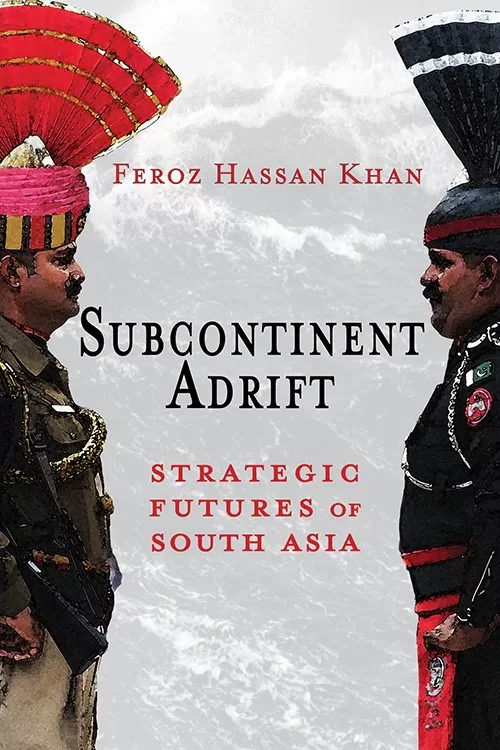
In the existing scholarly debates of this region’s politics, some writers contain exceptional views beyond the conventional literature patterns concerning South Asian regional nuclear politics between two neighbouring hostile nations. The book under review is a recently published academic account of the India-Pakistan protracted conflict under the nuclear shades maintained by a US-based Pakistani author, Feroz Hassan Khan.
The book contains various exceptional features based on the author’s two decades efforts to summarise his ideas about the changing nature of South Asian regional politics and its growing configuration with evolving global power politics. The central theme of the book revolves around the question of drifting the subcontinent’s politics and its impacts on the political, military, and economic dynamics of global power politics. The book highlights an interconnection between global politics and South Asian regional politics, which has been rarely touched in the mainstream literature on the ongoing conflicting strategic orientations of the two South Asian nuclear powers. Akin to a few specific studies on the New Delhi-Islamabad strategic contest, the intellectual insight of the author confirmed the main argument of the book with the help of various impartial and rational arguments. His reliance on impartial and rational research principles has enhanced the legitimacy and validity of the book’s findings in the last chapter.
Apart from an enlightening concluding analysis in the end, the debate in the rest of the six chapters contains arguments addressing and exploring South Asia’s evolving strategic regional dynamics. The first chapter traces the roots of the subcontinent’s conflicted politics due to the multi-layered disagreements between the governments of both contesting South Asian nuclear powers.
After introducing the decades-long hostility between India and Pakistan on rational grounds in the first chapter, the subsequent chapters continue the main debate with the help of several convincing and logical arguments. In this way, the second chapter presents a three-level international-bilateral-regional analysis addressing the missing dimensions of South Asian regional politics in the existing academic publications. The exciting part of the discussion comes in the sixth chapter, where the author outlined several new challenges to the present status of arms race stability in the politics of the nuclearised subcontinent.

The ongoing multifaceted efforts of India for isolating Pakistan politically and diplomatically in the present frameworks of great power politics have started placing Pakistan at a disadvantageous position in its regional strategic competition with India. The arrival of Modi in Indian politics and the rise of Hindutva in India are the key factors shaping the new determinants of the South Asian regional security environment. Moreover, Islamabad’s decision to sign a mega economic corridor project with Beijing, India’s growing strategic closeness with the US, and the growing reliance of India-Pakistan on modern warfare technologies are the main concentrations in the book.
The debate in all the chapters provide a comprehensive picture of conflicting South Asian regional politics, which is persistently increasing the intensity of India-Pakistan incompatible formal standings against each other in regional and extra-regional affairs. This scenario has posed serious threats to the scope of peace and stability in the nuclearised region parallel to augmenting the hostile approaches of New Delhi and Islamabad in their bilateral dealings. Additionally, the role of external players is significant in this regard because the leaders of both South Asian contestants have tried to gain the support of extra-regional players against each other.
In other words, this book is a reflection of the great powers’ South Asian engagement, which is shaping the strategic outlook of the region and contesting attributes India and Pakistan against each other. The involvement of great powers in the regional affairs of the subcontinent has structured Indian strategic alliances with the US in response to the Islamabad’s growing cooperative engagement with Beijing.
Based on these features, it is appropriate to maintain that this book has secured a reputable standing in the existing literature concerning the politics of the nuclearised subcontinent due to its independent analysis cemented in the author’s non-traditional way of looking at the diminishing values of peace and stability in a nuclearised region. The author’s arguments in all chapters present an incomparable account of South Asian regional complexities and sensitivities based on the enduring New Delhi-Islamabad rivalry and its unprecedented historical growth in diverse directions.
The uniqueness of this book can be analysed through the author’s different approaches to study the competing strategic behaviours of India and Pakistan, which go side by side in the book. Therefore, it is an appropriate study for the people interested in understanding the South Asian regional security environment from a different angle. Students of Politics, International Relations, Peace and Strategic Studies could find this book an interesting reading to be able to comprehend the mainstream security challenges of the New Delhi-Islamabad strategic competition.
To understand the author’s overall exceptional standing on South Asian politics, the intellectual contribution of the author in the form of various published research papers can be accessed from various online platforms. It is pertinent to mention here another academic account of the author Eating Grass: The Making of the Pakistani Bomb (2012), which cultivated a remarkable reputation in the international academic circles due to its primary focus on the history of Pakistan’s nuclear program. While keeping in mind the author’s vast research experience and practical knowledge about the strategic affairs of South Asian region, the book under review could be considered as an appreciable contribution in the existing literature addressing the question of peace and stability between New Delhi and Islamabad.