


The debate on Pakistan’s education system structured in several conventional patterns has always remained an area seeking sufficient attention from Islamabad-based policymakers parallel to maintaining an undeniable relevance with the contemporary challenges of Pakistan.
The country’s current education system consisting of complex and multi-tiered arrangements is generally based on structural fragmentations, which hampered the government’s vision for improving the performance of education institutions.
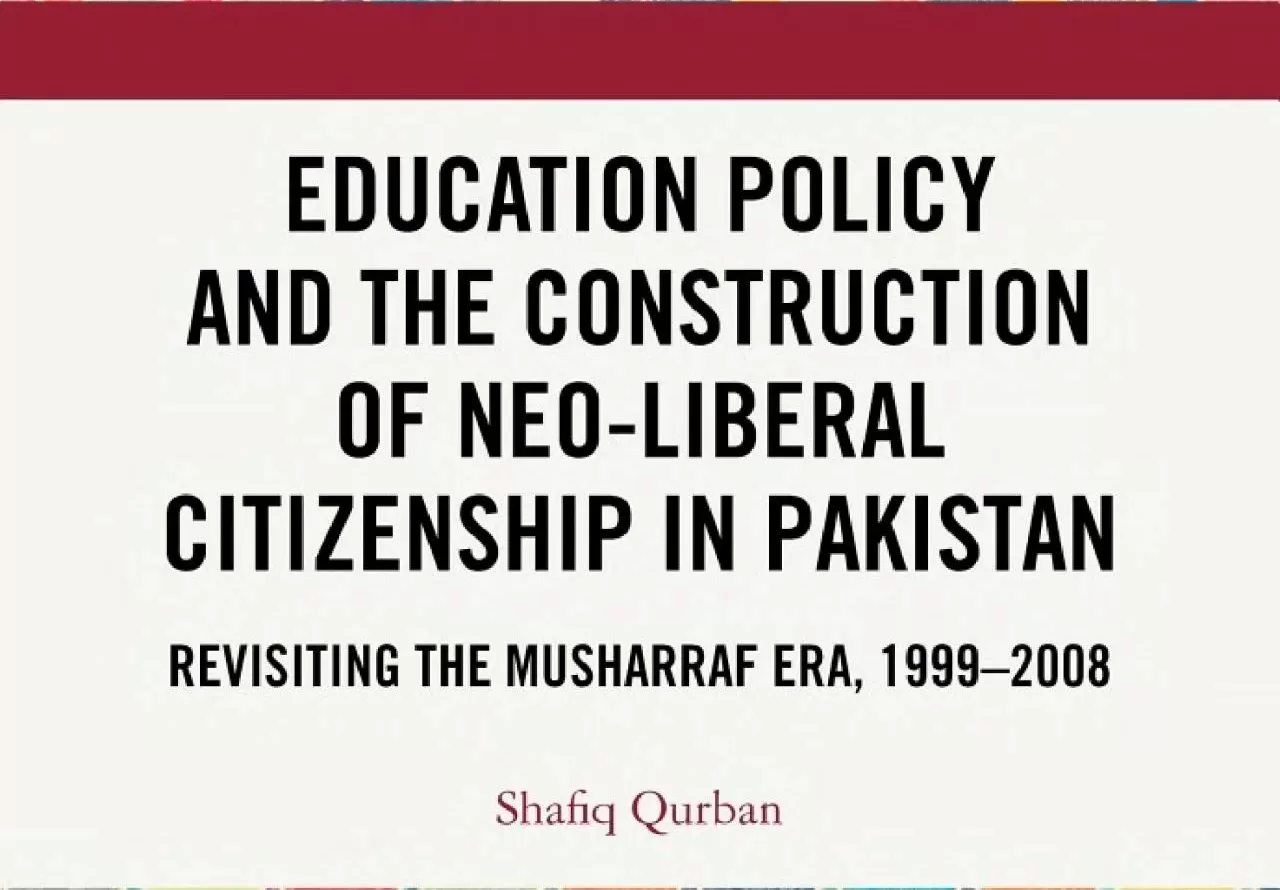
An analytical survey of Pakistan’s history provides a brief account of the government’s efforts to restructure the role of various education institutions while aligning them with the modern world’s standards. The existing academic considerations of leading intellectual communities concerning the complexities of Pakistan’s education system have discussed various policies which prevailed under different political administrations to improve the quality of education within the country with the support of a broader reform agenda. Thus, the discussion on the education reforms in Pakistan and its changing patterns cannot be completed without understanding the Musharraf regime when the government authorities were engaged in bringing multipronged developments in the country’s traditional educational framework. To identify conceptually the Musharraf era in the context of education reforms, the recently published book of a Pakistan-based author, Shafiq Qurban, has gained momentous significance in the existing academic conversations regarding Pakistan’s education system. Qurban is an emerging intellectual figure in Pakistan’s leading academic gatherings due to his unconventional way of concentrating upon the country’s structural problems and their inevitable impacts on the social, political, and economic attributes of the nation.
His quest for addressing the structural issues of the education system and its unprecedented growth under different governments led him towards the Musharraf era (1999-2008), when the government’s determination to improve curriculum was rationalized while altering the traditional national patterns of education.
While formally being associated with the Department of Political Science and International Relations at the University of Management and Technology, Qurban has cultivated a reputable position in the Lahore-centric Pakistan’s scholarly community. His expertise in a variety of fields, such as public policy, Extremis, constitutionalism, education and women’s empowerment, enabled him to provide academic feedback to the country’s leading policymaking frameworks.
The book under review is a glimpse of Qurban’s intellectual properties based on a conceptually resilient approach to analyze the Musharraf era’s improvements in the existing curriculum development efforts. It tried to align the country’s core academic values with the concept of national identity and proved its validation with contemporary Pakistan.
The book’s central theme revolves around the conceptual understanding of the country’s formal alteration in the education system based on specific liberal reforms. The primary debate is divided into ten different chapters concentrating on varying aspects of the book’s central theme concerning the integration of neo-liberal values from primary to higher education in the wake of the twenty-first century and under the shadows of globalization.
The inevitable prevalence of globalization in the international system was the fundamental force that convinced the Musharraf government to upgrade Pakistan’s conventional educational standards analogous to considering it an essential component of the government’s mainstream priorities. It incorporated the leading religious institutions with the government’s broader reform plan and treated them as an overlooked component of Pakistan’s conformist education classifications. Its association with the country’s ordinary schooling system is mainly inherited in the Musharraf government’s legislative upgrades, which have been commendably analyzed by Qurban in his study, initially doctoral research conducted in the Department of Politics and International Relations at the International Islamic University Islamabad.
The book commenced the debate with a brief introduction explaining the central idea and its relevance with contemporary Pakistan’s policymaking in the education sector. The book’s discussion under ten chapters endeavoured to explore the supporting literary contributions to validate Qurban’s academic standing in the country’s formal discussions on education reforms. The subsequent chapters emphasized different perspectives of educational transformation within the country, starting from the role of national ideology transforming traditional study patterns of the country.
After underlining the significant developments in the educational transformations of Pakistan, the book’s interesting arguments appear in chapter 4, when the author focuses on the main hindrances in modernizing the countrywide curriculum on the neo-liberal conceptual orientations. It marked a remarkable shift from the traditional ideological education standards to the neo-liberation conception of citizenship, where the inevitable influences of global developments are treated as unavoidable truths and irrefutable realities.
It exhibits the author’s exceptional intellectual insight, endorsing his conceptually robust and logically convincing analysis based on an adequate theoretical explanation. The book’s methodological consistency further enhances its rarity in the present academic deliberations related to Pakistan’s education system indoctrinated on specific fanatical ideological configurations.
In this way, the book provides a seminal intervention in the critical scholarship on Pakistan’s education system, challenging the overwhelming pressures of specific traditional patterns originating from the country’s decades-old ideological designs.
The author focuses on the government’s pursuit of overhauling the country’s entire education structure under Musharraf’s leadership, extending Pakistan’s educational scope beyond the conventional domains restricted to knowledge dissemination without considering it an appropriate source of achieving the desired outcome from multiple directions.
Based on this description, the book has revealed how state-sponsored reforms are instrumental in producing a specific version of depoliticized, economically rational, and globally aligned conception of citizenship. It enabled the government authorities to incorporate global political and economic developments with the country’s prevalent education structure under the neo-liberal auspices. In this way, this book is an essential reading for anyone seeking to understand the ideological and political directions of education in Pakistan and its modern evolution starting from the post-9/11 circumstances. The book’s central idea attempts to bridge a gap between the educational and political growths of the nation while providing a theoretical compact description to understand the ideological dimensions of governance in the Global South. Thus, the book’s arguments are merely linked with the Musharraf regime’s analysis, but it is a compelling academic survey considering education as a leading factor capable of contributing to the country’s mainstream high state-building aspirations.