



Originally Published in DJ in 2023
58 years have passed since the fateful day of September 6, 1965, a date that Pakistan holds in solemn remembrance. It was on this day that unprovoked and simultaneous attacks were launched by Indian forces, aiming at the cities of Lahore and Sialkot. This marked the outset of the Indo-Pakistan War of 1965, a significant chapter that has been indelibly imprinted upon the historical tapestry of the subcontinent. This narrative delves into the events leading up to the conflict, shedding light on the origins of India’s aggressive actions and Pakistan’s unwavering response.
The 1965 conflict, a watershed in regional history, spotlighted the indomitable spirit and gallantry of the Pakistani Armed Forces. Concentrated around the Kashmir dispute, the war epitomized the unwavering commitment, unmatched valor, and strategic astuteness displayed by Pakistani soldiers, seamen, and airmen in the face of overwhelming odds. Bracing against the sheer numerical and material superiority of their Indian counterparts, Pakistan’s Armed Forces confronted the challenge across land, air, and sea, emerging as a formidable front.
Beyond the battlefield, the Indo-Pak War revealed an amalgamation of forces, with both the military and civilian sectors rallying wholeheartedly. It was a moment when Pakistan coalesced as a united nation, solidifying the people’s unwavering support for the defense forces. Throughout the tumultuous conflict, the Pakistani military showcased unwavering bravery against an adversary wielding superior resources and numbers. This chapter in history stands as a tribute to the valor that fortified Pakistan’s resilience, unity, and unwavering spirit against all odds.
OPERATIONS BY PAKISTAN ARMY
The Indo-Pakistan War of 1965 witnessed the Pakistani Army emerging as a cornerstone in safeguarding the nation’s borders and orchestrating strategic counteroffensives against the Indian Army. The conflict, a tapestry of battles and strategic maneuvers, exemplified the Pakistani Army’s prowess and unwavering resolve. The Pakistanis army was carrying out its routine duties as a matter of fact 25% of the strength was on leave cycles and the border defense was a routine peace time defensive posture, with some army and mainly rangers manning the defensive positions, emplacements like border outposts and screen positions.
OPERATIONS IN BRIEF PAKISTAN ARMY
Defensive Excellence:
The Pakistani Army exhibited formidable defensive prowess across multiple sectors, including Sialkot, Lahore, Khem Karan, and the southern desert regions. Their staunch resistance thwarted Indian advances, dealing substantial blows to the opposing forces. The defense of Lahore, in particular, bore testament to the Pakistani Army’s tenacity against the Indian onslaught, reflecting their unyielding spirit, resilience in adversity, and strategic finesse in executing intricate defensive maneuvers.
Offensive Strikes and Counterattacks:
The Pakistani Army showcased its offensive capabilities through calculated counterattacks and strategic assaults against Indian positions. The Chamb-Jaurian sector bore witness to a standout operation where the Pakistani Army breached Indian defenses, claiming significant territory. Lieutenant (later Major) Shabir Sharif’s audacious feat stands out—a daring assault on an Indian Artillery battery, rendering three guns inoperative. In a remarkable display of resourcefulness, Major Shabir, ingeniously managed to tow a 25 Pounder gun back to Pakistani lines, employing an Indian truck (Shaktiman). This audacious feat not only underscored his tactical acumen but also amplified the toll on the Indian side. In the same battle, Major Raza Shah Shaheed stood out for his bravery, while commanding a tank squadron of 11 Cavalry. Both were decorated with Sitara-e-Jurat. There are scores of other such episodes.
Armor Warfare Excellence:
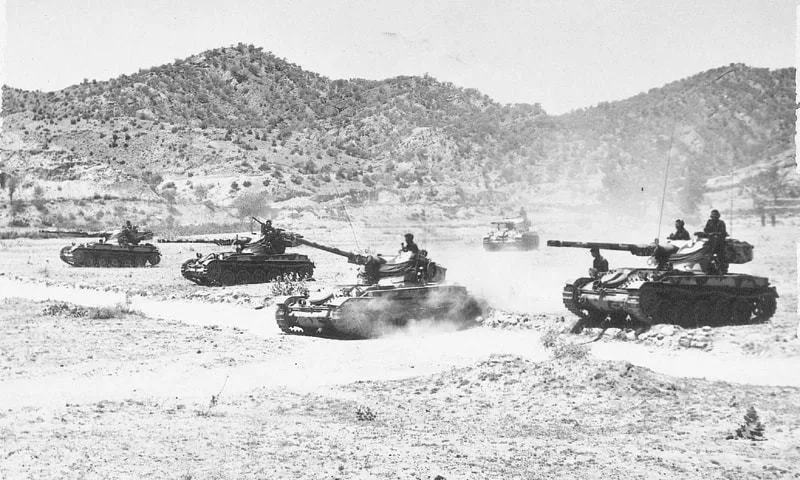
The Pakistani Army’s adept utilization of armored forces in tank battles showcased remarkable skill and valor.
The Battle of Chawinda, nestled within the Sialkot sector, epitomized Pakistani tank crews’ bravery in defending against a formidable Indian armored force, showcasing one of the fiercest tank battles, post-World War II. The Pakistani armour showed its prowess elsewhere too, particularly in Khem Karan Sector.
Crucial Aerial Support:
The Pakistan Army received pivotal aerial backing from the Pakistan Air Force (PAF), disrupting Indian supply lines and furnishing ground operations with cover. PAF’s triumphs in aerial combat, notably against Indian Hunters and Vampires, significantly bolstered defense strategies. The skirmishes above Chamb notably culminated in the Pakistani F-86 Sabres downing four Indian Vampire fighter jets, affirming their aerial dexterity.
Artillery and Infantry Excellence:
The Pakistani Army strategically employed artillery fire and infantry tactics, upholding strategic points and repelling Indian advances. The capture of Indian artillery and the adept use of artillery support underscored the army’s tactical finesse and seamless coordination.
Resilience and Determination:
The Pakistani Army’s indomitable spirit shone through, standing firm against superior Indian might. In the face of adversity, they rallied their strength to launch resolute counterattacks and sustain their defense.
Exemplary Leadership:
The Pakistani Army’s actions underlined their commitment to preserving national sovereignty and their adeptness in confronting a formidable adversary. The leadership, from top commanders to section-level officers, was exceptional. Notably, the Chamb-Jaurian sector served as a testament to their precision operations, shattering Indian defenses and extending their control from the Line of Control to the Akhnur Bridge. The ground battle for saving Lahore and allied strategic areas stand out.
The Kashmir Sector
During the Indo-Pakistani War of 1965, the Pakistan Army was involved in several military operations in the Kashmir region. The war began on April 1, 1965, and lasted until September 23, 1965. The conflict primarily centered around the disputed region of Kashmir and its surrounding areas. I will mention just two operations carried out in Kashmir Sector.
1. Operation Gibraltar:
Operation Gibraltar was a military maneuver conceived and executed by the Pakistan Army during August 1965 in the contested expanse of Jammu and Kashmir. This covert operation was formulated with the intent of clandestinely breaching the Line of Control (LoC) and provoking an insurrection within the predominantly Muslim populace of Kashmir against the Indian governmental authority. However neither the training and logistics were NOT adequate by far. This was brought out by Col SG Mehdi, then Commander SSG in his letter to GHQ after visiting HQ 12 Div. For this Col Mehdi was transferred and copies of his letter were ordered to be destroyed. Pakistani military strategists believed that such a local uprising, triggered by Operation Gibraltar, would substantiate Pakistan’s justifications against India on the global platform. Deliberately chosen as a historical allusion, the name “Gibraltar” aimed to draw parallels to the historical Muslim conquests of Portugal and Spain, originating from the strategic port of Gibraltar. No enquiry has ever focused on why the plan was put into motion when both the logistics and training were almost non-existent. No enquiry has ever cast responsibility on the military hierarchy whose wrong decisions cost us the lives of those several thousand “volunteers” who died in unknown places without any recognition.
2. Operation Grand Slam:
Also known as Operation Grand Slam, this was a Pakistani offensive launched in the Chamb sector of Jammu and Kashmir in end August 1965. The objective was to eventually link up with the guerillas that were launched inside Indian held Kashmir and also to cut off the Indian town of Akhnoor from the rest of India and potentially threaten the city of Jammu. This operation was carried out successfully and Pakistan Army was knocking at the Akhnur Bridge by 5 September 1965, when the Indians attacked Lahore and Sialkot on 6 September 1965, starting the all-out war.
The Pakistan Army launched a major counter offensive in the Sialkot Sector with the objective of capturing key areas and putting pressure on the Indian defenses. The sector was strategically important due to its proximity to the city of Sialkot, which was a crucial transportation and communication hub. One of the most prominent battles in the Sialkot Sector was the Battle of Chawinda. Pakistani forces launched an offensive to capture the town of Chawinda, located near the border with India. The battle lasted several days and saw intense fighting between the two sides.
Another significant engagement in the Sialkot Sector was the Battle of Phillora. Pakistani forces attempted to capture the town of Phillora, the battle involved tank warfare and artillery exchanges, where heroic actions were witnessed at tactical levels and Pakistan Army was able to not only defend its territory but retake some of the lost territories. The operations in the Sialkot Sector were marked by intense fighting and heavy casualties on both sides.
The Lahore Sector
During the Indo-Pakistan War of 1965, the Lahore Sector witnessed intense military operations between the Indian and Pakistani forces. It was the Indians who attacked Lahore on the morning of 6 September, when the Pakistan Army was on normal border watch and not in battle positions. By the time the Pakistan Army went into their operational area, the Indian Army had already penetrated the Pakistan defenses. It was here that the PAF saved the day not only for the Pakistan Army but the whole nation, because the advancing columns of the Indian Army were reduced to rubble by the PAF’s No 19 Squadron, led by Squadron Leader Sajad Haider and his team. The Indian historians have acknowledged this in different books. A monument dedicating to the heroic action of 19 Squadron adorns 4 Corps operational area in remembrance.
One of the significant engagements in the Lahore Sector was the Battle of Burki. In this battle, Pakistani forces launched an attack on the Indian positions near the village of Burki, located southeast of Lahore. The battle was fierce, with both sides suffering casualties. While the Pakistani forces made initial gains, the Indian Army managed to repel the attack and maintain control of the area. The Lahore Sector saw significant fighting, and while the Pakistani Army made initial gains, the Indian forces were ultimately able to repel the attacks and defend their positions. The war ended with no major territorial changes, and both sides claimed victory.
The Sulaimanki Sector
During the Indo-Pakistan War of 1965, the Sulaimanki Sector was a significant theater of military operations between the Pakistani and Indian forces. The sector is located in the southern part of Punjab, near the international border between the two countries.
The Pakistan Army conducted several operations in the Sulaimanki Sector as part of its broader strategy to engage Indian forces and achieve tactical objectives. One of the key objectives for Pakistan was to capture territory, especially beyond Sulaimanki Headworks to protect, provide more strategic depth to our defenses and put pressure on Indian defenses in this sector. The operations in the Sulaimanki Sector were marked by heavy fighting and casualties on both sides, where Pakistan Army was able to achieve its objectives. Another notable operation in the Sulaimanki Sector was the Battle of Dograi and Bedian. Pakistani forces launched an offensive to capture the Indian-held town of Dograi and the nearby village of Bedian. These areas were strategically important due to their proximity to the Sutlej River and their potential impact on the Indian defense lines. The Battle of Dograi was particularly fierce, with intense fighting between the two sides. The Pakistani Army made initial gains and managed to enter the outskirts of Dograi. However, determined Indian counterattacks pushed the Pakistani forces back, and the town remained under Indian control. The events of the war, including the operations in the Sulaimanki Sector, continue to be studied and analyzed by historians and military experts to understand the strategies, tactics, and outcomes of the conflict.
The Khem Karan Sector
The Khem Karan Sector was a strategically significant theater of operations during the Indo-Pakistan War of 1965. The sector is located in the northwestern part of India, near the international border with Pakistan. The war was marked by intense battles and military engagements as both countries sought to achieve their respective objectives.
The Pakistan Army conducted several operations in the Khem Karan Sector as part of its larger military strategy. The sector held importance due to its proximity to the town of Khem Karan and its strategic location in the defense of Punjab. One of the most notable battles in the Khem Karan Sector was the Battle of Asal Uttar. Pakistani forces launched an offensive with the aim of capturing the Indian town of Khem Karan and making advances deeper into Indian territory. The Indian forces had prepared well-concealed anti-tank defenses, including minefields, trenches, and well-emplaced artillery. Pakistani forces faced significant casualties as they encountered strong resistance from the Indian defenders. The operations in the Khem Karan Sector were marked by heavy fighting and casualties on both sides.
The Desert Sector
The Desert Sector, also known as the Rajasthan Sector, was a crucial theater of operations during the Indo-Pakistan War of 1965. This sector encompassed the vast desert regions in the western part of India, near the international border with Pakistan. The war in this sector witnessed significant military engagements and strategic maneuvering.
Pakistan Army conducted several operations in the Desert Sector as part of its military strategy during the conflict:
The operations in the Desert Sector were marked by fierce fighting and significant casualties on both sides. The battles in this sector were characterized by tank warfare, as both India and Pakistan deployed armored units in the desert terrain.
The events in the Desert Sector during the 1965 war have continued to be studied by military historians and analysts to understand the tactics, strategies, and outcomes of the conflict. The war had a lasting impact on the region and the relationship between India and Pakistan, shaping their military doctrines and approaches in subsequent years.
Ceasefire and End of Operations:
The war between India and Pakistan ended with a ceasefire on September 23, 1965. The ceasefire agreement halted all military operations and hostilities along the border, including in the Desert Sector. In summary, the Indo-Pakistan War of 1965 showcased the Pakistani Army’s unwavering dedication to safeguarding the nation, defying odds against a larger adversary.
Amidst challenging circumstances, Pakistani soldiers demonstrated unparalleled courage, mirrored by their exceptional leadership. This conflict etched a defining chapter in history, underscoring the Pakistani Army’s strategic acumen and valor.
Operations by Pakistan Navy
In March 1965, the Indian military conducted a joint exercise called “Arrow Head,” a naval maneuver involving a brigade group along with INS Vikrant and a fleet of seven destroyers and frigates in the operational area of the Gulf of Kutch. During this exercise, the Indian forces engaged in a comprehensive array of naval operations, with a particular focus on carrier-based activities. These encompassed anti-submarine measures, anti-aircraft defense, airstrikes, and reconnaissance missions. In April of the same year, clashes erupted between Indian and Pakistani forces in the Rann of Kutch region, as both nations vied for control over 3500 square miles of disputed territory.
As tension escalated, the Pakistan Navy (PN) initiated patrols of the approaches to Karachi, extending southeastwards from April 1965. PNS Babur, initially a training ship, underwent conversion into an operational cruiser. All operational units, including the submarine PNS Ghazi, were elevated to full operational readiness during this period. The standoff persisted for four months until an international tribunal intervened and called for an end to hostilities.
In response to intelligence gleaned from the Kutch Operations, the PN Headquarters strategized to position PNS Ghazi off Bombay in early September 1965, a strategic move intended to provide advanced warning capabilities. Upon the outbreak of hostilities and India’s assaults on Lahore and Sialkot, the Navy was tasked with a mission to neutralize an Indian Coastal Radar base located at Dwarka, which was aiding Indian Air Force strikes on Karachi. A Task Group comprising seven PN vessels, including the cruiser Babur and destroyers Khaibar, Badr, Shahjahan, Alamgir, Jahangir, and Tipoo Sultan, was dispatched for a midnight bombardment operation codenamed ‘Operation Somnath’ on September 7th-8th, 1965. The operation achieved its goals, and the PN Ships promptly resumed their patrolling routines off Karachi.
On September 18, 1965, two PN destroyers and the cruiser BABUR were assigned to protect the Pakistan Merchant ship MV Bagh e Karachi in the Gulf of Aden. The merchant ship, laden with vital supplies for the Pakistan Air Force, was escorted safely back to Karachi, marking another successful operation. In a separate engagement on September 22, 1965, PNS Ghazi, stationed off Bombay, identified two contacts, which were later confirmed as Indian Navy frigates.
After tracking them meticulously for a day, PNS Ghazi positioned itself, launching a precise attack at 1912 hours, resulting in direct hits after a full day of investigation and pursuit. These events underline the strategic acumen, resilience, and effectiveness of the Pakistan Navy during the the Indo-Pakistan War of 1965, as they adeptly carried out critical operations, safeguarding Pakistan’s interests and assets.
Operations by Pakistan Air Force
The Pakistan Air Force (PAF) played a pivotal and transformative role during the Indo-Pakistan War of 1965. Despite facing numerical and technological disadvantages compared to the Indian Air Force (IAF), the PAF’s strategic acumen, daring tactics, and unwavering commitment reshaped the dynamics of the conflict. Here’s an overview of the PAF’s contributions during the war:
Preemptive Strikes:
The PAF launched preemptive airstrikes on Indian air bases, particularly targeting the forward bases, in a strategic move aimed at disrupting the IAF’s operational capabilities. These attacks, including strikes on Adampur, Halwara, and Pathankot, forced the IAF to evacuate their advanced airfields, thereby gaining an initial air superiority in the conflict zone.
Air Superiority:
Despite being outnumbered and outgunned, the PAF managed to achieve air superiority over crucial battle areas. This accomplishment was vital in safeguarding Pakistan’s ground operations and preventing Indian air dominance, allowing the Pakistani ground forces to operate more effectively.
Aerial Combat:
The PAF engaged in numerous aerial dogfights with the IAF, demonstrating remarkable skill and tenacity. The Pakistani pilots, flying American-built F-86 Sabre jets, showcased their proficiency in aerial combat against the IAF’s more modern aircraft. These encounters underscored the PAF’s competence and ability to hold their own against technologically advanced adversaries. Some of these battles were seen by the general public, over, Sargodha, Lahore, Sialkot and Chamb-Jaurian sectors.
Strategic Bombing:
The PAF conducted strategic bombing missions deep into Indian territory, targeting key military installations, industrial centers, and infrastructure. These attacks inflicted substantial damage and compelled the Indian military to divert resources from the front lines to protect their hinterland.
Close Air Support:
The PAF provided crucial close air support to ground troops, aiding them in battles by suppressing enemy positions and facilitating advances. This support helped the Pakistan Army in breaking through Indian defenses and making strategic gains on the ground.
Innovative Tactics:
The PAF employed innovative tactics to maximize their impact with limited resources. Notably, they utilized B-57 bombers for night bombing missions, exploiting the cover of darkness to evade enemy defenses and cause significant disruption.
Some exceptional actions and decisive moments:
The PAF pilots were like air gladiators, whose heroics are endless and to write down about each of them is beyond the scope of this discourse. Several individual moments during the war showcased the PAF’s excellence. I will mention these briefly here:
Squadron Leader Sarfraz Rafiqui Battle of Chamb
September 1, 1965, marked a pivotal juncture in the Pakistan-India conflict, as the Pakistan Air Force (PAF) initiated a daring strike under the leadership of Sarfraz Rafiqui. As dusk settled that evening, the swift advancement of the Pakistan Army’s 12 Division in the Akhnoor sector of Indian Occupied Kashmir (IOK) prompted the Indian Air Force (IAF) to respond, with its No 45 Squadron promptly dispatched from Poona to Pathankot, deploying Vampire aircraft for close support amidst the challenging Kashmiri terrain. The escalating ground situation spurred the Vampires into immediate action.
In a series of three successive strikes, each comprising four Vampires, the IAF aimed to defend their positions. Despite the IAF’s claims of success, Major General G S Sandhu’s account in ‘History of Indian Cavalry’ offers a contrasting narrative. The first Vampire assault effortlessly obliterated three AMX-13 tanks of India’s 20 Lancers, alongside vital support vehicles.
Subsequently, the second sortie targeted Indian infantry and artillery, culminating in impactful explosions among ammunition-laden vehicles. However, a transformative moment materialized when Squadron Leader Rafiqui and Flight Lieutenant Imtiaz Bhatti of the PAF entered the fray. Patrolling near Chhamb at an altitude of 20,000 feet, they locked onto two Vampires guided by radar. With a swift descent, Rafiqui engaged the adversaries, dispatching the first Vampire with a lethal volley from the 0.5” Browning six-shooter, just as two additional Vampires closed in. This pivotal encounter marked a definitive turning point in the conflict, underscoring the PAF’s adeptness and strategic acumen. Sarfraz Rafiqui’s calculated actions illuminated the efficacy of the PAF’s approach, emphasizing that strategic maneuvers could indeed reshape the course of history even when confronted with daunting odds.
On 6 Sep 1965, Squadron Leader Sarfraz Ahmed Rafiqui led a formation of three F-86 aircraft on a strike against Halwara airfield. Soon after crossing the Indian border, Rafiqui had been warned about a large number of enemy interceptors being in the air by the leader of a returning F-86 formation. He, however, continued his mission single-mindedly. On the way back, the formation was intercepted by about ten Hunter aircraft out of which Rafiqui accounted for one in the first few seconds.
After Rafiqui shot down one Hunter aircraft, his guns jammed due to a defect and stopped firing upon which he refused to leave the battle area, as he would have been perfectly justified to do; he instead ordered his No. 2 to take over as leader and continue the engagement with the enemy. He himself now took up a defensive position in the formation in an attempt to give it as much protection as was possible by continuing fighting manoeuvres in unarmed aircraft whilst the remainder proceeded to give battle to the enemy. This called for a quality of courage and dedication on the part of Rafiqui equal to the best in the history of air fighting.
The end for him was never in doubt. He chose to disregard it and, in the process, his aircraft was shot down and he was killed but not without his action enabling his formation to shoot down three more Hunter aircraft.
Rafiqui thus provided exemplary leadership in battle and displayed outstanding courage in the face of exceptionally strong opposition. His inspiring leadership and selfless example significantly affected the subsequent course of the air war in which PAF never failed to dictate terms to an overwhelmingly larger and better-equipped enemy. Rafiqui’s conduct was clearly beyond the call of duty and conformed to the highest tradition of leadership and bravery in battle against overwhelming odds. For this and his earlier exploits, he is posthumously awarded HJ.
Air Commodore Sajad Haider the First Air Strike on Pathankot
The strike mission which he led on 6th Sep 1965, against Pathankot airfield, where his formation destroyed 13 enemy aircraft including nine MIG-21’s, was conducted in the best traditions of the PAF. The formation carried out repeated attacks in the face of heavy Ack Ack. For the determination, courage and exceptional flying skill with which he flew and led his Sqn during operations against the enemy. Squadron Leader Sayed Sajad Haider is awarded SJ”.
Saving Lahore
On the morning of Sep 6 when news came of the enemy attack on Lahore sector, a PAF squadron, which was on a mission elsewhere was diverted to stop the advancing Indians. This Squadron gave the Indians the fore taste of things to come. At around 0900 hrs the Squadron was ordered to strike the Indian army advancing on Lahore along with Amritsar-Wagha road.
Squadron Leader Sajad Haider along with Flight Lieutenants Mohammad Akbar, Arshad Sami, Khalid Latif, Dilawar and Ghani Akbar flew this historical mission which saved Lahore and in turn saved Pakistan that day. The formation armed with rockets, in addition to the guns, took off in Sep haze and levelled off at the planned height before heading towards the target. Shortly afterwards they were over the target area where to their amazement they spotted enemy vehicles of all sorts moving along the road crossing Wagah covered by Indian armour. For the while enemy did not see them but when they did, it was a sight to see the drivers jumping out to take cover leaving their vehicles to their fate.
In all they made six attacks each and the formation stayed for 16-17 minutes over the target, making sure that the enemy attack on the motherland was completely blunted. By the time they decided to exit, there were columns of fire all around, melting steel with enemy within. Sajad Haider called-off the mission after nearly all their ammo was depleted and fuel perilously low.
Squadron Leader M M Alam- the extraordinary feat and the Making of an Ace
The air duals overhead Sargodha, to defend this important base stay in the annuls of air history as one of valour and resilience of PAF pilots. It is here that Squadron Leader M M Alam made those historic kills.
On the morning of September 7th, the skies above Sargodha became a battleground as the Indian Air Force (IAF) launched a retaliatory strike. Anticipating this move, the Pakistan Air Force (PAF) was prepared, with the Sargodha Base standing at full alert. Among the PAF ranks, an exceptional pilot named Alam, accompanied by his wingman Flight Lieutenant Masood Akhtar, was patrolling the skies on a Combat Air Patrol (CAP) mission. As the haunting silhouettes of IAF Hunters appeared over Sargodha, Alam received radar vectors guiding him towards the incoming threat. In a synchronized response, another section of PAF Sabres, led by Flight Lieutenant Bhatti, endeavored to engage the approaching Hunters.
Yet, it was Alam who surged forward, positioning himself as the first line of defense. High above in an F-104, Flight Lieutenant Arif Iqbal keenly observed the unfolding events with profound fascination. Alam’s radar screen painted the locations of the enemy planes, and as he was vectored back towards Sargodha, his wingman Akhtar reported a contact with four Hunters. With a swift decision, Alam plunged towards the adversaries, shedding his external stores to enhance maneuverability. However, in the midst of the chaos, two more Hunters emerged behind Alam. Reacting with split-second instincts, he disregarded the four in front and climbed to confront the duo behind. The Hunter squadron changed course, abandoning their intended strike on Sargodha, and veered towards Alam.
Capitalizing on his F-104’s speed advantage, Alam executed a daring maneuver, pulling up and then reversing his course to close the distance. Fixating on the rearmost Hunter, Alam initiated his attack. His first Sidewinder missile launched, but missed its mark, exploding harmlessly on the ground. The skirmish played out amidst a web of high-tension wires, adding an element of peril to the dogfight. As the Hunters navigated to avoid the wires, Alam seized the opportunity and fired a second Sidewinder. The missile raced toward its target, colliding with the tail of the Hunter. Alam had achieved his first kill, downing the enemy aircraft. The Hunter’s pilot, Sqn Ldr Onkar Nath Kakar, ejected and was later captured as a prisoner of war. Amidst the flurry of action, Alam momentarily lost sight of the remaining five Hunters. His wingman’s voice cut through the chaos, revealing their positions. Alam swiftly located the five-enemy aircraft, flying in impeccable formation at low altitudes and high speeds. The Hunters, unaware of the impending danger, initiated a sharp left turn. In a matter of heartbeats, Alam seized his moment. He unleashed a torrent of firepower from his aircraft’s powerful weaponry, executing precise shots with deadly accuracy. The Hunters, unable to counter the onslaught, fell one after another, their demise etched against the backdrop of the Sargodha skies. Alam’s masterful skill, unwavering courage, and impeccable timing led to a breathtaking display of aerial combat prowess. His swift maneuvers and deadly accuracy resulted in a decisive victory, with the once-imposing Hunter squadron reduced to fragments in the skies over Sargodha.
This engagement, a testament to the pinnacle of piloting prowess, remains an indelible chapter in the annals of aerial warfare.
The Fear of F-104s and The Surrender of the IAF Gnat
An IAF Squadron comprising of Gnats intruded in the Sialkot Sector, in response to which the PAF scrambled F-104s to intercept them under Flight Lieutenant (later Air Chief Marshal) Hakim Ullah. On his arrival the IAF Squadron scrambled and one of the Gnats, was overheard warning others of the incoming Starfighter. This Gnat was flown by Squadron Leader Brij Pal Singh Sikand, who not only lowered his landing gear but landed at an abandoned airstrip in Pasrur. Air Chief Marshal Hakim Ullah is credited with forcing the Gnat down.
Squadron Leader Mervyn Middlecoat
He was commanding the elite No 9 Sqn equipped with F-104’s, when the war broke out in first week of Sep 1965. The Sqn was assigned with the precious and vital task of photoreconnaissance deep inside enemy territory, along with Air Defence of Pakistan. Another important task for the Star fighters was the interception of intruding IAF Canberra bomber aircraft. The only potent weapon available to PAF was the F-104, as it could fly the night interception missions and could pose threat to IAF bombers. After 1 Sep, the F-104s were extremely active in Air Defence and Air Superiority Operations. Out of 246 missions flown by F-104s during hostilities, 42 were at night against the IAF Canberras. Middlecoat was highly enthusiastic about these night interception sorties and flew many such missions. The first positive encounter between a Canberra and PAF night fighter took place on the night of 13/14 Sep when a Star Fighter flown by Middlecoat from Sargodha intercepted a Peshawar intruder during its high-level exit. The Sakesar radar carried out the interception. As Middlecoat arrived at the position directed by the radar, nothing was visible in the pitch-dark night. Middlecoat carried out a completely blind interception and was vectored about half a mile behind the intruder by the Sakesar radar. On arriving at the directed position, he fired his lethal sidewinder. Missile tone indicated acquisition of the target, and seconds later an explosion was seen at a range of about 4000 feet. It was an indication that the impact or proximity fuse of the sidewinder had fired, and the Canberra was assumed to have been destroyed, although confirmation was not possible since the encounter took place over the Indian Territory. Middlecoat also flew daring photo recce missions deep inside enemy territory. He flew with great courage and produced some extra ordinary results. The intelligence gathered by him while flying these missions proved to be of great importance to PAF and Pak Army in assessing the battlefield.