





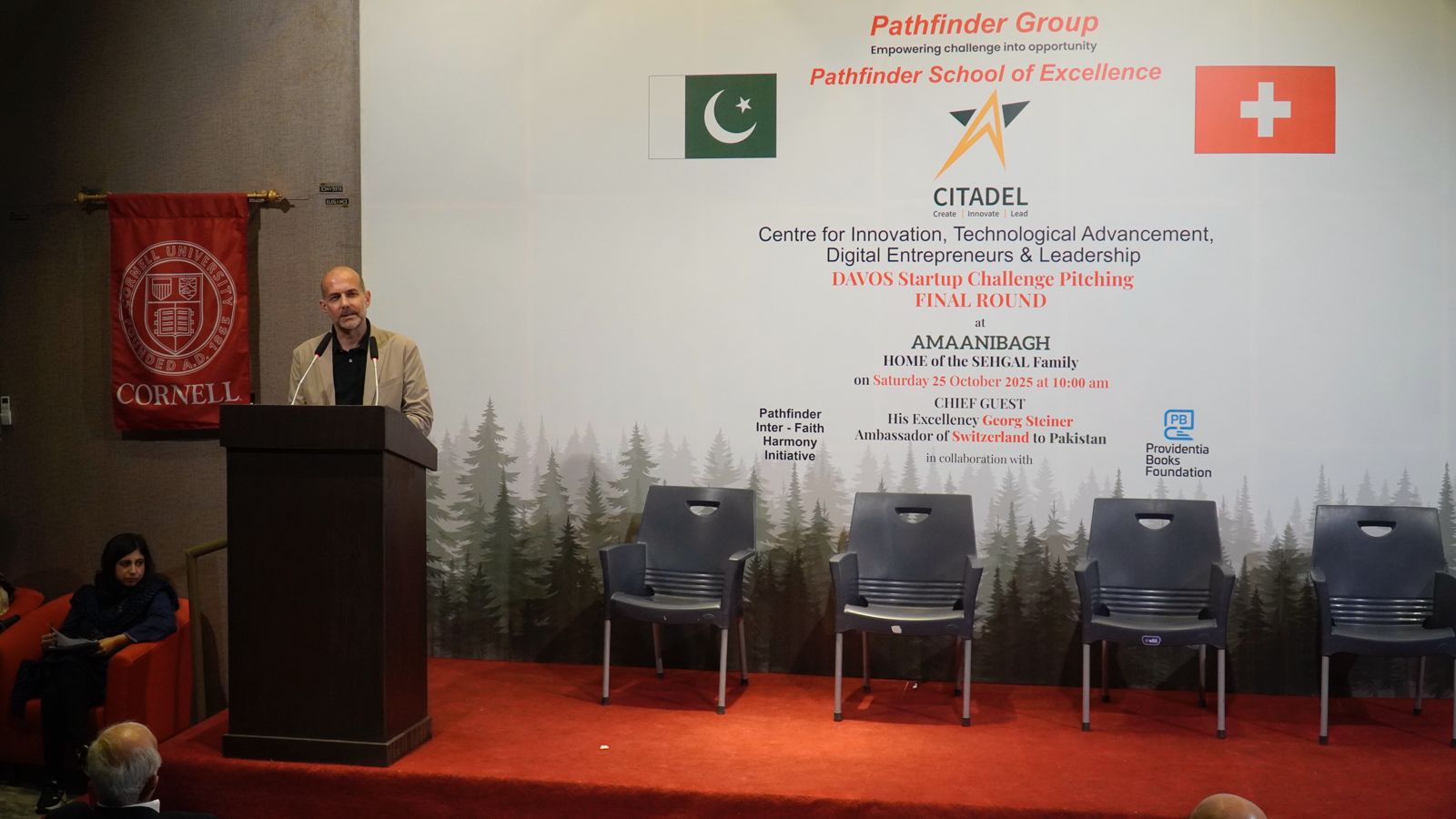
Pathfinder Group’s School of Excellence, Centre for Innovation, Technological Advancement, Digital Entrepreneurs & Leadership (CITADEL), successfully hosted the Davos Startup Challenge Final Round on Saturday, October 25, 2025, at AMAANIBAGH, Angoori, Islamabad. The event brought together some of Pakistan’s most promising startups, industry leaders, and diplomats for a day of innovation, inspiration, and entrepreneurial excellence.
Sehrish Mustafa (Master of Ceremonies)
I would like to take a moment to introduce you to the host organization’s inspiring initiatives. Highlighting the organization’s commitment to excellence with special emphasis on its Corporate Social Responsibility (CSR).
Pathfinder Group is Pakistan’s largest provider of integrated security services, employing over 12,000 individuals across 75 cities and towns nationwide. The Group’s Security Services Division comprises Pakistan’s two largest private security companies: Security & Management Services (Pvt) Ltd and Wackenhut Pakistan (Pvt) Ltd. Expanding beyond security, Pathfinder’s Financial Services Division includes Virtual Remittance Gateway (Pvt) Ltd (VRG) and iPath (Pvt) Ltd, with additional related companies currently under incorporation.
CITADEL is a cutting-edge innovation hub purpose-built institution meant to bridge the skills gap, empower digital entrepreneurs, and cultivate transformative leadership. Positioned at the intersection of technology, education, and enterprise, CITADEL aims to become Pakistan’s premier Launchpad for innovation and impact in the private sector.
Providentia Books Foundation (PBF) is a non-profit organization committed to promoting a passion for reading and learning amongst underprivileged children. The foundation connects book donors with individuals seeking educational materials, facilitating the donation and distribution process. Collaborating with publishers and other nonprofit organizations, PBF distributes books to schools in underserved communities, aiming to bridge the literacy gap and empower children through education. In a brief period, the foundation has collected more than 70,000 books and distributed over 61,823 of them across five major cities and several smaller towns.
Pathfinder Interfaith Harmony Initiative (PIHI)
Aims to promote respectful dialogue amongst faith communities; create safe spaces for collaborative action, and celebrate shared moral values that unite this nation. It develops an impetus for counter extremism with education, empathy, and engagement.
These noble objectives will be achieved through workshops, educational outreach, collaborative forums, and community projects. With such synergy, PIHI will strive to transform faith into a force for unity rather than division.
Our next speaker, Air Cdre (Retd) Khalid Banuri, the person whose career is a testament to the diversity, dedication and exercising innovative approaches. With his quiet demeanor, he effectively exercises the ability to master new ideas through collaborative toil and builds happy teams. He holds substantial experience in senior-level management, policy analysis, diplomacy, lecturing, and writing.
In recognition of his outstanding contributions, the Government of Pakistan has honoured him with two prestigious awards: a civil award of Sitara-e-Imtiaz for excellence in policy analysis, and a Sitara-e-Imtiaz (Military) for his dedicated service to the Pakistan Air Force.
Air Commodore (Retd) Khalid Banuri
Your Excellency, Georg Steiner, the Honorable Ambassador of Switzerland to Pakistan. Esteemed Judges, Distinguished Guests, Fellow Innovators, Ladies & Gentlemen. It is my absolute pleasure on behalf of CITADEL- the Centre for Innovation, Technological Advancement, Digital Entrepreneurs & Leadershipto welcome you all to AmaaniBagh on this fabulous and happening morning.
Our gratitude is especially due to the Ambassador of Switzerland, who, through his personal presence, has expressed his interest as indeed the value he bestows upon the notion of innovation and entrepreneurship in Pakistan, as we endeavor to create a Pakistan and Davos moment, to accentuate the broader vision conceived for the World Economic Forum (WEF) at Davos, Switzerland, in January 2026. Thank you as well to Ikram Sehgal, the person encouraging this whole process, and for his belief in the potential of the young Pakistani generations.
Welcome to the most anticipated event of our process—the Final Round of the Pathfinder CITADEL’s Davos Startup Challenge. In the larger ambit of the forthcoming global conversations, at the WEF, where world leaders would discuss the macro, we are gathered today to celebrate the micro—the brilliant, focused, and powerful ideas that have the potential to reshape our world. We are here to talk about the engines of tomorrow, built not in vast corporate halls, but in garages, co-working spaces, and in the minds of visionary founders.
Over the past weeks, we have seen hundreds of startups from across Pakistan step forward. They’ve tackled several subjects of contemporary and futuristic importance, from climate tech and healthcare to AI and financial inclusion, just to name a few. The passion, the resilience, and the sheer ingenuity on display have been nothing short of breathtaking. And from that impressive field, we have our short-listed startups for today’s final round. To our Finalists, look around you.
You have already achieved something extraordinary. You are not just here to pitch; you are here to be seen and heard by the people who can help crystallize your ideas and your vision into reality. You represent the vanguard of a new economy—one that is agile, purposeful, and bold. Enjoy this moment. Be proud.
And then, show us what you’ve got. A competition of this caliber would not be possible without the wisdom and discernment of our judging panel. Our esteemed judges, leaders, and experts from industry and technology have generously donated their time and expertise. Thank you for your critical role in identifying and championing the next wave of transformative companies.
Today, this audience is witnesses to the birth of what’s next. You are the potential partners, customers, and collaborators. The connections made in this room today could define the next decade of innovation. So, listen closely. You will see solutions to problems we face today and visions for a future we’ve only dreamed of. You will be asked to imagine, to believe, and to invest—not just the capital, but faith in a brighter, smarter, and more sustainable tomorrow.
Ladies & Gentlemen, let us now meet the future of this great country’s innovation generation. Today, we shall choose who remains in this year’s process to showcase at the world stage subsequently this time, as we distinguish them from those who might want to consider planning for the next opportunity.
Sehrish Mustafa: Thank you, sir. To introduce the Davos startup challenge, I would like to invite Advisor CITADEL, Imran Jattala. He is the founder of the National Incubation Center for Aerospace Technologies (NICAT). He is an eminent figure in the global innovation landscape, recognized for his pioneering work in establishing South Asia and the Middle East’s first Aerospace and DeepTech Incubation Center. A passionate advocate for innovation, Imran has been instrumental in leading large-scale innovation programs across Pakistan and the MENA region.
Imran Jattala Advisor CITADEL
Bismillahir Rahmanir Raheem. Assalamu Alaikum and good morning. I’ll take a brief moment to introduce this valued audience to what the Davos Startup Challenge is all about. Ikram Sehgal and the Pathfinder Group have been organizing the Pakistan Pavilion at the WEF for more than two decades. They have been showcasing the very best of Pakistan, the brighter side of our country, on the world stage for over twenty years.
This year, through the CITADEL initiative, Ikram Sehgal envisioned taking young, bright, and promising startups from Pakistan to the global stage. So, we organized this challenge. We issued a national call for startups, and more than 200 startups, including all of you present here today, applied. From there, we shortlisted 60 startups for the first pitching round held on October 11th. After the pitches, we narrowed it down further to 20 startups. Those of you present here today are among the selected few, chosen out of the 200 applicants who competed in this challenge. To all the startups here today, each one of you is already a winner. You have earned this stage. You are presenting your ideas before some of the brightest minds in this country. You have already achieved something remarkable. Now, come forward and present with passion, energy, and confidence, and aim to qualify for the top eight, because there is an exciting announcement awaiting you from Ikram Sehgal towards the end of today’s session.
As for some quick housekeeping, the pitching format will be 5 + 2 minutes, followed by a 2-minute Q&A session. To our judges, we kindly request that the Q&A be limited to two or three questions per presentation to ensure we stay within the schedule. Once again, a very warm welcome to all of you. We look forward to hearing some truly brilliant pitches today. Thank you very much.
Sehrish Mustafa
We are here today because we believe the talent, ingenuity, and sheer ambition found right here in Pakistan belong at the very highest levels of international dialogue.
Today, we have startups that have emerged from a rigorous, nationwide outreach, proving their market-readiness across the most critical high-impact domains that define the modern economy. We are looking for disruptive solutions in Artificial Intelligence, Fintech, Climate, HealthTech, AgriTech, and DeepTech that are essential for a resilient future. Having said that, let me introduce you to our esteemed panel of judges.
Our first judge is Engr. Dr Shahid Mahmud, the Chairman of Interactive Group. Dr Mahmud brings over 40 years of remarkable leadership in technology and infrastructure development. The next judge is Muhammad Aneel Iqbal, who serves as Sector Specialist for Corporate Finance at the Ministry of Planning, Development & Special Initiatives, Government of Pakistan. We have Dr Lalarukh Ejaz. She is the Director of the Center for Entrepreneurial Development (CED) of the Institute of Business Administration. Our next judge is Wajid Gulistan, the Chief Executive Officer of Rapidev Group and former General Manager of Research and Development at NRTC. We also have Miss Barira Hanif, Sector Specialist in Innovation, Ministry of Planning, Development, and Special Initiatives. Mr Umar Azad, CEO of NADRA Technologies. Let’s start with our first startup, ‘Wiser Machines.’ They leverage IoT & AI to help manufacturers predict and prevent unplanned machine breakdowns.
Ahmad Shaham Co-Founder, WISER MACHINES
We have developed an AI-powered maintenance engineer for manufacturers. Manufacturers play a crucial role in our lives, but unfortunately, every year, around 1 trillion US dollars are lost globally due to unplanned machine breakdowns. That means approximately 90 million US dollars are lost every year because of this issue. To tackle this challenge, we have developed an AI-powered maintenance engineer that helps maintenance teams not only analyze and detect problems but also prevent machines from going into unplanned breakdowns.
Here’s how we do it. Our complete solution consists of three major components: hardware, software, and an AI-based algorithm. I am proud to share that all three of these components have been developed in-house by our team, and they are proudly made in Pakistan. We are confident that we have the perfect team to take on this challenge. Our team members have professional experience in leading corporations such as Apple and PTCL, and we have been mentored by Tesla. In 2023, we were proud recipients of World Bank and HEC funding, and last year, we also won the World Bank ESG Innovation Challenge held in Malaysia. We are incredibly proud of our team and our journey so far. Thank you very much.
Sehrish Mustafa
Please welcome the representative from the next startup, SWICH, to the stage.
Shah Aun Hussain Co-Founder, SWICH
Ladies and gentlemen, Assalamu Alaikum. It always feels great when I see Swich on the big stage. Swich is a payments company that has processed over half a billion dollars, that’s billion with a “B” in premium value, since our inception just two and a half years ago.
We have also developed tap-to-pay technology, which allows customers to simply tap their credit card on a retailer’s phone with the Swich app installed. No passwords, no delays, just a quick and secure transaction. This feature is already live. Our app has over 10,000 downloads and holds an impressive 4.9 rating on the Google Play Store. The second part, and something we are very well known for, is the Swich Payment Gateway for online merchants, launched in 2024.
When I say “online,” I mean any business selling products or services digitally, whether through a website or even a small merchant in Badin selling through Instagram. Swich provides a single-window solution that supports all major payment methods, including Visa, MasterCard, Union Pay, Raast, QR codes, Easypaisa, and Jazz Cash.
Dr Lalarukh Ejaz
How many unbanked or underbanked users have you enabled? How do you keep your platform safe from fraud or regulatory issues? How are you considering those?
Shah Aun Hussain
We’re fully compliant with PCI DSS, which ensures that we follow the highest global security protocols. Just two months ago, we achieved this certification.
Umar Azad, CEO, NADRA Technologies
Following up on the regulatory aspect, how is your infrastructure set up? Is it localized or cloud-based? Where exactly is your data and transaction storage located from a compliance perspective?
Shah Aun Hussain
Because payments involve very sensitive data, the State Bank of Pakistan mandates that all transaction data be hosted within the country. We use two private hosting service providers, both based in Pakistan, to meet that regulatory requirement.
Umar Azad, CEO, NADRA Technologies
You mentioned a wallet and several partnerships. Is your technology localized or externally developed?
Shah Aun Hussain
Our entire technology stack is developed in-house by our own team. Nothing is outsourced. Payments and remittances are both highly regulated sectors, and while we are still in the process of obtaining our full licenses, we are currently operating under super-agency or partnership agreements. These agreements allow us to work under the licenses of partner banks and financial institutions.
Sehrish Mustafa
Now, I would like to invite the next startup, which is EKKO. It is an innovative portable device for homebased speech therapy. Using safe vibrational wave stimulation with app and cloud support makes therapy affordable and accessible.
Muhammad Ismail Nasir Co-Founder of EKKO
Every parent dreams of hearing their child say their first words, ‘Mom’ or ‘Dad.’ But for millions of parents whose children have speech disorders, those first words are often painfully delayed or may never come without help. Over 170 million people suffer from speech delays, including around 15 million in Pakistan alone. The problem begins early. Traditional speech therapy depends heavily on skilled professionals, frequent clinical visits, and high costs.
While digital tools exist, most fail to identify early developmental speech delays or are too dependent on therapists for progress. This creates a massive accessibility gap.
That is where EKKO comes in, a game-changer in early speech intervention. EKKO is a portable device equipped with a data-assistive platform that provides parents with an affordable, safe, and home-based solution that complements professional therapy when needed. At the heart of EKKO lies a simple hardware and software system that controls visual waves to target neural pathways essential for speech production. Its AI-backed data-assistive platform guides parents by providing real-time, data-driven feedback to optimize therapy sessions.
Umar Azad, CEO, NADRA Technologies My question would be with regards to, since you’re into health tech, the product that you have, the device that you have identified, and the app, has it been developed locally?
Muhammad Ismail Nasir
Our tech is in-house, and our product has been developed locally. We are not manufacturing it entirely right now; we are assembling it in Islamabad. However, we couldn’t find suitable materials locally, so we are sourcing raw materials from China and the United Kingdom, and then assembling and packaging the product here in Pakistan.
Dr Lalarukh
Tell me a little about your international clientele?
Muhammad Ismail Nasir
Yes, certainly. Initially, all our devices were sold in Pakistan, but due to strong word of mouth, we started getting international orders. Currently, we have users in the UAE, Saudi Arabia, the United Kingdom, Europe, and North America. We are not in South America or Africa yet, but Africa is a big potential market for us.
Sehrish Mustafa
The next startup we have is EDKASA, which is a tech company that leverages technology to make quality education accessible and affordable for students across Pakistan. Please welcome team EDKASA.
Annum Sadiq Co-Founder, EDKASA
You are all aware of the crisis in education. There are about 25 million children out of school, but what keeps me up at night is not only that number. It is the learning poverty among those who are going to school. About 77% of students experience learning poverty, which means they cannot read at their grade level. With the advent of AI and the growing importance of knowledge-based economies, this problem has become even more critical. That is the challenge EDKASA is trying to solve.
Our solution is simple. We believe in providing equitable access to education, and the word equitable truly represents what we stand for. Through our app, we have a B2C model that allows students who have access to smartphones and the internet to download and learn from it. The app has about 8,000 lectures, numerous practice questions, and covers 22 education boards.
We do not focus on O-levels but rather on the mass market, intermediate matric and K-12 education. However, we also understand that there is a digital divide. Many students lack access to smartphones or the internet. To address this, we developed a connected classroom system. Being a tech-driven company, we rely on data-driven insights and AI to make learning more personalized and effective.
A study conducted by LUMS University found that students who attended EDKASA’s classes for just three months improved their math scores by 150% and their English scores by 250%. These results, based on a randomized control trial, motivate us to keep going and improving. Through our work, we are directly contributing to SDG 4, which focuses on quality education, and SDG 10, which addresses reducing inequalities. At EDKASA, we are committed to making education accessible, inclusive, and transformative for every learner in Pakistan.
Dr Lalarukh
Firstly, I wanted to know how you are reaching out to and retaining underserved learners, especially women or girls that you talked about. Secondly, you mentioned learning poverty or educational poverty, and while you did share impressive numbers about downloads and views, as well as the case study conducted by LUMS, I’d like to know how you ensure and improve actual learning outcomes. What metrics are you using for that?
Annum Sadiq
There is a lot of focus on enrollment, getting students into the system. Even when we work with PEF, my biggest concern is always to measure the outcomes as well because we’ve been given these schools to improve the standard of education. Unfortunately, there are not enough KPIs for this, but we personally track these metrics very closely. Everything we do is data-driven.
In the schools we work with, we monitor downloads and questions attempted by students. We equip classrooms with the necessary technology, and the data is then sent to us at a centralized location.
All of this information helps us identify where students are struggling. This allows us to continuously tweak our curriculum. For example, we’ve noticed that students study the first few chapters of the syllabus in great detail, but often neglect the last few chapters, which are crucial for exams.
By identifying such patterns, we can customize learning materials and focus on helping students where they lose the most marks. Data is central to everything we do. Even in the schools we manage, where internet connectivity is available, we set up smart classrooms that send us real-time data for each learner.
Sehrish Mustafa
The next pitch, is VECTOR AI. It builds specialized AI solutions and Software as a Service (SaaS). Founded in July 2023, they build foundational models, enterprise Agentic AI systems, and production-ready voice AI. Their work serves telecommunications, education, insurance, and non-profits, with a focus on localization and customization.
Maaz Ali Nadeem CEO VECTOR
AI We primarily focus on the fact that enterprise AI is broken. Enterprise AI transformation is expensive, and the training of people hired for that transformation is also very costly and time-consuming. Traditional consulting is valued over time and not based on shared success and losses. For Pakistan, things are even worse, with a solid brain drain and limited local awareness of the AI infrastructure needed at a national scale. That is where we come in. We are a venture studio that becomes an embedded AI research and development partner for different enterprises and companies that are already selling services. We do an equity and revenue share in whatever we build, so we share the success or the loss. This portfolio approach allows us to offer endto-end delivery with dedicated support systems.
When we talk about what we have done in the past one and a half to two years, we built a product called Trillet AI. This competes with three of the biggest Y Combinator startups in the world. Trillet AI is a voice AI development platform similar to how Loveable builds apps. When it comes to Trillet, we have over 1,200 builders working on it, over 20 enterprises collaborating with it, and more than a million minutes of calls made through outbound AI powered by Trillet, all with proven records.
Umar Azad
As you see the AI space, ChatGPT, and big data evolving, what makes you unique compared to other platforms? And what is the logic or mechanism behind your success in Urdu and other languages, where most companies fail?
Maaz Ali Nadeem
The answer is twofold. Not all of our solutions are built entirely on our own foundational models because we add value over existing tools where it makes sense. For example, this particular solution was built on Gemini. It was prompt-engineered, context-engineered, and quality-assured in a way that perfectly matched the client’s requirements without the need to build a new local model. However, for clients like telecom companies with strict data privacy concerns, such as Jazz and Telenor, we fine-tune foundational models to run within their own systems so that their data never leaves their organizational boundaries. Telenor cannot have access to Jazz’s data, and OpenAI definitely cannot have access either.
Secondly, to stay profitable, you must build small, efficient models. You cannot deploy massive 70-million-parameter models in organizations that serve over two million farmers calling daily hotlines and still expect profitability. So, we finetune and context-engineer models with continuously updated knowledge bases, customized for each use case. For example, we build mini Urdu LLMs fine-tuned specifically for agriculture or for customer support, smaller, optimized models built for precise, localized applications.
Sehrish Mustafa
The next pitching startup is SmartSphere Technologies, they are from Karachi and are one of the best customizable conversational AI agents for every industry, from vice assistants to workflow and HR solutions. They deliver multilingual human-like interactions, boost efficiency, and unlock new possibilities.
Dr Rakhshan Zulfiqar Founder SMARTSPHERE TECHNOLOGIES
Assalamu Alaikum, Research shows that daily communication takes around 3 hours and 43 minutes, while the annual waiting time for customer queries adds up to nearly 31 hours. Around 26% of daily inefficiencies occur during communication, and approximately 1 hour and 42 minutes are wasted in scheduling meetings. To solve this problem, we developed conversational AI agents. These are AI-powered systems capable of human-like conversation. The unique selling point behind this solution is our LLM, which is still in the training phase. While not completely developed in-house, we began its development in France, expanded to the UAE, and are now bringing it to Pakistan. Our central operations are based in France, and the system is currently being used in the UAE for real estate and hospitality sectors. The model is completely customizable, making it adaptable across multiple industries, including real estate, healthcare, and others.
I would like to highlight that from the beginning, we have been profitable and fully bootstrapped. Our business model is simple and cost-effective. We charge a small implementation fee, around 5,000 dirhams for clients in the UAE, and approximately 200,000 PKR for clients in Pakistan. In terms of usage, we charge per minute. For the Pakistani market, the rate is around 7 rupees per minute. In the UAE, it is 40 dirhams per minute, and for the European market, it is 0.2 euros per minute. Most of our clientele comes from Europe, and we are currently delivering services in various sectors, including real estate and healthcare. Recently, we have also entered the final stages of signing a contract with the Government of France.
Sehrish Mustafa
Next startup is Eocean Pvt. Ltd. It is a communication platform as a service provider with over 15 years of experience, offering WhatsApp, SMS, Voice, RCS, and Chatbots.
Asif Jafri CEO of EOCEAN Pvt Ltd
Before this, I built Pakistan’s largest messaging platform. To give you context, all of you use smartphones and have bank accounts. Whenever you receive a bank alert, most likely that message is coming through my previous company’s platform. I founded that 15 years ago. Over the last five years, I’ve been working at another company called Kistpay, which provides smartphone financing for unbanked customers. My company, XNotify, focuses on a common problem in digital communication. Has it ever happened that you downloaded an app, tried to verify it, and the SMS never arrived? It wasn’t the company’s fault; it was a technical gap in communication delivery.
Many companies spend heavily on marketing, only to lose customer trust at the verification stage. Today, as smartphone users, we rely on multiple apps, company apps, WhatsApp, and other messaging platforms. This issue is not limited to Pakistan; I have experienced it internationally as well. When using my bank account abroad, the OTP or alert often fails to reach me if I’m not on roaming. People usually switch SIMs when traveling, but keep WhatsApp active to stay in touch with family. So, we thought, why not take mission-critical communication beyond SMS, directly to platforms where customers are active?
That’s the problem we’re solving. Every major organization relies on SMS for critical communication, but costs have risen dramatically, up to 15 times higher than before. Companies like Google, Uber, and large institutions are facing reduced profitability as SMS costs rise. We wanted to reduce this cost while improving efficiency. SMS, by itself, offers limited engagement and no insights. So, we created a solution that adds meaning, engagement, higher delivery rates, and valuable data analytics. This helps banks and companies segment customers, gain insights, and even create new financial products like “Buy Now, Pay Later,” which remains underdeveloped in Pakistan. Our system uses one API that connects all communication platforms through intelligent routing.
Sehrish Mustafa
I would like to invite Asani.io. It is building Pakistan’s first utility super app with end-to-end in-house design, production, deployment, and after-sales support, delivering IoT solutions for smarter renewable energy and utilities management.
Ansab Naqvi Founder, ASANI.IO
We have been working to solve motor casting and mismanagement issues at scale in Pakistan. We scaled the problem mapping to all utilities you can think of— anything related to power, fuel, gas, and more. The issue is that these sectors are broken, and their data resides in silos, causing critical inefficiencies across the supply chain. We streamlined this entire process down to tabs and grids to facilitate switching activities at scale with our platform, which includes hardware, software, and a complete end-to-end integration plan. Whether it’s monitoring water, motor tanks, supply lines, energy, costing, or operations at scale—domestic or smart city level—this platform solves the problem. Here are some of the web dashboards. The challenge we face is that we are competing with giants like Fire, Honeywell, and others. So, how do we enter such a market that handles critical operations worldwide? We developed a completely modular hardware and software system that can be plugged and played at both hardware and software levels. We are a full-stack product development company with expertise in end-toend hardware deployment and operations. For the US market, we are finding distributors and are already in talks with two partners to distribute our DNS platform and interconnected utility super app. I have been involved in the startup ecosystem for the past 7 years, over 3 of which have been focused on product development, with a background in operations and instrumentation. We have a full-stack team that manages inception to profitability.
Over the past four years, we have achieved revenues of 6.1 crore in Pakistan with very limited marketing efforts, maintaining a 100% success rate with our hardware installations. All hardware is developed and produced in-house. We are planning to expand our software offerings into the US market, including our utility super app, which is already in demand. We have been dedicated to building a company capable of operational scalability. After two years of transforming from a startup into a scalable enterprise, our 2024 revenue matched what we achieved in just 16 days of February. We deploy ERP systems, with our own scalability programmes, hardware, software, and planning tools, all designed to be expandable into any market.
Question
How much did it cost per person for you?
Ansab Naqvi
I can show that thing, but it’s more than 3CR or that we were over 30 million in 25 to 400 million in 26.
Question
This growth level doesn’t match the previous ones, and the projections are. I want to know about the basics.
Ansab Naqvi
We currently have approximately two orders worth $3 million. Our goal is to tackle major water distribution challenges for one company in Pakistan, while for another, we are concentrating on monitoring energy prices across more than a thousand transformers. We conduct a pre-assessment that can result in cost savings of 15% to 30%. Our software also helps optimize operations for the user. We hold a PTA licence and mainly focus on Wi-Fi integration, which removes the need for additional licences since we manufacture these devices in-house. To comply with PTA regulations, we include SIM cards and ensure our devices meet the necessary battery specifications. Our Wi-Fi-enabled devices control various operations, including motor controllers, pump operations, level sensors, and flow sensors. We assemble and design these devices in Karachi.
Sehrish Mustafa
Next, we have Prime Tech. They come from Lahore and offer Pakistan’s first locally designed automatic vending machine, providing reliable automation at a fraction of the cost of imported equipment.
Asad Mehmood Founder & CEO, Prime Tech Machinery
We manufacture automatic winding machines in Pakistan. Previously, no one was producing such machines in the country, which was a major issue: manual machines have accuracy problems, can’t produce the required output, and require highly skilled workers. The world is progressing towards Industry 4.0, and we are adopting these types of machines. We took the initiative to manufacture this equipment locally in Pakistan. My team and I are involved in designing its automation and mechanical structure. Mr Ashraf is our mechanical engineer, and Mr Yasir is our director. Essentially, we are also conducting reverse engineering; our advanced winding machinery is about 80% complete in terms of design and programming, thanks to our technological capabilities. We are also reverse-engineering other machines from Sky Power. We have had three or four meetings with the CEO of Sky Power, and after our last meeting, we will gain a manufacturing facility from Sky Power. They will also provide us with a team, and we plan to collaborate on profit sharing—this partnership will be between Sky Power and Prime Tech. Our initial target is to produce sixty machines in Pakistan over the first six months, then expand to markets in Africa. Swiss and German machines are excellent but come at a high cost. Chinese machines cost between 15, 20 lakhs, but their winding setups are very compact. No one is manufacturing such setups in Pakistan because it is very complex; it took us six months to design the programming. We decided to produce this machine for just one lakh rupees because we understand our buyers won’t pay six or seven lakhs for a machine.
Umar Azad
You are going for a JV with a bigger company, with a very established player at the very start of your production cycle. How do you plan to generate sustainable profits from this?
Asad Mehmood
Sir, right now we need funding. We are also doing profit sharing in that these winding machines have a high market demand; if we take this outside of Pakistan, it sells very well in African markets. The problem with winding machines is that they don’t typically require large setups; they are usually small-scale.
Sehrish Mustafa
The next startup we have is Exambites. It is like Netflix for education, an AI-powered learning platform turning textbooks into bite-sized animated videos, quizzes, and personalized study plans. With 20,000 users, it makes quality education accessible, engaging, and affordable. Please come up to the stage.
Muhammad Mamoon Sharif Founder of EXAMBITES
We’re building a Netflix for education. So, when you think of Netflix for education, imagine going to a doctor who starts giving the same medicine to everyone. It could be a disaster, right? Similarly, this is happening in our classrooms. Students are being taught in the same way, which causes a problem. They lack concentration because of TikTok, Facebook, and Instagram reels—less than 8 seconds of attention. It costs around £100 per month to send your child to a good test school, and still, 53% of them fail. How do we do it? How can we improve it? We engage students with 2D and 3D animated videos. Our solution costs 30 times less, and we use an award-winning AI and ML engine to personalize learning.
When we started our initiative, we built a USB Dongle containing all the educational content and distributed it to schools. However, one challenge we’ve faced is that we can’t instantly collect data back or provide timely feedback. To tackle this, I’ve decided to focus on the students who have internet access first, as more than 57% of Pakistan now has internet connectivity. Once we’ve reached out to this group, I’ll explore ways to engage with those who have no or limited internet access.
Muhammad Mamoon Sharif
The language we use currently is English, which is a universal language, and Urdu. We are planning to change the voice and text in the videos, and they are made in a way that they can connect. So Newton’s first law and Pakistan will be the same as Newton’s first law in Switzerland. So we just have to rearrange the whole combination of videos, and it can be equipped for any education system out there.
Sehrish Mustafa
The next startup we have is Tarsil. It is digitising field operations with an offline-first mobile app and cloud dashboard. Tracking deliveries, payments, and staff in real time to boost efficiency, cut costs, and drive sustainable growth. Please welcome.
Naeem Sattar Founder of TARSIL
Imagine you run a small water, milk, or delivery business in Lahore. Your riders go out early in the morning, but by noon, you have no idea where they are, how much stock they have left, or which customers they have served. Soon, you realize that a few deliveries were missed, some customers switched to competitors, and fuel was wasted. This is the daily struggle of millions of micro and small businesses in Pakistan, the real backbone of our economy, losing time, money, and fuel every day. On average, they waste around 2.5 hours daily on roads, paper notes, and manual reporting, resulting in 20 per cent fewer deliveries, 8 per cent higher fuel costs, and 88 per cent more back-office work, all because no smart, localized, and affordable tool works offline. This inefficiency costs Pakistani businesses billions every month, and we decided to fix it. We built a Field Management Services Platform with a mobile app for field staff and a cloud-based dashboard for business owners. Even offline, riders can record deliveries, track routes, and collect payments, while business owners can monitor staff and get real-time updates.
With Tarsil, businesses deliver 20 per cent more, save 8 per cent in fuel costs, and cut 88 per cent of back-office workload, all while preventing 100 per cent of revenue leakages and boosting cash recoveries by 30 per cent. In simple words, we help businesses deliver faster, grow faster, and achieve sustainability faster, and it is working.
Today, over 500 companies across 72 cities in Pakistan trust Tarsil to manage their operations. We have generated 67,000 dollars plus in revenue, growing three times annually, with a CACto-CLV ratio of 1 to 4.9 and average user revenue of 20 dollars per year.
Question
It is a logistical model for social media memes. How will you expand it to the MENA region or other parts of the Global South?
Naeem Sattar
Yes, we are on track to enter the Arabian markets first since we are currently receiving the most queries from that region. Right now, we have two clients: one in Riyadh and another in the UAE, both already using our application.
Additionally, we have received inquiries from Russia and Africa. We are in talks with a Pakistani business operating in Africa, and we have reached a consensus on a subscription model.
Sehrish Mustafa
Next, we have NexaVoxa AI. We are from Lahore. It is a conversational AI platform that delivers natural, real-time phone conversations with multilingual support. It helps businesses improve customer experience and engagement, cut costs, and stay available 24/7. Please welcome.
Dr Kamal Shahid Co-Founder of NEXA VOXA
NexaVoxa is a next-generation voice platform, so let me explain that it is not just another AI voice agent. I will clarify what it is, how it differs from others, and our competitors. NexaVoxa is a multilingual AI conversational platform that makes phone calls sound natural and scalable, helping businesses automate scheduling, sales workflows, and support, all while enhancing customer interactions with precision. The current problem is that even today, the most trusted and widely used communication medium remains the phone call.
People interact with their customers and clients via phone calls. However, relying on human agents to make calls takes a lot of time, involves long hold periods, and often does not result in proper answers. As a result, many depend on humans for customer interaction. We plan to develop a platform that not only provides a wrapper for an agent to use on your website but also allows you to train your own model. We offer a SaaS-based platform where you can train your own models. As for our position in the market, we are creating the next generation of voice solutions. Our product complies with four of the UN’s SDGs, namely SDG 7, 8, 11, and 17, which sets us apart from competitors like Meta, who focus on just one or two languages. We are supporting over 150 languages with regional dialects, enabling us to grow further in the financial times.
Question
Who are your existing customers, and how do you plan to expand? You mentioned focusing on regional, national, and international languages. What kind of competition do you anticipate in this area, and what strategies do you have in place to address that competition?
Dr Kamal Shahid
First and foremost, when it comes to potential customers, we are targeting businesses that rely on phone calls to communicate with their clients. This market is quite large. In the context of the Pakistani market, our main focus is on the telecommunications sector. Additionally, we are expanding into the educational sector. For instance, I have a background in the education sector, and during the admissions period, call centers receive an overwhelming number of inquiries related to admissions. Therefore, our two primary focuses are the telecommunications sector and the education sector. We are also exploring opportunities in real estate and other industries.
Sehrish Mustafa
Next, we have Chrio who replacing sports rooms with AI automation.
Abdullah Zubair Founder of CHRIO
Simply put, we help cricket federations increase their engagement by over 15%, reduce their engagement costs by more than 85%, and do all this with AI-based autonomous systems. Seventy per cent of cricket video viewers believe visual tech has significantly enhanced the viewing experience, whereas conventional tech has its problems and falls short.
For example, the current review system costs around $20,000 to $30,000 a day for Pakistan, yet it’s used only four to five times per match. Because it impacts the game so much, it remains highly conservative and resistant to innovation. Have you ever considered integrating AI into space entertainment and profiting from it?
Specifically, Chrio deploys predictive AI on every ball at half the cost, providing entertainment AI products to broadcasters — that’s where we start with our first product, Crit. We boost your in-game viewership by 15% by highlighting where the batsman erred, what they should have done, and where they should have executed it, all while keeping everything else intact.
We have the highest-level stadium fidelity graphics because all our animations are pre-rendered. Additionally, we have conducted national-level testing in the Traction Series and the national T20 this year, achieving broadcast-scale deployment and operation. Our analysis extends to complex shot predictions, where we incorporate factors like field placement into decision making. An example of this was shown live during the national T20 in Ramadan this year, where our model predicted a square cut should have been played.
This illustrates the difficulty in identifying the correct shots in real time. I’m also excited to showcase our current development: our avatar hitting the ball in real time using our physics system, which we plan to launch by year’s end, significantly enhancing our graphics system. We do all this through additional products that complement our core system. For instance, PCB has tasked us with creating a domestic decision system, replacing the costly international vendors Pakistan currently relies on—some costing up to $30,000 per day
Pakistan has no native tech vendor in this field, and we are the first to develop this locally. Moreover, since we track every ball and shot in a match, we are creating the world’s first match-tomatch rating system, assigning each player a score from 1 to 10 per game. This reintroduces player analytics into the game.
Question
You mentioned a $1 million valuation. What is this all about? Because your business model is opex-oriented. It’s not capex-oriented. So, in the presence of an opex-oriented model, how can you come up with a valuation of $1 million?
Abdullah Zubair
I believe when I wrote that, it was our post-money valuation we got for a previous round of funding, and that was the valuation that we raised on.
Question
And my other question is this that in your pipeline for customers, you mentioned PCB. Is this only PCB, because then it is a concentration risk?
Abdullah Zubair
Currently, the way this works is that I do not contact PCB directly. PCB hires a vendor, which is Trans Group. When I talk about broadcast companies, I am not referring to PTV or others who show the videos; I am talking about the on-ground team that actually handles the production.
These teams are allocated funds by PCB, Cricket Australia, and other such organisations, which are then distributed through vendors like us. The advantage for us is that we are part of the vendor, TransGroup, which covers all of Asia. This means it isn’t focused solely on the Pakistan Cricket Board but on everyone in Asia currently using TransGroup. We benefit because we don’t need to do the selling — they handle that for us, putting us on the table. All we need to do is provide our technical expertise, and that’s what we have been doing for the past year.
Sehrish Mustafa
Next, we have GeoSentient, whose system utilizes stable underground temperatures for efficient heating and cooling, employing closed-loop heat exchange systems.
Zain ul Abdin GEOSENTIENT
Is actually an energy-efficient and sustainable climate control solution. If you look at the buildings we use and live in daily, globally, we consume 40% of our energy in HVAC applications. As you’re aware, rising energy prices and dependence on fossil fuels for energy production make this unsustainable. Conventional HVAC systems also contribute to carbon emissions and climate change. Therefore, there is a pressing need for an affordable, eco-friendly alternative. At GeoSentient, we harness geothermal energy using stable underground temperatures by circulating fluid through a closed loop to provide efficient heating and cooling solutions. The main benefits of the GeoSentient system are energy efficiency; it saves approximately 40% more energy compared to conventional air conditioning systems. It is also very environmentally friendly compared to traditional heating and cooling options. Electric boilers typically have a coefficient of performance of 0.8, conventional ACs with inverter technology reach around 3.5, while the GeoSentient system can achieve an efficiency of four to six. Similarly, for cooling, the system nearly doubles the energy efficiency ratio.
The market opportunity is significant; the global HVAC market is valued at around half a trillion dollars and is expected to grow, with the geothermal sector expanding at an annual rate of 8 to 10%. Our initial focus is on urban buildings, especially in high-impact areas, with long-term plans to include the industrial sector and smart city integration. Our business model relies on direct sales and installation of systems.
Sehrish Mustafa
Next, we have AiBL from Rawalpindi which develops AI-integrated bionic prosthetics that restore natural mobility and independence for amputees. By combining artificial intelligence, robotics, and biomedical engineering, they are creating smart, affordable solutions that transform lives and set new benchmarks in assistive technology.
Hasnain Khan
Founder of AiBL According to the World Health Organization (WHO), nearly 7% of the global population faces lower-limb disabilities, and in Pakistan alone, 0.5% of people are living with similar challenges caused by road accidents, diabetes, birth conditions, or even war. To address these challenges, we created AiBL, an integrated bionic limb.
Our technology works by extracting data from the user’s muscles and using it to control the prosthetic’s motor. This means that an amputee simply has to think about walking, and the leg moves naturally, just like a real limb. We’ve also integrated machine learning models that can detect and adapt to the user’s intent, whether they want to walk, run, cycle, or perform other movements. This is our prototype, which we successfully tested with a patient named Haris, a tenth-grade student who lost his leg. When Haris thinks about moving his knee, the intelligent leg responds, and it moves as if it’s his own. But we didn’t stop there. We kept refining the design, the algorithm, and the overall adaptability of the system. Our second prototype and now our bionic foot are even more advanced.
The AiBL Foot is designed according to the natural human gait cycle, first the toe moves, then the heel, exactly how a real foot works. It also overcomes one of the biggest problems of traditional prosthetics, the point at which most mechanical feet break. Our design eliminates that weakness. We’ve completed the patenting stage and are now in the MVP phase. After medical certification, we’ll begin serial manufacturing.
Talking about the market, the lower-limb prosthetic market represents 0.716% of the global prosthetics market, which is a massive opportunity. Our initial targets include hospitals, rehabilitation centers, and defense and law enforcement institutions, and we are designing our product to have export potential as well. So far, we have won the National Championship by Ignite, pitched at Shark Tank Pakistan, where we received offers from all sharks for just 1% advisory share, and been incubated at the Ma’an Social Innovation Program, a special accelerator for disability-focused founders, where we qualified for 200,000 AED in funding.
Question
It’s clear that you have a very strong humanitarian angle; the story is really touching and well-articulated. But you haven’t spoken much about the costing, especially in comparison to imported prosthetics, and also about scaling your manufacturing facility. Could you please shed some light on that?
Hasnain Khan
There are currently no direct competitors in Pakistan working specifically on prosthetics for lower limbs. Bionics was being developed for DW, but beyond that, we don’t see any local players in this space. If we talk about international competitors, they are global giants; their products cost around $100,000 each, and they are not integrating AI into their systems.
In terms of scaling, we’ve already established collaborations with Fauji Foundation Hospitals, which have shown strong interest in our foot prosthetic, which is now ready for market, while the leg prosthetic is still in progress. When we visited Dubai, the German Hospital also expressed interest, and we’re in contact with them for scaling our foot prosthetic there as well. At this stage, we are in the development phase.
Our unique selling point is the low-cost, AI-integrated design. For example, our AI-powered foot prosthetic is expected to cost around PKR 35,000, making it far more accessible compared to international alternatives. While we are actively seeking funding, we are equally focused on research collaborations. Our partnership discussions with Zayed University in Dubai are underway, which will support us in obtaining medical certifications, something that is quite challenging to achieve within Pakistan.
Sehrish Mustafa
Next we have Edversity from Lahore. Edversity is building tech talent pipelines for emerging markets, training youth in AI, blockchain, and cybersecurity through localized, AI-powered personalized learning.
Saad Siddiqui Founder of EDVERSITY
We are bringing the next 1 billion people into tech. Developers, developers, and more developers. Everyone today is talking about artificial intelligence, blockchain, the Internet of Things, and whatnot, but no one is addressing how we’ll get the software engineers and developers to actually build these systems. According to Forbes, there’s a current shortfall of 4 million software engineers in the U.S. alone. Entrepreneur Magazine has stated that this developer shortage could devastate the entire global tech workforce, and as of now, the world has no scalable solution to address this problem.
On the other hand, across the Middle East and Pakistan, around 120 million young minds are unable to find jobs due to a lack of relevant skills. So, here comes Edversity, a technology-focused, futuristic skill development platform offering customized mentorship and guaranteed placements for our graduates.
We have multiple schools of learning:
• The School of Generative AI, where we develop AI programs and training.
• The School of Blockchain and Web3 focuses on block chain-native education.
• And the School of Emerging Tech, where we equip youth with skills in cybersecurity, metaverse, quantum computing, and other future technologies.
All our programs are developed in-house, in collaboration with the top 1% of industry experts, and in partnership with organizations like Pearson and the National Education Training Corporation, Government of Pakistan. So, what’s our solution? We are bridging the gap between academia and industry using AI, and our AI model is Asia’s only model supported by OpenAI, the makers of GPT.
We’re proud to be working with the Government of Pakistan, the Government of Saudi Arabia, Binance, Ignite, P@SHA, the Ministry of IT & Telecom, Careem, Pakistan Freelancers Association, and top universities like LUMS, Lahore School of Economics, and NUST. We have 1,000+ verified reviews across Instagram, LinkedIn, and Google, and our students are actively sharing their journeys online.
Question
I just have one question, why Edversity? Why not the other platforms?
Saad Siddiqui
AI is evolving rapidly, and most universities or recorded platforms are not keeping pace with what the industry truly demands. We co-design our curriculum directly with industry experts, ensuring our learners gain relevant, up-todate skills. All of our training programs are 100% live, not pre-recorded, and every two weeks our curriculum goes under review to incorporate the latest industry trends and requirements.
Question
Saad, you mentioned that there are 250 employers integrated within your system. I am very interested to know the actual percentage or number of students who have gone through your process and have secured employment within 3 to 6 months afterwards.
Saad Siddiqui
Thirty per cent of our students are women, and seventy per cent are men, and that’s a significant milestone for us. To further encourage women’s participation, we offer a 50% no-questions-asked scholarship to all female students enrolled at Edversity. Regarding placements, 67% of our students secure jobs within 6 to 12 months after completing their programs. We also work closely with local governments and industry partners to ensure employability.
Question
You mentioned that you have already in Saudi Arabia several times. It’s like 1 year and 10 months, and you have scaled up there. What is your main focus?
Saad Siddiqui
Our B2C programs are not live yet in Saudi Arabia. We were actually accepted into The Garage Accelerator, the only startup from Pakistan to achieve that. They had committed a $500,000 investment, but unfortunately, they backed out, which caused our B2C program to stall. Currently, we’re focused on our B2B programs. We’re actively working with Ericsson and the Saudi Digital Academy, where we already have an active contract and a strong engagement with their teams. So for now, our operations in Saudi Arabia are centered on B2B programs, while the B2C launch is planned for a later stage.
Sehrish Mustafa
We have HeyEve from Lahore is a startup transforming legal education through an AI-powered VR courtroom simulator. HeyEve enables students and legal professionals to practice real-world trials in immersive, risk-free environments, making legal training more accessible, engaging, and future-ready.
Ali Ahmed CEO of HEYEVE
We’ve built an AI-powered, virtual reality courtroom simulator that lets law students practice anytime, anywhere. With just a VR headset, they’re immersed in a real-time courtroom scenario, presenting arguments verbally to AI judges and juries who evaluate and decide based on those arguments.
All interactions are audio-based, with less than two seconds of response latency, and students can switch roles, from lawyer to judge to juror, while receiving instant feedback at the end of each trial. Our revenue model is clear and sustainable. We charge universities on an annual per-student basis, with three pricing tiers:
• $15,000 for up to 50 students,
• $30,000 for mid-size programs, and
• Enterprise pricing for larger cohorts or custom solutions (ranging $20k–$200k).
Compared to the $25,000–$40,000 cost per single mock trial, we’re 70% cheaper, fully scalable, and accessible from anywhere. To reach $3 million ARR, we need just 40 universities on board. We’ve already signed one 70k ARR SLA with a U.S. law school, with three more universities in our pipeline. Our marketing strategy is inbound-driven. We’ve already generated 100k+ impressions through our “Build in Public” campaign on LinkedIn and X, are hosting webinars, and partnering with U.S. mock trial organizations to run their competitions through our platform. Our work contributes to four UN SDGs: Quality Education, Industry Innovation, Peace & Justice, and Strong Institutions. We believe the real disruption won’t come from general-purpose LLMs; it’ll come from niche, high-impact applications that solve specific real-world problems, and that’s exactly what Hey Eve is doing, shaping the next generation of lawyers through immersive AI training.
Question
Since you’re discussing courtroom scenarios, you’re essentially talking about entering different markets targeting various countries, such as the USA or even Pakistan. This means you’ll need a strong understanding of local laws and legal frameworks in each jurisdiction. One key question is how you plan to address that complexity. Secondly, there’s the challenge of dealing with proprietary or confidential information, as you would likely require permissions to incorporate real courtroom cases into your model.
Ali Ahmed
In the case of training, the information we deal with isn’t highly proprietary, but we still maintain strict segregation between universities. So, whenever we onboard a new university, we deploy a dedicated ingestion engine for them, meaning only their data is stored and accessible within their environment. No other institution can access it. Right now, we haven’t faced any major data security challenges because most of this information is publicly available, especially through mock court and mock trial competitions.
Sehrish Mustafa
I would like to invite AI Team Force, an AI-powered SDR platform that’s democratizing sales automation for small and medium-sized enterprises.
Mohib Mirza Founder of Ai TEAM FORCE
Right now, over 92% of SMEs, businesses, and startups worldwide are failing not because they have a bad product or they don’t know what they’re doing, but because they can’t sell it. They can’t afford to put it in front of their ideal customers. So, most businesses have two options. Either they hire an SDR, a Sales Development Representative, which costs around $80,000 per year, or they try to do everything themselves. When you’re a small founder, you’re the designer, the support agent, the salesperson, everything. That sets you up for a slow start.
So, we did something people said was impossible, something that couldn’t be built in Pakistan. For the past year, we’ve been working like crazy and have compiled a database of over 750 million verified contacts globally. That database alone, when taken to market, is worth more than $2 million. And we achieved this by deploying our own web agents to automate the data collection and verification process, all within the same $3,000.This gives us a huge edge over companies that have raised millions of dollars to do the same. And yes, we are fully committed to GDPR and European compliance; we
take that very seriously. Now, a few features of our platform: within just 10 minutes, anyone can set up their campaign, which is our USP. Whether you’re from tech, sales, marketing, or customer support, even if you’ve never done sales before, you can use it. Because let’s be honest, sales can be intimidating. I’ve been in sales myself, cold calls, emails, and follow-ups, and I know how tough it gets. That’s why we’ve built a system that makes outreach simple, smart, and fully automated.
Our existing clients include one of Pakistan’s biggest publicly listed companies, and we’ve been fortunate to work with them early on. Just eight months ago, we were nothing more than an idea. But since then, we’ve made over $60,000 in revenue, worked with 19 enterprise clients, including major energy and logistics firms in Germany, and partnered exclusively with Truck It In in the AI and supply chain domain. Our goal is to reach $8 million in ARR by the end of 2028. We’ve already been offered $100,000 for 10% equity at a $1 million valuation, but we declined, not because we didn’t need it, but because we’re not looking for capital on unfavorable terms. We’re looking for strategic partners, especially from Switzerland and European partners who can connect us to networks, open doors, and create meaningful collaborations. We don’t need your cash; we need your connections.
Dr Lalarukh Ejaz
Thank you for your presentation. I was just wondering about responsible outreach. Have you considered aspects like consensual outreach, privacy, or compliance? It seemed a bit missing from your presentation.
Mohib Mirza
Absolutely, we take it very seriously, and will be adding it to our deck. When I was 16, the only thing on my mind was, “I’m going to keep calling this guy until he picks up.” My younger brother was 14 at the time, and together we worked in a call center. We made so many calls that, in the end, people either blocked us or abused us. In business, the core issue is always consent, and we figured that out early on. We built it into our system by ensuring, for instance, that if there’s a DNC (Do Not Call) list, you simply cannot call those numbers. If you do, you face a fine of 50,000 dirhams.
Sehrish Mustafa
The last startup is Invoice Mate. They’re unlocking the power of invoices with blockchain and artificial intelligence.
Muhammad Ali Head of TECH INVOICE MATE
Financing institutions lose millions, but more importantly, billions remain illiquid because these invoices are prone to fraud and inefficiencies, causing severe cash flow problems for SMEs. To solve this, invoices don’t just need digitization; they need trust, they need transformation, and they need a mate. At Invoice Mate, we turn invoices into a trusted asset class. We do this using several key differentiators. Meet our AI agents, Amigo, Kara, and Drew. They co-pilot both borrowers and lenders tirelessly, transforming the process of invoice financing into an efficient one. Our AI agents empower autonomous onboarding, finance readiness, and credit risk management. Our secret sauce is KYI, Know Your Invoice. KYI empowers these papers just like KYC empowers individuals. It ensures that every invoice is real, reliable, and ready for financing. Another USP, and my personal favorite, is that, for the first time, Invoice Mate is connecting invoice receivables with Web3 liquidity, essentially bridging the gap between the isolated worlds of Web2 and Web3. We are partnered with major banks in the Middle East, such as Arab Bank and Abu Dhabi Islamic Bank, as well as major business supply chains, to enable stablecoin-based,Sharia-compliant lending rails. Our license suite allows us to operate not just regionally, but globally, in both fiat and crypto mediums.
Question
So, you mentioned that you already have customers, right? Are these customers primarily locally based here in Pakistan — or are most of them located abroad?
Muhammad Ali
Roughly about 30% of our revenue is generated from Pakistan. We have partnered here with Bank Islami, CreditBook, and other financial institutions, including Soneri Bank.
Question
From the customer’s perspective, just a quick follow-up, you’re talking about SMEs, right? Partnering with banks is one thing, but how do you address the challenge of a small shopkeeper or a local store owner who wants to have your system deployed?
Muhammad Ali
By partnering with financial institutions, we are also unlocking access for SMEs. We onboard these SMEs through our partner financial institutions onto our platform. For small business owners or shopkeepers, that’s where our KYC process comes in. It serves as a gold standard for verifying invoices, which in turn helps these businesses become eligible for financing.
Question
Are you actually discounting or buying the invoices? Is that right? Secondly, are these invoices related to international trade only, or do local supply chains also get entertained? That’s my first question. My second question is: if the banks are already offering this product, and I believe most commercial banks do, both for corporates and even for SMEs, then where do you make a difference? Perhaps the volume with banks isn’t that widespread, or maybe their products are heavily collateralized and restricted. But what exactly sets you apart? Is it your pricing model that makes the difference, or do you offer a collateral-free, ready-cash facility? In other words, what’s your niche, specifically for the Pakistani market?
Muhammad Ali
Local supply chains from B2B businesses are also being supported. Banks usually claim to focus on SMEs, but in reality, the SME segment remains a niche part of their system. What we are doing is actually enabling SMEs to access our platform. Through a KYC-based process, we conduct due diligence and then connect them to financing, effectively enabling them to secure the lending they need.
Sehrish Mustafa
I would like to invite Air Cdre (Retd) Farhan Ahmed, the Director of CITADEL, to give his final remarks.
Air Cdre (Retd) Farhan Ahmed Director CITADEL
Ladies and gentlemen, Assalam-o-Alaikum and a very good afternoon. It was exciting and, to tell you very honestly, very inspiring. I wish all the startups that pitched today the very best of luck and Godspeed. Today, we move yet another step closer to the realization of our vision, to showcase and present Pakistan’s innovation landscape on the global stage. This day is not just about pitches and presentations; it is
about the hard work, the mentorship, and the belief that great ideas deserve recognition and success. We are here to celebrate effort, rigor, and the sheer commitment to helping startups find and establish their footing in a competitive market. Let me briefly walk you through the journey that brought us here. A few weeks ago, the Citadel team kicked off a national outreach drive. We reached out to founders and startups wherever they were on campuses, in co-working spaces, in digital communities, and through our network contacts. This wave of activity brought in around 200 applicants from across the country.
Next came a rigorous screening process. We looked for clarity of the problem, evidence of demand, early traction, and each startup’s capacity to execute. We asked: Is the insight real? Is the solution repeatable? Can this team navigate the messy middle, where the excitement of ideation meets the discipline of operations? From this filter, 60 teams earned a trusted seat before the judges’ panel, and that’s where the next layer of diligence began. The process was designed to reflect complete impartiality and fairness. Our judges were entirely external to CITADEL, entrepreneurs, operators, investors, and sector experts who came with only one mandate: to evaluate ideas and teams on merit, using a predefined rubric.
No inside tracks. No soft corners. Just clarity and fairness. For this, we are extremely thankful to our judges for their time, commitment, and high standards. The first round lasted two days. Sixty teams pitched and demonstrated where the market pain lies, what customers say, how unit economics can work, and where capital could accelerate growth. They faced tough questions on compliance, burn rate, defensibility, channels, and talent. With the rubric shared in advance, each team knew exactly what they were being evaluated on. Based on the judges’ evaluations, we identified a cohort that truly exemplifies merit and potential, and for those startups who applied but did not advance to this stage, remember, your journey is just beginning. The learning, iteration, and feedback you’ve gathered are precisely what build resilience and momentum. Keep testing. Keep refining. Keep putting your ideas in front of the right people. Remember: excellence is a habit, while persistence is how we grow. Ladies and gentlemen, today our independent evaluation panel will guide the next phase and select a focused cohort that will embark on a targeted training sprint with seasoned mentors. This will be a practical preparation to strengthen investor conversations, sharpen narratives, and tighten metrics. The successful startups will engage in mock Q&A sessions with experienced operators who understand both the pitfalls and the path to credible, investor-ready storytelling.
The CITADEL Davos Startup Challenge is much more than a logo or a hashtag; it is a global window, a curated moment where international investors, leaders, and partners listen to and engage with bold ideas. The teams moving forward will gain mentorship, access to a global network, and a roadmap to destinations that many founders and startups only dream of. So energize, focus, and prepare yourselves for your own success. I would also like to express our gratitude to all our judges.Sir, your neutrality, time, and candor have been the backbone of this challenge. To our industry partners and guests, your willingness to turn promise into performance makes this ecosystem stronger, and to our Co-Chairman and Founder for his vision and commitment. You never wait for someone else to fix things. You build, you test, you adapt, and you remind us that Pakistan’s best stories are still being written. This is how ecosystems grow, not through a single hero company, but through a culture of contribution, collaboration, and cooperation. As you move into the next phase, lean on one another, share feedback, and keep pushing the boundaries of what’s possible.
With this, we are extremely honored to have His Excellency George Steiner, Ambassador of Switzerland to Pakistan, with us today. Sir, thank you so much for sparing your time to be here. I now request you to kindly share a few of your reflections on the session we have just had.
H.E. George Steiner Ambassador of Switzerland to Pakistan:
Dear Ikram Sehgal, dear judges, and dear participants, it is a real honor for me to be here today with my colleague from the Swiss Embassy and to witness this wonderful event on a Saturday morning. When Mr Sehgal came to the residence and proposed that I come to see the competence, resilience, and energy of all of you here, it was, of course, an easy choice for me to say yes, we would come on a Saturday morning.
I am very impressed by what I have seen here this morning. It only reconfirms the impression I have had over the last three years that I have spent in Pakistan. Whenever I reach out to young Pakistanis, whether in Karachi, in Islamabad, or elsewhere, I am not only impressed by their resilience but also by their energy, and most importantly, by the intelligence that so many of these young people display. Their courage to speak up, to ask critical questions that might be uncomfortable at the moment, yet reflect the understanding that such questions must be addressed, and that challenges should never be avoided. This morning, I believe we have witnessed excellence in three key areas. Firstly, the content that has been presented to us is highly relevant. I recall presentations in the fields of education, financial services, and other important areas. It clearly shows that the young startups presenting here today can identify not only what human beings truly need, but also what markets demand, and how to offer real solutions that bring genuine benefit and sustainable success, even in highly competitive environments. Congratulations on the content and the fields you have chosen in your pursuit of success.
Secondly, I would like to congratulate you on the way you presented your ideas. We all know that it’s not easy to stand up and present, especially after preparing for weeks or months, when suddenly a technical issue arises. It happens everywhere, even in our embassy, even in the biggest firms. Yet, all of you who faced such challenges managed to stay composed, adapt, and continue your presentations with professionalism and confidence. That ability to remain focused and deliver despite setbacks is remarkable, and I sincerely commend you for it.Thirdly and most importantly, we have heard some of our colleagues talk about potential Unicorns. That, to me, represents true ambition, and I truly admire that spirit. Starting a business is one thing; identifying a sustainable path toward long-term success is another, but aspiring to become a unicorn is the next level. This is what Pakistan needs: turning potential and opportunity into real, tangible success. I believe that the startups we have seen here today will play a vital role in doing just that. I would also like to encourage those who, if I understand correctly, may not be chosen to go to Davos. Please remember, as was rightly said this morning, that it is already a great success to be here today. If you are not selected for Davos this time, your moment will come elsewhere, in another forum, another opportunity, and you, too, will achieve wonderful success. And to those who will be chosen to go to Davos, this wonderful and inspiring place, within the context of the World Economic Forum (WEF), I wish you great success. I am sure that your homeland, Pakistan, will be very proud of all of you.
Sehrish Mustafa:
Ladies and gentlemen, I am now honored to invite the moving spirit behind this entire initiative, the Co-Chairman of the Pathfinder Group, Ikram Sehgal, to share his thoughts. Let us hear from him about this exciting competition and his reflections on the future ahead.
Ikram Sehgal Co-Chairman, Pathfinder Group
Good Afternoon and a warm welcome to His Excellency George Steiner, honorable judges, members of the Pathfinder Citadel team, ladies and gentlemen, and particularly those who have competed today. You know, people say that dreams can come true, and I believe I am living that dream. I have always believed that Pakistan’s manpower potential is second to none. For a long time, that belief was focused on the Pakistan Army, where I served as an infantry officer and later as an aviation officer.
Then, of course, I moved into the corporate and enterprise world, and I discovered that it is indeed true that if you give Pakistani youth the opportunity and a platform, they will take it and excel. Today, that opportunity is here; the platform is Davos, and hopefully, much more will come from it.
I am deeply grateful to everyone who joined us today, and I must especially thank Ambassador George Steiner. By a remarkable coincidence, I discovered that one of his friends was also a very dear friend of mine: the late Colonel Hans Eberhart. He was someone I truly cherished, and we shared many experiences that most people don’t know about.
He often said, “The best things we do in life should remain unsaid, because they are not for ourselves, but for others.”
Now, this opportunity lies before you. It is up to you to utilize it. It is up to you to make Pakistan proud. It is up to you to take us to the next level. Let me share something personal. Once, in the late 90s, I asked an Indian friend why he wouldn’t help me set up something similar like HIT in Pakistan.
He smiled and said, “I won’t, because your youth is far better than ours. They will outstrip us any day.”
This is our time. This is our moment. Do not merely compete with India, surpass it. That is what we expect. There are also a few people sitting here who are not members of the Davos gathering.
I used to belong to a unit of the Pakistan Army, now called the 4 Sindh, and we held a small ceremony earlier today. We somehow managed to keep that juggling act going, thanks to Your Excellency for allowing it to happen.
Some of my comrades from the 4 Sindh are sitting here today, and I thank them for being here. There are some young officers too, and many have already fought battles. I won’t name them, as that might violate the Official Secrets Act, but these are the people who fight and die for you, the unsung heroes of our battlefields. So many of my friends have fallen; I can’t even count them. I try not to talk about them because doing so overwhelms me. But today was a good day for me, because we inaugurated the Sarmast Lounge, the 4 Sindh Lounge, here at Amaanibagh. It means a great deal to me. I want to thank all my colleagues from the Pathfinder Group; together, you made this event possible today. That is the essence of what we want to do in Pakistan: set in motion a machinery that takes us to new heights, whether on the battlefield, in the new battle-space, or in corporate ventures. Let’s go together. Let’s give the future of our country a real chance. This is the best chance we’ve got. Thank you, everyone, for being here.