
Indian and Pakistani armies share a common history but the memory of that shared bond has faded away. Soldiers of British Indian army belonged to different religions and ethnicities, but all were proud to serve the profession of arms. They fought side by side as comrades all over the world and never imagined future hostilities would take place between their communities.
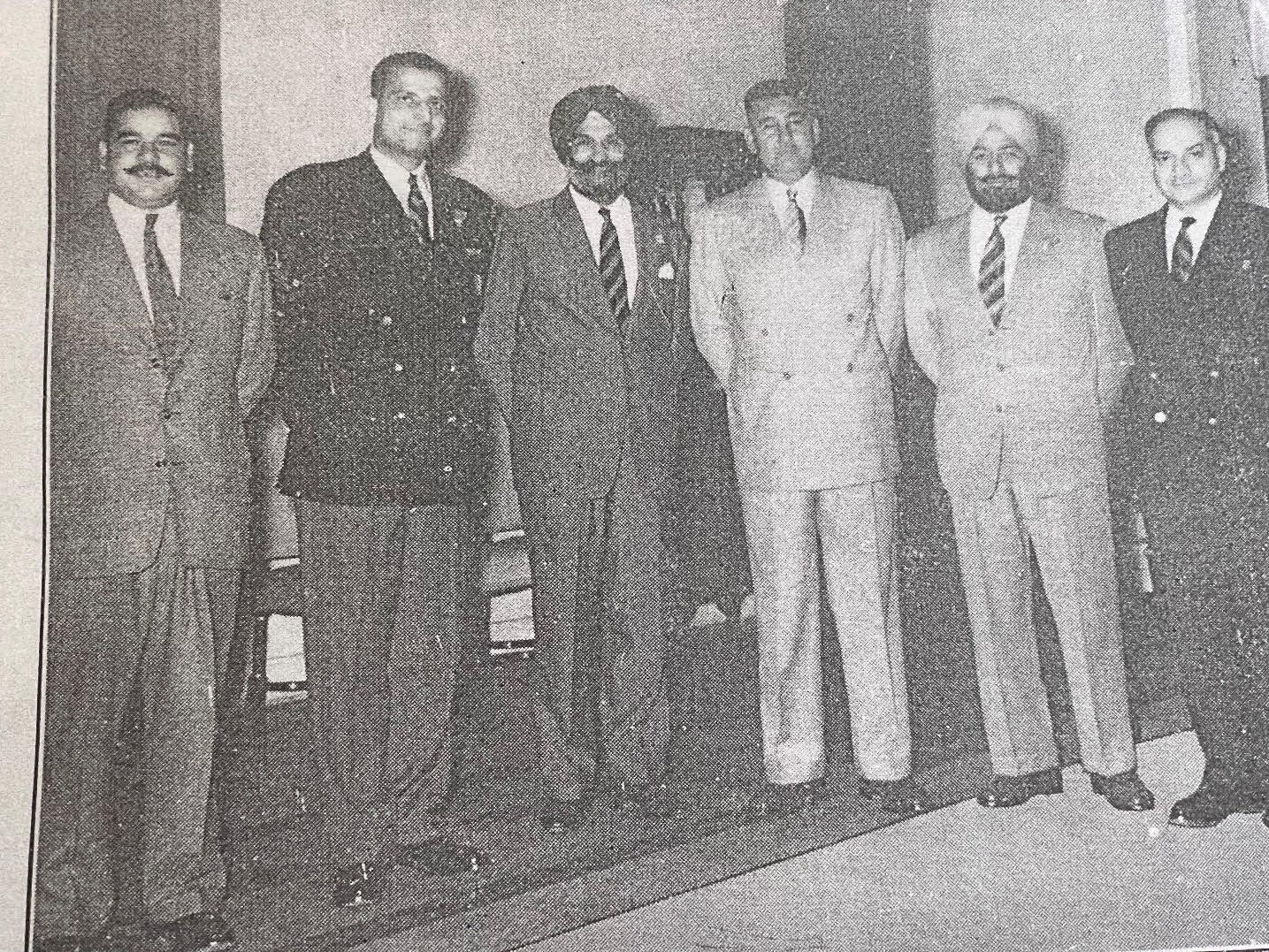
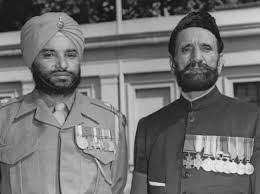
The above picture was taken in June 1956 during centenary ceremonies of Victoria Cross (VC) holders in London. Sepoy (later Subedar) Khudadad Khan represents the first generation who fought in First World War while Naik (later Subedar Major) Gian Singh represents the second generation of Indian soldiers who won his VC in Second World War.
Indian soldiers of British Indian army were not eligible for Victoria Cross (VC) until 1911. The highest award that an Indian soldier could get was Indian Order of Merit (IOM) prior to the eligibility for VC. Indian winners of VC belonged to all religions and ethnicities. Many Jat, Mahratta, Dogra, Garhwali and Gujar Hindus, Gurkhas, Sikhs, Punjabis, Pathans and Rajput Muslims fought with utmost bravery in battlefields all over the globe. Many rightfully earned the highest gallantry award.
Eleven VCs were awarded to Indian soldiers in First the World War and twenty-eight in the Second World War. In the First World War, six VCs were won in France and Belgium, three in Mesopotamia and two in Palestine. In the Second World War, eighteen VCs were won in Burma, six in Italy, two in North Africa and two in East Africa. Infantry VC winners came from different regiments of the Indian army. Gurkha Rifles won twelve VCs, Punjab Regiment nine, Frontier Force Rifles three, Baluch Regiment three, Garhwal Rifles two, and Rajputana Rifles two. Dogra, Sikh, Jat and Mahratta Light Infantry regiments won one VC each. The Indian cavalry won two VCs – Gobind Singh of 28th Cavalry (later 7th Light Cavalry) attached to 2nd Gardner’s Horse was the first VC winner from cavalry followed by Badlu Singh of 14th Murray’s Jat attached to 29th Lancers. Only one Indian gunner, Havildar (later Subedar Major) Umrao Singh of 30th Mountain Regiment and one from Corps of Engineers, Second Lieutenant (later Lieutenant General) Premindra Singh Bhagat of 21st Field Company won the VC.
Sepoy (later Subedar) Ishar Singh is the winner of VC that was awarded to an Indian for gallantry on Indian soil. Ishar Singh of 28th Punjabis (later 4th Battalion of 15th Punjab Regiment and now 12 Punjab Regiment of Pakistan army) won this VC on Indian soil at Haidari Kuch in Waziristan in 1921. 4th Battalion of 15th Punjab Regiment (now 12 Punjab Regiment of Pakistan army) has the rare distinction of winning three VCs and all three recipients were Sikhs (Ishar Singh, Gian Singh and Karamjeet Singh Judge). The only other battalion that holds this distinction is 2nd Battalion of 5th Gurkha Rifles – Subedar Netrabahadur Thapa of 2nd Battalion of 5th Gurkha Rifles received a posthumous VC. He was killed on Indian soil at Bishenpur in Manipur, but he was not an Indian citizen.
The British had special affection for Gurkhas, and it was not without reason as on every battlefield they proved their worth. Gurkhas were not Indian citizens and were recruited from Nepal that was not a British protectorate. Gurkha Rifles won two VCs in the First World War and ten in the Second World War. There were ten Gurkha Rifles Regiments numbered 1-10, each with two battalions. In 1948, an agreement was reached between the governments of United Kingdom and India where 2nd, 6th, 7th and 10th Gurkha Rifles were transferred to the United Kingdom to form the Brigade of Gurkhas of British army. India inherited the First, 3rd, 4th, 5th, 8th and 9th regiments.
2nd Battalion of 5th Gurkha Rifles holds the distinction of having three Indian VC winners among its ranks (Gaje Ghale, Agansing Rai and Netrabahadur Thapa). 5th Gurkha Rifles was part of Punjab Irregular Frontier Force (PIFFER) with regimental home at Abbottabad. On partition, 5th Gurkha Rifles left for India and many Indian officers of 12th Frontier Force Regiment and 13th Frontier Force Rifles that were allotted to Pakistan opted to affiliate with 5th Gurkha Rifles to maintain the old PIFFER connection. The list includes Field Marshal Sam Manisha and Major General Naranjan Prasad (both ex 4th Battalion of 12th Frontier Force Regiment; now 6 Frontier Force Regiment) and Major General Mohinder Singh Chopra and Major General Anant Singh Pathania (both ex 6th Battalion of 13th Frontier Force Rifles; now 1 Frontier Force Regiment).
Subedar Major Ganju Lama’s real name was Gyamtso Shangdarpa (1924-2000) and he was not a Gurkha but a Bhutia from Sikkim. Gurkha Rifles was an exclusive club reserved only for Gurkhas of Nepal. During the Second World War, additional Gurkha battalions were raised, expanding to forty battalions. Gurkha suffered heavy casualties with over nine thousand dead and several thousand wounded and were in dire need of manpower. It opened its doors to areas surrounding Nepal whose inhabitants resembled a Gurkha. He won his VC with First Battalion of 7th Gurkha Rifles but in 1948 opted for India and joined 11th Gurkha Rifles as 7th Gurkha Rifles became a British army regiment. On the other hand, Rifleman Tulbahadur Pun won his VC while serving with 3rd Battalion of 6th Gurkha Rifles of Indian army. In 1948, when 6th Gurkha Rifles was allotted to the United Kingdom, he stayed with his regiment and later became Regimental Sergeant Major (RSM) of 2nd Battalion of 6th Gurkha Rifles.
Muslim recipients of VC were part of the Indian army. Seven Muslim soldiers of Indian army won VC. Three VCs were awarded in the First World War (Khudadad Khan, Mir Dast Afridi and Shahamad Khan) and four in the Second World War (Abdul Hafiz, Ali Haidar, Sher Shah and Fazal Din). Of the seven Muslim VC recipients, four were Punjabi Muslims, two Pathans and one Muslim Rajput (Ranghar). The longest surviving Muslim VC holder was Ali Haider who died in 1999.
Three VCs were awarded posthumously and all three are buried outside India-Pakistan. Jamadar Abdul Hafiz (1915-1944), a Muslim Rajput (Ranghar) from the village Kalanaur was serving with 3rd Battalion of 9th Jat Regiment. He was awarded VC posthumously in April 1944 during the battle of Imphal on the Burma front. Lance Naik Sher Shah (1917-1945)was a Punjabi Muslim and won his VC posthumously in January 1945 on Burma front. He was from 7th Battalion of 16th Punjab Regiment (now 19 Punjab of Pakistan army). Naik Fazal Din (1921-1945) was a Punjabi Muslim from Hoshiarpur district. He won a posthumous VC in March 1945 in Meiktila on Burma front. He was from 7th Battalion of 10th Baluch Regiment (now 15 Baloch Regiment of Pakistan army).
Sepoy (later Subedar) Khudadad Khan (1888-1971) was the first Indian winner of VC. He won his VC in October 1914 in Belgium. He was a Punjabi Muslim from Chakwal area. The Salt range of Rawalpindi district was a traditional recruiting ground of Indian army. Generations of Muslims, Hindus and Sikhs of the region proudly served with the Indian army. Some writers have wrongly identified him as Pathan. There are two reasons for this confusion. One is his last name of Khan which is a common Pathan last name and second is the fact that a substantial portion of his battalion, 129th Baluchistan Infantry (later 4th Battalion of 10th Baluch Regiment and now 11 Baloch Regiment of Pakistan army) consisted of Pathans. This battalion went to the killing fields of the First World War with six Pathan (three Mahsud, two Jowaki Adam Khel Afridi and one Mohmand) and two Punjabi Muslim companies. Jamadar (later Subedar) Mir Dast Afridi (1874-1945) was a Kambar Khel Afridi Pathan of tribal area of Tirah. He was from 55th Coke’s Rifles (now 7 Frontier Force Regiment) but attached to 57th Wilde’s Rifles (now 9 Frontier Force Regiment) when he won his VC in Belgium.
Naik (later Subedar) Shahamad Khan (1879-1947) was a Punjabi Muslim from Tahiti village of Rawalpindi, a traditional recruiting ground of Indian army. He won his VC in April 1916 in Mesopotamia (Iraq). He was from 89th Punjabis (later 1st Battalion of 8th Punjab Regiment and now 1 Baloch Regiment of Pakistan army).
Sepoy (later Naib Subedar) Ali Haider (1913-1999) was a Bangash Pathan from Kohat district. Most cis-frontier (settled districts) Pathan recruits of Indian army came from Peshawar, Kohat and Hazara districts. He was from 6th Battalion of 13th Frontier Force Rifles (now 1 Frontier Force Regiment). He won his VC in April 1945 in Italy.
Many post-independence writers of India and Pakistan look at the past through the new prism of nationalism that can cause some confusion. On one end of the spectrum, Indian soldiers of the Raj are labelled simply as mercenaries and forgotten. The simple fact is that in contrast to conscript armies of Europe, the Indian army was a volunteer force where applicants always outnumbered the available vacancies. Mercenaries fight to live to enjoy their pay and pension, not eager to give the supreme sacrifice. On the other end, post-independence national narrative colors the acknowledgement. In India, most will honour only Hindu and Sikh soldiers of the Raj while in Pakistan only Muslim soldiers are remembered. Parkash Singh was a Sikh but was native of Lyallpur now in Pakistan and he won his VC with 5th Battalion of 8th Punjab Regiment that was allotted to Pakistan and is now 5 Baloch Regiment of Pakistan army. Three Sikhs won the highest gallantry award while fighting under the colours of 12 Punjab Regiment of the Pakistan army. Pakistan can rightfully claim these brave sons as its own. On the other hand, Abdul Hafiz was native of Kalanaur; now in India and he won his VC with 3rd Battalion of 9th Jat Regiment that was allotted to India. India can be proud of its son. Anyone can be proud of such individuals who performed beyond the call of duty, and many gave the supreme sacrifice to honour their oath.
“There is something unique and central in the faiths that the men in arms professed- to have been made incumbent upon men of different religions (Christian, Sikh, Hindu) to have lived, fought and died together.”
Major General Mohinder Singh Chopra about the Jullundur Brigade, Jullundur Brigade Book
Notes
Hamid Hussain. Indian Recipients of Victoria Cross, Defence Journal, January 2013
Hamid Hussain. Pakistan and Great War. Durbar: Journal of Indian Military Historical Society. Commemorative Edition, November 1918-November 2018, Volume 35. No. 2. Oxford: United Kingdom.
Sean Weir. Shah Ahmad Khan, VC, Durbar: Journal of Indian Military Historical Society. Commemorative Edition, November 1918-November 2018, Volume 35. No. 2. Oxford: United Kingdom.
Christopher Chant. Gurkha (Poole, Dorset: The Blandford Press, 1985)
War Times Friends website,
https://wartimefriends.org/en/interviews/dialogues_with_the_ambassador/victoria_cross_ali_hadar