
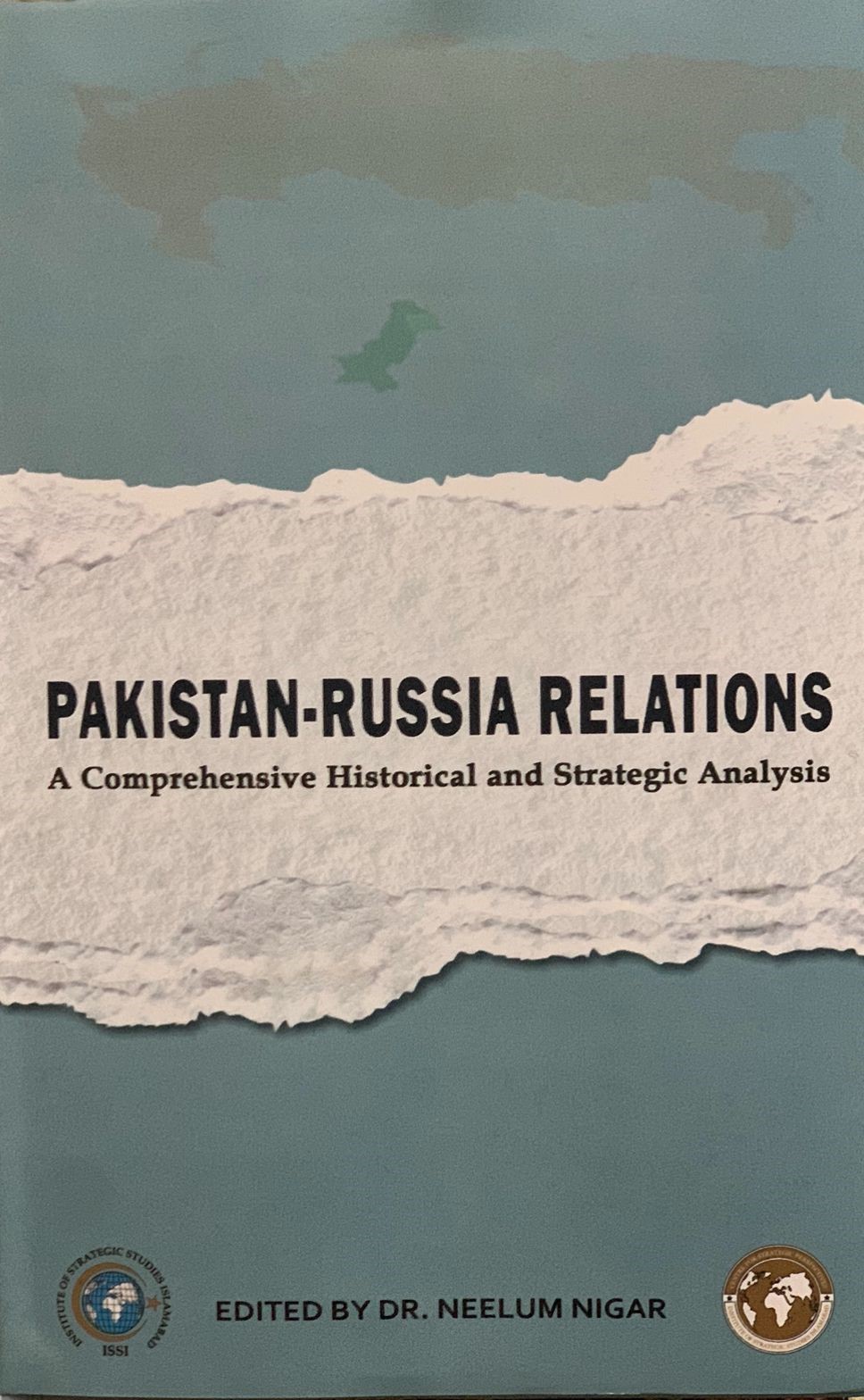
Comprehensive Historical and Strategic Analysis
Neelum Nigar (Edited.) (Islamabad: Institute of Strategic Studies Islamabad, 2025),
ISBN: 978-969-8772-23-9 (Pages: XV-321)
The present phase of Pakistan-Russia relations has attracted the attention of international intellectual communities towards the South Asian political landscape, where Moscow has rationalised its intent to cultivate multidirectional cooperative bilateralism with Islamabad. State authorities of the two sides have started collaborating in political, economic, and defence affairs while departing from their tradition bilateral interaction in its historical domains.
In this setting, the book under review has gained momentous significance in the Pakistani-Russian academic circles due to its exceptional analyses presented by authors from both countries. It is an edited volume compiled by an Islamabad-based author, Dr Neelum Nigar; she professionally belongs to the Institute of Strategic Studies Islamabad (ISSI) and is currently serving as Director of the Centre for Strategic Perspectives (CSP) at the Institute.
While arranging the views of distinguished scholars and renowned experts in the book from two countries, Nigar structured the book’s framework on four interconnected sections by emphasising the genesis of Pakistan-Russia relations and its landmark diplomatic achievements, growing strategic collaborations and regional security dynamics, the bilateral cooperative contacts in the economic, energy, and technology sectors, and increasing Islamabad-Moscow societal connections. The first section containing two chapters written by Ambassador Qazi M. Khalilullah and Dr Olga A. Kharina provide a chronological history of cooperative ties between the two states.
The former provides interesting arguments laced with empirical references, whereas the latter, with expertise on Russia-South Asia relations, underlined Key areas supporting the cordial Islamabad-Moscow ties. Both authors initiated the debate by maintaining a historical account of varying arguments expressing the Pakistani and Russian perspectives. The subsequent sections continued the discussion and covered different dimensions of Pakistan-Russia cooperative bilateralism and its shift towards constructing multileveled collaborative bonds.
The three chapters in the second section highlighted the important areas of strategic partnership in which Dr. Shabir Ahmad Khan treated the Pakistan-Russia ties as the response to the persistently evolving global political structure where the theories of realism, structural realism, hedging and liberalism are important for conceptual understanding (P.40)
The combination of naval exercises (Arabian Monsoon), military drills (Druzhba), and specific defence deals (MI35M Helicopters) are the milestone steps in this regard, according to Khan. Dr Nikolay D. Plotnikov from the Institute of Oriental Studies, Russian Academy of Sciences (IOS-RAS), presented post-Cold War developments in the Moscow-Islamabad diplomatic communication and political coordination while considering it a shift from the Cold War’s estrangement (pp. 59-60). Additionally, the joint vision of the two states on counterterrorism has been considered as an essential feature of their cooperative bilateralism, which has been covered by Dr Khuram Iqbal in the fifth chapter.
The contemporary patterns of Pakistan-Russia relations are emphasised in the book’s third section, which encompasses five chapters conversing on economy, energy, technology, and trading interconnectivity. Dr Ashfaque Hasan Khan, a renowned economist from the National University of Sciences & Technology (NUST), traced the challenges to the combined Pakistan-Russia economic vision parallel to presenting a concise overview of ongoing trading projects, ensuring trade connectivity and energy cooperation. Besides outlining specific challenges, the discussion on the viable economic opportunities has been conducted by Dr Afia Malik from the Pakistan Institute of Development Economics (PIDE). She offered an interesting comparison of Pakistan’s trade with the former USSR and the Russian Federation in her analysis (P. 125), corresponding with underscoring the collaboration in the energy sector.
The most captivating arguments emerged in the eighth chapter, inscribed by Muhammad Taimur Fahad Khan, research associate at the CSP-ISSI. Khan has attained an exceptional standing in the evolving intellectual thoughts on the improvement of Moscow-Islamabad bilateral ties. He was the first Pakistani researcher to participate in the Inter Russia Fellowship Program, and became the Honorary Research Fellow at the Centre for Scientific and Analytical Information (CSAI) at the IOS-RAS. Apart from mentioning the present initiatives and prospects of Pakistan-Russia relations, Khan has stressed on the overhauling of two-sided cooperative interaction by learning lessons from the stalled projects.
He referred to overcoming the institutional weakness with practical and long-term solutions while positively evaluating China’s transcontinental trading designs. The ninth and tenth chapters, designed by Dr Daria Saprynskaya, an analyst at the Gorchakov Public Diplomacy Fund, and Professor Adam Saud, an internationally prominent scholar on Central Asian studies, identified the geopolitical patterns of growing Pakistan-Russia partnerships. In the end, the last section containing the analysis of Dr Irina Serenko on cultural diplomacy and Dr Saira N. Abbasi on the multilateral forums traced the potential avenues of strengthening societal ties between the two states.
Natalia Melekhina’s last chapter focused on the challenges and opportunities for improving Islamabad-Moscow cordial interaction, parallel to concentrating on the specific strategic recommendations
Thus, the book is a thoughtful blend of Pakistan and Russian scholars, which is an exceptional academic effort laced with compelling perspectives highlighting Moscow’s strategic calculus and expanding interests in South Asia. In this way, this portrays an updated picture of Pakistan-Russia relations which is highly recommended for a wide range of readers who seek a deeper understanding of contemporary regional dynamics. Furthermore, scholars and students of International Relations, Strategic Studies, and Political Science can find this book particularly valuable for its impartial and evidence-based analysis.