
Davos, Switzerland, January 21, 2026
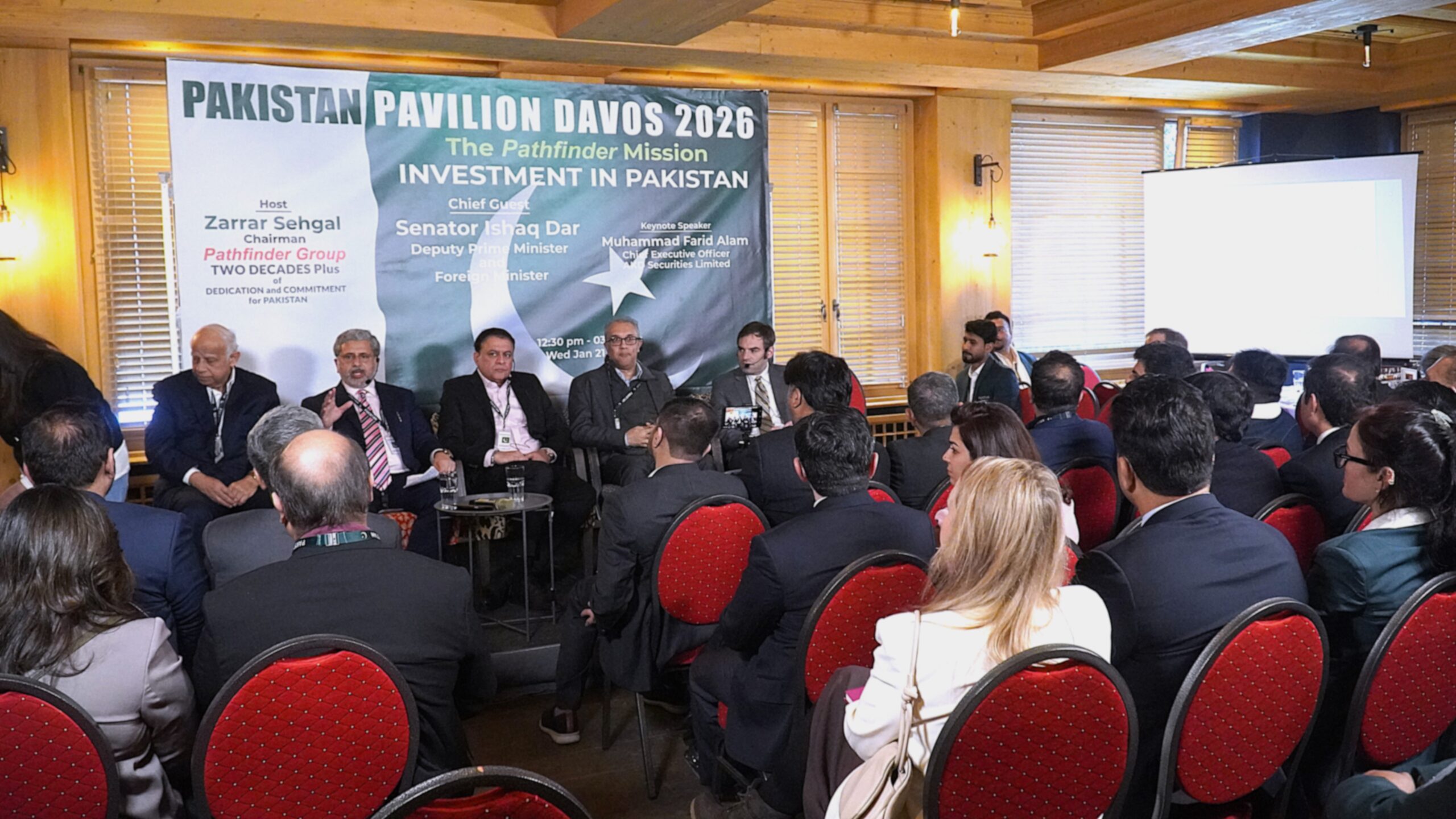
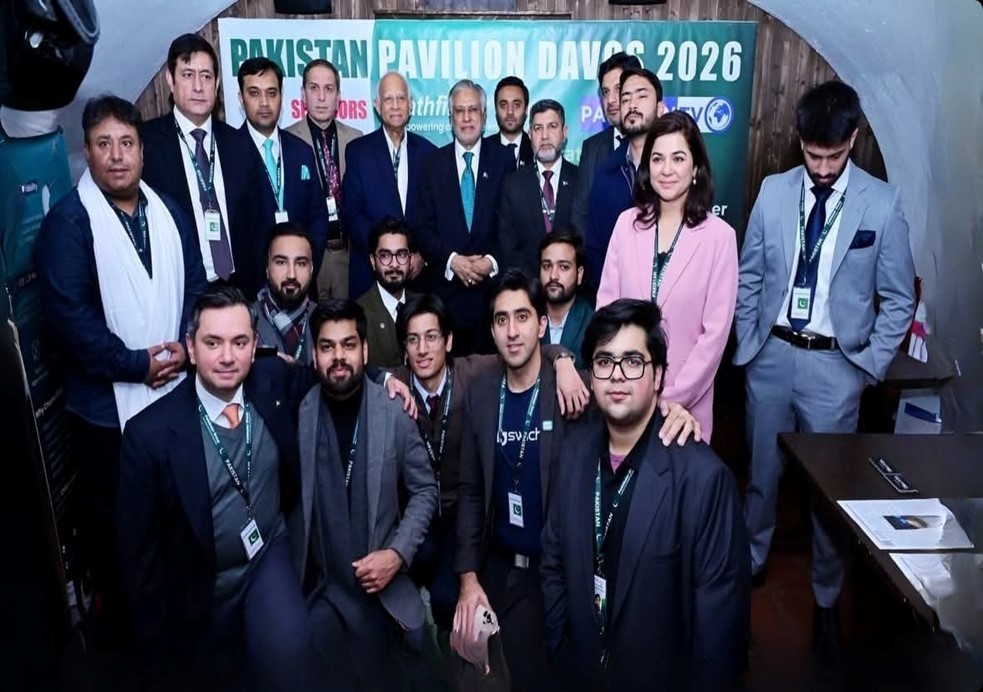
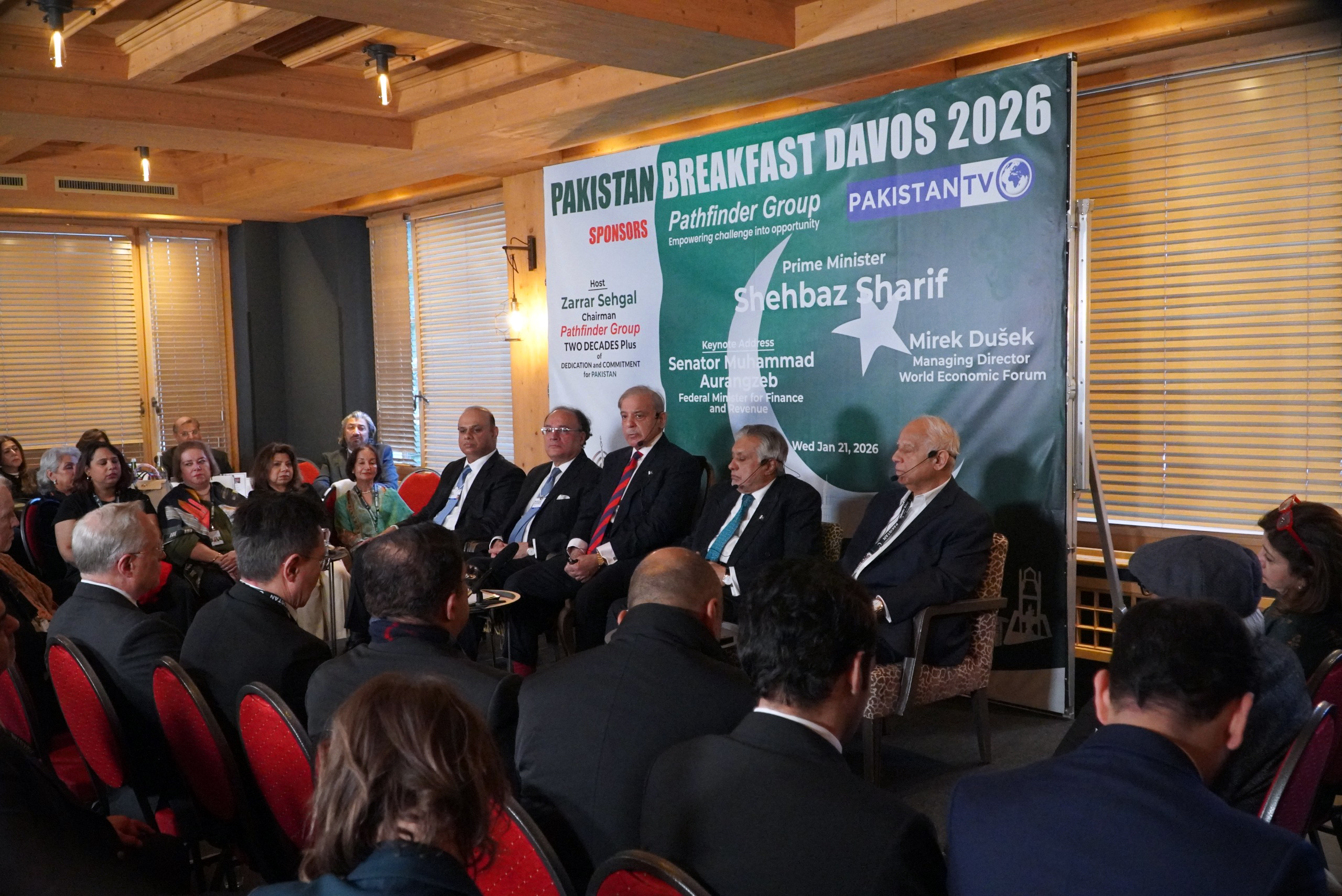
The Pathfinder Group hosted its flagship “Pakistan Breakfast” at the Pakistan Pavilion during the World Economic Forum (WEF) Annual Meeting in Davos 2026 on Wednesday, January 21, 2026, from 7:30 a.m. to 9:30 a.m., continuing a tradition that has become a cornerstone of Pakistan’s engagement at Davos for over two decades. Held at the Morosani Posthotel, the event brought together senior global leaders from government, business, finance, and international institutions.
The Pakistan Breakfast was hosted by Zarrar Sehgal, Chairman of the Pathfinder Group.
It was graced by Mian Muhammad Shehbaz Sharif, Prime Minister of Pakistan as the Chief Guest underscoring the importance Pakistan places on high-level international engagement and economic diplomacy at the World Economic Forum.
The keynote address was delivered by Senator Muhammad Aurangzeb, Federal Minister for Finance and Revenue, alongside an eminent group of international speakers, including Ross Perot, Jr., Chairman, The Perot Companies and Hillwood, and Mirek Dušek, Managing Director, Chief Business Officer and Head of Global Programming, WEF.
Zarrar Sehgal – Chairman, Pathfinder Group (Host)
On behalf of the Pathfinder Group, I welcome you to the 22nd Pakistan Breakfast. Distinguished guests, we have with us our esteemed Finance Minister, as well as an old friend, Mr Ross Perot Jr, Chairman of the Perot Group of Companies. We also look forward to welcoming the Prime Minister and the Deputy Prime Minister later this morning. Family members, old friends, thank you very much for coming. We are delighted to have you today. We are witnessing perhaps the most significant global realignment since 1945. Old alliances are being torn apart; NATO is under pressure. Trade alliances are being rewritten, and great pressure is being exerted on the post-Cold War order that had previously been maintained with some degree of success. Into this landscape enters Pakistan, a country of over 220 million people and counting. Where does Pakistan find itself? Frankly speaking, in an optimal situation. We are a nation with a vibrant youth population, skilled labour, and rapid technological progress. We are also a country rich in natural resources. I know there will be a lot of conversation today, led by people much better equipped than I regarding artificial intelligence and the start-up ecosystem. We have a breakfast session that will focus exclusively on those topics, and there will be speakers much more knowledgeable than I to address them.
However, I would like to take a step back first to discuss something perhaps even more germane and critical to us: our natural resources, specifically critical minerals and rare earth minerals. We possess perhaps the largest gold and copper deposits in the world. This places Pakistan in a pivotal position within a global supply chain that was first disrupted by COVID and is now being disrupted by newly imposed trade barriers. Pakistan has significant resources in copper, cobalt, and lithium, and, according to geological studies even rare earth minerals, which would be a true game-changer for us. This administration has done a fantastic job in developing these resources, establishing a framework for trade and development that projects almost $6 trillion worth of available mineral deposits. Almost $2.8 billion is expected to come from the Reko Diq copper and gold deposits annually as we work to develop them. I believe this will truly be Pakistan’s moment if we can harness these resources. What we achieve here will determine the position Pakistan finds itself in going forward. With that, I welcome you again to our Annual Breakfast. Next, you will hear from Ross Perot Jr. Ross is an old friend of ours and the first man to have flown a helicopter around the world in less than 30 days. He sits on many boards and was also recently referenced in a popular show. Ross, thank you for being here; we would like you to say a few words.
Ross Perot Jr. – Chairman, Perot Group of Companies (U.S.):
Thank you very much. Ikram, thank you and your family for inviting me. This is our 22nd Pakistan Breakfast. Joel, it is great to see you again. All three of us used to work at an institute called the East West Institute where we focused on Track II diplomacy, helping to build bridges around the world. Our founder, John Mors was a critical player in maintaining global peace and stability, and that is how I became friends with Ikram and Joel. Looking at the world today, I also serve as Chairman of the United States Chamber, where we are very active in building business ties globally. Last year, we sent over 25 delegations around the world. With over three chapters in the United States and 140 offices worldwide, we are deeply involved in promoting global economic growth between our nations. We have maintained a very active programme with Pakistan and a productive dialogue between the United States and Pakistani businesses. It is an exciting time for us as we continue to grow these relationships.
As Zarrar said, the world is under strain. From a business perspective, while politicians act as they do, it is our responsibility to maintain these connections. These long-term business relationships can maintain stability, and we are working hard to build that stability, prosperity, and economic growth globally.
It is an exciting time in the world; there are certainly things to worry about, but we also have the AI revolution coming. This revolution will bring massive productivity increases. It is going to be an exciting era to witness, and I am sure all of us are embracing AI and learning how to use these tools. AI today is very crude compared to what we will see in ten years. You read about the energy and chip demands associated with AI, but we will also see huge efficiency gains in both AI and GPUs. This revolution will continue, becoming increasingly productive and serving as a great tool to make the world even more successful. Zarrar, thank you. I am glad to be back, and I must remind the group once more what a great helicopter pilot your father is. When he came to see me recently, and I am still an active helicopter pilot myself, I put him in the cockpit. He didn’t need any warm-up at all, even though it had been 20 or 25 years since he last flew. He took off, flew around Texas, and got us back in one piece. He is a natural helicopter pilot and a very good friend. Thank you very much.
I am so impressed that you watched Landman in Pakistan. As a Texan, that show represents a bit of who we are. We now host all of Taylor Sheridan’s studios, the largest in Texas, where he films all those shows. I know Taylor and the cast well. Do you watch Lioness? The last scene featuring Nicole Kidman was filmed in our barn, which some of you have seen. She was with us for a week. If you have ever been around a Hollywood set, you will notice it is not very efficient.
As a businessman, you look around and wonder why they aren’t working all the time, but we had 300 people in that barn. They turned it into a hacienda for a major drug-dealing operation. They told me, “Nicole is going to come in and kill a drug dealer; do you mind?” I went to my wife, Sarah, whom many of you know, and asked, “Do you mind if they kill somebody in the barn?” She said, “No, absolutely not. No killing in the barn.” I went back to Taylor and told him she didn’t want anyone killed in there. He asked, “Okay, can we kill him outside the barn?”
I said I’d check. He eventually said, “Look, we’re going to kill him outside, but you’re not really going to see him get killed.” We eventually watched the show together, and Sarah said even that was too much. So, I am not sure about any more “killing” in the barn! But if you look at that last scene, it is indeed our barn. If you ever come to Texas, make sure you stop by to visit, and we will show you the studios. I am excited that Texas culture reaches around the world; I have friends in Africa and Europe who watch these shows, and now I can tell Taylor that he has great fans in Pakistan as well. Thank you.
Zarrar Sehgal (Host):
Thank you, Ross. We grew up watching Dallas, so Landman wasn’t a big jump for us. I will now turn to Mirek Dušek, Managing Director here at the World Economic Forum. Mirek, thank you for joining us. I know there are many demands on your time, especially this week, and your rise within the World Economic Forum has been like a rocket ship. I appreciate you coming.
Mirek Dušek – Managing Director, Chief Business Officer, & Head of Global Programming WEF:
Thank you for the amazing partnership with your company, Pathfinder, but also with Pakistan overall. You have been with the World Economic Forum since the get-go, and I wanted to recognise that. It is always a pleasure to be here. I have two functions at the Forum: I am responsible for the overall meeting here and I am also the Chief Business Officer. In that role, I work with amazing companies like yours around the world, which is what makes the WEF special. We started back in the 1970s by working mainly with the private sector, and I am happy that more and more companies are joining the Forum as partners. You mentioned the AI revolution. When I look at the types of companies that have joined us over the past year, we have added 140 major companies from around the world. The trend is clear. We are adding companies, particularly in the AI and ICT industries, as well as energy and financial services. There are certain insights you can glean just from observing the growth of our partners at the Forum.
I would also like to thank the Finance Minister. It is a pleasure to be here in your company, and I know you have a long-standing engagement with the WEF. I would like to say a few words about the overall context as we see it. I have the pleasure of working with the team that designed the program for this Annual Meeting. You may have seen the theme, “Spirit of Dialogue.” There are two dimensions to it. One is rooted in the tradition of this gathering; this is the 56th year of the Annual Meeting in Davos. There is something that regular attendees call the “Spirit of Davos,” which has always served as a platform for dialogue.
We existed through the Cold War, the 1990s, and the early 2000s, navigating various geopolitical eras. As you mentioned, Zarrar, I think there is a robust consensus right now that we are entering a new era. Whether it is a transition or we are already in it, it is a more contested world. However, the essential function of people coming together from around the world to exchange ideas and gain a better understanding of different perspectives has never been more important. We are building on that tradition again this year. Then there is the second dimension: because of the current contestation and the increasingly complicated, fragmented geopolitical environment, we believe we must play our part. While it is often said that multilateral institutions are under pressure, we feel it is our duty to do our best to fulfill that role. This is reflected in our attendance, with 65 heads of state and government present. We have the President of the United States arriving today, and we hosted several European leaders, including the Vice Premier of China yesterday. It is vital that we drive this engagement and, hopefully, foster greater understanding.
I also want to address another aspect that is equally important. When looking at the global economic landscape, alongside fragmentation, we see an unprecedented pace of innovation and technology deployment within industry and society. I will conclude with that thought. In fact, I am just heading to a session titled “Shaping the AI Supersystem.” Mr. Perot, you mentioned earlier that this is not only about the technology, the Large Language Models (LLMs), the world models, and physical AI, or the state of the economy; it is truly a whole-of-industry shift. When policymakers consider competitiveness in the context of the AI revolution, they must think of it as a system.
We are already seeing tremendous innovation within the financial services sector regarding how to invest in and ensure these advancements. There are also significant shifts in energy demand and what that implies. We see nuclear power returning in a big way, and various new technologies are being discussed alongside other systemic aspects. I wanted to highlight this because I know that, together with Pathfinder, we have done work regarding the innovation ecosystem in Pakistan. This will be a major focus for us here at the Annual Meeting in Davos, and we very much look forward to your contributions. Thank you for having me.
Zarrar Sehgal (Host):
Thank you, Mirek. I know you are running from one event to another, so we truly appreciate your time. Despite my earlier promises, I will touch on AI for a moment since it has been mentioned. I know we will discuss digital financial inclusion, a field where the Pathfinder Group has been a leader through our platforms, such as the Asaan Mobile Account (AMA) and VRG. However, I believe AI can play a critical role in Pakistan’s future, specifically in the field of education. Admittedly, there has been an education gap in Pakistan, with a large youth population currently out of school. We are seeing a shift where traditional three or four-year degrees are being challenged by artificial intelligence; these skills can now be taught in under a year. What used to take years to master can now be acquired much faster, and I believe AI will be instrumental in bridging that gap for us very quickly. Thank you, Mirek, for bringing AI into the conversation.
Next, I would like to introduce our keynote speaker, Finance Minister Senator Muhammad Aurangzeb. We are delighted to have you with us. His career spans over 35 years plus in the finance industry, having served as the CEO of several major institutions, most notably Habib Bank Limited, as well as leading JPMorgan Chase in the Asia region. A Wharton MBA graduate, you have held numerous senior positions across the global banking sector. More pertinently, you have been the architect of reforms through the IMF and other avenues in Pakistan. You have revived economic growth and placed it on a sound footing. We are obviously very keen and excited to see where you take Pakistan next, economically. With that, I give the floor to you. Thank you very much for being here.
Senator Muhammad Aurangzeb – Federal Minister for Finance and Revenue:
Thank you, Zarrar, Chairman of Pathfinder Group, distinguished participants, it is a real pleasure to be back here again. I will pick up from where we left off last January regarding Pakistan’s journey. You will, of course, hear from the Prime Minister regarding where we are, but more importantly, where we are going. During the course of last year, we consolidated our gains in terms of macroeconomic stability. All macro indices, whether it is our current account, fiscal surpluses, or inflation, are moving in the right direction. Inflation is now down to single digits; the policy rate is down; and our foreign exchange reserves are stable, now at 2.3 times import cover. This is not just my assessment; we have external validation. The three global rating agencies upgraded us over the course of the last year and they are maintaining a positive outlook for the country.
Furthermore, as you mentioned, we are in a Fund review, and we have completed the second review of the current program and the first review of the Climate Resilience Facility. This progress is all on the back of structural reforms, something that has been elusive for Pakistan. While there is often debate regarding whether reforms are truly happening, the reality is that we are receiving significant international recognition for reforms that are no longer in the design phase, but are very much in execution. This is particularly true for our tax authority in terms of people, processes, and technology. As was mentioned regarding AI, technology is playing a critical role by leading with data analytics and connecting databases.
We are utilizing AI-driven production monitoring to stop “leakages,” and in Pakistan, “leakages” is often a euphemism for corruption. The only way we can bring this to the next level is through technology which reduces human intervention. We have made good headway, though we still have a long way to go. Our tax-to-GDP ratio is now in double digits, but we still have work to do before we can declare true fiscal sustainability.
That being said, we are working to bring previously untaxed sectors into the net. There is a frequent discussion about whether we are simply going back to the same taxpayers for more, while there is an element of that, the only way to move beyond it is by expanding the net and ensuring greater compliance and enforcement through technology. Let me give you a live example of what this actually means. NADRA, the institution that holds our national identity database has access to my entire lifestyle data, everything from the houses I own and my travel history to my cars and utility bills. Similarly, the Federal Board of Revenue (FBR), our tax authority, has records of the taxes I pay. All we have done is connect these databases so that we can inform individuals and corporations of what they owe the government, backed strictly by data rather than other means. That is what is happening on the taxation side.
On the energy side, significant reforms have also taken place within the power sector. We have brought the circular debt down and improved governance. Many boards of the power distribution companies are now manned by the private sector, and their chairpersons are also from the private sector. As I mentioned, circular debt is being brought down, and we now have five DISCOs (Distribution Companies) on the active privatization list. For three of these, we have Alvarez & Marsal as sell-side advisors, and we have engaged a Turkish investment bank to advise on the other two. As we move forward, the Privatization Commission will decide whether we proceed with outright privatization or an outsourcing model. The reform of State-Owned Enterprises (SOEs) is absolutely critical. We lose close to a trillion rupees every single year due to the inefficiencies of these SOEs. To address this, we have handed over 24 state-owned enterprises to the Privatization Commission. The fact that, after decades, we have been able to privatize our national airline is a significant tailwind for other privatization processes. It ticks many boxes. First of all, it involved local investors—large local groups who collectively submitted bids totaling about a billion dollars, one of which was successful.
Secondly, and Sabrina is sitting here, her group made a $500 million investment last year in terms of share purchases in Pakistan. This demonstrates the growing confidence of our major corporate players in the country’s economic direction. I am a firm believer that before we talk about FDI or foreign investors, we must provide the level of comfort that encourages local investors to invest in Pakistan. That is the starting point, and from that perspective, we are on our way. In terms of public finance, debt servicing remains our single largest expense. To address this, we have revamped our Debt Management Office, which works directly under me; a former Deutsche Bank professional now leads it. We have executed liability management trades to reduce the size of our debt servicing so that we can allocate these funds to other critical areas. Furthermore, we plan to return to the international capital markets this year. Our current focus is on issuing Pakistan’s inaugural Panda Bond. This will be the first time Pakistan accesses the Chinese capital market, which is the second-largest and deepest in the world. We have been remiss in not doing so earlier, and we look forward to that reaching fruition. We are currently awaiting final regulatory approval, and if all goes well before the Chinese New Year, we should be conducting the inaugural Panda Bond issuance.
Subsequently, we will look at whether we go for US Dollars, Euros, or Islamic Sukuks. This is important because, as you mentioned regarding multilaterals and the IMF, we need to get back on track and regain credibility with international investors, whether in the capital markets or the banking sector. This will be critical for our road back to the global market. Where do we go from here? We have gone through repeated boom-and-bust cycles. Every time we enter a stabilisation phase, there is a “gold rush,” and everyone, especially domestically, starts asking, “Where is the growth?” However, because we have been an import-dependent economy, the moment we put our foot on the accelerator and reach a certain GDP growth, we essentially run into balance-of-payments problems.
We have tried that approach repeatedly, only to end up running back to the lender of last resort. That is why we are currently in our 24th IMF program. This time around, under the Prime Minister’s leadership, we are very clear: it has to be export-led growth. This is not just a narrative; it is the only way we can achieve sustainable growth. It is as simple as that. On July 1, while much of the world was moving in the opposite direction, we introduced a new tariff regime aimed at reducing regulatory duties, additional customs duties, and other barriers. This was done to make Pakistan’s industry more competitive by allowing for cheaper imports of raw materials and intermediate goods. There has been a lot of resistance in Pakistan regarding this because we have protected our industry for the longest time, but we cannot continue to do so. We must make them competitive. As I have stated in various forums, we must provide the industry with competitive energy costs and the right taxation regime, and we must bring their financing costs down. The latter is an area where we have made very good progress.
However, having said that, our industry must also review and change its own business models to ensure they are competitive. This applies to companies as much as it does to countries. I was just mentioning to the Managing Director that when I was here last year, there was a discussion regarding whether the rules-based order was going to change. At the time, I did not realize just how significant that change was going to be. Everyone must be adaptive; everyone must react. As I often say, it takes two to tango; the government will do what is necessary, but industry must also play its part by reviewing its business models. Our growth must be export-led for the sake of sustainability, and we will provide the necessary ecosystem. This is all in the context of what I call the “old economy.”
We should now discuss the “new economy,” especially since AI is such a significant theme this year. For Pakistan, AI means several things; I see it in the context of Web3, Blockchain, and AI combined. We have one of the top five freelancer populations in the world. Currently, many are coding at rates of $12 to $14 per hour. However, the first Centre of Excellence has already been established at LUMS, a very renowned university in Lahore. It was funded by a $13 million donation from a highly successful Pakistani-American to set up a Blockchain Centre of Excellence. If we can upskill and reskill our youth and our freelancers, and many of my IT colleagues are sitting here today, they can start coding at rates anywhere from $50 to $250 per hour. That is fantastic for them and great for the country.
Regarding IT services, for the first time in our history, exports touched $437 million in the month of December. This means we are likely to exceed $4 billion, or perhaps even $5 billion, in annual IT exports. Think about that in the context of our traditional export base, which has hovered around $30 billion for the last couple of decades, fluctuating only by about 5% up or down. In one go, this new sector is providing the kind of momentum we have been looking for. Before discussing crypto and other sectors, I want to touch upon minerals and mining.
We recently saw the largest syndication in Pakistan’s history, a $3.5 billion facility led by the IFC, which has been closed for the Reko-Diq project. In fact, this would have been completed in October, but the US government shutdown caused a delay. We were very keen for US EXIM to join because a significant portion of project procurement originates from the United States; it was vital for them to participate in the main syndication, and they have now done so. As Zarrar rightly pointed out, the first year of exports, with commercial operations expected to begin in 2028, is projected at $2.8 billion. Again, in the context of our traditional export base, that represents a 10% increase.
Our challenge now is to bridge the gap between now and 2028. However, 2028 is not the “North Star” or the final destination; Reko Diq is simply the first mine, and other projects are already underway. From our perspective, the Tethyan Belt in Balochistan is Pakistan’s supply-side response to the inevitable global copper and energy shortages as the world moves toward energy and EV transitions. This project is merely the first step in that journey. Other projects in our pipeline are going to come online, and hopefully, that will allow us to move into smelting. While a single mine cannot support value addition on its own, once we achieve scale, we can move into smelting and further value addition. Just as nickel has been for Indonesia, copper, InshaAllah, will be for Pakistan as we move forward. Regarding this export-led strategy, many people ask where the exports and the strategy are. We need to bridge the gap between now and 2028, and between IT and minerals and mining, what I call the “new economy.” I believe we will, InshaAllah, be in a very sustainable position.
The last thing I want to mention is AI and crypto. I chair the Pakistan Crypto Council. When I was here at this time last year, the data showed Pakistan’s growing role; according to Chainalysis, we were ranked number ten, then seven, and by the beginning of last year, we were number three, with 40 million crypto users in Pakistan. Currently, this activity is happening outside the formal economy. To address this, we formed the Crypto Council and the Pakistan Advisory & Regulatory Authority (PARA). We are very grateful to the White House and the UAE government for the support we have received in establishing this regulatory authority. We have issued No Objection Certificates (NOCs) to HTX and Finance to begin exploring tokenisation. We are looking at public debt as the first use case, before moving on to remittances and real estate to see how we can take those forward. From our perspective, it is not only about the use cases; it is also about addressing KYC (Know Your Customer), AML (Anti-Money Laundering), and suitability requirements. We must bring these activities into a regulated environment as we move forward.
As the Prime Minister is about to arrive, this is a suitable point for me to conclude this snapshot of our current standing. Things are looking up, but as I have stated, there is no room for complacency. Pakistan has a long way to go. We must break away from these boom-and-bust cycles, and doing so will require patience to ensure we do not fall back into that rut. We are very grateful to all our bilateral partners, and you will hear more on this from the Prime Minister. They have supported us through thick and thin. There are not many countries in the world that can engage with both the US and China in the same breath, and we are very fortunate at this point to do exactly that. From this perspective, I believe we have the right pillars in place to take the country to the next level. I keep on saying that the ball is in our court, how we capitalised on this, how we sort of take it forward and don’t miss the opportunity this time. Thank you for your patience here.
Zarrar Sehgal (Host):
Senator Aurangzeb, thank you very much for your encouraging words. I should also mention the discovery of antimony in Pakistan. For those interested in critical and rare earth minerals, antimony is an essential component in the manufacturing of military equipment, such as night-vision goggles. This discovery could be pivotal for Pakistan and we hope the government will invest in the infrastructure needed to develop these resources. While we wait for the Prime Minister, I would like to ask about the privatisation of Pakistan International Airlines (PIA). Rather than focusing on the past, how do you envision the future of this transition? The government has retained certain aspects of the airline, so what are your thoughts on how the transition will unfold?
Senator Muhammad Aurangzeb – Federal Minister for Finance and Revenue:
I give a great deal of credit to the caretaker administration, as that is where the process began by parking liabilities into a holding company. The two major hotel assets, the Roosevelt and the Scribe, were also moved there, effectively carving out what I would call “Old PIA.” With the debt term out, the entity that investors have now acquired is the “New PIA, “the “clean” version of the airline. Quite frankly, that is how we must look at all things going forward in terms of our existing stock: how we stop the bleeding and how we move the “new” entities forward.
If you ask investors to come in, after what I have no problem describing as decades of negligence, mismanagement, and kicking the can down the road, and expect them to take the good with the bad, it simply does not work in real life. Therefore, the PIA model is a good way to think through these challenges. Regarding broader privatisation, we also have insurance assets. While insurance is profitable, I often encounter certain mindsets in my role as head of the Cabinet Committee on State-Owned Enterprises.
People frequently tell me two things: first, that they are “doing God’s work” and therefore should not be touched; and second, “don’t worry, while it might not have worked for several years, this time, InshaAllah, it will go forward. “It is tough to swallow those arguments. Therefore, we have taken these matters to the Cabinet Committee on Privatisation, chaired by the Deputy Prime Minister. As I mentioned, we now have 24 state-owned enterprises on the active privatisation list.
Another area where we would request help is in engaging sell-side advisors, individuals like yourselves, to provide the right counsel regarding international legal experience. We have faced challenges because, for a couple of decades, there has been a perception that the government is not serious about privatisation or about letting the private sector lead the country. I believe our current progress ticks a lot of boxes, proving that we are serious and committed to seeing these processes through to the finish line. As I mentioned, this includes the five DISCOs, the outsourcing of three airports, our insurance assets, and several other financial institutions that are now on the active privatisation list.
Zarrar Sehgal (Host):
Well, you always have my services pro bono. For Pakistan, I will always offer them for free; that is perfectly fine. One area you haven’t touched upon is the stock market and its recent rise. Do you feel more reforms are needed there? While you mentioned prioritising local investors, a stock market ultimately requires foreign participation to fully mature.
Senator Muhammad Aurangzeb – Federal Minister for Finance and Revenue
My information is slightly dated. I last checked a couple of hours ago, but the market hit a new high today. I believe the index reached the 189,000 mark. I believe that whatever is happening in the stock market is a derivative of what is happening in the real economy. I look at this from a few perspectives. First, corporate profitability is real.
Second, approximately 120,000 new investors have entered the market. We had nine IPOs last year, and there are 16 IPOs in the pipeline for this year. To me, this is very encouraging. Given the buoyancy in the market, entrepreneurs are willing to engage with the Equity Capital Markets (ECM); they are doing so because they want to modernize and expand.
We are beginning to see the results of that reflected in our growth; last fiscal year, our economy grew by 3.1%. In the first quarter of this fiscal year, the economy grew by 3.7%. Furthermore, Large-Scale Manufacturing (LSM), after a long hiatus, has shown a year-on-year growth of 6%. I connect these data points and conclude that if people are coming forward with IPOs, they must see a real opportunity to expand their businesses as we move forward. I view the stock market very much within the context of the real economy, and it serves as a fantastic data point to illustrate how things are progressing.
Zarrar Sehgal (Host):
I know this might be slightly outside your primary area, but Finance naturally overlaps with trade. With the global trade barriers currently being erected, has this provided Pakistan with new opportunities to enter into agreements with other countries?
Senator Muhammad Aurangzeb – Federal Minister for Finance and Revenue:
While trade is somewhat outside my direct expertise, I became involved because I was asked to negotiate tariffs with the United States. I led those discussions with Ambassador Tai and Secretary Lutnick. I believe we landed relatively well with a 19% tariff, which is competitive compared to our regional peers. However, we are in a rapidly changing world. We must ensure that we adhere to the terms of the tariff deal we negotiated with the US by July 31st. Simultaneously, we must ensure our industry becomes competitive enough to take full advantage of the comparative advantages we possess at this point. As I said, it is not my primary area of expertise, but I have learned a great deal about trade over the last year or so.
Zarrar Sehgal (Host):
I would like to welcome our distinguished guest, Prime Minister Shehbaz Sharif. Thank you very much, Sir, for joining us. I also want to thank our Finance Minister for his keynote address; we truly appreciate your time. With that, I hand over the floor to the Prime Minister. Thank you, Sir.
Mian Muhammad Shehbaz Sharif – Prime Minister of Pakistan:
Thank you very much. Mr Ikram, host of this wonderful gathering of Pakistani entrepreneurs, international dignitaries, and esteemed businessmen and women; Deputy Prime Minister Ishaq Dar; Finance Minister; ladies and gentlemen: Good morning, Guten Morgen, and Assalam-o-Alaikum to all of you.
It is truly a great honour and a pleasure to be here. I am very grateful to Ikram Sehgal whom I met today after perhaps two or three decades. Alhamdulillah, he is in excellent health, and his son is now leading the way. The Finance Minister has already addressed you and provided a clear picture of Pakistan’s economic and social situation. I will not repeat those points, as that would be quite redundant for you here in Davos. It is a chilly morning, at least for me, but I believe the global economic challenges are making the environment both warmer and more demanding.
Ladies and gentlemen, Alhamdulillah, Pakistan is now out of the woods. Back in June 2023, the economy was in a very fragile condition. I was concerned, concerns shared by the then-Finance Minister sitting to my left, that, God forbid, we could default on our sovereign financial obligations. I met with the Managing Director of the IMF in Paris in June 2023, and that meeting proved to be a turning point. We agreed on a short-term program, and those difficulties are now behind us. Pakistan is moving forward with a sense of accomplishment and purpose. Our macroeconomic indicators are quite reassuring: our inflation rate has decreased from 30% to 5.5%, and our policy rate has dropped from a steep 22.5% to 10.5%. Our IT exports are showing promising progress. While our overall exports face various challenges and our social indicators need continuous improvement through joint efforts, the path ahead is clear: Pakistan must focus on export-led growth. We have implemented fundamental structural changes in our system. I want to share a few important milestones with you. These goals may be familiar to our Pakistani brothers and sisters present here, as they have been mentioned numerous times in the past; however, they were not achieved in a significant way in previous decades. We have made substantial changes to our revenue collection system, which is now being fully digitised. Our tax-to-GDP ratio currently stands at 10.5%, compared to 9% just a couple of years ago. This is a significant achievement. Secondly, our agricultural exports last year were very encouraging. We are also entering the mining and minerals sector on a grand scale. We have signed agreements and MOUs with American and Chinese companies. By the grace of Allah, Pakistan has been blessed with an abundance of natural resources, still buried within the mountains of northern Pakistan, Gilgit-Baltistan and Azad Kashmir, as well as the provinces of Khyber Pakhtunkhwa and Balochistan, which have decided to move forward at an accelerated pace.
We are making significant progress in the fields of cryptocurrency, artificial intelligence, and information technology. Our IT exports have experienced remarkable growth in recent years. To support this growth, we have introduced several initiatives to facilitate IT exports, which now officially amount to $3 billion annually. It is often said that a portion of unofficial transactions exists in our IT sector, but we are working diligently to make these processes transparent.
Our youth bulge presents both a challenge and a significant opportunity. Therefore, the Government of Pakistan, alongside provincial governments, has introduced several programs to empower our youth through vocational training. The National Vocational and Technical Training Commission (NAVTTC) is the federal agency providing modern training to our youth. These programs are thoroughly vetted by third-party audits and are combined with international certifications. As a result, our youth are securing productive employment in the Gulf States and other parts of the world, as they are highly qualified, well-trained, and certified by international companies in their respective fields.
Regarding our international partnerships, we maintain strong economic connections with China and have also strengthened our relations with the United States. There is great hope for significant cooperation in the fields of mining and minerals, as well as continued collaboration in counter-terrorism, IT, and artificial intelligence (AI). I believe Pakistan is at a pivotal moment, poised for rapid growth across agriculture, industry, mining, AI, and IT. Our future looks promising, and I do not doubt it. I have a few additional points that should reassure those who believe in Pakistan’s strength: this government is committed to complete transparency. For example, we have just concluded the privatisation of Pakistan International Airlines (PIA), a national asset that, unfortunately, faced significant setbacks over the last few decades. It has now been acquired by the private sector in Pakistan.
The privatisation process was completely transparent; every aspect was broadcast by Pakistani channels and shown live around the world. For the first time, the entire nation witnessed the transparency of this transaction, and there has been no doubt regarding its authenticity, which I believe is now our hallmark.
We are moving forward in other areas of privatisation, including the outsourcing of airports and the privatisation of our power sector, specifically, distribution companies and transmission lines. It is also true that we are adhering to a very stringent IMF program in letter and spirit to restore our credibility. In past decades, our relationship with the IMF was often characterised by a game of “hide and seek.” We would enter a program, then abandon it, creating a significant gap and a level of mistrust between the IMF and Pakistan. That gap has now been bridged by honouring our commitments, even though they have been tough for the average citizen. Ordinary people have had to make sacrifices and pay a heavy price to uphold these commitments. As a result, the IMF is now cautiously using Pakistan’s success story as a model for other developing nations.
Now, we must move toward growth. I will be meeting with the IMF Managing Director after this interaction to discuss our achievements and structural reforms very openly. This includes the privatisation of entities that were draining our economy, for instance, the utility stores that offered substandard goods to the public. Corruption was rampant there, and the bureaucracy exploited these institutions; they have now been completely shut down ending that drain forever. This single action has saved billions of rupees for the national exchequer. Similarly, the Pakistan Agricultural Storage and Services Corporation (PASSCO), which had also become a centre of corruption has been closed, saving billions of rupees for the poor people of Pakistan. Similarly, the Pakistan Public Works Department (PWD), infamously known as one of the most corrupt entities in the country has been closed. We encountered challenges and pressure from vested interests, including employee protests and resistance from certain quarters.
However, we remained steadfast in our commitment; failing to act would have been unjust to ourselves and the people of Pakistan. This process is progressing rapidly. I believe that unless we address the economic challenges we face through these measures, difficult as they may be, our economy will not be on a sound footing, regardless of our other efforts. These achievements result from a collective endeavour. It may sound unusual to some, but I must assert with all certainty that this progress has been made through teamwork and complete harmony between the political and military leadership. Please do not misunderstand my statement. We live in a region that has experienced four martial laws, where the establishment has historically played a significant role in important matters. The critical point is that we must understand the reality on the ground if we intend to serve the common people of Pakistan, alleviate our mounting foreign and internal debts, reduce poverty and unemployment, and ensure the prosperity and progress of our country. Achieving this requires a sense of understanding among various stakeholders, with a shared sense of ownership and a clear purpose to move forward.
Despite the difficulties, we have reached an understanding on a program that serves the broader interests of Pakistan. This does not imply that we agree on every issue. Where there is complete consensus, we embrace those points and advance. In cases of contentious discussion, we set those matters aside for the time being. That is the reality, ladies and gentlemen. I have been honest and straightforward with you; it would be misleading to present a picture that does not reflect the facts. Harsh and challenging as these facts may be, we must acknowledge them and move forward together. Pakistan is at a crossroads, poised for significant growth. We are a nation of 240 million people. As I mentioned earlier, our substantial youth population represents both a great challenge and a tremendous opportunity. We are fully committed to transforming this into an opportunity by equipping our youth with the tools and prospects that will make our country great. We will face challenges along the way; there will be difficult roads ahead.
However, as long as we remain dedicated to serving the country with unwavering effort, resilience, and determination, I do not doubt that we will reach our destination through selfless sacrifice and, of course, unity in thought and action.
Zarrar Sehgal (Host):
Thank you very much, Prime Minister. We all pray for your success and for the success of Pakistan. Thank you very much for your words. I will next ask the Deputy Prime Minister Ishaq Dar to say a few words. Thank you, Sir. He is, of course, a former Finance Minister and currently serves as the Foreign Minister.
Ishaq Dar – Deputy Prime Minister of Pakistan:
Honourable Prime Minister, fellow ministers, ladies and gentlemen, good morning. It is a great pleasure to be here again. I have been attending this breakfast meeting for some time, and I would like to give credit to Ikram Sehgal who has hosted it for over two decades. We have had many interesting, useful, and informative discussions at this forum in the past. I will not reiterate the details regarding the economy, as the Prime Minister and our esteemed Finance Minister have already briefed you. As the Prime Minister mentioned, we have moved from stability toward a growth trajectory. A country with approximately 2.5% population growth cannot sustain itself on only 2.5% or 3% economic growth.
Therefore, the Prime Minister and his finance team are actively pursuing higher targets, and I am confident that these targets are achievable. Our country has demonstrated resilience before; in 2017 we achieved a 6.3% growth rate. At that time, we had our highest foreign exchange reserves and very low inflation, which stood at 3.59%. This shows that Pakistan has the capacity to reach significant targets once again. At that peak, we were ranked the 24th largest economy globally, only four positions away from joining the G20. Unfortunately, from 2018 to 2022, we slipped to the 47th position. The Prime Minister has detailed the challenges his government faced when he took office in April 2022. Today, we are out of the woods. Stability has been restored, and our focus is now on growth. Regarding Pakistan’s diplomatic standing, only three years ago, the country was considered diplomatically isolated. Today, we are fully engaged and integrated into the international system. Alhamdulillah, it is now challenging for the Prime Minister to choose whom to invite, as so many distinguished dignitaries wish to visit Pakistan.
Likewise, there is a long list of pending invitations for the Prime Minister to visit other countries. This represents a unique turnaround. In contrast to 2012 when we won the UN Security Council election by just one vote, this time we secured 182 votes against five.
This reflects the global confidence that now exists. Under the leadership of the Prime Minister, we are taking a proactive role in addressing critical global issues. We are currently in a serious, transformative, and challenging phase of global diplomacy, spanning from North to South and East to West. We are actively engaged everywhere, often operating under the radar, as we strive to contribute to peace and stability around the world. We are working together with our regional partners and are active in all international forums. I am confident you will hear more positive news soon, InshaAllah. I wish you all the best. Enjoy your stay in Davos. Thank you.
Zarrar Sehgal (Host):
Thank you very much, Deputy Prime Minister. I will now hand over to Co-Chairman Ikram Sehgal for the vote of thanks.
Ikram Sehgal – Co-Chairman, Pathfinder Group:
Prime Minister, thank you very much for coming. In fact, I don’t know if you recall, but it was former Prime Minister Nawaz Sharif who first brought me to Davos in 1993 and I became a member in 1994. Prime Minister, I want to express this clearly: the true measure of your government’s success lies in how your cabinet members respond. When I call the Foreign Minister, I receive call-backs from Beijing and Jeddah. If I contact Senator Aurangzeb, he gets back to me, even if it’s in the middle of the night when he’s in the United States or the UK. This level of responsiveness is exactly what we need. Now, let’s talk about the Pathfinder agenda. The Pathfinder agenda is all about Pakistan, nothing but Pakistan. We have hosted the Pakistan Breakfast here for 22 years, and we have never accepted any funding from the government; this initiative has always been supported entirely by the private sectors, and we have achieved a lot because of it. Prime Minister, when you visit the Congress Center, you will discover something you may not be aware of the “Agent Interoperability of Pakistan” is being highlighted there as a remarkable accomplishment. This means that anyone using the Asaan Mobile Account (AMA), a World Bank initiative focused on financial inclusion and women’s empowerment, can now easily access banking services. Individuals who previously couldn’t open a bank account due to a lack of access or internet connectivity can now open an account in under two minutes using their mobile phones.
Currently, we have 13.5 million accounts across 16 participating banks. Any person can visit a branch of any of these 16 banks; for instance, a Habib Bank or UBL account holder can deposit or cash a check at any participating branch. Additionally, these transactions can also be made through 70,000 EasyPaisa agents, meaning one doesn’t necessarily need to be an account holder of a specific bank to utilise this network. The World Economic Forum has recognised us as a Asaan Mobile Account (AMA) initiative because we have targeted the poor and underserved. Before our initiative, 80% of Pakistan’s adult population did not have bank accounts. Today, that figure has decreased to 70% due to our 13.5 million accounts, and continues to grow. We are also pursuing other initiatives. We are currently in discussions with one of our major investors in Pakistan, Arsen Tomsky, CEO of inDrive, regarding potential collaborations aimed at combating smog in Pakistan as part of a corporate social responsibility (CSR) effort. In conclusion, thank you once again, Mr Prime Minister. We look forward to welcoming you here again next year, InshaAllah.