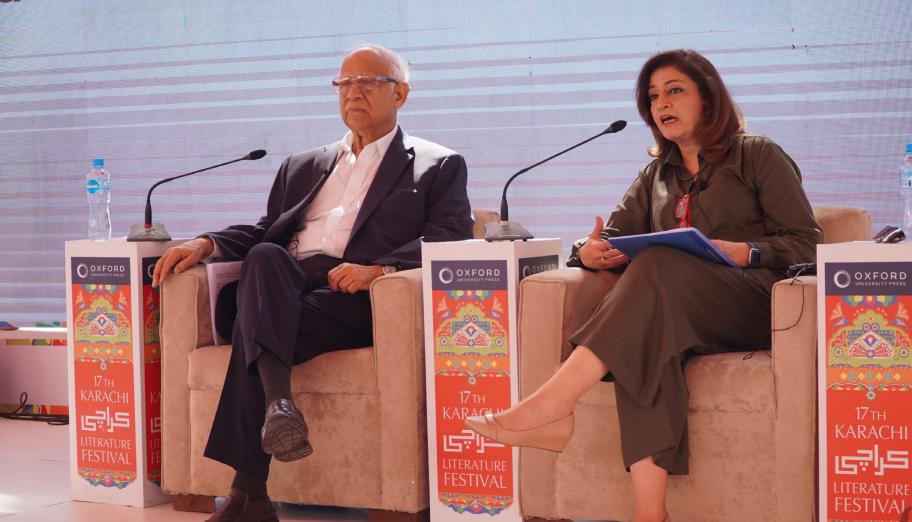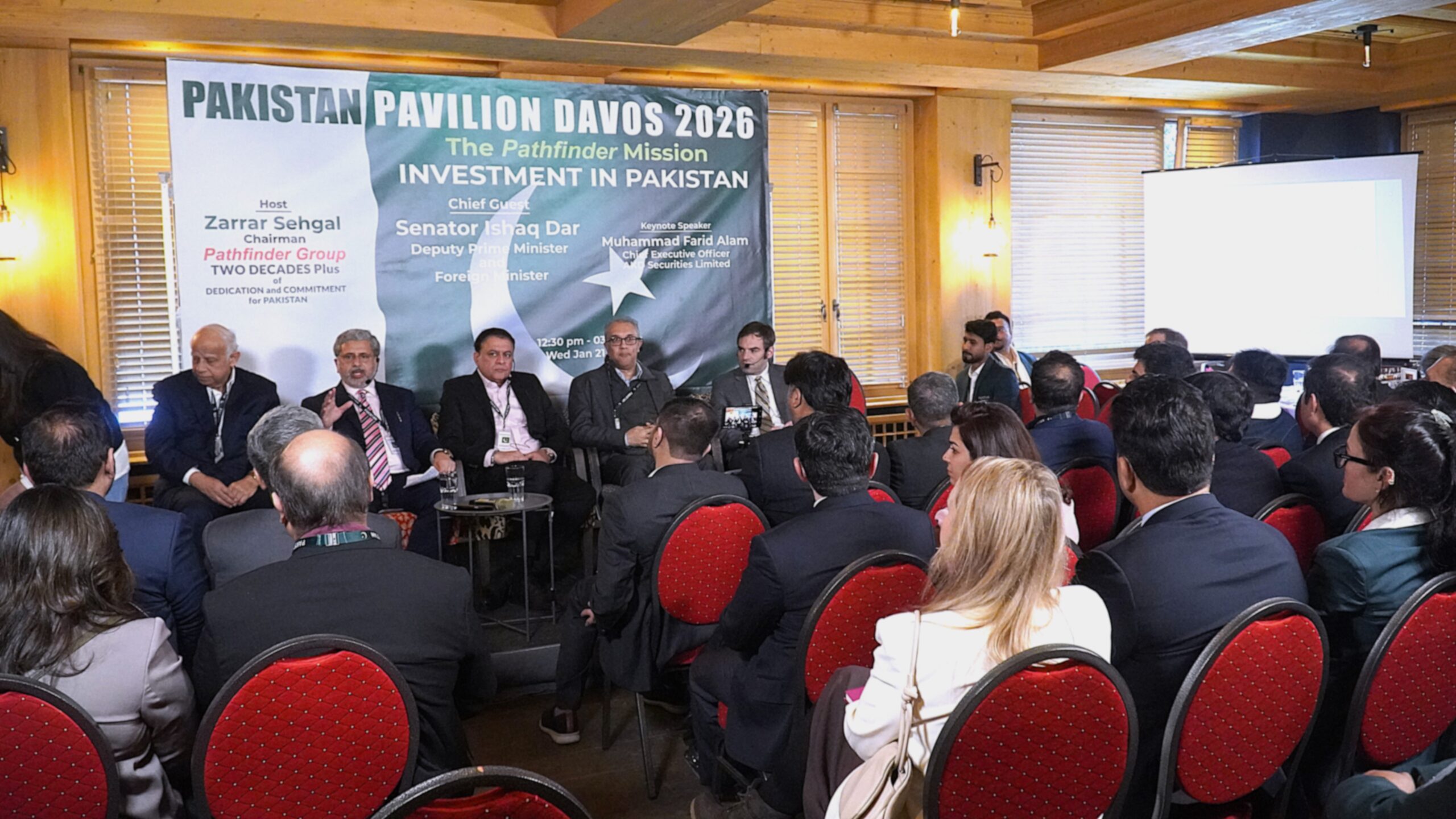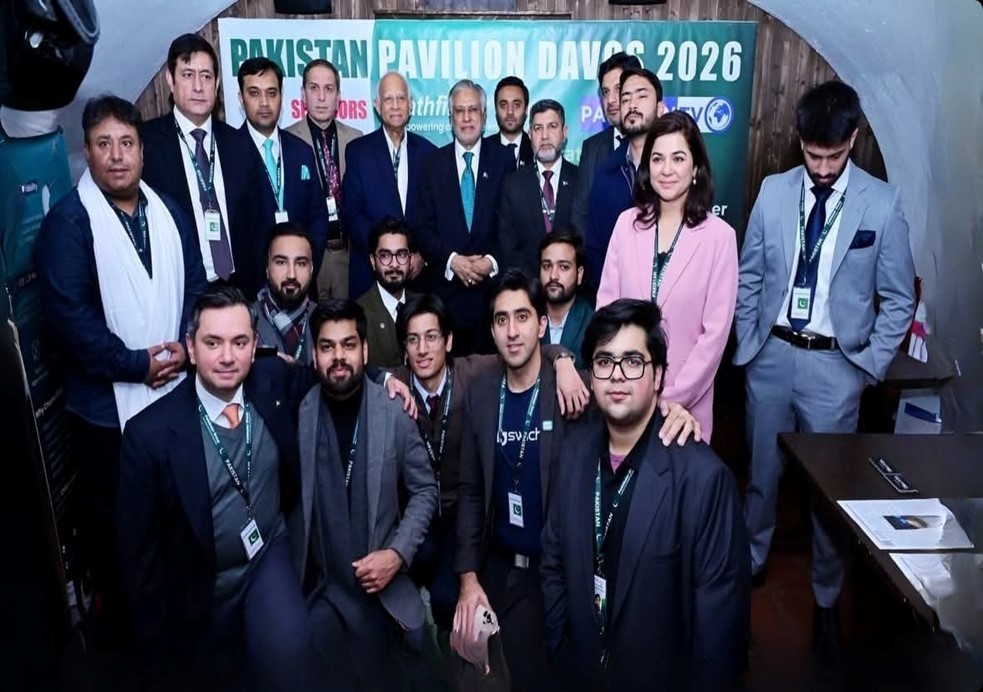




Panel Discussion & Presentations
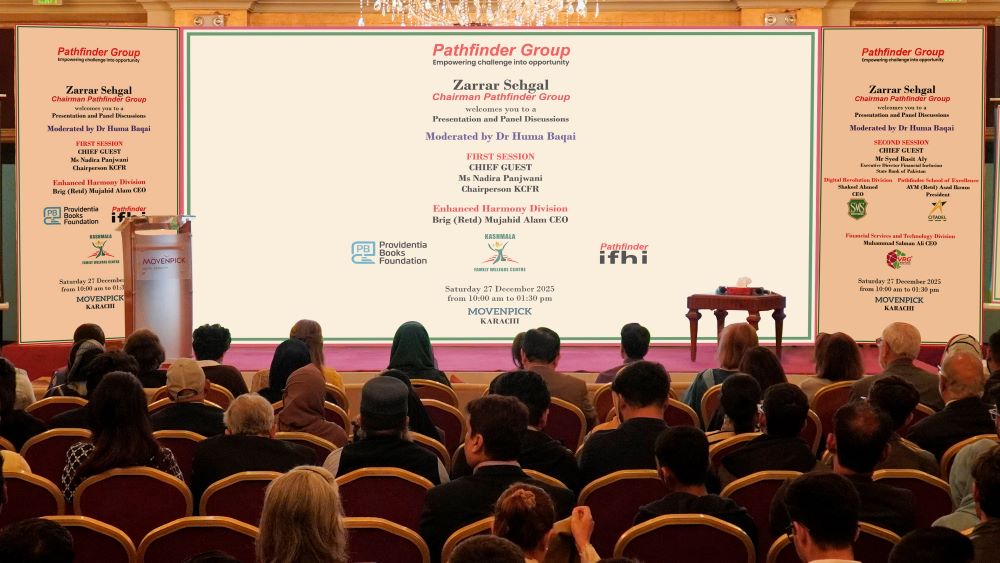
Session 1
Dr Huma Baqai (Moderator):
Good morning, Assalam-o-Alaikum, a very warm welcome on behalf of the Pathfinder Group. Ladies and gentlemen, this has almost become like an early event for me. We host a curtain raiser for the Davos World Economic Forum (WEF) and the Pakistan Breakfast, which has been organized by the Pathfinder Group and the Sehgal family for the last 25 years. And I think they’re the only torchbearers for Pakistan at the World Economic Forum. Now, that tends to be internationally recognized. I don’t need to formally introduce the Pathfinder Group. Every time I read about them, I learn something new. So, this time, the learnings were that the Pathfinder Group has 12,000 employees all over Pakistan in over 50 cities and towns in Pakistan. And that is saying a lot. I speak about this every year, but it didn’t surprise me. They’re known both nationally and internationally. And, of course, they have the leadership of the security market. They’re also now internationally known for digital financial inclusion through Virtual Remittance Gateway (VRG), Asaan Mobile Account (AMA), and financial inclusivity, which is actually critical for Pakistan. It is recognized globally by the World Economic Forum’s Edison Alliance.
Most importantly, what I find fascinating about this corporate business group known for, is its international diplomacy and carrying Pakistan’s name forward when others thought it wasn’t important. I’ve been a small part of it for many years now, and I’ve seen everybody who wanted to be invited come and speak. We got requests that we could be a part of the delegation. But very few wanted to actually contribute to keep the torch burning. And that has been done almost alone, solely by Ikram Sehgal and now his very able son, Zarrar Sehgal. I meet the family every year. Ikram Sehgal called me yesterday to remind me to be here on time and not complain about the traffic. He said we’re seriously thinking it’s going to be Huma Baqai Sehgal now. Anyway, it is an honour to have this relationship. I consider them family, so do they. And I find it very interesting that they can adopt not just people who work with them and make them a part of their larger circle, but also people like me, whom they think are committed to Pakistan. And people like all of you sitting here who think they are committed to Pakistan. And then the procession grows larger every year. We’ll be talking about a lot of other things. But before I do that, I will invite the Chairman of the Pathfinder Group, Zarrar Sehgal, to come and say a few words.
Zarrar Sehgal – Chairman, Pathfinder Group:
Thank you, Dr Baqai, as always. Welcome, everybody, esteemed guests, and family members. Our esteemed chief guest, Ms Nadira Panjwani. She is a philanthropist, holder of Sitar e Imtiaz and Hilal e Imtiaz. These twin honors are very rare in civilians. We are really grateful to have you today, from the Pathfinder Group’s perspective. And I think it is very pertinent for the topic we have today and the panel discussion we will have. Ladies and gentlemen, we stand today to address twin issues that are intertwined and shape the future of Pakistan. That is of Interfaith Harmony and the Education crisis. And as we navigate the complexities of our diverse society, it is imperative to recognize what we see today that our strength lies in unity, our understanding, and our collective will to forge a brighter future.
We will talk about interfaith harmony. And my daughter, Elena, will be speaking about that in detail. So, I don’t want to take away any part of that. Pakistan is home to a rich tapestry of cultures, languages, and religions. This diversity is not merely our characteristic, but it’s a treasure, and it’s on which we were built. Interfaith harmony is essential for fostering a sense of belonging for all our citizens. It’s actually a requirement of society and the societal foundation of our religious beliefs. Historically, our nation has witnessed moments of profound unity that have transcended sectarian divides.
And I know this seems strange when the focus is often on our differences. These moments, though, remind us of our shared humanity and our common aspirations for peace, prosperity, and justice. Today, it’s our responsibility not just to revive the spirit of togetherness but to engage in active dialogue that promotes respect and understanding. And this is where the Pathfinder Interfaith Harmony Initiative (PIFHI) comes from, which the Pathfinder Group is promoting.
PIFHI, which was the brainchild of Elena Sehgal, was really premised on one basic understanding. You have schools, mosques, temples, and churches, which should really form the platforms of interfaith discussions where we learn from each other and celebrate our differences. But really, when you link it, the common linkages over here are education. And this is where the other initiative comes in, the Providentia Books Foundation, which was the brainchild of my other daughter, Amaani Sehgal. When you bring education, and you link it with interfaith harmony, this is where you start to dismantle a lot of the stereotypes and misconceptions that lead to conflict.
Let’s talk about the education crisis in Pakistan, because I don’t think you can talk about interfaith harmony without addressing the pressing education crisis that really threatens our society. Education is the foundation upon which we build our future. Yet, sadly, millions of children in Pakistan remain out of school. I know this personally because we work with fantastic organizations like the Citizen Foundation, where we’ve contributed a lot, and Providentia Books Foundation works very closely with such foundations. Not only that, other NGOs that we partner with, schools that we partner with, where really our focus is to provide books, other supplies to these marginalized children that remain out of school, that are from communities where the government has not been able to reach.
What this crisis is doing is, it is not just hampering individual potential, but it is also hampering our collective progress as a society. So, education is a powerful tool, not just for societal progress, but also for promoting interfaith harmony. When children are educated together, regardless of our divide, then they promote diversity from a young age. They develop not just empathy, but critical thinking and responsibility towards each other. So, it is vital that our education curriculum reflects the pluralistic nature of our society, teaching our students various cultures and religions respectfully. Quality education must be accessible to all, regardless of their background.
Today’s panel discussion is about a call to action. It’s about the recognition of the interconnectedness of interfaith harmony and education, as we strive to build a society that is peaceful and an educational framework that is inclusive. I urge each one of you, community leaders, students, to act to promote dialogue, understanding, and access to education.
This brings us to the third pillar of what we’ll talk about today, that is the Kashmala Welfare Center. Without community togetherness and female empowerment, you cannot get to a lot of these goals, because that’s where it starts. And that’s exactly what the Kashmala Welfare Center has done so far. It is fostering community togetherness by focusing on female empowerment, teaching basic skills, and providing access to healthcare and other initiatives.
Dr Huma Baqai (Moderator):
Thank you, Zarrar. You’ve made my job easy by introducing all the Initiatives about which we’ll be talking today. Perhaps what I want to add is that running a business, representing a country internationally, and then at the same time, involving every single member of your family in philanthropy, in community service, and the kind of community service, which is more than charity, is an incredible feat.
Pakistan is known for philanthropy. Pakistan is known for charity. What Pakistan is not known for is empowering human resources, empowering the youth, and teaching them to fish. And that is perhaps what the Pathfinder Group under these three initiatives is doing. In the next half post brunch, we will also be talking about the Centre for Innovation, Technological Advancement, Digital Entrepreneurs & Leadership (CITADEL), which is again a great initiative, not just to bring name and fame to the Pathfinder Group, which it will, I’m sure, but to empower the youth.
This time, we are actually, not we, I like to say we, but I mean Ikram Sehgal, Zarrar Sehgal, and the family, are taking startups to the World Economic Forum. This is something new, and a first, and is a very expensive enterprise. But the whole idea is that we are able to showcase the talent of Pakistan at an international platform. These startups will become multipliers for the economic growth of Pakistan. More importantly, the topic of Davos 2026 is the spirit of dialogue. And the Pathfinder Interfaith Harmony Initiative, Providentia Books Foundation, Kashmala Welfare Centre, all of those are that lend that spirit to the dialogue, and they’re also futuristic. Now, I am going to invite Brigadier (R) Mujahid Alam, CEO of the Enhanced Harmony Division (EHD).
Brig (R) Mujahid Alam – CEO, Enhanced Harmony Division (EHD):
Bismillah ar-Rahman ar-Rahim. Honorable Chief Guest, Ms Nadira Panjwani, distinguished ladies and gentlemen, and dear students, Assalam-o-Alaikum and very good morning. At certain moments in history, we are reminded that the true measure of a life is not found in wealth, accumulated or titles earned, but in the quiet legacy of goodness we leave behind. Every once in a while, a leader emerges whose vision goes far beyond boardrooms and balance sheets. A leader whose heart beats for people, for dignity, and for humanity itself.
Today, as we speak about the CSR journey of the Pathfinder Group, we are really recognizing the compassion and moral courage of one man, Ikram Sehgal, the Co-Chairman of the Pathfinder Group. His vision has not only shaped organizations, but it has touched lives, opened doors, and given hope where hope was fading. His leadership reminds us that true greatness is not measured in profit or power, but in the quiet miracles we create for others.
Of all the initiatives and endeavors undertaken by Ikram Sehgal over the last many years and decades, I feel these CSR initiatives of Pathfinder Group are one of the most important and gratifying because of their direct impact and benefit towards nation building. The Enhanced Harmony Division of the Pathfinder Group is a purposeful embodiment of the humanitarian vision of Ikram Sehgal and the Sehgal family. The belief that society thrives when its most vulnerable members are supported lies at the heart of EHD’s creation.
Built on compassion, service, and social responsibility, the division serves as a structured platform to uplift those who are underprivileged, underserved, and overlooked. EHD brings together three transformative initiatives, each addressing a different aspect of societal well-being. Providentia Books Foundation is nurturing minds and igniting curiosity, and advancing literacy, educational access, and a culture of learning. Knowledge is humanity’s most enduring inheritance and the quiet force that reshapes destinies long before change becomes visible. Through the Providentia Books Foundation, learning is not treated as a privilege but as a shared trust. Amaani Sehgal, the founder of Providentia Books Foundation, will be talking in greater detail later on. Pathfinder Interfaith Harmony Initiative (PIFHI) is building bridges of understanding, tolerance, and peace and promoting dialogue and peaceful coexistence among diverse faith communities.
Pakistan’s true strength lies in its diversity of faiths, cultures, and traditions, a diversity that must be protected through understanding and respect. In a nation shaped by shared history and shared hopes, harmony among faiths is essential for social stability, national unity, and moral progress. And young Elena Sehgal, who is the founder of this initiative, shall be sharing more details later on. Kashmala Family Welfare Center stands as a sanctuary of care for families facing hardship, offering them dignity, support, and the warmth of human kindness and providing women, families, and local communities with welfare, skills development, and empowerment services. I shall be giving some more details later on.
Together, these initiatives form a unified ecosystem of hope and opportunity, working to strengthen communities through education, harmony, and welfare. These initiatives are like luminous threads woven into the fabric of society, threads of compassion, hope, and moral clarity. One committed individual can set in motion a ripple of progress that touches countless lives. The vision of EHD is to create an empowered, harmonious, and educated society where every individual, regardless of background, has the opportunity to thrive with dignity and purpose.
And the mission is to serve humanity by expanding access to education, fostering interfaith understanding, and delivering holistic welfare services, ensuring that the most vulnerable communities receive the support and opportunities they deserve. I am happy to see a large number of college and university students in the audience. My dear students, at this stage of your lives, you hold an extraordinary power. The power to give your time, your talent, your energy, and your heart to something larger than yourselves. Pathfinder Group’s initiatives are built on a simple belief that young people can change the direction of a community and even the destiny of a nation.
Providentia Books needs your passion to light the spark of learning in children who only need a helping hand. PIFHI needs your voices, your empathy, and your courage to build bridges in a society that deeply needs understanding and unity. I invite you to join us, volunteer, participate, and bring your ideas, your idealism, and your humanity. Let us build something meaningful together. In conclusion, I would just like to say that these projects of EHD are not just CSR activities. They are reflections of a leader’s soul. They show what happens when one person believes deeply that every life matters and every child deserves opportunity. When leadership is guided by conscience, it becomes a force that reshapes society. And when vision is rooted in empathy, it becomes a light that continues to illuminate long after the individual has stepped aside. Ikram Sehgal’s leadership is a reminder that real greatness comes from lifting others quietly, consistently, and with love. Thank you very much.
Dr Huma Baqai (Moderator):
I want to talk about something else, which is critically important and has been very closely monitored and nurtured by the Pathfinder Group, and that is women’s empowerment. I don’t remember the Pakistan Pavilion at WEF not having a session on women’s empowerment. And I also don’t remember myself not being a part of it. And I was speaking about it, literally, I would open my heart, say things, and they would be accepted, putting a lot of people on the floor.
But I was always given the space to do that. And I’m not surprised that the three initiatives of CSR are led by the three powerful women of the Sehgal family. Kashmala, Amaani, and Elena. My first interaction with Amaani was with a very hands-on, indulgent father. She came to my office to interview me for her school project. Her father waited patiently in my office, and she interviewed me. That interview is still on YouTube and is still largely viewed. We are all proud of you. My university is also a small part of the Providentia Books Foundation.
Amaani Sehgal – Founder, Providentia Books Foundation:
Assalam-o-Alaikum. My name is Amaani, and I’m going to give a brief introduction to the history of Providentia Books Foundation and its mission. About five years ago, I learned from my grandfather that many corporations were throwing away excess books instead of donating them. These were books that were still in good condition but were being trashed simply because donating them took more effort. That honestly shocked me. Donating a book to someone who needs it feels like the obvious choice. Especially in a country where access to educational resources is still uneven. To me, it felt like a waste of education and also a real environmental loss. That realization reminded me of something from my childhood. When I was about seven or eight years old, I was visiting my grandfather and grandmother’s house in Karachi. One afternoon, a bus pulled up outside.
At first, I assumed it was just a regular transport vehicle. But then I saw children my age stepping off with backpacks. I later learned that the bus was not taking students to a school since the bus itself was a school. Seeing that stuck with me and made me understand early on that education does not fail because students do not care. It fails because access is limited. Those two experiences planted the seed for Providentia Books Foundation. It began with a simple idea. These were books sitting unused on shelves and in storage. And at the same time were schools and organizations that could not afford basic learning materials. Providentia Books Foundation exists to connect those two realities. Its goal is to make sure books are not thrown away or burned, but instead reach people who can actually benefit from them. The mission of Providentia Books Foundation is to make reading and learning more accessible by removing cost as a barrier.
Through its platform, individuals and organizations can donate books. And schools and NGOs can request materials that match their needs. These include textbooks, reference books, exam guides, and general reading material for students of different ages. The focus is not just on giving books, but on making sure they are useful and relevant. Providentia Books Foundation also works closely with partner schools and organizations to distribute books thoughtfully. Donations are not random. Schools request specific materials. And Providentia Books Foundation works to meet those needs so that books actually become part of classrooms and learning spaces. This approach helps ensure that the impact lasts beyond a single donation.
Providentia Books Foundation would not exist without my grandfather, Ikram Sehgal. He has spent his life focused on expanding access to education and opportunity in underserved communities across Pakistan. Whether mentoring through supporting schools, organizing relief efforts, or mentoring young people, his approach has always been hands-on and action-driven.
When the idea of Providentia Books Foundation first came up, he did not treat it like a side project. He gave it his full attention, asked the right questions, connected the right people, and made sure the mission stayed focused. His leadership helped turn a simple idea into something structured and sustainable. Because of that commitment, Providentia Books Foundation has now donated over 60,000 books to 30 schools and NGOs across five major cities in Pakistan. These books are now in classrooms, libraries, and community centers where they are being read and shared. What started as a small effort has grown into something that continues to expand its reach.
Today, Providentia Books Foundation stands as proof that improving access to education does not always require massive systems or complicated solutions. Sometimes it starts by noticing what is being wasted and choosing to redirect it with care and attention. Seeing how far Providentia Books Foundation has come reflects its mission and my grandfather’s belief that education should be accessible, practical, and real.
Dr Huma Baqai (Moderator):
I know that they’ve really worked hard because I had those donation boxes at my university, books were donated, and later distributed. So, you have a long way to go, but why I think this is critical. We have other initiatives also, but it is when Gen Z takes up projects like this, is passionate about it, and is committed to it, then we ensure the sustainability of such acts. And the fact that she’s committed to it, taken inspiration from her grandfather, and he’s helped her, supports her to take it forward, is hope. What Pakistan desperately needs is hope.
We just celebrated Quaid-e-Azam’s birthday, and he said that education is a matter of life and death for this country. Yet, Pakistan allocates the least amount in the whole region to education. And now it’s a foregone conclusion that unless the private sector comes forward to invest in education, there is no way it’s going to take off. And it is initiatives like these that keep that hope alive for the children of Pakistan. Because in some ways, with a heavy heart, I think the state has failed them.
Now I’m going to invite Elena Sehgal. Elena will talk about the Pathfinder Interfaith Harmony Initiative (PIFHI), which is more critical than any time in the past. Both interfaith and intrafaith. And Elena will also tell us what triggered this.
Elena Sehgal Founder, PIFHI:
Assalam-o-Alaikum. Everyone, my name is Elena Sehgal, and today I will be talking about the Pathfinder Interfaith Harmony Initiative. This is a cause I feel deeply connected to, and one that feels especially urgent in light of the growing religious and political divisions we are not only witnessing in Pakistan, but all over the world. What does the Pathfinder Interfaith Harmony Initiative do? It aims to bring together Pakistan’s diverse religious communities, sects, and cultural traditions. At a time when misunderstanding and mistrust threaten social harmony and national unity, PIFHI works to create spaces for connection rather than growing conflict. The Pathfinder Group has a legacy of national service, including securing over 100 Christian churches every Sunday for more than 30 years. This commitment reflects a deep respect for interfaith protection and coexistence.
PIFHI builds on this foundation by promoting empathy, dialogue, and mutual respect, offering people the opportunity to collaborate meaningfully toward a more peaceful and inclusive society. On a personal level, PIFHI reflects the work I’ve been involved in for the past year in my home city, New York. As a teenager witnessing growing religious division, I co-founded an interfaith project alongside one Jewish and one Christian peer to encourage understanding among young people. This is called The Agapé Project. It focuses on building genuine connections and friendships between teens of different faiths. Through shared service and community work, we highlight values that unite us rather than divide us. This hands-on approach to healing religious tension is why I strongly connect you with the mission and importance of PIFHI.
Some more information on The Agapé Project, for the past year, it has grown significantly, organizing six major events that reflect our core mission. These include monthly service initiatives, partnerships with other non-profits, and the use of social media to spread awareness and amplify our message of peace and unity. Our work has included baking over 100 cookies for a homeless shelter, painting and decorating 30 flower pots for a nursing home under construction, donating 400 books to public schools throughout the city, creating sustainable toys for local animal shelters, and spending six hours one night collecting and distributing essential items such as clothing and toiletries. Through these efforts, we’ve engaged more than 150 students from diverse religious backgrounds across the city, creating and collaborating in a space for impact and dialogue despite our religious differences. To speak about the objectives of Pathfinder, what the Agapé Project does in New York mirrors the meaningful and necessary work of the Pathfinder Interfaith Army Initiative in Pakistan.
PIFHI is built around five key objectives: dialogue and understanding, youth engagement, community projects, countering extremism, and training and capacity building. These goals serve as a reminder that progress is always possible. Even in the face of violence and division, meaningful change begins when people come together to support one another and strengthen unity for the future. The work includes hosting an annual interfaith peace forum, conducting outreach in schools and universities, launching a leadership fellowship for young interfaith changemakers, and organizing joint service projects in areas such as health, environmental action, and disaster relief. The initiative will also document and share success stories from across the country to highlight how unity is already being practiced on the ground. Operating under the Pathfinder Group’s Social Impact Division, PIFHI partners with religious organizations, NGOs, educational institutions, and governmental departments, including the Ministry of Religious Affairs. This is to enlarge our impact and further advance peace and unity in our nation.
One example of PIFHI’s work is its effort to bring together members of Hindu, Sikh, Jewish, Parsi, Christian, and Muslim communities. The first session, held on August 2, 2025, at Amaani Bagh, introduced the initiative’s goals and long-term vision. The second session, the PIFHI Advisory Council meeting, held on September 13, 2025, shifted focus towards strategy, collaboration, and long-term impact. At the core of both gatherings was the belief that without dialogue, no real progress can truly be made. Looking ahead, PIFHI aims to strengthen partnerships with communities and local leaders, expand outreach, particularly among younger generations, and introduce new programs and promote dialogue, learning, and inclusion.
The initiative also seeks to empower youth and women as ambassadors of peace, use data and community feedback to refine future efforts, and continue working towards a society grounded in respect, tolerance, and most importantly, shared humanity. None of PIFHI’s work would be possible without the dedication and commitment of its council members. Thank you to everyone who contributes their time, insight, and effort to advancing this mission. I’d also like to offer special thanks to my grandfather, whose empathy and kindness have been not only a guiding force in my own life but also a meaningful source of change in Pakistan.
Dr Huma Baqai (Moderator):
I will now request Brigade (R) Mujahid Alam to come and speak about the Kashmala Family Welfare Center.
Brig (R) Mujahid Alam CEO, Enhanced Harmony Division (EHD):
I am happy to have in the audience with us Kashmala Sehgal, who is the founder of the Kashmala Family Welfare Center. I’ll briefly go through some basic information. The center is a flagship initiative of the Pathfinder Group, and it was established in 2022 and is located in the underserved village of Chouki Mamrez, Pabbi, in KP. The center serves as a beacon of hope for women and girls who are often confined to their homes, offering them relief from limited health care access and social restrictions that hinder skill development. It actually stands as an oasis, providing safety, opportunity, and empowerment for females in the area.
The center is supervised very ably by Zakia Khan and operates from a dedicated three-story facility. It comprises eight functional units run by a team of 10 staff members, including a lady doctor, a dentist, an ultrasound technician, an Aalima, vocational trainers for crochet stitching, basket making, and beauty services, and support staff. The center serves approximately 20,000 beneficiaries, from a total population of over 30,000 in the village and surrounding communities. The free medical services include free checkups, essential medicine, 24-7 emergency ambulance service, and hospital referral, supporting 20 to 30 women and children daily with continuous care.
The dental unit actually runs five days a week, sometimes even six, providing free dental checkups and basic treatments for women and children with all the essential equipment and a qualified dentist. The ultrasound unit is a very important unit. It conducts 15 to 20 scans daily for maternal and general diagnostics, using a basic ultrasound machine and a trained technician to ensure timely, affordable care. This saves the women in the village from traveling all the way to Peshawar for this service. Otherwise, it is provided right there at their village, at their doorstep. The vocational training and income programs include a sewing and stitching program, which was started in 22, and 50 women undergo six months of training in the morning and evening batches, with eight graduates now running homebased businesses. They have established their own businesses in their homes. We have crochet and warm clothing. They learn both these skills, and also these are sold for some local income.
Basket making program is a very interesting and a very important program. Many people who are not familiar with the fact that baskets are very much in demand and valuable in KP, for fruits and vegetables, and also for giving gifts. There is a trainer there with over 30 years of experience. The women are provided free raw material at their homes. Initially, when they started making it, the baskets would only sell for 10 rupees in the market, and these actually were being exploited. But since we started this program, the baskets now sell for more than 50 rupees, and it gives them a handsome earning also.
A very important beautician training and the services provided there cost only about 5,000/, and most of the brides of the village, they come there for that. The beauticians have been trained, and some of those girls have started their own salon business from their homes now. There is also a small women’s shop for essential services. In the Quran and Islamic teaching, there are free daily classes for 10 to 15 students, and there is a trained Aalima who does this. Here is just a summary of this thing, and you can see how many beneficiaries have benefited from the different programs, which I have highlighted just now. And actually, the total number of patients that have been served with medicines, ultrasound, and all, is in excess of 25,000 now.
The plans include a small loan program for women entrepreneurs, sugar and pregnancy testing services, a fully stocked pharmacy, a kitchen garden training program, a women’s gym, and a small park for children. And you will be happy to know that two more centers are under construction. One is in Bhakhar in South Punjab, and the second is in Abbottabad. This brings me to the end of this brief introduction to Kashmala Welfare Center. It is actually a treat visiting that and going and seeing how the women and the girls of that area, who otherwise are almost always confined, benefit from this.
Dr Huma Baqai (Moderator):
And as you can see, ladies and gentlemen, we now have a full house. These initiatives are impacting real lives and making a difference in the lives of the people of Pakistan. I was just informed that four students from Gwadar are here today in the hall, and they have also been supported by the Pathfinder Group’s initiatives. So, boys, please join me on the stage. The four boys from Gwadar, and there is a girl as well. Please introduce yourself and tell us what you do. Why are you here?
Student: My name is Balaksher.
Dr Huma Baqai (Moderator): Balaksher, what are you studying?
Student: I am studying at Cadet College Jajja in Class 10.
Dr Huma Baqai (Moderator): And you are from Gwadar, and you are studying at Cadet College Jajja because of the Pathfinder Group?
Student: Yes, I am studying at the Jajja College because of the Pathfinder Group.
Student: My name is Zeenat Shehdad. I am studying at Girls’ Cadet College Jajja in my second year. I am a pre-medical student.
Dr Huma Baqai (Moderator): Wow! You’re going to be a doctor.
Student: My name is Abdul Sabor. I have been studying at Cadet College Jajja for five years. I am a second-year ICS student, and I have been supported by the Pathfinder Group for five years.
Student: My name is Cadet Shehbaz. I study at Cadet College Jajja in Class 8.
Dr Huma Baqai (Moderator): And what do you want to be in the future?
Student: An army officer.
Dr Huma Baqai (Moderator):
These five students are from Gwadar, and this is just the tip of the iceberg. I would now like to invite Ikram Sehgal to come to the stage, meet the students, and say a few words.
Ikram Sehgal Co-Chairman, Pathfinder Group:
Bismillah-ir-Rahman ir-Rahim. Let me tell you the story of these students. Their father works with us and belongs to Gwadar. About five years ago, he said to me, “My children are getting no education, and they cannot even speak English.” Pathfinder Group sponsored them to study at the Jajja Cadet College, and I am proud to tell you that they have been outstanding students. Most of them have topped their classes at Cadet College Jajja. In fact, one of them has also appeared for the Air Force initial test. However, because he is too young, he will probably have to wait another year. He topped his class with a score of 92 percent.
I just want to say that I brought them here because they are very close to me. They were on leave from Jajja during the holidays, so I thought it would be good for them to be here. I said, “Come along.” I just want to tell you that there is no dream that is not possible. And particularly to the young people sitting at the back: reach for the sky, and you will get there. Thank you all for being here. I would like to thank Ms Nadira Panjwani and Dr Huma Baqai for being here.
Ladies and gentlemen, I just want to say a few words on the CSR side. You know, when you have your granddaughters living your dream and seeing their dreams come true, you realize what life is really about. Anybody can make money, but ensuring that a fellow human being benefits from the money you make is what makes life worthwhile. And I think that is the essence of what we are doing today. As my granddaughter referred to earlier, this includes the schools that we support. About 30 years ago, a Christian church was attacked in Murree, and I decided, through my security company, to guard Christian churches on Sundays free of cost. At one point, we were guarding 120 Christian churches. Today, we guard about 35, free of cost, on Sundays.
Let me tell you something important about this. We used our armoured cars, and the crews assigned to those armoured cars were normally off on Sundays. We offered our guards overtime, but they flatly refused. They said, “It is our Islamic duty to guard our Christian brothers.” They did not take overtime. Now, let me also tell you the upside of it. The churchgoers started bringing picnic baskets for them on Sundays. So, it became a two-way street. Today, I saw both my granddaughters here and witnessed what they are passionate about. Amaani is where she is today, and she is studying at Cornell University, which makes me very proud. And Elena, of course, has her own project, the Agapé Project, which has now evolved into the Pathfinder Interfaith Harmony Initiative. What this shows is that if we work together, if we share and spread the blessings that God has given us for the benefit of our fellow human beings, that is far more important. It is something that lets you go to sleep better at night.
So, I am very grateful to you, Nadira, for being here. I know you had a family commitment and that you have to leave, and I truly appreciate it. And what a wonderful job you have done as the Chairperson of the Karachi Council on Foreign Relations (KCFR). You have taken it to a remarkable level, and I also appreciate your Senior Vice President, Dr Huma Baqai, who is also sitting next to you. It is wonderful to have you both here.
Dr Huma Baqai (Moderator):
To me, the most inspiring part of this morning has been a learning journey. It is heartening to see young minds from Gen Z taking up projects and being passionate about them. However, the most inspiring moment was meeting those five students from Gwadar who have reached a certain level and whose future now seems secure.
Ms Nadira Panjwani also does something very similar. Of course, the Karachi Council on Foreign Relations, of which both of us are a small part, always tries to do its best, and the leadership, of course, rests with Ms Nadira Panjwani. She is also an inspiration through her work with the school for the blind and the deaf. Usually, I would meet students who would come and recite a Qirat or perform a Tarana, and we would appreciate them, which was wonderful. But then I met Hans Raj at NED University, who had topped earlier and is now studying engineering at NED University. And I can tell you that, too, is Nadira Panjwani’s contribution.
Nadira Panjwani – Chairperson, KCFR:
Bismillahir Rahmanir Rahim. Respected Ikram Sehgal, mentor, friend, and Patron-in-Chief of KCFR, Zarrar Sehgal, Chairman of Pathfinder Group, ladies and gentlemen, greetings to everyone. Earlier this month, when Sehgal called to invite me to this event, I was about to regret as I have a function at my home later today. But when he told me that this event was about the welfare work of the youngest members of his family, I knew I had to be here. Because what can be more heartwarming and reassuring than seeing young people rise to serve society? In a world often driven by self-interest, when young people walk this path, it gives us hope and the promise of a more humane world. Youth is a time of energy, creativity, and boundless idealism. So, when young people channel their energy and enthusiasm into service, change becomes inevitable, and this change can become a powerful force for good.
The term philanthropy appeared some 2,500 years ago in Greek mythology, where values of love for humankind were highly regarded. Similarly, the Romans of that time took philanthropic practices very seriously and saw these as their obligation towards the advancement of society. Mediterranean emperors used to give tax exemptions to their favorite charities like orphanages, shelters, and infirmaries. All major religions of the world directed their followers to do what is right and just for those in need. The Torah requires that 10% of a Jew’s income be allotted to a righteous seed. In Christianity, charity is considered the highest form of love, as recorded in St. Paul’s New Testament. And for us Muslims, zakat is a fundamental pillar of our faith.
Through this mandatory charitable contribution, we purify our wealth. What is commonly known in the West as a foundation has its origins in the Islamic institution of waqf. This is basically a permanent endowment of property or wealth for charitable purposes, and once established, it cannot be reversed. The practice of waqf reflects Islam’s emphasis on Sadqa-e-Jariyya, which is ongoing charity and a way of ensuring that wealth serves humanity across generations. Providing necessities like food, water, shelter, clothing, healthcare, and education has always been the primary objective of most charities. But with the passage of time and advancements of society, philanthropic activities have now evolved and become more diverse and complex. Today, philanthropy is not just about charitable donations. It’s about responsibility.
In a world facing global challenges, economic inequality, climate change, refugee crisis, and all forms of humanitarian challenges, philanthropy steps in where public systems fall short. Key trends in modern giving are community-centered support, technology-driven philanthropy, collaborative partnerships, and a shift from just giving to creating sustainable impact. It is very pleasing to see that Pakistani youth are increasingly philanthropic, showing a strong engagement in volunteerism, education initiatives, and social change movements. Thousands of young volunteers nationwide are joining such welfare and service projects. With over 60% of Pakistan’s population under 30, youth philanthropy has the potential to transform society on a large scale.
Young people are more connected through social media, and this enables them to mobilize quickly for various causes like flood relief education drives, and healthcare campaigns. Youth often find new solutions to old problems through technology, innovation, and their fresh perspectives. Their infinite energy and positivity help them overcome all barriers and hurdles. Active participation in these programs nurtures their empathy, leadership, and civic responsibility. I’m truly delighted to have heard about Amaani and Elena and their work and seen their wonderful contributions to society. Despite being blessed with privilege, they have chosen the noblest path, and that is the path of service. They have transformed privilege into purpose. Where others might have been tempted to retreat in comfort and self-indulgence, they have stepped forward with courage and commitment. I think there is a warm round of applause.
While honoring Amaani and Elena, we must also celebrate their parents and elders who have taught them lessons of empathy and compassion. They have given their children the greatest inheritance of all, which is a kind heart that cares. It is important to remember that philanthropy is not about being rich. It’s not about money. It is about being a good human. A student who volunteers time to teach underprivileged kids, a neighbor who shares food with a hungry family, or a young professional who donates skills to a community project are all philanthropists of the highest order because the essence of philanthropy is to serve, to uplift, and to stand in those in need. Every act of kindness, as Brigadier Mujahid said, no matter how small, is a thread that weaves into the fabric of society. The true measure of our lives will not be found in what we have accumulated but in what we have contributed. So, let us go forth with open hearts, knowing that in service to others we discover the highest purpose of our own existence.
Session 2
Dr Huma Baqai (Moderator):
I will now formally start the proceedings of our second session. Our second session promises to be just as interesting as the first one. It discusses very interesting themes, primarily financial services and financial inclusion, as well as the CITADEL and WEF Davos, which are futuristic in nature.
Before I request our four speakers to come and formally speak about what I just said, financial inclusion, innovation, creativity, startups, tomorrow, future of Pakistan. I’d also like to say a few words about the forthcoming World Economic Forum, which is going to be held from January 19th to January 23rd. Pakistan, as usual, keeping its 25-year legacy, will be represented by the Pathfinder Group. The theme this time is ‘A Spirit of Dialogue’ and the conceptual papers that have come out categorically say that, yes AI is important, yes technology is important, yes the world is changing but the world is also fragmenting at a pace and government structures are fragmenting at a pace that you just don’t need to do a dialogue, you need to have a dialogue with the spirit.
The themes that are there are a cooperation in a contested world, which could be more relevant? Unlocking new sources of growth, which is so critical, investing in people, something we heard about all of this morning, deploying innovation responsibly, building prosperity with planetary boundaries, of course, the reference is the climate, enabling real dialogue, problem-solving around shared challenges, and spotlighting innovation driving the future. Of course, the Pathfinder Group is not behind; like I said earlier this morning, we’ll be taking startups to Davos this year, and they will be representing Pakistan.
The five days that you spend in Davos are like a journey. I usually just go there for those five days, but what happens in those five days can be compressed over months. You learn so much, you get to meet so many people because it’s like a global forum where people from across the world, across continents, across capitals, across industries, and across forums come together to set the future tone and find a solution to those problems.
At the WEF, Pakistan has its breakfast called the Pakistan breakfast. It’s a characteristic of the Pathfinder Group, which is not only represented by the highest rankings in Pakistan but also in Switzerland. It’s one of the most well-attended events. I, with fondness, remember that when Bilawal Bhutto had joined us there, it was seen by the press as a relaunch for him. He became the darling of the press, and he spoke really well, and then we had Shahid Khakan Abbasi, who was the Prime Minister then. He was more in the news these days than when he was the Prime Minister, and this is my favorite quote: “Somebody from the audience said why is this being done by the private sector? Why doesn’t the government take this over? And he categorically, with his uncanny honesty, said, thank God the government does not, because if it had, would it be so good?”
The lone torchbearer remains Ikram Sehgal and his son, Zarrar Sehgal. One of the sessions that is a must at the WEF Pakistan Pavilion is, of course, a session on women’s empowerment. We always talk about it there. Then there are sessions that are around education. We always talk about it, and then there are sessions about giving Pakistan a face, projecting Pakistan in the most positive way possible. This is all and more what Pakistan at Davos is all about.
We are a very India-centric country. So just to give you a sense of what Davos is like, an entire street at Davos is literally overtaken by India. They have Tata tea stalls. We also shiver in the winter and the cold and enjoy the Tata tea, but that is the kind of image-building India is doing there. And yes, I salute the Pathfinder Group for doing this for Pakistan there, but I think more people should come on board. If it is private right now, it should be a public-private partnership. The ownership should happen from the private sector also, and the ownership should be more than just, we like what you’re doing. It should, I’m going to be very candid, and I can afford to be that. We need to put our money where our mouth is because this is an extremely, extremely expensive enterprise. And Mr Fareed is sitting there, he’s been a part of it, and he knows what it takes.
And also, the fact that the kind of facilitation the Pathfinder Group does for people who choose to become a part of the delegation. Not only do you get this exposure and learnings happen, and you represent Pakistan, but you also network for your own business. And that’s a tremendous thing, a tremendous opportunity. And I still can’t understand why it has not caught the imagination of our people here. Why is that? I was just speaking to someone at the brunch, and they said, why is the textile sector of Pakistan not represented? Why don’t we have stalls of khadi and ideas? So, they have presence globally, and they’re making good money, but why are they not investing money to project Pakistan at the best forum available through Ikram Sehgal at the WEF, which will not only do Pakistan good, but it is going to do them a lot of good.
Ladies and gentlemen, become our multiplier, become Pathfinder talk about it. It’s an opportunity of a lifetime. And even if you get to go once, the experience will remain with you. As I said, those five days are almost like a journey in a lifetime. And it’s amazing. It’s like a journey to another place. You have an interface with Palestinians, you have an interface with Russians, you have an interface with actors, and of course, if you’re a part of the annual meeting, it’s fantastic, but you can all connect there digitally. You can also connect to them here, sitting here digitally. But I tell you, becoming a part of it is a whole new experience. And I would want you to put your hands together to appreciate Ikram Sehgal and Zarrar Sehgal.
I’ve seen his company’s top management putting up posters. The ownership is unbelievable. Very senior people who will be going onto this page and speaking in five minutes are setting up the hall. And with complete commitment. I tell you, you need to see it to understand what it is. And then you realize what this man done for these people to get that kind of commitment. And once a Pathfinder, always a Pathfinder. I will now invite the CEO Digital Revolution Division (DRD) Pathfinder Group, Shakeel Ahmed, to come and say a few words about it. Let me ask you one thing.
Shakeel Ahmed – CEO, Digital Revolution Division (DRD):
How many of you believe that the way we ran our businesses ten years ago will still be the same ten years from now? The truth is, it will not. The world has changed, technology has changed, and customers have changed as well. Today, Pathfinder is changing with this reality. Welcome to the Digital Revolution Division.
The Digital Revolution Division consists of two main companies: SMS Services Pvt Ltd and SMS Technologies Pvt Ltd. Both are delivering a complete digital transformation ecosystem to empower the future through smart, digital, and transformative solutions. Every business today faces similar challenges. The world demands more efficiency, more intelligence, more speed, and more resilience than ever before.
Pathfinder Group’s Digital Revolution Division, or DRD, was created not just to sell technology but to provide solutions to real-world problems such as inefficiencies, downtime, and security threats. We have built a comprehensive portfolio of technology-driven services, ranging from smart safety and security solutions to smart building management systems, smart agricultural solutions, cybersecurity solutions, retail intelligence and customer insights, ERP and customized application development, e-commerce and quick commerce solutions, and managed telecom services.
Let us begin with something foundational for every business: security. I am not talking about traditional security, but an intelligent kind. Today, security is about intelligence because threats do not announce themselves. They happen silently, and they happen very fast. Imagine a world where security threats are automatically detected and reported, even before anyone notices them.
We provide an IoT- and AI-based alert system for real-time emergency detection, incident analysis, and response. Our IoT sensors continuously monitor the environment, including air quality, temperature, pressure, movement, and vibrations. This data is sent to an AI engine for verification. For example, if there is a slight rise in temperature inside a server room, a burning smell in a storage facility, or an employee entering a restricted zone, the sensors detect it and send the alert to the AI. Once verified, alerts are triggered and sent to the relevant authorities so that action can be taken before the situation becomes a disaster. Through DRD, we provide security that acts and protects. Our IoT devices and cameras are eyes and ears that never sleep. We offer an IoT- and AI-based surveillance system where the AI understands what it sees. Imagine it is midnight, your family is asleep, and everything seems calm. Suddenly, someone tries to enter your premises.
In the past, this might have gone unnoticed. Today, our sensors and cameras detect the movement, send alerts to the AI for verification, and if confirmed as a threat, the alert is sent to the command and control room. The security team is immediately dispatched and reaches the site within minutes. While most systems are still analyzing footage, our response is already on the ground.
Let us move from security to sustainability. Buildings today must be intelligent and efficient. Most buildings waste energy, not because people are careless, but because their systems do not communicate. Buildings have HVAC systems, lighting, power, elevators, networks, and security systems, all operating independently. Each consumes power and is prone to failure. Now imagine a system that integrates all of these into a single platform with a centralized dashboard. Building managers can control everything from one interface, reduce energy wastage, and make buildings truly intelligent.
In manufacturing, productivity and downtime elimination are critical. Downtime is deadly. A single machine failure can halt an entire production line. Every minute costs money, and every breakdown costs reputation. Now imagine a machine that tells you it is going to fail in the next five days. This is predictive maintenance. Our IoT sensors continuously monitor machine health, temperature, vibration, and movement. Any anomaly detected is sent to the AI for verification, and once confirmed, alerts are sent to the relevant teams. This reduces downtime and increases productivity.
We also provide complete supply chain visibility through real-time tracking. Without supply chain visibility, you are already behind. Our solution provides end-to-end visibility of your products, from manufacturing to distributors, retailers, and finally to the customers. This allows better planning, optimized pricing, inventory management, and improved productivity.
In agriculture, we offer IoT- and AI-based solutions that support farmers in multiple ways. Smart crop monitoring uses IoT sensors to track soil moisture, temperature, and nutrient levels in real time, while AI analytics predict optimal irrigation and fertilizer schedules. For livestock tracking and health monitoring, we use wearable devices to monitor animal health. If an anomaly is detected, alerts are sent to the farmer, allowing early intervention and reduced mortality. We also support agriculture through remote sensing and drone technology, providing a bird’s-eye view of crop health for precision agriculture. With GIS integration, farmers can plan targeted interventions for improved crop management.
Now, let us move to the invisible battle, cybersecurity. We provide a fully managed cybersecurity operations center operating 24/7 to monitor and protect your digital assets. We track anomalies, investigate them, and respond in real time. Imagine it is 2 a.m. at an operations center of a financial institution. Employees have gone home, and the security team is monitoring routine network traffic. But somewhere across the world, an attacker quietly launches a cyberattack, targeting your systems, your data, your entire digital backbone. Systems freeze, emails stop working, and data starts disappearing. You have no idea what is happening until things go down. This is where our cybersecurity operations center comes in. We provide real-time threat detection and response services. Hackers do not stop, and neither should we.
We also provide comprehensive security assessments, periodic audits, and automated patch management to ensure your systems remain protected and up to date. Retail today is not just about selling; it is about understanding. Our retail intelligence and analytics platform studies customer behavior, identifies buying patterns, and uncovers insights that help retailers optimize pricing, inventory, and promotions. For example, if cola sales increase in one region over the weekend while bottled water sales increase in another, this is not a coincidence; it is a pattern. Our analytics uncover such insights, enabling targeted marketing and better decision-making. When customers feel understood, they respond, they become loyal, and this leads to higher sales and revenues.
Now, let us address the nervous system of any organization: ERP. As businesses grow, manual processes break down, and businesses fail when departments don’t talk. ERP fixes this. We provide customized ERP solutions that automate and integrate all business processes into a single platform. Our ERP adapts to your processes, not the other way around. Whether you run a factory, a retail chain, or a logistics company, our customized ERP platforms connect all business functions into one seamless ecosystem. Our ERP team has delivered several successful ERP implementations for medium to large enterprises and is implementing ERP in Pathfinder Group to transition it from manual to digital processes across all business functions, supply chain, finance, HR, payroll, and more.
In e-commerce and quick commerce, we are developing an instant delivery platform, with a mission to deliver groceries and medicines within 30 minutes. This platform will provide access to people without having expensive international card payment systems like Visa and Mastercard. Through the Asaan Mobile Account (AMA) platform, customers will gain access to secure digital wallets, enabling seamless participation in e-commerce and quick commerce while advancing digital financial inclusion.
Our Agent Interoperability solution allows cash-in and cash-out facilities through any agent network, regardless of the customer’s bank. This enables faster settlements and reduces cash handling. This also facilitates delivery riders like Food Panda riders to deposit cash at any nearest agent network without dependency on a specific bank or wallet.
Through SMS Technologies (Private) Limited, we deliver end-toend managed telecom services, covering the design, fabrication, and deployment of high-performance telecom towers, along with comprehensive site management, preventive maintenance, and on-ground technical support. Connectivity is the backbone of digital transformation, and we are already managing hundreds of telecom towers nationwide, ensuring uninterrupted mobile network availability and operational reliability for our customers. In conclusion, the Digital Revolution Division, through SMS Services and SMS Technologies, is delivering a complete, transformative ecosystem. DRD is not just a collection of services; it is a promise of smarter operations, safer environments, stronger businesses, and a more digital Pakistan.
Dr Huma Baqai (Moderator):
Thank you so much, Shakeel Ahmad. This is not a peek into the future. This is the future, and it is promising, and it is our today and our tomorrow. And I’m glad that the Pathfinder Group is ahead of others in doing so. Now, I have the distinct pleasure of inviting Air Vice Marshal (R) Asad Ikram, the President of Centre for Innovation, Technological Advancement, Digital Entrepreneurship and Leadership (CITADEL). That’s a tall order. I was a part of the inception and inauguration of this center.
Air Vice Marshal (Retd) Asad Ikram – President CITADEL:
Syed Basit Ali, Zarrar Sehgal, Ikram Sehgal, ladies and gentlemen, Assalam-o-Alaikum. Especially the young ones here, and the even younger ones sitting at the back. It is always a wonderful experience to speak to young people. It gives you energy as well. All of us studied physics in school, right? I am talking to the youth sitting at the back. The ones in the front definitely studied physics, I know that. But did the ones at the back study it or not? My Urdu is quite good, and my English is also quite good, so I will be switching between both languages. You may remember those questions from physics: what would happen if there were no gravity? And similarly, what would happen if there were no friction? So that made me think of another question: can we imagine a world without innovation? I asked one of the AI tools what would happen if there were no innovation, and this was the answer I got: an image of people making houses, pots, and basic tools. But do you think this is correct? Why not? Because there is innovation even in that. So, if there were truly no innovation, the human race would be just like any other animal species.
This tells us how fundamental innovation is to human survival. In many ways, we are aliens on this planet. We need clothes to survive; other animals do not. Plants do not need them. The insect kingdom does not need clothes either. We also need to cook our food, so we need fire. Without innovation, the human species would not have survived on this planet. When we talk about innovation, we often think only of technology. We think of new machines, new services, or new technological breakthroughs. But that is not entirely true. Innovation exists across the entire spectrum of life. These are just a few examples, and even here, there is some bias toward technology. In business, we have new business models, new ways of making deals, and new ways of managing supply chains. In technology, of course, we see smartphones, AI, renewable energy, healthcare, and education. There were times when there were no blackboards, and then came whiteboards. That was innovation in its time. We also see innovation in government and policy, as well as in how societies are governed and how public systems function. There is social innovation, innovation in arts and culture, different forms of painting such as watercolor and oil painting, and innovation in environmental sustainability. All of this reflects the continuous innovation throughout human history.
I wanted to understand the relationship between innovation and wealth. When you look at countries like Switzerland, which has one of the highest per capita incomes, you also see that it ranks very high in innovation. There appears to be a direct correlation between innovation and wealth. And, where are we? Unfortunately, nowhere near that level. But there is nothing to worry about. This simply means that we have an opportunity to grow. China was once in a similar position and has moved significantly upward. India has also progressed in the last couple of years. So, we should not be discouraged. We can become more innovative and, as a result, become wealthier. Innovation drives wealth creation, and wealth then enables more innovation because you can invest more in research and development, infrastructure, and training. This creates a positive cycle. So how do we become innovative? There are many books on this, and today, AI and innovation are discussed everywhere. The usual ingredients include world-class education, investment in R&D, a strong business environment, robust infrastructure, a culture that celebrates creativity, smart and stable governance, and public-private collaboration. But how does all of this actually happen? You need many players. Often, we hear about the triple helix model: government, academia, and industry. But that is not enough. You also need financial institutions that can lend and regulate, legal frameworks that protect intellectual property, entrepreneurs who are willing to take risks, and many other stakeholders. In reality, it is the entire society that must be innovative. Not a single organization or segment of society can be missing. At CITADEL, we call this a whole-of-nation approach. That is why, at Pathfinder Group events, you see people from across the entire spectrum of society. You see all age groups and all professions represented. No single institution or segment can do this alone. Now, let us look at the problem. One immediate issue we identified is that 31 percent of graduates in the country are unemployed. Those of you sitting at the back will soon be graduates, so this applies directly to you. We need to create 2.5 million new jobs every year. At the same time, we have a very limited window: about 15 years before Pakistan’s population begins to age and the proportion of young people starts to decline.
When I first heard this, I thought it was impossible. I assumed our population would keep growing forever. But when I checked the data, it turned out to be true. Birth rates are expected to decline, and after 2040, the median age of the population will begin to rise. If we fail to act within these 15 years, we will face serious challenges, including a smaller workforce and fewer taxpayers. What is the solution? It is not rocket science. For unemployment, we need graduate employability. That sounds simple, but there are deeper issues. When you talk to industry leaders, they tell you that while there are many graduates, their skill sets are weak. Communication skills are poor. Time management is lacking. Project management, negotiation, and stress management skills are missing. This means we have problems on both the supply and demand sides. And, of course, we also need to create more jobs.
That is why I deliberately mentioned wealth creation earlier. When wealth is created, we can invest more in innovation, and innovation then leads to sustainable growth. Sustainability is critical. This cannot be a one-year or two-year program that disappears with a change in government. Long-term, consistent effort is required. So, what are we doing at CITADEL? First, we are establishing the Career Jumpstart Institute, focused on graduate employability, emerging technologies, and soft skills. Second, we have the Escape Velocity Accelerator, which targets startups that need to scale, create jobs, and generate wealth. Third, we provide consulting services to help Pakistani companies adopt new technologies, improve efficiency, and compete globally.
Together, these form what we call the CITADEL Framework. The first vertical is the Career Jumpstart Institute, covering emerging technologies, soft skills, competencies, and national and global placements. The second is the Escape Velocity Accelerator, supporting startups through investment value chains and global collaborations. The third is corporate innovation, focusing on executive development and the Sustainable Development Goals to ensure inclusive and sustainable growth.
As part of the Escape Velocity Accelerator, we launched a national challenge to select top startups to represent Pakistan’s innovation potential at the World Economic Forum in Davos, Switzerland, in January 2026. This is especially relevant for the younger audience here. This will not be a one-time initiative; we plan to do this every year.
We received around 200 applications, shortlisted them to 40, then to 20, and finally selected 7 startups at the national round held on 25th October, which was attended by the Swiss Ambassador. None of us from CITADEL were on the judging panel; the evaluations were conducted by experts from industry and academia. These seven startups will represent Pakistan in Davos.
Right now, we are preparing them through a global readiness training program, covering investor readiness, pitch mastery, business scaling, global positioning, impact, and sustainability. Experts from Pakistan and abroad are supporting this effort. Looking ahead, we are launching short-duration upskilling courses, AI transformation workshops for companies, more acceleration challenges, and several conferences. One major upcoming event is the Startup Challenge at the World Economic Forum in Jeddah on 22nd and 23rd April 2026. Applications will open on January 1, followed by selection rounds and preparation before the final event.
We are also organizing the AI and Future of Work Conference with COMSTECH OIC in Islamabad on January 8, followed by the Aerospace Technology Exhibition and Conference in April, Inshallah. If any of you have a startup or know someone who does, please spread the word. And yes, CITADEL will be coming to Karachi as well, Inshallah, early next year. We already have a growing ecosystem with partners from companies, universities, and international organizations. Our motto is simple: build the future together. We do not believe in predicting the future, because predictions often fail. The best approach is to build the future collectively. I would like to end by sharing a verse from Allama Iqbal:
“Jahan-e-Taza ki afkaar-e-taza se hai namood, Ke sang-o-khisht se hote nahin jahan paida.”
Iqbal understood that buildings alone do not create progress. What truly matters is a change in mindset. Changing how we think is the most powerful transformation we can achieve, for ourselves, our communities, our society, and our nation.
Dr Huma Baqai (Moderator):
I would also want to acknowledge the presence of three university vice-chancellors and honours here. So, you can become a part of the ecosystem. We have a small Institute, Sohail University, and Sir Syed University. And of course, vice-chancellors can only do this much. I’m also a vice-chancellor. It’s you, the youth at the back. You need to decide what to do tomorrow. And that will change today.
I have the distinct privilege and honour to now invite Salman Ali, who is also a friend, CEO of VRG, Banking the Unbanked, and Asaan Mobile Accounts. When it was launched, we were in a hotel like this. And I went downstairs and asked, I thought there was a program going on. Someone said, is it for ordinary people? I said, yes, it’s for ordinary people.
Salman Ali – CEO, VRG:
Assalam-o-Alaikum. Thank you very much, Syed Basit Ali, for being here. Thank you to the Chairman and Co-Chairman of the Pathfinder Group, and to the family members and colleagues as well. I will speak about the vision and mission of the Pathfinder Group, which is to uplift the lives of underserved people. Many have approached this objective from different perspectives. We chose to do it from a technology angle. What we did was establish the Virtual Remittance Gateway, VRG. We focus on enabling people rather than just creating products. Instead of building a fancy app and limiting ourselves to metropolitan cities, which at that time covered only about 7 percent of the population with access to financial inclusion in Pakistan, we created a platform. This platform works for both feature phones and smartphones.
Even today, and I am sharing 2025 statistics, out of nearly 200 million subscribers in Pakistan, 47 percent are still using feature phones, while 53 percent are using smartphones. Our objective was to bring these people into the financial net. They do not have internet access. They cannot install fancy apps on their phones. So, what can be done? We need the right solution for the right people, and that is exactly what we have done.
Now, before going further into the journey of VRG, let me explain the product. In collaboration with the State Bank of Pakistan, Pakistan Telecommunication Authority, the World Bank, the Ministry of Interior, and the Ministry of Finance, we launched a new platform called the Asaan Mobile Account Scheme. Although we launched it nearly three years ago, the journey itself took five years due to challenges, red tape, and bureaucracy. However, with consistency, patience, and especially the guidance of our Co-Chairman, Ikram Sehgal, we were able to make it happen.
This product is now live. Anyone can dial the static code *2262# from a smartphone or a feature phone and open a bank account instantly, without submitting documents and without internet access. In fact, you can turn off your internet and still open a bank account within one and a half minutes. All screening checks, KYC, and verifications are completed on the backend in real time. You receive a message confirming that your account has been opened.
We launched this service three years ago. The product follows a many-to-many model. On one side, all telecom operators are integrated through our TPSP license, which stands for Third Party Service Provider. We are the only company in Pakistan that qualifies for this license. On the other side, we hold a PSOP license, which allows us to connect with banks. What we did was merge both licenses. As a result, from any telecom SIM, a person can open a bank account in any participating bank through USSD technology, without using a mobile app and without entering into a one-to-one relationship with a single bank.
This many-to-many model has never been implemented anywhere in the world. It has been recognized by the World Economic Forum three times. On this very project, the WEF produced a documentary on the digital video bank account. Let me share some very interesting statistics. As we speak today, we have opened 13.6 million accounts in just three years, something that has never been achieved anywhere in the world. This is our claim to fame. According to the State Bank of Pakistan, not a single fraud has occurred on this platform so far, due to the robustness of the security algorithms.
The most important achievement for me personally, especially considering how weak we are in women’s education and women’s empowerment, is that out of these 13.54 million accounts, 36 percent belong to women. This has never happened in Pakistan before. This means that women in FATA and in the Northern Areas are actively using this technology. Data shows how frequently a woman in FATA performs digital transactions through USSD during the first, second, and third ten-day periods of a month, and the value of those transactions. We share this data and analytics with the State Bank to help drive policy decisions for these regions.
This demonstrates accessibility and genuine uplift, particularly for women, who can now apply for loans, pay bills without leaving their homes, open bank accounts, and save money digitally instead of keeping cash hidden at home. This is a significant achievement. So far, we have processed nearly 202 billion rupees through this platform. Out of this amount, 73 percent has been processed through Raast, it is one of the largest real-time payment platforms in Pakistan. But this is not the end.
The next focus area is Agri-Inclusion. Agriculture contributes around 23.5 percent to Pakistan’s GDP. The question is, what are we doing for farmers, and are we truly uplifting their financial ecosystem? In January 2025, during the World Economic Forum, we launched the Agri-Inclusion platform in collaboration with ZTBL, the Agricultural Bank of Pakistan. Using the same USSD platform, nearly 500,000 farmers are already paying bills, applying for loans, and receiving funds directly into their accounts within hours instead of days. They can also make repayments and purchase inputs such as seeds and pesticides.
But even this is not the end. We are now moving to the next phase by integrating weather technology, weather-based advisory services, and soil monitoring. Farmers can access all this information by simply dialing *2262# from a feature phone. Imagine a system where farmers receive guidance on weather, soil conditions, and market rates. This is one of our biggest objectives: to help farmers achieve better yields and, ultimately, better income. This will transform the farming industry in Pakistan.
Another major challenge we identified is SME digitization. A large portion of GDP comes from SMEs, yet digitization remains limited. Much of the current effort focuses on QR codes, similar to what India has done. But what about the 47 percent of people who still use feature phones? How can they make digital payments to local shops without smartphones? The answer is simple. Use USSD.
We have launched this service with HBL Connect, one of the most innovative banks in Pakistan. Within just one month, we recorded around 2,850 transactions, with an average ticket size of nearly 20,000 rupees. This means people are making merchant payments at local stores using USSD, without smartphones. These are real-time payments with real-time settlement, where funds are credited directly to merchant accounts. This has never been done in Pakistan before. SMEs account for nearly 40 percent of GDP, yet digitization is minimal. If we can digitize even 50 percent of them, it would significantly improve tax collection and transparency. All of this is driven by the proactive direction of the State Bank of Pakistan. Over the last five years, I have worked closely with the State Bank, PTA, and the Ministry of Finance, and they have been instrumental in making this possible.
Now, let me talk about what I personally consider the next game-changer after the Asaan Mobile Account (AMA). While accounts and ATMs are interoperable, agents in Pakistan are not. There are nearly 7 lac agents nationwide, many of them located in underserved areas. Why should an EasyPaisa agent only serve EasyPaisa customers? If ATMs are interoperable, why not agents? We worked with the State Bank for nearly two years on this solution, and finally, VRG received the mandate. On January 15, 2025, we signed the agreement with the State Bank and began implementation with EasyPaisa. They opened over 127,000 agents nationwide for interoperability. After a four-month pilot, the project was officially launched on November 21 under the supervision of the State Bank. One surprising outcome was that we discovered over 22,000 Foodpanda riders held accounts with HBL Connect. After launching interoperability, large volumes of cash-in transactions began occurring at EasyPaisa agents late at night, followed by cash-out transactions in the morning. Riders no longer need to search for specific agents. Any agent can now serve them.
Previously, around 9 million agent transactions occurred monthly in silos. With interoperability, this number will multiply. Cash will enter the formal system, circulate digitally, and reduce cash holding. This network will also enable loan collections, insurance products, and micro-insurance distribution, benefiting both customers and agents. This marks a new chapter in Pakistan’s financial history. We are committed to scaling this project to the level of Asaan Mobile Account (AMA). Current services include account inquiry, cash-in, cash-out, and interoperable biometric verification. Dormant accounts can be reactivated at an agent using biometric authentication, without visiting a branch. Many more services are in the pipeline.
The transaction process itself is simple and takes less than a minute. Go to the agent, provide the account number, verify via thumb impression, and the transaction is complete. At the end of the day, it is about liquidity and sustainability. We also received special approval in 2023 to directly settle through PRISM Plus as a non-banking entity, reducing settlement cycles and improving fund availability. This again was made possible through the support of the State Bank. To conclude, uplifting people is important, but sustainability is key. The sustainable model is financial inclusion. Bring people into the financial system, provide credit, micro-insurance, and flexible financial services. For people without smartphones, the feature phone becomes their debit card.
This platform is, in essence, the poor man’s debit card. There is much more to come, and I will share those developments in future sessions, Inshallah. We are working beyond metropolitan cities. There is a whole world outside Karachi, Lahore, and Islamabad. Places like Pabbi are actively using Asaan Mobile Accounts (AMA). Financial inclusion has increased significantly, and while exact percentages are with the State Bank, we are proud to be recognized as key contributors to the National Financial Inclusion Strategy 2024 to 2028. Thank you very much.
Dr Huma Baqai (Moderator):
Without further ado, I will invite Syed Basit Ali. He is the Executive Director of Financial Inclusion, State Bank of Pakistan.
Syed Basit Ali – Executive Director of Financial Inclusion, State Bank of Pakistan:
Assalam-o-Alaikum and good afternoon. Honorable Chairman and Co-Chairman of the Pathfinder Group, my former boss and former Governor of the State Bank, Mr Yaseen Anwar. Ladies and gentlemen, it is indeed an honor for me to be here this afternoon. I did have a speech written for myself, but I think I will set it aside. I will just share a few thoughts, as most of the topics have already been covered by other speakers. There are one or two points that I would like to emphasize because they have not been stated so openly, and they are important, at least to me.
Financial inclusion, banking on equality, and priority sector lending are all very important. But to me, and to the State Bank, and I am very pleased to see this reflected in the work of the Pathfinder Group, especially as this is my first opportunity to interact with them, it is really about the philosophy behind these initiatives. It is not about showcasing what IT technologies are being offered. It is about the underlying thinking and belief that no country and no society can grow if only a few prosper while the majority is left behind.
All of these efforts point in one clear direction. Doing business is important. It is essential. But it must be business that benefits everyone, not just a select few. You may be surprised to know, and I certainly was, that over the years, as I have followed IMF publications and documents since the early 2000s, the focus has changed significantly. Earlier, the emphasis was almost entirely on balance of payments issues, something we have all heard about. However, over the last one and a half decades, the narrative has shifted. Today, the IMF talks about the whole society and the whole economy. It talks about climate, about women, and about other marginalized segments as well.
This clearly shows that even institutions like the IMF have recognized that growth cannot occur in isolated segments. If we truly want growth, then everyone must grow together. Otherwise, in the end, no one will grow. I would like to thank all of you for this, and I am grateful for the opportunity to be here. Thank you, Sir Yaseen. I must say that Sir Yaseen, like many of our former governors, has been instrumental in nurturing financial inclusion. Traditionally, the State Bank has focused on monetary policy or on the regulation and supervision of the banking sector. Financial inclusion is a very challenging area, and that is why it has not always received the attention it deserves. Thank you, Sir, for being the driving force behind this important agenda. Thank you, Sir Ikram Sehgal.
Ikram Sehgal Co-Chairman, Pathfinder Group:
Bismillahir Rahmanir Rahim. Thank you, Huma, and Basit Ali. First of all, I would like to acknowledge all of you who are here. There are so many of you, friends of mine, that if I started taking names, it would take me half an hour to mention all of you.
But I would like to recognize financial inclusion, because the first person I went to, who really helped me, was Yasin Anwar. He went out of his way to help. He was the Deputy Governor of the State Bank at that time, and then, of course, he became the Governor. He truly went out of his way, and I must say that I had no clear idea of what was to be done because I am not a techie. But I did know one thing.
What I wanted to do was to include the poor, the deprived, and the people who do not have access to finance. He guided me, and of course, I put together a team. We made a lot of mistakes until we finally got the right team together. So, thank you, Yasin, for being with me, both as Deputy Governor and then, of course, in your own right as Governor of the State Bank. It was a great help. I must also acknowledge, after Yasin Anwar, all the Governors who came after him. I do remember that one of the licenses we got was signed by Ashraf Mahmood Wathra on the very last day of his governorship. He signed that letter, and he rang me up and said, this is the last thing I am doing. And, of course, Dr Reza Baqir and the others who came after him also played their role.
The journey shows that if you have people like this at the top of an institution, then throughout the institution, you will have excellence. That excellence is reflected in one of the finest institutions of this country, an institution that has survived many unfortunate things that have happened to other institutions in this country, the State Bank of Pakistan. We love working with the State Bank of Pakistan because we received a tremendous amount of support from them. And unlike this, we also work with the PTA, and we have done a lot of work with the PTA as well. We are, I think, almost the only competent entity that has two regulators, the State Bank of Pakistan and the PTA.
But let me tell you about the surprise. The surprise is that the World Economic Forum took this up and told us something that we ourselves did not know. They said there are one-to-one platforms all over the world. A mobile company to a bank. There is no other platform in the world that does many-to-many. We were the only platform in the world, and we did not even know it ourselves. The World Economic Forum actually made a documentary on us, which was a surprise not only to us but also to everybody in Pakistan. Zarrar was in the Congress Center when somebody pointed it out to him and said, there is a documentary that is talking about you people. So, the world is full of surprises.
I want to take a moment to acknowledge my family. I want to start with the father-in-law of my son, Masood Sharif, who has passed away, and whose wife is here. Thanks to him, I got not only a daughter-in-law but truly a daughter, Kashmala, who is the mother of three wonderful grandchildren, Amaani, Elena, and Suleiman. Suleiman, unfortunately, is a little unwell today, so he had to go back. And of course, I want to acknowledge my wife, who must have gone after her grandson because he is not well and is not here. But above all, it really helps when you have a very good son.
I am very grateful to God that I have a son like Zarrar and two daughters, Haya and Nefer. In fact, Nefer once came to me and said that the poor do not have anything. They do not have bank accounts, and they do not have access to these things. She said we must do something about it. And so, we did. Let me tell you why the World Economic Forum supports us. If I were to tell you, you would not believe it. The World Economic Forum supports us because their hierarchy said that ours is the only company in the world where they have seen what Huma alluded to.
People working with their own hands, setting up the banners, setting things up themselves. They said they have never seen CEOs of any other company in the world do this. Everybody was getting involved, working with it, and being part of it. Let me also tell you something else. My wife does not like me to say it, but I am in my 80th year. But the point is that I believe in two things. I believe in the youth of this country. One of my best friends was the person who created HIT, the Hindustan Institute of Technology. I requested him in 1998 and 1999, at Davos, to help me do something like this in Pakistan. He was a Dogra from Kashmir, from the ruling family that used to rule Kashmir. He flatly said no, I will not help you. It was a shock to me. I thought, this man was a friend of mine, why would he not help me? When I asked him why, he said that if he were to help me, and since our youth is far better than their youth, they would be far ahead of them.
I am very glad that all of you from the universities are here. Please take part in the competition for startups. After more than 200 applicants, we are ultimately taking seven startups. Initially, we were taking eight, but one of them dropped out. As Air Vice Marshal (Retd) Asad Ikram said, the judges were from outside. So, we are taking seven startups to Davos, and this is also being supported by the World Economic Forum for one reason. They said that no country in the world has ever brought its startups to Davos. So, this time, we are taking our startups to Davos. Several firsts are coming up, and we hope that these things will continue to happen. But above all, please do remember how the countries of East Asia became tigers. How did Bangladesh turn around?
They turned around because they brought women into the economy, and once women came into the economy, the economy started booming. So, you have to do that. The other thing is financial inclusion. You have to give people financial access. They must have access to loans. They must have access to everything. And we are doing a lot of things in that regard. I think Salman, in his enthusiasm, forgot one thing. Can the poor man, the deprived person, get a Visa or a MasterCard? He will not be able to do that. We are now on the verge of creating a virtual card called PayLite that will be available to the common housewife without a smartphone. If she wants to order McDonald’s, she can do that on PayLite.
These are all new things. And we are looking to you not only for innovation but also for CSR. We are looking for volunteers from all of the young people to come and help us in the Providentia Books Foundation and to help us in the Interfaith Harmony Initiative. Please come and help us. There is only one way we can do this.
I want to just touch upon something that Huma mentioned, but she did not share the entire context in which it was said. When Shahid Khaqan Abbasi was the Prime Minister, he was asked by the crowd at Davos if Ikram Sehgal had been doing this work for many years, and why the government did not support him. He replied that if the government had helped, whatever you see me doing here would also not be done. That is exactly what he said. So, I believe in the private sector, and I believe in public-private partnership. That is why, for the last 22 years, I have not taken a single penny from the government. This time, we are having a full session at WEF Davos. As far as I know so far, because I have been told to please arrange for a straight-back chair, I think perhaps the Prime Minister is coming.
Certainly, the Finance Minister is coming himself. He has said that he will be there for two sessions. We also have many other great speakers. In fact, we have so many excellent speakers coming from foreign countries. We have Michael Kugelman coming. We have Adam Weinstein coming. People who will help to project Pakistan. So, we decided to do something that has also never been done in Davos before. A Qawwali has never been performed in Davos before. We are taking a Qawwali group from here as well. And for the first time again, there will be two Pakistan Nights at Davos, on Wednesday and Thursday, the 21st and 22nd of January.
I want to thank all of you. I particularly want to thank all my staff who have been working all night here. I would also like to thank Ms Gaity Khurram from the Karachi Council on Foreign Relations, who worked here. Also, Taha and Bilal. All these people have been working all night to set this up. I want to thank all of you who took the trouble to come here on a Saturday. Inshallah, we will have more functions like this, and we will have more people coming in. I hope that next time we will remove this partition and go a little further down.
Mr Basit Ali, thank you very much. And thank you also for not reading from your speech, because what you said came from the heart, and that was even better. Thank you, Huma. As always, you were the one who really held it all together. And thank you, Brig Mujahid, he and I have come a long way together in the army, and even before that, in school. Since I was maybe 11 and you were 8, because you were in the same class as my sister. We also have Farid Alam on our board, who is present here today.
I would also like to acknowledge the CITADEL Group, Asad, Farhan, and Khalid Banuri, as well as Shakeel from the IT department. And of course, my family. My sisters-in-law have always been like sisters to me: Rukhsana, Irum, Alia, and Ambreen. Thank you, everyone. Thank you for being here, and please wish us the very best of luck for the WEF, Davos this year.