
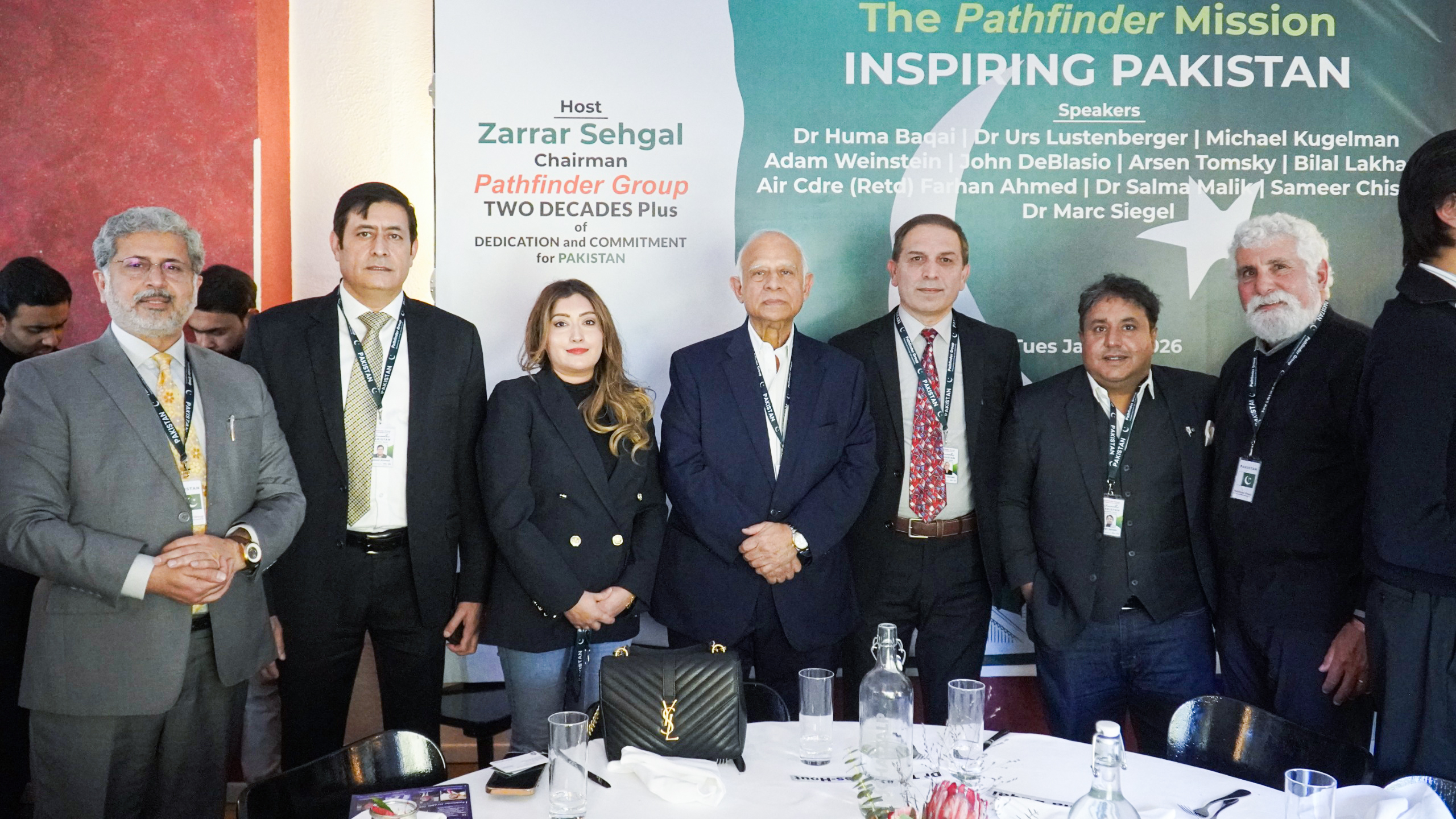
Davos, Switzerland, January 20, 2026
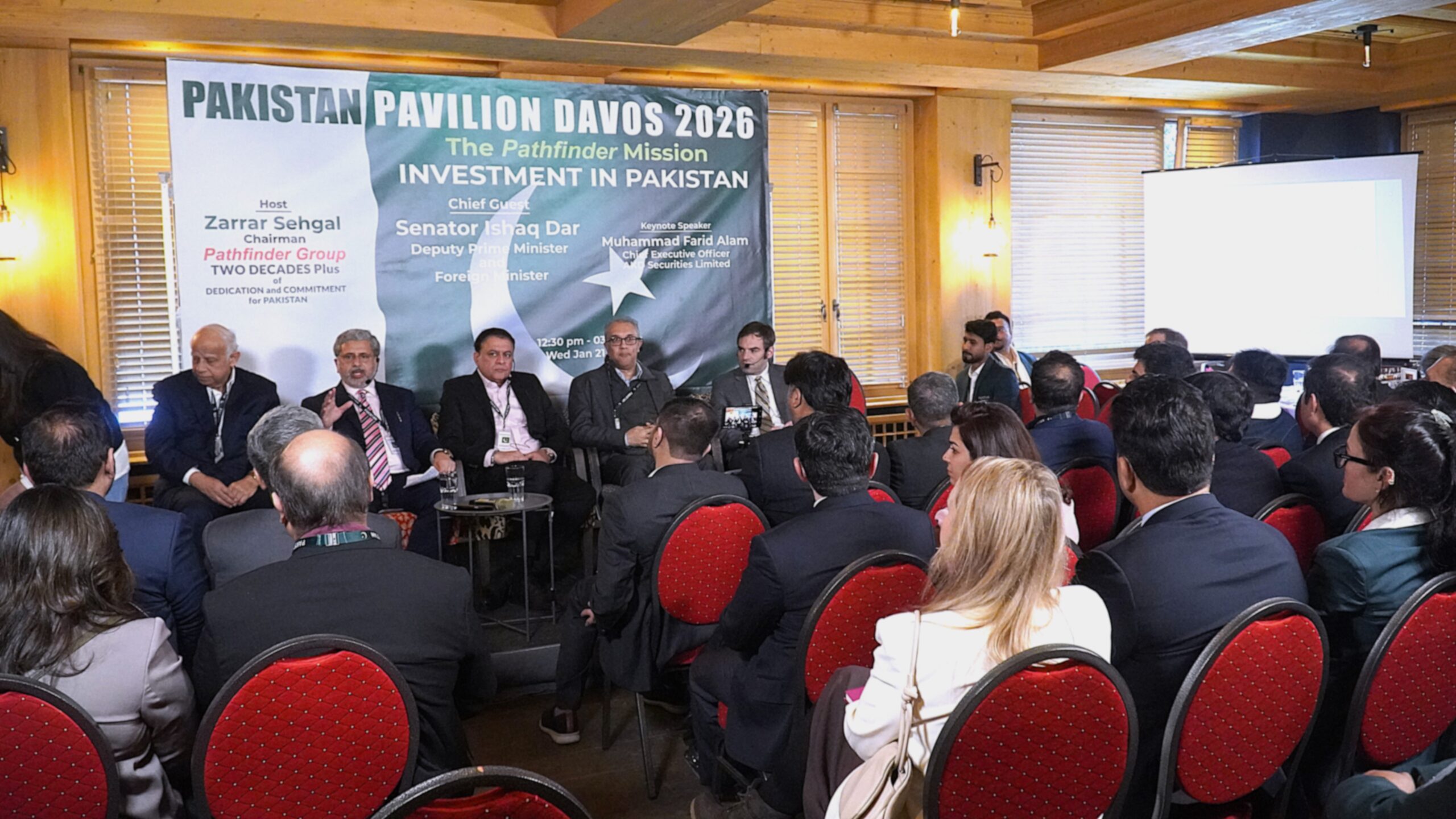
The Pathfinder Group hosted the “Inspiring Pakistan Lunch” at the Pakistan Pavilion during WEF
DAVOS 2026 on Tuesday, January 20, 2026, from 12:30 pm to 03:30 pm. Held at the Schatzalp
Restaurant, the exclusive luncheon brought together global policymakers, business leaders, academics, investors, and thought leaders to engage in a dialogue on Pakistan’s evolving economic,
strategic, and innovation landscape.
Dr Huma Baqai – Senior Vice Chairperson, KCFR (Host):
To me, it is almost like coming home. I have been here seven times, but the Pathfinder Group is doing it for the 15th time. Tomorrow, the breakfast, which has become the main Pakistani event at Davos, with the whole school of Pakistan attending it, along with a large presence of the press and many very important people, will take place for the 22nd time. Of course, it is hosted by the Pathfinder Group, its Chairman, Zarrar Sehgal, and its Co-Chairman, Ikram Sehgal. Ladies and gentlemen, it is interesting that a man (Ikram Sehgal) who is supposed to be a hardcore businessman has, somewhere along the line, become the face of Pakistan’s international diplomacy here. And not just here, but in many other places as well. And not just international diplomacy, but also someone who finds solutions to the challenges of Pakistan. And today, we have a list of speakers who are not going to talk about the potential of Pakistan. They are going to talk about what is happening in Pakistan right now, and why we think it is inspiring, and why we believe Pakistan is going to take off. The Pathfinder Group employs over 12,000 people nationwide. And I have seen how they treat it.
They are a Pathfinder family; it’s not just a slogan. I have seen it in practice. Additionally, they are also mentoring a significant number of young talents in Pakistan. For example, I was identified by Ikram Sehgal 20 years ago somewhere along the line, and I would like to think I am part of the Pathfinder family. Sometimes I say I am part of the Sehgal family. It is almost like a living legend, ladies and gentlemen. And I do not know when or how this man finds the motivation to do all of this. Because we all know and understand that this is a very expensive enterprise, and he deliberately keep the government out of it. We had a former Prime Minister of Pakistan with us here once, and someone from the audience asked him, why does the government not pitch in? Why is the government not doing something? Where is the Pakistani government? Why is this entirely a private initiative? He said, thank God for that, you know much better. I agree. So that is what Pathfinder is, but it is also a lot more. There is a sentence I have picked up because it carries a lot of truth. And that sentence says that if I did not consider all of us sitting under this roof, all of us who love Pakistan, one thing remains clear: ‘Once a Pathfinder, always a Pathfinder.’ So, with that, I will invite Zarrar Sehgal for the introductory remarks.
Zarrar Sehgal – Chairman, Pathfinder Group:
Ladies and gentlemen, first of all, I would like to thank our distinguished guests and family members for joining us. This has obviously become an annual tradition, and we are all delighted to welcome you on behalf of the Pathfinder Group. And on behalf of, what we often say is two decades of us being here, but in reality, it has been over 30 years. So, it is really more like three decades of us being here. Thank you for joining us. All of us here know that a great deal of work has gone into putting this week of activities together. So hopefully, you can join us for all of our events. I am very delighted to see everyone, familiar faces as well as some new ones. So, thank you once again for being here. And I look forward to hearing from all of our speakers.
Dr Huma Baqai: Before we hear from Pakistanis about Pakistan, let us hear from people who see Pakistan from the outside, who have grown fond of Pakistan, who love Pakistan, and who stand shoulder to shoulder with Pakistan. Every speaker has just four minutes each. We are looking forward to listening to you, but we also want to give a chance to many other people who are here. And later, during other programs, you will get a chance to speak in more detail and project whatever you would like to. But here, you have exactly four minutes. My first speaker is Dr Urs Lustenberger, President of SwissCham Asia, who has also become a dear friend of mine. I cannot imagine the Pakistan Pavilion without him.
Dr Urs Lustenberger – President, SwissCham Asia:
Thank you for the nice introduction, and thank you to the Sehgal family for organizing this wonderful event. When I talk about the inspiration drawn from Pakistan, I think the inspiration comes mainly from the people. Their resilience, their strength to deal with adversity, and their ingenuity in dealing with the things that are going on in the world. Unfortunately, Switzerland and Pakistan have recently shared similar tragedies. Switzerland had a tragedy over a year ago where a party of young people was severely injured. A lot of deaths happened at a Christmas party. Pakistan had a similar event just recently at a shopping mall. I know that Pakistan will be much better at dealing with this than Switzerland is. We are still learning. We don’t know how to do it. We don’t know how to improve, for example, fireproofing, etc. Everyone is in shock, and nobody knows really how to deal with it, whereas I know Pakistan knows how to deal with it. Things like that are much easier to deal with. It is easier to look forward. It’s easier for a country like Pakistan to fight a war, resolve it, get over it, and do something positive out of it.
In my eyes, when I see that, when I see, for example, the problems that you had with your neighbouring country and how you dealt with it, when I see the resolve, and then I see the growing friendship again, you can jump over your shadow. You can do things. For me, when I look at the whole thing, and here I can just follow up with my predecessor, when I look at Ikram, when I look at Zarrar, when I look at the Pathfinder family, then for me that is a symbol of inspiration. I would like to be able to have the same legacy when I am reaching Ikram’s age. I don’t think I will make it. Thank you very much.
Dr Huma Baqai (Host): Thank you so much. And yes, the tragedy with Switzerland and the tragedy with Pakistan, we are also grieving right now. We are also trying to recover from it. As Dr Urs Lustenberger spoke about South Asia and India-Pakistan relations. I have the perfect name to talk about it. Michael Kugelman, Senior Fellow for South Asia at the Atlantic Council and the former Founding Director of the Wilson Centre’s South Asia Institute. He keeps a close watch on South Asia, especially on IndiaPakistan relations. I follow him on Twitter very closely, and let’s see what he has to say. By the way, he is also becoming a regular here. This is his second time here with us.
Michael Kugelman – Senior Fellow for South Asia, The Atlantic Council:
Thank you very much, Huma. Let me begin by thanking my dear friend Ikram and his family for having me. This is indeed the second year that I have been here. With such great memories from last year, it is wonderful to be back again this year. I am often asked why someone who sounds like me, who has a name like mine, decided to make a career out of studying Pakistan. Not many people like me, to be quite frank, study Pakistan. On the whole, in the United States, and certainly in Washington, D.C., where I am based, the number of specialists on Pakistan is quite small. It has always been that way. I think there is something that draws me to Pakistan. I do not talk about the responses one typically hears, the hospitality, the good food, the resilience, and all that. That is certainly true, but for me it goes beyond that. What draws me to Pakistan, in addition to its being a fascinating and complicated place, is that it is an odds-defier. It is defying the odds all the time.
If you just look at the last twenty years, or even less than that, in 2008, there was a global financial crisis. There were concerns that Pakistan would experience a financial meltdown, and it did not. It did not happen. Then the next year, there was a well-known prediction by a U.S. expert that the Pakistani state would collapse in about six months or so. It did not collapse. Then, as you move into the early 2000s, there were concerns that Pakistan would not be able to manage an unrelenting campaign of terrorism. It did. And if you fast forward to just a few years ago, there were fears of another economic meltdown. There were fears that Pakistan would default on its loans. That did not happen.
This odds-defying happens at the individual level, and it happens across society as well. One example is cricket, Pakistan’s national cricket team, which often comes out of nowhere and scores upsets against better teams. This happened a few years ago, and the list goes on and on. But there is an essential point to be made here. Being an odds defier is admirable, but it also points to a potential problem. Why are you having to face such low odds to begin with? Ideally, you get to a point where your odds are better, and you do not have to worry about defaulting or collapsing. And this brings me to another important issue. Pakistan, let us be very clear, still has a lot of work to do. It needs to strengthen its economy, strengthen its security, and become more of a major global player. But I think it is well on its way, especially through its global engagement. If you look at what Pakistan has been doing over the last year, and even over the last few months, it is becoming more present and more prominent globally. If you look at its diplomacy and other activities in the Middle East, for example, there is a very strong case right there. Pakistan is no longer dealing with the image problems it faced some years ago, and I think that is a big help. I also think this can catalyze as Pakistan looks to do more in the world.
I will conclude with this. There is a major opportunity for Pakistan right now. The world is undergoing a massive turn, and we all know why. There are many reasons for it. There is a major backlash against the U.S.-led world order. The global South has been emboldened. There is a growing push toward multipolarity. With all of these advantages, Pakistan is seeking to become a bigger regional player and perhaps even a bigger global player. Pakistan can find its space in this rapidly evolving world. In this way, Pakistan can shift from being an odds-defying but fragile state to a stronger state, one that can play a greater global role and, in turn, make itself stronger at home. Thank you.
Dr Huma Baqai (Host): I have something very interesting here. Because the next speaker I have is Adam Weinstein, Deputy Director at the Quincy Institute for Responsible Statecraft.
Adam Weinstein – Deputy Director at Quincy Institute for Responsible Statecraft:
Thanks for having me. I hope you do not mind if I refer to a few notes. This is my second year here as well. Michael and I were both here last year, and I think we are both glad to be back. I know I am. We are returning after a year marked by a positive trajectory in U.S.-Pakistan relations, which is the lens through which I view these issues. In fact, I think it is safe to say that U.S.-Pakistan relations are closer right now than they have been in years, and perhaps even decades. We are seeing renewed ties, for example, through U.S. military exchanges with Pakistan. Just last week, U.S. and Pakistani soldiers completed joint exercises at Pakistan’s National Counterterrorism Center and posed for photos together, something that would have been unimaginable just a few years ago. We also see the United States coming to Pakistan’s aid again. During the devastating floods in Swat last year, the United States was present at Nur Khan Air Base, helping victims and helping Pakistan strengthen its resilience.
In addition, there is direct contact at the highest political and military levels between the United States and Pakistan. We are moving away from years of very stagnant, technocratic, and bureaucratic diplomacy toward a more human relationship. I think this is possible because there is an unconventional administration in Washington. Of course, that brings both positives and negatives, but for Pakistan, I believe it represents a real opportunity. I also want to speak about the major strategic changes taking place in Pakistan. When I first started visiting the country, it was at the tail end of a very violent period during the 2010s. At that time, civilian casualties from the fallout of the war on terrorism in Pakistan were common. Suicide attacks in major Pakistani cities were a regular occurrence. Pakistan was deeply fearful of its neighbors, as well as of the sectarianism and extremism emanating not only from its immediate surroundings but also from Iran and the Gulf. If we look at Pakistan today, the picture is very different. Pakistan is no longer a battlefield for the region. Instead, it has become a source of stability. We now see Gulf countries looking to Pakistan as a security guarantor, which is extraordinary when you think about it. This means that the strategic environment Pakistan finds itself in today is highly advantageous for its future.
I also believe that, in terms of U.S.-Pakistan relations, there is a once-in-a-lifetime opportunity right now to reset the relationship. Pakistan can take advantage of some of the changes happening in Washington. Of course, not all of these changes are positive. The current administration in Washington is highly unpredictable. It is committed to great power competition with China in ways that place Pakistan in a vulnerable position. It has also, at least temporarily, closed the door on people-to-people ties by restricting immigration pathways for Pakistanis. I believe these are mistakes on the part of Washington. At the same time, there is a real opportunity for Pakistan to seize this moment and pursue a relationship with the United States that is less rooted in counterterrorism, war, and security, and more focused on investment and long-term, sustainable economic development. I sincerely hope Pakistan takes advantage of this opportunity. And as a friend of Pakistan, I am happy to help in whatever small ways I can.
Dr Huma Baqai (Host): I would like to invite the Founder and CEO of inDrive Arsen Tomsky. InDrive is a household name in Pakistan now. I work in an institute which has about 300 employees, at least half of them are driving. And young people trust it. They’re loving it. And it’s in Pakistan. So that’s something that’s a huge advantage for us.
Arsen Tomsky – Founder and CEO, inDrive:
Let me tell you a story. It was a very cold day in the coldest city in the world, Yakutsk, Russia, my hometown. The temperature was minus thirty-five degrees Celsius. On that same day, all the taxi companies in the city doubled their fares. It was an unfair cartel agreement. Of course, a lot of people were absolutely furious because it became extremely difficult, for example, to travel even two miles to school with your child in such bitterly cold weather. This created a very sharp sense of injustice.
At that time, a twenty-year-old student created a special profile on social media. People could come there and say, I would like to go from point A to point B, and I am willing to pay this amount. Then people started to negotiate. In a short time, about fifty thousand people in this relatively small city began using it. I saw that it was a clear social transformation. We took this idea and turned it into a technology startup. Over the last twelve years, we have built a truly large-scale global company. From day one, we have been fighting injustice. Today, we operate in one thousand sixty-five cities across forty-eight countries. We are now the second-largest ride-sharing company in the world by number of app downloads, right after Uber.
This model is especially good for countries that start from a position of instability, because people there often need access to fairer systems and external support. We launched in Pakistan because we saw that the situation was not stable, and that instability is not good for people. In a short time, inDrive became a market leader in the country. This happened because many people switched to us and actively invited others in their social circles to do the same. We continue to protect people from price manipulation because we do not set fares. People do. It is a peer-to-peer model. We also protect people from inflated commissions. We charge around ten percent of the fare, instead of twenty-five or forty percent. That is much fairer. But our work goes beyond ride sharing. We now invest millions in Pakistani startups. We support talented artists. We support female tech entrepreneurs. Globally, we run six non-profit initiatives, all with the same goal: to reduce injustice. My goal today is to find a local partner for one of these initiatives. This year, we want to launch an anti-smog initiative in Lahore. Smog is a very serious problem in the city. So, if you are interested in partnering with us, please reach out to me.
John DeBlasio – Chairman, Continuity Global Solutions & Executive Chairman, DT Global:
Thank you very much to my partner Ikram Sehgal, the Sehgal family, and SMS Pathfinder. We have been partners with SMS Pathfinder for nearly half a dozen years now, and it has been a real pleasure working with them and being partners here at the World Economic Forum, both as attendees and as participants invited to speak about Pakistan and its potential. First of all, I have to compliment whoever came up with “Inspiring Pakistan” as the overall theme and marketing approach. I think it speaks directly to Pakistan’s potential. It highlights the opportunity inherent in the country’s human capital, and it points to where Pakistan can go in terms of governance and capability as reforms continue to take shape.
We are very excited to be part of an ecosystem in Pakistan, both on the economic side and through the security-related work that we do. I think Pakistan, at this moment, has reached a very critical point in a geopolitical sense, particularly because of the balance of power in South Asia and Pakistan’s central role within that environment. Without question, this has been a very interesting period for the world. But as we have experienced it here, and as we have seen it from the United States, the importance of Pakistan in the global geopolitical landscape has become increasingly clear. Because of this, we are very enthusiastic about continuing our work in Pakistan. We are actively exploring alternative opportunities and new areas of engagement. And if anyone here has an interest in partnering with us, we are certainly open and ready to help make that possible. So, thank you very much for having me. I am truly inspired by what all of you are doing, and by the efforts to build on the West’s networks in ways that can help provide a better future for Pakistan.
Dr Huma Baqai (Host): The next speaker is Professor Dr Marc Siegel. He is the Director of the Global Security and Resilience Project, Homeland Security Graduate Program at Santiago State University. He’s been to Pakistan a dozen times. And right now, against all odds, he’s teaching in Ukraine.
Dr Marc Siegel – Director of Global Security and Resilience Projects, Homeland Security Graduate Program, San Diego State University (SDSU):
It is great to be back here again, with what I consider my Pakistani family. Ikram likes to joke that I am a Siegel, he is a Sehgal, and that I am the lost branch of the family. So, it really does feel like family. When I think about what is inspirational about Pakistan, I go back twelve years to my first visit. I met Ikram in Washington, and he invited me to come to Pakistan to train his company on the new international standards for security operations and human rights. He genuinely wanted Pathfinder to become the first company in the developing world to achieve that certification, which we ultimately did.
If you remember what Pakistan was like twelve years ago, many Americans were predicting that it was heading toward becoming a failed state. People would ask, why would you go there? But when I arrived, what I quickly realized was that what truly makes Pakistan different is its people, and the dedication of its people. The challenges Pakistan needs to overcome are immense. I have seen similar challenges in many places around the world. But the Pathfinder family, and the way Ikram and Zarrar give back to the community, is an example not just for Pakistan, but for the rest of the world. Thank you. And now, as someone who teaches in a country where I sometimes cannot understand why my students would come to listen to me teach risk management, as the only foreigner teaching in a war zone, it puzzles me at times. But I have learned lessons there that I believe are also very important for Pakistan today.
One key lesson is that Pakistan has tremendous young potential, especially in technology and development. But to truly differentiate in artificial intelligence and other advanced fields, young people need to realize that they live within a political environment and that they also have a responsibility to give back. They need to put down their cell phones. Another key point is the need to return to an older approach to education, one where we focused on critical thinking, where we learned by asking questions, rather than assuming that we always had the answers. So again, thank you for having me back here. I see great potential for Pakistan moving forward. Pakistan can be a role model for much of the developing world if it can combine strong soft skills with strong hard skills. And once again, thank you, Ikram, for being a great friend to all of us here today.
Dr Huma Baqai (Host): And now, I will invite Hend Alhinnawi, Secretary-Elect and Senior Humanitarian Tracker. I was really fascinated by her. It was inspired by ordinary people doing extraordinary things. It was founded in 2011, and she works on artificial intelligence for social good.
Hend Alhinnawi – Executive Director & CEO, Humanitarian Tracker:
Good afternoon, everyone. Thank you to Ikram Sehgal, Chairman Zarrar Sehgal, Kashmala, and the Sehgal family for the invitation today. I am a Syrian American and an honorary Pakistani, so I truly feel as though I am among family here. What is incredibly impressive to me is the dedication of the Pakistani people to Pakistan. That dedication deserves a round of applause. The love for the country is what is driving it forward. It is the love for the Pakistani people that they want to see, the potential they already recognize, and the investments that are being made. I do not even need to speak about it in detail. You can see it clearly on the ground.
Part of the reason I am here today, and part of why I continue to support the Pathfinder Group, is to explore how we can offer our resources to Pakistani youth, to Pakistani NGOs, and to Pakistani organizations. We want to make our crowdsourcing capabilities and our artificial intelligence tools available to them, so they can use these resources to grow and advance. Perhaps next year we will be able to come back and discuss a concrete use case together. But for now, thank you very much for the invitation. I am really looking forward to getting to know all of you.
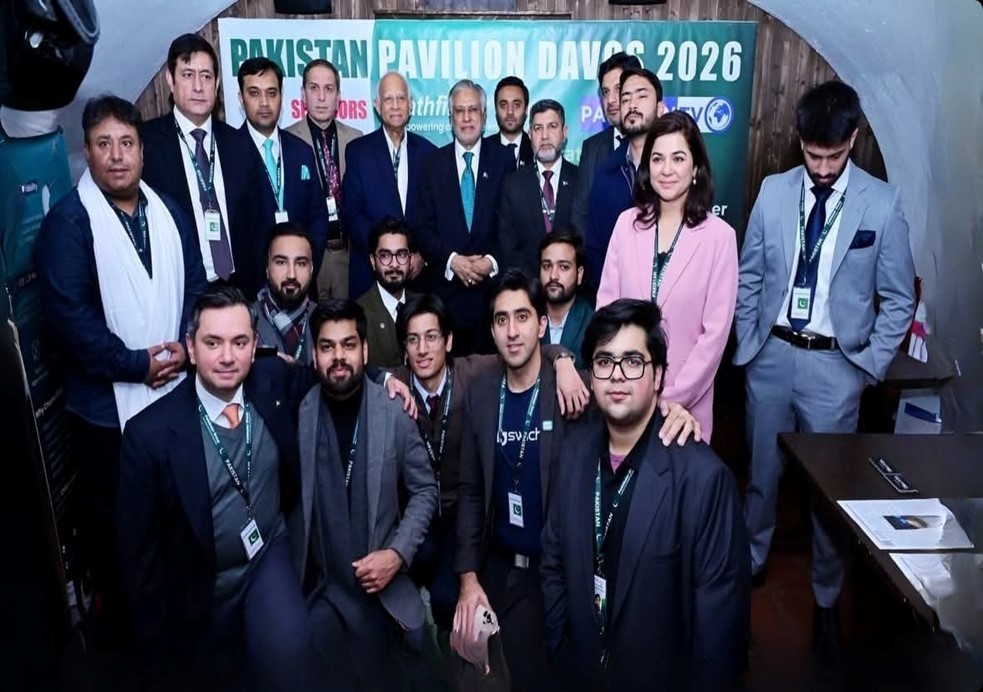
Dr Huma Baqai (Host): Every time I meet Ikram Sehgal, and we have a conversation, I think he has already done everything that needs to be done. And then he comes up with something new that fills us with inspiration. This time, it is the Center for Innovation, Technological Advancement, Digital Entrepreneurs and Leadership, CITADEL. We have Farhan here with us today, the Director of CITADEL. CITADEL is working with the youth of Pakistan, and for the youth of Pakistan. This is the first time that Pathfinder has actually brought eight startups to Davos. These startups went through a very stringent competition. They were evaluated by private sector professionals, they won those competitions, and they are now here. So, this is the first time that startups from Pakistan are present here in Davos. Why is this so critical for Pakistan? It is critical because this is our demographic. Seventy percent of our population is youth.
Air Cdre (Retd) Farhan Ahmed – Project Director CITADEL:
Thank you very much, and welcome to all the distinguished guests. Talking about Pakistan and the topic of “Inspiring Pakistan,” I won’t simply call it Pakistan’s potential, though it certainly has potential. Everyone has seen it. We all face challenges. We fall, we get up again. Someone may push us down the hill, but we come back, climb the hill, and rise again. No matter the situation, no matter the environment, no matter our geography, we come back. The force that drives us to rise again is the force of youth. The median age of Pakistan is around nineteen years. Today, sixty percent of our population of over 220 million is below the age of thirty. And as I am sure everyone here will agree, it is not just the youth that are our resource, it is their hard work, their real entrepreneurial mindset, that makes Pakistan inspiring. That is the essence of “Inspiring Pakistan.” To illustrate, one of the largest freelance communities in the world comes from Pakistan. There are over 1.5 million freelancers in IT alone. In just half a decade, these young people have taken Pakistan’s IT exports from less than a billion dollars to three billion dollars today. This is where we are, and this is what we represent. I am deeply thankful to our Chairman and to everyone who has supported this vision.
What we need to do now is equip our youth with the right tools, the right environment, and the right institutions. Their energy, combined with these resources, will make Pakistan a new engine of growth, one that is sustainable. To achieve this, we have launched the initiative of CITADEL, which represents three verticals. The first is the Jumpstart Academy, which equips young graduates with the skills needed to bridge the gap between what academia teaches and what industry requires. For this, we have partnered with leading AI and high-tech companies, and we continue to reach out to other major players in the local market. We identify industry needs and then prepare these youth to drive Pakistan’s economic growth and digitalization. The second vertical is the Accelerator Program, which provides vital guidance for young entrepreneurs. The eight entrepreneurs you see here today are not just founders; they represent eight ideas. CITADEL showcases them to global leadership and industry partners, highlighting the real entrepreneurial face of Pakistan to the world. This is the path we are taking forward. We believe in collaboration and cooperation, and we call on all of you to join hands with us. Let us empower our youth, advance technology, and drive shared progress in digitalization and AI in Pakistan.
Dr Huma Baqai (Host): So, this particular initiative is also very close to my heart. I’m a very, very small part of it. I was a part of the launch. And I think it’s very timely. It’s bold. It’s brave. It’s ambitious. And because Ikram Sehgal is behind it, it will succeed. And now, let’s hear from the youth. So, I have Bilal Lakhani, a young journalist, telling us what journalism is like in Pakistan.
Bilal Lakhani – Contributor at The Express Tribune:
Thank you so much, Huma. My own wife doesn’t call me young anymore, so it’s nice to hear that someone still considers me young. I am absolutely delighted to be here. Thank you to Ikram Sehgal, Zarrar, Kashmala, and everyone else who made this possible. I want to spend a little time on the topic of “Inspiring Pakistan,” but from the perspective of overseas Pakistanis. I flew here from New York, where I host a podcast called Extraordinary Pakistani American Stories. The reason I want to focus on this is that this is one of the most exciting times to be an overseas Pakistani. Not just because we are sending in $35 billion in remittances, which is equal to, and even slightly higher than, our annual exports, contributing to a real economic boost, but also because Pakistani Americans, and Pakistanis around the world, are coming of age. This is not just in the traditional parent-sanctioned careers of medicine and law, but also in business, technology, entrepreneurship, and politics. There is now a growing group of what we call Pakistani “Mamdanis”, Pakistani Americans and Pakistanis entering public office, changing the conversation about what it means to be Pakistani abroad.
I was recently meeting with the President of the Girl Scouts of America. She happens to be a Pakistani American, leading the largest girls-led organization in the United States. Who would have thought that Pakistani Americans would be making such a significant impact across industries and sectors? The core message I want to share today is that it is time we tell our story of coming of age, both as a community within Pakistan and as a diaspora. We need to step into our power. Watching elections, even in the U.S., like the New York mayoral race, I have seen how the Pakistani American community came out and became a central force in shaping the outcome. This is the kind of impact we need to create, not just in Pakistan, but outside of Pakistan as well, because a rising tide lifts all boats.
Dr Huma Baqai (Host): The insight that you’ve given us is great. We just don’t look at the kind of, we look at the kind of contributions overseas Pakistan has made, but the role and what it’s going to become for the future of Pakistan is critically important. Just outlined by Bilal. And now I have a very interesting speaker. Muhammad Farid Alam represents one of the most prominent securities in Pakistan, AKG Securities. He’s the CEO. The stock exchange in Pakistan is growing by leaps and bounds. And it is becoming more inclusive. The question is, is it reflective of Pakistan’s economy?
Muhammad Farid Alam – CEO, AKD Securities Limited:
Respected Ikram Sehgal Saab, Co-Chairman of Pathfinder Group, Chairman Zarrar Saab, members of the Sehgal family, ladies and gentlemen, Assalam-o-Alaikum. It is an absolute honor for me to be here once again and to discuss Pakistan in this distinguished gathering. I am reminded of a poet from the subcontinent who, about 150 years ago, said something that I would like to dedicate to Ikram Sehgal. It is in Urdu, and I will translate it into English. He said: “Don’t take us lightly. The sky revolves for centuries, and only then, from the wail of the dust, do people like Ikram Sehgal appear.”
I hope that was not too difficult for my foreign friends to follow. Dr Urs Lustenberger touched upon resilience. Dr Saab, I just want to say to him and to everyone here that resilience is not really taught in Pakistan; it is inherited. In Pakistan, we may be scarce in many resources, but our faith bridges the gap between what we have and what we aim to achieve. That gratitude, that determination, fills the gap, and we continue moving forward. So, I think my job here is relatively easy. I represent the capital markets, which have performed exceedingly well over the past couple of years. The market has risen fivefold in the last two and a half years. Those of you who actively follow the market understand that Pakistan has done exceptionally well. It is one of the best-performing markets in the world over this period, and there seems to be no stopping it.
I represent security, and my young team and I usually form broad convictions about the stock market. I distinctly remember that on December 20, 2024, we set a bold target for the index: we anticipated it would reach 165,000 by the end of 2025. I am glad to report that we achieved this target in August 2025. At the time we made this forecast, the consensus among other corporate brokerage houses was 122,000. So, we were already ahead of the curve, and we achieved this without any compromise on conviction. Now, looking ahead to 2026, our strategy anticipates that the market will cross the 263,800 level, representing a potential upside of 53% from its current value, which has already increased fivefold. When we talk about Pakistan and its economy, much has contributed to these results, yet the market still appears relatively cheap. Historically, the market has traded at price-to-earnings multiples of 13 and even 11. I have been around long enough to have seen this.
Today, based on the points I just mentioned, the market index reflects only an 8.5 times price-to-earnings multiple. So, we have not yet reached previous highs, and we anticipate that the market could cross the $100 billion milestone in 2026. Achieving this would be a landmark moment, not just for us, but for many others who follow Pakistan’s markets closely. There is much more I could say about the market, but suffice it to say that the momentum is strong. Conviction, the privatization program, monetary easing, and several other factors are driving the market upward. Due to limited time, and as Huma reminds me, I will stop here. Thank you very much.
Dr Huma Baqai (Host): I now invite Sameer Chishty, who is the Executive Chairman of AsiaPak Investments. His company has been investing in Pakistan for the last decade.
Sameer Chishty – Executive Chairman AsiaPak Investments:
We hate talking about ourselves because we are terrible at it. But when Ikram Sehgal calls, when my high school buddy calls, you take the call, and I figured, how badly could I screw this up? I mean, look at that view. Look at that view outside. I do not even know why anyone is looking in my direction. I have three very simple points that I would like to make. In fact, we shared very similar talking points yesterday at a couple of events hosted by some Western private equity firms. What I think is remarkable is how capital formation will be aided not just by Pakistan. Local families, local entrepreneurs, and Chinese corporates have driven a lot of this. But increasingly, Western capital is also looking to Pakistan, interestingly, as a sea of stability and a country with a strong, independent foreign policy. I was making a slight joke, a half joke, though no jokes are really all jokes, that Pakistan might be able to teach something to Europe as we enter a new 19th-century age of great power competition. That would be interesting.
Anyway, here are my three quick points. We are unabashedly, unapologetically bullish on Pakistan. I would not even say bullish. We are maximum bullish on Pakistan. And our bullishness is driven by a conviction born out of ten years of investing in Pakistan. Over those ten years, we have acquired ten companies. We have improved ten companies with better management, strategy, technology, and products, and by injecting new capital. We have made a lot of money for ourselves, which is why we do not like talking about it, and for our partners, our fellow investors, our debt holders, and our equity holders. It has been an outstanding story in the world. Pakistan has been good to us, and largely that is because there is tremendous opportunity in literally every sector. So, when people ask, where is the opportunity, I think that is their own question, frankly. It is about what you want to do, what you know how to do, and how you want to participate in Pakistan.
As I was saying, we have acquired ten companies, and that is what we do. It is a very simple private equity playbook that all of you know. It just was not being done much in Pakistan. After two decades or more of my brother and me having careers in New York and Hong Kong, we said, why are we spending our lives building other people’s countries, and why not our own? If Vietnam can do it, and Indonesia can do it, and India can do it, why can’t Pakistan? We came to Pakistan essentially to prove that. To prove it to ourselves, to prove it to our friends, and most importantly, to prove it to our parents. There are a couple of specific points which, over the next few days, I hope to discuss with many of you. I also hope people like Michael will talk about this more and more, because we think two fundamental internal drivers are creating an environment conducive to capital and to capital formation. One is the government’s ongoing reform program and strong fiscal discipline. There is a lot more to do, but it is a good start.
The second is strong security, something we do not talk about much in polite investment circles. This second factor is strongly supportive of capital formation. It is a strong Pakistan Armed Forces, especially the force of the flag, which is effectively air superiority combined with nuclear capability, and many European countries today wish they had something like that. Anyway, we are huge fans of Pakistan. We are huge fans of Pakistan. This is not driven by a need for patriotism, but by a real money opportunity of deploying capital. Over the last ten years, we have never shared this publicly; we have deployed four billion dollars into Pakistan. This has been with partners, with Chinese partners, with a few other families in Pakistan, and with the support of a lot of very smart banks. Second, we have an investment pipeline across multiple sectors of five billion US dollars that we are extremely excited about. This time, we think we can expand that to include a lot of technology, because Pakistan’s technology sector has finally come of age.
Dr Huma Baqai (Host): I would now invite another overseas Pakistani who is our pride and loves Pakistan, Hassan Sharif.
Hassan Sharif Khan – IT Entrepreneur and AI Expert:
I am between you and lunch, so I will keep it brief. Last year, I spoke about how languages will be lost if AI and information models are not built fundamentally from the ground up. At the end of that talk, I thought I would have Arabs and Pashtuns coming up to me to talk about how their languages would be lost. Instead, the gentleman who approached me was a Welshman, and he said, my language will be lost. That led me down a rabbit hole of looking at all the languages in and around the UK that are suffering in the same way. So today, I thought I would talk to you about a similar topic, but in a broader vein. AI is the new revolution. If you look back at the industrial age, there were haves and have-nots, and similarly with the second industrial revolution, the result was the same. The AI revolution is unfolding in much the same way. When you walk up and down the promenade, you can already see some of that in action. I want to give you an example of what societies will look like that are the haves of AI.
I want to start with education, especially since Dr Siegel spoke a little about critical thinking. I want to talk about basic education. You will have students who speak multiple languages and who have tailored teachers, with generative AI-based digital teachers providing customized education. For example, my son reads faster than he is at math, but his math is not going to catch up for another two years. Now you can have kids in the same grade operating at different levels, whether in math, reading, or other subjects, and you can customize the AI to teach them together. Ultimately, the function of coming together in a school will be more about interaction and learning critical thinking skills. In the field of jobs, I used to work at Freddie Mac. One of the things we did there was that when you paid your mortgage, the servicer would receive the payment, the Freddie Mac chain would receive the funds, and the investors would get paid. All of that was automated. You did not need the ten thousand or so employees that we had to run Freddie Mac and Fannie Mae. The reason those employees existed was that some people would make prepayments on their mortgages or make early payments. The employees handled those exceptional scenarios where humans had to intervene because the IT systems could not react.
But that has changed. Corporations are going to change, and we are going to see companies where those exception scenarios are now handled by agentic AI. As you walk up and down the promenade, last year, everyone said AI. This year, it says agentic AI and return on investment. I will talk about that in relation to CITADEL Group in a moment. Health care is also going to change. Imagine you are in rural Cork, you speak a very specific dialect from Peshawar, you are pregnant, and you do not have regular access to a doctor. Digital Zoom meetings are different because you still have to schedule them and see a doctor on the other side. But imagine instead that you have specific pain, or you are at a particular stage in your pregnancy, and you can speak to someone from your home, without leaving your home, and get advice that at least helps you through the basic portions of your pregnancy. The haves will have access to things like that.
Language models are very good at translating, but fundamentally, there is still a huge, wide-open space when it comes to the many dialects of languages that exist. I work at Amazon Web Services, and one of the key things we are trying to build right now is support for dialects of English. One of the most common requests in health care is for a Chinese accent in English. So, this is not only about new languages, it is about dialects. That is critically important for the haves to have, because any language or dialect that does not have this, just as I said last year, is potentially lost. I want to wrap up with two points. One is that the Pakistan Air Force has been very effective because of its pilots, largely because of the maneuvers they can perform. The haves of the future will have air forces where that skill set is translated into AI. Aircraft will work with data-generating AI and artificial intelligence systems. That is a huge way in which things are changing. That is the future society of the haves. Finally, what we are doing with CITADEL here is very important for starting to build that future society. That must happen. And with that, I will wrap up.
Dr Huma Baqai (Host): Our next speaker is a woman, a professor from Pakistan. But what is different here is that she’s broken both the glass ceiling and the pink ceiling. She is a professor of defense and strategic studies, teaching it for many years, and is also now a part of policy-making.
Dr Salma Malik – Director External Linkage, Defence and Strategic Studies, Quaid-i-Azam University:
Thank you, everyone. This is my first time at Davos, and thank you, Mr Sehgal for this opportunity. With so many people saying so many great things, I honestly find myself at a loss for words. My vocabulary has completely deserted me. However, when I look at women in strategic studies, I represent a small sample of a very small group that has managed to break the glass ceiling. But breaking that glass ceiling was never easy, for people like Huma, for people like me, and for many of the people in this room. It is never an easy job. And it is not only about breaking the glass ceiling, but it is also about breaking the glass walls, the horizontal barriers that keep crashing down on us. That is a huge task. In Pakistan, and I think elsewhere as well, women are underrepresented in high politics and diplomacy, in military affairs, and those who are part of that circle often adopt a very well-established, safe, gender neutral tone. That approach does not always work for the politics involved, but it is largely because they want to create a niche for themselves, which is very important.
Now that many of those women have created that niche, they are also in a position to create the change that was always required of them. Yet the work remains very tough. It is a steep uphill climb, and there are no slides that can carry us up to the full sky. It is an unfortunate but very real and formidable challenge, and it is a challenge that we are taking on. Interestingly, when I look at the younger generation of women, what stands out is that they have no respect for those glass ceilings or glass walls. They break them, they break them at will, and they do it loudly and clearly. That is a wonderful story. At times, in fact, we have to calm them down a little and tell them that they do not have to move so fast, that they should think about the poor guys in the picture as well. And yet they are very vocal, and that in itself is powerful.
Because time is short, I will focus on just one aspect. Where do women really make a change? I have been part of several initiatives under the Women, Peace, and Security agenda. We were part of India-Pakistan conflict dialogues and similar efforts. But for me, the highlight came in May 2025, when several of my female colleagues called or sent WhatsApp messages asking which port to take to reach Lahore port, because they wanted to come to shop, to chat, to dine, and to see how Lahore had developed a port. We had to tell them that we are also waiting for Lahore to become a port city. But we explained that they could cross the border from Attari to Wagah and come and enjoy time with us there. In that way, we transcended borders. We did that through online poetry sessions. We did it by exchanging short stories. And those short stories were not about six zero, they were about what we were feeling at a human level.
Those things are very important. They brought in empathy. They reduced the sense of hostility in the adversarial picture that younger generations often inherit about one another. I think we need much more of that, and women are best suited for this role. I am sorry, men, that is just not how men usually work. We did it, and we did it with confidence. We did it without thinking twice about who would say what, or what was happening in higher politics. I will end my three minutes on this point. A long time ago, when I was leading a contingent of young Pakistani women strategists, which was a very prestigious moment for me, Rose Miller referred to that team of young Pakistani strategic thinkers as women, and women of mass destruction. Today, I proudly feel that many of those young women in the strategic circle and beyond have become women of mass transformation.
I would appreciate it if we could take a short break from our lovely food and applaud the women in this room, from Shahnaz Sehgal, the silent powerhouse, to Kashmala, to Amaani and Elena, the third generation, and of course, to the men who make this environment so enabling for us. We cannot walk this path without our partners, both at home and around us, who do not gaslight us and who do not harass us, because these are very real concerns. I would also like to applaud the work done by Zakia, who, at a very small community level, has created remarkable change. Zakia mentioned that she is part of the Kashmir welfare initiative, where, within a small community, she helped transform the environment for underprivileged women into one where women are working, engaging in honorable vocations, and inspiring many young girls to follow the same path and become equally formidable.
Dr Huma Baqai (Host): Another empowered woman, Dr Ying Zhang, Singularity Academy, Singapore, and another one who’s broken both the glass ceiling and the pink ceiling.
Dr Ir. Ying ZHANG – Founder & President, Singularity Academy Switzerland:
I really appreciate Ikram Sehgal for organizing these events every year in Davos. This is now, I think, my tenth year joining here. Every speaker was invited to talk about the Spirit of Pakistan, and I was the one who volunteered to speak about Pakistan. I felt I needed to express my deep appreciation for the country. The first time I joined this event, in this very room, it was because of this gathering that I met my husband, and now we have four children. Over the past decades, we have worked very closely with Pakistani businesses, especially with Ikram. Even though I have not visited Pakistan, whenever I speak with Pakistani friends in Switzerland, they always consider me Pakistani. Once, when I was in Davos dressed up like a Pakistani woman and walking along the street, many Pakistani men approached me and spoke to me in their language, which I did not understand, asking if I was from Pakistan. Pakistan is very dear to my heart, and I sincerely want to thank you. Many people say they wish to be part of the Sehgal family. I want to say that Ikram Sehgal is already part of my family.
Over the past few years, I have also been part of SwissCham Asia, where I serve as chairwoman for the Greater China region. One of the important things we do is work with universities to develop monthly research in the form of an Asian brief. We talk about each Asian country, its economy, and its business environment. Every month, we also publish a Pakistan column dedicated to discussing Pakistan. I want to mention that the reason we do this is that Pakistan is not just about spirit. It is actually a snapshot of all the conflicts and opportunities of this world. The platform that Ikram has consistently built to talk about the future of Pakistan and the Spirit of Pakistan deserves much more attention from Davos and from the West. No matter whether you are talking about America, China, Asia, or Europe, one of the most important questions is how connections can be built, how opportunities can emerge, and how insistence and persistence can help humanity survive. The one country that can truly demonstrate all of this is Pakistan. For all of this, I want to thank you, and I want to thank all of you who show up here every year. You bring this spirit to what can sometimes feel like a boring Switzerland, and at the same time, you give us the chance and the hope inspired by the Swiss Alps. Thank you.
Dr Huma Baqai (Host): We all know that tech and AI are going to give a tailwind to Pakistan’s turnaround. So, my last speaker, but not the least, Usman Sheikh, founder and Chairman of OZI Group.
Usman Sheikh – Founder and Chairman, OZI Group: I want to start with this verse. If you have the will and the power, then the whole world and the Almighty are there to help you. For that, I would like to salute Zarrar and Ikram Sehgal, whose will has turned this into the fifteenth time and the twenty-second time in Davos. It is purely because of the will they have shown. I feel extremely privileged to be here, as this is my first time, and I feel very proud to share some of my views on inspiring Pakistan. I want to share my story. I am a computer science and engineering graduate, and I joined one of Pakistan’s most prestigious institutions, NADRA, where we worked on national identity cards. I also had the opportunity to live in China for two years, and that experience completely changed my way of thinking. There, I saw how Chinese people build ecosystems of helping each other.
After that, I returned to Pakistan and started my first company, OZI Technology. I identified a gap in the gaming industry and established the first Pakistani gaming company under the name OZI Technology. Within one year, it became a million-dollar company. What really mattered was the realization that we often think we need money to start something. We do not need money. We need a better strategy. That strategy led me to build my first million-dollar company. After that, I stopped focusing only on my own company and started helping others understand how they could build million-dollar companies themselves. In this way, I helped people leave their jobs and start their own gaming studios. Today, we have a portfolio of more than thirty studios under the OZI Group, each crossing the million-dollar mark. This was not just because I wanted to make a lot of money. It was because I wanted to become a role model for Pakistanis, to show that if I can do it, why not you? With this mission, I also started Pakistan’s first electric bike initiative back in 2019, and we learned our first lessons there.
Today, we have more than two hundred gaming studios in Pakistan competing with India, Vietnam, and Turkey, and together they are bringing one billion dollars into Pakistan’s economy. Similarly, we now have more than seventy-five electric vehicle companies that have already sold over one lac bikes in Pakistan. What I would like to say is that the hope we have built through resilience is in Pakistan, and the time for Pakistan has already come. All of you who are here should not delay by thinking that maybe Pakistan will rise someday. Pakistan is already on its way to becoming the next economic power.
Dr Huma Baqai (Host): Ladies and gentlemen, please put your hands together for the man himself, Ikram Sehgal.
Ikram Sehgal – Co-Chairman, Pathfinder Group:
Bismillahir Rahmanir Rahim. I will start with Dr Huma Baqai. I think, as you said, you are part of the Sehgal family. I will begin by thanking the many people who have come here. Joel Cowan has been very calm and has been sitting very quietly. He is 92 years old. Thank you for coming. People do not know Joel Cowan very well, but I think you were 21 when you founded a city, Peachtree City, in Georgia. He also headed the Institute of Business Administration at Georgia Tech. I have been coming to Davos now for 32 years. Thirty-one years ago, I met my good friend, also now in his 80s, Mr Paul Gorchy, the owner of the Panorama Hotel. We stayed at the Panorama Hotel until last year. Mr Gorchy sold the hotel about four years ago but he put a clause in the agreement that the Sehgal family would still occupy the seventh floor for three years. The new owners waited for those three years and then hiked the price four times.
I would also like to mention our partners, John de Blasio, and someone who is like a brother to me, Tauqeer Khalid. I look to Tauqeer for many things. I do not understand finances at all, and I ask him to handle that. Let me tell you what a great privilege it is to ensure that we are the first company in the world, in history, to present startups during Davos at WEF. This shook things up. I received top-level messages from three leading Indian entrepreneurs who are friends of mine. I do not want to say it loudly, because nobody shall know about it. They said to me, what a wonderful idea, we wish we had thought about it, and we are going to do it next year. But the point is, I hope you all display everything you are displaying in front of us at AmaaniBagh, Islamabad, named after my granddaughter, and that is very good. I would then like to thank Shahnaz, my wife, my son Zarrar, Kashmala, and my sisters-in-law, who are here with me; Alia and Nasreen are also here. There are many others I have thought about. Dr Marc Siegel jokingly said that we are cousins. I believe we are lost distant cousins, like lost tribes.
I would like to thank the CITADEL team, AVM Asad, Farhan, and Imran Jattala, who are working day and night, producing things like the catalogue you have seen here. It has been a great honor to have people like Sameer Chishty and Usman Sheikh with us. You will hear more from them, as they will try to incorporate some of their interesting ideas and speeches. I also have Imran Bhawani here, a friend of mine from Dubai. If I look at the other table, I see my friend from the Swiss Chamber of Commerce. We are like partners for life. Similarly, I would like to take this occasion to thank Mr Arsen Tomsky. I want to tell you a little secret. Five companies approached us, and they were good companies. We thought yours was one of the five companies that were making a real difference to poor people. Then I went back to something my daughter Nefer had thought about a long time ago, Assan Mobile Account (AMA). We asked ourselves, how do we change the lives of people? At that time, the World Bank joined the initiative for women’s empowerment and financial inclusion. The State Bank and the Pakistan Telecommunication Authority set this up, and as I mentioned, they said they wanted a third-party service provider, someone who could make something through which, even without the internet, you could open a bank account.
I am proud to say that, frankly speaking, even though we did not know it at the time, we are the only company in the world that has created this platform. It is a many to many platforms, for many banks and many telecom companies. It works on USSD, and it also works on smartphones. We now have about 13.5 million accounts. You can imagine a person with no literacy and no hope, I will use the word in hell, trying to open a bank account, because no bank would go through six different forms and signatures. And then, of course, the person would not even understand the account. Now you can open an account in less than two minutes on your phone. That is how 13.5 million accounts have come into existence. We are glad to say that people are now partnering with us, and we are also thinking of partnering with others to move into what we call the developing world. We will go into both worlds, but especially the developing world, because that is where poor people need financial access the most. Unless you give women financial access, you cannot be satisfied. Before us, 80 percent of Pakistan’s adult population did not have bank accounts, only 20 percent did. After our work that figure rose to 30 percent. Before us, only 18 percent of bank account holders were women.
Today, 38 percent are women. I think we made a difference, a big difference. We are supported by good people and good friends who believe in us. We made it because of them. I was very proud of what Sameer Chishty and Usman Sheikh have done. It makes a person proud, as Pakistanis, to do something that truly matters. I once asked my son what he had done right in Pakistan. He said, we made our money legitimate. That was a good thing for us. We did not scam people, we did not manipulate imports, and we did not bribe anyone. Let me tell you another secret. My son first introduced me to this idea when he gave me a book called Atlas Shrugged, which is something I grew up with. He said, no business with the government. I do no business with the government. The moment I do business with the government, I have to worry about bribes and delayed payments.
Here at Davos, the former Prime Minister of the country, Shahid Khaqan Abbasi, was once asked a question when he was Prime Minister. He was asked why the government does not support Ikram Sehgal when he does all this by himself. He said that whatever is happening here would not happen if the government started supporting it. That was a very good thing. We need the government as regulators and policymakers, but not as business partners. Public-private partnerships are possible, but businesses should remain private. Yesterday, when I was given a list of 60 people from the government delegation, including the Prime Minister, I said we would keep it to 15. After some back and forth, we agreed on 15. There may be some additions, but we do not know if that will happen. This is the kind of problem you face when the government gets involved.
We also have many events coming up. Another first-of-its kind event is that Sufi music has never been heard in clubs in Davos. Tomorrow night and the night after, at the Morosani Posthotel club, which accommodates about 150 people, we will have Qawwali and Sufi music. If you have not been to the Pakistan Breakfast, the Prime Minister is expected to attend, along with the Finance Minister, the Deputy Prime Minister, and possibly another guest. The Deputy Prime Minister will also open the Pakistan Lounge tomorrow. The Pakistan Lounge will showcase all Pakistani startups. The CITADEL team will be there as well. After that, we will have the event on investment in Pakistan. The Deputy Prime Minister has promised to do his best to attend. Then, of course, we will have Qawwali until around 10 or 11 p.m. The next morning, we will have the Digital Pakistan Breakfast, where we are promoting Digital Pakistan. After that, startups will present directly to investors and other participants.
There is a lot of interest, and many people have said they would like to be part of it. We will also stream the event so people who are not in Davos can watch it. We will then have the Pakistan First event, where former Prime Minister Shahid Khaqan Abbasi will be the chief guest. I think he is the best person for this. He is neutral and can give an objective viewpoint about Pakistan. All in all, we have an outstanding program. In the end, let me briefly tell you my agenda. My agenda is Pakistan. In 1971, I made what many considered a major mistake. I had a rising career in the army. My father was Punjabi, and my mother was Bengali. When the siege and carnage started in East Pakistan in 1971, I was asked certain questions. Incidentally, I was the first Pakistani prisoner of war to escape from India and return home. I was given a medal, which was later taken away from me because I answered honestly, I said the country would break up, and that is exactly what happened. I cannot tell you how much slander I faced from friends. Some stood by me, and I consider myself very lucky. Some of Pakistan’s greatest heroes remain in my memory, and some of them died for this country.
In December 1971, two very close friends of mine were martyred. One was Shabbir Sharif, who received the Nishan-e-Haider. The other was Sabir Kamal, a distant cousin, who received a high decoration on April 8, 1971. He went away, got married, traveled in Europe for three weeks after his marriage, came back, and died on December 8. He, too, should have received the Nishan-e-Haider. There were others as well, people like General Ali Kuli, General Akram, and General Asif. One of my hero’s grandsons is here today. I would also like to mention General Hidayat Ullah Khan Niazi, a fine gentleman, who in 1965 returned with 106 bullet holes in his aircraft after locating the Indian armored division near Sialkot. Pakistan’s intelligence had lost track of that division, and it could have taken Sialkot. He was one of my best friends and a very tough commander.
Let me also share that when both of us were flying helicopters in Gilgit, we were flying unarmed helicopters. That was the first-time helicopters were used there. We were attached to the People’s Liberation Army because Pakistan did not have helicopters in 1970. That shows you how far China has come. Some of us even wore PLA uniforms and went into Xinjiang. The point is, you can do a lot. These people represent what Pakistan can be. They represent the platform Pakistan can become. We look to all of you to be a part of this journey. I also look to my extended family, which includes my staff. I would not be honest if I did not mention them. They put up banners, manage speakers, distribute menus and catalogues, and set up backdrops. You will see them working tirelessly tomorrow and the day after. Let me end with a small thought. The best advertisement I ever saw was when Coca-Cola got the Olympics contract and called itself the drink of the Olympics. There was nothing official about it, just a powerful idea. Thank you, everyone, for being here. I would especially like to thank Michael Kugelman and Adam Weinstein. Thank you to the CITADEL Group, the Swiss Chamber of Commerce, the inDrive team, and all of you. We had a very good conversation, and we would like to keep that conversation going. We hope to see you again. Thank you all.