
The World Economic Forum (WEF) Annual Meeting 2026 in DAVOS unfolded at a time when global politics is increasingly shaped by strategic competition, economic recalibration, and technological acceleration. The liberal certainties that once framed globalisation are steadily giving way to realism, fragmentation, and power politics. For Pakistan, engagement at such a forum is not optional. It is necessary. In an environment where narratives are shaped by participation, absence carries a cost. Presence, however, must be purposeful.
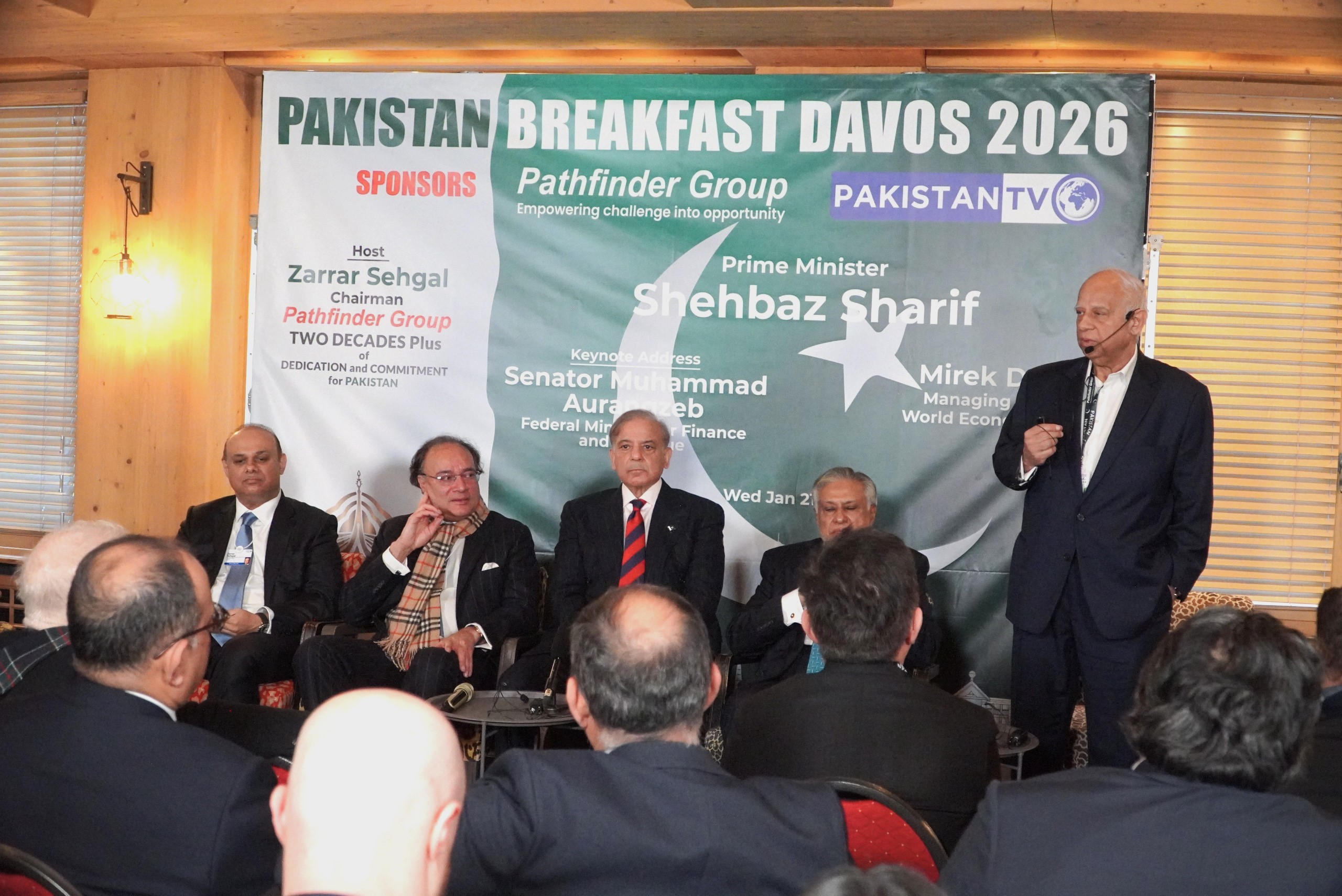
Over the years, the PAKISTAN PAVILION has evolved into an institutional anchor for Pakistan at DAVOS rather than a temporary venue. In a world where most engagements are episodic, sustained presence builds familiarity and credibility. The Pavilion has provided precisely that, a stable platform through which Pakistan can engage policymakers, investors, scholars, and innovators with coherence and discipline. There were several substantive SESSIONs at and around the PAKISTAN PAVILION at DAVOS, which reflected the breadth of Pakistan’s engagement, spanning investment diplomacy, social resilience, technological transformation, and bipartisan dialogue.
Hosted by Dr Huma Baqai, Rector MiTE and Vice Chairperson of Karachi Council on Foreign Relations (KCFR) the SESSION on Women Empowerment, Financial Inclusion & Family Healthcare, was particularly significant in framing human development as a strategic imperative. Hend Alhinnawi, Executive Director & CEO of Humanitarian Tracker, graced the SESSION as Chief Guest. The speakers included Prof. Linda Zangwill, Professor of Ophthalmology and Co-Director of Clinical Research and Director of the Imaging Data Evaluation and Analysis Program, Dr Ir. Ying Zhang — Professor of Innovation & Entrepreneurship and Founder & President of Singularity Academy — Dr Salma Malik of Quaid-i-Azam University, and Alina Timofeeva, Senior Advisor in Technology and AI and an international expert commentator. The discussions on empowerment and financial inclusion are often misunderstood as peripheral to national security. In reality, they are central to it. Societies fractured by exclusion cannot sustain stability. The SESSION emphasized that digital financial inclusion, targeted social protection mechanisms, and family healthcare are not welfare add-ons but pillars of long-term resilience. The conversation moved toward execution, how social protection programs can be digitized, how women-led entrepreneurship can be integrated into formal markets, and how healthcare delivery models can leverage innovation.
Equally significant was the SESSION titled “INVESTMENT IN PAKISTAN,” which featured a panel that demonstrated both financial expertise and geopolitical insight: Muhammad Farid Alam, CEO of AKD Securities Limited; Mr Sameer Chishty, Executive Chairman of Asia-Pak Investments; Mr Michael Kugelman, Senior Fellow for South Asia at the Atlantic Council and Abu Bakar, former Chief Executive Officer of the Pakistan Software Export Board. Their contributions ensured that the discussion was grounded in strategic and economic realities. Michael Kugelman offered a candid assessment of regional geopolitics and its influence on investor calculus, reminding us that strategic alignments inevitably shape capital decisions. Muhammad Farid Alam’s financial analysis about Pakistan anchored the economic conversation firmly in market fundamentals rather than aspirational optimism. That realism, in my view, was the SESSION’s greatest asset.
The global investment climate today is neither sentimental nor impulsive. Capital is cautious, selective, and disciplined. It seeks predictability, regulatory coherence, currency stability, and above all, political continuity. I have consistently maintained that investor confidence is not built on declarations; it is built on sustained policy consistency. This SESSION addressed that fundamental truth directly. The emphasis on macroeconomic stabilization, foreign exchange management, and institutional reform underscored what serious investors already understand: structural credibility precedes capital inflows.
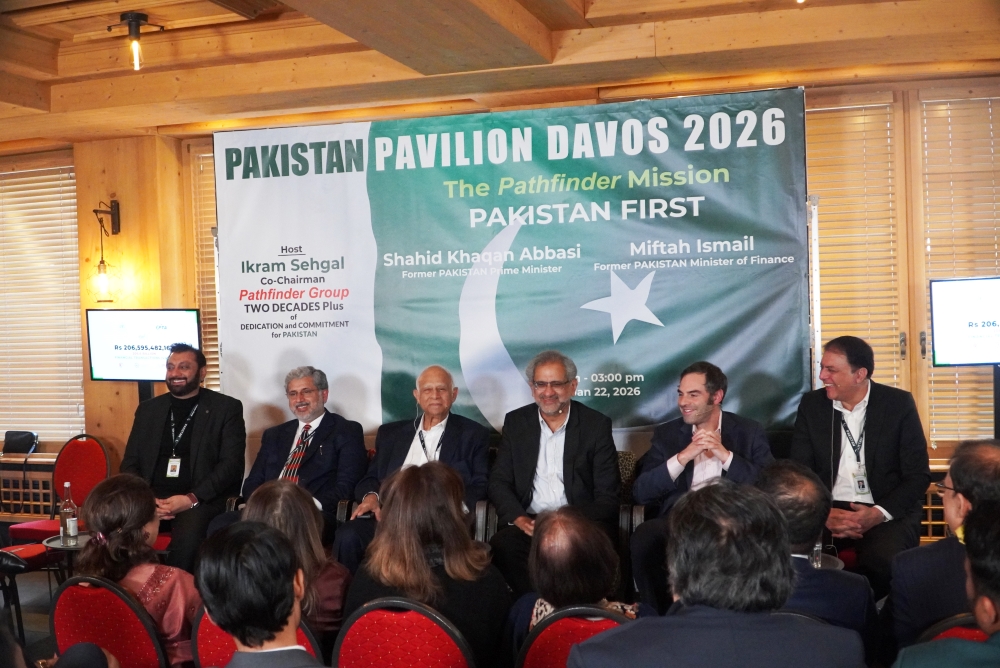
I am grateful to Former Prime Minister Shahid Khaqan Abbasi for joining as the Chief Guest at the Pakistan First event. Bipartisan engagement on economic reform is indispensable. Policy volatility has historically undermined Pakistan’s credibility. The dialogue reflected an understanding that national economic recovery must transcend party lines. Shahid Khaqan Abbasi articulated the structural reforms required for fiscal discipline and institutional strengthening. Abu Bakar contributed insight into Pakistan’s software export trajectory, while Farid Alam and Michael Kugelman contextualized domestic reform within global strategic shifts. There was broad convergence: fiscal discipline, export expansion, and institutional reform are no longer optional. Sustained cross-party alignment on these priorities could meaningfully alter Pakistan’s long-term trajectory.
Pathfinder Group’s deliberate cultural diplomacy initiative this year won hearts at WEF. While India has consistently leveraged Bollywood evenings to project its cinematic soft power, Pakistan chose to articulate its identity through a deeper civilizational expression: Sufi music and Qawwali. PAKISTAN NIGHT at the PAKISTAN PAVILION was not staged as entertainment alone; it was a strategic assertion of cultural heritage. The performance by Numan Haider and his Qawwali ensemble, composed of Gen Z artists, conveyed a timeless message of peace, spiritual harmony, and unity rooted in South Asia’s Sufi tradition.
Beyond DAVOS, the momentum carried into Islamabad on 14 February 2026, when Pathfinder Group convened a high-level forum titled “PAKISTAN PAVILION DAVOS 2026: Experience, Lessons Learnt and Beyond.” Hosted at Amaanibagh, the objective was clear: convert visibility into measurable outcomes. I must appreciate the hard work of my employees, especially the CITADEL team: AVM (Retd) Asad Ikram, President – CITADEL, Air Cdre (Retd) Khalid Banuri, Principal Advisor CITADEL; Air Cdre (Retd) Farhan Ahmed, Project Director; and Imran Jattala, Vice President. The FIRST SESSION, moderated by Dr Salma Malik, “The STARTUP Experience and Lessons Learnt,” elaborated on the DAVOS experience, and participating STARTUP founders reflected candidly on investor engagement, partnership development, and lessons in global positioning. CITADEL has become a household name not only in Pakistan but also worldwide. Eight selected STARTUPs from Pakistan proudly represented the country at the World Economic Forum in DAVOS, receiving well-deserved applause for their achievements. This recognition comes as a result of a rigorous evaluation process conducted by independent judges, ensuring transparency and impartiality. I have always believed in the potential of the youth; for them, the sky is the limit. HE Georg Steiner, Ambassador of Switzerland to Pakistan, was the Chief Guest. He acknowledged Pakistan’s evolving innovation footprint. I am grateful for the Ambassador’s recognition because international credibility is reinforced when external stakeholders validate domestic progress.
Pakistan’s Gen Z entrepreneurs are no longer waiting for opportunity; they are creating it. At Pathfinder CITADEL, we recognized early that talent exists across this country and beyond; what it requires is a credible, transparent platform grounded in strict meritocracy. The SECOND SESSION introduced the Pathfinder CITADEL JEDDAH STARTUP CHALLENGE 2026, which will be organized in partnership with OIC-COMSTECH during the WEF Spring SESSION in JEDDAH in April. The Pathfinder CITADEL STARTUP Challenge emphasizes merit over influence, with participating STARTUPs undergoing further scrutiny to uphold excellence. Out of 337 applications received, 283 were national and 54 international, representing sixteen countries, including Pakistan, Azerbaijan, Afghanistan, Bangladesh, Saudi Arabia, Egypt, Indonesia, Turkey, Tunisia, Malaysia, Gambia, Nigeria, the Netherlands, Sweden, the United States, and the United Kingdom. This diversity reflects growing confidence, both in our platform and in Pakistan’s capacity to convene cross-border innovation ecosystems.
An online live pitching segment featured STARTUPs from OIC member states: Waychit (Gambia), Arogga (Bangladesh), Bytecorp (Saudi Arabia), ReNile (Egypt), and Digital360 Sdn Bhd (Malaysia). Pakistani ventures included Nerdflow, Exambites (Netflix for Education), Digital Chotu, EcoGen, and LeObran Ltd (WeatherSense). The diversity of sectors, from Ed-tech to climate technology, demonstrated breadth rather than narrow specialization. Esteemed judges included Dr Muhammad Usman of TechAQuest, Noman Waseem, CEO of Supreme Technocrafts Aviation Services, Amir Zahoor, Co-Founder of RemoteWell, Dr Danish Hussain and Prof Saif Ullah Awan from NUST. Their presence ensured that the evaluation was rigorous and merit-based. I have always insisted that standards must not be compromised. Pakistan does not lack ideas; it often lacks disciplined execution frameworks.
As we move towards JEDDAH, an ecosystem expected to host over a thousand international companies, even larger in scale than DAVOS, our ambition is clear: Pakistan must not merely participate; it must shine. Initiatives like these are more than competitions; they represent a structured roadmap for Pakistan’s innovation journey, rooted in integrity, global collaboration, and the confidence of our youth.
I am grateful to the Chief Guest at the SECOND SESSION, HE Prof Dr M Iqbal Choudhary, Coordinator General of OIC-COMSTECH. His contributions as a science diplomat for Pakistan and the Muslim Ummah are exceptional, and we are indebted to him. He emphasized science, technology, and entrepreneurship as engines of intra-OIC cooperation. He believes that Platforms like CITADEL can bridge that gap by linking policymakers, investors, and founders.
Taken together, the SESSIONs at DAVOS and the Islamabad CITADEL forum reflect a structured progression, from dialogue to delivery. Engagement at DAVOS builds networks; forums at home convert those networks into partnerships. This continuum is critical. The global environment will remain uncertain, marked by intensifying strategic competition, technological disruption, and uneasy coexistence between economic nationalism and interdependence. In such a world, Pakistan’s path forward requires discipline, reform, and strategic patience. I am convinced that institutional continuity is our greatest strength. The PAKISTAN PAVILION is not an event; it is a platform. CITADEL is not a showcase; it is a pipeline. Investment dialogues are not speeches; they are commitments.