






Smart Security Solution for Cities, Industrial Facilities & Critical Infrastructure
A Digital Brain, Eyes, And Reflexes For Cities And Facilities
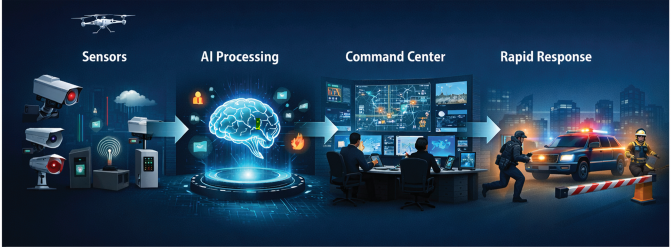
Modern cities, industrial facilities, and critical infrastructure are living systems dynamic, interconnected, and constantly under pressure. As urban density grows and industrial operations become more complex, the nature of security threats has changed. Today’s risks are faster, smarter, and often simultaneous. Traditional security models built around standalone cameras, alarms, and manual monitoring are struggling to keep up. A new paradigm is emerging, Pathfinder’s SMS Services Private Limited (SMSS) has built a next generation Smart Security Solution not as a collection of devices, but as an intelligent organism one that sees, thinks, predicts, and reacts in real time.
From Cameras to Cognition
Conventional security systems are largely reactive. They record incidents after they happen, rely heavily on human attention, and operate in isolated silos. By the time an operator notices a threat, damage is often already done. Smart Security Solution by SMSS changes this fundamentally.
It functions like a digital brain with eyes and reflexes continuously observing its environment, understanding context, anticipating risks, and responding instantly. Designed for smart cities, industrial facilities, and critical infrastructure, it delivers always-alert protection where seconds matter most.
An End-to-End Intelligent Security Architecture
Smart Security Solution by SMS Services is not about watching it is about preventing. By combining sensors, artificial intelligence, edge computing, secure networks, and automated response systems, the platform delivers four decisive outcomes:
⁍ Early threat detection.
⁍ Real-time, actionable intelligence.
⁍ Coordinated, automated response.
⁍ Tamper-proof, legally admissible evidence.
The result is a system that is proactive rather than reactive, and intelligent rather than manual.
Why Traditional Security Falls Short
Despite significant investments, many organizations face persistent gaps:
⁍ Incidents are detected too late.
⁍ Cameras, alarms, and access control systems work in isolation.
⁍ False alarms overwhelm security teams.
⁍ Response times are slow and uncoordinated.
⁍ Automatically taking action without waiting for human intervention.
These weaknesses expose cities and facilities at the very moments when fast, synchronized action is most critical.
How SMS Services built Smart Security Closes the Gap
Smart Security is designed to eliminate these blind spots by:
⁍ Seeing danger early, before it escalates.
⁍ Understanding context, not just isolated events.
⁍ Predicting what may happen next, based on patterns and data.
⁍ Taking automated action, without waiting for human intervention.
⁍ Preserving court-ready evidence from the first second.
Security becomes an active protection mechanism, not a passive observer.
Four Capabilities That Matter Most
| 1. Detect The system continuously monitors for threats such as: • Weapons, fights, and intrusions. • Fire, smoke, and gas leaks. • Suspicious or abnormal behavior. • Unauthorized access to restricted areas. Detection happens instantly, across multiple data sources, without fatigue or blind spots. |
| 2. Predict Using AI and pattern learning, the system identifies: • High-risk zones. • Time periods with elevated threat probability. • Locations where incidents are likely to occur next. With every incident and near-miss, the system becomes smarter. |
| 3. Respond When a threat is detected, the system acts immediately by: • Locking or unlocking doors. • Activating lights, sirens, or public alerts. • Notifying security teams, police, or emergency services. • Guiding safe evacuation routes. These actions happen in seconds, not minutes. |
| 4. Prove Every incident is documented with: • Video clips. • Event logs. • Timelines. • Court-ready reports. This ensures transparency, accountability, and legal compliance. |
The Architecture Behind the Intelligence


One Platform, Many Environments
Smart Cities
• Public safety and crowd control.
• Traffic and accident management.
• Flood and disaster monitoring.
• Emergency response coordination.
Industrial Facilities
• Worker safety.
• Theft and intrusion prevention.
• Gas and fire detection.
• Predictive maintenance.
Critical Infrastructure
• Power plants and substations.
• Airports and seaports.
• Water utilities.
• Banks, hospitals, and universities.
Real-World Smart City Use Cases
Public Asset Protection
Aggressive behavior toward public assets triggers instant detection. Evidence is captured, maintenance tickets generated, law enforcement alerted, and cost-recovery documentation prepared automatically.
Major Events & VIP Protection
Risk thresholds are dynamically adjusted. Surveillance density increases, security units are pre-positioned, and post-event intelligence reports are generated.
Road Traffic Accidents
Sudden stops and crash acoustics activate emergency protocols. Traffic signals are overridden, emergency lanes cleared, and responders dispatched instantly.
Fire & Smoke Detection
AI-based detection alerts fire services automatically, clears traffic corridors, and generates response-time analytics.
The Future of Security is Intelligent
Smart Security is not just another security system it is an intelligent guardian for cities, facilities, and critical infrastructure. By unifying detection, prediction, response, and proof into a single platform, it
delivers safety that is faster, smarter, and more reliable than ever before. In a world where risks evolve
every day, security must evolve faster. Smart Security makes that possible.
In a world where cities never sleep and industries never pause, security can no longer afford to stand still. Recognizing this shift, Pathfinder’s SMS Services did not simply upgrade traditional systems they reimagined security itself.
A New Beginning
Through innovation, integration, and deep operational experience, SMS Services built more than a platform; it created a living digital ecosystem that protects people, assets, and infrastructure in real time. From smart cities to critical facilities, the system learns, adapts, and strengthens with every challenge it faces.