

In early nineteenth century, several contenders of the Afghan throne engaged in a fratricidal war. In 1839, Shah Shuja (r 1803-09 & 1839-42) was living in Ludhiana on British pension when a trilateral agreement was reached involving East India Company, Shah Shuja, and Singh Sahib of Lahore Ranjit Singh. Shah Shuja was restored to the Afghan throne with British and Indian bayonets, and the loser Dost Muhammad Khan swapped the place going in exile. In 1842, a general uprising against Shah Shuja forced British retreat and Shah Shuja and several of his partisans were killed and others escaped to India.
Kazi was the honorific title given to the learned scholars who travelled for learning and migrated in all directions with links to India, Afghanistan, and the Middle East. Many served the ruling dynasties as judges and counselors. The chief Kazi of Kabul was Abdur Rahman who was a Barak Khattak from Ghazni and his family was the microcosm of the scholars’ networks of the era. His one brother migrated to Baghdad, another to north-western Afghanistan and the third to Karak in then India.
Abdur Rahman was married to Shah Shuja’s sister. A Parsee Dr. Jamshed Gai of Peshawar also ran a clinic in Jalalabad and used to come to Jalalabad and Kabul. Another Parsee doctor, Framjee, specialized in eye and ear, nose and throat diseases and ran clinics in Peshawar and Nowshera and part of the small Parsee community of Peshawar. Dr. Gai was a friend of Kazi Abdur Rahman. Abdur Rahman was killed along with all immediate family members (wife and two daughters) by Barakzai rivals and the only survivor was his infant son Kazi Mahmud Khan. The maternal grandmother of Mahmud wrapped him in a wicker basket along with valuables including gold and precious stones and took him to a village on Kabul-Jalalabad Road. She rushed a servant to Jalalabad to check if Dr. Gai was in Jalalabad. Luckily, Dr. Gai was in Jalalabad and when informed about the disaster in Kabul, he got into his carriage and headed to the village. He took Mahmud along with his young Tajik maid in his carriage and took him to Peshawar.
Dr. Gai raised him as Muslim and invested all the gold in real estate in Peshawar, Nowshera and Kohat in Mahmud’s name. At the age of ten, Mahmud was sent to Bombay for further education where he was under the care of Gai’s friend Sataravala family. His Parsee godfather found Mahmud’s aptitude for languages, and he completed Munshi Fazil and law. He became interpreter and scribe for British officials in Peshawar and became Meer Munshi (chief scribe). Native scribes served as teachers of British army and political officers in native languages especially in Persian and Pashto. They also served as translators, interpreters, and negotiators with native power brokers in tribal areas and Afghanistan. He also became legal advisor to the Peshawar cantonment. He was independently wealthy due to wise real estate investment by Dr. Gai; his properties in Peshawar, Nowshera and Kohat cantonments were rented to officials and many British army officers, Non-Commissioned Officers (NCOs) and other ranks (ORs) borrowed money from him.
His son Kazi Abdul Ghani (1874-1958) followed in his father’s footsteps and completed Munshi Fazil and law. He served at junior administrative service posts in then North West Frontier Province (NWFP) and tribal areas as tehsildar, district magistrate, and assistant political agent. He retired in 1939 as additional session judge. He also served in tribal areas and worked closely with political agent of Khyber tribal agency and later Chief Commissioner Sir George Olaf Roos-Keppel (1866-1921). He translated many Pashto and Persian works in English including a book on Pushto grammar and history of Sultan Mahmud Ghazni. His family had extensive army connections and four sons of Kazi Abdul Ghani served in the army including Major General Abdur Rahim, Major General Abdul Aziz, Lieutenant Colonel Abdul Rashid, and Major Abdul Khaliq.
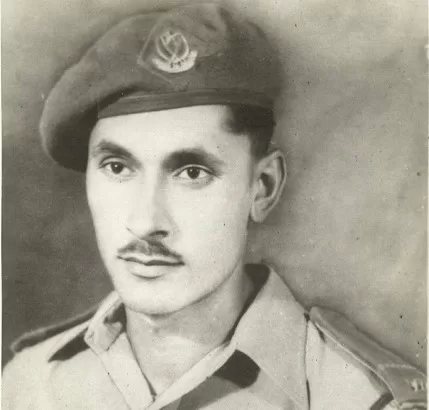
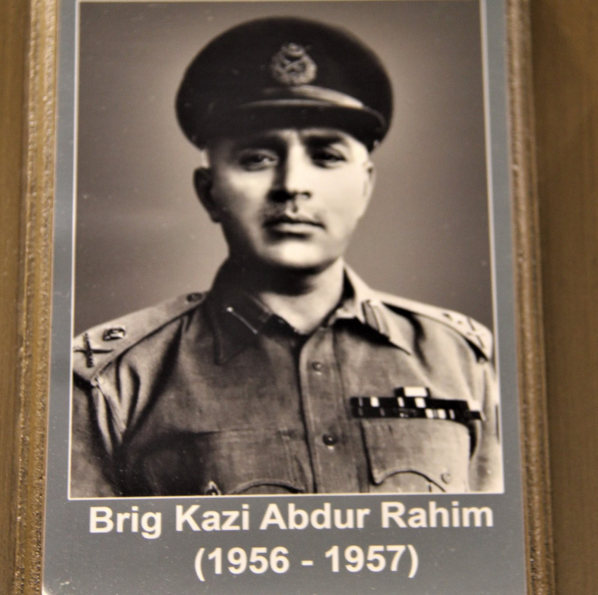
Major General Kazi Abdur Rahim was born on 17 March 1917 in Peshawar. His early education was at Frontline High School Peshawar Cantonment and he graduated from Edwards College Peshawar. He joined 9th Indian Military Academy (IMA) course in October 1936. The training course was five terms, each lasting six months. In the first term Agha Muhammad Yahya Khan (later General and Commander-in-Chief of Pakistan army) and in the remaining terms J. T. ‘Jangu’ Sataravala (later lieutenant general of the Indian army) were his roommates. It was a connection going back three generations when Abdul Rahim’s grandfather was under the care of Sataravala’s ancestors in Bombay.
Abdur Rahim was commissioned in July 1939. He spent the first year with The Royal Warwickshire Regiment before joining 2nd Battalion of 13th Frontier Force Rifles (now 8 Frontier Force Regiment of Pakistan army). The class composition of the battalion was one company each of Sikh, Pathan, Dogra and Punjabi Muslim. The battalion was stationed in Madras from 1937 to 1940 when it moved to Waziristan. In 1941, Rahim was posted to Tochi Scouts, North Waziristan where he remained till the end of 1942. He re-joined the battalion in December 1942 before it was moved to Burma in March 1943.
Officers of 2/13 FFR who went to Burma included Commanding Officer Lieutenant Colonel N. G. Guy, Second in Command Major Robert Elsmie, adjutant Captain A.H. Catterill, Captains Rahim, Walker, Sutherland, Penty, Ferard and Lieutenants Smyth, Law, Khattak, Rakhman Gul, and Gilani.
In the First Burma campaign, the battalion was part of 63rd Brigade and immediately after arrival suffered a disaster. A party of the brigade officers was on a reconnaissance mission when it was ambushed and the Commanding Officer and adjutant were killed. The second in Command Major Robert Elsmie took over command and on 06 March A and B companies under the command of Captain Rahim were sent towards Pegu but used for a roadblock to counter Japanese infiltration before falling back to Taukkyan to help C and D companies. Captain Rahim took command when Major Elsmie was called to brigade headquarters. In addition to CO and adjutant, Lieutenants Law and Khattak were killed, and Captains Walker, Sutherland and Lieutenant Smyth were wounded. The Unit served as reconnaissance battalion of 39th Division and trained in East Bengal for jungle warfare. It was part of 4th Brigade in second Arakan campaign. After the war, the unit returned to Avadi camp in Madras where Lieutenant Colonel J.T.C. Parson Smyth was in command. He was frequently on leave and in his absence, Rahim commanded the battalion.
In the first week of August 1947, Dogra and Sikh companies of the battalion were left in Madras. Muslim personnel of the infantry, artillery and engineers units assigned to Pakistan joined the Punjabi Muslim and Pathan companies of 2/13 FFR. Rahim was in command of this train heading for Kohat and 2/13 FFR later moved to Tal. Rahim joined Brigadier (later Major General) ‘Ganga’ Hayauddin (4/12 Frontier Force Regiment; now 6 Frontier Force Regiment) then commanding Bannu brigade to assist him in withdrawal of regular troops from Waziristan in Operation Curzon. Rahim also helped in additional recruitment for Tochi Scouts and reorganization of the wings.
He joined the 1948 Staff College course at Quetta that was the shortest course. He served as GSO- I of 7th Division followed by command of 6/13 Frontier Force Rifles (now 1 Frontier Force Regiment). He was promoted Colonel in May 1949 and posted to Pakistan Military Academy at Kakul as Chief Instructor and Deputy Commandant serving under Brigadier Francis H. Ingall. He was promoted Brigadier in December 1950 and appointed Inspector General Frontier Corps (IGFC) (May 1951-December 1953) followed by command of 53rd Brigade in Comilla in East Pakistan (December 1953- December 1955) and then command of Bannu based 102 Brigade. He then served as Military Secretary (MS) at GHQ and in this capacity, he convinced C-in-C, General Muhammad Ayub Khan that all short service commissioned officers who pass staff college course would be eligible for promotion as regular service officers. Prior to this change, short service commissioned officers were not allotted Pakistan Army (PA) numbers and usually retired at the rank of Major.
There was an incident that strained Rahim’s relations with Ayub. In 1957, a Republic Day party was celebrated at Rawalpindi Club and during the party a scuffle broke out between some officers on the issue of dance partners. The next day Ayub summoned Adjutant General and MS telling them to start the process of sending six offending officers home. Rahim summoned all six officers to his office, gave each of his new posting order and told them that each month he will receive their performance report. He then went to the Chief and informed him about his decision. Ayub Khan, in the presence of his staff told Rahim that ‘is your next proposal to take over my position?’ but let Rahim’s decision stand. All six officers survived and later rose to senior ranks.
In December 1958, he was sent for a one-year senior officer course at Camberly and in January 1960 was appointed GOC of 14th Division and Deputy Martial Law Administrator of East Pakistan. He developed problems with President Ayub Khan on two issues. He sent civil and military intelligence reports about meetings of Awami League leaders including Shaikh Mujibur Rahman with American Consul General Archer Kent Blood and Indian Deputy High Commissioner recommending action. In another incident, he removed all pictures of Ayub Khan and ceremonial gates arranged for Ayub’s visit telling Governor Lieutenant General Mohammad Azam Khan that President Ayub Khan is not visiting a foreign country or a colony of West Pakistan. Ayub during a dinner at the Flagstaff House told Rahim that “I’m opening a post of Member Water and Power Development Authority (WAPDA) to manage both East and West Pakistan and I want you to take over after seeking retirement”. Rahim politely thanked and declined and told him if he wanted to retire him he could.
In April 1961, Rahim was called to Rawalpindi to go through a medical board that declared him medically unfit to command a division due to diabetes. In May 1961, Rahim was removed from his command on medical grounds and replaced by Major General Muhammad Muzaffar (a gunner officer who in 1960 had been superseded on medical grounds of having diabetes). Rahim was demoted to Brigadier rank and posted as President of Inter Services Selection Board (ISSB) at Kohat. A number of senior officers spoke with President Ayub Khan and C-in-C General Muhammad Musa advocating that Rahim’s rank be restored and the President ISSB post elevated to major general rank.
In December 1961, Rahim resigned and moved to Karachi to help Adamjee Group set up Adamjee – Duetz tractor factory. In 1964, Defense Secretary Nazir Ahmad Khan asked him to establish Oil Companies Advisory Committee (OCAC) with the help of five oil companies operating in Pakistan. He served as the Secretary OCAC till June 1969 when he was appointed Resident Director Royal Dutch/Shell Oil Company. In 1966, when General Agha Muhammad Yahya Khan became C-in-C, he restored the honorary rank of Major General. He died in February 1981.
Rahim’s two sons also joined the army. Khalid Rahim joined Guides Cavalry. Tariq Rahim was studying Electrical Engineering at Peshawar University, winning gold medal in his first year. In the summer of 1966, he left his engineering study to join 39th PMA Long Course. He was selected for training at Royal Military Academy Sandhurst and won the coveted Queen’s Silver Cane, awarded to outstanding overseas cadet. After commission, he joined 13th Lancers. Tariq served as ADC to Prime Minister Zulfiqar Ali Bhutto and later transferred to Foreign Service. In 1981, he was stationed in Tehran and came to Pakistan to attend his father’s funeral. After the funeral in Karachi, he was on the Pakistan International Airline (PIA) flight to Peshawar when the plane was hijacked and taken to Kabul. Tariq was shot and killed by the hijackers within two weeks of his father’s death.
Major General Abdul Aziz Kazi completed his law degree from Aligarh University. In 1935, his father’s British superior officers encouraged him to send Abdul Aziz to the army. During the interview, when asked about his hobbies, Abdul Aziz replied that ‘his hobby was collecting speeches of Gandhi’. That settled the matter and the officer later told his father that if he were alone, he would have ignored it, but other members of the board rejected him. During the war, when doors were opened wide for training of emergency commissioned Indian officers, he joined Officers Training School and commissioned in 1941. He served with 9 FFR, 1 FFR and 15 FFR. In view of his legal qualifications, he served with Judge Advocate General (JAG) branch of Indian and Pakistan armies.
He was close to both Ayub Khan and Yahya Khan and played a crucial role in early 1969 during transfer of power from Ayub Khan to Yahya Khan. In early 1969, with deteriorating health condition of Ayub Khan due to heart attack and widespread protest movement against his rule, there was discussion about a contingency plan of Martial Law. In these discussions, Yahya and A.A. Kazi would meet Ayub three times a week in the evening without prior schedule and when all arrangements were agreed, Yahya Khan decided to sideline Ayub Khan. In a final effort, Ayub tried to open a channel with Mujib ur Rahman and Mujib was brought secretly to the President House from his jail cell for few meetings with Ayub Khan. However, these efforts failed and in March 1969, Ayub declared Martial Law handing power to Yahya Khan. A.A. Kazi’s two sons, lieutenant Colonel Adeel, joined 12 Cavalry and Major Amir joined 9 FFR.
Lieutenant Colonel Kazi Abdur Rashid joined 12 Baloch Regiment. He raised 30 Baloch Regiment and in 1965 was commanding it in Run of Kutch. He stumbled on a landmine that shattered both his legs. It was the expert care including several reconstructive surgeries done by a first-rate physician Major (later Lieutenant Commander) Munir at naval hospital that saved his legs. After two years of rehabilitation, he went back to command 13 Baloch Regiment and Kurram Militia. Major Abdul Khaliq joined 11 Punjab Regiment and later served with 2 East Bengal Regiment and East Bengal Regimental Center in Chittagong.
Kazi family’s history is intertwined with the history of dramatic changes of 19th and 20th century when the old order was disintegrating, and a new order was being established in the region bordering India and Afghanistan. The story has many layers of fratricidal wars among Durranis and Barakzais in Afghanistan, exile, opening of new avenues of western education and participation in the establishment of modern institutions under the British Raj. A Parsee doctor’s act of kindness and fidelity to a deceased Muslim friend at the time of a disaster changed the trajectory for a family.
Acknowledgement
The Author thanks Major (Retd) Khalid Rahim; son of Major General Kazi Abdur Rahim for details about the family. All errors and omissions are author’s sole responsibility.
Notes
Wing Commander (Retd) Sardar Ahmad Shah Jan Saddozai. SADDOZAI: Saddozai Kings & Viziers of Afghanistan 1747-1842 (Peshawar: Public Arts Press), 2007.
Daniel P. Marston. Phoenix from the Ashes: The Indian Army in the Burma Campaign (New London: Connecticut: Praeger), 2003.
Sami Khan. Three Presidents and an ADC: Life, Power, and Politics (New Delhi: Pentagon Press), 2008
Nawid Senzil. Aman-allah and the Afghan Ulama: Reaction to Reforms, 1919-29. PhD Dissertation, The University of Arizona. 1987
Dissertation-Reproduction (electronic).