

Cultural Diplomacy and the Projection of Pakistan’s Soft Power
While global platforms such as the World Economic Forum (WEF) Annual Meeting in DAVOS often feature vibrant cultural showcases, India has consistently organized multiple Bollywood-themed evenings each year, projecting its cinematic soft power to a global audience. However, this year, for the first time, Pakistan ventured to compete with India by presenting a legacy equally profound and spiritually deeper: Sufi Music, particularly Qawwali.
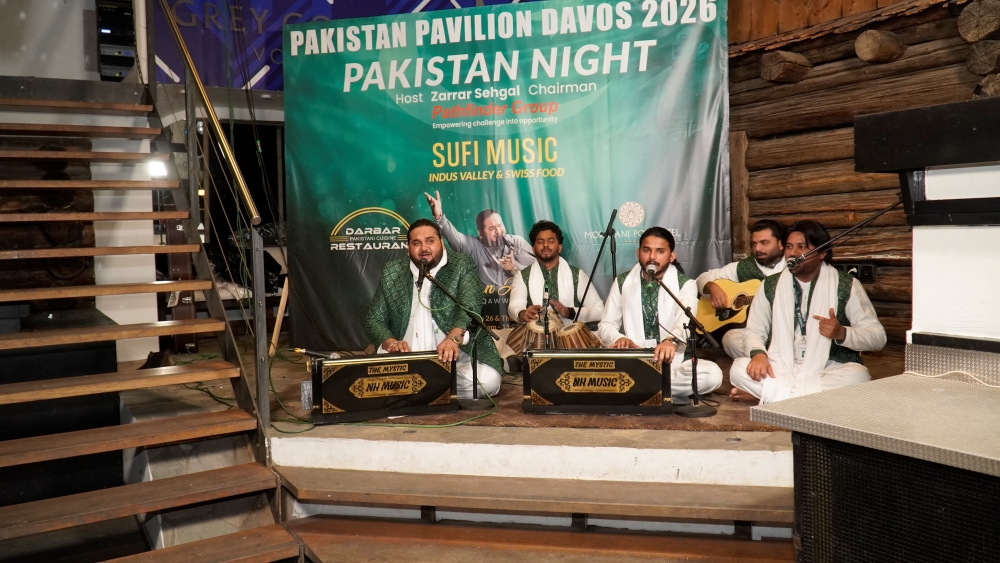
At the WEF Annual Meeting in DAVOS, the spiritual sounds of Sufi music echoed through the global corridors of dialogue and decision-making. An initiative by PATHFINDER GROUP, PAKISTAN NIGHT at the PAKISTAN PAVILION brought to DAVOS something deeply rooted in our identity, the timeless message of peace, love, and unity preached by the Sufis of South Asia.
In contemporary international relations theory, cultural diplomacy is widely understood as a central mechanism of soft power, a term most prominently articulated by political scientist Joseph Nye. Nye defines soft power as the ability of a state to influence others not through coercion or economic inducement, but through attraction, by shaping preferences via culture, political values, and foreign policy legitimacy. Within this framework, culture becomes not merely an expression of identity but a strategic resource in global politics.
Cultural diplomacy operationalizes soft power by projecting a nation’s civilizational narratives onto international platforms. As scholars of public diplomacy argue, influence in the 21st century increasingly depends on perception management and symbolic capital. In this context, the presentation of Sufi music at DAVOS represents a form of strategic cultural articulation. Drawing upon a centuries-old spiritual tradition rooted in pluralism, transcendence, and metaphysical unity, Pakistan engaged in what constructivist scholars would term “normative signaling.”
Rather than advancing its image solely through geopolitical discourse, it leveraged its intangible heritage to shape global perceptions. From a theoretical standpoint, such initiatives align with the broader literature on nation branding and symbolic diplomacy, where states employ cultural artifacts to reinforce legitimacy and differentiate themselves within competitive soft power environments.
Sufi music emerged from Islamic mysticism (Tasawwuf) between the 8th and 12th centuries, when Sufi saints sought deeper spiritual connection through remembrance of God (zikr), poetry, and rhythm. Music is seen not just as entertainment but as a spiritual pathway for purifying the heart and awakening divine love. Sufi music emphasizes themes like divine love, unity, self-purification, tolerance, and compassion, using metaphors of worldly love to convey deep spiritual longing in an emotionally accessible way. One of the central practices was ‘Sama’ (literally “listening”), a devotional gathering where poetry and music were performed to inspire spiritual ecstasy and reflection. Different regions developed their own forms of Sama, from the whirling ceremonies of the Mevlevi order (Whirling Dervishes) in Anatolia to devotional chanting traditions in Persia and Central Asia. Sufi music reached the Indian subcontinent in the 12th–13th centuries through traveling Sufi saints. It was here that the tradition evolved into one of its most powerful and recognizable forms: Qawwali.
A key historical figure in this development was Amir Khusrau, the celebrated poet, scholar, and disciple of the great Chishti Sufi master Nizamuddin Auliya. Khusrau blended Persian, Arabic, and local South Asian musical traditions, laying the foundation for Qawwali as a structured devotional art form. Qawwali became closely associated with Sufi shrines (Dargahs), where it was performed to express longing for the Divine, praise the Prophet Muhammad (PBUH), and honor Sufi saints. This devotional musical form was shaped and elevated in the shrines of Lahore, Multan, Sehwan, Pakpattan and other spiritual centers.
Over time, Pakistan became the distinguished torchbearer of Qawwali, preserving and refining its classical depth, poetic richness, and spiritual intensity. The global rise of Qawwali owes much to legendary Pakistani maestros such as Nusrat Fateh Ali Khan and Sabri Brothers, who introduced this sacred art form to international audiences performing in Europe, North America, and beyond, transforming Qawwali into a global spiritual sound and establishing it as one of Pakistan’s most powerful cultural identities. Unlike commercial entertainment, Sufi music carries a timeless message of love, peace, unity, and transcendence beyond borders and divisions. It represents the spiritual heartbeat of South Asia and remains one of Pakistan’s most authentic and distinguished cultural legacies. If nations compete through soft power, Pakistan’s strength lies not in imitation but in authenticity.
At DAVOS, during PAKISTAN NIGHT, the performance of Sufi music and Qawwali was more than cultural entertainment; it was a statement of identity. Renowned artist Numan Haider and his Qawwali group, a dedicated and compassionate group of artists of Gen Z, delivered a soul-stirring performance that transcended language, nationality, and culture. Numan Haider is a celebrated Pakistani singer, songwriter, and music director known globally for his contributions to Qawwali and Sufi music. As the lead vocalist of his Qawwali band, he represents Pakistan internationally, blending classical tradition with contemporary expression.
He is currently pursuing his Bachelor’s degree in Arts and comes from a family with deep roots in centuries-old Qawwali traditions, including his grandfather Ustad Nazeer Ali Khan (Dhapayi Wali), carrying forward the legacy of masters like Ustad Badey Karam Din Khan and Ustad Mian Chajju Khan Qawwal. Beginning his career as a music teacher, he has trained many students in instrumental and vocal techniques. His guiding philosophy is: “Let passion be the rhythm, skill the instrument, and devotion the melody.”
Numan Haider’s Qawwali band brings his vision to life with a talented ensemble. Ribal Khalid is pursuing a Bachelor’s degree in Science and manages the band while playing the guitar. The band’s vocal harmonies are enhanced by side vocalists and choir members Sadaqat Ali and Kashif Ali, who also play the harmonium. Tabla player Qasim Raza provides the rhythmic foundation, and sound operator Abhishey ensures the group’s sound quality. Through Sufi music, Pakistan presented its soft image to the world, and that is an achievement we celebrate with great pride.
PAKISTAN NIGHT was not merely a musical gathering; it was a strategic cultural diplomacy initiative. It was a reminder that while nations debate the future, culture builds bridges. At a FORUM where global discussions often revolve around economics, geopolitics, and technology, this event highlighted another powerful dimension of Pakistan, its cultural depth, spiritual traditions, and artistic excellence. Pakistan projected a message of tolerance, harmony, and coexistence.
The event demonstrated that Pakistan’s global narrative extends beyond policy debates and investment opportunities. It showcased the country’s civilizational richness and its ability to connect hearts through culture. Through music, hospitality, and shared human connection, PAKISTAN NIGHT successfully contributed to showcasing Pakistan’s soft image and evolving goodwill among international participants at DAVOS.
Over the years, PATHFINDER GROUP has consistently played a pioneering role in positioning Pakistan positively at global platforms, particularly at the WEF Annual Meeting. Its PAKISTAN PAVILION initiative has evolved into a recognized space for thought leadership, economic diplomacy, and cultural outreach. It bridges policy, business, and culture under one umbrella. While global FORUMs often focus on strategic and economic narratives, the Group ensures that Pakistan is represented not only as an emerging market or geopolitical actor but also as a country with deep cultural roots, creative talent, and a message of peace. In a FORUM where leaders gather to discuss economies, geopolitics, and global challenges, Pakistan also chose to speak through its spiritual heritage.
The PAKISTAN NIGHT event this year was remarkable, showcasing the dedication of the PATHFINDER GROUP to strengthen Pakistan’s soft power, engage the diaspora, and develop international partnerships founded on mutual respect and cultural understanding. It is time to shift from a purely geopolitical narrative to one rooted in civilizational values.
By utilizing international FORUMs such as the WEF, Pakistan can transform its image from a “security-centric” state to a “culturally rich” economic partner, effectively narrowing the soft power gap with India. Pakistan should lean into its unique strengths – Sufi music (Qawwali), its world-renowned fashion/textile industry, and its status as the custodian of the Indus Valley and Gandhara civilizations.