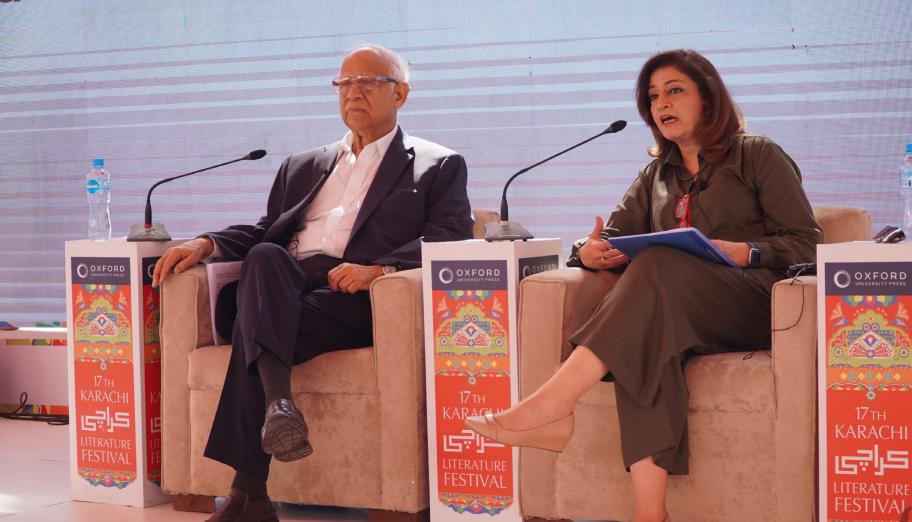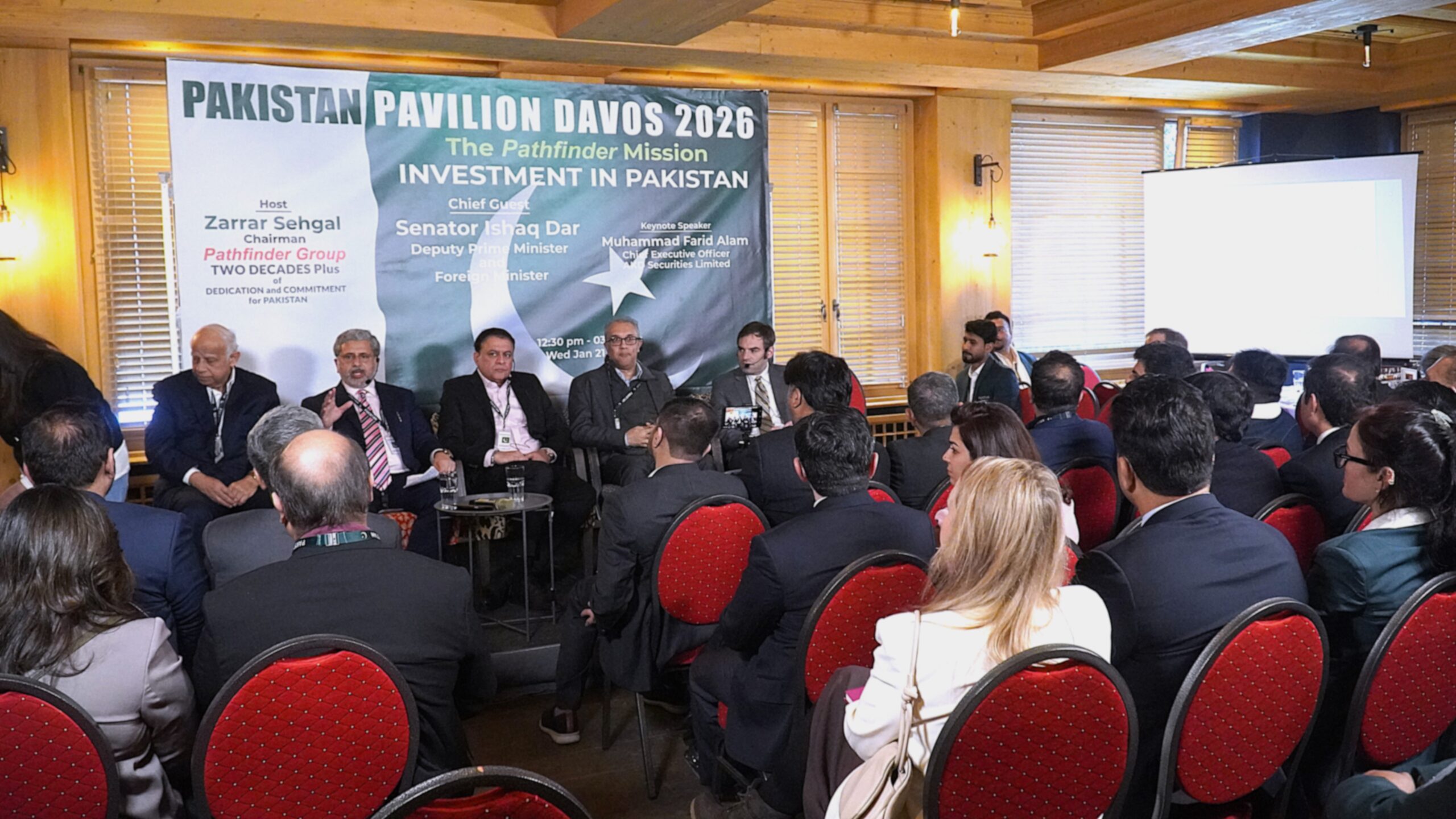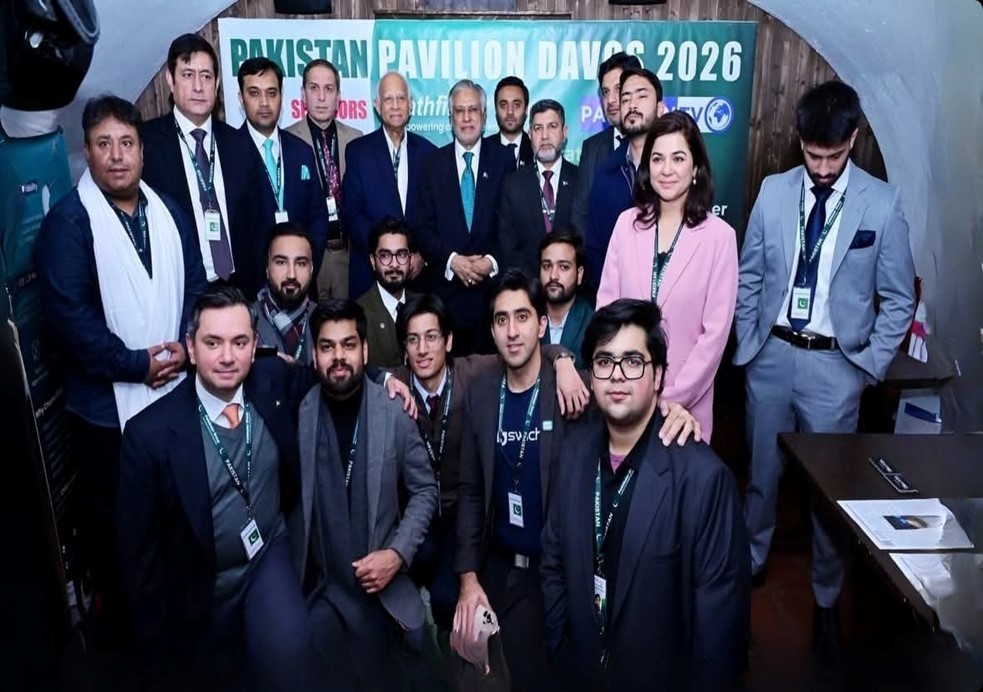





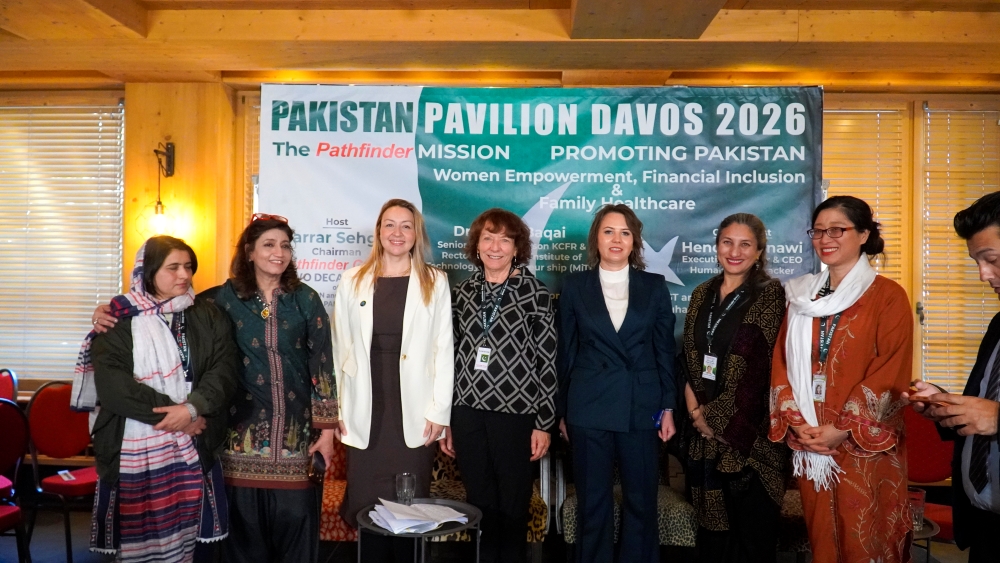
The Pathfinder Group hosted a focused high-level session titled “Women Empowerment, Financial Inclusion & Family Healthcare” at the Pakistan Pavilion during the World Economic Forum (WEF) Annual Meeting, Davos 2026. The event was held on Wednesday, January 21, 2026, from 10:00 a.m. to 11:30 a.m. at the Morosani Posthotel and brought together policymakers, development practitioners, academics, and global experts.
Dr Huma Baqai, Senior Vice Chairperson, KCFR (Host):
Mao Zedong is famous for saying that women are holding up half the sky; if you don’t give them due, the sky will fall. So, over to you, Dr Ir. Ying ZHANG.
Dr Ir. Ying ZHANG Founder and President, Singularity Academy Switzerland:
Thank you very much for inviting me here and for allowing me to represent women. I feel privileged to be here and to speak about who I am. I am Asian. I am Chinese. I was born in China, grew up in China, and received my education there. Then I came to Europe, to the Netherlands, where I completed my higher education and my PhD and started working at a Dutch university. After that, I went to Harvard, and later I came back to study in Switzerland. I have four children, and I have a wonderful husband, a Swiss husband.
My life has been very interesting because as my husband often says, I have gone on a journey. I went on a journey from a communist and socialist country to a capitalist country, from a centralized system to a kind of democratic system, and from the older generation to the younger generation. I have been very privileged to work closely with the older generation, and at the same time, because I teach at a university, I am always surrounded by the younger generation. This has given me many opportunities to see what the problems of our world are and what the real opportunities of our world are. That is why your question about younger women really resonated with me.
To be honest, in my mind, I always feel that my body is ageing, but my mind is always young. Because I work in academia and in education, and currently, an important part of my work is hosting and managing three hospitals in Germany, burnout hospitals that take care of women, mothers, and children. They mainly serve European people, European families, and European mothers. Every time I go to work in these hospitals, it makes me really sad, because I see that the problem is not only with Asian women, but also with European women, who are also extremely burnt out.
They do not work five days a week, but six days a week. They work 24/7. There is no break time. Many mothers work in the workplace, and at the same time, they have to look after their families and take care of their parents. Their illnesses and mental stress come from having too many things on their plate. This is what we really need to take care of. I also remember that several years ago, when I joined a major congress in the West, one of the topics was the UN Sustainable Development Goals (SDGs).
One part of the 17 SDGs is gender equality, the idea that women need to be equal to men. I told the host that I believe this is an absolutely wrong topic. Because if you look at human history, and also at biology and genetics, the gender that has been discriminated against is actually men, not women. Everyone here always says my mother’s side. In the family, the mother often holds the financial power, right? In children’s education, the mother in the family holds the dominant position. The father, I do not know, maybe he is working, maybe he is sleeping, or maybe he is watching a football match, but the father is not the one making the most important decisions. And research shows that a good mother can actually make three generations of a family prosper.
Dr Huma Baqai, (Host):
Prof Linda Zangwill, we were both at that session that talked about health gaps. Do you still think in this time of age, even in the first world, access to health for women is limited, or the focus is limited, or the research for women’s health is limited?
Prof Linda Zangwill, Prof of Ophthalmology & Co-Director of Clinical Research & Director of the Imaging Data Evaluation and Analysis Program:
Yes, I do. It is improving a lot. You mentioned that there has been much less research in the United States. Back in 1977, in the United States, research was largely done on men because there was a drug that caused a significant number of miscarriages among women. As a result, they decided not to include women in research at all. Then, in 1993, the FDA required that women be included in research. More recently, researchers are required not only to include women, but also to analyze the data to determine whether there are sex differences in the effects of certain drugs, whether for cardiovascular disease, cancer, or other conditions.
However, there are still many disparities. In the United States, the maternal death rate for Black women is much higher than that for White women. Access to care remains a major issue, so there are still many problems. It is getting better, but there are still significant gaps, and some of those were briefly mentioned earlier.
In addition, I am a professor at a university, and I started my career there in 1993. At that time, I was usually the only woman in the room. That has changed dramatically. Now, there are many women in the room. Today, half of medical school students, or even more than half, are women. Still, there are gaps. At major conferences, there is now awareness. There is almost always a female moderator at major conferences. But when you go to local conferences, that is often not the case. You will frequently see only men speaking on the podium.
At our university, there is a lot of activity and momentum. There are initiatives for women in health sciences, women in leadership, and many related programs. I work in health sciences, which includes three schools: the School of Medicine, the School of Pharmacy, and the School of Public Health. For the first time, all the deans of these schools are women. Now, the chancellor and the vice chancellors are all women. At the same time, the younger generation is much less tolerant. They do not accept these disparities. When I attended a women’s conference early in my career, I was told certain things about how to manage work and family. I always worked at home one day a week. I would go to schools and volunteer, take my kids to their doctors, and still work, but I would say that I was working at home. Now, that is no longer the case.
People say openly, I need to leave. I need to take my daughter or my son to an appointment. There is no hiding it, and it is much more acceptable that this is simply what you need to do. Men are doing it as well. Men are taking on more roles in family life, and as a result, some of those strains between work and life are beginning to change.
Dr Huma Baqai, (Host):
The debate in Pakistan is that we are raising empowered women, but we are not grooming our men to live with empowered women, and that is becoming a huge problem.On the research side, when policymakers looked at how many women were now in Congress, they realized that research funding was also being directed toward breast cancer, which is highly prevalent among women. Previously, much of the funding had gone mainly to cardiovascular diseases, which were long considered largely male diseases.
In Pakistan, it is now mandatory to have day care facilities in multinational corporations, which is something relatively new. This allows women to continue working, something many of them previously had to give up. There is also a multinational company, Dawlance. I had a conversation with their CEO, and he told me that they are the only company in Pakistan that provides one day of period leave.
He said he came under immense pressure from across the company to change the name of the leave, because people felt it was still taboo. They said we still do not want to talk openly about what women go through, so we have turned it into a taboo. But this is a company in Pakistan that actually gives women this leave by name , Period Leave Coming back to AI and technology, I want to ask Hend Alhinnawi to speak on this. In AI, and in technology more broadly, and especially in digitalization, do you think women are catching up as fast as men?
Ms Hend Alhinnawi – Executive Director & CEO, Humanitarian Tracker:
Women have always caught up to men and beaten them. Let us get one thing clear. There is no catching up. Culturally, yes, we have to catch up, but women have always caught up, and statistically, I do not want to say better, but they have been more studious, let us say.
I want to take you back to something the Prime Minister said, and something Ikram Sehgal said yesterday, which is the idea of opportunity. When I think about women’s empowerment, it is not charity, like saying, oh, we are going to empower these women. Today, 50 percent of Pakistan’s population is made up of women, and 50 percent of that is youth, young women. If you empower these women, and this is not charity, you are not doing it out of goodwill; you are doing it because it gives you a return on investment of almost 90 percent.
If you invest in education, health, and political engagement, up to 90 percent of those women will give back to those same sectors. So, you are making a smart investment, an economic investment, a sustainable investment, when you invest in women. Women’s empowerment is not about saying, oh, we empowered these women, and now we move on. This is what grows a country. The Prime Minister talked about how we are now ready to grow. There is zero chance of growth if you do not invest in women in Pakistan and in other places. But especially in Pakistan, because women make up 50 percent of the population.
I want to share one story about how I run an organization called Humanitarian Tracker. It uses crowdsourcing and AI for social good. We were actually the first to combine these two things in the social good space. The spark for this came when I was very young, early in my career, and working in the Middle East. My program director did not want to go on a particular trip, so they sent me instead. I was young, and I said, sure I would go.
I got on a bus, and it took about five hours to get there. It was a graduation program for women who had gone back to school later in life to learn how to read and write. We had funded this program. I went to the graduation ceremony, I sat through it, and when it was over, one of the women came up to me and hugged me, thinking that I had been responsible for the program. I was just a representative. I asked her what made her decide to get involved. She said, I am married, I have five kids, and I was tired of someone else reading documents for me. I was tired of having to rely on my husband to help me with these things. She explained that she wanted to be a good role model. So, she enrolled, she learned, she graduated, and then she got a job at the same institute to help other women.
She cried. I cried. That moment changed her life, but it also changed my life. When I think about empowerment, I think about that woman. I think about the 13 million Asaan Mobile Accounts (AMA) that Co-Chairman Ikram Sehgal was talking about. I think about Chairman Zarrar Sehgal and the opportunity for all of us to be here today and to have these conversations.
Dr Huma Baqai, (Host):
By the way, just to put things on the record, this is my seventh time at Davos. We have always had a session on women’s empowerment. Always. In Pakistan, it often feels like there is less representation of women, and many spaces are still dominated by men. Sometimes, we end up talking about what we need in life or what needs to be done for ourselves.
Salma and I both work in the men’s world. I still walk into rooms where there are no women. And now, I do not care. I do what I do. So, Salma, what is it like working in this men’s world as you move forward? And also, what we need to understand, and what was just said so powerfully, is that this is not charity. You have to do this for financial reasons. It is about economic growth. It makes good sense.
Dr Salma Malik – Associate Professor, Defence and Strategic Studies & Director External Linkage at Quaid-i-Azam University:
Thank you, Huma. I think we were expecting this to be very professional, but the personal stories really add that human touch alongside the professional experience. When I started my career, I started fairly young. I used to be a very sweet, young, and, I suppose, good-looking person, and many times that actually became a disadvantage. Even if you have passable looks, it can work against you.
When I started teaching, half of my class was taller than me. The only ones who were not taller were the girls. They would look at me and think, okay, there she is, we can attack her with difficult questions. During my first two to three years as a teacher, I adopted a very serious, somewhat tough, and almost toxic demeanor because I felt the need to make my mark. For each lecture I delivered, I would read at least eleven books to prepare—always a minimum of eleven books. I would also write a full script for each session.
I made a point to pause during my lectures and pose challenging questions that stimulated critical thinking. From that stage to where we are now, I completely agree with you. We still walk into rooms where there are no women. And even when women are present, sometimes they are only there to add to the numbers. Their voices do not really matter. A woman may contribute something important to the discussion, and she is heard, but when the same point is made by a male counterpart, it is appreciated, highlighted, and repeated. Someone will say, Mr so and so said this, and that makes all the difference, even though a female colleague may have said the same thing earlier. We still face this kind of ignorant behavior. When there is hard work done by women, or when there are policy positions to be acknowledged, men are often given preference. These are the challenges that we are all up against.
Dr Huma Baqai, (Host):
Do you think this is changing? Linda just said it is changing.
Dr Salma Malik
I do agree that the younger generation is much less tolerant of being pushed to the back burner. The girls are very ferocious. They really want to make their mark. At times, as I was saying yesterday, you actually have to moderate them and tell them not so fast, take your time, learn, and learn the ropes. But for them, the ropes are not the same, and that is actually a very good thing. They now have many hands-on tools and opportunities that they are tapping into. However, the parents’ generation is still largely wired into an old-fashioned school of thought, where a girl is a girl and a boy is a boy.
Dr Huma Baqai, (Host): So, these mindsets still exist. I know cases where a very smart girl is asked to stay at home and pursue a local degree, while a not-so-smart boy is funded to go abroad for his studies.
Dr Salma Malik
Absolutely.
Dr Huma Baqai, (Host):
This happens all the time. Girls come to my office in tears, saying that their father or their family will not fund their foreign education. Sometimes I tell them, maybe they do not have the money. And they say, no, they have the money, but I am a girl. And then they internalize it.
I am now going to come to a young voice, Ms Alina Timofeeva. Alina, you were in Russia, then in the UK, and then you became a commentator for the BBC and Bloomberg, I understand. You comment on hardcore financial issues. Is that right?
Alina Timofeeva – Senior Advisor in Technology, AI, Cybercrime:
Yes. I am a senior advisor in data and technology. I was brought up in Russia, and I was brought up to be a housewife. I am the first woman in my family to work, and I am also the first person in my family to work in the corporate sector. I had the opportunity to work in the UK for Accenture and Oliver Wyman. Recently, I moved to Saudi Arabia.
Now I am actually helping women in the GCC in terms of progression, and there is a lot of growth. I also had the opportunity to visit Pakistan, where I met Abu Bakar. I was a state guest, and I saw firsthand the youthful population and the women who really want to progress and make a change.
Something I strongly connect with from my personal story is the idea of opportunity that you mentioned, because I did not have opportunities growing up. I come from a very poor background, and I taught myself, whether it was preparing for the Moscow Olympics, going to university, coming to the UK on my own, or persevering through a corporate structure that I had never seen myself in before.
For me, it is really about creating opportunities for other women, both in the UK and Russia, and now globally, in Saudi Arabia and beyond. And I feel that where this starts, it is not only where corporations start helping, like the big corporations we see today, but it starts from childhood itself. We talk a lot about AI right now, and AI is an opportunity to equalize, because you do not have to pay anymore, and you do not have to do extremely detailed scientific work to participate.
Dr Huma Baqai, (Host):
How savvy are women with this? With Science, Technology, Engineering, and Maths STEM education, we still struggle. In STEM education, the number of women is still low. Now they call it STEM, with Arts included. Back in Pakistan, we are struggling with women opting for STEM education. They choose easier subjects, social sciences, but not hardcore STEM fields.
Alina Timofeeva, Senior Advisor in Technology, AI, Cybercrime:
What we see historically is that women were actually known for programming a few decades ago, before boys took over those spaces. So, it is probably around the age of five or six when this interest starts to shift, when girls begin pursuing something else. A lot of it is about showing role models and showing opportunities. And as I mentioned with AI, it is not super scientific anymore. There are opportunities to do many different jobs, like product management, project management, building applications, design, fashion, and many new things that did not exist before. In my family, I was the first person to attend university, and I was a Mathematician.
Dr Huma Baqai, (Host):
What were the triggers for that?
Alina Timofeeva – Senior Advisor in Technology, AI, Cybercrime:
Well, actually, my grandmother wanted me to be a housewife. She believed that if the ratio was ten to one, I would definitely get married. So, I did a bachelor’s degree and a master’s degree, and I still have not gotten married. Personally, I excelled in Math, and wanted to leave my small town for better opportunities.
Dr Huma Baqai, (Host):
Six women spoke, so it’s time for man to speak. Over to you, Hassan.
Hassan Sharif Khan, IT Entrepreneur & AI Expert:
It is a pleasure. First of all, thank you for allowing me to join all of you today. I want to talk a little and expand on AI. As you know, I work for Amazon Web Services (AWS), so I come across many interesting developments. We often talk about what is possible, but I want to start by discussing what has already happened and what is currently happening in this space. Then I would like to put some challenges on the table about what is possible and what we need to do to enable it. There is a Ba-Ikhtiyar program in Pakistan, and among other initiatives, one of the things they started was enabling mobile-based e-commerce. This allowed women in rural areas to work remotely by running their own e-commerce businesses. More importantly, AI played a role in this by allowing them to take photographs of the clothes they were selling and generate images without models or users, and then showcase those products online. In a way, it is an example of bringing the boardroom into rural areas, rather than expecting people to come to the boardroom. There is also the Awaaz-e-Sehat program with LUMS. It is still in its initial stages, but it essentially provides firstline healthcare through AI, where triaging happens at the AI level and is then escalated to human professionals when needed. They have rolled this out to about 500 women, and in some cases, they have seen 7 percent higher detection rates, and in other cases, up to 40 percent. These are very encouraging initial results, and hopefully, we will see this expand further. The city government has also started something similar.
However, the problem remains that in Pakistan, women are 38 percent less likely to have access to cell phones. So, access is still a major issue, and inclusion is still lagging. While the Asaan Mobile Account (AMA) makes it possible to open an account in less than two minutes, the reality is that many people still do not have access to mobile phones. A lot of these AI models are simply not accessible without that basic access. So, this is what is possible right now, and these are some of the things that are already happening. But I want to open up the discussion to the art of the possible. I want to start with The Citizens Foundation (TCF), because ultimately, enablement begins with education. Access to education is critical, and customized education is especially important. I sit on the DC chapter board for TCF.
This past November, we raised 4.6 million dollars and opened eight new schools just through the DC chapter, which is one of the highest-performing chapters. But the problem is that we still cannot keep up. There are many girls who are not getting access to education. About 50 percent of girls drop out of school at different grade levels. Dropout rates, especially during COVID, were a major challenge, and we struggled to keep girls in school. One of the things I am exploring, and I would encourage everyone to think about this as well, is how to build customized education.
Pakistan has significant language barriers. We have more than sixteen unique languages, each with its own dialects. We were also talking earlier about STEAM and how to get women involved. I do not think the issue is that women are not interested in engineering. I think the issue is that the medium through which it is taught is not conducive to their learning.
It is similar to the problem you mentioned earlier about women not being included in studies at the National Institute of Health (NIH). The same approach needs to be applied to education. Teaching methods need to be customized. What works for boys, such as very visual learning, may not work the same way for girls, or it may need to be adapted. AI can help customize education for every single student, even within the same classroom.
Dr Huma Baqai, (Host):
So, you think AI is the route to inclusivity, especially for women?
Hassan Sharif Khan
Some of the new AI models can already enable real-time conversations in different dialects. It is almost like having a team of teachers focused on one student, instead of the one teacher to many students model we have right now. From a resource perspective, that is not possible with traditional systems, but AI can enable it.
Dr Huma Baqai, (Host):
Thank you so much for this great input. I want to come back to you, ladies. When I was discussing with this panel about what we would be talking about, everyone kept asking me what the set of questions was. I told them I never have a fixed set of questions. I do it by instinct. That naturally led us into a broader discussion about what empowerment actually is. What you see on the backdrop, women’s empowerment, financial inclusion, and family health care, is really a triangular relationship. You cannot have women’s empowerment without economic empowerment. Economic empowerment does not happen unless there is financial inclusion. And if health gaps continue to exist, and we do not consider the cycles that women go through, then women’s participation will always be compromised. So, Dr Zhang, my question to you is this. What is empowerment to you, and are we treating it the right way?
Dr Ir. Ying ZHANG Founder and President, Singularity Academy Switzerland:
Okay, the short answer is that it really depends on our mentality. Everyone here has been talking about this. For example, you mentioned that you are already used to walking into boardrooms full of men, and you have accepted that reality. I would say that this is only one layer of the men and women dynamic.
For me, as an Asian woman in Europe, I have had to accept much more than that. I am not only a woman walking into a boardroom, but an Asian woman walking into a boardroom full of Western, white, middle-aged men who do not listen. And that is extremely difficult.
There is a path for men and women when it comes to education and being empowered early on, but when you reach the glass ceiling, that is the most difficult moment. That is where it becomes hardest to break through.
Dr Huma Baqai, (Host):
So, for you, empowerment is more about equity and acceptance?
Dr Ir. Ying ZHANG
From my experience, I was told directly by top leadership at my university, and even by the mayor, that because of my Asian face, they could not promote me any further. I had already reached the level of president, and at that point, I said, I am done. I decided I would do it myself. I built my own university. I built my own hospital. And in the future, they will come to my hospital, and they will come to my university to study. And that was then, when I truly realized what empowerment meant.
Dr Huma Baqai, (Host):
Salma, what is empowerment to you in Pakistan’s context?
Dr Salma Malik:
Empowerment, primarily for me, is being heard. The equity part is very important. Many times, you do not need to be ahead just to avoid obstacles; you need to be ahead because someone genuinely wants you to be there.
Very often, it is not just your family or blood relatives, but also your partners who play a crucial role. I would like to compliment my husband in this regard. When we got married, I chose very deliberately the person I wanted to marry. I had the choice to do that. I was empowered, I was empowered in that regard.
Dr Huma Baqai, (Host):
Which also means you could marry at a mature age. But this kind of empowerment does not come naturally to women in Pakistan. Marriage is often not a choice; it is imposed.
Dr Salma Malik:
In my case, we had an open choice. If you did not want to get married, you simply did not have to. Yet the entire society would ask, how could you do that? The mission was always to get the daughters married. So, empowerment starts from home.
Dr Huma Baqai, (Host):
So, to you, empowerment is a choice?
Dr Salma Malik:
Empowerment is choice, yes.
Dr Huma Baqai, (Host):
It’s critically important because choice also means you can choose not to be a breadwinner. We have started slotting that choice out. Women often have two jobs; they can choose to do one. Similarly, men can choose to be homemakers. Why can’t we make that switch? If I am better at making money and my spouse is not, why can’t we switch roles? We still haven’t matured to that level. So, Alina, what is empowerment to you?
Ms Alina Timofeeva:
I had to overcome a lot of challenges, and hit a lot of doors and get a lot of rejections, and they would never give up. So, for me, it’s really about creating opportunities, and you know whether it’s a senior gentleman or a colleague, it’s having an opportunity to introduce, to advise, and to help.
Prof Linda Zangwill:
I think that one thing that’s overlooked is the informal networks. I think a lot of men, when they’re creating a session or an academic, they just think of their friends, right? They have a network, and I believe that women should engage more in networking both with other women and with men. Informal outings, like playing golf, are less common for them. Many networking opportunities still occur in these informal settings. I actually started playing golf because I felt I wasn’t making progress in networking, and I think many of these informal interactions aren’t happening for them.
Dr Huma Baqai, (Host):
So, Ms Hend Alhinnawi, what is empowerment to you?
Ms Hend Alhinnawi, (Chief Guest):
Empowerment is an individual choice. What is right for me may not be right for you. So, when we think about empowerment as some big thing that hits you in the face, it is actually made up of many small acts. Women before us fought and built the path; we stood on their shoulders, and then we built some more.
For me, empowerment may be choosing to stay at home. For you, it may be working ten jobs. In a village, empowerment could be something as simple as owning a cell phone that allows her to communicate. Or it could be getting into a boardroom and feeling seen, not small. True empowerment is when it is personalized.
Dr Huma Baqai, (Host):
It’s personalized, it’s maturity, it’s choice. Salma, would you like to add something?
Dr Salma Malik:
Just one word. Many times, an empowered woman, someone who knows what to say and is bold enough to speak up, is also considered “askable” for harassment because she is perceived as brazen or bold. That mindset has to be addressed. Not every empowered woman can easily face harassment.
Dr Huma Baqai, (Host):
I think that comes back to choose, and, as she said, it requires a gradual change in societal constructs.
Dr Salma Malik:
Many people feel that if there is a strong woman in the room, they can harass her, make comments, say silly things, and get away with it. I have seen this happen many times. Whenever young women complain about gender harassment, it is often not taken seriously.
Dr Huma Baqai, (Host):
Yes, it is often trivialized. I want to say something about Pakistan. This is one of my favorite statements: Some terrible husbands are actually fantastic fathers. They stand right behind their daughters and let them become who they are. With that provocative statement, I will open it to the audience. Any questions?
Q&A Session
Muhammad Farid Alam – CEO, AKD Securities Limited:
My simple observation, and I’ll come back to your statement first. You said something I remember hearing when I was young: the only good husbands stay bachelors. They don’t really consider it necessary to be married. I remember my personal experience when I asked my wife to learn to drive; she was hesitant. For years, she didn’t want to, and then I finally got her a car, and she drove. Very late, I realized that she was not willing to be the driver in the family. She said, “No, if I learn to drive, I will also have to do some household chores.”
And one more thing, she’s a housewife. Yes, that’s a lovely word for her. I noticed whenever my friends came for dinner, she would be irritated, so we made a deal: each time my friends came unannounced, and they wanted food, I would pay her 200 bucks as pocket money. The last part is that, in my observation, she also takes care of my accounts, every investment and every payment.
Dr Huma Baqai, (Host):
So, we have a word for this now, Farid Alam. Some of you may know it, and some of you may not. We call it “weaponizing incompetence.” Women do it less, men do it more. “I can’t do the housework. I can’t take care of the children. I can’t put them to sleep.” A lot of that is changing now. Women also weaponize incompetence sometimes:
“I can’t drive, and I don’t want to drive.”
But essentially, two concepts are floating right now in feminist literature. One is reflective glory. A woman, with pleasure will stand up and cheer for a husband, a son, or a brother. How many men will stand up for a woman who has done better than they have? I was in this global conversation, and there were people from South Africa. It was a discussion on one of these International Women’s Days. I was, of course, part of the panel; there were also South Asian women. The question posed to us was: we always say there is a woman behind a successful man. But who is behind a successful woman? I gave a very cautious answer. I said, “A secure man is behind a successful woman.” But there was someone very famous on that panel, and she said, “Huma, let’s be honest: every successful woman has broken relationships behind her. Very few men can take that.” I’m largely talking about South Asian cultures here.
Ms Hend Alhinnawi:
I truly love the thought about who is behind a successful woman. From my perspective, the most important thing is the partner. I want to take this moment to thanks my partner, who is sitting quietly in the corner, working. I also want to add one more thing beyond the partner. It’s the tribe behind the woman, her parents, her best friends, the people who listen when she calls, wondering, “Did she do it?”
Dr Huma Baqai, (Host):
But I also wonder if it’s about fixing each other’s crumbs. Have we created that network? Do we really help other women? So, back to you all, any questions?
Abu Bakar, Former Chief Executive Officer, Pakistan Software Export Board (PSEB):
I spent the last 13 months in Pakistan facilitating the IT industry, and I must say, I am very optimistic, being completely blunt and honest. The young generation, especially young female entrepreneurs, is incredible. If you go and talk to the students in universities, you will find that ten years ago, you wouldn’t have seen this many women or young girls with creative ideas, building products. I think this is a very pleasant and emerging change. That being said, we aren’t there yet. To be very honest, we are still dealing with the divide between urban and rural populations. I would describe it in a two-dimensional way. On the rural side, the divide is massive. In urban cities, however, I don’t see much of a divide anymore. In fact, I see more women emerging, particularly in the tech space, and the gap there has narrowed almost completely. But on the rural side, that divide remains significant. And that’s what we need to continue working on. It’s not just about the women themselves; it’s also about the men. As you said, it’s often the men who empower women. How they choose to empower them makes all the difference.
Dr Huma Baqai, (Host):
You see, at least in South Asia, we live in a patriarchy. It is a patriarchy and it is changing, but it will take a very long time to reach a point where there is genuine choice, opportunity, support, and equity. These are the key terms that have come out of this panel discussion. All right. Any more questions from the audience?
Imran Jattala – Vice President, Pathfinder CITADEL:
I want to share my story. I come from a very small town in Pakistan, and growing up in that culture, it was very difficult to accept that women were equal to men. Later, I moved to Islamabad for my engineering degree, and then I did my MBA from Harvard International Business School. I still claim that I’m not fully there yet, but I’m trying to be. I am at the point where I accept and acknowledge that women are equal, and even better in some dimensions. In my first job, I was working with female colleagues on programming projects. That was the first time I truly realized that they had equal intellect and could outperform us any day. That was the turning point for me.
Dr Huma Baqai, (Host):
I’m really glad that you’re honest enough to acknowledge that, because a lot of men in Pakistan will never admit it. That’s why I say lousy husbands make great fathers, because when the realization comes, it comes for the child, not the spouse.
Bilal:
I actually had a very similar question to your point— that lousy husbands make great fathers. I noticed that in myself. I’m not a lousy husband, but I am a much better father than I am a husband. I’m curious, from a woman’s perspective, how does that make mothers or wives feel? How can we do better as men for women, especially in those moments? For me, when I became a father to a daughter, that’s when the light switch completely changed. I’m just curious, how do we show up as better husbands in this context?
Dr Huma Baqai, (Host):
Okay, so I’m going to put this question to the mother of three very accomplished girls. You go first, Linda.
Prof Linda Zangwill:
I think the key is to just listen, support, and be present. Take up tasks that are traditionally considered women’s tasks. And then ask yourself—why are they considered women’s tasks? Participate in carpooling, pick up the kids, do the cooking, or any other responsibilities. Discuss the division of these tasks openly.
It doesn’t have to be about who enjoys cooking or who likes doing a particular task. It doesn’t have to be gendered; it may be traditional, but what matters is having a fair split of responsibilities and genuinely helping out.
Dr Huma Baqai, (Host):
So, housework is not a woman’s work. We probably need to make this distinction clearly.
Air Cdre (Retd) Farhan Ahmed Project Director CITADEL:
We’re just listening to you all. I actually do not agree with the statement that men and women are equal. I do not. You are far better. Frankly speaking, I’m speaking from my heart. I’m a father of two daughters and have been married for, let’s say, 29 years. I truly believe it is practically not possible for men to raise children or manage families the way women do.
I was raised by a single mother, as I lost my father very early. I truly believe that if a wife were to leave, for example, for an eternal abode, the husband is incapacitated. He does not have the capacity to manage everything on his own.
Dr Huma Baqai, (Host):
Sorry, Farhan, we can discuss that, but what you’re describing is exactly what we call weaponizing incompetence. This is exactly what Linda was referring to. I keep saying, it’s housework. It’s not women’s work. By the way, we have statistics to prove that career trajectories for women are slower because they carry the burden of housework. If you were to put a timeline on when women truly gained the freedom to become economically empowered, two inventions made it happen, most of you probably know them: the washing machine and the birth control pill. These gave women freedom. So, what is the washing machine? It’s housework. And what is the birth control pill? It’s a choice. I think we need to understand what statistics tell us before making sweeping statements. Now, there’s a man here who employs a lot of women, and I want him to speak on this, Ikram Sehgal.
Ikram Sehgal – Co-Chairman, Pathfinder Group:
I was very young at the time when East Pakistan and West Pakistan separated. I used to go to Bangladesh after my sister passed away, and the regiment that my father had raised, and in which I serve, was then ruling Bangladesh. Generals Zia-ur-Rehman, Ershad, Major General Shafiullah, and others were in power at that time.
The person who was my best friend back then was effectively the virtual Prime Minister of the country. He used to work late at night and get up late in the morning. I had to go out in the morning and sit in the drawing room, waiting for him to wake up. During that time, I met a gentleman who was very eager to get things done. He was a very practical person and the one who established a bank.
As an army officer, I grew up thinking that a letter of credit (LC) was a girl; I really did not understand much about finance. But he tried to explain to me that if you bring women into the economic cycle, give them resources like chickens, eggs, and money for garments, they will spend it, and that money will circulate, eventually benefiting the wider economy. He correctly predicted what we are discussing now. He said that, in developing countries, a time would come when women would gain the confidence to become entrepreneurs themselves. It was a gradual process, and I believe, as you said, that you have to get women involved.
A classic example is my sister-in-law, Irum. She came out of high school and joined me. Today, she heads one of the largest companies in surveillance equipment. Similarly, if you look around, many of the people here today are women from our company. You saw them serving tea, going around, putting up banners, and managing the logistics.
To give you an idea, the cost of putting up one banner at a stage in Davos is 25,000 Swiss Francs. If you have two functions, that is 50,000 Swiss Francs, enough to cover travel expenses for my 30-person team coming to Davos and back. What I want to emphasize is that you have to get women into the economic mainstream. If women are excluded, a large portion of labor, like that of women working in agricultural fields, is never quantified. Their contribution must be recognized because it is very hard labor.
Our success with the Asaan Mobile Account (AMA) illustrates this. When we started, 80% of Pakistan’s population did not have bank accounts. Now, about 70% remain unbanked, but we have 13.5 million accounts. Previously, only 18% of these account holders were women.
Today, women make up 38% of AMA accounts, and 60% of all transactions are conducted by women.Our success is based on integrating women into the economy with sound economic principles. When women become self-confident, they invest more in their children’s education and health, which in turn reduces the burden on the state. These are intangibles that often go unnoticed but are crucial.
Dr Huma Baqai, (Host):
A study found that if a mother has completed basic high school, she is more conscious of her child’s health and seeks medical attention much sooner. We were examining mortality rates, and we found that women with a high school education have lower mortality rates than uneducated women. Many women still lack access to literacy. We have two minutes for your final takeaway from this discussion, and we will start with you, Ms Hend.
Ms Hend Alhinnawi (Chief Guest):
I want to add one thing to Ikram Sehgal’s comment, which is about quantifying this work. Being a full-time domestic engineer, which is the fancy term for housewife, involves child care and all household chores. It is like having ten full-time jobs. They tried to quantify it, and it was estimated that this work would be valued at about $300,000 annually. When you hear those numbers, it really brings home the point; this is real data. My final words are two things. First, I want to appreciate the men who have the self-awareness to say, “I did not know better, but now I know better, and I will try better.” At the end of the day, it’s teamwork. Women’s empowerment is built on the shoulders of all the brave women who came before us, men and women alike.
Prof Linda Zangwill:
Everyone here in this room, it’s not just about women, it’s not just about men. It’s about spreading and sharing our vision, our understanding, and our personal stories, how we got to where we are, and what needs to be done. Every country is different, and every situation is different, but we need to work together to empower women. Thank you.
Ms Alina Timofeeva:
I had the opportunity to be in Pakistan, and it was truly unique to see the youthful population firsthand. We had some conversations, panels, and meetings with PISA and P@SHA. I think that in the context of Pakistan, in addition to investing in digital infrastructure, we must invest in women, starting at a younger age.
Dr Salma Malik:
I believe education and economics are the two keys to empowerment, along with having a strong network of partners. Your own family, your primary family, the person you are married to or partnered with, can make or break even an empowered woman. Having a partner who has the courage and comfort to take a step back, allow the woman to make mistakes without judgment, matters a great deal. This also benefits the next generation.
Dr Ying Zhang:
I would make two points, one at the national level and one at the economic level. The GDP, this so-called “index,” should be reconsidered. Every woman, as you said, is like ten full-time workers, that’s at the unit level. But at the long-term level, women’s value should include their children and the future value these children bring. It’s similar to how banks measure assets and future value. Second, at an individual level, from our experience in hospitals in Germany and Asia, every stressed-out woman stresses the whole family, especially children. This is serious, and often, the root cause is the relationship with men. This is why the younger generation increasingly refuses to marry or have children. That is one of the most dangerous trends for humanity. If women stop bearing and raising children, we have no future. Men, please, listen to women and be ready to support them.
Dr Huma Baqai, (Host):
Before I invite Ikram Sehgal for the vote of thanks, I want to end on this note: it’s not about “us” and “them.” It’s about our planet and our children. The best gift you can give your child, your own flesh and blood, is to love and respect their mother. Secure homes bring out the best talent in our children. If we want to make homes secure for our children, we need to treat women better. It’s simple common sense.
Ikram Sehgal, Co-Chairman, Pathfinder Group:
I would like to present a solid example of women’s entrepreneurship. I have here a lady named Zakia, who cannot speak English. She is from a village called Pabbi. Three or four years ago, she came to me and said, “Can you help me?” She had previously worked at a health unit before she got married. She said that after giving birth to so many children in one room, she started helping the women in her village. She opened a small clinic in a single room and began providing basic care, dispensing headache pills, drips, and other simple treatments. I asked her how much money she needed. She said, “25,000 for medicine. But please, give me the medicine, don’t give me the money.” Just one room and 25,000 rupees. After some time, she returned and said, “I need a bigger place. More women are coming to me for help.” I agreed. Then she came back again and said, “The women in my village are exploited. They make and sell baskets. The people who send the baskets give them 12 rupees per basket, while selling the same basket for 75 or 80 rupees. They provide the materials but pay the women very little.” I said, “Okay, we’ll give you the material.” Now, Zakia gives the women who make baskets 36 rupees per basket instead of 10. They make approximately 5,000 to 6,000 baskets a month. Then she told me that many women in the village have dental problems, but the men do not allow them to visit a medical unit. So, we bought a second-hand dental unit and installed it there. Today, it has a fullfledged dentist. Around 30 to 40 women visit her every day because they cannot go to male dentists for their dental issues. She also asked for a sewing machine, initially ten, now up to 100 sewing machines, and started training women in tailoring.
Beyond that, she noticed that destitute women often lacked dowries or basic beauty skills. So, she started a salon training program. Today, four salons have been opened in that town by the women she trained. This is women’s entrepreneurship in action. Zakia is the embodiment of it, and she has not even understood a word of what I just said.
Dr Huma Baqai, (Host):
And there isn’t just one Zakia. I believe there is a Zakia in every home. It’s about giving opportunities, providing funding, and believing in women. Believe in us. Believe in your own women, not just your daughters, but also your wives. Thank you all.