





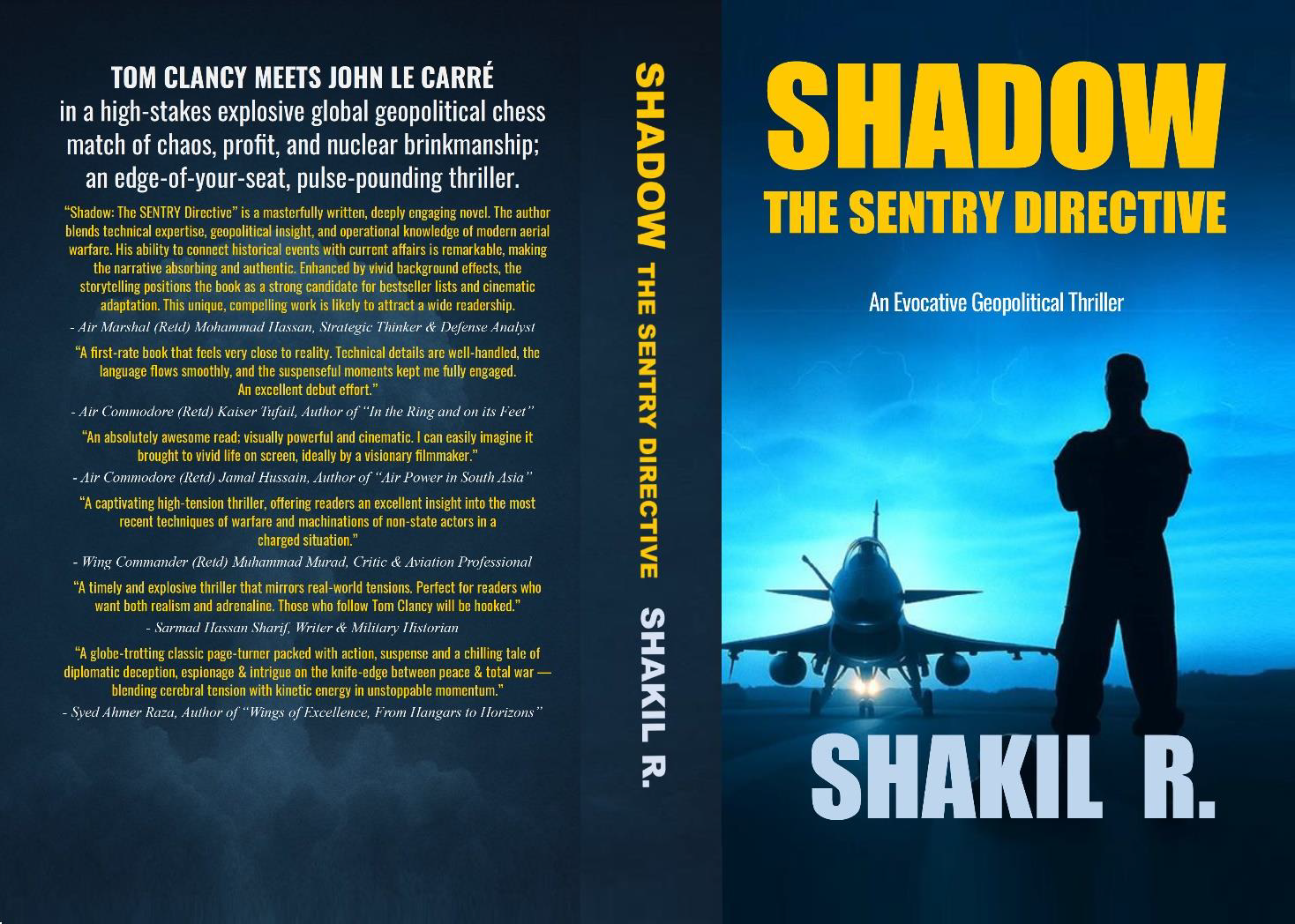
Shakil R. Crafting a New Era of Geopolitical Thrillers
An Interview with Air Cdre (Retd.) Dr. Shakil R. Sheikh, Author of Shadow:
The SENTRY Directive
Introduction
Air Cdre (Retd) Dr. Shakil R. Sheikh represents a unique intersection of disciplines: a retired PAF Aerospace Engineer turned strategic storyteller. In an exclusive interview conducted in Islamabad, Defence Journal sat down with the author to discuss his debut novel, Shadow: The SENTRY Directive. The discussion explores how military realism informs fiction, the importance of operational security in literature, and the strategic message behind a thriller that advocates for peace through strength.
Segment 1: The Strategic Vision
Aslam Quadri (Interviewer): Thank you for joining us. To begin, could you outline the core premise of Shadow: The SENTRY Directive?
Dr. Shakil R. Sheikh
Thank you. The novel explores the fine line between war and peace, and the hidden actors who profit from pushing nations over the edge. My career in military aviation taught me that the most dangerous fires often begin not with a bang, but in silence.
This story is built on that realism. We see the narrative through two protagonists: Sohail Mirza, a Pakistani pilot, and Ananya Rao, an Indian diplomat. Their hunt for the truth forces them into an alliance against a common enemy: organizations that view our region not as a homeland, but as a marketplace for chaos.
This is not a story that asks for peace from a position of weakness. It is about earning stability through strength and the courage to cooperate against shared threats.
Aslam Quadri (Interviewer)
What makes this unique in the geopolitical thriller genre, particularly regarding the blend of military precision and emotional depth?
Dr. Shakil R. Sheikh
Most geopolitical thrillers are written about generals and presidents from a distance. Shadow operates on the runway and in the cockpit. It pairs the physical reality of pushing a fighter jet to its limits with the emotional cost paid by those caught in the crossfire. I wanted to write a thriller that is not just read with the mind, but felt. It informs by technical expertise but is born from imagination and hope.
To the best of my knowledge, this is among the pioneering works of English-language geopolitical thrillers from Pakistan that highlights the cost of war and the value of peace.
Segment 2: Authenticity & Operational Security
Aslam Quadri (Interviewer)
The novel features what is described as the largest air battle of the century. Drawing on your PAF background, how did you craft these sequences to be technically authentic without compromising security?
Dr. Shakil R. Sheikh
That sequence is built from the inside out. I tried to translate the sensory overload of combat—the G-forces, the calculated calm of a pilot’s voice. I operate on a simple principle: Keep the physics real, but the secrets safe.
I describe capabilities that are publicly known through official media briefs or logically extrapolated, but specific tactics, vulnerabilities, and classified technologies remain firmly in the realm of fiction. It is about giving readers the feeling of authenticity without ever compromising security. From the JF-17’s and J-10C’s performance envelopes to weapon systems, the hardware is as real as public data allows. When Sohail flips a switch, it’s the right switch. This accuracy is a mark of respect for our institutions.
“I describe capabilities that are publicly known… but specific tactics, vulnerabilities, and classified technologies remain firmly in the realm of fiction.”
Aslam Quadri (Interviewer)
Your writing combines the technical precision of authors like Tom Clancy with a distinct regional perspective. How did you find your voice?
Dr. Shakil R. Sheikh
I took the surgical, technical blueprint of authors like Clancy and Forsyth, then poured into it the humanity of our region. My voice comes from that fusion: a deep respect for the machinery of war, but a deeper respect for the people who operate it.
I see each chapter as a scene, blending dialogue and visuals to create a mental movie, where every footstep and every weapon fired evokes a picture in the reader’s mind.
Segment 3: Characters & Human Cost
Aslam Quadri (Interviewer)
Sohail Mirza, call sign ‘Shadow’, is a complex protagonist. What makes him different from typical thriller heroes?
Dr. Shakil R. Sheikh
Shadow is a hero defined by his emotional weight. He’s a genius in the air but haunted on the ground. His call sign isn’t just about being a ghost; it’s about the burden he carries. He shows that true strength isn’t the absence of pain, but the courage to carry it and still do your job.
Aslam Quadri (Interviewer)
You feature a dual narrative with an Indian diplomat, Ananya Rao. Why was this cross-border perspective important?
Dr. Shakil R. Sheikh
A single narrative creates a villain; a dual narrative creates understanding. By giving equal weight to Ananya, I force the reader to see the humanity on both sides of the border. She is not Shadow’s enemy; she is his mirror. Their shared grief becomes the bridge that politics can never build. For young readers in both countries, it’s an invitation to imagine the other as human, not propaganda.
Aslam Quadri (Interviewer)
The antagonist, Darian Blackwood, represents “chaos capitalism.” How does this mirror real-world economic warfare?
Dr. Shakil R. Sheikh
Blackwood is the most dangerous kind of villain: the one who believes he’s the hero of his own story. He doesn’t want to rule the world; he wants to orchestrate instability for maximum profitability. His evil is bureaucratic, clinical. He represents a modern truth: the greatest threats to peace are no longer ideologies but amoral financial equations. Look at the business models of private military companies, hedge funds that short currencies during instability, or the dark economy of disinformation. Blackwood is an amalgamation of those real forces.
Segment 4: Geopolitical Balance & Regional Security
Aslam Quadri (Interviewer)
The novel emphasizes peace from a position of strength. Why is this idea central to your story?
Dr. Shakil R. Sheikh
Because history shows us that peace from weakness is just a pause between wars. Lasting peace comes when all parties see greater value in stability than in conflict.
My novel argues that when nations are confident in their security, they can negotiate from a place of wisdom, not fear.
It’s a message for the new generation: true power isn’t in dominating others, but in securing a prosperous, stable, and shared future.
Aslam Quadri (Interviewer)
Through SENTRY’s creation in Istanbul, your novel shows Pakistan taking leadership in regional security. What strengths does Pakistan bring to such multinational initiatives?
Dr. Shakil R. Sheikh
Pakistan brings immense strategic value: a proud military, a youthful, tech-savvy population, and a geographic position that is a bridge, not a barrier. SENTRY is a fictional platform, but it’s built on the very real potential of Pakistan to be a net exporter of security and stability.
Thematically, it represents the ultimate upgrade: moving from a 20th-century model of nation-states squabbling in the dark to a 21st-century model of shared intelligence.
Aslam Quadri (Interviewer)
How did you approach handling India-Pakistan tensions to emphasize fiction over politics?
Dr. Shakil R. Sheikh
I deliberately created a powerful, external antagonist who forces traditional rivals to look beyond each other. The real conflict isn’t India vs. Pakistan; it’s Order vs. Chaos. It’s not about taking a political side; it’s about asking a universal question: when faced with a common enemy, can old rivals unite? I’m writing about human beings caught in geopolitical games, not being jingoistically patriotic.
Segment 5: Future Adaptation & Literary Landscape
Aslam Quadri (Interviewer)
The novel has a cinematic style. Do you see Shadow being adapted into a TV series or film?
Dr. Shakil R. Sheikh
From the first page, I wrote with a visual canvas in mind. The aerial ballets and high-tech war rooms are designed for visual impact. My aim was to create a mental movie which my readers could visualise; I wasn’t aiming to write a movie or a serial.
However, some of the readers have commented that they see it in the tonal space of shows like Homeland or The Night Manager, but with a fresh, authentic Pakistani viewpoint; one that offers the Global South’s perspective that the world is now seeing emerge.
Aslam Quadri (Interviewer)
How do you see Shadow fitting into Pakistan’s literary landscape?
Dr. Shakil R. Sheikh
I believe Shadow is one of the pioneering efforts to create a new shelf in Pakistani fiction; one that is confident, outward-looking, and unapologetically commercial without sacrificing depth. It proves that we have incredible stories that can compete on global thriller shelves. It tells young writers they don’t have to choose between being authentically local and ambitiously international.
Segment 6: Closing Statement
Aslam Quadri (Interviewer)
What message do you hope readers, especially younger Pakistanis and defence enthusiasts take from your debut novel?
Dr. Shakil R. Sheikh
My message is simple: Your narrative is yours to write. Don’t let anyone else tell your story. We are a nation of immense talent and resilience. This book is proof that a Pakistani can not only imagine a future of stability and leadership but can also craft a world-class story around that vision. To the youth I say: Dream audaciously. Come for the Thrill, Stay for the heart, and leave with hope.
Author’s Closing Note: If there is one thing I hope readers take from Shadow: The SENTRY Directive, it is this: The future of our region is not a story to be written by others. It is a story we write ourselves. This book is a hope for a different kind of courage. Not just the courage to fight, but the courage to question, to understand each other, and to build peace from a position of strength.
Today we live in a changed reality. The world is shifting towards economic coercion and cognitive domain warfare. Corporations and state actors often believe in creating chaos for profit. If today’s youth want a better future, they need to understand this landscape. They must not only stand up and question leadership but beware of external profiteers seeking to destabilize our sovereignty.
Social media and information warfare are colonizing thought processes and economies. This novel is my contribution to countering that narrative. I hope it entertains you, but more importantly, I hope it makes you believe that a smarter, safer, and more sovereign future is not just a dream: it is a mission within your grasp. This story is, in spirit, yours.
Closing Note from the Interviewer
As the interview concluded, Air Cdre (Retd.) Dr. Sheikh emphasized the urgency of narrative sovereignty. Shadow: The SENTRY Directive stands as more than a book; it is a call to action wrapped in the thrill of a page-turner. It is poised to ignite conversations across borders and generations within the defence community.
Book Details
● Title: Shadow: The SENTRY Directive
● Author: Air Cdre (Retd.) Dr. Shakil R. Sheikh
● Genre: Geopolitical Thriller / Military Fiction
● Availability: Globally available via self-publishing channels.