


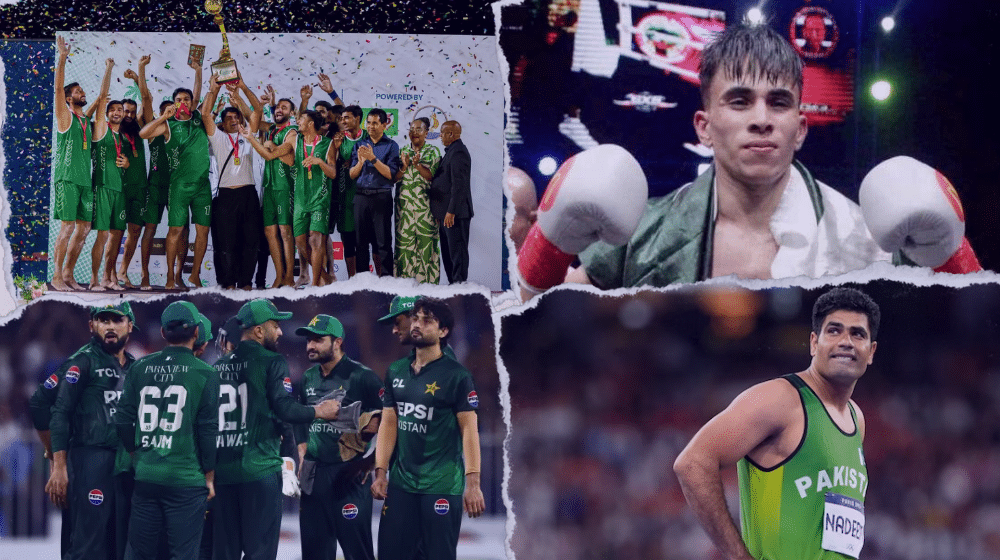
“Dedicate yourself to SPORTS Promotion, for when you and I are gone, leadership will go into the hands of Youth, and Youth is our wealth, a raw material that must be hammered into shape, into burnished steel to strive and smite in Defence.”
Abstract
Pakistan stands at a critical demographic crossroads, with nearly two-thirds of its population under the age of 30. While traditional defense paradigms prioritize kinetic capability and institutional statecraft, modern national security increasingly relies on human capital, social cohesion, and institutional resilience. This article argues that comprehensive sports development is not a peripheral recreational luxury but a core national security imperative. By examining the historical vision of Pakistan’s founders, identifying structural systemic gaps, mapping the expansive global sports economy, and proposing a centralized civilian-military institutional framework, this paper outlines a strategic roadmap to convert a potential demographic vulnerability into an engine of national capability.
SPORTS as a National Strategic Imperative
For Pakistan, the time has come to completely redefine our relationship with “SPORTS”. It can no longer be pushed to the margins of public policy as mere recreation, casual entertainment, or the rare pursuit of an occasional international medal. In the modern theater of comprehensive statecraft, structured physical culture is a frontline strategic asset.
It directly impacts nearly every vital pillar of our national progression: the structural fitness and mental health of our citizens, youth development, early education, broad-based employment, civic harmony, state identity, global tourism, domestic manufacturing, advanced tech integration, and total national resilience. Pakistan stands at a momentous demographic crossroads. Real-time data from the 7th Population and Housing Census 2023 confirms that an astonishing 66.6 percent of the country’s population is under the age of 29. This youth-heavy demographic is our ultimate strategic variable. If we actively endow this generation with rigorous education, vocational skills, deep-rooted discipline, physical health, and productive avenues for systemic engagement, it will become an unmatched economic engine and our greatest national asset. However, the alternative remains stark. A historic demographic dividend left unharnessed will inevitably decompose into a destabilizing demographic burden. Pakistan operates within a narrow, closing window of opportunity to convert this youth bulge into highly disciplined, productive human capital. To succeed, structured physical culture must be placed at the center of our national development framework.
The Founder’s Vision
This strategic worldview is woven directly into the foundational fabric of our state. Our founding leaders perfectly understood the vital link between youth development, physical conditioning, and sovereign survival. In his historic April 1948 address to the Pakistan Olympic Association, Quaid-e-Azam Muhammad Ali Jinnah issued an inspiring call to action, urging the newborn nation to dedicate its energy to the promotion of sports. He explicitly challenged our youth to transform themselves into “burnished steel” to defend Pakistan’s long-term integrity, solidarity, and honor.
Jinnah’s vision transcended basic fitness. He was drawing a direct, unbreakable line between physical movement, moral character, organizational discipline, and comprehensive national defense. The enduring lesson was clear: a state cannot forge sustainable power merely through the cold mechanics of bureaucratic institutions; it must deliberately construct the physical, mental, and ethical capacity of its young citizens.
Our early history demonstrates that athletics were tightly bound to the project of nation-building. Before independence, the historic Mohammedan Sporting Club of Bengal —deeply intertwined with Aligarh and the wider Muslim political mobilization of the 1930s and 1940s—proved that athletic dominance could build collective organizational discipline, cultural pride, and immense political confidence. Following the dawn of independence, this vital partnership between athletic performance and national capability was sustained through direct institutional patronage. Pakistan’s armed forces actively served as the primary incubator and foundational support system for elite athletes across field hockey, cricket, and squash.
Our early Olympic triumphs and the legendary global dominance of pioneers like Hashim Khan occurred because athletic excellence was treated as a direct reflection of sovereign strength. Sports and national development were never treated as separate paths in Pakistan’s formative years.
The Opportunity We are Missing
Pakistan School and university competitions have quietly decayed, our public facilities are aging, talent identification remains completely inconsistent, and professional sports management is highly scarce. As a direct consequence, Pakistan spends its energy searching for rare, isolated champions after they cross the finish line through sheer personal grit, rather than building the systemic assembly line that predictably creates champions.
The critical missing link is the absolute revitalization of grassroots sports. While every child cannot become an Olympic competitor, a resilient state requires that every child be exposed to the life-lessons of sports. Establishing structured school leagues, college championships, district tournaments, and high-performance talent pathways will systematically yield healthier, more disciplined, and highly confident citizens while effortlessly bringing our elite athletic talent to light.
A structured, nationwide school-to-university athletic pathway should be just as normal, rigorous, and protected as our academic curriculum.
Table 1 — Pakistan’s Structural Sports Gaps
| Area | Current gap identified in the supplied material | Strategic consequence |
| Policy | No unified national sports policy | Fragmentation and weak continuity |
| Institutions | Institutions often work in isolation | Duplication and poor coordination |
| Grassroots | Schools lack infrastructure, trained staff and regular leagues | Weak talent identification |
| Competition | Limited tehsil/district-level leagues and pathways | Talent is lost before elite level |
| Academia–industry | Weak integration of universities, sports and industry | Missed innovation and employment |
| Youth engagement | Risk of negative or unproductive digital behavior | Lost demographic opportunity |
SPORTS ECONOMY
The modern global sports landscape has moved far beyond simple stadiums and isolated athletes. It is an expansive, multi-billion-dollar macro-economy driven by broadcasting rights, sports tourism, retail apparel, specialized sports medicine, predictive data analytics, event logistics, and interactive digital media. Global sports capital is valued in the hundreds of billions of dollars and is projected to expand significantly over the coming decades.
For Pakistan, this is a massive opportunity to ignite a completely new industrial ecosystem. Consider the city of Sialkot. Pakistan proudly manufactures the highest quality, match-grade sporting equipment for global tournaments. Yet, we capture only a tiny fraction of the broader economic value chain because we lack the surrounding architecture: sovereign global brands, high-profile domestic leagues, specialized athletic management agencies, state-of-the-art broadcasting networks, and global sports tourism events. A vibrant, state-backed domestic sports culture would instantly spark a massive wave of downstream demand across our textile, leather, transportation, hospitality, advertising, and digital sectors opening up fields of opportunity for small-and-medium enterprises (SMEs) and young entrepreneurs.
Furthermore, sports technology offers an attractive frontier for our tech-literate youth. Our young digital workforce can build high-value careers in performance analytics, wearable health sensors, AI-driven broadcasting, fan engagement software, and E-sports—providing tech-driven employment for young people who may never step onto a physical field. The sports economy must be prioritized as a self-sustaining industrial powerhouse, not an ongoing budget expense on stadiums.
What Other Nations Understood
The historical paths of leading global actors show that sports are systematically treated as a core component of state power. UNESCO’s International Charter explicitly mandates that physical education and sport must occupy a central position in public education, urging states to connect sports policy directly to health, youth development, and broader socio-economic goals.
American experience goes back more than a century. In 1905, President Theodore Roosevelt intervened in the crisis surrounding college football and brought university leaders together to reform the game. The process contributed to the creation of the Intercollegiate Athletic Association of the United States, precursor of today’s NCAA. The significance is not that Roosevelt created the Ivy League—he did not—but that national leadership recognized the need for standards, rules and institutional responsibility in collegiate sport.
The history of the Ivy League offers a valuable lesson. Formed in 1954, the Ivy League is fundamentally an “Athletic conference” rather than an academic ranking system. While the term strictly defines a sports partnership, this shared athletic identity ultimately helped shape these schools into the elite academic institutions we recognize today. It bound them into a cohesive ecosystem where sports tradition and academic excellence mutually reinforced each other. In Pakistan, we tend to admire the Ivy League’s academic prestige while overlooking the broader athletic-academic culture that helped build it. CHINA directly built competitive sports into its central national development model, successfully spinning a vast public infrastructure into an elite high-performance system.
Table 2 — The “Power–Economy” Correlation Index
| Correlation Level | Index Score | Meaning | Countries in This Bracket |
| DIRECT MATCH | 0.90+ | Sports success is perfectly aligned with wealth. | USA, China, UK, Japan |
| HIGH CORRELATION | 0.70 – 0.89 | Wealth is the primary driver of medals. | Germany, France, Italy |
| THE “SYSTEM” BONUS | Over-Performer | Training systems beat the bank account. | Hungary, Australia, South Korea |
| THE “RESOURCE GAP” | Under-Performer | High wealth potential , Large population, low medal output. | India, Pakistan, Nigeria |
The United States engineered a highly lucrative connection between university athletic departments, grassroots youth sports, and multi-billion-dollar corporate professional leagues. Closer to home, India has successfully transformed its domestic sports environment into a massive commercial engine and soft-power asset through targeted public-private initiatives like the Indian Premier League (IPL) and the state-led Khelo India platform.
The common denominator among these states is not simply high capital expenditure. It is that they build deliberate, integrated systems around sports.
PAKISTAN has historically attempted the exact opposite: we construct a stadium, sponsor a fleeting tournament, and wait for anomalous success. A resilient state requires a continuous, permanent ecosystem that seamlessly hooks together the primary school, the local community, the university, the independent athletic federation, the high-performance academy, the professional league, private industry, and international competition. Leading economies consistently dominate the world sports stage, while states with vast populations and economic resources underperform whenever their internal institutional architecture is fractured. Wealth alone does not guarantee success; rather, the strength of the state’s institutions determines its capacity to transform human capital and resources into international influence. In nutshell, the lesson for Pakistan is powerful: physical fitness can be treated as a matter of national human capital, not merely personal lifestyle.
Table 3 — Global Power Balance vs Top 15 Economies (2026)
| Rank | Top 15 Olympic Nations (Combined All-Time Medals) | Top 15 Global Economies (2026 Nominal GDP Projections) |
| 1 | USA | USA |
| 2 | Great Britain | China |
| 3 | Germany | Germany |
| 4 | France | India |
| 5 | Italy | Japan |
| 6 | Sweden | United Kingdom |
| 7 | China | France |
| 8 | Russia* | Italy |
| 9 | Japan | Russia |
| 10 | Hungary | Canada |
| 11 | Australia | Brazil |
| 12 | Canada | Spain |
| 13 | Norway | Mexico |
| 14 | Netherlands | Australia |
| 15 | Finland | South Korea |
Pakistan Strategic Market Position Note: Pakistan’s economic rank hovers as the ~43rd largest globally. However, a distinct ‘Resource Gap’ remains evident. Many large global economies currently fall behind in terms of continuous physical pipeline returns. A clear market opportunity exists to bridge economic power with true athletic achievement through institutional realignment.
*Note: Olympic data combines Russian Empire, Soviet Union, and Russian Federation.
SPORTS as Human Capital
The most important return on our sports investment is not found in an Olympic gold medal or a lucrative media contract. The ultimate return is the development of the individual human being.
Structured sport systematically teaches deep civic virtues: punctuality, teamwork, emotional resilience, strategic leadership, clean competition, respect for rules, and the psychological capacity to recover from failure. Evidence-based World Health Organization (WHO) guidelines confirm that regular physical movement among children and adolescents is directly linked to optimized cardiovascular fitness, cardio-metabolic health, sharp cognitive outcomes, and robust mental health.
For a nation carrying a massive youth bulge, these character traits are of vital national interest. A child who learns to train diligently every morning embraces the power of delayed gratification. A player who suffers a painful defeat learns how to face adversity without breaking. A team captain learns the heavy burden of collective responsibility. An elite athlete learns that success depends entirely on rigorous preparation rather than excuses. They are qualities of citizenship and leadership.
A Strategic Role of Institutions
Pakistan’s core deficit is not a lack of raw athletic talent; it is a critical shortage of institutional architecture. There is a compelling strategic case for synthesizing our educational network, provincial governments, sports federations, universities, corporate enterprises, and the armed forces into one cohesive federal framework.
Throughout our history, the military has consistently demonstrated an unmatched ability to execute large-scale, mission-oriented, and highly disciplined programs. Its structural contribution to Pakistan’s sports legacy is significant. The military’s operational capacity can be a powerful asset within a unified national sports mission—particularly in building infrastructure, training coaching staff, instilling discipline, and providing institutional stability.
But this should be conceived as a civilian–military partnership, not the militarization of sport. Education must remain central; provinces must execute programmes locally; universities must develop research and talent; private industry must provide investment; and independent governance must protect merit and transparency. The objective is one unified national mission executed by many institutional partners.
The National Sports Mission
To manage this vital transformation, Pakistan should consider establishing a centralized National Sports Mission Authority (NSMA) structured around four clear, unshakeable pillars.
First, Infrastructure. Existing stadiums and sports facilities should be upgraded, while modern community sports complexes should become part of urban and rural planning, ensuring every neighborhood has green space for youth development.
Second, talent and leagues. Sports should be restored to schools and colleges through structured competitions progressing from school to tehsil, district, provincial and national levels.
Scholarships and academies should provide pathways for talented athletes. Third, the sports industry. Pakistan should target the development of a multi-billion-dollar sports economy by expanding broadcasting, sports tourism, merchandise, technology, fitness, event management and exports, while fully utilizing the industrial capabilities of Sialkot and other manufacturing centers.
Fourth, governance and standards. A national framework should establish clear standards, merit-based selection, and transparency in funding, independent auditing, professional coaching and continuity across political cycles.
Crucially, Inclusion must be the cornerstone of this mission. Women, individuals with disabilities, and youth from our most isolated rural or economically disadvantaged communities must be given equal access to elite training facilities, modern equipment, competitive tournaments, and international scholarship pathways.
Table 4 — Proposed National Sports Mission: Four Strategic Pillars
| Pillar | Core actions | Expected strategic return |
| 1. Infrastructure | Modern sports complexes; upgraded stadiums; sports integrated into urban and rural planning | Access, participation and training capacity |
| 2. Talent & Leagues | School → tehsil → district → provincial → national competitions; scholarships; academies | Talent identification and high-performance pathways |
| 3. Sports Industry | Broadcasting, tourism, merchandise, technology, fitness, events and exports; activate Sialkot/Faisalabad capacity | Jobs, entrepreneurship, exports and investment |
| 4. Governance & Standards | Central policy framework; merit; transparency; audits; professional coaching; continuity | Institutional credibility and sustained performance |
From Playing Sport to Building the Nation
Pakistan does not face a binary choice between economic growth and sports development. Properly designed, a comprehensive national sports policy directly fuels both.
The core question confronting our policymakers is not simply: How many international medals can Pakistan win? The grander, more inspiring question is this: What kind of nation can Pakistan build if we systematically unlock the physical, mental, and moral potential of our youth?
A comprehensive national sports strategy acts as a powerful preventative health measure, lowering public health burdens while boosting worker productivity. It creates entirely new economic sectors, fosters intense national pride, and offers a constructive alternative to negative digital habits or social drift. It expands our horizons for tourism, tech innovation, and industrial exports, while restoring an essential element of our collective national confidence.
Our founders understood that a state’s greatest treasure is its people. Today, that golden rule must be applied to a country whose greatest asset is its youth. This demographic window will not remain open forever. We must convert this youthful energy into productive human capital before the clock runs out. Sports offer one of the most powerful platforms on earth to achieve this transformation.
- Sports is not entertainment—it is human capital.
- Sports is not an expense—it is a strategic investment.
- Sports is not merely about medals—it is about national capability.
- Sports is not peripheral to statecraft—it is a national strategic imperative.
Pakistan’s future strength will not be determined solely by its conventional military hardware, industrial output, or state governance. It will depend on the physical vitality, mental resilience, and moral fiber of its young people. The task before the state is not simply to produce a handful of isolated champions, but to build a nation of champions.
References
- Pakistan Bureau of Statistics. (2025). 7th Population & Housing Census 2023: National Census Report. Government of Pakistan.
- Pakistan Olympic Association. (n.d.). Foundational History and Elite Chronology.
- National Collegiate Athletic Association (NCAA), The History of the NCAA.
- https://ivyleague.com/
- Government of Pakistan, Revised National Sports Policy 2005; Hafsa Ali, Richard Wright & Geoff Dickson, “Sport Policy in Pakistan,” International Journal of Sport Policy and Politics, Vol. 15, No. 3, 2023, pp. 563–575; Pakistan Sports Board policy framework.
- Pakistan Sports Board, History of National Games.
- Guy M. Lewis, “Theodore Roosevelt’s Role in the 1905 Football Controversy,” Research Quarterly, Vol. 40, No. 4, 1969, pp. 717–724.
- Hafsa Ali, Richard Wright & Geoff Dickson, “Sport Policy in Pakistan,” International Journal of Sport Policy and Politics, Vol. 15, No. 3, 2023, pp. 563–575. DOI: 10.1080/19406940.2023.2219272.
- World Health Organization. (2020). WHO Guidelines on Physical Activity and Sedentary Behaviour. Geneva: World Health Organization.
- UNESCO. (2015). International Charter of Physical Education, Physical Activity and Sport.