


Perspective on Deterrence and Escalation Post-Pahalgam
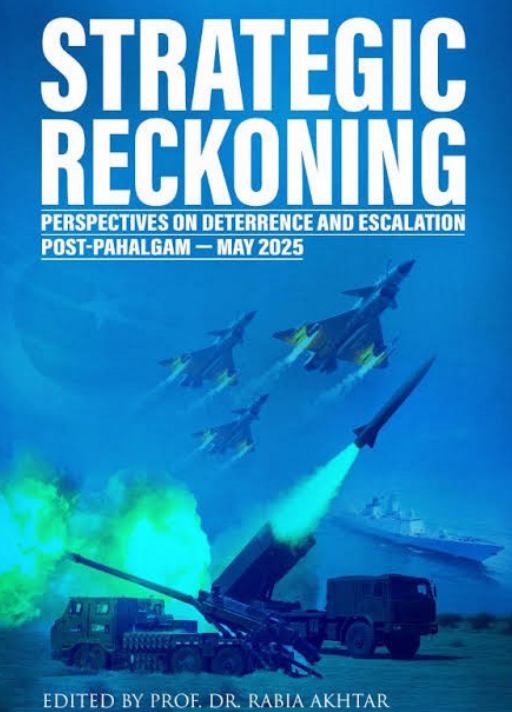
EDITED BY PROFESSOR DR. RABIA AKHTAR (ISLAMABAD: CSSPR-IRS, 2025), (PAGES, 344)
It is an edited volume, compiled by Professor Dr Rabia Akhtar, published jointly by the Center for Security, Strategy and Policy Research (CSSPR) from the University of Lahore and the Institute of Regional Studies (IRS), Islamabad. Dr Rabia Akhtar, Dean, Faculty of Social Sciences at the University of Lahore and the founding director of CSSPR, having remarkable expertise in South Asian nuclear dynamics, prepared this fast and well-organized edited book to articulate the implications of the May 2025 crisis on deterrence, escalation management, and regional security and stability.
She has tried to provide a comprehensive account of the post-Pahalgam South Asian crisis between a pair of nuclear contestants and their persistently growing strategic divergences laced with certain inconsistencies.
The book’s main structure is divided into twenty short research essays outlined by people from the military, diplomatic, and academic backgrounds. Starting with an inspiring preface written by an Adviser, National Command Authority, Lt. Gen. (Retd.) Khalid Kidwai, the book’s first and last chapters, containing introductory and concluding remarks by Dr Rabia Akhtar, shed light on Pakistan’s responses to New Delhi’s new abnormal, and the Indian doctrinal transition jeopardizing the scope of regional stability.
She outlined the four-day brief armed confrontation between New Delhi and Islamabad as the turning point of South Asian history, placing the regional security environment under new pressures of Indian unilateral and preemptive actions intended to facilitate it in acting “as judge, jury and executioner in responding to militant provocations” (p. 17). She analytically views the recent episode of the 2025 crisis under the nuclear shadows, and marks it as New Delhi’s preferred escalatory, reckless behaviour designed by the Narendra Modi government.
The book’s central theme revolves around the updated deterrence equilibrium of South Asia, challenging the traditional wisdom attached to the India-Pakistan rivalry in which the conventional patterns of mutual restrains and caution have been explicitly undermined. The clash that erupted from the Pahalgam incident was formally condemned by Pakistan, while proposing a neutral and impartial inquiry with Islamabad’s full cooperation, which was rejected by India (p. 119). India’s refusal to conduct a joint inquiry was followed by its strict diplomatic measures, and it expelled Pakistan’s New Delhi-based diplomatic mission and unilaterally dismissed the 65-years-old Indus Waters Treaty. These moves of the Modi government raised the temperature and escalated into a multi-domain armed conflict, which proved an inseparable connection between conventional and nuclear deterrence.
The book offers a comprehensive account of different arguments on the aftermath of the Pahalgam incident, which resulted in India’s offensive operation to alter the existing security landscape of the South Asian nuclearized subcontinent, in which Islamabad always preferred a wise warfighting strategy against New Delhi’s offensive policy orientations.
Dr Rabia Akhtar’s effort, in assembling the opinions of prominent figures of Pakistan’s strategic community in a single volume, could reasonably be treated as an appreciable rapid academic response to the changing regional security apparatus of South Asia. Within months, the articulation of intellectual contributions collected from leading figures of Pakistan’s strategic community tried to highlight the country’s doctrinal manifesto and its political positioning, aligning with the fluctuating regional security landscape.
The contributions of retired generals, air commodores, rear admiral, ambassadors, and different academic figures attempted to formulate conceptually Pakistan’s role in the four-day clash of hybrid domain. In Dr Rabia Akhtar’s words, this uncertain future raises the probability of collapsing regional strategic equilibrium, because “the May 2025 crisis served as a brutal reminder of how quickly deterrence stability frays when one side tests the limits” (p. 331). She underlined the regional sensitivities, embracing the unavoidable realities of Indian doctrinal drift, proving it impartially an aggressive player relying on preemptive striking options without calculating its impacts on the South Asian nuclear dyad.
The adoption of such behaviour forced it to take substantial measures seeking to control the circumstances affecting the New Delhi-Islamabad deterrence equilibrium established in 1998. In this way, the book’s last chapter attempted to offer a summary of escalating risks in the next decades of South Asian politics, in which Pakistan is determined to keep the door open for de-escalation through a measured approach. It also confirmed that the troubling asymmetry cannot support deterrence stability, especially in an outrageous situation where one side’s restraint alone cannot produce the desired outcome against the other side’s constantly pressuring conduct.
This edited book is an impressive work of dispassionate crisis scholarship deserving unconditional admiration to contributing authors, because their arguments collectively prove a departure from the Cold War’s lessons, where the probability of an intense conventional conflict was low between two superpowers with gargantuan striking capabilities.
Thus, the book gives an unpleasant feeling about the South Asian weakening deterrence equilibrium, degrading the regional security and political landscapes, which seek timely responses from the two competing nuclear powers. These responses are strictly associated with the recalibration of strategic postures based on an updated framework of existing communications, strategic signalling, confidence-building measures, and commitments to overcome the probable scenarios of misinterpretations and miscalculations in critical circumstances. In this way, the common point in the book’s chapters is to sensitize the respective leaders from New Delhi and Islamabad to the transition of nuclear deterrence from a stable equilibrium to a complex and uncertain strategic matrix.
In this debate, the greater responsibility lies on the Indian government, which prefers to establish a “new normal” in the region, and this New Delhi’s thinking is deficient in rational calculations. It has converted the desired “new normal” into a “new abnormal,” as it is dubbed by Dr. Rabia Akhtar as a crisis of disorder rather than a crisis of a new order (p. 16).
What makes this edited book different from the existing literature on the 2025 Pahalgam crisis is the contribution of academic strategists and policy partitioners which are known as the architects of the country’s strategic postures, and its reliance on deterrence stability. It treats the 2025 crisis as a turning point in the New Delhi-Islamabad hostility instead of considering it another episode of a South Asian crisis. On similar lines, the book did not purely narrate the crisis in a descriptive manner, but explained its lessons for future deterrence scenarios, where the Indian doctrinal change is pushing the entire region towards an uncertain future.
This doctrinal drift has raised critical questions about the validity of deterrence stability, functioning to avert the perceived threats of an armed confrontation between nuclear rivals. Now the actual concern is not merely link with the possession of nuclear weapons by New Delhi and Islamabad. However, it is more relevant to a comprehension of permissible force structures adopted by the contesting two-sided leaderships under the nuclear umbrella. Based on these unprecedented narrations, it can reasonably be maintained that this book is an intellectual endeavour to prove a logical interconnectedness between theoretical understanding of the India-Pakistan strategic contestation and its appropriate application to contemporary South Asian strategic developments.