



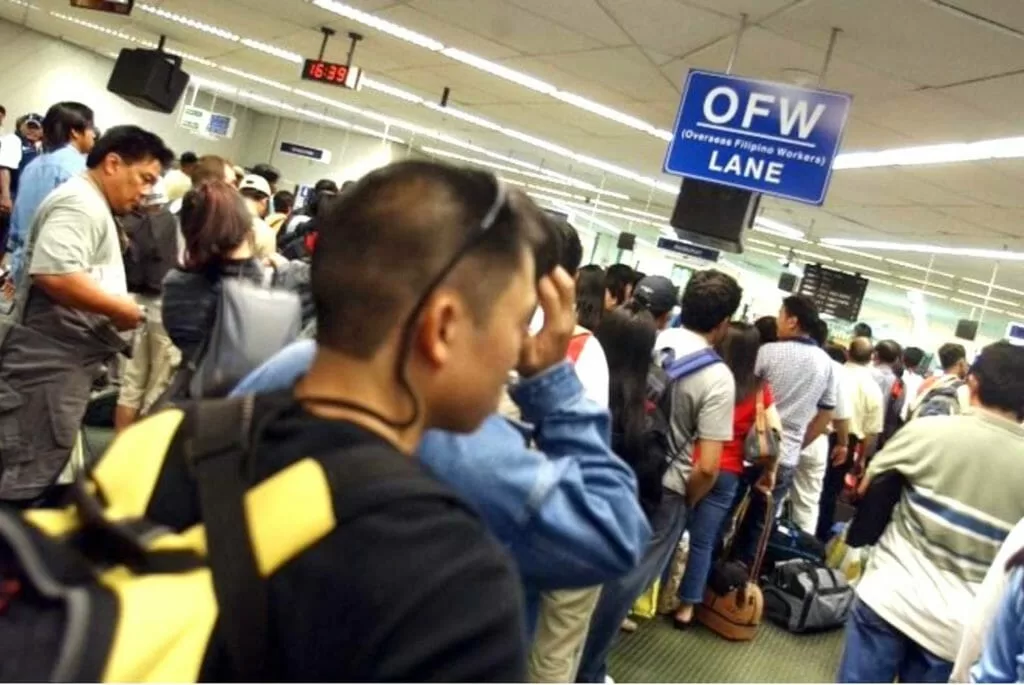
The Filipino is a truly global labour force. Filipino workers can be found in hundreds of countries around the world. It is astounding to think that this archipelago in the middle of the Pacific can produce so many people who leave for so many destinations around the world.
Daily, nearly 5000 people are leaving the Philippines to go everywhere – and ‘everywhere’ really means everywhere. The Philippines stands out as a “broker state,” having built a “true migration industry that, in 2017, accounted for over 2.3 million Overseas Filipino Workers (OFWs), with their remittances making up nearly 10% of the GDP.
Every year, 172,000 Filipino women leave their country to work abroad, seeking better income opportunities to financially support their families, with the majority engaging in domestic work. This trend is a result of a situation in the Philippines characterized by chronic underemployment and overqualification of the workforce, particularly among women. Paradoxically, this circumstance leads to the impoverishment of educated segments of society, as despite their access to employment, remuneration remain meagre in comparison to their skills. It is within this context, starting from the 1960s, that the state-regulated migration strategy emerged.
You find Filipinos in Africa, in Europe (Spain, the UK, Sweden, Germany), in the streets of Hong Kong and Tai Pei, in Taiwan, in Korea, in Japan and all over the Middle East (e.g. Saudi Arabia, Syria, Lebanon, the UAE). The Philippines is unrivalled in this regard – you do not have the same size and scope of migration from other places. The Canadian government even introduced a policy to bring in low wage care givers to provide care for children and the elderly. And because of this, the Philippines counts as one of the top remittances earning countries in the world, not surprising given the global scope and scale of migration.

Labour brokerage describes how the Philippine state mobilises its citizens and sends them abroad to work for employers throughout the world while generating profit from the remittances that migrants send back to their families and loved ones remaining in the Philippines. In a nutshell it is the transnational apparatus of institutions that helps to facilitate the out-migration of workers. There are agencies in the Philippines, but it is also the network of consular and embassy offices all around the world that actually play a role in helping with marketing and bi-lateral agreements with those countries to facilitate migration. Labour export is promoted as a way of providing jobs to people in the Philippines that they would not ordinarily have, as providing a source of income that they can’t enjoy in the Philippines. It can therefore cut social unrest.
This kind of labour brokerage is thus a policy of the govt to manage a growing population, to provide jobs that are not available at home. At the same time, it encourages the education in the population when children and grown people see a perspective in making a living abroad if they have good basic education, skills and a command of English (or another language)
The popularity of Filipino domestic workers is the result of constructing a laudable image that serves as a guarantee of work quality. They are “valued for presumed qualities such as ‘docility,’ ‘humility,’ ‘adaptability,’ ‘dedication to work,’ ‘good humour,’ ‘family-orientedness,’ as well as proficiency in English and high levels of education.

Since 2006, emigration has increasingly taken on a feminine dimension, as illustrated by the year 2012, during which more than 155,000 Filipino domestic workers were newly employed abroad. But especially in northern countries, there are better opportunities for workers and female workers. A central point is the excellent proficiency in English. There are specific test results that illustrate the high English proficiency of the Filipinos: The average TOEFL score of the Filipinos was 88/120 in 2018, which was the sixth highest out of 36 counties in Asia (Educational Testing Service, 2019). Additionally, 77% of the IELTS test-takers in the Philippines obtained a score of 6.5 or over in 2018 (IELTS, 2019). The fact that the country has the largest number of English-speaking call centers (Keitel, 2009) is indicative of their strong command of the language.
In a recent conference dealing with improvement of English teaching, participants from the government sector underscored the need for an interagency government body to regulate and support ESL (English Second Language) provision in the country in order to further capitalize on its economic potential.
Representatives from the academe focused on teacher training and professional development, highlighting the need for skills in differentiated instruction, materials development, and knowledge sharing. Apart from English, general knowledge of the prospective workers is important. Prior to 2011, the Philippine education system consisted of 6 years of primary (elementary) school followed by 4 years of secondary (high) school, with students graduating at the age of 15 or 16.
A major reform was undertaken to lengthen the duration of schooling. Kindergarten was added in 2011 and then two further grades in 2016 and 2017. The current system has 6 years of elementary school, 4 years of junior secondary school and 2 years of senior secondary school. Students graduate at age 17 or 18. The reform brought the length of schooling in line with K-12 systems common in other countries. The TVET system is managed by the Technical Education and Skills Development Authority, which accredits programs and organizes the system of skills certification of trainees (TVET is an acronym for Technical and Vocational Education and Training).
After training, students can sit an examination to obtain a National Certificate (NC), which is granted at levels I, II, III and IV, with the latter being the most advanced. Vocational training can also lead to a Certificate of Competency, for those who did not complete secondary school. There are also a variety of TVET opportunities that are not part of the NC system but lead to qualifications recognized by the industry and government.
In addition, technical and vocational education and training must adapt to advances in science and technology, climate change and unpredictable events to develop the appropriate job-related skills