


In May 2025, yet again the world bore witness to India’s tried and tested tactic of manufacturing crisis designed and orchestrated to serve domestic political agendas. The grotesque playbook this time included the script of a heinous terrorist attack in Pahalgam massacring innocent tourists in the name of religious identity. As always, India within hours, without a shred of credible evidence blamed Pakistan. This wasn’t an aberration. It was the continuation of India’s familiar script authored over years.
Uri and Pathankot in 2016, Pulwama in 2019 and this time around a tourist spot deep inside a military infested area, each orchestrated to externalize internal fractures and project blame across its borders. Shedding crocodile tears, the Indian leadership, its media and intoxicated on Hindutva ideology public demanded revenge. Pursuing an agenda of influencing domestic politics, the Indian Government decided to embark on a misadventure through use of an unwilling military instrument. New Delhi miscalculated and crossed a line it was not prepared to defend.
The Indian political establishment, desperate to unite a fractured electorate, wove an elaborate narrative of victimhood, fueled by a complicit media that screamed vengeance, a dangerous display of war hysteria and jingoism rather than objectivity and truth. Under the guise of self-defense, India initiated a series of actions that started with targeting civilian areas inside Pakistan aimed not at military objectives, but striking places of worship with standoff weapons, killing innocent Pakistanis in an utter disregard of international law and a sheer display of arrogance and madness.
In its arrogance, the Indian leadership thought Pakistan as weak and underestimated Pakistan’s national resolve and expected Pakistan to take the blow laying down. Alas, it didn’t happen the way the Indians’ thought and what followed was a lesson written not with words but with precision, power, and professionalism. On the night of May 6/7th, Pakistan Air Force answered India’s aggression with iron-fisted clarity and merciless retribution. Indian Air Force intrusions that considered itself invincible in the presence of Rafales were bloodied, both literally and metaphorically. The skies over the plains of Punjab and hills of Azad Kashmir, became the proven ground of dauntless courage where PAF won every round. Indian losses were heavy, and the myths of air superiority shattered beyond repair. In what can only be described as an aerial bloodbath, PAF jets dominated with precision strikes and flawless execution, sending a message of fear and shock that echoed far beyond the borders deep into hearts of Indian policy makers.
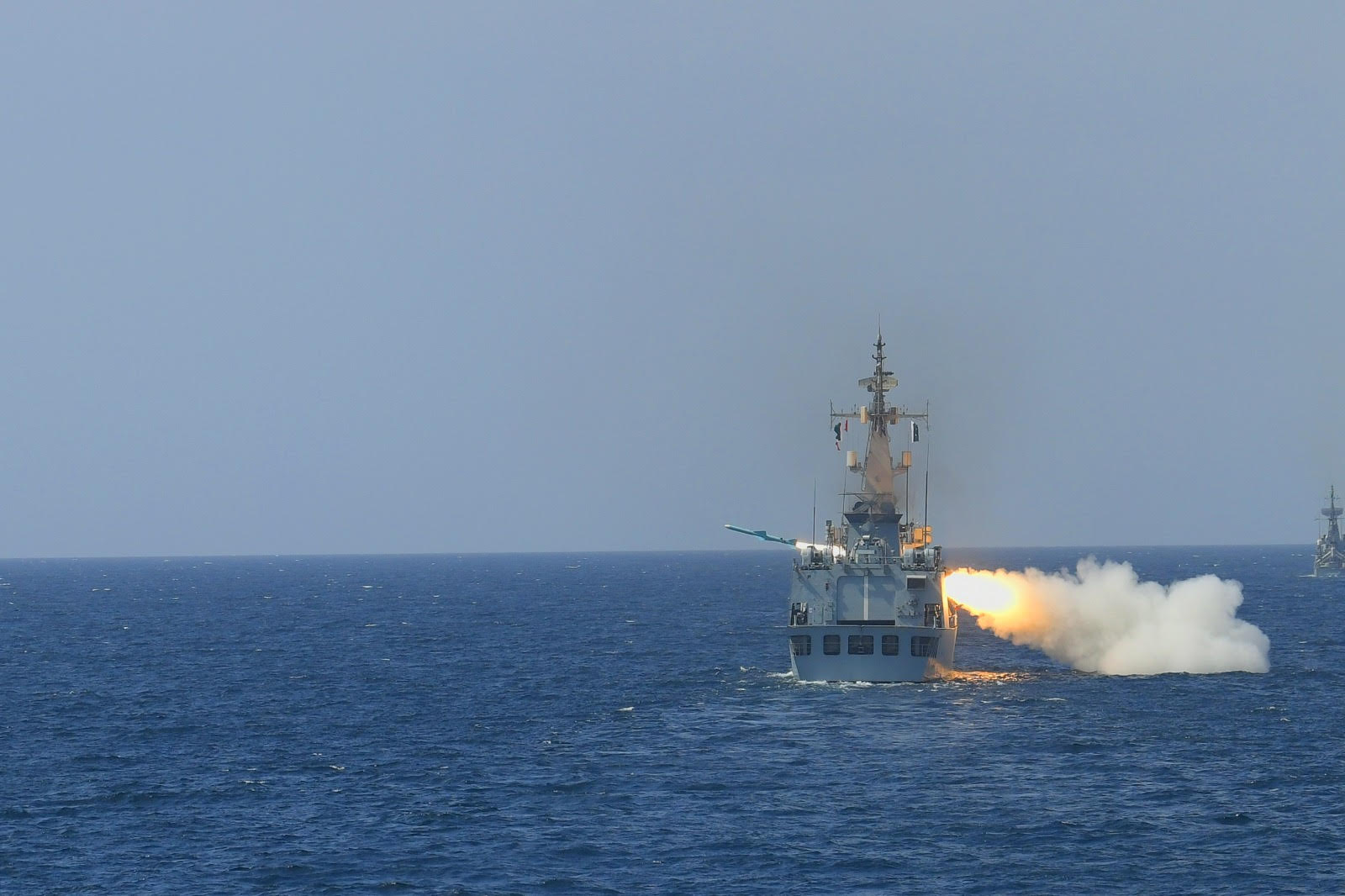
Yet, while Indian jets kept falling like flies from the sky, the Indian government and its deceitful media spun tales of valor and fabricated IAF victories fantasizing downing of scores of PAF aircraft. The scale of the embarrassment was such that the Indian establishment resorted to denial, distortion, and deception. The damage was already done and was done massively, not just the credibility of IAF as a first responder which remained grounded for next two days suffering an absolute paralysis, the fake façade of Indian civil-military-media triangle crumbled under the weight of its own lies. At sea, Pakistan Navy stood vigilant, deployed across its key maritime zones with readiness and resolve. In stark contrast, the Indian Navy, much-touted “blue water navy” chose the safety of its harbors over the test of battle. The carrier group that wanted to project power, tucked tail and ran to Karwar fearing PN reprisal deciding not to leave the comfort space of its home base.
Most IN ships remained docked, their silence echoing the fear of becoming victim to PN’s offensive and assertive deployments. Like their brethren in the skies, Pakistani sailors maintained dominance at sea and successfully achieved their assigned mission of deterring aggression from or at sea living upto Navy’s motto –
“Himmat ka alam, mojo pe qadam, Allah ka karam”
Humiliated and hesitant, India then resorted to modern battlefield tricks, deployed armed drones, loitering munitions and long-range vectors all across Pakistan. But none of these could deter the will of the Pakistani Armed Forces, who stood unshaken in their posture, patiently and prudently. Then came the miscalculation of the decade: the attack on PAF airbases during the night of 9th and 10th May. In an effort to deter Pakistan from a response, India made a strategic blunder. Crossing the threshold of escalation, India invited upon itself the full weight of Pakistan’s retaliation. With calculated precision, Pakistan Army, in close coordination with other services, unleashed a barrage of stand-off strikes across India’s military depth. From the ridges of Kashmir in the north to the military installations of Jamnagar in the south, key Indian command-and-control nodes, logistics hubs, and forward airfields were hit with surgical clarity. Fatah-II MLRS did exactly what it was built for; snatch Fatah (victory) from the enemy.
This was not blind rage, it was deliberate, restrained, and deeply effective. Each strike carried with it a signal: We do not seek war, but we will never tolerate aggression.The decision-making paralysis within Indian ranks became obvious as reports of confusion, friendly fire and internal disarray emerged. Their attempts to hide losses couldn’t mask the truth on ground. Nor could their propaganda drown the sounds of sirens across Indian cities or the international response.
The United States, which had initially declared a hands-off policy, was forced to step in, not because of pleas of belligerents, but because of the sheer clarity in intent of Pakistan and its armed forces. Imbued with complete civil-military harmony, Pakistan’s political leadership engaged diplomatically while its Armed Forces secured national interests with strength, restraint, and strategic clarity. This wasn’t a ceasefire agreed under pressure. Pakistan ended the operation not because it was forced to, but because it had achieved its objectives which was to punish the aggressor, to restore deterrence, and to make it unmistakably clear: any aggression will be met with overwhelming and unified response.
Operation Marka-e-Haq, though lasting only 96 hours, will be etched into history as a doctrine of resolve. It was not merely a military operation, it was a national statement. It showcased strategic prudence of leadership, professional excellence of armed forces, seamless display of unity between its political and military institutions and above all a resilient spirit of its people. Lessons of Operation Marka e Haq: the war of righteousness will now be studied in war colleges and strategic think tanks as a case study in deterrence, response, and statecraft.
Across the border for India, it will remain a haunting lesson that numbers and rhetoric mean little when pitted against unmatched resolve, clarity of purpose and national unity. The enemy crossed the Rubicon and was made to regret it. Perhaps the greatest takeaway for Indian leadership is: never again mistake Pakistan’s patience for weakness, silence for fear and resolve for granted.
“Pakistan Zindabad”