





Karachi’s Drinking Water Crisis and the Strategic Case for Desalination
Introduction
(Karachi’s Paradox of Water Abundance and Scarcity)
Karachi, a megacity of over 22 million people and Pakistan’s principal economic engine, faces a structural paradox. Despite sitting on one of the world’s longest and most resource-rich coastlines, access to safe drinking water has become one of the city’s most persistent and destabilizing daily crises. Water insecurity in Karachi is no longer a technical problem; it has evolved into a multidimensional failure of governance, infrastructure, and strategic planning.
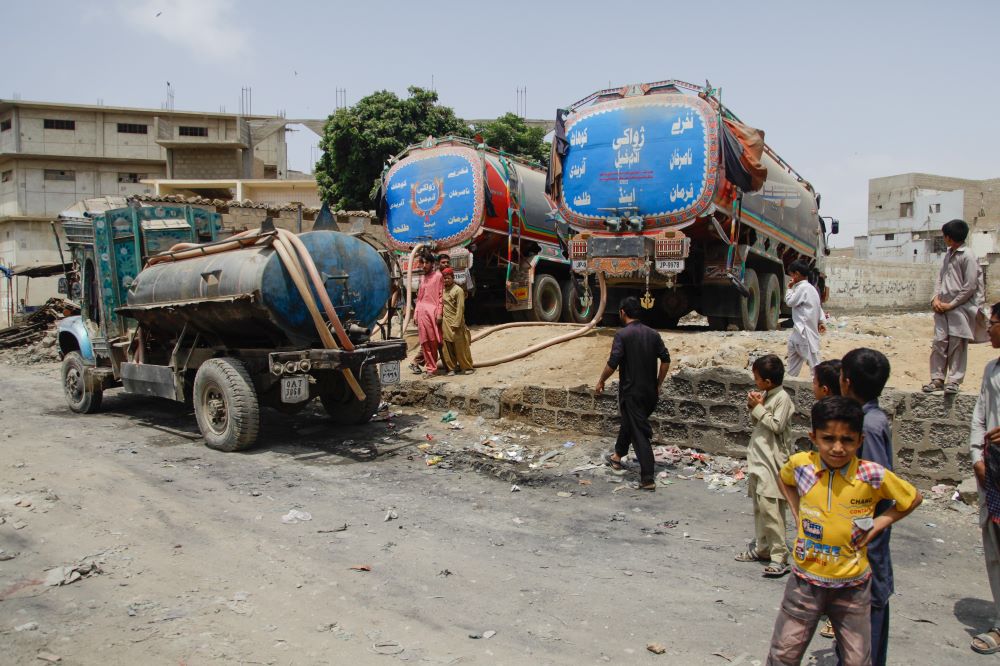
The city depends almost entirely on the Indus River system for its potable supply. Current daily demand exceeds 1,200 million gallons, while actual supply rarely surpasses 600 million gallons. This chronic deficit is filled not by public infrastructure, but by a vast and largely unregulated tanker economy that now functions as a parallel water utility. What began as a temporary coping mechanism has transformed into a permanent system of dependence — costly, unsafe, socially unequal, and strategically dangerous.
This article presents a comprehensive policy analysis of Karachi’s water crisis, with a specific focus on Clifton and Defence Housing Authority (DHA) areas. It examines the environmental, health, governance, and security dimensions of the problem, evaluates the tanker-based parallel water economy, and argues that seawater desalination must be treated as strategic national infrastructure rather than a municipal option.
A City Surrounded by Contaminated Water
Quantity Crisis vs Quality Crisis
Karachi’s water crisis is not merely a matter of insufficient volume. It is equally a crisis of deteriorating quality. Even where water is available, it is increasingly biologically unsafe and chemically contaminated.
Coastal Pollution and Heavy Metal Contamination
Scientific sampling along Karachi’s coastline and coastal aquifers reveals alarming concentrations of heavy metals, including lead, cadmium, mercury, nickel, and chromium. These pollutants originate from untreated industrial effluents, ship-breaking yards, and the Lyari and Malir rivers, which discharge toxic waste directly into the Arabian Sea. Simultaneously, Karachi releases nearly 500 million gallons of untreated sewage into the sea every day. Large segments of the coastal belt have become biological hazard zones, with extremely high levels of E. coli and other pathogens.
Public Health Implications
Ironically, some of the most severe exposure now occurs in so-called elite localities such as Clifton and DHA, where residents increasingly rely on private bore wells and tanker water sourced from contaminated aquifers. In effect, Karachi is surrounded by water, but almost all of it is structurally unsafe for human consumption.
Unstable water
Karachi’s water situation is dire, with nearly half of the population lacking access to safe drinking water. A staggering 81% of residents rely on purchased water due to widespread contamination, with over 90% of water sources biologically contaminated. This leads to waterborne illnesses like diarrhea, typhoid, and hepatitis, affecting vulnerable populations like women, children, and the elderly ¹ ².
Key Statistics
• Contamination Levels: 93% of Karachi’s water supply is contaminated, with 79.1% of source water and 85.5% of household water contaminated with E. coli.
• Water Scarcity: Karachi faces a daily water shortage of 550 million gallons, with demand at 1,200 million gallons and supply at 650 million gallons.
• Health Risks: Waterborne diseases claim around 50,000 lives annually in Pakistan, with 20,000 children dying in Karachi alone.
• Groundwater Quality: Salinity levels range from 4,000-12,000 PPM, exceeding WHO’s safe limit of 1,000 PPM.
The Karachi Water and Sewerage Corporation (KW&SC) struggles with infrastructure issues, including leakages, illegal connections, and poor maintenance. The city’s water infrastructure is plagued by ageing pipelines and inadequate treatment facilities, water situation is quite concerning. Here’s a comparison of seawater and underground water quality in the area:
Seawater:
• pH: 7.2-7.8
• Salinity: 33-38%
• BOD5: High values, especially in Ghizri creek (306±0.8mg/l) and Hawskbey (1216±7.3mg/l)
• COD: High values, indicating organic pollution
• Heavy metals: Ni > Pb > As
Underground Water:
• 80% of samples contain TDS above 500 ppm, making it saline
• Dominated by HCO3 and Ca-Cl hydrofacies, indicating seawater intrusion
• High levels of Zinc (88% of samples), Iron, and other metals
• Contaminated with coliform bacteria, E. coli, and other pathogens
Water quality is typically described using various parameters, including:
• pH: measures acidity/basicity (scale: 0-14)
• TDS (Total Dissolved Solids): measures dissolved substances (units: ppm or mg/L)
• EC (Electrical Conductivity): measures salinity (units: μS/cm or mS/cm)
• BOD (Biochemical Oxygen Demand): measures organic pollution (units: mg/L)
• Coliform bacteria: measures bacterial contamination (units: CFU/100mL)
Common units for water quality parameters:
• ppm (parts per million) or mg/L (milligrams per liter)
• μS/cm (micro-siemens per centimeter) for EC
• CFU/100mL (colony-forming units per 100 milliliters) for bacteria
Simple Comparison Table
| Feature | Unstable (Surface) Water | Underground (Groundwater) |
| Location | On the surface | Below the ground |
| Reliability | Low (seasonal) | High (year-round) |
| Pollution risk | High | Lower (but possible) |
| Treatment need | High | Moderate |
| Cost of access | Low | Higher (drilling/pumping) |
| Recharge speed | Fast (Rain) | Slow (years/decades) |
The Tanker Economy: A Parallel State
Scale and Structure of the Tanker System
Few urban systems globally are as dependent on private water tankers as Karachi. In many districts, tankers supply 30–40% of total daily consumption.
Financial Burden on Households
While piped water costs a few rupees per thousand gallons, tanker water costs between PKR 1,500 and 3,000. Low-income households spend up to one-quarter of their monthly income on water alone.
Political Economy of Tankers
The tanker system survives through municipal corruption, police protection, and political patronage. In many areas, legal pipelines are deliberately throttled or left unrepaired to maintain artificial scarcity.
Erosion of State Authority
Water has effectively become a controlled commodity governed not by the state but by informal power structures. In this sense, Karachi’s tanker economy represents not just inefficiency but a direct erosion of state authority.
The Hidden Dangers of Karachi’s Tanker System
Public Health Time Bomb
There is no regulatory regime governing tanker water quality. No routine bacterial testing. No sanitation protocols. Medical professionals increasingly link tanker dependence with hepatitis, typhoid, cholera, kidney disorders, and heavy metal poisoning.
Road Safety and Urban Death Toll
Thousands of heavy tankers operate daily on narrow residential roads. Consequences include frequent fatal accidents, destruction of sidewalks and drainage lines, and massive infrastructure damage.
Infrastructure Destruction
Repeated movement of 20–30 ton vehicles causes asphalt deformation, sewer ruptures, and pipeline failures, directly worsening Karachi’s already collapsing urban systems.
Groundwater Collapse and Saltwater Intrusion
Unregulated pumping from illegal bore wells has caused irreversible aquifer depletion and saltwater intrusion, particularly in coastal zones of DHA and Clifton.
Environmental Crime on a Massive Scale
The tanker economy operates without extraction limits, environmental assessments, or pollution liability. It constitutes one of Pakistan’s largest unregulated extractive industries.
Institutional Corrosion
The system survives only through bribery, protection rackets, and political sponsorship, creating a parallel governance structure where water access depends on money rather than citizenship.
Strategic Vulnerability
Any coordinated disruption — protest, conflict, or disaster — can instantly deprive entire districts of water, exposing hospitals, security installations, and emergency services.
The Tanker Water Economy: Comparative Analysis
| Parameter | Piped Supply | Tanker Supply |
| Cost per 1,000 gallons | PKR 5–15 | PKR 1,500–3,000 |
| Quality control | Regulated | None |
| Sustainability | Medium | Zero |
Hidden national losses exceed PKR 200–300 billion annually, excluding loss of life and disability.
Why Tankers Cannot Be Reformed
Tankers cannot be fixed. They can only be phased out and eliminated. They are not scalable, not safe, not sustainable, and not governable. Every desalination plant removes thousands of tankers from the road — saving lives, money, groundwater, and institutional credibility simultaneously.
Why Clifton and DHA Matter Strategically
Demographic and Geographic Rationale
Clifton and DHA combine direct coastal access, high population density, strong payment capacity, and existing security infrastructure.
Water Demand Profile
Together, they house approximately 1.5–2 million people, with a daily potable demand of 50–80 million gallons — ideal for pilot desalination projects.
Seawater Desalination as Strategic Infrastructure
Technology Model
Reverse Osmosis (RO) systems remove salts, heavy metals, pathogens, and microplastics, producing WHO grade drinking water.
Strategic Benefits
• Public Health:
Reduction in disease burden and healthcare costs.
• Economic Impact:
Elimination of tanker monopoly, lower household costs, increased property value.
• National Security: Urban water security is now globally recognized as a non-traditional security threat.
Limitations and Real-World Constraints of Desalination
• High Capital and Operational Costs: A 25–50 MGD plant costs USD 70–180 million
• Energy Dependency: A 50 MGD plant requires up to 30 MW continuous power.
• Environmental Risks: Brine disposal threatens marine ecosystems without proper diffusers.
• Governance Risks: Without independent regulation, even world-class plants can collapse.
Desalination: From Option to Strategic Infrastructure
Globally, countries like Israel, Saudi Arabia, and Singapore now derive large portions of their water from desalination. For Karachi, it must be treated as core national infrastructure.
A Practical Path Forward
• Phase One: Pilot (Years 1–2): One 10–15 MGD plant for Clifton–DHA.
• Phase Two: Urban Scale (Years 3–5): Two 25– 40 MGD plants.
• Phase Three: Megacity Integration (Years 6–10): Total capacity of 200–250 MGD.
The Real Resistance Will Be Political
The greatest threat is not cost , it is vested interest. Tanker mafias and informal power networks will resist through legal obstruction, media pressure, and administrative sabotage.
International Case Lessons
• Israel: Centralized national water authority.
• Saudi Arabia: Largest desalination capacity globally.
• Singapore: “Four National Taps” model.
• Key lesson: Technology works only when governance works.
Conclusion
Karachi’s water crisis is no longer an engineering problem. It is a state capacity problem. A nuclear armed megacity with unlimited seawater, proven technology, and massive private capital should not rely on rusted tankers and contaminated bore wells for survival. For Clifton and DHA, seawater desalination is not a lifestyle upgrade, it is the last realistic line of defense against urban decay and for Pakistan, and the lesson is stark. Any megacity that cannot provide clean drinking water despite having every natural and technological advantage is already facing a deeper crisis of governance, one that no amount of rhetoric can hide.