DAVOS, Switzerland, January 21, 2026
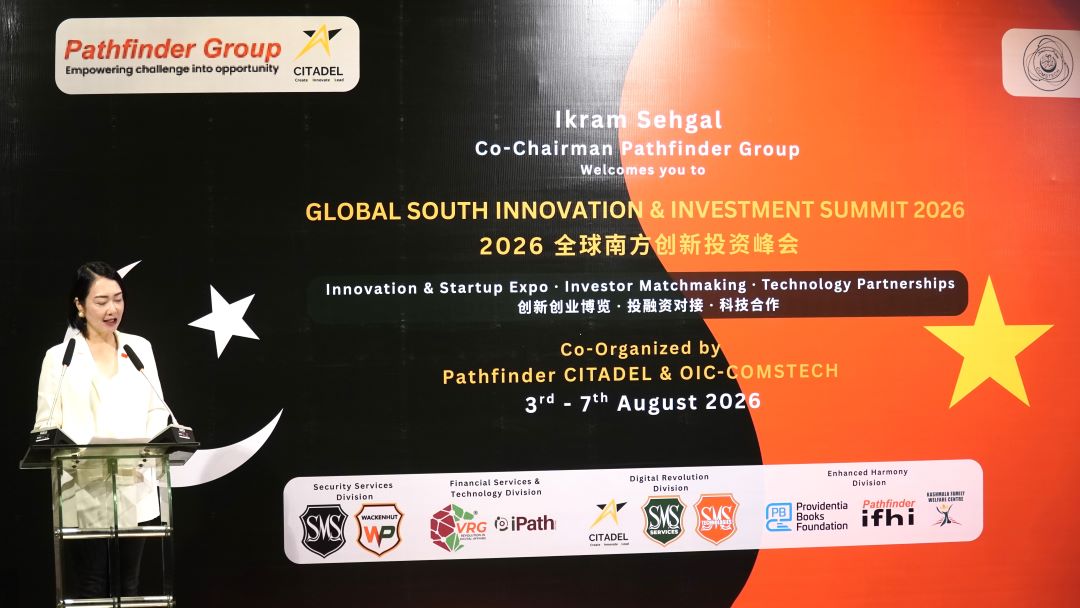
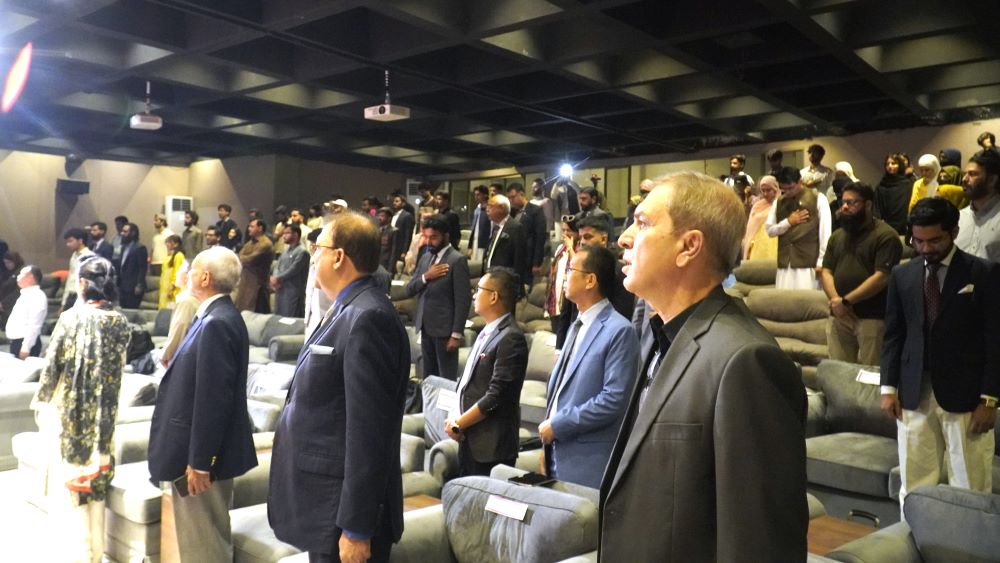
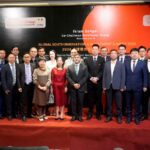
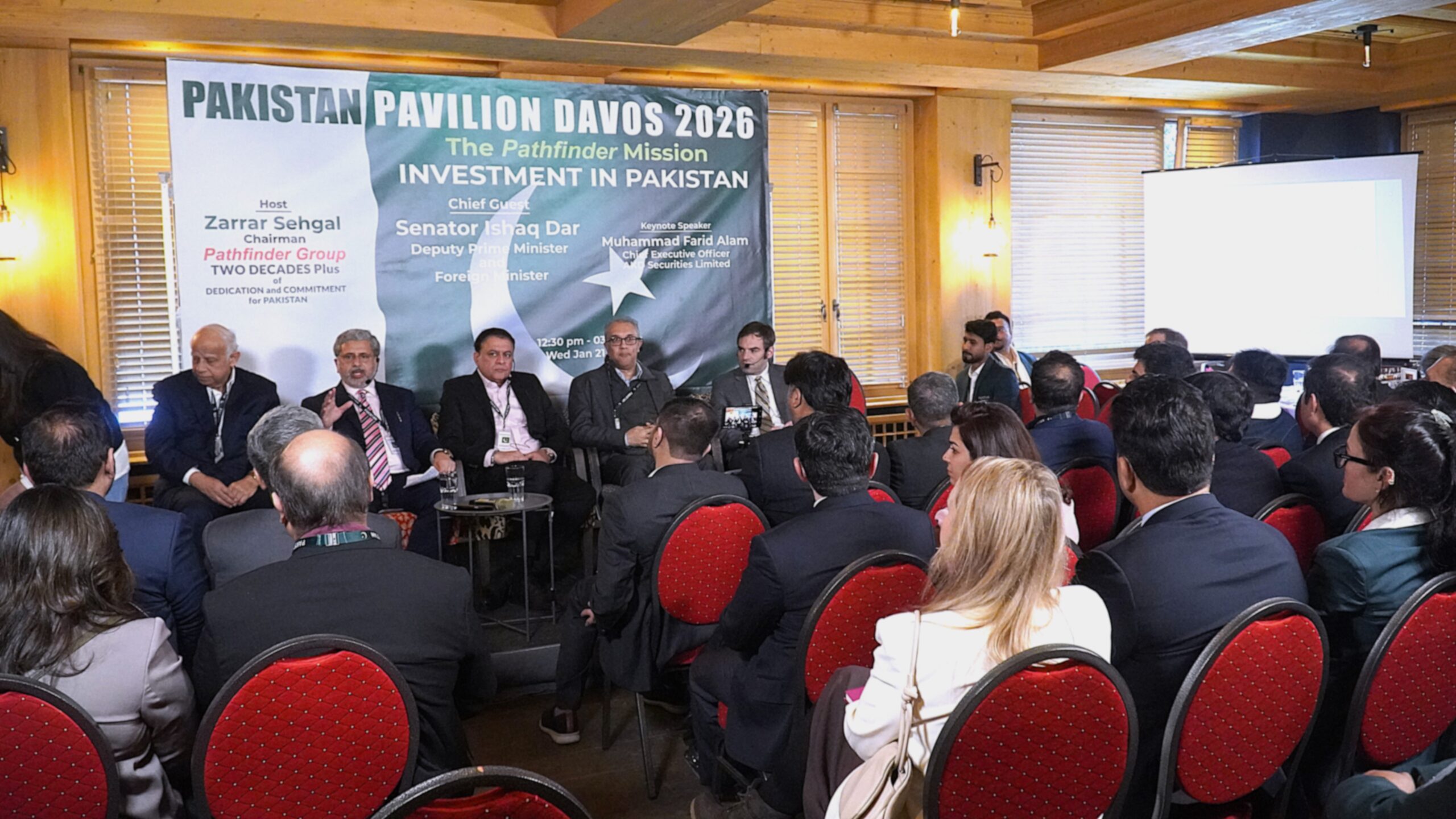
Pathfinder Group hosted the “INVESTMENT IN PAKISTAN” at the PAKISTAN PAVILION during the World Economic Forum (WEF) Annual Meeting in DAVOS 2026 on Wednesday, January 21, 2026, from 12:30 pm to 03:00 pm. Held at the Morosani Posthotel, the exclusive luncheon brought together global policymakers, business leaders, academics, investors and thought leaders to engage in a dialogue on Pakistan’s evolving economic, strategic, and innovation landscape.
Ikram Sehgal, Co-Chairman, Pathfinder Group
I would let the keynote speaker Farid Alam moderate the session as well.
Muhammad Farid Alam,
CEO AKD Securities Limited (Moderator)
Respected Ikram Sehgal, Sehgal family, my colleagues here – Assalam-u-alaikum and a very good afternoon. This is now the THIRD SESSION, you must be feeling the fatigue of DAVOS. In our school and college life, we studied the laws of motion. One of them, the law of inertia, says that a body at rest will remain at rest, and a body in motion will continue its motion until an external force is applied. To me, Ikram Sehgal is that force which has truly gathered us all here. He has enabled Pakistan to reach a stage where we should be opening our wings.
Whoever has the capacity and capability should go around the world and showcase Pakistan – his own company, his exposure, and the things he can do better by bringing somebody over or by selling whatever he has to offer. I believe this two-way traffic is very important. Each time I am here, a lot of energy is created. But sometimes, as science says, energy can neither be created nor destroyed; it only changes its form from one to another. In the case of Pakistani entrepreneurs, leaders, and thought providers, this energy is sometimes lacking. People like Ikram Sehgal are doing a great service to humanity, to Pakistanis, and to everybody by bringing us all together. He has given us this platform to discuss people who truly matter and who have already shown grace and risen. My topic today is something very close to my heart as an investment banker representing Pakistan’s capital markets. I am passionate about investing in Pakistan. My next few minutes will be confined not only to the listed space but also to private equity, which will be covered in more detail by my colleague and friend Sameer Chishty, because he has a lot of activity taking place in Pakistan – not only through the listed space, but in the private space as well. As we discussed earlier, Dr Urs Lustenberger said Pakistan is a resilient state. As a Pakistani, I felt pride in that statement, instead of hearing the usual words like “potential.” My colleague Huma Baqai also said: Don’t limit yourself to these words like ‘potential.’ She said, “Go beyond the potential.” And she is absolutely right. So, my answer to that is: in Pakistan, resilience is not taught – it is inherited. Whoever is in Pakistan, and I see the youngsters sitting here, that resilience is something reflective in everything we do. Since I represent the capital markets of Pakistan, I often take entrepreneurs, the shining ones, abroad and invite international fund managers to visit Pakistan. This two-way traffic has been going on for many years. I myself have been to about 31 countries, and my friend sitting here, Ali Fareed Khawaja, along with many others, has shown the world, even to the Black Rocks of the world, what Pakistan’s capital market is all about. We have had every top-notch investor and fund manager visit or invest in Pakistan. Yes, it is true that presently many of us really want them to return, and there is no reason why they should not. As I will show in the presentations and the talk we are carrying on today, what somebody who is looking to invest in Pakistan values most is exchange rate stability. The fact is that in Pakistan, the investor class have made money. But foreigners, because of the PKR-Dollar parity changes, often did not end up making money. They used to earn capital gains, but on the dollar side, their profits were halved or sometimes wiped out. For the last three years, however, due to reforms that I will highlight, and which you already know have taken place, the PKR versus Dollar has remained quite stable for two and a half years. How we have been able to achieve this is a long debate, but suffice it to say, Pakistan today is not what it was, especially when it comes to investing. My foreign friends are no longer turning away from Pakistan and the emerging or frontier markets, because their own countries were giving them good returns. They ask me, “Farid, why Pakistan?” And I counter-question them: “Why not Pakistan? You have had an interest in Pakistan before, and you will obviously be coming back.” But, as I said, it is not only the listed space that I want to talk about today; it goes beyond that as well.
In Pakistan, what has happened is that we are now back to CPEC Phase 2 and ML-1 projects. The financial close for Republic projects is around the corner. In the morning, the worthy finance minister said it is just being delayed because of one reason, but all the homework has been done.
In Pakistan, assets – both real estate and stocks – are still trading below book value. Some of them have been undervalued for the last couple of years. Representing the capital market, I understand what it means when we say: “Whoever has survived the storm has learned the art of making money in the stock market.”
It is said that if you can bear one or two of the onslaughts, the highs and lows, then you are in for success. For example, in July 2023, the Karachi Stock Exchange index was 39,000.
Today, it is 189,000. The good part is that one of the ratios we use in the financial market is the price-to-earnings ratio. We take price in the numerator, earnings in the denominator, and whatever comes is called the multiple.
Just imagine: a company priced at 100 rupees and earning 10 rupees. The multiple would be 100 divided by 10, which is 10. I have traded and worked for a bank, which is now Samba Bank, formerly Crescent Bank. At that time, the index was 765, let’s say 800, or for argument’s sake, 1,000. From an index of 1,000, today the market is at 189,000.
So just try to grasp what has happened to Pakistan’s economy over the years. Ideally, if the denominator (earnings) were to go haywire, the multiple would be affected. But I am saying the price-to-earnings multiple continues to remain the same. In fact, it is low, 8.5 times right now, whereas we have traded at 11 times and even 13 times multiples. What has happened is that over all these years, despite the odds, high inflation, high interest rates, high electricity costs, etc., the multiple is still not at the level we achieved in 2017. Earnings have grown to such a level that a share that was first at 100 rupees with earnings of 10 rupees is now priced at 1,500 rupees, with earnings of 150 rupees or more. So only then do we get that denominator, and when we divide, it comes to the same number. Otherwise, it would not count. This is simple mathematics: in Pakistan, earnings have grown so much that the price-to-earnings multiple continues to remain safe. In fact, it is lower than what we achieved earlier. We also reached something like 99 billion dollars in market capitalization. Although the market has performed very well – the index has risen from 39,000 to 189,000 – the price-to-earnings multiple is still only 8.5.
At the Karachi Stock Exchange, and among many who closely watch this market, it is expected that even this year, we will see a rise of 53% in local bourses. To me, the risk we carried for so long was the absence of reform. The good news is that in Pakistan, reforms are happening, and happening at the right pace.
Pakistan had a reform agenda in gas, power, and privatization, and these reforms are paving the way for smoother sailing for investors. As we all know, the greatest asset of Pakistan is its people. I am deeply touched when I see people with lesser means smiling and remaining content even when circumstances are not kind to them. That Shukar Alhamdulillah concept is powerful. Sometimes people get carried away with contentment, but those who truly feel what this nation gives them understand its value. I would also like to acknowledge the vision of Mr Ikram Sehgal, the Sehgal family, and their able team for showcasing these youngsters at DAVOS.
I believe this is something they will remember for the rest of their lives. The FORUM you have provided them at such a young age is invaluable. In Pakistan, we do not suffer from a lack of ideas. What we lack is the scale of capital required for youngsters and others to grow. You will also know that fintech adoption, digital banking, freelance exports, IT services, and e-commerce penetration are all on the rise, even though e-commerce is still at a nascent stage. Pakistan is like my friend who once said, “I will not learn how to ride a bicycle or a motorbike. Whenever God gives me, I will drive a car.” His confidence was rewarded – God gave him the car at an early age.
Similarly, Pakistan leapfrogged from landlines straight to mobile phones. Even domestic workers now know how to use smartphones, and this has transformed their lives.
I am thrilled to see youngsters here who are working on AI-enabled services in education, health technology, and more. We should also not overlook agricultural technology. There is a company called Agri Tech. Every time someone asks me, “Farid, are you interested in Agri Tech?” I reply, “No, the share price has gone very high.” But I am not referring to the company’s stock; I am referring to agriculture technology itself. There was a time when Pakistan had very small land holdings. Today, we are looking for larger land holdings with the idea of exporting not just raw produce but value-added products.
Agri-business has immense potential for investment in Pakistan, but it requires food processing, controlled atmosphere storage, cold chain logistics, smart irrigation, halal food exports, and even halal tourism.
Last year, I learned about halal tourism at an international conference. I was surprised to see that many hotels around the world now advertise themselves as “halal hotels.” This is a new market opportunity. When I discuss investment, it is obviously both private and public.
Ladies and gentlemen, Pakistan is passing through a transition in energy. We all know that three things have haunted investors and the investment climate in Pakistan: high interest rates, high energy costs, and super tax. Two of these issues have been settled; the third, the super tax and taxation, still exists. I keep reminding Finance Minister Aurangzeb SB, and I am glad that he usually agrees, though he says it will be addressed in the budget. If the government provides a framework on how and when to reduce the super tax, many companies currently sitting on the sidelines will come forward to be listed. Once you are listed, you must behave and be disciplined. But many companies hesitate, saying,
“If we list and start behaving, while our competitors do not, we will be out of the market.”
The good news is that due to tax reforms, there is now no escape. Agricultural income is also taxed. People used to say, “We earned this luxury from agriculture.” But now that too is taxed. The chain is such that if you are spending, and God forbid it is bad or forgotten money, sooner or later you will be caught.
Another piece of good news relates to energy costs. We all know that in Pakistan, the per-unit cost of electricity is high. But recently, K-Electric floated an international tender to produce 240 megawatts of electricity. To my utmost surprise, this contract was won by a Canadian firm called JCM, five investment bankers, at 3.1 cents per kilowatt hour, which is about 9 rupees per kilowatt hour. This is among the lowest rates in the world. Yes, Pakistan has skeletons in the cupboard, but new entrepreneurs and people who matter are now in a position to compete with the best in the world. For example, at Dhabeji, we now have wind and solar combined in a hybrid model. The 240 megawatts will go to K-Electric because it was their tender. But at 3.1 cents, even crypto miners say this is ideal energy, because energy is what they need most.
So, this is how we have achieved some of the things I have discussed. How have we been able to achieve stability in the exchange rate? This is something you can verify – the market rate is now a very tight belt. Pakistan’s foreign exchange reserves have increased to $16 billion, up from a low of $3 billion. Let me also remind you that Pakistan’s external debt is now under control. We owe $80 billion to the world, and this is after paying $24 billion in the current year. So, Pakistan’s balance of payments position is quite stable right now.
This is what it takes for anybody to truly understand Pakistan’s potential. Given our geographical positioning, Pakistan is a bridge between Central Asia, China, the Middle East, and South Asia. Hence, investment combined with technology is required in logistics. As I explained earlier in the case of agriculture, both locally and regionally, efficient logistics, supply chains, port operations, and trade facilitation are critical. A great deal of know-how and capital is required if we are to play the role the world expects of us. People often say geography is destiny, and Pakistan is situated at a crossroads of the world. The world cannot ignore this, and I completely agree with those who make this point.
There is more good news. In May 2025, Pakistan entered the League of Nations with a GDP of over $400 billion. Taxation has also improved significantly. The Federal Board of Revenue (FBR), which used to collect 7 trillion rupees, now collects 13.5 trillion – doubling in just three years. Many people say that every time we set a target for the FBR, it is not met. But I remind them that even if the target is missed by 5–10%, doubling revenue in less than three years is a remarkable achievement.
In Pakistan, we have been taught by our parents and elders that aiming low is a crime. So, the FBR and authorities set ambitious targets. Even if they fall slightly short, achieving 13 trillion plus is still a great number. We also know that smart capital does not arrive at the peak of comfort. It arrives at the bottom of conviction.
Many of us are convinced today that Pakistan offers exactly what smart capital seeks: a young and dynamic population, scale, reform momentum, and valuations that reward courageous investors.
In every field, Pakistan is now excelling. Beyond May 10th, wherever we go in the world as Pakistanis, we are recognized more positively than before. So, due to time constraints, I will conclude with this message to international investors: when you invest in Pakistan, remember that you are partnering with a nation that has refused to give up. We can bend, but we cannot be broken. This is something we all carry in our lives as Pakistanis – as a nation, we cannot be broken.
As Allama Iqbal once said:
“Batil se dabne walay aye asman nahi hum, So bar kar chuka hai to imtihan hamara.”
Translation:
We are not the ones to be suppressed by falsehood/wrong. We have been AVE tested a hundred times already.
To me, Pakistan is an uncut diamond – raw, resilient, and ready to shine. Thank you very much. I would like to request Michael Kugelman to kindly share his thoughts on the given topic: what Pakistan’s economy is today, how he viewed it a year or two ago, and what we can expect from Pakistan’s economy in the near future – not in the distant horizon, but within the next year or two.
Michael Kugelman,
Senior Fellow for South Asia, The Atlantic Council
It is always an honor to be here, and I thank my friend Ikram Sehgal for including me in this discussion.
As I mentioned yesterday, Pakistan tends to defy the odds. There have been several times in recent years when there was strong fear and expectation that Pakistan’s economy was going to collapse. Just a few years ago, as the Prime Minister himself said earlier this morning, there was a very real concern that Pakistan would default on its loans – and yet, that did not happen.
So, to answer the first part of your question: Pakistan’s macroeconomy has stabilized significantly. You laid out the facts, and we know them all. Foreign reserves are in a better place, and inflation is down. But at the same time, it is important to acknowledge that macroeconomic stabilization does not equate to microeconomic stabilization.
There are continued levels of economic stress for many across Pakistan. Recent data on household income shows that people are not spending as much on food as they used to, simply because they cannot afford it. Food insecurity is a very real issue.
Poverty rates remain significant and problematic. Keeping this broader view in mind is very important. In terms of the future, I find it encouraging that the current government is committed to reforms. I have been studying Pakistan for 20 years, and I feel that every government says it is committed to reforms, but often, if not always, they fall short. So, it is promising that this government appears serious.
The privatization of PIA was a landmark, even though it is just one case. Privatization has been a priority for quite some time, and key donors like the IMF have been pushing for it. So, this is significant, but it is only a start. Hopefully, we will see more of that.
Let me end with a broader comment on geopolitics, because that is my area of study. There has been a lot of talk over the last year about how Pakistan has enjoyed a resurgence, becoming more present and prominent on the global stage. This is true. But to maintain that level of influence globally, Pakistan must ensure sustained, long-term growth.
That is why all this discussion about reforms and the economy is so critical. You do not need significant military power to be a regional power; economic strength alone can achieve that. The UAE, Singapore, and even Bangladesh, to some extents are examples. But if you do not experience sustained growth, if you do not have core exports that are competitive globally, it will be difficult to maintain global significance.
So, I hope for Pakistan’s sake that it can maintain this momentum toward reforms, and that soon enough we will see sustained growth. That will enable Pakistan to be more present and prominent geopolitically, while also strengthening itself at home.
Muhammad Farid Alam,
CEO AKD Securities Limited (Moderator)
You have touched upon something important. Right now, Pakistan is perhaps doing things rightly. But what is it that we must constantly do to maintain the upper edge we are currently enjoying, even without tangible investments coming our way?
We are in discussions about capital markets, and we are planning to move back to emerging market status from frontier market status, because we have behaved well in the last couple of years.
So, I would like you to kindly answer in two terms:
● one from the perspective of capital markets,
● and the other from the perspective of private equity.
Michael Kugelman,
Senior Fellow for South Asia, The Atlantic Council
Since I am not an economist, I will answer your question more broadly. There is still a lot that Pakistan needs to do. I was not suggesting that the country is 100% on the right path. In fact, it is quite clear, and we should be candid about this, sometimes the lights don’t stay on. Basic issues like this are critical when it comes to thinking about long-term growth. One does not want to put the cart before the horse, so to speak.
For sure, Pakistan is not experiencing the kind of energy crisis it faced in previous years, but the challenge is still very real. In terms of what could be done better, let me return to geopolitics. Pakistan understandably seeks more foreign direct investment (FDI) from key donors, particularly those far afield, such as the United States. There is momentum to attract investment from the U.S. as well as the Middle East. But I would argue that Pakistan also has an opportunity to work more closely with its immediate neighbors. It may sound strange to say this, given the India-Pakistan problem, but there are opportunities to partner economically with other South Asian countries. For example, based on recent changes in Bangladesh, there is now trade happening between Bangladesh and Pakistan for the first time. Pakistan also has a long-standing friendship with Sri Lanka. While Pakistan does not have deep relations with every country in the region, it also does not have strained relations with any of them, aside from India. There is something to be said for defining investment broadly, not just in terms of securing capital from outside, but also investing time in dialogue with neighbors. Not necessarily India, but other neighbors, to discuss shared challenges. Pakistan faces many significant challenges that are also shared by its neighbors – whether we are talking about climate change, connectivity, or public health. Promoting dialogue to tackle these shared challenges and sharing best practices can bolster Pakistan’s capacity to address them. These issues certainly tie into economic concerns, especially climate change risks. So, I will leave you with that thought.
Muhammad Farid Alam,
CEO AKD Securities Limited (Moderator)
So, coming to Sameer, because this topic naturally flows to you.Pakistan right now does not have a balance of payments crisis, and politically, the regime is doing better. How has this given you the comfort to pursue private equity at the scale you are doing? What has been your experience in investing in Pakistan?
Because, as I said, smart money can move to any part of the world. Yet you deliberately chose to invest in Pakistan, and you have been investing quite a lot for quite several years now. What is your take on the decisions you made in the past, and how do you view them today?
Sameer Chishty,
Executive Chairman, Asia-Pak Investments
First of all, I dare not talk about macro strategy with everybody sitting in the room; frankly, you are better off asking Michael about that. I will give you a personal view and share our proprietary investment philosophy. We have enjoyed Pakistan and benefited from Pakistan. Let me start with the negatives. It hasn’t been easy. The ease of doing business is still not where we would want it to be. Second, promised reforms take too long, but they do happen eventually. This is why this morning’s conviction statements by the finance minister, prime minister, and deputy prime minister gave us a lot of confidence. From private interactions we have had in Islamabad, we believe we are finally on track for long-awaited reforms that will dramatically change the dynamics, lower our risk premium, and improve our returns and investment duration. The real issue has not been policy itself, but U-turns on policy or failure to implement policy. Someone as smart as Michael can provide a proper study on this, but our focus is simple: whatever you decide, just go do it.
We were fortunate enough to spend a session with the Chinese Politburo; we do that every few years. They said one thing: if they had one piece of advice to give to the prime minister of Pakistan, it would be, “Just don’t change your mind, even if you think the decision was wrong. Stick with it. Because if you change your mind once, people will come at you for everything you do. So just do it. What’s the worst that can happen?” That is our fundamental view.
Nevertheless, we do think there are still opportunities in Pakistan, certainly in the private markets. Most of the economy is in private markets, not in public markets. We don’t think Pakistan’s assets are priced properly, which creates a great pricing arbitrage. We also think Pakistani companies generate cash — they throw off earnings. While those earnings don’t always get rewarded in the market for other reasons, if you like cash, this is a good place to own assets.
Frankly, what we do is not complicated. It’s not rocket science. It’s your classic middle-market private equity play: buy underperforming companies, buy companies that need better management, sharper strategy, more efficient capital structures, and then do some neat things with technology and distribution.
The complicated part is not the strategy, but it’s the execution. One of our mantras is “do less.” It may sound strange coming from a McKinsey guy, since McKinsey always comes up with giant strategies. But our view at Asia-Pak is: do less, because everything is really hard. Everything hard takes a long time. The entrepreneurs in this room are nodding their heads – they know the difference between doing two things and three things is not linear, it’s exponential. It becomes exponentially harder. So, our approach has been to do less and make that happen. Looking forward, we are still optimistic. We are always optimistic. That is one of the curses of being an entrepreneur; you are hit with the optimism stick. So, we are even more optimistic now, certainly in policy and macroeconomics. I am not a geopolitical analyst; I won’t pretend to be one, but I do feel a temperature change. When I speak to larger private equity investors in the U.S. and Canada, like retirement funds in Canada or European Union funds, the conversations feel different. They don’t start from a place of skepticism anymore.
Muhammad Farid Alam,
CEO AKD Securities Limited (Moderator)
While you invest in Pakistan or elsewhere, do you invest in companies with tangible assets and infrastructure, or do you also invest in technology-driven ventures? Do you mix your capital between fixed assets and technology?
Sameer Chishty,
Executive Chairman, Asia-Pak Investments
That’s a great question. Honestly, I haven’t thought about it in strict categories. What we have done effectively, and perhaps we should have thought about this more, is focus on underperforming assets where there is a lot to do. Unfortunately, Pakistan does not develop, own, and scale technology often enough. While we may develop it, we don’t scale it. Often, we import technology and distribute it. I recall attending a Future Investment Initiative (FII) event where one of the leading speakers said,
“We don’t develop technology, we distribute it.” My immediate thought was: “You should come to Pakistan!” Because here, there is so much more to do in actually owning and developing technology. That is where fundamental capital formation happens – when you own and develop technologies yourself.
Muhammad Farid Alam,
CEO AKD Securities Limited (Moderator)
Abu Bakar, coming to you. Pakistan seems to be adopting new technologies very quickly. It is our habit, as I said earlier, to leapfrog: from landlines straight to smartphones, and from bank branches to digital payment systems. In your space, we now have digital banks, EMI wallets, and other innovations. Developed countries are only now catching up in terms of the adoption of digital banking and payment solutions. Do you think Pakistani youth have played a role in this rapid adoption, or is it simply the need of the hour to move away from branch banking? How will this change affect us going forward?
Abu Bakar,
Former Chief Executive Officer, Pakistan Software Export Board
First of all, thank you for having us, and thank you, Mr Ikram Sehgal, for the opportunity. This is my second time here. Last time I was here, I highlighted the 22 years of service you have given to the nation truly commendable, and done independently. You are a true example of dedication. Let me broaden the discussion beyond fintech. The tech market in Pakistan is booming, and we need to believe in it. By way of background, I spent 35 years in the U.S. — studied there, worked in private equity, venture capital, and across different sectors. Then I moved to Pakistan for 13 months to lead the Pakistan Software Export Board, the prime entity responsible for the tech industry and exports.
The numbers you heard earlier show that we are growing, and the reason is that we are finally getting some things right. The biggest hurdles for Pakistan have been perception, geopolitical risks, and insufficient focus on bringing youth into mainstream markets. These were fundamental issues. But in the last year or two, I have seen a fundamental shift – in tone, language, and reception. Incoming queries have changed dramatically. The campaign “Pakistan Now” is a call to action. If you have not realized what has happened in the last six months, you must. The seat at the table is there for us, but it has a short shelf life. If we do not use it, we will lose it again. That is the lesson we must learn.
I am very optimistic after working for almost a year with the youth. Our biggest asset and opportunity is our youth – incredibly talented, connected, savvy, and entrepreneurial. Someone asked me to describe the nation in one word. My answer: resilient. Throw whatever you want at Pakistanis – even if you don’t give them internet, they will figure out how to export. They are the most resilient people in the world. This resilience comes from creativity born of limited opportunities. I grew up in Karachi for the first 20 years, then moved to the U.S. from a humble background. I did not attend elite schools, but I learned to figure out solutions for everything. That resilience is what propels our nation forward. Now, to another point: as Sameer said, we are doing well, but not great. We must be conscious of this. Our potential is far bigger than what we are achieving. We focus on services – delivering talent, outsourcing – but the next level will come when we create our own products and technologies.
Our biggest IT companies are still not billion-dollar firms because they remain service-based. Service businesses will only get tougher. We have been discussing with decision-makers how to foster entrepreneurs who can develop world-class products on a global scale. This needs to be ten times more than what we are doing today.
For entrepreneurs and startups here, you are the luckiest generation. This is the best time to pitch globally. Ten years ago, even two years ago, I could not say openly that I was from Pakistan. My shop was in India, my front office in the U.S., and people were afraid to admit that they had a back office in Pakistan. Now, you can boldly say: “My back office is in Pakistan.” The same Pakistan that now has credibility in cyberspace and technology. We have shown the world that we are better than many others, and we have proven it.
Now is the time to be confident, to think big, and to go all in. Exports are growing, and the ecosystem is expanding. But our problem is not policy, not reports, not skills. Our problem is execution. I went into the offices and asked, “Why don’t we do this?” The answer: “Oh yes, we have a study for that.” But nothing happened. Execution is our weakness. We have tremendous ingredients, raw materials, talent, and opportunities. Internally, we can do so much. Externally, we can do even more. We just need to figure out how to execute better and at scale.
Muhammad Farid Alam,
CEO AKD Securities Limited (Moderator)
Many of us, including myself and the youngsters here, may not have inherited great fortunes, but our parents educated us. That is perhaps the best gift to impart to your children. One thing Pakistan is now doing rightly is focusing on non-traditional exports. Beyond textiles, which remain important, we are exporting technology. Post–May 10, exports of products like the JF-17 Thunder and IT services have grown to over $13.5 billion, with inquiries far exceeding current capacity. Our acceleration as a nation is rapid. The question is: in the Pakistan of tomorrow, will success be led by technology, or by traditional industries complemented with technology? I would like Michael to reflect on this philosophical question.
Michael Kugelman,
Senior Fellow for South Asia, The Atlantic Council
One has to adjust to the times. What drives the global economy today is technology in all its variations. Countries that depend solely on one export eventually struggle. Bangladesh is an example. For years, its Ready-Made Garment (RMG) industry drove growth, but recently its economy has faltered. This shows the need for diversification. Pakistan must continue textiles, but also capitalize on IT, AI, and other exports. The challenge is differentiation. How does Pakistan set itself apart from Singapore, India, and Europe? Economists must answer that.
Sameer Chishty,
Executive Chairman, Asia-Pak Investments
Technology is failing me here, but let me share. Half my life has been as a technology investor. I co-run SparkLabs, the world’s third-largest early-stage tech investor. About 18 months ago, we developed a thesis: the entire world will need its own intelligence. Today, most computing power sits in the U.S. or China. Our thesis, even before Trump’s policies shifted, was that every country would need to own its own data, its own intelligence, its own computing power, and develop its own apps on proprietary data. A nation’s intelligence, put to good use, becomes its economy. This led us to build sovereign AI factories in the middle markets. We are currently building four – two in the Nordics, one in Europe, and one in South Asia.
Abu Bakar,
Former Chief Executive Officer, Pakistan Software Export Board
I think we have said it all, but again, if the question is whether we should invest in the traditional sectors or the new ones, the answer is simple: we should invest in anything that brings money into Pakistan.
However, the focus must be on the new economy, because we need to future-proof ourselves. This is where Pakistan can truly change the world. The biggest appetite, the biggest need, and the greatest value we can offer in five years may not be textiles. Absolutely not. It will be talent and intelligence – and that is what we have. We need to groom this right now, today. This is the opportunity before us.
Muhammad Farid Alam,
CEO, AKD Securities Limited (Moderator)
The margins in textiles and technology are worlds apart for the country.
Ikram Sehgal,
Co-Chairman, Pathfinder Group
I would like to welcome Dr Sania Nishtar, one of the finest technocrats, both during Musharraf’s government and afterwards, to comment a little bit about investment in Pakistan.
Dr Sania Nishtar,
Chief Executive Officer, Gavi
Thank you very much. First of all, I want to congratulate Mr Ikram Sehgal. For several decades, you have consistently and proactively represented Pakistan here, making Pakistan present in DAVOS. I truly want to commend you for your role. Now, I am the CEO of Gavi, the global vaccine alliance. Unfortunately, I cannot be as present in Pakistan-focused events as I would very much like to be. But I wanted to be here to pay my respect and express my solidarity. This, of course, is our home in DAVOS, and I am delighted to see you all on stage talking about investments in Pakistan.
Pakistan is an amazing destination – a jewel that has not yet been fully discovered. You will find people very proactive and facilitative. There is a government that genuinely wants to facilitate investments. All I can say is that Pakistan is a destination you should prioritize.
Ikram Sehgal,
Co-Chairman, Pathfinder Group
Well said about Pakistan. Dr Sania Nishtar is one of the finest technocrats I have worked with, both in and out of government. She set BISP on the right path, and today, what people are doing in BISP is built on the foundation she laid. I would also like to congratulate our panelists, Farid Alam, Abu Bakar, Sameer and Michael. You gave a broad spectrum of what investment in Pakistan can be today. You are absolutely right: three years ago, when I spoke at think tanks in the U.S. and Europe, I encountered “Pakistan fatigue.” I kept telling them: “You haven’t seen anything yet.” And now, things have changed in the last year. The finance minister is not here, but I must tell you that a lot of work has been done in adhering to promises made. In the past, people used to make promises to the IMF and World Bank, then return and throw the book aside. Now, promises are being adhered to — and it is a difficult process. You could not have a more authentic voice than Farid Alam. Thank you, Farid, for being here. Abu Bakar brings both sides of the story, and Sameer as well – both of them have worked inside and outside Pakistan.
Abu Bakar told me that in one year, he made 17 foreign trips just to promote Pakistan’s software exports. He did a lot of work for the Pakistan Software Export Board. Sameer, of course, has invested directly – putting money where his mouth is, so to speak. I think we have had a terrific session in that sense. Thank you, everybody.