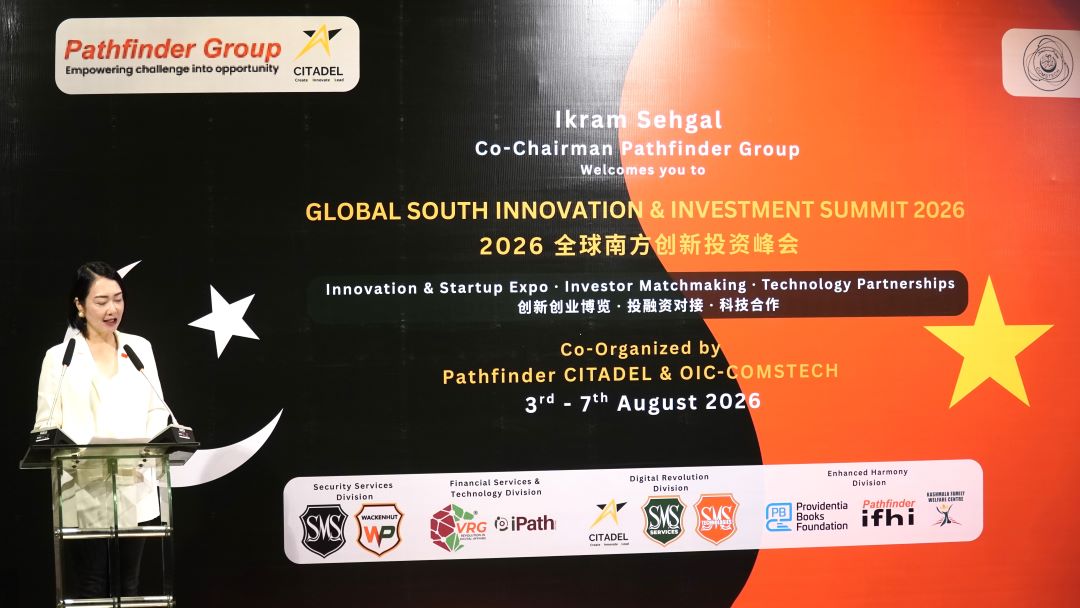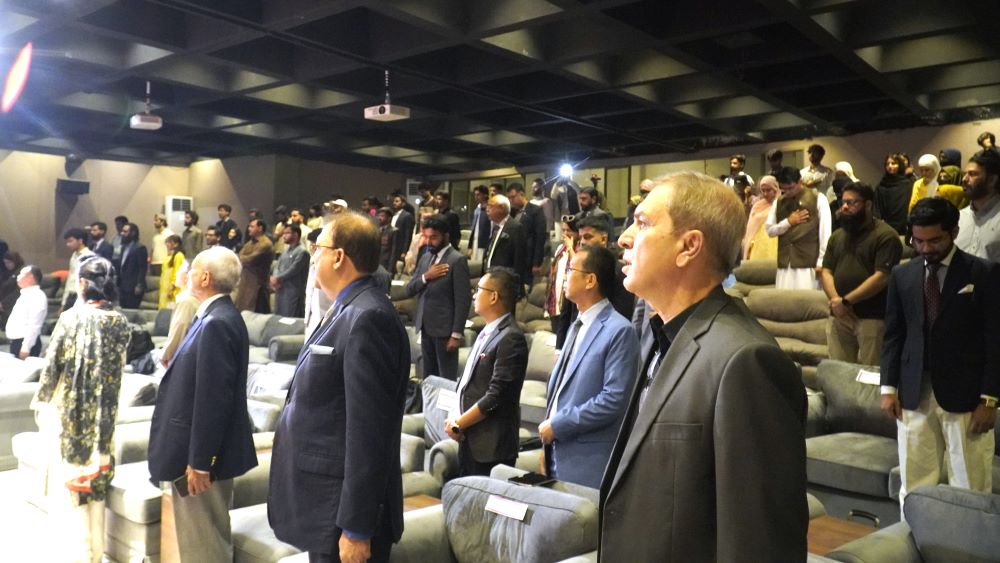

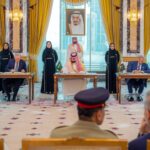

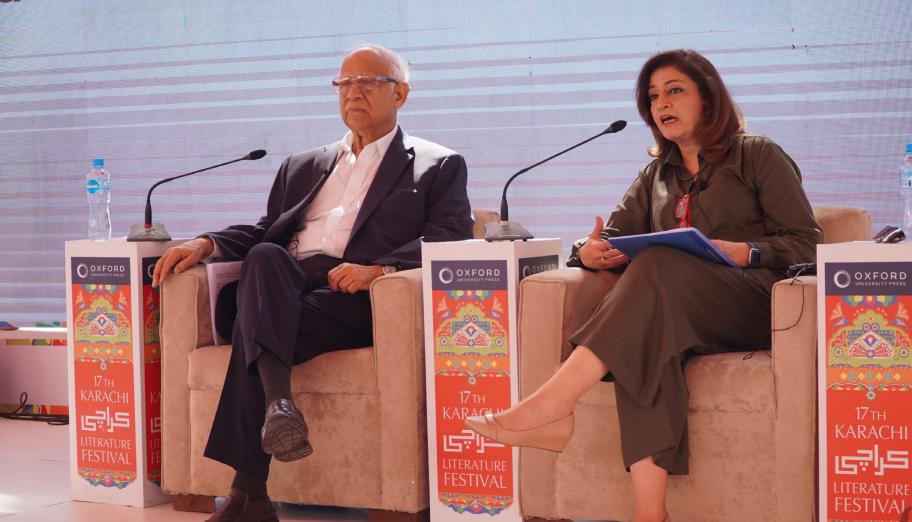
Ikram Sehgal in conversation with Dr Huma Baqai at 17th Karachi Literature Festival (KLF)
In a deep-dive conversation with Dr. Huma Baqai, Rector of the Millennium Institute of Technology and Entrepreneurship (MiTE) about the rapid shift in the geopolitical landscape of the subcontinent. Ikram Sehgal, Co-Chairman Pathfinder Group, addressed a packed audience at the Karachi Literature Festival (KLF) 2026 on the theme “Evolving Power Dynamics in South Asia”.
Dr Huma Baqai
The reason why Power Dynamics in South Asia have become so pertinent is because the world is going through what a lot of people call – almost a rupture. A 40-year-old system has collapsed and a new system is not setting in and we say that the fulcrum of growth is moving from the West to the East, the importance of South Asia is also increasing. If the importance of South Asia is also increasing then of course the two protagonists, i.e. India and Pakistan, determine the direction of South Asia in so many ways. However, there also other very important critical players. I have someone whose looked at these issues for the past 40 years and written books on it. Is a security expert by profession, but is also former military person? He also escaped Indian custody in 1971 and survived it. He flew helicopters during the first part of the 71’ conflict and then in the infantry as a rifle company commander. But that is not just it. This man somewhere along the line, became the face of Pakistan’s international diplomacy and since there are many students sitting here; some of you may not know all this. Many of you must have heard the news and listened to the reports that the World Economic Forum (WEF) had recently concluded. You know that at the World Economic Forum (WEF), the world’s movers and shakers come together and decide how the world will move forward. For the past 22 years, one person and one Group have ensured Pakistan’s presence at this forum. His name is Ikram Sehgal and today he has become the identity of Pakistan there and Pakistan is recognized through him. This time, we had a strong representation and I was also a small part of it. We had the Prime Minister, the Deputy Prime Minister Ishaq Dar Sahib, senators and the next day, Khaqan Abbasi was also present. So, it was completely political and very important for Pakistan. Unfortunately, yesterday we were all a bit saddened as Pakistan witnessed that terror attack in Islamabad. Baluchistan also had some unfortunate reports coming in, which were handled well by our Armed Forces. But when it happened in Islamabad, we were all somewhat shaken.
The question is: What is the landscape of South Asia now? Has Pakistan’s position changed after the conflict with India? Does Pakistan now have a new role in global and regional politics? And along with that, does Pakistan have any strategy to advance in this new role or will it just create hype for a while and then fade away?
Ikram Sehgal
First, I would like you to tell us: I know you are working on a strategy paper. We all know that a dangerous US Strategy paper has come out in which they stated “Make America great at any cost and every cost.” Even though, we are in a good space and have a good relationship with America, but at the same time, we are also part of the discussions happening with Iran.
Does Pakistan have a strategy for what is happening? I think it is safe to say that we really do not have a strategy as yet and I am not surprised because the Americans and the US National Security Strategy which president Trump outlined in November last year just came out; and it is a very important document because it legitimised a lot of things that a lot of western countries and other countries are doing but without spelling it out. Obviously, any national security strategy which works on theory and does not take practice into account is not worth the paper is written on. So, the first time, I commend the US President for legitimizing something which is now a factor which will make sure that any national security strategy takes that into account. Now what are the important things that we know? We knew that Israel used to take action against all the middle eastern countries whether covertly or overtly. We knew that the United States would use gun boat diplomacy whenever it so required just like the British used it earlier. Now all these things were in a grey area. With the strategy that was outlined in November and which was carried out against Venezuela. It legitimized lot of things. So, what did it say? It said that (1) a government that is not really freely elected and (2) a government that may be using drugs in money laundering etc. That is fair game. and with that they actually went into Venezuela and took the president of Venezuela and brought him to United states under US laws. Now that is a factor that is a very clear factor. So, let’s take it into Pakistan’s account. For the last 70 years or so, we have always been reactive. If somebody attacked us in Balakot, we’d go back into action. If somebody came to us at the Army Public School in Peshawar, we went into action. We never had a strategy which really said, “Okay fine, we’ll catch you before you do it”. And I think for the first time, I must commend the Armed Forces when they went after certain militants’ headquarters in Kabul and Kandahar. When they went in with Airforce strikes and drone strikes, they took them out and that should be fair game and should be the underlying thing. As far as India is concerned, at this particular moment, somebody is up there talking about a book called “Shattered Lands” which is a very important book. It is written by Sam Dalrymple. It clearly states that India was not a country in 1947. Around ¾th of India did not belong to India at that time. It came through coercion, it came through force, and it came through self-refuge 615 princely states that had the option to either accede to Pakistan, accede to India or become independent were given no chance. Of course, later on we know the major important ones like Junagadh, Hyderabad and Kashmir, but there were 65 states. Three quarters of India did not form the Indian Union. So the fact of the matter is and particularly and the portion which we now call Assam and the seven sisters Assam included, were not even part of India. So, all these lands remained available and I think the time has now come. If India, for example, I have no doubt in my mind that what is happening in Baluchistan, the BLA, what is happening in TTP, has got a lot of Indian connections behind it. So, what is stopping us now? In fact, most of their leaders say this outright.
Amit Shah and these people say it outright on television. Their generals say, “we will stop the water and we will starve Pakistan and we will make Pakistan dry”.
So, what is stopping us now? Now the US National Strategy document is there on which we should form our national security strategy, that is the thing. That’s why when you asked me this question, I will say that it is a strategy which now must evolve positively.
Dr Huma Baqai
But another question that is very important for Pakistan and that is we are in strategic convergence with China and with America and we are in a very good space at this time. So how will this triangular relationship work out in South Asia? Because in India we are seeing some more developments. You see in India, their own people are saying that it is a lost decade under Modi. But now he is increasing his relations with America. Tariffs fell from 50% to 18% and went into great convergence with Europe. Both in terms of trade and in terms of defence. You said we don’t have a clear strategy right now. So, we don’t have a strategy to capture this particular moment, so whatever is happening till now, is just the Trump moment and the Modi baggage or do you see a better future for Pakistan beyond this?
Ikram Sehgal
Look, your previous strategy was for the obvious reasons that you had so many sanctions placed on you. When you and I used to go to any think tank in the United States and talk, they used to talk to us about the Pakistan fatigue. They didn’t want to hear about Pakistan, right? and May 9th change that. Before that, the world used to accept that India is a regional super power and that there was no comparison to India. After May 9th, that changed. May 9th has shown that it does not depend upon what the amount of your force, but what it depends upon, is the lethality of your force and how you execute that lethality. So, I think that May 9th showed that. If May 9th had not happened then India would have done a lot with us from then until now. From May 7th to May 9th, you could hear their drones roaming here and there. They had even reached Karachi; Multan and they were moving around freely. I mean, they thought they had freedom of action everywhere. Six hours into May 9th taught them. I have been a director of the bank, which was owned primarily by Middle Eastern sources. I stayed there for 16 years, until a few years ago, when I stepped down from the directorship. We were 3 branches and now we have more 1000 branches and the other directors were Arab. When i used to go to them, they would repeatedly say “Ikram, why don’t you accept that India is a dominant power.” So I used to tell them that no, you should not belittle the power of Pakistan. Pakistan’s has its own potential. Pakistan has its own resources. Pakistan is a country that can clothe and feed itself. Pakistan is a country with adequate mineral resources. Pakistan is a country with adequate manpower resources. Right? And Pakistan is a country which is the only Muslim country which has nuclear weapons and the means to deliver these missiles. So please do not ignore that. Sometimes we used to have dinner together and we used to end up watching a Bollywood movie after. In almost one of every three of these Bollywood movies Shahrukh or Ajay Devgan would show up and trap the ISI. Then they would go on to destroy the Pakistan army and then he would go on to kill 100- 200 people. Hence, I told them we should not watch these Bollywood movies. If this is a reality for them then they should send these actors to fight. India’s propaganda is very strong. Don’t take this as a joke. Their propaganda is very strong. These Bollywood movies is their propaganda and is one of their narratives, however, they have started changing that narrative a little bit.
The point is you see why there has been a change by the middle east countries approach towards you?
Earlier they used to have a subservient dealing towards you. Now the change has started. Saudi Arabia has already signed defence agreements with you. Other countries are also ready to work with you. But this has happened because they have realized that Pakistan also has strength. And I tell you confidently, whenever we project Pakistan in DAVOS, we do it for a reason.
Why? Because our children — the population I often talk about Gen Z today, in fact, I see many students here from the universities — they are our future. This is our future and as long as our future exists, no one can touch us. And you will take this country forward. Our time may have passed, but you will take this nation ahead.
Dr Huma Baqai
Having said that, Ikram Sahab, tell us — there is another propaganda in India at this moment. And they are saying that we are doing Sindoor by other means and we are indeed succeeding. They go on to mention Baluchistan as well. I will come back to what happened yesterday in Islamabad and what it was, was an act against humanity.
An Imam Bargah, a mosque and a Friday prayer; these acts cannot be carried out by Muslims. So, tell me, are we defeating ‘Sindoor by other means’ as well, or is it still a challenge for us?
Ikram Sehgal
Look, there are many aspects to fighting terrorism. And in those aspects, it is not just kinetic. Military options alone are not enough. There are many other options like non-military, non-kinetic options that you can use. What I’m going to say is something people often disagree with and are not happy with either. Look, a terrorist emerges with a suicide vest on and he goes to an Imam Bargah and detonates himself. When this terrorist went out, what did he have? He had a suicide jacket and he had explosives. Where did he come out from? He came out from a safe house. In that safe house, the jacket was delivered to him as were the documents for travel. No ordinary person goes into a grocery store and just picks up explosives. They need money for that.
A terrorist does not do this alone; this is an organized crime. Organized crime provides ID cards, passports, transportation and safe houses. They handle all these things. And organized crime does this for money. Where does the money come from? It comes through money laundering. The easiest way to launder money is through foreign exchange dealers. Now, in Pakistan, where tourism is limited or almost non-existent, why do you need foreign exchange dealers? Every bank has foreign exchange department. If you need foreign exchange, you can go to the bank and get it legally. But foreign exchange dealers operate with almost complete freedom. Out of say 100 dealers, 10-15 may be digital or regulated, but 85-90 are the ones who can move money for you in illegal ways. Let me give you a practical example: If you close all foreign exchange dealers today, it will not make much difference. Perhaps inward foreign exchange will reduce for one or two months, but eventually, people will find other ways to send money for their parents, for their wives, for their children through the banks. Everything will be legitimate. So why can’t money laundering be stopped? Because their lobby is so powerful that they protect this system. Money laundering will not end until foreign exchange dealers are shut down. And there is no need for foreign exchange dealers, no need at all. Every bank has foreign exchange counters, you can exchange your money at the foreign exchange counter and they can process your money. So, the action to curb money laundering has to be military, and if you look at the last two days, the military has handled some of these countermeasures well. But the action was only against those they could trace immediately. They could not reach the origin points where the money came from. There are two ways to address this: (1) Trace the flow of money from the source and (2) Legitimizing funds across borders wherever possible and take action.
Dr Huma Baqai
Another critical factor is digitalization of the economy. If this is done properly, the situation will improve. You have already made significant progress in this field. You have also taken initiatives so that many women in Pakistan now have bank accounts. So, does this tie in with the digitalization of the economy?
Ikram Sehgal
Yes, it definitely ties in to the digitalization of the economy. As long as cash continues to circulate, money laundering will continue. Here’s the simple truth: Why is cash so prevalent?
Suppose someone takes a bribe of 20 million rupees. They cannot keep it in the bank, and if they try to buy property, they can get caught. So, they try to send the money abroad. How do they do it? Through foreign exchange dealers. The dealer takes the 20 million and moves it. Meanwhile, the labour class who are regulated, their money also goes through this exchange. This is how the system works. But the foreign exchange dealer who takes one dollar there delivers the full dollar here within hours. You ask, how do they make money? It’s very simple. From the 20 million rupees they take, they keep 20% and transfer the rest. So, it’s a money pipeline. And they use that same money to pay off people locally. So, my point is this:
until you control this pipeline, nothing will change. These are vested interests. This is all about cash. Why do you pay any telephone bill in cash? There is no need. You have mobile wallets. You have Asaan Mobile Account (AMA) that cost nothing to open, connected to 16 banks. It costs nothing. Pay through those.
Do not pay any bill in cash — not telephone bills, not electricity bills, nothing. Then you will have a documented economy. You will know whether telecom companies are earning 800 billion or 2.1 trillion. But they won’t allow that, because it goes against their vested interests. Many things have happened, and I could say much more, but I don’t want to, because it will seem like I’m projecting my own company. My point is that this change will come. When we started, you talked about women. 70% of Pakistan’s adult population had no bank accounts. Out of the remaining 30% of individuals only 18% were women had bank accounts. With the Asaan Mobile Account (AMA) initiative, 38% of women now have accounts and of this 60% of transactions are being done by women. So, until you bring women into the economy and until transactions are properly documented, nothing will change. Bangladesh progressed because they brought in Grameen Bank, and then other banks followed. Southeast Asian countries progressed because women were brought into the economy. Even China also came up because of this. So, you must bring women into the economy as a driving force.
Dr Huma Baqai
Ikram Sehgal Sahab, I want you to hold your thought for a moment. There is one question that is probably on all our minds right now, and many of our problems are connected to it and that is the relationship between Pakistan and Afghanistan. When the Taliban came to power, I remember I had also written a book on the Taliban and Ikram Sehgal Sahab has extensively done the same. When they came into power there was an atmosphere of happiness and people thought that now Pakistan’s and Afghanistan’s problems would be solved. But in reality, the problems between Pakistan and Afghanistan have become more serious, and they may become even more serious. And today, many people say that the eastern border is more dangerous than western border and our economic growth are also connected to this issue. It has reached the point where people are now saying that Baluchistan has become part of the global ‘Great Game.’ There are so many stakes involved there. So again, coming back again to the strategy, Ikram Sehgal Sahab, if our relations with Afghanistan are not good, what will happen to the China-Pakistan Economic Corridor (CPEC)? What will happen to Gwadar? And overall, what is our strategy in dealing with terrorism?
Ikram Sehgal
Let me start by going back a little. In our country, there were two major morons very serious ones. The first moron was when someone said, ‘The defence of the East lies in the West’ and East Pakistan was lost. What did you do? 90% of your Army was stationed here, and only 10% was there. Still, you said, ‘The defence of the East lies in the West’ that chapter ended. Then the second moron came. He said, ‘Afghanistan gives us strategic depth.’ But Afghanistan gives us only strategic headaches, nothing else.
Afghanistan is not really one country. We should not recognize it. They do not recognize the Durand Line, so why should we recognize Afghanistan? Afghanistan is actually four countries: (1) Afghanistan is the Pashtun area (2) Afghanistan is the Uzbek area (3) Afghanistan is the Tajik area and (4) Afghanistan is in the Hazara area. They are four distinct countries.
Secondly, the present Taliban government is illegitimate. It is illegitimate for two reasons. First, 50% of the electorate women are not allowed to vote. So, what legitimacy do they have? Out of the remaining 50%, about 18–20% are minorities. So, a minority of about 18% is ruling the entire country today. That is not a legitimate government to start with. We should not recognize it. They do not recognize the Durand Line, yet you are recognizing them. When you do not recognize them, that is wrong. Let me tell you something: all these people, these mullahs you will see they will give Bagram Air Base back to America. Why? For money and for legitimacy. They will say, ‘Take Bagram Base, just let us stay in power. ‘Why would America take Bagram Base? As a base, it is of no real consequence. It is just a listening post.
Today, with all your surveillance aircraft, satellites, etc., you don’t really need such a listening post. But it is there as a symbol to Russia and China that we’ve got a base here. Now I go back to the point you raised earlier I also missed this question: What should Pakistan’s strategy be? Pakistan’s strategy should be: ‘Friendship with all and malice toward none.’ This is also in line with Quaid-e-Azam’s principles. Look, George Washington said in his farewell speech, it was a very good speech. He said “Never make inveterate foes and inveterate friends.” You need to balance the equation.
Yes, it is true that China is a very reliable partner, and we must be very grateful to China because during times of crisis, they have always helped us. But we cannot turn our back on the United States. It is a superpower that needs to have strategic balance in this region.
That strategic balance, I am sure you’ll take it from me, they will work it out with Tehran. They do not want a regional conflict in this region. This strategy of an Armada coming etc. It’s a bullying tactic which worked previously, but will probably not work with Iran. But the point is that we need to have a strategic balance with both. Let me tell you why. Once, while running a think tank, I had four former US ambassadors with me. They knew me well and began questioning me about the Pakistan fatigue. I asked them,
‘How old is your newest aircraft carrier?’ They said, ‘Twelve years old. It’s called the Gerald R Ford.’ I asked: ‘How many aircraft carriers do you have?’ They said: ‘Eleven.’ I said: ‘China has four aircraft carriers that are only four years old. They’re equipped with the latest technology and armaments. Their decks have catapult systems, making it much easier for aircraft to take off and land.’ I said: ‘By 2028, they will have eleven aircraft carriers so they will have enough aircraft carriers similar to you.’
‘You have a problem. You need to have force projection in the Pacific and the Atlantic. China only needs force projection force in the Indian Ocean. So, ‘if you ignore Pakistan, the Indian Ocean may become a Chinese Ocean.’ At that time, they laughed at me and thought it was nonsense. Now they realize it could actually happen. Therefore, they are engaging with Pakistan. And that is not out of love for Pakistan. Whenever countries engage, it may be out of emotion, but the major thing is that the national interest of the country comes first whether it is Pakistan, the US or China. National interest always comes first. We should hold our national interest dearly.
Dr Huma Baqai
I have a trick question for you now. At present, difficult talks are happening between Iran and the US in Oman. A few days ago, Pakistan was invited to be on that table. There is a saying: ‘If you are not sitting at the table, then you are the menu.’ Pakistan was escalated to be there, which was good. But now we have a difficult triangular relationship with China. The US has one push, China and Russia have another different push. So, is Pakistan a bridge state? Will Pakistan be forced to choose sides, or will it be able to walk this tightrope and maintain balance? Is this tightrope walking?
Ikram Sehgal
Let me make one thing clear. There is no doubt that China has been a great help to us these years without any doubt. But what choices does China have? How does it get to the Indian Ocean without us?
The China-Pakistan Economic Corridor (CPEC) is meant to give China land access, and that land access is only through Pakistan. So geographically, Pakistan is there. It is also in China’s interest. Now the point is I don’t think China has got an aggressive device against anybody. China’s has economic designs. It promotes its strategy through the economy, and it has done so very well.
Even if you look at the literal states surround the Indian ocean and even in South America, Latin America, suddenly you find Chinese big investment there, especially in Africa, where China’s investment is now triple that of the US. So, Pakistan must maintain a balancing act. Whenever foreign leaders or opposition leaders come to DAVOS, I tell them: don’t criticize others here. Talk about Pakistan. Be clear about our interests. Secondly, You must state very clearly as you have heard me say, even at DAVOS. Whenever a head of government or an opposition leader comes to DAVOS, I tell them: “Now that you are here, do not abuse or criticize others. Talk only about Pakistan. We should be very clear that this is our national interest. We want an economically sustainable region. We want both of you investing in our country. We are ready to accommodate both of you, as long as they don’t act against each other.” About Iran and the US, many people don’t know that in their last Iran and US confrontation, Israel suffered serious losses. On CNN, BBC, and Al Jazeera, you only saw civilian areas being hit.
You didn’t hear about Nevatim base – its a F35 base. Nor did you hear about the Dimona nuclear reactor. 70 % of the ballistic missiles from Iran went to those bases. None of the ballistic missile had explosives in them. Iran just wanted to deliver a message and it did just that. Mr Trump bailed out Israel by stopping the war when they were attacked. Do you think anyone in their right mind would keep all their nuclear enrichment material and storage in one place? When they had been saying for ten days, ‘We will attack you, we will attack you.’ If they had to keep 1000 or 2000 kilograms there, they wouldn’t have kept it there. And even if they had kept it there, what would have happened to it? So, Iran has its own capabilities, and they know very well what they are doing. Iran is not Venezuela. Iran has clearly said that wherever there is an American base or Israeli involvement, that place is a legitimate target for us. If you look at it, in almost all Middle Eastern countries, their bases are present everywhere. That is why permission for airspace was not given. Their propaganda is so strong that you cannot rely only on CNN, Al Jazeera, or the BBC. It is just like Pakistan. For example, look at what is happening now with Bangladesh cricket. You are seeing the Indian point of view that Pakistan is boycotting. But in reality, they the Indians have boycotted a whole country. They are not even talking about Bangladesh. Their propaganda is that strong.
Dr Huma Baqai
Right now, our optics with Bangladesh are very good. After 14 years, direct flights have resumed. There is trade, convergences, tech convergence, now even student convergences are being discussed and talks about a defence pact are also happening. So how do you see this in the South Asian security matrix? Because Sri Lanka is there, Nepal is there, now Bangladesh is also there. Is India becoming isolated in the region? Is South Asia no longer dominated by India?
Ikram Sehgal
Look, the first thing I keep saying again and again is this: about one and a half or two years ago, when visas were opened, I was allowed to go. I had my only sister there. She was younger than me and she was married there. I went to her grave to offer Fateha.” I met many people there, and again and again they asked me: ‘What should happen now? They were like we are making this agreement, that agreement.’ I told them: ‘Don’t make any agreements.
What do you actually need?’ They said: ‘We want Pakistan and Bangladesh to deal with each other like one country.’ The Pakistanis said you’re going there so speak to them, and this is what I also said there: ‘Just write it on one page: NO VISAS, NO TARIFFs. RUPEE–TAKA Compatibility. START direct FLIGHTs. That’s it. The matter ends there.
Then finally, one more thing: Let your Chief of Army Staff or Chief of Armed Forces say that any attack on Bangladesh is an attack on Pakistan. And Pakistan should say that any attack on Pakistan is an attack on Bangladesh. That’s it, the matter is finished. You don’t need long, complicated agreements. Student exchanges and other things will happen automatically. They happened before, they happen now and they will continue. Why were no flags allowed in Bangladeshi cricket stadiums before?
Because whenever Pakistan and Bangladesh played, only Pakistani flags were visible. This was not a propaganda. People didn’t bring those flags for show. There is a lot of goodwill in Bangladesh for Pakistan and you have moved a little ahead. You are part of South Asia. You are part of Central Asia. You are part of the Middle East. You have become slightly different. They did not move away from you, you moved ahead.
Dr Huma Baqai
Today, defence and security are not only about the conventional front. There is the economic front, the diplomatic front, the innovation front and the technology front. We talk about innovation, technology, youth and women empowerment. But my heart says we must focus seriously on youth empowerment. 70% percent of our population is youth. Is our government really geared towards that? Dr Ishrat wrote an article and said that the hardware of the economy is doing well, but the ‘software’ of the economy, investment in young people is not happening.
Ikram Sehgal
This time, we did something that had never been done before at the World Economic Forum. We decided to take STARTUPs from Pakistan. Two hundred (200) STARTUPs competed and judges were appointed. Our organization name CITADEL hired independent judges from outside not from within our own system. They shortlisted 60 out of 200 applicants. Then from those, 20 remained. Those 20 competed in a full competition in Islamabad, in fact, in front of the Swiss Ambassador. From there, EIGHT STARTUPs were selected. The average age of these children was 23 to 24. We took these eight STARTUPs at our own expense and for the first time, we presented Pakistani STARTUPs at the World Economic Forum (WEF).
Dr Huma Baqai
This was very important because I was there. Our EIGHT children pitched in front of an international audience at the PAKISTAN PAVILION where there they received seed money. Now another event is happening in JEDDAH on the 22nd and 23rd of April. I urge all young people involved in STARTUPs and innovation: Please pitch your ideas because this is a FORUM where only merit matters and it’s a great opportunity. And I think the turnaround in Pakistan’s fate is now in your hands. We handed over a very difficult Pakistan to you and now you take care of it.
Ikram Sehgal
Regarding the STARTUPs that are being in JEDDAH, the last date for submissions was 4th February. Many universities NED, LUMS, IBA, etc. requested an extension. We extended it and by the 7th of February, at least 300 applications had been received. Out of these, 46 are from foreign countries.
These 46 STARTUPs are from outside Pakistan and we are working with them through the OIC Comstech university network. Again, what I want to highlight is the Digital Cooperation Organization (DCO), an institution established by FOURTEEN countries, led by Saudi Arabia. They had their assembly yesterday in Kuwait. In fact, they gave an OBSERVER status to a Pakistani company for the first time.
Dr Huma Baqai
These may seem like small things happening about Pakistan which are not being portrayed in the same way. We don’t even realize that our youth are pitching in Switzerland and winning money competing internationally. We don’t know that our children are going abroad again and competing internationally. With the youth bulge we have, we are not embracing it ourselves but others countries are ready to take them on. So I think this needs to be understood. Any student here who wants to do something can come to me or they can come to Pathfinder team, and we will tell you what can be done.
Now, coming back to South Asia, the fragmented world, the ruptured world, and also what kind of anxieties that are leading to the collapse of collective security and rule of law. Last May’s incident, we realized that if we had not invested in our nuclear program, we would have been in deep trouble today. In this whole situation, what questions are on your mind? The floor is now open for questions. Who would like to ask?
Question
“My name is Syeda Bukhari. It was a lovely conversation very enlightening we learned a lot of things. One thing I observed is that we are sending our kids abroad. Obviously, when you meet other clients or donors, you get a lot of exposure and confidence. But at the same time, I am concerned: why are you still looking for seed money from outside? Why don’t we have this conversation internally? Second thing, How much has the government really assisted them to come up to this point? Where is the government’s support in building up these products? Third point: we always talk about transfer of money, but we never talk about transfer of technology, transfer of training. Why? Why are these people so eager to finance us but don’t want to share their knowledge? They don’t want to transfer their expertise on the ground.
Dr Huma Baqai
Before answering a question, I want to share a very interesting story with you. I have been going to the World Economic Forum (WEF) for many years, and I have mentioned these many times. But today, with a larger audience, I want to share it again. At that time, Khaqan Abbasi Sahib was Prime Minister and a guest at the PAKISTAN PAVILION. One person asked: ‘Why is this a private initiative? Why doesn’t the government support it?’ Do you know what Khaqan Abbasi Sahib replied? He said, ‘Let it remain this way. The government will only spoil it.’
Ikram Sehgal
Look, the EIGHT STARTUPs we took to DAVOS started with 200 applications, all from within Pakistan. Many children from universities are involved, and I noticed that a lot of people from NED participated as well. We were very happy to see that there is an institution where a lot of things are being done. The potential was there. And similarly, you see, there’s a lot from IBA as well. Besides that, you see, out-of-the-way universities, people came from Thatta and from Nazimabad. People did come, so you see our biggest problem was to disseminate that feeling: “Because, we are doing this.” Now, because we did it once and it spread over LinkedIn and social media, more people are coming. Insha’Allah, as this grows, we are not saying that only the Pathfinder group should do it. We want 20 more people to come similar to the Pathfinder group.
Dr Huma Baqai
By the way, Pakistan is also providing seed money to many STARTUPs here. I actively cultivate the industry and many other universities are doing the same. So now confidence is growing. We have one issue. I should say this sitting here: but until recognition comes from outside, we do not recognize our own people. That’s a little issue of ours. Perhaps, maybe, that’s the case.
Ikram Sehgal
I want to tell you about an investor from Berlin. That person came to DAVOS and told two STARTUPs, “I will invest.” Negotiations were going on between them, but one man is investing in two STARTUPs.
Question
You said in the beginning that we do not have a strategy. The reason we do not have a strategy is because strategies are not made in our Parliament; they are made somewhere else, which is why we do not have a strategy. Okay, there are two or three things I would like you to strategize. We joined the Board of Peace. What benefit did Pakistan get? What compulsion did Pakistan have to join the Board of Peace? Saudi Arabia did not join nor did China. What was our compulsion? Please strategize on this. Second, we have still not strategized whether we should send troops to Gaza or not. This has not been discussed in Parliament either, please strategize on this as well. Third, it has been widely circulated on social media whether Israel should be recognized or not, but Hamid Mir said that, “Quaid-e-Azam has already stated that we cannot recognize Israel because it is an illegitimate country”. So, we cannot do that. These are the three issues please strategize on them. Thank you very much.
Ikram Sehgal
First, regarding the Board of Peace, this question should be put across to the government. I am not in the government, not at all. Do not misinterpret this. I am a private-sector person. I am not part of any political party, and I never will be. Now, regarding the Board of Peace, what were the circumstances? What information did they have? Since I do not have full information, I cannot say with certainty. Okay? You are right. Quaid-e-Azam certainly said this, and I 100% agree with you. But at the end of the day, many Muslim countries recognized Israel. Right now, let me ask you: Has Palestine recognized Kashmir for being part of Pakistan? Why didn’t they? We keep speaking for them, dying and sacrificing, but they couldn’t stand up and speak for us? The day when the most oppression was taking place in the Mashreq; Yasser Arafat was getting the Peace Medal in Delhi. So, one must speak equitably. It is not right that what is happening to them, but one has to be realistic. One should not live in a fancy cloud.
Dr Huma Baqai
Now, since I have some understanding of international relations, let me enlighten you about Pakistan going to the Board of Peace. At this time, it is almost symbolic because we are in good space with the US and we need to cultivate that. We have made no commitments. Similarly, regarding troops in Gaza, our stance is clear that we will not test ourselves with Hamas. And right now, the situation is that most peace initiatives are non-starters because the US is unable to restrain Israel. We are second or third tier in this context. So, I think sometimes we must go beyond emotions and think: Is it in our favor? We should perhaps prioritize Pakistan first and then make decisions, rather than letting emotions make us critical of everything.
Ikram Sehgal
I just want to add something here. Look, the help we get is different from others. You might think that when sanctions came from the US and all the Western countries left us, there was one country that helped us – France. Why did they help? The Consul General is here, but France helped you. They helped and gave submarines and even Exocet missiles. Okay? They gave a lot. My point is: it was in their national interest to help us and we should be thankful for that.
Question
First of all, as the discussion is happening here, there are a lot of youth present. I want some terms or definitions to be clarified so the youth also understand. For example, there is ongoing discussion on rare earth minerals in global FORUMs. Second, what could be our long-term solution for Baluchistan? Third, since Pakistan was created and until ’71, we have not learned our lesson. Now, what can we expect, and what are our long-term solutions for peace? We are stuck with just clothing and sheltering ourselves, but we are not exploring technology and the information space.
Ikram Sehgal
There is no doubt that we have second-largest copper and gold reserves in the world, and our rare earths fall in the same category. That is why the love and affection we are getting is due to material consideration. We have to see how to exploit it. But let me take you back to after the American Civil War. There was a strong conflict between North and South; many people died or were injured. North prevailed. Later, President Grant, who was Chief of Command, said: “What should I do? How should I develop?” He initiated a westward movement. He started development in the West, building railways. Similarly, in Baluchistan, you will need development. You will have to build new cities along with the old cities forcefully if needed. Build new cities alongside old ones, develop water resources, provide jobs and do many out-of-the-box thinking. In a way, the British followed a similar policy but gave the money to sardars, not to the people. You have to ensure these developments reach the people.
Dr Huma Baqai
Baluchistan must get its real rights. I think that’s the only way forward.
Question
You said the American President acted in Venezuela legitimately because of issues there. On the same basis, can’t the Taliban be considered legitimate? Couldn’t the same logic apply to the Taliban?
Ikram Sehgal
They are not a legitimate government; they weren’t elected, they were planted there. Are we an elected government in Pakistan? That question would be for a politician.
Dr Huma Baqai
If we view this from an international relations perspective, this argument is not just restricted to Pakistan. The argument is global: Trump’s actions in Venezuela is giving licences to China or Russia to act in their own areas of influence, which were earlier considered unacceptable.
Also, regarding Afghanistan, we conducted hot pursuits and pre-emptive strikes, like the Army Public School attack happened. We have made difficult decisions and these are difficult equations. If we try to divide International Relations into black-and-white terms one will never find the answers.
Question
I would like to ask about the defence pact which has taken place between Pakistan and Saudi Arabia and there is a NATO type of language is used in that defence pact light attack one country is attack on another and there are also reports circulating by Bloomberg, Turkey is also joining that defence pact which it would be turning into trilateral defence pact.
Ikram Sehgal
First of all, I don’t know if you have heard about something called the ‘Main Task Force.’ The Main Task Force has two divisions of Pakistan that have been stationed in Saudi Arabia for the past 35 to 40 years, near Tabuk in the north, close to the Yemen border. This is called the Main Task Force.
What one has done is legitimizing something which already is part of parcel DNA. It means that if anything happens to Saudi Arabia, it will happen to Pakistan. I think it was necessary to do that because I think we were not getting the full amount of compensation we should have got. Now I think we will get proper recognition and because of that. As far as Turkey is concerned, if you’ve been to Turkey, they say Pakistan right or wrong very clearly. When the Indian issue happened, India cancelled their airport contracts and many other things.
Turkey responded, ‘Go ahead, it doesn’t make a difference.’
So, my point is, if it does happen, if you remember the olden days, which actually started off with the Baghdad Pact and then became the Central Treaty Organization, in the end the real pact was between Pakistan, Iran, and Turkey. Pakistan, Iran, and Turkey which are non-Arab, non-Arab Muslim countries were part of this. And I hope to God that one day that comes about again.
Question
Assalam-o-Alaikum. Noman Yusuf here. You talked about forceful development in Baluchistan. Outside Quetta, I think most areas are not even accessible for us now. So how can we actually do that? Secondly, Russia and the US’s last nuclear treaty expired two days ago. So, what implications would it have on the nuclear arms race now? Would Pakistan and India actually engage in that or not?
Ikram Sehgal
As far as the nuclear arms race is concerned, if you have one bomb or ten bombs, it doesn’t matter. One can kill as much as ten. How many times will you kill one person over and over again? It doesn’t matter. You only get killed once. Now as far as development is concerned, the entire coastline is available to you.
You can make new cities in Pasni. You can make new cities in Ormara. You can make new cities near Gwadar. You can make a lot cities. If you make modern cities and plan them properly, near the beaches you can have proper residential areas and north of the beaches you can have industrial areas or whatever. Because if you know, the wind direction is from southwest to northeast. So, you have regular things accordingly. So, you can do that, but it requires planning. And by the way, there were Western countries that came a few years ago and said, ‘We are ready to do this on a BOT basis which is Build-Operate-Transfer.’ And they were ready to take the risk along the coast. Right? However, you know, I am not a member of the bureaucracy, so I cannot answer questions on behalf of the bureaucracy.
Dr Huma Baqai
About the nuclear treaty expiring, I think there is a new push regarding the treaty. After it expired, conversations are being initiated by the United States to have discussions not only with Russia but also with China. And on that front, Pakistan is in a safe position, and that is how we have managed our nuclear program till today. Ikram Sehgal has almost been in the line of fire, but that means we had an intelligent audience. This has been a lovely conversation.
Contributed by:
Asfia Bashir
Holds M.Sc and serves as a Coordinator at Providentia books foundation.She is passionate about impactful work and meaningful contributions.