





Beyond Geography-Building Legacy Through Resilience, Enterprise, and Hope
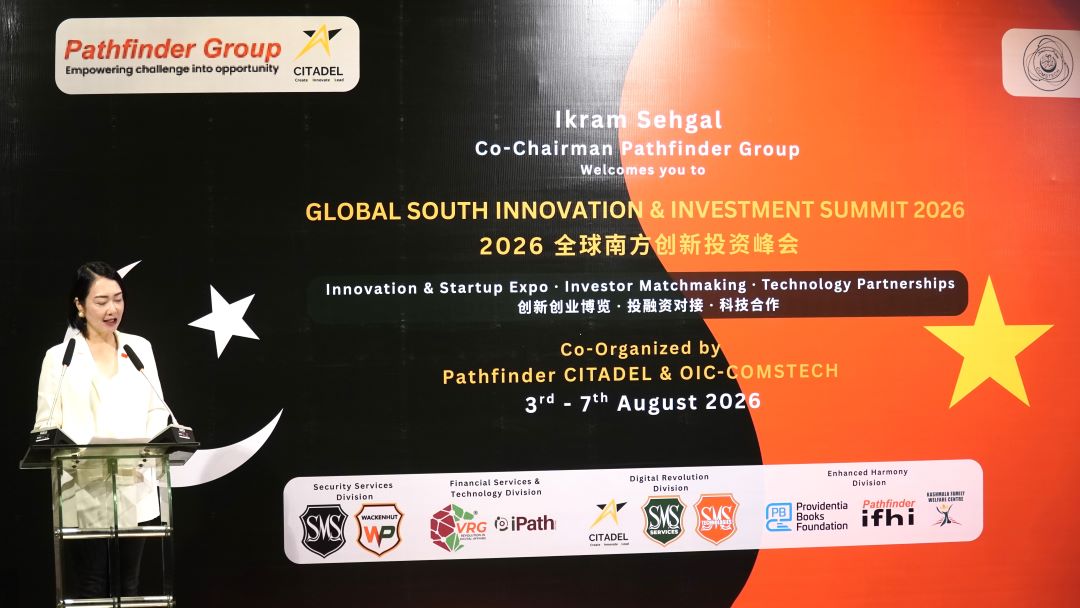
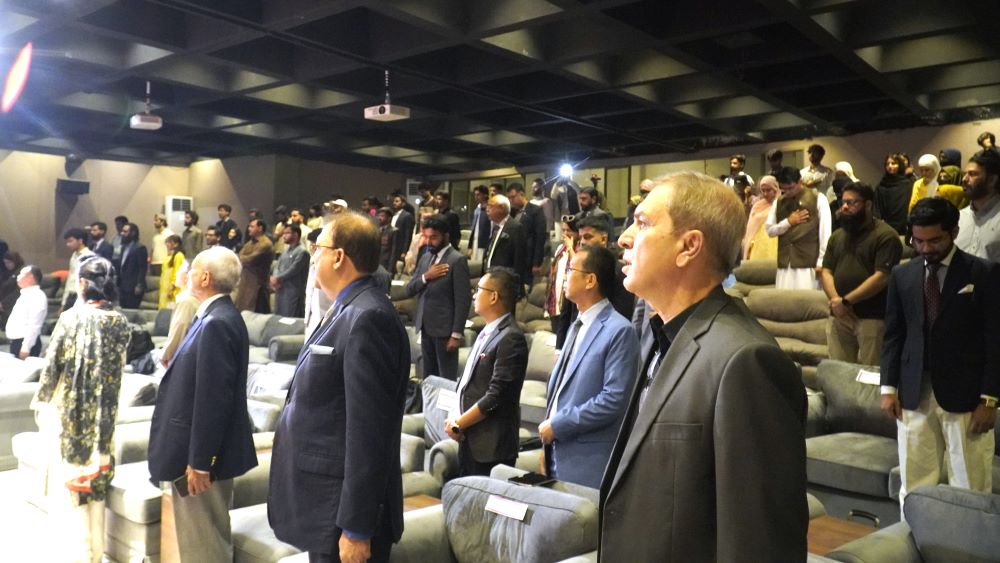
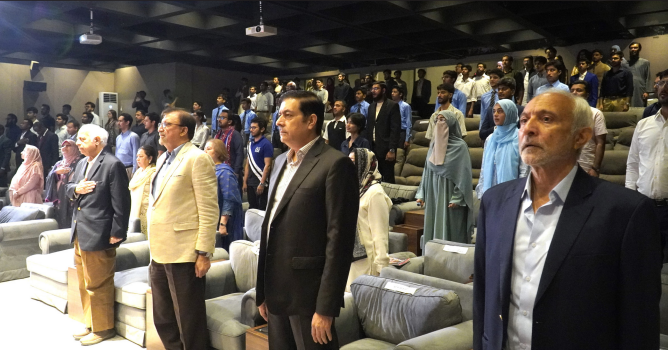
The Global Shapers Community Pakistan, in collaboration with CITADEL Pakistan and the Pathfinder Group, hosted a landmark “Meet the Leader” session titled Beyond Geography – Building Legacy through Resilience, Enterprise, and Hope at AmaaniBaagh, Angoori, Islamabad, on 10th May, 2026. The event brought together over 100 students from more than 10 universities, and nearly 45 Global Shapers from across Pakistan for an inspiring day of dialogue, leadership engagement, cultural performances, and youth-focused collaboration. The highlight of the programme was an interactive conversation with Ikram Sehgal, Co-Chairman, Pathfinder Group, who shared insights from his remarkable journey spanning military service, entrepreneurship, leadership, and nation-building, while emphasizing resilience, faith, and service to humanity.
First Session
Mahrukh Faraz, Member, Global Shapers Community (Host):
Assalam-o-Alaikum. Today marks the culmination of our efforts over the past week, and we have accomplished this on very short notice. We are sincerely grateful to everyone who has taken the time to be here, especially on a Sunday morning, and to those who travelled across cities to join us. Our entire team is extremely delighted to host all of you for this annual “Meet the Leader” session.
I am Mahrukh Faraz, a member of the Global Shapers Community and a development consultant by profession. I will be your host today. Before we begin with the official agenda, I want to extend my gratitude to two specific organisations that made this event possible. First, the Global Shapers Islamabad Hub, my community, my people, who conceived the idea for this session and have been dedicated to giving back to the community since 2012. The second organisation is our esteemed partner, Pathfinder CITADEL, the Centre for Innovation, Technological Advancement, Digital Entrepreneurs & Leadership, which helped bring this vision to life. We could not have done this without their support.
I would like us to spend a few moments understanding the community that made today’s event possible: The Global Shapers Community. Many people think we are just a group of young professionals and students organising events and community initiatives. However, the reality is that the Global Shapers encompass much more than that. To explain this further, I would like to invite a highly accomplished Global Shaper to the stage, someone who played a key role in my recruitment into the community. She embodies everything that the Global Shapers Community represents. Please join me in welcoming, with applause, Shehrbano Jamali.
Shehrbano Jamali, Member Global Shapers Community:
Hello, Assalam-o-Alaikum, and a very good morning. It is a delight to be here and to look around the room at people who want to be enablers of change. An important part of the Global Shapers Community is that we want to open doors and opportunities for all young people in Pakistan, working for a common cause: how can we make a better Pakistan and shape a better world?. I am going to keep this brief. I want to spend a few minutes talking to the young students in this room about how you can become a part of this community and what we stand for. The Global Shapers Community is an initiative of the World Economic Forum. In 2012, Professor Klaus Schwab noted that 50% of the world at that time was under the age of 30. He asked how we were ensuring that those perspectives from the youth were reflected in the activities and work being done in the world. Today, the Global Shapers Community has about 10,000 active members in 450 hubs globally. Ultimately, what I tell everyone is that everywhere in the world you travel, you will always have a friend and someone to guide you in those cities. We have impacted over 15 million people around the world through our activities.
I want to focus for a moment on Pakistan. We have 11 active hubs across the country, from Umerkot to Khuzdar to Quetta to Islamabad. I am so pleased to have my colleagues with us today; we have 43 Global Shapers in the room from five different cities. I was speaking to Ikram Sehgal just the other day, and I mentioned to him that an active effort of the Global Shapers Community is to move away from elite networks and empower people working at the community level. We want to give opportunities to the people who are our “eyes on the ground.”
Today, we have representatives from the Wah Hub, Rawalpindi Hub, Okara Hub, Peshawar Hub, and Islamabad Hub. In the near future, we hope to have all 11 hubs represented in this room through our work with CITADEL.
I also want to mention a few specific projects we have been working on. The Karachi Hub is conducting a Mangrove Safari, and we have over 30 to 40 other initiatives currently underway. We have projects that we have been doing for over 10 years. From a Global Shaper perspective, we work in six impact areas. Number one is inclusion. In Islamabad, we work on inclusive communities, including a project on interfaith harmony. We work with the Christian community to discuss common principles that can help us build a harmonised society. Regarding skills, the Islamabad Hub won an innovation grant prize. I am pleased to share that since 2020, the Global Shapers community, through the support of the World Economic Forum, has received up to 30,000 Francs for community-level work.
I specifically want to highlight two milestones. In 2024, the World Economic Forum introduced an innovation prize with the Global Alliance for Youth. Out of over 500 hubs, the Islamabad Hub was among the first to win that prize in its very first cohort. The following year, the Peshawar Hub did the same; from 500 hubs globally, Peshawar was in the spotlight for its project, CLIM. On the subject of career counselling, in the last two years, we have delivered sessions to over 2,000 students around Islamabad and Rawalpindi. These are students we work with continuously to reskill across 20 different schools. We aim to collectively spread this initiative to the rest of Pakistan. We are not just talking about basic career counselling; we are talking about empowering the next generation with the skills they need to thrive, such as Artificial Intelligence, entrepreneurship, and boot camps. This aligns with everything CITADEL is also trying to achieve.
Regarding ClimateSynth, we have representatives from the Peshawar Hub here today. Adnan is leading that project, and we are very happy to have him. It is an AI-generated platform they are building in Peshawar to empower communities. I encourage you to talk to him about it later. The Rawalpindi Hub is also here today. Green Blue is an excellent initiative for which they won 10,000 Francs. There is significant innovation happening at the community level.
Beyond community work, I want to talk about the phenomenal Global Shapers in this room. We are not just building inclusive societies or protecting the planet; we are also representing Pakistan at the international level. Over the last four years, we have had four Global Shapers attend the Annual Meeting of the World Economic Forum in Davos, where we channelled what it means to be a Pakistani and showcased our work. Similarly, we have Global Shapers representing Pakistan at the Annual Meeting of the New Champions in China. These are living examples of the opportunities available for youth to take forward the betterment we make, not just in Pakistan but at a global level.
Recently, through the Global Shapers Community, the World Economic Forum and its Global Foresight Network introduced a program called “Future 50.” The idea of this program is intergenerational collaboration: how are we planning for the next 50 years, and how are the youth involved in these conversations? The youth should not have to live with the unintended consequences of decisions being made today. How are we making sure that youth are ultimately at the focal point of the conversations we’re having? I think this is exactly why events like this, and meeting individuals like Sir Ikram Sehgal or the team at CITADEL, are so important: we deserve to be in those spaces. We deserve to occupy those spaces because 67% of Pakistanis are under the age of 30. How can we talk about 2050 when we are not in those spaces? I think it is through tech, AI, and the work we’re doing that we earn those spaces.
I’m so pleased to share that I, along with Osama and Zulqarnain, who couldn’t be here today, just published a piece on the World Economic Forum regarding intergenerational collaboration. It particularly focused on South Asia and the work we can do with our philanthropic networks to empower and make decisions for the next 50 years. I am also pleased to share that Hassan, who is here with us today, will be representing us in designing what the next 50 years in the energy sector could look like. For all the young people present today, we ultimately need to be enablers. We need to create opportunities and actively share them with youth members across Pakistan, because we’re all working toward a common cause.
With that being said, I want to spend two minutes on how you can become a Global Shaper. To the older generations with us today, we would love for you to share this within your networks for people who you think could be excellent representatives of this community. We essentially look for individuals aged between 18 and 27. The idea is that you need to be a leader in your community. You just need to have a passion and the heart to want to do something for your community. That could be as small as something I tell everyone: every summer, I have a lot of “Loquats” that grow on my tree. We put a box outside with a poster saying, “These Loquats are free. They are for everyone. Take them, but be considerate of others.” That is all it takes if you actually want to make a difference. I can assure you that every April, when we do that, within three hours, those Loquats are all taken and none are wasted. So, for the young people in the room, if you are between the ages of 18 and 27, this is a perfect opportunity. All you need is love for the community and for Pakistan. You can apply through our individual hubs.
In Pakistan, there are 11 hubs. Please make sure you apply to the hub nearest to your city, which could be Rawalpindi, Islamabad, Wah Cantt, or any of the others across Pakistan. If you come from an area where there is no hub and you want to create one, all you have to do is email the Global Shapers Community; you could be the founding curator of a hub in your city. I’m working closely with our community champion to see whether we can open hubs in Sukkur or more in Baluchistan best way to stay informed is to follow “ISB Shapers” for Islamabad recruitment, or “Global Shapers Rawalpindi” on Instagram and LinkedIn. Once a year, we recruit through a specific process.
I’m happy to carry this conversation forward if anyone is interested. Ultimately, we’re all here because we believe we can create a better space, not just in the world, but for our communities and for Pakistan. I also want to end by saying I’m so grateful to the Pathfinder Group and CITADEL for opening their doors to us with such a warm welcome. We have fantastic people here today to have conversations that will truly matter 50 years down the line.
Mahrukh Faraz (Host):
Thank you, Shehrbano, for introducing us to aspects of Global Shapers that even I wasn’t aware of. Without further ado, let’s dive into the session we’ve all gathered for. Please bear with me for a moment as I set the stage for this conversation.
The theme of this year’s “Meet the Leader” session is “Beyond Geography: Building Legacy with Resilience, Enterprise, and Hope.” The context behind this discussion is that many people my age, whether slightly younger or slightly older, have grown up in an environment where there was always a desire to relocate. People wanted to move from a village to a city, from a small town to a metropolitan area, or even change countries altogether. The world has changed significantly; access to learning and information has improved and become more widely available. This has impacted the opportunities available to us, allowing us to find employment slightly more easily in different parts of the world. However, the essence of opportunity itself has also evolved. We are currently experiencing economic contraction, high inflation, and rising unemployment, all while navigating the ongoing adoption of AI, which is indirectly influencing many of our career prospects. Collectively, these factors have compromised the ecosystem we operate in, reducing the opportunities we can seize, or at least that is the general perception.
Let me share an example from my own experience. I work in the development sector, and this past year has been particularly challenging for us due to a significant decline in development financing in the country. Many people I know have lost their jobs, and companies are recalibrating their revenue models to adapt to the current climate. Many of us are left wondering whether to stay in our careers or explore other job opportunities, especially given the already limited space in the sector.
To address concerns like these, which I believe resonate with everyone here, especially young people, we have organised this conversation. It will be moderated today by Maaz Ali Nadeem, the Co-founder and CEO of Vector AI, a company specialising in AI solutions. In my view, Maaz is the perfect fit for this discussion because he exemplifies how to achieve success despite limited opportunities in your environment.
I want to introduce the remarkable leader who will be conversing with us today. I believe most of us are familiar with his name; it’s hard to find a young person who hasn’t heard of him. Anyone who knows his story is truly inspired. He grew up in East Pakistan and fought in the 1971 war, becoming the first Pakistani prisoner of war (POW) to escape from Indian captivity. After returning to Pakistan, he built a business that now employs 12,000 people across 75 cities. His organisation, the Pathfinder Group, is Pakistan’s largest private security provider and facility management company. That’s not all; he has been hosting Pakistan Breakfast at the WEF annual meeting in Davos for more than 2 decades. He has authored 10 books, introduced Defence Journal (a monthly journal), and represented Pakistan on numerous global stages. He is committed to staying in Pakistan while making it impossible to be ignored on the international scene.
Please join me in giving a warm round of applause for the man, the myth, the legend, Co-Chairman of Pathfinder Group Pakistan, Mr Ikram Sehgal.
Maaz Ali Nadeem, Co-Founder & CEO, Vector AI:
Assalam-o-Alaikum, Welcome to AmaaniBagh on this fine Sunday morning! I hope you are all awake and ready. There isn’t much for me to discuss today; we have much more to hear from others. I would like to thank Mr Ikram Sehgal for the time we are about to enjoy together, Insha’Allah.
Sir, my very first question is this: if you were to narrate a story from a third-person perspective, who is Ikram Sehgal?
Ikram Sehgal, Co-Chairman, Pathfinder Group:
First of all, I want to talk about myself. I am the son of a Punjabi father and a Bengali mother. Throughout my life, I have often felt like I was in the wrong place at the wrong time. In 1971, I was serving in the army and was very proud to be part of the Pakistan Army, a sentiment I still hold today. However, having a Bengali mother was not viewed favourably during that time. Despite being the first Pakistani prisoner of war to escape from India, I made a controversial statement then, and perhaps it remains controversial today: “I cannot have my father’s people killing my mother’s people.” This was during the events taking place in East Pakistan. As a result, I went from being seen as a potential hero to being treated as a complete zero.
I was among 32 officers and thousands of soldiers who were imprisoned in India without any acknowledgement that we were prisoners of war. I escaped on the 16th of July 1971. The next day, I broke into the American Consulate General in Calcutta and celebrated my 25th birthday on 18 July there. While the staff at the Consulate was not thrilled to have me there, they were unsure what to do with me, but because we were members of SEATO and CENTO, they offered me several options. One option was to place me inside a crate with oxygen because the U.S. Military Air Transport flew through Kolkata twice a week. They suggested, “We will pack you in there and send you to Bangkok to sort this out.” However, I did not want to risk being trapped inside a crate and possibly never waking up again. Long story short, making my own way I managed to return home.
Upon my return, I was told, “You cannot tell the story you are sharing about East Pakistan. You are not allowed to say anything that contradicts the official narrative.” The narrative at the time was that “all Bengalis are traitors.” During my time in protective custody and interrogation, my father was sent by the authorities to see me. I loved him dearly. He approached me and said, “Chand,” which was my nickname, “what is wrong? You are a hero, a genuine hero. Why do you feel the need to say this?” I replied, “Daddy, there is one significant difference between us.” He insisted, “There is no difference. Everyone knows you are my son.” I said, “Daddy, the problem is that you had a Punjabi mother, while I have a Bengali mother. I cannot support this false narrativeof “Bengalis being traitors.” He later returned to the authorities and told them, “As far as I am concerned, you can shoot him, but he is not going to change.”
Anyway, long story short, I was sent to West Pakistan to be processed out of a unit. The war had not yet started. I was assigned to a unit called Forty-Four Punjab, led by one of the most courageous officers in the Pakistan Army, Lieutenant Colonel Taj, who already had a Sitara-e-Jurat. Lieutenant Colonel Taj was known throughout the army for being flamboyant. He told me, “Look, I do not like Bengalis. I will never promote you, and I will process you out. After the war, if you survive, you will go home, but I will never promote you beyond the rank of Major.” He also said,
“I am going to give you ‘Delta Company’ are call the company of ‘Deserter Company.’” This conversation remained between him and me, and nobody else knew about it.
However, various events unfolded, and on the morning of December 13th, 1971 at 0500hrs he removed his crown from his shoulders and gave me battlefield promotion as a Major. He renamed my company as “Sehgal Company.” Today, “Sehgal Company” still exists within Forty-Four Punjab (now 4 Sindh) and that remains one of my proudest achievements as a soldier. I am the only living person with that honour. The three other companies in the battalion are named after Nishan-e-Haider recipients such as Major Shabbir Sharif and Muhammad Hussain and Brig Moin Shakeel, all were martyred in action. The fourth company, is Delta Company named after me. I decided then and there that the love I had grown up with was what truly mattered. My father helped raise the East Bengal Regiment when I was three years old. I later received my commission in that same regiment and had the honour of commanding Bravo Company in the East Bengal Regiment, my father’s company, where my company commander was Major Zair Hussain. Major Zair Hussain later became a Brigadier. His son, who was eight years old at the time, is Maj Gen Shakeel, who is here with us today and serves as the Vice Chairman of the Pathfinder Group. You can imagine the connection. His wife is also there; she was only three or four years old then, the daughter of his father’s colleague Maj (later Lt Gen) Zakir. We still call her Guriya. The point is that you must keep your relationships strong. It does not matter whether you are Punjabi, Bengali, Baloch, or Sindhi. You are Pakistani, and Pakistan is what truly matters above everything else.
I will briefly explain where I started from and then how I managed everything. However, I can tell you one thing: in Pakistan, merit is often viewed as a disqualifier. From December 13, 1971, until I was removed from the army and dismissed without any reason on January 24, 1974, I was repeatedly selected for difficult assignments whenever something happened. During the Sindh language disturbances on 9 July 1972, I received direct instructions from (him) President Bhutto, despite being only a Major, to manage the situation at the University of Jamshoro. He instructed me to use maximum force but avoid causing fatalities. I was also involved in establishing the first Desert Battle School at Umerkot (33 Div). Later, while conducting operations in Balochistan, Delta Company formed the infantry heliborne company. Many people do not know that Iranian Cobra gunships and Chinook helicopters assisted the Pakistan Army in Balochistan in 1973.
I made the mistake of standing FIRST in the Captain-to-Major promotion examination out of 3,500 officers. When the results were announced, I was temporarily attached to Brigade and Division Headquarters for operations at Talli Tangi (near SIBI) surrounding my own company, and two FC companies and probably two companies of Engineer making the road to Mawand instead of being with my unit. I requested permission to show the results to my Commanding Officer, Colonel Taj. He agreed, and I carried the results back to my unit. When I showed him the document, he looked at me and said, “You bloody fool.” I replied, “Sir, I stood first.” He responded, “I told you. Now they will target you. You had no business standing FIRST.” That reflected the state of affairs at the time.
Ultimately, I decided not to take the Staff College Entrance Examination. At that time, I was newly married, and during operations, there was a case in Quetta. While everyone else was studying, I was busy taking my sisters-in-law to watch movies and visiting places like “Lal Kabab”. My wife was upset and told me, “You are going to embarrass me. Azharul Islam (Horsey), Sikander Shami, and Yaqub Masood (all instructors at Infantry School) will take the top positions because they are studying, while you are taking us out to watch movies instead.” However, I was determined not to participate in the Staff exam.
Then Maj Gen Iqbal (GOC 33 Div) called me and insisted, “You must appear for the exam, there are no issues against you.” He was the Director of Military Intelligence in 1971. As a result, I decided to take the exam. During the paper, I intentionally left two questions worth five marks each unanswered. The invigilators, who were Commanding Officers from my Brigade, asked me, “You teach this subject. How can you leave these questions unanswered?” I simply replied, “I do not know.” Even then, I ended up standing FIRST in the exam by mistake.
General Pervez Musharraf also took the exam with me but failed. Out of 300 candidates, only 30 passed. Even so, 100 individuals were selected to attend Staff College, and he was one of them. The person who finishes FIRST is usually sent to Staff College in Camberley, UK. Considering my views in 1971 and the fact that my mother was Bengali, how could I have gone to Camberley and potentially rose to higher rank. As a result, I was “dismissed” from the Army under Section 16 of the Pakistan Army Act without any reason being provided. There was no Court of Inquiry, and I was never allowed to defend myself. I was simply sent home.
Many years later, Maj Gen (later General COAS Pakistan Army) Abdul Waheed Kakar (then Adjutant General) reviewed my case. He completely exonerated me and recommended that I be reinstated and granted the same rank as my peers, who by then were close to becoming Maj Gen. He described my case as one of the worst injustices. The matter was escalated to the Ministry of Defence, but they believed it could no longer be corrected. I eventually received a letter stating that I was “compulsorily retired without the benefits,” but the circumstances surrounding my dismissal were never properly documented. Today, I am a “dismissed” former Army officer who teaches at the National Defence University, the Air Force War College, and the Pakistan Navy War College. I have also taught at the National Defence College in Bangladesh. Despite being a dismissed officer, I delivered the first-ever lecture on National Security Strategy at the National Defence University in 2002, thanks to Air Marshal Masood Akhtar, who headed the National Security Wing and insisted that I deliver the lecture. I have now nearly completed a “National Security Strategy” for Pakistan because I realised that what many people speak in grand rhetoric, but there is often little substance behind it. Speeches may sound impressive, but there is frequently nothing tangible to support them. I took time to reflect on the next steps in my journey, and that reflection brought me to where I am today.
I would also like to recognise two very special people. My wife, who is here with us today, and my son. My son, Zarrar, is now the Chairman of our family company and is regarded as one of the top aviation lawyers in the world. According to The Legal 500 and other rankings, there is no one better in the field of aircraft securitisation and leasing. Recently, at Harvard, he chaired the panel on constitutional discussions and held his own among American peers. When I first informed my wife about my dismissal, she was deeply shocked. I remain grateful that she stood by me during that difficult period, and today we are still together. Everything you see today in the Pathfinder Group is the result of our family’s hard work. My son and wife hold the shares, while I only hold one share in the company. The point I want to emphasise is that destiny often blesses you in unexpected ways.
Sitting here in the front row are General Shakeel and Brigadier Mujahid Alam. I also want to mention my late sister, who passed away; she was three years younger than me. Brigadier Mujahid and my sister were classmates at the Convent when they were only ten years old. We share a long history. During difficult times, true friends remain by your side.
General Ali Kuli has also been a steadfast friend. We share memories from Lawrence College. Although he is five years older than I, we became very close later in life. When my sister passed away, his wife, who had been one of my sister’s close friends, told me, “Shahnaz may have died, but I am your sister.” To this day, she remains like family to me. The food you will enjoy today has actually been prepared at her son’s café, and they have many successful business ventures. I serve as a Director in several of their industries, making me the only non-family member on their board. I am emphasising this because true friends will stand by you, and people with sincere intentions will never abandon you.
I take great pride in my education. After leaving the Convent, I attended Lawrence College Murree, where Brigadier Mujahid later served as Principal. My character was shaped during my years at Lawrence College. Unfortunately, many things have changed since then. In those days, during thunderstorms, we would select the six best runners, give them paper satchels, and send them out in the rain to scatter paper. Fifteen minutes later, two hundred boys would chase after them. We called this activity a “paper chase.” In the army, we had a similar activity known as a “road walk and run,” or RWR, which we jokingly called “Running Without Reason.” That was where our character was built, through the people we met and the lessons we learned. Others here from different schools and colleges have probably had similar experiences. The character you develop during your education, especially during your later school and university years, along with the networks you build, shapes the person you ultimately become. That, in essence, is the key takeaway.
Mahrukh, I am truly impressed by the tremendous work you have done. While I knew about the Young Global Leaders initiative, I did not fully understand the scale of the Global Shapers Community until you introduced me to it. I genuinely believe our destiny is coming together beautifully today. Consider yourselves blessed.
Maaz Ali Nadeem:
That’s amazing! Let’s discuss Pathfinder Group a bit more. We’ve talked about what inspired your journey, but now I’d like to focus on the company itself. Why did you decide to start it, and how challenging was that process? It’s difficult to encapsulate 50 years, 75 cities, and 12,000 people in just a few words; that doesn’t truly convey the essence of it. Could you share more about the heart of Pathfinder Group?
Ikram Sehgal:
First of all, regarding the name “Pathfinder”: General Musharraf, when he was a Major, was the head of the Pathfinder team in the Special Services Group (SSG). The Pathfinder team operates behind enemy lines to establish a drop zone. They set out flares to guide C-130s and other aircraft for parachute landings in the designated area. He led that team, and I was the pilot.
This journey truly began when I was discharged from the army. I found myself without money and with nowhere to go. Although my father was well-to-do, he was retired, and I did not want to depend on his finances. I started working as an instructor pilot at the Lahore Flying Club because of my aviation background and my Commercial Pilot License (CPL). We often conducted low-altitude spray flying over cotton and rice crops, flying just 10 feet above the ground in a straight line. It was difficult and demanding work.
I soon realised that in every role I took, someone else was always being credited for my efforts. One day, I walked into the office and found another person sitting at my desk. In an attempt to undermine me, they had shifted my workstation several rows away. Without saying a word, I gathered my belongings and prepared to leave. My clerk at the time, Abdul Hamid Quadri, approached me and asked, “Sir, what are you doing?” I replied, “I will never work for anyone again.” He then asked, “What will you do?” I said, “I am going to start my own company.” He responded, “But sir, you do not have any money.” I admitted, “That is true, but we will figure something out.” He insisted that he would join me. Initially, I was skeptical and thought he might be joking because I could not afford to give him 600 rupees. That was in 1976, and the company was incorporated in 1977. Mr Quadri then said, “Sir, you cannot type, and you do not know how to operate a telex machine. Who will handle those tasks for you?” I acknowledged that he had a point. He added, “I only need 300 rupees to give to my mother. I will stop smoking, but I want to support you.” Yet he assured me, “Whatever it takes, I believe in you, and I will go with you.”
Fast forward to 2026, and Abdul Hamid Quadri is still with me. He is also a shareholder in the company. He remains a vital part of my team and is one of the two people authorised to sign cheques. My wife signs them reluctantly because she is naturally pessimistic and fears that nothing will succeed, but Mr Qadir signs without hesitation. Recently, I had the honour of attending his youngest son’s wedding, which was a delightful occasion for me.
This experience strengthened my resolve to never work for anyone else and to build my own path. I must stress that while you may come up with many ideas, not all of them will succeed. Do not be discouraged by failure; instead, let it motivate you to improve. That mindset has contributed greatly to where I am today.
Over the years, we ventured into different businesses, and eventually the Pathfinder Group entered the field of barter and counter-trade, one of which involved tea. Fortunately, I had the opportunity to visit Bangladesh by chance. My unit, which had been formed by my father and was also commanded by General Shakeel’s father, was stationed there. When General Shakeel’s father was commanding the unit, and I was serving as the Adjutant, his company commanders included notable figures such as General Ershad, who later became the President of Bangladesh, General Zia ur Rahman, another future President, and General Shafiullah, who later became the Chief of Army Staff, along with several other generals and deputy commanders.
This unit was informally known in Bangladesh as the “2 E Bengal Mafia.” They effectively ruled Bangladesh even alter the assassination of General Zia when Gen Ershad took over and ruled for almost a decade. I had the honour of serving as the Adjutant when the Acting Commanding Officer, Major Zia, received the news in Joydebpur in 1968 where the unit was stationed that his son had been born in CMH Dhaka. He told me, “Come with me, Chand.” We then went to see the baby, Tarique Rahman.
His mother Khalida Zia ousted Gen Ershad and ruled as PM for two terms. Tarique Rahman, Gen Zia’s and her son, is now the PM of Bangladesh.
At that time, opportunities for Pathfinder Group emerged because of our connections. In Bangladesh, whenever they said, “Chand, you do this” or “You do that,” we gladly assisted them. Our efforts were modest, and we never took commissions. This helped us build credibility and establish ourselves in the business world. We later adapted our business model to focus on services and established Security Management Services (SMS). Today, we are recognised as the leading private security services company not only in Pakistan but across the developing world, although I remain modest about it because meritocracy is still a challenge. For 40 years, we proudly held the largest contract on the American side by guarding the US Embassy with a force of two and a half thousand guards.
Over the years, companies such as Wackenhut and G4S were involved. However, as circumstances evolved, we eventually acquired Wackenhut as a separate entity. At the time we took over, Wackenhut had around 50 vehicles. Today, we operate approximately 450 armoured vehicles. We are now active in 75 cities and towns, and our guards are the best-paid in the country, receiving benefits and privileges that others do not receive.
To illustrate how we treat our employees, just this past Wednesday, we held a session with one of our dynamic young team members, who tragically passed away that very night due to a brain haemorrhage. It came as a shock to all of us. Shakeel Ahmed, his CEO, immediately took charge of managing the situation. We responded as we always do for any of our employees facing such circumstances. I will ask Shakeel to share what we have done for his family.
Please pay close attention to this. We do not do these things as an extra gesture. We do them because we are Muslims, and we believe it is our duty to take care of our people.
Shakeel Ahmed, CEO DRD & SMS Services:
The company provided the widow with six months of full salary, followed by half of her salary for the next 18 months. Additionally, the organisation has offered free education for the children, covering all fees, books, and other necessary expenses. In times of grief, individuals often struggle to manage the financial burdens that arise. Having that support is crucial to help them through their sorrow. The company extends this assistance to every employee who passes away while still in service.
Ikram Sehgal:
What I want to convey is our commitment to giving back to our employees. If you were to ask them outside, you would find many who have been with us for 20, 25, or even 30 to 40 years. We take pride in being a family, and we believe in looking after one another the way a family should.
In the past, when SMS and Wackenhut were thriving, I ignored my wife’s advice to invest in real estate. Instead, I decided to establish a new company focused on financial inclusion and women’s empowerment, which aligns with a World Bank initiative. Today, we are the only company in the world capable of facilitating a “many-to-many” platform that connects all five telecom companies to 16 banks. People who want to open a bank account with less than 50,000 rupees face significant challenges. However, through our platform, anyone with a phone, whether it is a smartphone or a basic feature phone, can open an account in less than two minutes.
This service is called the Asaan Mobile Account (AMA), and we have already facilitated 14 million accounts across 16 banks. My team often asks me why I do not publicly promote our platform. I tell them to focus on the satisfaction of what we are accomplishing rather than seeking unnecessary recognition. For example, the current “Fuel Pass” system will operate on our platform. Although we will not receive credit for it, we will manage it effectively. Equally important is our mission to empower women. Previously, women held only 18% of bank accounts. Today, 38% of the accounts on our platform are held by women. It is crucial to bring women into the mainstream economy because, without their involvement, progress will remain stagnant.
Our primary focus now is the underprivileged people of this country, and this platform was designed specifically for them. I can honestly say that we have succeeded in our endeavours. Every initiative we undertake, whether it is CITADEL, promoting interfaith harmony, or any of our other projects, is rooted in Corporate Social Responsibility (CSR). However, our approach to CSR is centred on increasing individual worth and fostering independence.
I have a deep interest in the young leaders in this room. I want you to be at the forefront, representing Gen Z in the future. You have the power to amplify voices that often go unheard. Unless you create opportunities for people, such as establishing these HUBs for Global Shapers, they will never have a platform to share their bright ideas.
On the business front, yes, we aim to generate revenue. I have no desire to rely on handouts. I will earn money, involve others in the process, and ensure that those funds are used wisely. My goal is not simply to provide for people, but to empower them by giving them the tools to succeed on their own.
Maaz Ali Nadeem:
There is a Chinese proverb that states, “Give a man a fish, and he eats for a day; teach him to fish, and he eats for a lifetime.” This succinctly captures the essence of our discussion. Regarding the importance of caring for the people who work with you, I recall our meeting in Karachi. I met Salman right after our initial introduction; he is the person behind the AMA platform. He showed me his medical card and said, “Maaz, look at the benefits it offers.” Then he added, “Go downstairs in front of the Kavish Plaza and ask any guard you see to show you his card. Compare it to mine, and if you notice any differences, please let me know.” This illustrates the purpose of our work and what we aim to understand.
Mr Sehgal, you have a journey spanning at least 63 years. Throughout this journey, who do you remember fondly? Is there someone who defines your story, yet who you haven’t had the chance to talk about regularly? Is there someone behind the scenes whom you remember with gratitude?
Ikram Sehgal:
First of all, of course, I can see that all these people are truly inspired now. Many people do not know about Quaid-e-Azam’s strategic vision. Quaid-e-Azam had an extraordinary strategic vision, and, surprisingly, Pakistanis are not fully aware of it. Imagine the father of our nation is often remembered simply for creating the country, but people rarely discuss how he actually went about achieving it. I am currently associated with the Quaid-e-Azam House Museum in Karachi, and the more I study him, the more I realize how deeply inspiring he was.
When Gandhi and Nehru launched the Quit India Movement on 8 August 1942, there was pressure on the Muslim League to follow the same path and refuse all cooperation with the British Empire. At that point, only 20 percent of the British Indian Army consisted of Muslims, and Muslims were not considered entirely loyal because of the events of 1857. However, the British Empire desperately needed soldiers during the war. Quaid-e-Azam made a remarkable decision. He said that while Muslims would continue striving for independence, they would still serve during the war. Because of this decision, Muslim representation in the British Army rose from 20 percent to 40 percent. More importantly, after the war, many British officers argued that Muslims could not simply be left at the mercy of the Hindu majority in a united India, and that they deserved an independent homeland. That was the level of Quaid-e-Azam’s foresight.
There was another example of his vision in 1946, when Mr Fazlul Haq, Mr Huseyn Shaheed Suhrawardy, and Mr Abul Hashim approached him regarding an undivided Bengal. They argued that if Bengal remained united, Muslims would retain Calcutta Port and Assam, creating a strategically strong state. Quaid-e-Azam immediately supported the idea. However, Congress opposed it and demanded the partition of Bengal. Eventually, East Bengal became Muslim-majority and West Bengal Hindu-majority. Interestingly, many years later, Muhammad Yunus spoke about the idea of a stronger independent Bengal with strategic regional integration, showing once again how far ahead Quaid-e-Azam was thinking in 1946.
The second person who inspired me most was my father. He was an unusual man. My grandfather owned a company called H. Karim Brothers, which helped build Bombay Marine Drive. He had moved from Sialkot, and my father was educated in Bombay. Later, when my granduncle who was the Executive PWD passed away, my grandfather moved back. My father then studied at Murray College and later attended King Edward Medical University as a medical student. At that time, when many people were joining the army, my father also joined. Because of this he married a Bengali woman, my mother. People may not know this, but Mr Huseyn Shaheed Suhrawardy was related to my maternal grandfather’s side, and Mr Muhammad Ali Bogra was related to my paternal grandfather’s side. My great grandfather Khan Bahadur Mohinuddin Ahmed was Deputy Commissioner (DC) Balasore (Orissa). When my father brought his Bengali wife home, his mother strongly opposed it. To avoid conflict and to protect my mother, my father decided to remain in the army and stay away from Sialkot.
That is how we grew up. My sister and I were raised in a very liberal environment. We were encouraged to argue respectfully and express our opinions. My father never forced us into blind obedience. The only issue came when I did not want to join the army. I loved the army, but I wanted to earn money instead of living a difficult military life. However, because of pressure from Gen Yahya and Col (later Gen) MAG Osmany (who was my godfather), my father told me to serve for a few years and leave if I disliked it. Once I joined, I never looked back. I was in love with the army, and I still love it today. The people who were unjust to me were individuals within the army, not the institution itself. The Pakistan Army is one of the finest armies in the world. Today, by coincidence, we are celebrating Marka-e-Haq, but if you truly go down to the troops, you will understand their spirit. My old unit is now a Mechanized Infantry Battalion in Gujranwala and still sends me updates almost daily. The Commanding Officer of the unit today was not even born when I left it, yet they continue to keep me informed about their achievements. There is something within this army that goes beyond individuals.
If you ask me who inspired me most, I would say Quaid-e-Azam first, and then my father. My mother was loving but she believed basic education was sufficient. It was my father who insisted on sending my sister and me to boarding school at the age of seven. We studied in convent schools, later attended Lawrence College, and eventually I joined the army. My father suffered greatly in 1971. People would come to him in Lahore and accuse his son of being a traitor. Imagine a Punjabi father hearing that every day. Yet, many loyal friends stood beside us, including Shabbir Sharifwhose mother make it a point to visit my “isolated” mother regularly and remained close to our family. That is why General Raheel Sharif is like a younger brother to me. Many people inspired me during that time, especially my friends from Lawrence College. We excelled in everything. When we joined the Pakistan Military Academy, the few cadets from Lawrence College consistently ranked at the top. One weakness we had, however, was swimming because Lawrence College did not have a proper swimming facility. One of the projects I later undertook was donating a modern swimming pool to the college during Brigadier Mujahid Alam’s tenure. It is nearly complete now, and I have named it then Col Majeed Sehgal Swimming Complex after my father.
Maaz Ali Nadeem:
People may agree or disagree, but I personally believe we may never find another person like Ikram Sehgal in this country. However, who do you think people today should look up to? India had figures like Ratan Tata and others who became national inspirations. Pakistan also has such people, but unfortunately, we do not read enough about them because the media rarely highlights those who genuinely contribute positively to society. Along with yourself, who do you think Pakistanis should listen to and learn from?
Ikram Sehgal:
I will not point toward one individual. I will point toward all of you, especially the young people sitting here and the members of the Global Shapers Community. If I can help create one hundred people who think and act positively for Pakistan, then I will consider myself successful. There are many inspiring people in this room, including General Shakeel, AVM Asad Ikram, Farhan Ahmed, Khalid Banuri, Salman Ali, who is leading VRG, and Ali Shah, who is in Atlanta right now.
What matters most is that all of you understand your own potential. Our slogan is “Every challenge is an opportunity.” If you believe in God and believe in yourselves, there is nothing you cannot achieve. Do not focus on projecting yourself individually. Whenever something succeeds, it succeeds because of teamwork. For example, projects like CITADEL are succeeding because of bright young minds working together. Similarly, the work being done by Brigadier Mujahid and his team in interfaith harmony is remarkable.
I deeply believe in the youth of Pakistan. No one can challenge them if they are given direction and opportunity. In fact, I would like to announce something today. At AmaaniBagh, I want to create a separate lodge and headquarters for “Global Shapers Pakistan.” I will personally establish it with accommodation facilities, a Secretariat, and support systems so that young people across Pakistan can collaborate and work effectively.
Maaz Ali Nadeem:
That is incredible news for us, and we would love to continue this discussion after the session. Since you mentioned Global Shapers, we are also very interested in your association with the World Economic Forum. How did it begin, and why have you continued organizing Pakistan at Davos for more than twenty years?
Ikram Sehgal:
I joined the World Economic Forum almost by accident. I had accompanied Nawaz Sharif to an investment conference in Zurich along with Arif Nizami. Mr Sartaj Aziz suggested we visit Davos. At Davos, I met a secretary from Klaus Schwab’s office named Anne Marie Meiser. She noticed I was drinking tea instead of coffee and struck up a conversation with me. Later, she introduced me to Klaus Schwab. He was intrigued that I was both a businessman and a columnist writing regularly in the media.
At that time, the World Economic Forum required businesses with turnovers of around 100 million dollars, while my company was far smaller. Yet Klaus Schwab said they valued the combination of business experience and intellectual engagement. He asked if I could afford the membership fee of 20,000 Swiss francs, and that is how I joined in 1994. Later, I noticed that Indian businesses had massive representation at Davos, while only a handful of Pakistanis attended. India had pavilions for Karnataka, Maharashtra, and many technology companies. Pakistani businesses showed little interest in creating a national presence, so I decided to establish the Pakistan Pavilion myself. Over the years, it attracted investment opportunities and international attention. Unfortunately, many business leaders who promised support would withdraw at the last moment, despite spending far more on entertainment on a single day elsewhere. Still, we kept the initiative alive. I approached Pervez Musharraf and invited him to participate. The event became a success in 2003, and later the Pakistan Breakfast at Davos became yearly tradition.
Today, the Pakistan Pavilion remains one of the few national representations at Davos supported primarily by private efforts rather than government backing. Last year was especially important because Pakistani startups participated for the first time.
I also realized the importance of culture and entertainment. Countries like India bring Bollywood celebrities to promote their image globally. We could not afford that, but we still tried to showcase Pakistani music and culture. That is why I invited a young Qawwal, Noman Haider, today. He is educated, talented, and represents the cultural side of Pakistan. He, along with his band, also went to Davos with us this year. I always tell young people not to neglect arts and entertainment because culture shapes how the world sees a nation.
Maaz Ali Nadeem:
I can personally testify that the Pakistan Pavilion at Davos is an incredibly patriotic representation of Pakistan. Most national pavilions are fully backed by governments, but this is one of the few representing an entire country through private initiative. That is not a small achievement.
Ikram Sahab, one final question before we open the floor. How important has the concept of Tawakkal and divine faith been in your journey?
Ikram Sehgal:
Completely central. Everything happens because of God. I can give you an example from my life. When I escaped the Indian prison in 1971, I had prepared a perfect escape plan where every detail was carefully organized, but before I even reached the wall, everything began going wrong.
Nothing worked according to plan, yet I survived and sit before you today. How can that happen without divine intervention?
Faith is essential. I was scared but courage is nothing but the control of fear. You must believe absolutely in God and in His guidance. I admit I am not as regular in prayers as I should be, though my wife constantly encourages me. But I firmly believe that divine intervention shapes our lives.
When we started our IT journey in 1983, many things happened simultaneously that seemed impossible without God’s support. I consider myself merely a source through which ideas pass. Some ideas succeed, and some fail, but everything comes from Him.
When we first began constructing this place, it was nothing but wilderness. Qamar Bhatti and I climbed up here exhausted, and I told him we would build a mosque and an auditorium here. At the time, he thought I was mad. Yet today, all of you are sitting here.
Interfaith harmony is also extremely important to me. I studied in a convent school for five years, where Sister Leo taught me valuable lessons about humanity and compassion without ever trying to convert me. Later, after attacks on churches in Murree, we began providing free security to churches through our company. At one point, our guards protected 125 churches every Sunday without charging overtime because they believed it was their duty as Muslims to protect minorities. That is what Islam teaches us.
Maaz Ali Nadeem:
That definitely answers the question. I think it goes beyond religion and reflects how we should care for people in general.
One final question. If you were sitting among the audience listening to someone like yourself speak about his journey and experiences, would you feel proud of him?
Ikram Sehgal:
As a human being, I would want people to be proud not simply because of who I am, but because they feel inspired to do better themselves. If people can take my example and improve upon it, that is what truly matters. Everything we do should benefit others as well. A real partnership means wanting your partner to succeed alongside you.
Before I finish, I want to mention the people of Balochistan. At the moment, they are among the most deprived people in the country. Much of their wealth leaves the province while little reaches them. One of my major ideas is the development of a greenfield deep-sea port at Pasni. Dr S. Frederick Starr one of the foremost experts in the world on Central Asia, the Middle East and the Caucasus, has supported this concept strongly. Because of its strategic location outside the Strait of Hormuz, Pasni could become a major gateway for mainland Asia. But the most important aspect is this: the project must belong to the Baloch people themselves.
Every building and every property should involve Baloch ownership. If people have ownership and opportunity, they will protect and strengthen their future themselves.
My latest article in Defence Journal is titled “Pasni: A Destiny Changer.” It is only one idea among many, but I hope it becomes a reality for the sake of Pakistan.
Maaz Ali Nadeem:
That brings us to the end of this intimate discussion. We will now open the floor for a few questions from the audience.
Q&A Session
Question:
Assalam-o-Alaikum. My name is Mariyam and I am one of the Global Shapers, I wanted to sort of double click on the thing you said about how you call yourself a Zaria (source) for other people because I really agree with the terminology you used, I think that is exactly how I see it, because I believe that people genuinely want to help, they just need to find a way to do it, so how would you encourage people like me for example, if I want to either find those Zaria or if I want to become that Zaria for other people, like on the receiving end and on the giving end, how would you encourage people and specifically the youth to do that?
Ikram Sehgal:
I will start by sharing a very famous saying: “Do not expect to receive, but to give, because it is in giving that you receive.” It is truly in giving that you receive. You have been given an opportunity as a Global Shaper, and you must think about how you can leverage your own potential. There are many ways to do this. By becoming a Global Shaper, you have already demonstrated that you possess the necessary qualifications. You could not simply walk in from the street and become a Global Shaper. Therefore, you must look around you and ask yourself, “What is the best thing I can do? What is good for the community? What is good for individuals?” Then, commit yourself to doing that.
You must align your priorities accordingly. Remember one thing that I often tell people: many refer to war principles, but I say that peace is also about the selection and maintenance of aim. Once you determine your objective and decide, “This is what I am going to do,” then remain committed to it. Yes, you may need to adjust from time to time, but never lose sight of your purpose. Do not jump onto your horse and gallop off in every direction. Some people do exactly that. Instead, remain focused on what you are doing and leverage not only your ideas, but also your own potential, turning yourself into a genuine asset that can benefit others.
From my own understanding, and I have known about the Global Shapers Community for quite some time, although I was not directly involved because we usually engage through the World Economic Forum when they invite us to participate, I believe that the very fact that you have come together as part of this initiative means that you form the nucleus of something extremely significant.
If you can reach out and bring Gen Z along with you, especially the best and the brightest minds, and if you can carry people forward with you, then you can achieve remarkable things. Let me give you an example: what does Pasni represent? All these Middle Eastern states keep threatening to send Pakistanis back, but if we properly train our manpower in places like Pasni, we will no longer be dependent on handouts from others. The best workers in the Middle East are Pakistanis, and that is the first step forward.
My point is that you must think in those terms. You must think outside the box. You must say to yourself, “Fine, let me think differently. Let me create something new.”
Question:
I am Hourab Din, and I am the curator of Global Shapers Rawalpindi. I have a question, and I say this because I am deeply inspired by your life and the way you have lived it, and to be honest, are still living it. Through our work at Global Shapers Rawalpindi, we have been closely engaging with vulnerable communities, including religious minorities. In these interactions and conversations, we have observed a significant level of cognitive burden and a deep sense of fear among people. I am truly inspired by how you continue to work with such energy and courage despite all circumstances. I want to ask: what is your personal recipe for bravery and being outspoken? How can we, in our own interactions with people, help them come out of this fear, change this mindset, and give them the confidence to live freely, participate actively, and stay in the race of life with dignity and strength?
Ikram Sehgal:
First of all, I want to go back to what I said about divinity. You have to believe that whatever happens to you is by the will of God and nobody else. Man proposes, but God disposes. If you have complete faith, then you begin to understand life differently. Some of my closest friends died for this country. Other than Shabbir Sharif, there was Sabir Kamal Meyer, a distant cousin. He received two Sitara-e-Jurat awards, one in April 1971 and another in December 1971. He wanted to marry a particular girl, who was the daughter of a General and an ambassador. In between everything, he got married, spent only two weeks on his honeymoon in Europe, and then returned and was killed on Dec 8, 1971. I often ask myself: Why did God keep me alive? I have gone through many hardships and difficult experiences. Why was I spared? When you truly believe in God, you eventually say to yourself, “God kept me alive for a reason.” One of the biggest reasons became clear to me during my escape. People did not know who I was. They thought I was a destitute man. Along the way, I encountered Hindus, Sikhs, Muslims and Christians. They never looked at me as a Muslim; they simply saw a human being in need. In my book, I wrote something that I later regretted. As a Pakistan Army soldier, I had grown up believing that “the only good Indian is a dead Indian.” Later, I apologised for writing that because I realised there are many good Indians in the world and I should never have said such a thing. You must believe that God created human beings for a reason. Their beliefs belong to them, just as your beliefs belong to you. As long as someone’s beliefs do not interfere with yours, there should not be a problem. What I dislike is when someone, even as a Muslim, tries to impose on me what I must believe or how I must live. Even divisions into sects, in my view, are wrong. Our religion was meant to be simple. It teaches that there is nothing between you and God. No priest, no intermediary, nothing else. It is a direct relationship.
My point is that faith should lead you to care for your fellow human beings. I must tell you honestly that I consider myself a very small person compared to some of the colleagues I work with because the strength of their faith and sincerity is extraordinary. Sometimes I may be brusque or short with them, and later I apologise by saying, “I did not mean it that way.” Yet they are not offended because they know there was no malice behind my words. They understand that I was simply trying to do my best. Belief must teach you to accommodate your fellow human beings. You must give other people a space. If you give people space, then you will receive space in return.
Question:
Since many of us here are students, and I am 21 years old, I want to ask: if you yourself were 21 years old in 2026, in the era of AI and everything happening today, what is the one piece of advice you would give yourself? What path would you follow so that your future self could become the kind of person Ikram Sehgal is at the age of 80? In other words, what is the one piece of advice you would give to your younger self?
Ikram Sehgal:
The one piece of advice I would give you is this:
never stop learning. Keep educating yourself. The best education does not come only from books. I am a graduate of the Pakistan Military Academy, although technically I did not receive my degree at the time because, in 1965, we were not awarded degrees. We were sent straight to war. I eventually received my degree years later when one of my course mates became a General and later a Commandant.
He arranged for our degrees to be issued and handed them to us. So technically, I was not even considered a graduate for many years.
But the point is that I kept educating myself. I continued learning, reading books, studying history, following experiences, and learning from life itself. I learned a great deal through that process. Sometimes I ask people whether they have read certain important books, and I am often surprised when they have not. For example, T. E. Lawrence’s “Seven Pillars of Wisdom,” I asked several people about it, and they had never read it. I thought to myself, “This person is studying history and geography, yet has not read Seven Pillars of Wisdom.” I am not saying that you should necessarily follow everything in that book, but the thought process behind it teaches you a great deal. So please, keep educating yourself.
Also, if you want to venture into anything in life, think through the process carefully first. Do not invest your resources into something you do not fully understand or something you are not completely informed about.
I have failed at many things. It is not as though I have been successful in everything. People may talk about the American Embassy contract or other achievements, but believe me, those opportunities were not given to me because I had “blue eyes.” They were given because my guards were the best in the world. They were prepared to die for what I believed in.
The important thing is that you must continue educating yourself, not only through books, but also through experience and through the people around you. Listen carefully to what others say, then separate what is right from what is wrong. That choice ultimately belongs to you. You have to follow your passion. Take your passion and make it happen. Remember these words: “Take your passion and make it happen.” You do not have to follow society’s expectations. If you simply follow society, you may become a very successful bureaucrat, and everything may appear fine on the surface. But if you truly follow your passion, then you must also ensure that you create the means and opportunities to make that passion a reality.
You must prepare yourself properly for it. For example, I am not going to suddenly walk into something like CITADEL, with artificial intelligence, cybersecurity, incubation, and all these advanced fields, pretending that I know everything about them. I do not know everything about these areas.
However, I know enough to identify and select the right people for the right jobs. That is the key point. You do not have to become a jack of all trades. Instead, you should strive to excel in your own field and make sure that you choose the right direction and surround yourself with the right people.
Question:
My name is Adil Nadeem, and I am one of the Gallians from Lawrence College. Sir, as all of us know, you are also an old Gallian. You know what Lawrence College is like, and you know the kinds of challenges we face there. We often have to find solutions to problems on our own. So, I would like to ask: was there a particular challenge in your life that helped you stay true to yourself and guided you for the rest of your life? What was that challenge, and what lesson did you learn from it?
Also, I may not get another opportunity to ask this, so I would like to add another question. In our country, when people become successful or acquire wealth, many choose to move abroad, live in foreign countries, and enjoy a luxurious lifestyle there. What made you remain true to yourself and commit to staying in your own motherland, Pakistan, and helping it succeed?
Ikram Sehgal:
I think I answered this question, in a way, at the beginning. The first thing was this: please believe me, as a helicopter pilot, although I was originally an infantry officer, I was flying helicopters, including the brand-new Alouette III helicopters. Whenever Sheikh Zayed used to come to Rahim Yar Khan, I was often assigned to remain with him.
One of the first major opportunities that came my way was an offer to become Sheikh Zayed’s pilot in Abu Dhabi. It was a highly attractive offer with a fabulous salary. However, I decided against it. I said to myself, “This is my country. This is my father’s country.” This country may have tarred and feathered me and even called me a traitor, yet I stand before you today as proof that my determination to remain Pakistani never changed. I decided long ago that I would never leave this country. I will live here, and I will die here. That sense of determination gives you strength.
Yes, I love travelling. I love travelling with my family and I enjoy visiting places abroad. However, I do not own a single property outside Pakistan. All my property, most of it in the mountains, is here in this country. Because of Lawrence College, I developed a deep love for the mountains.
To answer your question directly, your home ground is always the best place for you. Never forget your roots. That is where you come from, and that is where your true identity lies. What have we done in Pathfinder Group? We have taken elements of Western corporate culture and blended them with Oriental culture to create something that reflects our own values and traditions. This is entirely Pakistani.
Question:
I am going to ask a tough question because you referred to many army personnel who are your colleagues. We also know this for some very strong reasons over the past three years. When I look at this country, I feel that there are only three things shaping where we are today. Sorry, it may take a little time to build the context. You spoke about the script that you had to follow after 1971, but we young people are also being told to follow a different script today. I have always been a very vocal person in my life, and I have often been told either to stay quiet or that I would be silenced. Should young people remain completely honest, or should we only focus on three things: making money, building connections, or going abroad? Should we keep our patriotism alive in the middle of all this? How can young people work alongside our security apparatus? I want to refer here. Whatever respect I have earned today is because of my own ability. I have been invited to the World Economic Forum (WEF), also to Geneva, New York, and Seoul, and I was invited because of what I can contribute. I do not have wealth, a famous family name, or bureaucratic connections. I returned to Pakistan after completing my master’s degree, but here I am constantly told that unless I bring money or powerful connections, I have no place. I feel welcomed abroad, but not welcomed in my own country. I would rather live, die, and build my career here in Pakistan, but I do not feel encouraged to do so. As someone who has worked in these spaces, and speaking about people in the armed forces who are also present in these spaces, I want to ask: are we even allowed to exist here? Do we matter? Or is it only power and influence that matter in decision-making?
I am asking this very honestly because I have been thinking about it for the past ten years. I have helped more than 20,000 people in my life, yet I still feel that I may not survive here. I feel that if I stay in Pakistan, I may never own a house or have a secure future. I am deeply disappointed. I still have patriotism, but I no longer have optimism. I would like to ask for your guidance.
Ikram Sehgal:
A lot of people do not know that Imran Khan is one of my closest friends. When he started his political party, he asked me about his future in politics. I told him, “Once you become deeply involved in this system, it may destroy you.” At that time, I also told him that I would provide him with bodyguards. From the very first day he entered politics, my guards were with him. At one point, there were 36 of my guards stationed at Bani Gala. I will not go into all the incidents that took place afterwards, but eventually our security company was banned. Not only was it banned, but the SECP also issued a circular stating that any company connected to the Sehgals, to Ikram Sehgal, or to my family should be shut down. Their bank accounts were to be frozen, and their offices seized. All of this happened because those 36 guards were protecting Imran Khan.
General Qamar Javed Bajwa, the then COAS. Gen Shakeel and General Bajwa had grown up together, and I also knew both of them since 1965 when they were kids together, both their fathers’ serving in 16 Baloch (with 2 E Bengal in the same Brigade in Jessore Cantt). So, Tony and I went to meet him at 11 PM in his COAS residence. The DG ISI was also present. When General Bajwa arrived, he asked the DG ISI what the issue was. The DG ISI replied that there were many complaints against Ikram Sehgal and mentioned various allegations. I asked him whether he personally believed those accusations but replied that he had only heard the complaints, many of which had come from his operatives and competitors. I asked him “So let me understand this clearly. Your NCOs and my business competitors have brought you these complaints?” General Shakeel was sitting there, and he could confirm that the then DG ISI could not even look me in the eye. When this man was COS 5 Corps as a Brigadier with Lt Gen Ijaz Chaudhry as Corps Commander 5 Corps, he used to go out of his way to give me “protocol”. Eventually, General Bajwa turned to him and instructed him to fix the matter. Gen Bajwa also remarked that at that moment it was not considered appropriate or fashionable to have guards with Imran Khan. For the record we did continue until Imran Khan himself requested (from jail) that the guards be removed.
You may decide whether I was being pragmatic or brave. Yes, I could have resisted, but I also had to be practical. I had to consider the fact that 12000 of my employees along with nearly 50000 to 55000 dependents, could lose their livelihoods. I instead of trying to act like a superhero. I made a practical decision and I compromised. That is why I would also advise you to be pragmatic in life. Do not assume that every situation requires dramatic resistance. I am not saying you should compromise your principles or your integrity, but you must learn to be practical. I have been pragmatic throughout my life.
Today, part of my pragmatism is that I no longer say everything I truly want to say publicly. I used to write a regular newspaper column, but for the last three years, I have not written a single one because I cannot freely express myself. Television channels such as PTV or Geo often invite me to appear, but I usually decline and say, “Let it be.” Please understand what I mean when I say this: be pragmatic. Life requires pragmatism. At the same time, you should always remember the K.I.S.S. formula: “Keep It Simple, Stupid.” That formula should guide you. On matters that are truly life and death, yes, take a stand. But otherwise, be wise and practical.
You have no idea what I have gone through. Even after announcing this “Meet the Leaders” event, look at the hatred that will immediately appear on LinkedIn. People accuse me of various things and of attacking my reputation. But that is natural. You have to learn how to absorb criticism and keep moving forward. You must stay firm in what you truly want to achieve.
One thing I have always maintained is that I do not work with the government. I do not have a single government contract in any business. Whenever a new political government comes into power, one of the first things they do is investigate Ikram Sehgal. They ask how many plots he received or which contracts he obtained, and then they discover there is nothing. That is why I always advise people: never become dependent on government business.
Maaz Ali Nadeem:
This is one last question that I cannot ignore from Zahid, who is one of our youngest members from Global Shapers.
Question:
Assalam-o-Alaikum. My name is Zahid Ali, and I am from Chitral. First of all, I would like to say that I am the proud son of an army officer, as my father also serves in the army. I mention this because my question may be considered a little controversial.
At the beginning, you spoke about how you started your business. In Pakistan, we see institutions and businesses such as DHA, Askari, Fauji Foundation, and Fauji Fertilizer Company, along with many other ventures linked to the armed forces. It often appears that a very large share of private business activity in Pakistan is associated, directly or indirectly, with the military establishment.
My question is:
How much has this reality influenced your own business ventures? Do you think that people with an armed forces background have an advantage in Pakistan’s business community compared to those who do not come from such backgrounds? Do you think there is an unfair advantage in this system, or is it simply my perception?
Ikram Sehgal:
One thing is certain: there has been an unfair advantage. But the real question is why we, as a society, allowed it to continue. When I started my business, I initially thought about what I could do in connection with the military sector. I am answering this openly because I have already written about it, so I am not concerned about controversy anymore. I started thinking fifteen years ahead. I acquired the agency for the Steyr Mannlicher sniper rifle.
I also obtained agencies related to military-grade firearms, Pinzgauer all-terrain vehicles, tactical trucks, APFSDS ammunition, and several other defense-related products and systems. Then, when my father passed away in 1983, I approached one of my former platoon commanders from PMA, who later served in the SSG, and asked him to become the chairman of the Group. He asked me why. I told him that my father had always guided me about what was right and wrong, and that after his passing, I would only trust someone like him for such guidance. He agreed and later told me something very important. He said, “All of these products are things the Pakistan Army requires.” Then he asked me, “Why do you hate the Pakistan Army?” I replied that I loved the Pakistan Army. He then explained that because I was idealistic and unwilling to pay bribes, those in the army who took bribes would never procure those weapons or systems from me. That day, I decided to step away from the weapons and defense procurement business entirely. Recently, one of my colleagues from the Air Force approached me with another defense-related business idea. I told him clearly that if we ever worked together, it would only be in a non-lethal field, not in weapons or military procurement.
So yes, I agree with you. Corruption existed, and it exists since long ago. I am talking about the years 1990 and 1991, when I completely exited the procurement business. I have never returned to it since then. People did receive unfair advantages. Some misused their positions. Some entered businesses and sectors they should never have entered, including real estate and other commercial ventures. This is not hidden from anyone. I can say this openly because I have already written about it in my books. That is precisely why I left the procurement business and why I do not want to do business with the government.
For example, I once facilitated the sale of two sugar mills from Heavy Mechanical Complex to Bangladesh, and I was never paid for it. I also worked on the television license fee commission when Pakistan Television Corporation was earning only 16 crore rupees. I helped increase it to 40 crore rupees, yet I still did not get paid. So, working with the government, whether civilian or military, has always been difficult. Civilians have also done many questionable things. Bureaucrats have done the same. Therefore, we should not blame only the army. The issue involves everyone who has held power in this country. and what about the political parties? Today, except for Jamaat-e-Islami (and I am not a member of JI) which political party can honestly claim complete integrity? Every sector has problems. So, do not blame only the army. The deeper issue is that our society as a whole has gradually degenerated into this culture. Yes, the armed forces and defense institutions had advantages, and many people took advantage. That was not right.
The real problem is that we never enforced accountability the way we should have. If accountability had been implemented properly from the beginning, things would have been very different today. But whenever the time came to hold someone accountable, powerful people escaped consequences. Individuals became prime ministers and presidents despite being widely known for corruption around the world. So, what can we do now? My advice to you is this: focus on what you can do for this country today. That is what truly matters.
Maaz Ali Nadeem:
I do not really want to end this session, but unfortunately, we must respect the agenda and the time constraints. I believe there is still so much more to learn and discuss that we could not possibly cover, not even in two months, let alone in two hours. Thank you, everyone, for listening and participating so thoughtfully throughout the session. A very special thank you as well to Sir Ikram Sehgal for sharing his experiences, insights, and guidance with us today.
Second Session
Mahrukh Faraz (Host):
The next session we want to have today is about a division of the Pathfinder Group that works much more within the community and less in the boardroom. The idea behind this division is to work towards social cohesion, interfaith harmony, and advocating for community initiatives. Amani Sehgal founded the Enhanced Harmony Division, and the division’s current CEO is Brigadier (Retd) Mujahid Alam. I would like to invite him onto the stage so that he can tell us about the initiatives the division is currently working on and how people like us can contribute to the division itself and the projects they are trying to run.
Brig (Retd) Mujahid Alam, CEO, Providentia Books Foundation & Enhanced Harmony Division: Bismillahir Rahmanir Rahim. You heard a great deal during the inspiring session with Mr Sehgal, with a lot of emphasis on compassion, welfare, and the importance of CSR. I just want to emphasise that, at certain moments in history, we are reminded that the true measure of life is not found in the wealth accumulated or the titles earned, but in the quiet legacy of goodness we leave behind. Every once in a while, a leader emerges whose vision goes far beyond boardrooms and balance sheets, a leader whose heart beats for people, for dignity, and for humanity itself.
Today, as we speak about the CSR journey of the Pathfinder Group, we are recognising the compassion and moral courage of one man, Ikram Sehgal. His vision has not only shaped organisations but has also touched lives, opened doors, and given hope where hope was fading. His leadership reminds us that true greatness is not measured in profit or power, but in the quiet miracles we create for others. Of all the initiatives and endeavours undertaken by Ikram Sehgal over many years and decades, I believe these CSR initiatives of the Pathfinder Group are among the most important and gratifying because of their direct impact and contribution towards nation-building.
Now, the Enhanced Harmony Division (EHD) of the Pathfinder Group is a purposeful embodiment of the humanitarian vision of the Sehgal family, and its vision and mission are clearly defined. EHD brings together three well-structured groups: the Providentia Books Foundation, the Pathfinder Interfaith Harmony Initiative (PIHI), and the Kashmala Welfare Centre. All these centres are functioning very effectively.
The Providentia Books Foundation is now functioning in 15 cities across Pakistan, and we are trying our best to advance education and help young students and children, particularly the underprivileged and underserved. They are the primary focus of our attention and efforts.
The Pathfinder Interfaith Harmony Initiative (PIHI) is building bridges of understanding and tolerance while promoting dialogue and peaceful coexistence among diverse faith communities. Please remember that diversity is part of the Creator’s basic design, Allah’s design. Diversity exists throughout the universe, including diversity of faiths, and it is our responsibility to respect it.
As mentioned in the Qur’an, particularly in Surah Al-Ma’idah, verse 48, Allah could have made all people one nation and one faith, but different paths and laws were given to test humanity. Therefore, we should respect religious diversity and promote interfaith harmony, which is also a core value of the Pathfinder Group.
Similarly, the Kashmala Welfare Centre, which is located in Pabbi, KPK, stands as a sanctuary for underprivileged women and girls. It serves them through many welfare projects that are being carried out there.
I just want to emphasise one thing. In Mr Sehgal’s wonderful and inspiring talk, you also heard about the purpose of life and what his purpose was. A long time ago, a very famous writer by the name of Mark Twain, whom those of you who have studied history must know, said that the two most important days in your life are the day you are born, and the day you find out why you were born and what the purpose of your life is. What is the purpose for which Allah Almighty created you and brought you into this world? This is something every one of you has to think about for yourselves and find an answer to. Allah Almighty has not sent us into this world without a purpose.
In Surah Al-Mu’minun, verse 115, Allah Almighty clearly says that He did not create humans and Jinn without a purpose. If I were not created without a purpose, then what was that purpose? This is something all youngsters must think about, and I am so glad that so many young students from universities, particularly from my college, Lawrence College, and from Global Shapers, are here today.
I will conclude by saying that you, the young people, are living in a special time of your lives. The choices you make today, the habits you develop, the goals you set, and the opportunities you take will shape the rest of your life’s journey. Take advantage of the opportunities and favourable chances that come your way.
You heard a great deal in Ikram Sehgal’s talk about the different opportunities that came to him and how he used them in a positive and constructive way. I will explain this with an analogy from Shakespeare’s play. Those of you who have studied English literature know that Julius Caesar is a very famous play by Shakespeare. In that play, he says at one stage:
“There is a tide in the affairs of men Which, taken at the flood, leads on to fortune; Omitted, all the voyage of their life is bound in shallows and in miseries. On such a full sea are we now afloat, and we must take the current when it serves, or lose our ventures.”
A tide means that, in every person’s life, a wave comes and rises. It does not last for just one minute, one hour, or one day. It extends over a few years. For all of you sitting here, the tide has already begun.
It has started and will continue for another five, six, or seven years. The phase of life you are currently passing through is like that tide, like that wave, a crucial period during which you can either seize opportunities for acquiring knowledge, learning new skills, developing leadership qualities, achieving meaningful personal growth, and above all, strengthening your character. Strengthening your character is extremely important.
So, I would like all of you to think about this. This wave that has come into your life, this opportunity that you have received, should be utilised fully. I just want to say one thing in conclusion: this wave usually comes much earlier in our lives, but as you heard in Ikram Sehgal’s words, that wave is still present in his life, and he is still making full use of those opportunities.
That is a living example, a classic example, of
“there is a tide in the affairs of men.”
Mahrukh Faraz (Host):
I will now connect this to the next session we have today. Very naturally, it connects because we are going to be talking about another part of the Pathfinder Group, which is CITADEL Pakistan. They are our esteemed partners for today’s event. To understand who they are, CITADEL stands for the Centre for Innovation, Entrepreneurship, Technological Advancement, Digital Entrepreneurs and Leadership.
To talk more about their ambitions for young entrepreneurs and the kind of ecosystem they want to build for innovators, I would like to call onto the stage Mr Imran Jattala, Vice President of CITADEL.
Imran Jattala, Vice President, Pathfinder CITADEL:
Assalam-o-Alaikum and good afternoon. I was also given a script, but I am not going to give a full presentation today because I can see that there are very energetic and capable people sitting here. Today is the 10th of May, and I sensed that many of you might belong to the “9th May generation,” so I think it is important to address this.
“Iyyaka na’budu wa iyyaka nasta‘een.”
What does it mean? What is the next verse after this, and the verse after that? Have you ever reflected on these verses? How will we recognise the people who are guided by Allah and are on the straight path? Have you ever thought about this? Who are the people guided by Allah?
I work with Mr Sehgal not only for this reason, but because he is definitely one of them. Twelve thousand people work for him, and more than fifty thousand people depend directly or indirectly on the livelihoods generated through his work. He is definitely one of those people. I am part of the Pakistani startup ecosystem, and I have been studying successful entrepreneurs for the last ten years. Anyone, especially in Pakistan, who has created jobs and created abundance, is definitely among those upon whom Allah’s blessings are present. There should be no doubt about this. Finding the straight path merely by looking at it is, in my understanding, difficult for us to explain clearly. But when someone has already reached a certain level, and Allah’s blessings are evident upon them, it becomes easier to identify such people.
Therefore, keep a destination in your life. Have a North Star in your life if you want to become like Ikram Sehgal. Then you will begin to figure out the pathway as well. Whether you want to become Ronaldo, Ikram Sehgal, Imran Khan, or Wasim Akram, first decide what you want to become in life, where you want to go, and what your destination is.
And always remember: direction is more important than speed. If your destination and direction are correct, sooner or later you will reach there. But if both are wrong, you will never end up where you want to be.
What does CITADEL do? CITADEL provides you with such a platform. We came here last year for an event. Air Cdre (Retd) Khalid Banuri had invited us to talk about failures and the fear of failure, which, by the way, is my area of expertise: how to fail well. After that, Sehgal Sahab called us and said that we should also teach people not just how to fail, but how to fail fast, fail well, fail forward, and ultimately how to succeed.
I have been honoured to work with a truly powerful team. We provide three tracks within one platform, which we call CITADEL. The first is skill development and future skills such as AI, cybersecurity, and blockchain. That is one of our major focuses. The second is a startup acceleration program. Anyone who has already identified a customer segment, made some sales, and wants to unlock the next level, that is where we help.
We have taken startups to the World Economic Forum in Davos, where the Prime Minister of Pakistan and the Deputy Prime Minister of Pakistan inaugurated the pavilion. Those startups gained global exposure, thanks to Ikram Sehgal Sahab.
The third track is innovation consulting. This is where we really need to double down, especially for people working in the development sector, like Mahrukh and her colleagues. Please do join us in this area as well. Anyone willing to work or contribute to consulting, startups, or skill development is welcome to connect with us.
Mahrukh Faraz (Host):
The truth is that today’s event would not have been possible without the support of the Pathfinder Group and CITADEL. It would be safe to say that what CITADEL represents, and what today’s gathering represents, is essentially the idea that whatever is best happening for Pakistan is happening within Pakistan because of platforms like CITADEL.
I would now like to bring today’s ceremony to a conclusion because we have something very important to share with the entire audience here. It is extremely important and overwhelming for us, as the official MoU signing between CITADEL Pakistan and Global Shapers Pakistan.
For this ceremony, I would like to invite Air Cdre (Retd) Farhan Ahmed Sahab and Muneeb Maqbool from Global Shapers Pakistan. For us, this partnership means that we look forward to doing and achieving much more together with the entire group, Insha’Allah. We hope that we will continue to live up to their expectations. For the signing ceremony, I would also like to invite Ikram Sehgal, AVM Asad Ikram, Imran Jattala Sahab, Shakeel Ahmed, Khalid Banuri Sahab, and Gen Shakeel onto the stage.
Ikram Sehgal, Co-Chairman, Pathfinder Group:
Bismillahir Rahmanir Rahim. The major thing about education is that you never stop learning. Hopefully, just as I reached my 25th birthday at the American Consulate in Kolkata, I also hope to celebrate my 80th birthday on 18th July here at AmaaniBagh.
Let me tell you, without any regret, that Global Shapers bring an entirely new dimension to us. We can energise Gen Z, we can energise the youth, but to do that, you need people who are totally dedicated and completely motivated.
Do you know what courage is? A lot of people ask me, “You are very courageous.” I tell them, “No, I was never courageous. I simply controlled my fear.” If you can control your fear, then you are courageous. If you can set out towards your destiny with clear intentions, you will achieve what lies at the end of the rainbow.
I believe that Pakistan has a great future, and that great future lies in the youth of Pakistan. I think the MoU signing between CITADEL and Global Shapers gives structure to that vision. If we can bring this dimension into the regular ethos of the country, I think we will succeed.