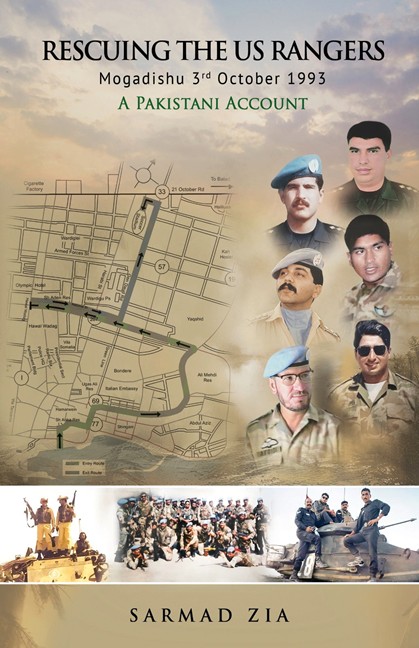
SARMAD ZIA (LAHORE: VANGUARD BOOKS, 2026), ISBN: 978-969-402-707-4
(PAGES. XXIV-169)
The debate on the contribution of the Pakistan Army in global peacekeeping operations has always remained an area of less scholarly attention in the international intellectual circles, despite witnessing the sacrifices of the Pakistani soldiers in the regional and international peace operations. Apart from constantly averting continued threats of Indian aggression in the regional South Asian security complexities, the role of the Pakistan Army in the Somali civil war has been briefly acknowledged by the international community. It could be treated as a missing dimension in international military studies and peacekeeping operations, where Western narratives are always positioned as the dominant trend. On these lines, the book under review is a commendable academic version of Pakistan Army’s pain and anguish in Mogadishu while protecting American soldiers trapped in diverse critical conditions. An Islamabad-based researcher, Sarmad Zia, author of the book, is currently serving as Assistant Director of Research at the Army Institute of Military History. While completing his higher studies at the country’s top-ranked university, Zia cultivated a commendable reputation in geopolitics, defence, and foreign policy. In his analysis across the book’s brief five chapters, he has attempted to offer an exceptional account of the various arguments, highlighting the well-coordinated and well-planned rescue operations of Pakistani soldiers in Somalia.
This is a story of unheard and unnoticed rescue operations operating under the United Nations Operations in Somalia (UNOSOM I and II) and centred on the active role played by Pakistani forces. These operations were carried out in Somalia’s critical war zones, such as Mogadishu, Kismayo, Merca, and Afgoye, and made Somalia an extraordinary and unforgettable chapter in Pakistan’s military history (p. 08). In this context, the author has mentioned the government of Pakistan’s wider peacekeeping efforts beyond Somalia and highlighted Pakistan’s broader pursuit of a rational global vision for advancing peace through a pragmatic approach. It has resulted in an admirable role of forces in Congo (1960-1964), West New Guinea (1962-1963), Namibia (1989-1990), Kuwait (1991-1993), Haiti (1993-1999), Cambodia (1992-1993), Balkan States (1992-1996), Rwanda (1993-1996), Angola (1995-1997), East Slavonia (1996-1997) and Sierra Leone (1999-2005) (p. 09). It provides a glimpse of Pakistan’s continued efforts to uphold the United Nations’ international peacekeeping missions and their appropriate executions in the required directions.
Based on these descriptions, it can be maintained that Pakistan’s exceptional warfighting capabilities, especially in irregular military operations, are a marginalised scholarly area that requires appropriate attention from the world’s leading intellectual communities. The mainstream military academic account conversing United Nations peacekeeping operation in Somalia generally overlooks the remarkable contribution of the Pakistan Army in saving American Rangers under a crucial security environment. Thus, this book is a study of extremely hostile conditions of the Somali civil war, which were efficiently managed by the Pakistani soldiers while avoiding the high probabilities of collateral damage. Despite confronting the challenging circumstances of Somali guerrilla warfare tactics and their multi-directional executions in Mogadishu, the lack of sufficient and credible information about the ground realities and their critical formations was the major challenge for the Pakistani soldiers, a fact unambiguously acknowledged in the book’s arguments.
These challenges led to vague operational planning in Somali’s perilous intrastate war conditions, where operational bankruptcy constrained the scope of desired operational outcomes, as clearly highlighted in the book. The author’s arguments, supported by various sets of empirical evidence, enhanced the validity of its findings, formulating a narrative for Pakistan, or a counternarrative to the Western media reports laden with several misinformation narratives. These dominating narratives sometimes reflect the internationally evolving disinformation campaign targeting Pakistan’s constructive and productive role in the world, particularly from the United Nations’ platform. In this scenario, the substantial descriptions of selected rescue operations conducted under the auspices of the United Nations present Pakistan’s rationally empowered position, as admired in the book. With the support of extensive primary data, the author’s interviews with the relevant veterans comprise his attempts to portray the actual challenges and circumstances that multiply the suffering of Pakistani soldiers in Somalia due to limited resources and lack of advanced military equipment. Rather than focusing on such operational insufficiencies, Pakistan’s contribution to Somalia’s peacekeeping efforts strengthened the credibility of UN peacekeeping missions worldwide. This book thus could be considered an exceptional academic study concentrating on the considerable courage, professionalism, the sufferings and inevitable sacrifices of the Pakistani forces serving under the United Nations mandate. The author’s non-traditional way of expressing his opinion, laced with convincing first-hand information sets, has made it an essential read for students of politics, international relations, defence, security, and strategic studies. Politicians, diplomats, military officials, and policymakers can find it an appropriate account that explains the complexities of joint military operations, particularly those involving multistate coalitions.