




The India-Pakistan four-day confrontation in the kinetic domain has inaugurated a new debate in leading global academic circles, compelling them to alter their conventional visualisations of contemporary nuclear politics. New Delhi’s formal attempt to rationalise its offensive strategic aspirations through Operation Sindoor led to Islamabad’s reactive defensive approach in the form of Operation Bunyan-un-Marsoos. Both operations emerged as key factors in updating the international system’s understanding of the politics of nuclear rivals, centred in the Cold War era. In this scenario, the respective strategic communities in India and Pakistan have begun working to upgrade their contrasting versions of nuclear deterrence.
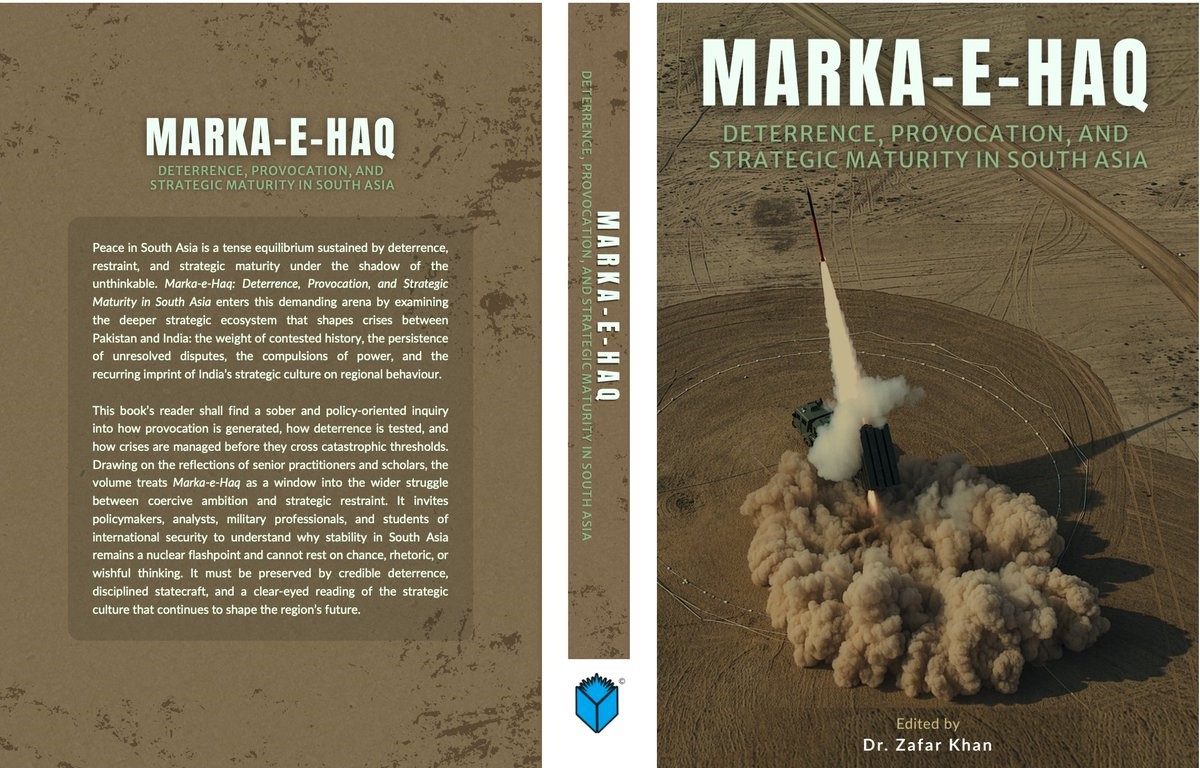
These visualisations raised the probability of direct confrontation between two neighbouring nuclear adversaries beyond their sub-conventional-level engagements. The book under review presents a comprehensive account of the Marka-e-Haq (battle of righteous), which was more than an expected tactical response by Pakistan to India’s reckless strategic posture and its operationalisation in the aftermath of New Delhi’s false-flag operation in the Indian Illegally Occupied Jammu & Kashmir (IIOJ&K). In May 2025, tensions between the two South Asian nuclear states rose following the tragic Pahalgam incident, which eventually led to New Delhi’s strategic endeavour to normalise its aspired compellence, forcing Islamabad to normalise deterrence, as mentioned in the book (p. 106).
It is an edited book compiled by Dr Zafar Khan, Executive Director of the Balochistan Think Tank Network (BTTN). The book presents a brief account of the varying analyses maintained by career diplomats, the military high command and leading academicians, who are actively engaged in studying the changing patterns of South Asian regional security complexes under the nuclear shadow.
Apart from a brief introduction by Dr Zafar Khan, the ten brief chapters cover different topics related to recent strategic developments in the protracted contestation between New Delhi and Islamabad, marked by their persistently evolving, multifaceted, hostile interactions in diverse directions. The contributing analyses by different authors in this edited volume generally emphasise regional deterrence, military crisis, strategic stability, and the contesting formal political behaviours of India and Pakistan.
After a short introduction by the editor, the first chapter, authored by a retired ambassador, Zamir Akram, who was prominently Pakistan’s Permanent Representative to the United Nations and presently a serving advisor to the Strategic Plans Division (SPD), underlines the major turning points of Indian strategic transformation starting from its first Prime Minister, Jawaharlal Nehru. It was the strategic manifestation of the so-called Non-Aligned Movement, facilitating India’s adoption of a covert approach to securing multidimensional support amid the Cold War’s structural bipolarity.
It is called, in the chapter, the prevalence of geopolitical opportunism in Indian mainstream defence planning, benefiting from the capitalist-communist divisions of the world (p.8).
The author calls it a chronological description of India’s strategic transformation, defining New Delhi’s preferred way of achieving mainstream foreign policy goals offensively, in parallel with the Saffronisation or Hinduisation of the armed forces at the national level, especially under the present Bharatiya Janata Party (BJP) rule (p. 16).
A logical explanation by Dr Zafar Nawaz Jaspal in the second chapter focuses on the present national security strategy of the Modi government, primarily originating from the so-called Doval Doctrine, which instructs the New Delhi-based architects of national security to adopt a policy of institutionalised terrorism. Dr Jaspal, an Islamabad-based Meritorious professor of International Relations and Vice Chancellor of the country’s top-ranked university, has investigated an overt involvement of the Indian intelligence community in the domestic politics of territorially adjoining nations, which explicitly reflects the imprints of former RAW’s official Ajit Kumar Doval on the country’s adopted national security strategy.
It prioritises an ‘offence-defence’ strategy to combat the challenges posed by terrorism and insurgency (p. 35). Dr Jaspal mentioned four points of the Doval Doctrine rationally proved to be the responsible factors endangering the scope of peace and stability in the region’s intense nuclear apparatus, where Pakistan is New Delhi’s prime target.
Another prominent academic figure in the Islamabad-based strategic community, Dr Rizwana Abbasi, highlights the twin flashpoints of the two South Asian nuclear arch-rivals, Kashmir and water, while fundamentally focusing on the vicious regional hydro-political patterns associated with the politics of the Indus River Basin (IRB).
Professor Abbasi is a widely published author with a respectable global standing in the leading debates of the international strategic community, concentrating on the militarisation of Kashmir. It has caused a strategic shift in the Indian military modernisation and weaponisation of water, explicitly empowering New Delhi’s regional hegemonic ambitions while ignoring the overwhelming impacts on the broader vision of South Asian peace.
In her concluding analysis, Professor Abbasi identified the territorial dispute over Kashmir and the evolving contestation over water resources as the two fault lines that make war highly likely and make peace elusive between New Delhi and Islamabad (p. 65-66).
An impartial examination of Indian strategic culture (commonly known as Bharati Strategic Culture) and its evolution, from Kautilya to Modi’s doctrine of violence and unilateralism, is provided in the book’s fourth chapter by Lieutenant General Mazhar Jamil (retired). The chapter explains Pakistan’s response in the form of cohesive deterrence – a strong, cohesive response with potent capabilities.
The notion of cohesive deterrence is called in the chapter as “the resolute national will to defend against the increasing Indian aggression and imperialist strategic culture, with a strong integrated response in all domains of the conflict spectrum, while the FSD (Full Spectrum Deterrence) within the precincts of CMD (Credible Minimum Deterrence) remains its central pillar with ready and robust strategic capability” (p. 84).
After providing a rational understanding of the South Asian complex security environment, centred on the offensive designs of Indian regional hegemonic misconceptions and the rejection of the multilateral opportunities in the region, the book’s discussion of the current scenario appears in the fifth chapter, authored by Brigadier Dr Zahir Kazmi (retired).
He focuses on the significance of Marka-e-Haq in the South Asian new normal, where Pakistan’s strategic posture is defined by a measured response, doctrinal adaptability, and recalibrated deterrence (p. 88). Additionally, Dr Rabia Akhtar mentions New Delhi’s dangers of overconfidence and the illusion of controlled escalation in the sixth chapter. Based on her strong intellectual standing in the intricacies of South Asia’s nuclear deterrence and strategic stability, Professor Rabia Akhtar analytically reviews India’s self-deception doctrine and its associated risks to regional stability (p. 123).
The book’s subsequent chapters unfold the intensity of strategic contestation between New Delhi and Islamabad in the post-2025 setting, with Brigadier Dr Naeem Salik (retired) outlining the escalation ladder and the likelihood of future crises. The reassessments of deterrence stability following the May 2025 crisis are also highlighted by Lieutenant General Khalid Ahmed Kidwai (retired).
The incontrovertible lessons from the Marka-e-Haq are emphasised by Lieutenant General Sarfraz Sattar (retired), and a logical future prediction in the presence of a fragile notion of stability is mentioned by Lieutenant General Aamer Riaz (retired) in the end. The opinions of four retired senior military officials in the last four chapters (seventh to tenth) were presented, drawing on a combination of their extensive practical experience and pragmatic academic insights.
These chapters are logically organised and complement one another while advocating strategic maturity and its effective demonstration, alongside available military capabilities. The inclusion of such analysis in the book proves an inseparable connection between the theoretical dimension of strategic knowledge and its operational performance. Thus, the intellectual demonstration by senior military professionals strengthens the validity and credibility of the book’s arguments, which are loaded with conceptually sound explanations.
Based on these narrations, the book could be considered a timely and thought-provoking contribution to the existing literature exploring the evolving dynamics of India-Pakistan’s perpetual rivalry, laced with the region’s strategic complexities. These complexities required appropriate attention of the strategic communities beyond the Cold War’s blueprints.
Moreover, the book’s central theme makes it a multidisciplinary study that examines the India-Pakistan crisis through diplomatic, political, technological, and strategic perspectives. The multidisciplinary nature warrants a wide readership, including people from diverse professional backgrounds, especially those interested in updating their understanding of the South Asian versions of deterrence and crisis management, as well as the persistently evolving regional strategic environment in South Asia.