


Major General Naseerullah Babar was born in 1928 Ilmaeil Khel near Akora Khattak Nowshera, Khyber-Pukhtunkhwa Pakistan. His family is from the Babar tribe of Pashtuns and hails from the village of Pirpiai in district Nowshera.
Babar’s early education was from Presentation Convent School, Peshawar from 1935 to 1939. From 1939 to 1941 he attended Burn Hall then located at Baramula and Srinagar. The school was subsequently shifted to Abbottabad after Partition. He also attended Prince of Wales Royal Indian Military College in Dheradun and joined Pakistan Army in 1948. He was part of the first PMA long course which graduated in 1950.
Army career and Indo-Pakistani Wars
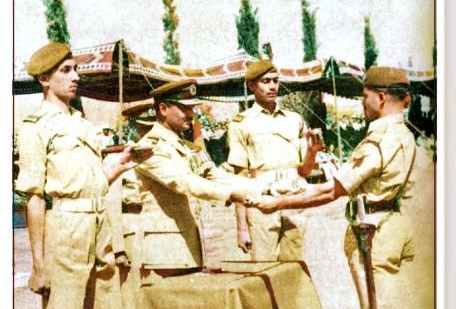
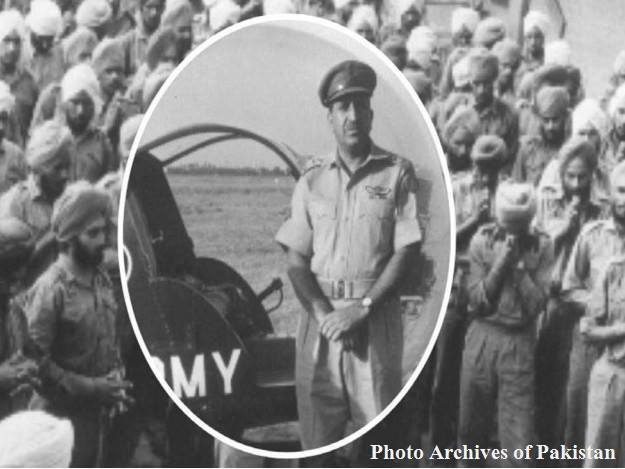
In his long career in the Army, Babar served in the Artillery Corps and Aviation. During the 1965 war with India, Babar single handedly captured an entire Indian company of soldiers (over 70 POWs) and was awarded Sitara-e-Jurat for this action.
First Sitara-e-Jurrat of Army Aviation
On 1 September 65, Lieutenant Colonel NUK Babar alongwith Major AB Awan (later Lieutenant Colonel) and captain Akram (later Brigadier in Army Aviation) flew into the battle zone in one “Bubble” primarily in search of some enemy weapons to be kept as souvenirs. On way to CHAMB near PAUR village, they spotted an Indian company post in disarray. Major Awan, who was on the controls, landed near by, on the insistence of Colonel Babar, who probably, had the inkling of making lemonade out of the available lemons. The enemy in the trenches, consisting of some 70-75 soldiers (including tow junior commissioned then on Colonel Babar turned into a drill instructor.
In the meantime India aircraft were seen in the air so Major Awan was told to take off in his H-13 and he reached back safely. Since there were some injured as well, in the surrendering crowd, so they were put in an abandoned jeep and Captain Akram was ordered to drive them to some medical facility. Then the Indian prisoners were made to fall-in, like a squad on a parade ground, in three ranks and were ordered to march on by Colonel Babar. He followed them all along till they arrived at BHIMBER where they were handed over the Brigade headquarter. For this astonishing venture, he was awarded Sitara-e-Jurrat (SJ) and became the first aviator to get this prestigious bravery award, incidentally in 1971 war, he again got another SJ in the same area as Artillery Commander, where he was also wounded. To keep the record updated, he much later as a retired Major General became the federal minister of Interior after getting into politics and willingly got into a school bus being hijacked by some Afghani miscreants. He finally lured them into a killing ground and solved the problem for this he was awarded yet another bravery award of Hilal-e-Shujjat in December 1994.
In the 1971 war, he commanded an artillery brigade in support of 23 Division and later commanded an infantry brigade until he was wounded and evacuated from the battlefield. He also had the distinction of having been awarded SJ & Bar. In 1972, he was appointed Inspector General Frontier Corps. He resigned from the Army in 1974 while commanding an infantry division and was appointed Governor of Khyber-Pakhtunkhwa.
Joining the PPP
Babar joined the Pakistan People’s party (the PPP) in 1977 after the arrest of Zulfiqar Ali Bhutto. He famously threw away his Hilal I Jurrat (with bar) and other army medals at the presiding officer of a military tribunal, when Zulifqar Ali Bhutto was handed by the military regime of General Muhammad Zia-ul-Haq.
Assassination of Shiekh Abdullah Azzam
Naseerullah Babr became the Special Assistant to the Prime Minister Benazir Bhutto in 1988. he extradited some 100 Egyptians to Cairo. Also believed to have played a rile in the assassination of Palestinian-Afghan Mujahideen leader sheikh Abdullah Yusuf Azzam in Peshawar on November 24, 1989 in a car bomb killing him and his two sons.
Interior Minister 1993-1996
In 1988, Babar was a Special Assistant to the Prime Minister, Benazir Bhutto and successfully ran the election for Begum Nusrat Bhutto from Chitral during the preceding elections.
Elected in the 1993 general election on a People’s Party Ticket from Nowshera he defeated Awami National Party President Ajmal Khattak, with the PPP’s victory in the election and was appointed Federal Minister for the Interior by Benazir Bhutto.
It is believed that General Naseerulllah Babar was one of the major proponents of backing what eventually became the Taliban. This support was driven by a desire to influence the future of Afghanistan, and to provide some stability on Pakistan’s Western border. General Babar was also involved in a crackdown on MQM. His operation was very controversial. From the second quarter of 1996, Karachi became governable yet the political process to remove the grievances of people in urban Sindh was not launched.
1997 and onwards
After the dismissal of Benazir Bhutto’s second government by Farooq Leghari, Babar contested the 1997 elections again from Nowshera as well as from Karachi. He was defeated in Nowshera by ANP candidate Wali Muhammad Khan and from Karachi by Nawaz sharif’s nominee Ejaz Shafi.
Contesting again in the 2002general elections he was defeated in the electoral sweep of the religo-political alliance the Muttahida Majlis-e-Amal, mainly due to Musharaff’s goals of bringing Islamists in Khyber-Pakhtunkhwa and Balochistan to power.
In October 2007, he left the Pakistan Peoples Party due to his disagreement with Benazir Bhutto over her support for General Pervez Musharraf. This action was considered as a major blow for the Pakistan Peoples Party because he was their major political leade in the Khyber-Pukhtunkhwa.
Death
On 19 August 2008, Naseerullah Babar suffered a mild stroke and was admitted to a hospital. He recovered and returned home in November 2008. Naseerullah Babar died on 10 January 2011.