




Abstract
Leather tanneries is one of the 29 occupations that the government of Pakistan has listed in the worst forms of child labor and decided to free it from this men-ace. With the advent of the era of fast globalization, child labor drew equal attention from perpetrators as well as the protectors. In case of Leather tanneries Industry in Pakistan, once pressure built and the child labor issue highlighted by the international media, global actors impacted positively in collaboration with the government of Pakistan and the local industry to eliminate child labor from the industry. However, a holistic success is still in limbo.
Tanneries are also included in the list of 27 worst forms of child labor. This sector is also among the six selected by the government of Pakistan to immediately address with the support of the ILO-IPEC. Tanneries in Kasur city are mainly located in areas like Niaz Nagar, Dingarh, Younas Nagar, Kot Maulvi Abdul Qadir. Peripheral areas include Mangal Mandi, Pacca Qila etc. All these areas are contiguous and form one large cluster. There might be a few more tanneries 20% children under 14 years of exist in rural areas because of elsewhere in Kasur district having over 5000 workers including 15-20% children under 14 year of age1. In Kasur, tanneries are practically within the city. They do not exist in rural areas because of transportation costs of shipping hides, and chemicals.
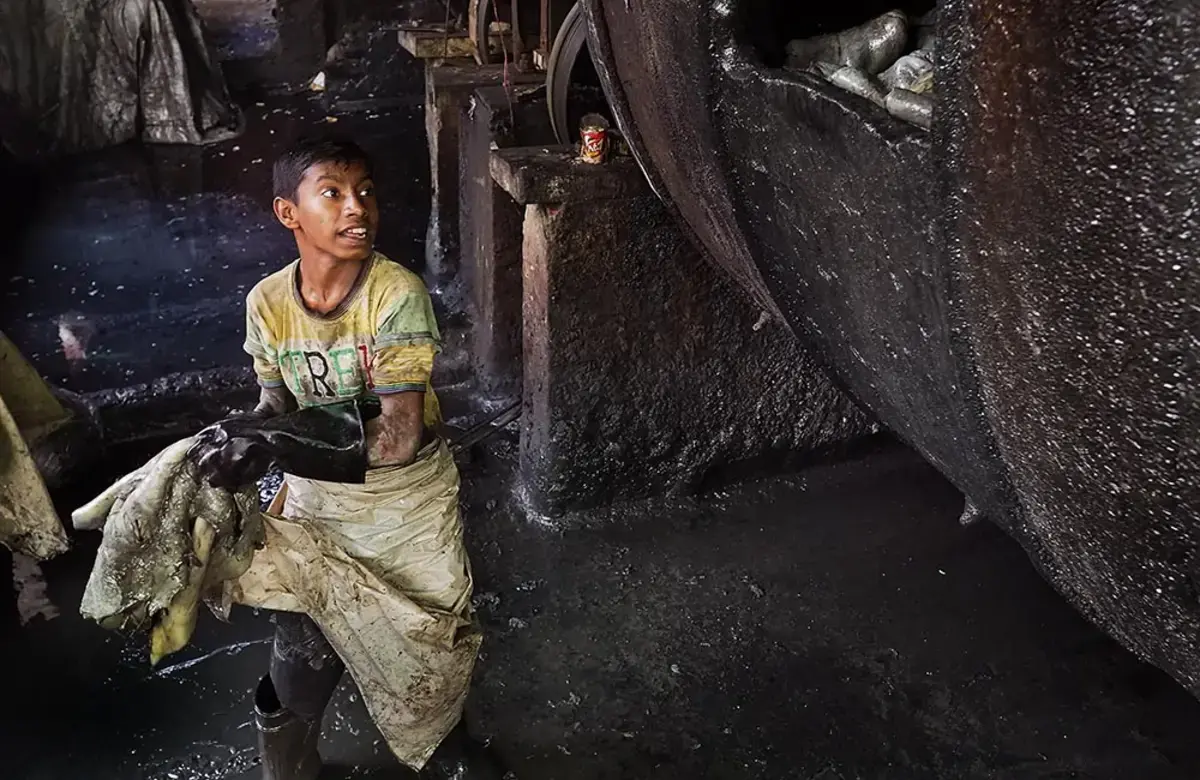
Chemical market is located within the tannery cluster area and it would not be feasible to have chemical shops in rural areas for only one or two tanneries. Also, since planning is poor and frequent visits may be required to chemical shops based on immediate needs, tanneries cannot afford to be located in rural areas with the chemical market in the city. Kasur is an under developed district with low literacy rate and serious pollution and environmental problems, mainly because of tannery affluent. The Action Program worked with children in the 15-17 age group working in tanneries, one of the worst forms of child labor in Pakistan. They work in different tanning processes such as salting raw hides, trimming, liming, shaving, operating and retrieving hides from drums, loading and unloading, and spray painting. Each process is accompanied by different hazards and some of them have direct and immediate effects on the health of children. Some of these effects include stomach disorders, eye and skin infections, cuts and bruises. Long term effects may include serious effects because of exposure to various chemicals, toxic gases and formal dehyde (which is carcinogenic) with limited, inadequate or no safety measures or devices2.
Children come from all over Kasur city and suburbs (some from villages as well) to work in tanneries doing different works: Spray painting of leather pieces, drum work, pond/ vat work, spreading leather head part on plates, drying semi finished leather, loading/ unloading leather & chemicals, handling waste etc. Some children do peripheral work like plying donkey carts to transport skins, hides, leather, waste, chemicals. Some work on chemical shops within tannery. Tannery owners normally have a core technical staff, and employ gangs of contractors & subcontractors to work on tannery premises. Contractors/ subcontractors employ children. Often fathers and sons work together. All tannery children are boys. Girls do some peripheral work at home with elder women. No. of Christians in adult & child workers is proportionately higher than their population.
Tanneries associations include Dingarh Tanneries Association and Small Tanneries Association. Barely 20-25 out of 250+ tanneries can be called modern. Rest are traditional. Most small tannery owners are barely educated. Occupational safety & health and physical environment is generally terrible. Very little conscious-ness/ use of safety devices is observed3. Sudhaar, a national NGO, managed an NFE center with IPEC funding in Mangal Mandi from 1995-2000. Since then it is being managed by local NGO r. Foundation comprising center supervisors and teachers who worked previously with Sudhaar. They are being funded by South Asia Partnership. Studies avail-able include: Saeed Awan on OSH, Punjab Labor Dept on Child Labor in tanneries (reliability questionable), Child Labor in Kasur Leather Industry by Innovative Consultants, Women in Kasur Leather Industry. Kasur District Government-Tanners-UNIDO funded program on treatment of tannery waste operational. KTWMA (Kasur Tannery Waste Management Association etc) office located in Kasur4.
A baseline study was commissioned by ILO-IPEC in 2003 in Kasur to determine extent of child labor in this sector and options for possible interventions. The study identified 717 male children working in the tanneries of Kasur district with no incident of girl working. Out of these 333 were in 5-14 year age group and remaining 384 in 15-17 years age group. The study revealed that most working children start work for supporting their family, another major reason came to forth was desire to learn the vocation/skills, and family pressure to work for gaining some financial support. Some children reported that they were pressurized by the family to take up work in tanneries. Other reasons came to forth were bad performance in schools, compulsion of work due to father’s death, unemployment or addiction, high school bills too compel! the parents to put them in pupilage in any trade. Parents also gave the reason of low academic achievement of their children; and the need to support family financially’. Centre for Improvement of Working Conditions and Environment, labor department government of Punjab carried an Occupational Safety and Health (OSH) study, commissioned by ILO-IPEC. The study revealed that the children suffered from disturbed sleep, pain in lower back, neck and shoulders. Personal hygiene of these children was very poor, and had also suffered from eye infections, and other skin diseases and respiratory diseases. Signs of stunted height and weight were clearly visible. These children were exposed to chemicals and suffer from dehydration, abdominal pains and ENT diseases and in some cases to physical punishment6.
How Children Join Tanneries
As is the case in many sectors, a number of children in Kasur are either school dropouts or never enrolled in schools (the combined proportion is estimated to be between 40-50%). They come from the poorest of families. Their parents are suffering sever economic hardships. They are deeply concerned that If their children remain idle, they will fall a victim to social evils like gambling, drug abuse or crime. One option is getting the children recruited by contractors to work in tanneries. This option solves the delinquency problem immediately and promises economic gains in 3-4 years when the child is earning enough to contribute to household income. In some cases the families may be running into debt (to tannery contractors or other money lenders including employers of family adults in other sectors family members or friends) and children’s income seems to be the only source to clear the debt in the long term. The father speaks to a contractor and requests that his son be taken in as an apprentice on a mutually agreed daily wage which is usually very low to start with. Sometimes the father himself is working for a contractor or even as a con-tractor and this makes the induction even easier. In some cases where the father has taken an advance from a contractor and is unable to pay the installments in time, it becomes a compulsion to induct the son to supplement the income.
Debt Bondage
Debt bondage is the most accurate way of describing forced child labor in tanneries like in any other sector such as carpet weaving, brick klin etc. When fathers (whether tannery workers or not) have taken advances from contractors and they are unable to pay the installments in time, their children become de facto bonded to the con-tractor until the debt is cleared. Many people take advances (called peshgi in local language) to meet the house-hold expenses or satisfy other needs, their children are then attached to the contractor who paid the advance. They cannot leave or switch jobs unless the advance is cleared or the contractor decides that he can recover the advance through some other means (which is rare). The children work in the day time, sometime until late evening, and the workload increases at different times of the sea-son when hides arrive in large numbers and they have to be processed. The children spend the nights at their homes but as stated above, they are de facto bonded, although Bonded Labor System (Abolition) Act prohibits the debt bondage.
Children Wages
Children are paid for their work in cash. In case of younger children, the payment is usually received by families while older children get the payment directly. Payment can be on weekly or monthly basis. It is usually based on the amount of work done (e.g. number of head part of hides spray painted). If an advance has been given to the child/ family, the installment is deducted form each payment.
Risks faced by Children and Families
Physical risks include handling dangerous chemicals, exposure to toxic gases, inhalation of formal dehyde fumes, cuts and bruises. Children face the risks of verbal and physical abuse from adult workers, contractors and even some tannery owners who are not their direct employers. Risk of sexual abuse is not entirely unknown. They learn to smoke, sniff glue and possible expo-sure to drugs and x-rated films from adults. Those who have taken advances are under a constant threat of incurring the wrath of the contractor if they are unable to pay the installment. They are also afraid that if their children working with the contractor are unable to put in the “desired” amount of work, they will earn less and also be at risk of being ill-treated by the contractors. An underlying fear is that the contractor may fire the child at some pretext. Worse (in their perception), the con-tractor comes home and degrades the family in front of the entire neighborhood. The net result is that children are told to work hard and be “obedient- so ensure that the con-tractor does not get angry with them.
Working Environment
The tanneries are generally big establishments because they need space for small ponds and vats, place where drums are to be installed, space for installing various machines, storage for raw and semi-finished hides, chemicals, place for spray painting and also for other processes. Many tanneries are two storey buildings (with improper and inadequate structures) where the upper storey is usually used for spray painting. In general, hygienic conditions are appalling. There is hardly any fencing around ponds and vats. Wiring is in tatters and poses a constant risk of electrocution. Very few tanneries have wash rooms. Safety equipment is either nonexistent, or in poor conditions or the workers do not have enough awareness to use it7.
Tanning work has traditionally been seen as dirty work and the last choice by a majority of workers. Tanneries have existed in Kasur since pre-partition days. At that time Hindus did not like to work in tanneries because they consider the cow as sacred and for them it was an anathema to process hides. Muslims also abhorred working in tanneries because of its low status. So only the lowest and poorest classes comprising both Muslims (generally low caste) and other religious minorities (mainly Christians) took up this work. Even today Christians are disproportionately represented in tanneries work force in comparison to their population ratio in Kasur. The children are quite mature and some of them are deeply frustrated with the unbalanced economic structure of the society. The economic situation is quite bleak as they have daily wage employment which is low paid coupled with harsh attitude of the sub-contractors and tannery owners. When they are not “fortunate” enough to be working in tanneries, some are engaged in illegal and criminal acts such as using drugs, drinking, gam-bling, and theft etc. During the informal interviews with children and employers regarding safety equipment several comments were made. Mostly children said “When we used safety equipment the pace of work decreases and we make less money”. It is a common observation that the use of safety equipment/ devices is low and irregular even where it is available. Other than the concern for reduction in pace of work, lack of awareness on serious threats posed to health is a major reason why this is done. Most children are not trained or used to working with safety equipment and some consider it a slur on their macho credentials to be seen using safety devices. Some children said “We don’t have access to safety equipment” while the employers said “We provide safety equipment to workers but they don’t have any interest to use it.” Some of the employers stated “We can’t provide safety equipment on regular basis because the business is going down every day and the profit margin has decreased to a large extent and in this situation how can we use our budget on safety equipment”. Since the market demand for safety equipment is low, such equipment is scarcely available in the relevant establishments in the tannery clusters in Kasur8.
Information available from different but limited sources indicates that sustainability of the action pro-gram of ILO-IPEC to end child labor in this sector was attempted through involving community and district government in the activities and giving them ownership of the project right from the beginning9. The com-munity groups were not only involved into monitoring but were also transformed into Citizen Community Boards (CCBs) through the active involvement of the Executive District Officer (Child Labor) and Social Welfare Officer which launched projects in education or child labor sector10. CCBs took over programs from implementing organizations. The other aspect of the sustainability included the role of districts government capacities were build which to inculcate child labor programs in the district developmental program and other devolved departments11 resulting in installation of CLMS in which SWO was instrumental12.
District governments were encouraged to register more CCBs, and to increase funds for those working on CL/WFCL issues, so that project activities could be carried out. Project details were shared with District Coordination Committees (DCC) chaired by Zila Nazim/ DCO. It was made obligatory that DCC meeting should be called in quarterly, to give inputs and to link project activities with the district government led initiatives. Owners of tanneries and their associations too were involved to sensitize them on child labor issues for bringing change in their practices13. The district government agreed on developing PC-I (project document) on the issue of WFCL/CL in one of the DCC meetings. A training program was launched for formal school teachers on WFCL/CL issues. Three hundred and twenty eight children were facilitated in getting through a health screening exercise with the support of District Health Department followed by treatment supported by the project. Tanneries Association Din Garh took a bold and long term sustaining step by opening a free dispensary in the tannery cluster area for providing diagnosis and medical treatment to the workers, both adults and children. Three com-munity groups were organized and registered as Citizen Community Boards (CCBs) with the Community Development Department Kasur. These CCBs are eligible to receive funds from the district government based on appropriate proposals developed by them. However, the major drawback was the funding issue for CCBs from government as the rules call for 20% share by CCBs for any development project. The communities are as a whole extremely poor and they were not able to raise 20% share. Other than that there are serious hurdles such as political interference and bureaucratic delays in getting proposals approved and release of funds. There are some concerns that the CCBs are expected to commit part of the proposed funding as unofficial fee for getting their proposals approved. The Action plan faced another major drawback in term of government officials’ transfer as six key persons were transferred during the life span of project. This affected the continuity of activities and on each occasion when a key government official was transferred and a new official took charge, the whole mobilization and relationship building exercise had to start from the scratch. This was particularly acute when the District Labor Officer was transferred at a crucial juncture as the Child Labor Monitoring System was being put in place.14
The EDO literacy was involved in all the stages of the project. The main purpose of the involvement of EDO Literacy was that after the windup of the project the best practices and lessons learnt could be adopted in the government vocational trainings centres. Hence advocacy for literacy and vocational training of tannery children started from the beginning of the project’s15 however the project failed in its efforts to mobilize EDO (Literacy)16.
Life time of the project increased from 24 months to 29 months. As a result of that target of providing literacy to working children was increased and achieved from 250 to 328. Similarly pre-vocational training target was enhanced and achieved from the original 50 children to 77 children. The Kasur District Government agreed on developing PC-I (project document) on the issue of WFCL/CL in one of the DCC meetings. This is an important outcome and will need follow up by the implementing agency even after the completion of the program. The ILO/IPEC provided regular facilitation in implementation of the project through training sessions. There were very few problems of coordination with IPEC and these were solved through regular communication and meetings. Monitoring visits and review meetings with IPEC were instrumental in ensuring that the project was kept on track in terms of targets and deadlines. Punjab Labor Department’s Centre for Improvement of Working Conditions & Environment (CIWCE) provided support an organizing training sessions on OSH. The CIWCE has extensive experience in OSH and child labor issues and their professional input was instrumental in securing the support of Tannery Association, employers, contractors and workers. The Tannery Association Dingarh (TAD) support-ed the project interventions despite their reservations on child labor as seen in the context of international convention on child rights. They see it more in the perspective of poverty and the need for children to work to support their families and feel that the employers are actually doing a service by letting children work. Despite that major difference in per-spectives, the TAD is eager to take up welfare activities that may bene-fit the contractors and tannery labor including children. A practical example is establishment of a free dispensary by the TAD for contractors and workers funded by the association. The dispensary does not require donor funds or external sup-port and it will be sustained by the TAD. The TAD is also interested in OSH but a proper plan needs to be formulated and supported with a cost sharing arrangement. There is little expectation of employers implementing OSH practices with-out cost sharing in the short term. EDO (CD) was the focal person for the DCC. He ensured that DCC meetings were held in time and there was adequate participation. He coordinated with DCC members and the Sudhaar project management to ensure that DCC feedback and comments were incorporated in the project implementation. Besides this, District Labor Officer (DLO) and District Social Welfare Officer (SWO) were working under EDO (CD). The DLO cooperated and participated in awareness activities and played a key role in installing the CLMS. The SWO was instrumental in registering CCBs organized under the project. EDO (Education) cooperated in training of teachers from formal government schools based in project target areas. He and his focal person worked extensively with the project team in developing the Kasur District Education Plan. The project was unable to mobilize EDO (Literacy) into action despite repeated and sustained efforts. The common activities were literacy centers and vocational training and there was much to learn from each other in these two areas but the EDO (Literacy) could not see the connection perhaps because of workload and lack of capacity. The Action Program focused on 15-17 age group children working in WFCL in Tanneries Industry of Kasur District. All child labor in tanneries comprises boys. They may be as young as 8 years and as old as 17 years. Greater part of child labor is 12+ (an estimated 75-80%). Children work in de hairing, liming, washing hides and slicing away superfluous mass from them. They carry wet hides to open ground and spread them out for drying collecting them later and repeating the cycle with fresh haul of hides. They work on electrically operated drums in which hides undergo a number of chemical processes. When a specific process is completed, the window of the drum is opened and drum is then rotated again. As a result hides fall out of the drum. However some of the hides get stuck to the walls of the drum and young children are sent inside to peel them off. This exposes them to various toxic gases. One of the most dangerous processes in which children are involved is spray painting of hides. Hides (head or body part) are hung on wires or spread out on wooden stands while children use hand operated spray guns to paint them. At the final stage of the process, formaldehyde (carcinogenic) is added to make the hides shine and its pungent odour makes breathing difficult. They produce finished leather pieces (head or body parts of cow hides). The leather pieces are sold by the tannery owners to buyers mostly coming from Peshawar, Sialkot and Lahore. Some tannery owners do not go through all processes and sell the hides in a semi finished state which is called “wet blue” stage. The goods produced by small tanneries are mostly for the domestic market. Medium and large size tanneries are mostly exporting the goods. The difference is that of quality of finishing. In tanneries, boys are exclusively employed. Some girls may be engaged in very preliminary tanning processes at home (mostly related to dehairing and cleaning hides) but they do not work in tanneries. A vast majority of children in tanneries comes from Kasur city while there may be a small number of migrants or rural workers. There would be lit-tle to choose from ethnic groups, mostly the child workers are Punjabi along with some Pathans. There is one important aspect however. Considering their population ratio in Kasur, Christians are represented in tanneries in higher numbers than Muslims. The historical background is that Hindus considered tanning an “unholy” process because of usage of cow-hides while the Muslims considered it “dirty” work so only the poorest chose to take up this profession. This explains why Christians are present in a higher proportion (they are among the poorest and have no bias against the tanning work itself). Tannery owners (who own the working place, equipment, tools, hides, chemicals etc.) sub-contract differ-ent processes to different contrac-tors. Each contractor organizes a team or “gang” employing both adults and children to undertake a specific job at a specific rate within a mutually agreed deadline. It is the contractors who employ workers —both adults and children — and do a verbal agreement with them normally on per piece basis. The contractors use the tannery premises, equipment, tools (they may have their own tools in some cases), hides and chemicals provided by the tannery owner. However tannery owners do not employ the actual -orkers directly nor do they pay t. m directly. Payment is made to the contractors who dictate their own t, rms to the workers. The gov-ernmen. officials appreciated and acknowledged the contributions of international and national organizations in fighting against the worst forms of child labor in Pakistan. The Action program contributed towards the WFCL through the joint venture of ILO and Pakistan’s gov-ernment on WFCL while Sudhaar worked as implementing agency. The strategy adapted in implementa-tion of the AP with different ways as the project worked at national, provincial and district level. At nation-al and provincial levels it facilitated the EFA goals, ILO Convention 182 (ratified by Pakistan Government in 2001) and National Policy & Plan of Action to Combat Child Labor while on district level, the Action Program follows the basic approach of upstream and downstream activities. Upstream activities include linkages with Health Department, vocational training providers, social safety nets like Zakat and Bait ul Maal, facilitating District Education Department in developing the District Education Plan and finalizing Child Labor Monitoring System with the advice of District Coordination Committee. The downstream activities included establishment of literacy centers (for 15-17 children) followed by vocation-al training, linkages with social safety nets and credit program to families of target children, and health screening followed by medical treatment.
The action plan made extensive efforts within the limits of means and available resources. However the external macro factors responsible for perpetuating poverty and decreasing economic and social opportunities did not allow optimism to flourish on a wide scale. The people’s frustration with “sys-tem” did not change much. They certainly welcomed the project interventions that came their way but they could see few chances of these interventions being up-scaled or sustained in the long term. While tannery children man-aged to get a break through literacy intervention and a selected few were linked with vocational training, very few of them were able to find further opportunities to leave tanneries and pursue their careers in new trades. Career opportunities could have convinced the tar-get groups more strongly that the project interventions were relevant to their lifel’.
End Notes
1-Elimination of Worst Forms of Child Labor from Surgical Industry of District Sialkot”, Final Output Form-Sailkot, (Lahore, Sudhaar. (1/7/2008).
2-ILO-IPEC, http://www.ipec-pakistan.org/ipec/tbp/tbp_06_a.htm, (12/9/2007)
3. Fawad, Usman. CEO Sudhaar, letter to Chaudhry Saifullah, Program Officer ILO, 23rd February 2003, Lahore, Pakistan
4. ILO-IPEC, http://www.ipec-pakistan.org/ipec/tbp/tbp_06_a.htm, (12/9/2007)
5. Ibid.
6. Elimination of Worst Forms of Child Labor from Tanneries Industries of District Kasur”, Op. Cit.
7. ILO-IPEC, , (12/9/2007).
8. Ibid.
9. Elimination of Worst Forms of Child Labor from Tanneries Industries Kasur”. Op. Cit.
10. ILO-IPEC, Op. Cit.
11. Elimination of Worst Forms of Child Labor from Tanneries Industries of District Kasur”, Op. Cit.
12. LO-IPEC, Op. Cit.
13. Elimination of Worst Forms of Child Labor from Tanneries Industries of District Kasur”, Op. Cit.
14. ILO-IPEC, Op. Cit.
15. Elimination of Worst Forms of Child Labor from Tanneries Industries of District Kasur”, Op. Cit.
16. Ibid.
17. Life Magazine (June 1996) pp.38-48