


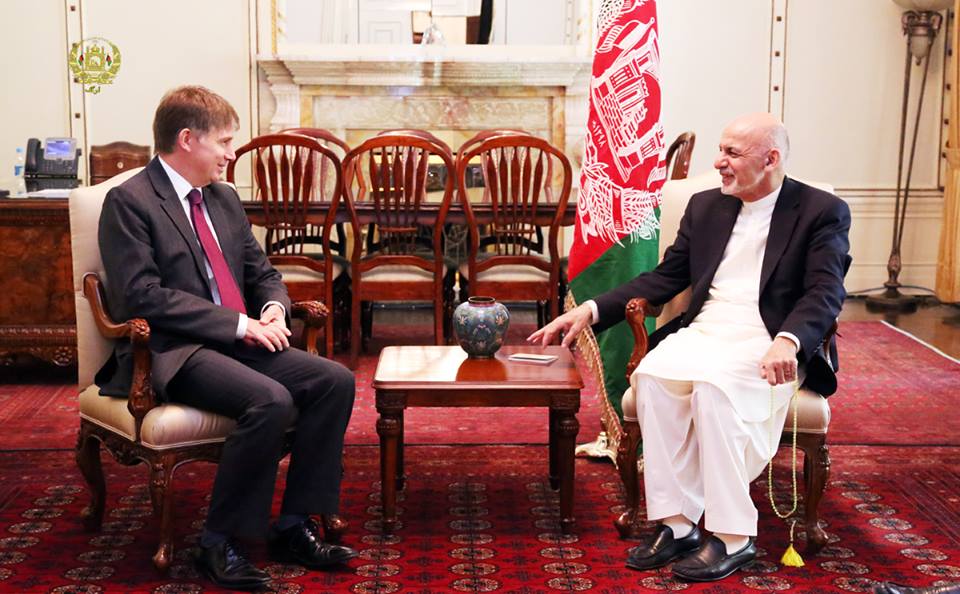
The failures of Afghanistan’s dysfunctional government are phenomenal. So called decade of transitions is marred by corruption and inefficiency. President Ashraf Ghani is busy in useless pursuits, recently he took his anti-Pakistan rhetoric to new heights by threatening to shut the Afghan transit route for Pakistani exports to Central Asia if Islamabad does not allow Afghan traders to use Lahore’s Wagah border for two way trade with India. In a recent meeting with UK’s special envoy for Afghanistan and Pakistan Owen Jenkins in Kabul, he claimed that Afghanistan was no more a landlocked country as it has many transit routes for import and export of goods.
Pakistan has no problem in facilitating Afghanistan in its imports and exports and Islamabad has proved its sincerity throughout the history of bilateral relations. Pakistan has, for decades, offered Afghanistan duty free imports and exports at the cost of its national economy, which has suffered losses to the tune of billions of dollars because of smuggling of goods imported by Afghanistan, under the garb of transit trade agreement, back into Pakistan. Despite all this, Pakistan never backtracked from its commitment to help Afghan people and even worked out a more comprehensive transit trade agreement with Kabul. Pakistan has already allowed India to trade with Afghanistan through Karachi port.
Afghanistan is allowed to send its exports to India via Wagah, however the issue of allowing India trade with Afghanistan through Wagah border is quite different as it involves serious security risks for Pakistan besides facilitation of trade to India at the expense of Pakistan’s own economy. It is also a question of concessions in bilateral trade between Pakistan and India where New Delhi is inflicting losses to Pakistan through non-tariff barriers. Under these circumstances, the insistence of Afghanistan to allow India trade through Wagah is apparently aimed at safeguarding and promoting India’s commercial interests at the expense of Pakistan.
On the political landscape, Hezb-e-Islami Afghanistan led by the prominent Warlord Engineer Gulbaddin Hekmatyar is all set to join the Ashraf Ghani government in Afghanistan. The two sides have signed the draft pact despite US resistance. Even though some political observers believe the step will pave the way for ensuring peace in the war and insurgency ridden country, the move is, however, unlikely to get endorsement from Washington that enjoys complete influence over the ruling set-up in Kabul. The deal with Afghanistan’s second-biggest Mujahideen group that has been largely inactive in recent years, marks only a symbolic victory for President Ghani, who has been struggling to revive peace talks with Taliban and other warring factions that have been facing militancy, bloodshed and uncertainty over the decades. “This agreement is signed after two years of negotiations between the High Peace Council (HPC), the leadership of the Afghan Government, and the Hezb-e-Islami. Today the peace dialogues have been successfully completed”. The deputy Chief of HPC Habiba Sorabi said at the ceremony in Kabul where Hezb-e-Islami delegation shook hands with members of the High Peace Council, responsible for reconciliation efforts with militants or the warring factions of Taliban, and the national security adviser of Afghanistan. The agreement will come into force when it is formally signed by President Ashraf Ghani and Hekmatyar, the government has said, though no date has been set.
Though Gulbaddin Hekmatyar, a prominent anti-Soviet commander in the 1980s was accused of killing thousands of people in the Afghan capital during the 1992-1996 civil war, he was considered one of the sensible and educated Warlords in Afghanistan yet offering tough resistance to American influence in Kabul. The agreement will pave the way for him to stage a comeback in mainstream politics in a pattern well established by other warlords, such as General Abdul Rashid Dostum, currently the country’s first vice president. According to initial draft agreement, the government will offer Hekmatyar legal immunity in “all past political and military proceedings” as well as release of Hezb-e-Islami prisoners. Hekmatyar is designated a “global terrorist” by the US government. The Afghan government, analysts believe, will work towards lifting those restrictions in order to reintegrate him into local politics. The US State Department had earlier said Washington was not involved in the talks but welcomed the potential truce.
The US was alleged in the past to have sabotaged dialogue process in Kabul with the militant groups. In a strong message to the international community through his speech to the UN General Assembly’s ministerial session on September 21, Prime Minister Nawaz Sharif reiterated that “Pakistan has a vital stake in ending conflicts, fostering peace, fighting terrorism, strengthening democracy, promoting human rights, generating global growth…” He added that Pakistan has long proposed intra-Afghan dialogue as the most viable course to end decades of conflict and suffering in Afghanistan. “We have been facilitating the process of reconciliation in Afghanistan…There have been setbacks. That, however, is not a sufficient reason to abandon the path of peace and rely on the military option, which has failed, for the past decade and a half, to stabilize Afghanistan”, PM added. “Progress will be assured only when the Afghan parties themselves conclude that there is no military solution to the Afghan war, and work assiduously, through a meaningful dialogue process, for achieving reconciliation and peace at home”, Nawaz Sharif went on to emphasize.
Simultaneously, in Islamabad, the United States recognized Pakistan’s progress in disrupting militant networks in its tribal areas; the acknowledgement came during the meeting of US-Pakistan Defense Consultative Group (DCG). The joint statement said “US reiterates its support for the armed forces of Pakistan in their ongoing operations in the Federally Administered Tribal Areas (FATA), including North Waziristan, and recognizes the progress made in disrupting militant networks that had helped enhance security on the Pakistan-Afghanistan border.” The US also acknowledged the progress made by Pakistan’s Armed Forces in Operation Zarb-e-Azb. “Pakistan reaffirmed its commitment to take action against all terrorists and violent extremists without discrimination,” the statement said. The Pakistani side also expressed its support and desire for stability in Afghanistan.

Meanwhile, US congressmen Ted Poe and Dana Rohrabacher have moved the “Pakistan State Sponsor of Terrorism Designation Act in Congress” on September 21. In a statement posted on his website, Poe demanded US President Barack Obama to issue a report “within 90 days of passage detailing whether or not Pakistan has provided support for international terrorism.” “Thirty days after that, the secretary of state must issue a follow-up report containing either a determination that Pakistan is a state sponsor of terrorism or a detailed justification as to why Pakistan does not meet the legal criteria for designation,” he added.
At this juncture the editorial board of International New York Time did well on bringing Afghanistan back to focus though recent editorial on Sept 17, captioned: “The Afghan War quagmire”. The piece has analyzed the Afghan situation in the context of President Barrack Obama’s two terms of presidency.
“Eight years ago, President Obama pledged to wind down the war in Iraq and redouble efforts to defeat the Taliban in Afghanistan. ‘As president, I will make the fight against Al Qaeda and the Taliban the top priority that it should be,’ he said during a campaign speech. “Now, at the twilight of his presidency, these goals are receding further into the distance as America’s longest war deteriorates into a slow, messy slog.”
Yet there are non-serious persons like Bruce Riedel who keep propping up silly comments. A former CIA analyst, Bruce was Advisor on Afghanistan to Obama administration during the first term. Amongst others, Bruce Riedel too is responsible for making Afghanistan what it is today and was rightly dropped by Obama from his Afghanistan team. Now, in an effort to secure a niche in the next administration, Bruce has made his presence felt though his nonsensical piece “Pakistani Army today is a patron of terrorism”. As expected, the piece has been carried by Indian websites, led by Rediff.com.
Still living in 2008-12 time frame, Bruce Riedel has called for an offensive strategy against terrorist networks and this includes “hitting out at terrorist groups inside Pakistan”. He is of the view that “dismantling and disrupting terror networks and their safe havens inside Pakistan should be on the agenda of the next American President”. And that Obama’s decision to use drones to kill Taliban leader Mullah Akhtar Mansoor “deep inside Pakistan” should be a pointer in this regard.
Bruce seems to be suffering from memory loss pertaining to his dormancy years. Under international pressures from Human Rights entities, including UN Council on Human Rights, drone warfare shall soon become a distant memory as outlined by Barrack Obama during his “Commencement Address at West Point” on May 28, 2015: “I also believe we must be more transparent about both the basis of our counterterrorism…We have to be able to explain them publicly, whether it is drone strikes or training partners… when we cannot explain our efforts clearly and publicly…we erode legitimacy…and we reduce accountability in our own government.” We seldom hear of drone attacks these days yet Bruce wants to turn the wheel backwards.
Bruce opined that Pakistan today was a unique country. It was a victim of terrorism and its Army was a patron of terrorism in other parts of the world “in particular in its immediate neighbourhood of Afghanistan.” Maybe Riedel needs to have his head examined for ignoring wide ranging acknowledgements from political and military leadership from all over the world, of course excluding Bruce’s special friends, Afghanistan and India, about the effectiveness of Operation Zarb-e-Azb and the dividends accrued from it. He also did not mention the obstructions being thrown-up by Afghanistan in the way of Pakistan’s efforts to manage its border.
Compare this with the reality that most hideouts of terrorists in Pakistan’s tribal belt have been destroyed. A large number of terrorists have been killed, the rest are on the run and some are in the cozy company of President Ashraf Ghani. A vast majority of Afghan fighters have, since long, shifted to Afghanistan, where they control large swaths of territories, and are no longer dependent on so called safe heavens in Pakistan. The Afghan National security forces do not have the will to challenge Taliban’s writ in the rural areas and US-NATO guys confine their actions in urban centers which the Taliban often occupy. Taliban have proved to be extraordinarily resilient and resourceful. While the whole world is making earnest efforts to bring the Taliban to the negotiation table, the likes of Bruce want a return of the Bush era—by suggesting that solution to Afghan crisis lies in the use of brutal military force.
General (R) John Allen, former US mission commander in Afghanistan (2011-13) has recently acknowledged that: “Situation on the ground in Afghanistan has become more challenging and is perhaps worsening”. Vanda Felbab-Brown, a senior fellow at the Brookings Institute is of the opinion that the Afghan government today is cut out from the large parts of the country. “We are at a moment of interesting and challenging situation in Afghanistan,” Falbab said.
The Afghan government remains weak, corrupt and roiled by internal rivalries. The casualty rate for Afghan troops is unsustainable. The economy is in shambles. Resurgent Taliban forces are gaining ground in rural areas and are carrying out meaningful attacks in the urban centers, including the heart of Kabul. Opium trade remains a pillar of the economy and a key source of revenue for the insurgency. It is unlikely that the Afghan forces in the near future will be able to defeat the Taliban. Neither the Taliban will make any significant strategic gains or be able to take and hold on to strategic terrain. It’s an ugly and costly stalemate.
One tends to agree with NYT’s analysis that “At the very least, the next [American] administration needs to carry out a top-to-bottom review of the war. American taxpayers and Afghans, who have endured decades of war, need a plan better than the current policy, which offers good intentions, wishful thinking and ever-worsening results.” However, one wonders why the NYT stopped just short of telling the next President of the United States: “Stupid! Mainstream the Taliban politically, the likes of Karzai, Ghani and Abdullah will lead you nowhere”.