

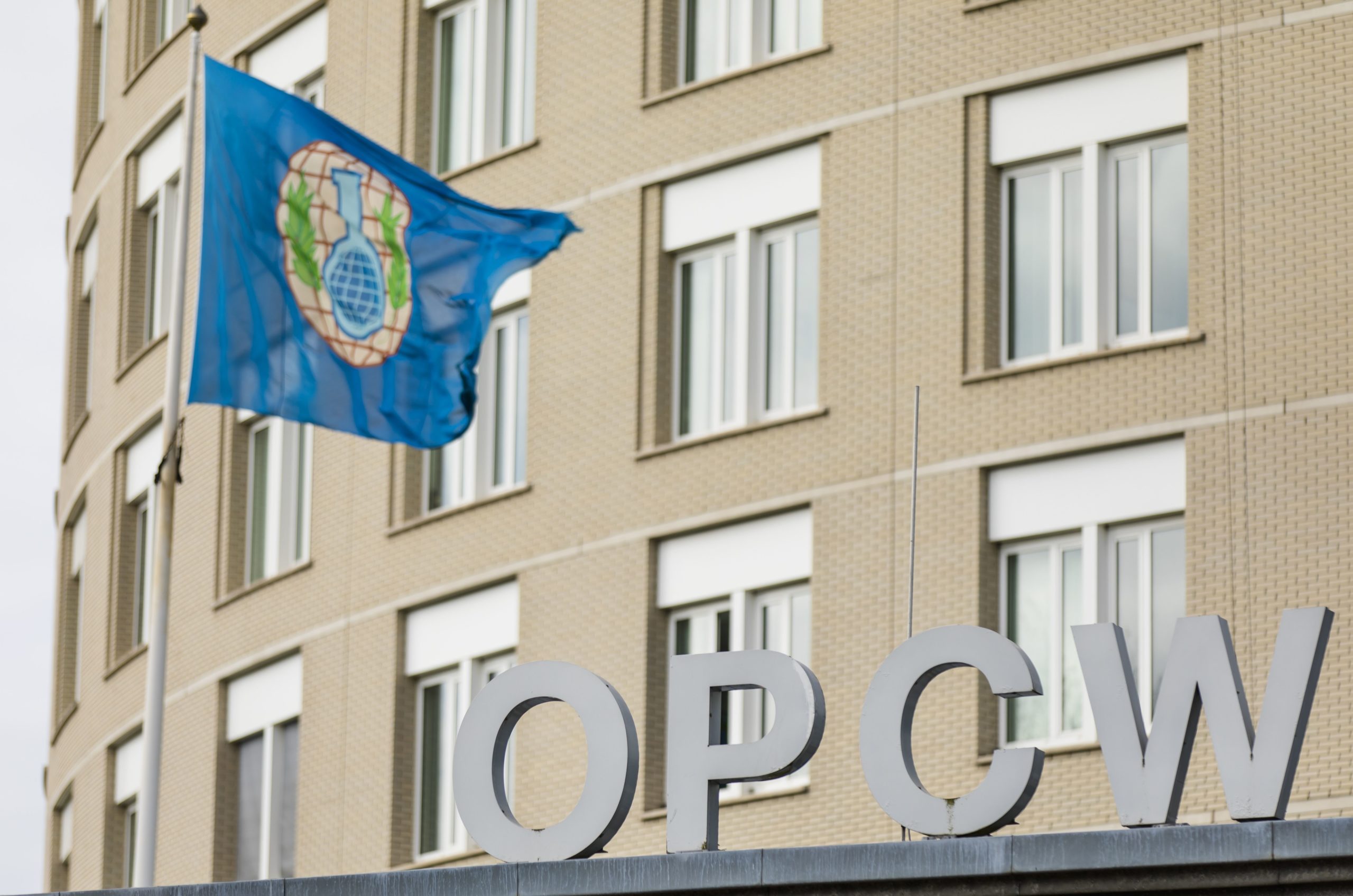
Abstract
In the aftermath of the chemical weapons attacks in Syria and the Col. Sergei Skripal incident in London, the British government sub mitted a proposal in Organization for the Prohibition of Chemical Weapons (OPCW) to enhance powers of the organization. As a result, an unprecedented historic voting took place in June 2018 during a special session of OPCW in Hague. The agenda of voting was to give the OPCW new rights and privileges to define the guilty side for chemical attacks. It is important to mention that Pakistan ‘abstained’ in voting and provided an official explanation that ‘Islamabad is against any kind of politicization in OPCW’. In this regard the following facts are interesting. According to recognized global security architecture there is United Nations Security Council (UNSC), the one and only authorized organization to ‘blame a country’ for violations and impose punitive countermeasures. Russia along with China strongly supports the idea of UNSC as the most respected and qualified authority in the World to invoke ‘blame ‘ against the state level cases. Therefore, it is a settled phenomenon that endorses the UNSC being the historical product of creating international mechanisms of solving global problems. One can argue about the effectiveness of the UN because some international disputes are still unresolved such as Kashmir, but this is the system and it works like this. Only UNSC has the right to initiate investigative procedures and impose sanctions. In November 2018 a special session of OPCW conference will take place in the Hague to implement the previously taken decision. This article draws an attention to the matters that are crucial to understand. Opting for ‘abstention’ would not serve the diplomatic posturing, rather a clear-cut ‘Yes’ or ‘No’ is deemed necessary for pragmatic foreign policy. Hence, this article is an effort to persuade the decision makers to make the correct choice which corresponds with the national interests of Pakistan.
Key Words: chemical weapons, OPCW, Pakistan, Russia, global politics, foreign policy
Introduction
The Chemical Weapons Convention (CWC) is an important instrument to curb military activities in the domain of chemical agents that could be used as an instrument of war. It came into force on April 29, 1997 with ratifications of 193 states party to its draft.1 Only Israel has not ratified the treaty though it signed the draft whereas South Sudan, Egypt, and North Korea stayed completely out of the premises of CWC.2 These three states have neither signed nor ratified the CWC. In September 2013 Syrian President Bashar-ul-Assad wrote a letter to the then United Nations Secretary General Ban Ki-moon to confirm his country’s willingness to join ewe. The letter was received in UN headquarters on September 14, 2013. Syria through this letter offered an immediate observance of its obligations under the treaty as opposed to the 30 days stipulated in the treaty (under the treaty it has to follow the 30 days rule). Finally, Syria acceded to the treaty on October 14, 2013 while agreeing to the complete destruction of its chemical stockpile including the weapons. The Spokesperson of the United Nations Secretary General issued the following statement on September 14, 2013:
“The Secretary-General, in his capacity as the depositary of the 1992 Convention on the Prohibition of the Development, Production, Stockpiling and Use of Chemical Weapons and on their Destruction, has today received the formal instrument of accession to the Convention by the Syrian Arab Republic Pursuant to the Convention, any State may accede to the Convention at any time. The Convention will enter into force for the Syrian Arab Republic on the thirtieth day following the date of deposit of this instrument of accession, namely on 14 October 2013. The Secretary-General welcomes the accession of the Syrian Arab Republic to this Convention”.3
As required by the convention, the Organization for the Prohibition of Chemical Weapons (OPCW) supervised the destruction of Syrian chemical weapons.4 The convention is also signed and ratified by both Pakistan and India. The first step was to initiate a confidence building measure that came to play its part in August 1992 when both states signed a bilateral agreement for the prohibition of chemical weapons.5 Article-1 of the bilateral agreement between India and Pakistan stated that:
“They undertake never under any circumstances: a) to develop, produce or otherwise acquire chemical weapons; b) to use chemical weapons; c) to assist, encourage or induce, in anyway, anyone to engage in development, production, acquisition, stockpiling or use of chemical weapons”.6
Article 2 of the agreement also committed both governments to sign the chemical weapons convention which India and Pakistan did in 1993. In 1992 both Islamabad and New Delhi were unable to join the convention as it was under discussion at the United Nations and opened for signatures on January 13, 1993.7 Contrary to signing the convention, the bilateral agreement did not commit both India and Pakistan to ratify the Chemical Weapons Convention. Pakistan signed the convention on January 13, 1993 and subsequently ratified it on October 28, 1997. India on the other hand signed the convention on January 14, 1993 and ratified it on September 03, 1996.
Under the declaration protocols at the time of signing the bilateral agreement in 1992 both India and Pakistan declared that there are zero stockpiles of chemical weapons with them. As a matter of fact India lied while signing the bilateral agreement. This came to surface when India ratified the Chemical Weapons Convent ion (CWC) in 1996; it declared its chemical stockpile with military applications that was developed by its Defense Research and Development Organization (DRDO). This in fact gave birth to a controversy around bilateral agreement of 1992 that India breached and violated.
Pakistan is member of the OPCW and had maintained firm believe on the elimination of chemical weapons and their usage. It had signed the ewe in 1993 with a plea to discard the presence of such weapons in South Asia, whereas its neighbor India while signing the bilateral agreement had maintained massive stockpile that it revealed in 1996 before ratifying the Chemical Weapons Convention (CWC). Contrary to the good gestures of Pakistan, India until today had not valued such Pakistani efforts to keep the region safe from chemical weapons neither it abandoned its stockpile. Though, Pakistan had respected the international concerns and ratified the convention but India preferred to dodge both regional and global consensus on chemical weapons.
This tendency has recently taken over at a bigger stage and we are observing quite an interesting political discourse. The international consensus once united against the prohibition of chemical weapons is now shaky and exposed to global pressure. This happened in the context of almost 50 times different chemical attacks in Syria8 and more recently in London where a double agent Col. Sergei Skripal was poisoned by chemical agents like ‘novichok’.9 The chemical attacks in Syria took the investigation towards United Nations Security Council and were vetoed by Russia. The Skripal case is now revolving around OPCW with potential impact on the organizational neutral portfolio. The hotchpotch is at its peak as recently as in June 2018 the OPCW has been installed with greater portfolio and powers not only to investigate but also to instigate the potential attacker. This has opened a new paradigm and the tussle has begun between East and West. Pakistan as responsible member of the international community has shown reluctance to stand on any side as it had opted for ‘abstention’ during the June 2018 voting to enhance rights and powers of the OPCW.10 The upcoming paragraphs of the study would highlight some of the important aspects of ongoing controversies around enhanced powers of the chemical watchdog.

What’s the Matter at OPCW?
The Organization for the Prohibition of Chemical Weapons (OPCW) being the primary inter national body keeps an eye over military usage of chemical agents. In June 2018 a special session was convened on behalf of the United Kingdom to give more power to the organization encompassing new rights and privileges to define the guilty side for chemical attacks.11 There are almost 193 member states party to OPCW and according to the OPCW rules, a two-third majority of the members present, minus abstention, is needed to adopt the proposal. Around 82 states voted in favor of the UK led proposal and 24 voted against the resolution whereas Pakistan was among those who preferred to ‘abstain’.12 The British proposal submits that:
“The Secretariat shall put in place arrangements to identify the perpetrators of the use of chemical weapons in the Syrian Arab Republic by identifying and reporting on all information potentially relevant to the origin of those chemical weapons in those instances in which the OPCW Fact-finding Mission in Syria determines or has deter-mined that use or likely use occurred, and cases for which the OPCW-UN Joint Investigative Mechanism has not issued a report” 13
The resolution was success adopted in June 27, 2018. Though in November 2018 a special of OPCW conference take place in the Hague to implement the previously taken decision. untie June 2018 the organization has only cherished a limited mandate to identify whether a chemical agent was used in an attack. The aftermath of the voting brought new power into its mandate that now allows the organization to identify the attacker, which in turn creates controversies. who is behind the attack is a mandate that will most probably push the organization into political waters. Traditionally, the power to blame and take punitive measures was only vested in the United Nations Security Council (UNSC). Most likely after the November 2018 voting this task will finally be handed over to OPCW and Director General of the organization would exercise greater power.
The British proposal argued that new powers were needed to deal with repeated chemical attacks in Syria. This got impetus in the aftermath of chemical attacks in London that targeted the double agent Col. Sergei Skripal who was a serving colonel in Russian intelligence. Col. Sergei also became an agent for the British intelligence agency and was captured by the Russian authorities. Later in 2010, he was handed over to the British authorities under a spy exchange agreement. According to Britain, Russians have tried to kill Col. Sergei along with his daughter and thereafter the mantra of diplomatic crises erupted.14 As a result almost 150 Russian diplomats were expelled from Britain and United Sates.15 The same numbers of diplomats w ere also expelled Russia.16
Russia has denied the British government claims and tagged, the OPCW resolu11ori an effort to manipulate the mandate the organization. They categorically maintained that the British move is “beyond the mandate” of the watchdog and the members of the organization shall not become victim of an “artificially created crisis”.17 Russians though had not been able to convince majority of the members who how ever voted in favor of the measures. The resolution secured 82 votes to 24 that exceeded the required two thirds majority needed. While cherishing the success British Foreign Secretary Boris Johnson said the resolution would “strengthen the ban on chemical weapons and pre vent impunity for their use”18
Backed by countries like France, Germany and the United States, such an expansion of power of the OPCW is strongly opposed by Russia, Iran and Syria. They believe that attribution of responsibility goes beyond the mandate of the OPCW. The OPCW was founded in 1997 as the implementing body for the Chemical Weapons Convention (CWC), which entered into force the same year to prohibit the use of chemical weapons and require their destruction. In previous investigations of alleged use of chemical weapons, the OPCW fact-finding-missions only had a say on whether and what chemical weapons have been used.
Russian Deputy Minister for Industry and Trade Georgy Kalamanov criticized the British led proposal and said that “the only international body or international court who can decide who would be guilty when we are dealing with members of the United Nations is the Security Council.19 During his visit to Turkey on April 03, 2018, the President of Russia Vladimir Putin she wed his anger over the evolving controversy in the OPCW, when he said that “Britain, the United States, two dozen other countries, and NATO have expelled a total of more than 150 Russian diplomats in response to the poisoning, and Moscow responded in kind”.20 On the issue of Col. Sergei Skripal poisoning Putin claimed that “the nerve agent [novichok] could have been produced by some 20 nations using materials that are available on the open market”.21
This perspective of Russian President seems more logical when it is contested with Gary Aitkenhead view of the situation. He is the Chief Executive of Britain’s Defense Laboratory at Parton Down. Mr. Gary Aitkenhead said on April 03, 2018 that “scientists have not verified the precise source of the weapons-grade ‘novichok’ used in the attack because it was not the laboratory’s job to say where the poison was produced. It is our job to provide the scientific evidence that identifies what the particular nerve agent is but it’s not our job to say where that was actually manufactured”.22
The nerve agent that Parton Down laboratory identified is ‘novichok’ that Moscow had developed during the Cold War. It seems that Britain based on the idea that ‘novichok’ belongs to Russia, have concluded that Moscow is behind the poisoning of Col. Sergei Skripal and his daughter. Mr. Gary further explained his apprehension that “his Parton Down laboratory just provided the scientific information to the British government, who have then used a number of other sources to piece together the conclusions that they have come to”.23
Maintaining the official tone of Moscow, the Chief of Russian Foreign Intelligence Agency (SVR) Mr. Sergei Naryshkin on April 04, 2018 claimed at a security conference in Moscow that “the Skripal case was a ‘grotesque provocation’ staged by U.S. and British security services”.24 Expanding the Russian apprehensions, the top diplomat Foreign Minister Sergy Lavrov called the poisoning case an orchestrated fabrication and ‘mockery of international law’. He said that:
“The so-called Skripal case has been used as a fictitious, orchestrated pretext for the unfounded massive expulsions of Russian diplomats not only from the U.S. and Britain but also from a number of other countries who sim ply had their arms twisted. We have never seen such an open mockery of the international law, diplomatic ethics and elementary decorum”.25
The kind of political hassle that has erupted between Russia and Britain is somehow leading the international politics towards an arms twisting phenomenon. States who are even nowhere in the dis course of chemical politics were ready to favor the OPCW vote and those who are quite relevant decided to abstain. It seems power politics did play its role in the OPCW voting.

Will OPCW become an arm-twisting plat form for global powers?
The organization will now be in a stronger position to direct the blame towards a potential violator in the aftermath of its investigations. In 2017, when the United States along with its close allies took the Syrian chemical attack into UNSC, Russian veto effectively put stall on the UN OPCW joint body in charge to probe the matter.26 Learning from this episode the British government did not take the case of double agent Sergei Skripal to UNSC rather it avoided the traditional political setup and proposed to provide greater power to OPCW not only to establish the facts around chemical attacks but also identify the culprits. That is why today there is greater pressure over Russia, who will not be able to revoke fingering towards Moscow’s involvement in the attacks. There could be enormous political, diplomatic, security and economic sanctions on Russia for not complying with the OPCW findings. This whole creates a mess around political order. Whether it’s the system of UNSC that defines defiance of the states or it’s the sub ordinated institutions of the United Nations that identify the violators?
This is in fact not an issue of normal politics. The politics around UNSC is already so complicated and how it has been manipulating its mandate is of no secret. But the real problem is associated with the emergence of politics at subsidiary organs of the United Nations. There are many international forums that assist the United Nations to uphold its mandate and the final authority that is vested in the system belongs to UNSC. States due to their political and economic strengths are capable to bargain and project their interests with powerful nations and somehow are able to get relief through UNSC decisions. If the issues are taken to the international forums that have ‘power to blame’ then the whole system of United Nations should be ready to receive political aftershocks. No state would surrender to institutions neither institution have that political writ over sovereign states. When it comes to global actors or regional, my apprehensions become manifold. Have we forgotten what happened when UN inspectors reported that they did not find Weapons of Mass Destruction (WMDs) in Iraq? The United States unilaterally attacked Iraq.
There are many situations when United Nations behaved like a paralyzed organization to act or to respond efficiently. This mainly hap pens when great power politics takes over rationality. Are we Pakistanis not aware of the facts circumventing Kashmiri freedom struggle against atrocity, killing, torturing, rapping, and political sup pression by the Indians. The UN is the custodian of Kashmiri’s right to self-determination and is the only body to curtail Indian brutal actions. Weakening the UN portfolio would strengthen states like India, who are able to find likeminded friends. Have we not seen manipulation in Nuclear Suppliers Groups (NSG) when it gave ‘wavier’ to India, a country against whom the NSG was established in 1974? How good are the Indians in manipulating the United Nations mandate and still are bidders to join the Security Council as permanent members? There is no trust on great powers role to lead peace and stability but what is believed to be trusted is the ‘Mandate of the United Nations’ that the civilized nations have vested in ‘its covenant. It is the conduct of each and every single member of the United Nations that defines the future of this organization.
Pakistan must not surrender to the politics of great powers rather stand with the system and take all necessary diplomatic actions to raise its voice. So, what is voice of Pakistan when it comes to OPCW? Are we stooges that fear to vote and prefer to abstain or we are a responsible nation that keeps an eye over political orchestration of institutions? Remember, this orchestration is not very far from us to trap us, after hurting our economy and sacrificing thousands of lives in the war against terror, what against terror have got from our so-called fiends, for the record it is not appreciation but the mantra of ‘do more’. OPCW is an important body but changing the mandate originally assigned to it is somehow politically mandated. Pakistan must be concerned about the use of chemical weapons on innocent people in Syria and irresponsible acts involving an attempt to kill double agents like Sergei but that does not suggest we become a stooge to great power politics. Pakistan’s abstention in June 2018 OPCW voting reflected this behavior.
China did not abstain nor India, both voted against the UK proposal and so did Iran and Syria. Our abstention is provoking weakness as we are dependent on Britain who has never cooperated with us to instigate Indian RAW nexus with Altaf Hussain. And there could be many explanations that surface to highlight the hypocritical phobia vested in international politics. Wasn’t it a bad move when Pakistan voted against Trump’s decision to move its Embassy to Jerusalem when United States was categorically denouncing each and every single state going against its stance? We did well and must continue to support global cause of peace and ensure that our diplomatic power is sided with those who are in need or at-least are our friends in crises. The idea is to showcase Pakistan’s pragmatic foreign policy without creating a pulse of weak ness. On this matter of OPCW stand with Russia and China or sit in the boat of UK and United States. Take this nation into confidence and go for a pragmatic decision.

Conclusion: Policy Options for Pakistan
Unprecedented historic voting took place in June 2018 during a special session of OPCW in the Hague. The agenda of voting was to give the OPCW new rights and privileges to define the guilty side for chemical attacks. It is important to mention that Pakistan abstained in voting and provided official explanation that ‘Islamabad is against any kind of politicization in OPCW’. In this regard these are the facts. According to recognized global security architecture there is United Nations Security Council (UNSC), the one and only authorized organization to ‘ blame a country’ for violations and impose punitive countermeasures. UNSC is the most respected and qualified authority in the World for state-level cases. UNSC is the historic product of creating inter national mechanisms of solving global problems. One can argue about the effectiveness of UN, because some international disputes are still unresolved, but this is the system and it works like this. Only UNSC has the right to initiate investigative procedures and impose sanctions. In November 2018 a special session of OPCW conference will take place in Hague to implement the previously taken decision. The main purpose of this article was to draw attention to the matters that are crucial to understand. This time ‘Yes’ or ‘No’ option shall be the choice of Pakistan. Opting for ‘Abstention’ would not serve the diplomatic posturing of Pakistan. So, how to persuade the decision makers to make the correct choice, which corresponds with the national interests of Pakistan, was the key question this article wanted to highlight.
It’s quite common for UNSC members to different opinions about particular issues and disagree sometimes regarding principal matters. Moreover, out of 15 members 5 possess veto privilege to block any decision they want. In practice it leads to situation where the western group of members insist on sanctions against a country on same allegations and China/Russia use veto because of lack of proof or unreliable information sources. For many years western block has been looking for ways out of this dead end. Since Syrian conflict has started this East-West in UNSC rivalry dramatically escalated.
However, let’s get back to this June voting in OPCW. Despite healthy logic more than half of OPCW members voted for west-proposed idea to give this organization additional right to define the guilty side in chemical attacks. Remarkable fact was that most of these voters were small countries, all were actually were under pressure of some influential states and could not refuse. This was in fact an arm-twisting strategy of the western capitals.
It is important to mention that Pakistan abstained in voting and provided official explanation that Islamabad is against any kind of politization in OPCW. Many countries also preferred to abstain due to the same reasons. Unfortunately, the problem is that according to OPCW voting procedures all the abstained voices are not counted and the percentage of “YES” and “NO” quickly changes to “YES”. At the end of the day the June voting created a precedent which now prepares the ground for changes in global security architecture. So the decision is taken and ground is created. Next step is to implement it.
In November 2018 a special session of OPCW conference will take place in Hague to implement the previously taken decision. So, what lessons Islamabad must learn from this whole episode and make a correct choice that corresponds with the national interests of Pakistan? Below are mentioned few of the arguments that should be enough to help the policy makers to take pragmatic decision at upcoming November meeting of OPCW.

1. First we have to understand clearly that in some sense OPCW will get might and power of UNSC. This will lead to collisions, confrontations and political stalemate giving hype to international instability.
2. OPCW has a reliable reputation of being a highly technical organization, which provides expertise on alleged use of chemical agents. The task of OPCW is to find out the facts, summarize them and prepare a report. Report can include only the following positions:
• Chemical weapon was or wasn’t used,
• Type and name of the chemical agents,
• Time and place of the attack,
• Proofs that victims died because of use of the mentioned chemicals.
That’s all. No accusations and no blamed suspects.
3. OPCW then goes to UNSC that examine define suspects and take decisions.
4. If during November meeting, the OPCW finally gets the new and wider authority it would create imbalance and ambiguity. There are still numerous complaints about procedure violation during Syrian chemical attacks investigations. Outcomes of some of the reports lack proofs, the investigation were conducted without visiting the places of attacks, chemical samples from sites of attacks were collected not by the inspectors themselves but by some unauthorized civil or military persons. So, the question of credibility is on the table.
5. It’s easy to predict that with out eliminating these weak points granting the OPCW super power abilities will be too dangerous. Who can guarantee that in today’s unstable world this power would not be used against an imaginable country “X” to topple down its ‘uncomfortable’ government on fake allegations? May be tomorrow it is Iran or any other country that can become a victim of OPCW enhanced power. Today Pakistan is considered as a friendly partner but it doesn’t take too much time to turn it into a hostile regime.
6. It must be mentioned that Pakistan’s strategic ally China in June also voted against the western initiative. So did India. Most probably they will do the same in November to prevent this decision from being implemented.
7. Controversy between key members of OPCW unfortunately only contributes to widening of misunderstandings, harms the OPCW reputation and could provoke some concerned countries to cancel their membership of OPCW. That would lead to loss of universality of the convention, loss of effectiveness and ruin the reputation.
Therefore, Pakistan should take more decisive stance and directly express its unwillingness to become a victim of global politics. Abstaining would be the most useless way of consuming Pakistan’s voice in OPCW voting in November 2018.
End Notes
1 “State of Palestine Joins the Organization for the Prohibition of Chemical Weapons,” Organization for the Prohibition of Chemical Weapons (June 21, 2018), available online at: https://www.opcw.org/news/article/state of-palestine-joins-the-organisation-for-the prohibition-of-chemical-weapons/ (accessed on July 05, 2018).
2 “Angola Joins the Organisation for the Prohibition of Chemical Weapons,” Organization for the Prohibition of Chemical Weapons (October 16, 2015), available online at: https://www.opcw.org/news/article/ango la-joins-the-organisation-for-the-prohibtion-of-chemical-weapons/ (accessed on July 05, 2018)
3 United Nations, “Secretary-General Receives Syria’s Instrument of Accession to Chemical Weapons Convention,” Meetings Coverage and Press Releases (September 14, 2013), available online at:
https://www.un.org/press/en/2013/sgsm 15279.doc.htm (accessed on July 05, 2018).
4 Destruction of declared Syrian chemical weapons completed,” Organization for the Prohibition of Chemical Weapons (January 04, 2016), available online at: https://www.opcw.org/news/article /destruction-of-syrian-chemical-weapons-completed/ (accessed on August 18, 2018).
5 “India-Pakistan Agreement on Chemical Weapons,” Nuclear Threat Initiative (October 26, 2011), available online at:
https://www.nti.org/learn/treaties-andregimes/India-Pakistan-agreement-on chemical-weapons/ (accessed on September 22, 2018).
6 “India Pakistan Chemical Weapons Text,” Nuclear Threat Initiative, available online at: https://www.nti.org/media/documents/india pakistan cw.pdf (accessed on September 22, 2018).
7 “Origins of the Chemical Weapons Convention and the OPCW,” Organization for the Prohibition of Chemical Weapons (November 2017), available online at: https://www.opcw.org/fileadmin/OPCW/ Fact Sheets/English/Fact Sheet1-History.pdf (accessed on August 18, 2018).
8 “Rick Gladstone, “U.S. Says Syria Has Used Chemical Weapons at Least 50 Times During War,” The New York names (April 13, 2018), available online at https://www.nytimes.com/2018/04/13/world/middleeast/un-syria-haley-chemical-weapons.html (accessed on September 12, 2018).
9 “Russian spy poisoning: What we now so far,” BBC (September 26, 2018), available online at: https://www.bbc.com/news/uk-43315636 (accessed on September 27, 2018).
10 Shahabuddin, “OPCW Being-Trudged ‘Beyond its Mandate’?” SASSI August 17, 2018), available online at: http://SASSI.org.pk/2018/08/17 /is-the pow-being-trudged-beyond-its-man date/#comments (accessed on September 20, 2018).
11 Press Association, “Nations to vote on call for extra powers for chemical weapons watchdog,” Daily Mail (June 26, 2018), available online at: http://www.dailymail.co.uk/wires/pa/article-5890043/Nations-vote-call-extra-powers-chemical-weapons-watchdog.html (accessed on July 15, 2018).
12 Fourth Special Session, “Report of the Fourth Special Session of the Conference of the State Parties,” Organization for the Prohibition of Chemical Weapons (26/27 June 2018), available online at: https://www.opcw.org/fileadmin/OPCW/CSP/C-SS-4/en/css403_e_. pdf (accessed on July 02, 2018).
13 India Joins Russia in Voting Against West-Backed Move to Expand Powers of OPCW,” The Wire (June 28, 2018), available online at: https://thewire.in/diplomacy/india-joinsrussia-in-voting-against-west-backedmove-to-expand-powers-of-opew (accessed on July 15, 2018).
14 Amanda Erickson, “The U.S. and Europe say the Kremlin poisoned Sergei Skripal. Russians don’t buy it,” The Washington Post (March 26, 2018), available online at: https://www.washing tonpost.com/news/worldviews/wp/2018/03/26/who-poisoned-sergei-skripal-notrussia-russians-say/?utm_term=.2c82eeab35e8 (accessed on July 12, 2018).
15 “Countries to expel more than 150 Russian diplomats over nerve attack in Britain,” The Straits Time (March 26, 2018), available online at: https://www.straitstimes .com/world/united-states/trump-expel s-60-russians closesseattle-consulate-after-uk-chemical-attack (accessed on June 19, 2018).
16 Kathrin Hille, “Russia expels 150 diplomats and closes US consulate in retaliation against UK allies,” Financial Times (March 29, 2018), available online at: https ://www .ft.com/content/1 d7968e2- 3 3 7 9 – 11e 8 – a c 4 8 – 1 O c 6 f d c 2 2 f0 3 (accessed on June 12, 2018).
17 “Martina Bet, “UK and Russia set for Showdown as Boris Johnson calls for boosting world chemical watchdog,” Express (June 26, 2018), available online at: https://www .express .eo.uk/news/politics/979606/UK-and-Russia-set-for showdown-as-Boris-Johnson-calls-for boosting-world-chemical-watchdog (accessed on June 28, 2018).
18 “Raf Sanchez, “UK overcomes Russian resistance to strengthen OPCW chemical weapons watchdog,” The Telegraph (June 27, 2018), available online at: https://www.telegr aph.co.uk/news/2018/06/27/uk-overcomes-russian-resistance strengthen-opcw-chemical-weapons/ (accessed on July 10, 2018).
19 “Member states divided over British proposal on expanding OPCW powers,” XinhuaNet (June 27, 2018), available online at: http://www.xinhuanet.com/english/2018-06/27/c137282889.htm(accessed on July 10, 2018).
20 Denis Pinchuk, “Putin says hopes chemical watchdog meeting can put end to Skripal row,” Reuters (April 03, 2018), available online at: https://www.reuters.com/article/us britain-russia-putin/putin-says-hopes chemical-watchdog-meeting-can-put end-to-skripal-row-idUSKCN1HA2DC (accessed on July 08, 2018).
21 lbid.
22 Jack Maidment, “Salisbury nerve agent ‘probably state made’ but Porton Down scientists unable to say it came from Russia,” The Telegraph (April 03, 2018), available online at: https://www.telegraph.co.uk/politics/2018/04/03/porton-scientists-have not-verified-precise-source-nerve agent/ (accessed on July 10, 2018).
23 lbid.
24 ”Russia Loses Vote By Chemical Weapons Watchdog On New U.K. Poisoning Probe,” Radio Free Europe Radio Liberty (April 04, 2018), available online at: https://www.rferl.org/a/russia skripal-poisoning-opcw-emergency meeting/29145154.html (accessed on June 13, 2018).
25 “Russia Calls Diplomat Expulsions ‘Mockery’ of Law,” VOA News (April 05, 2018), available online at: https://www.voanews.com/a/russia-lavrov-skripal-case/4333721.html (accessed on June 05, 2018).
26 “Russia uses veto to end UN investigation of Syria chemical attacks,” The Guardian (October 24, 2017), available online at: https://www.theguardian.com/world/201 7/oct/24/russia-uses-veto-end-un-investigation-chemical-attacks (accessed on July 10, 2018).