

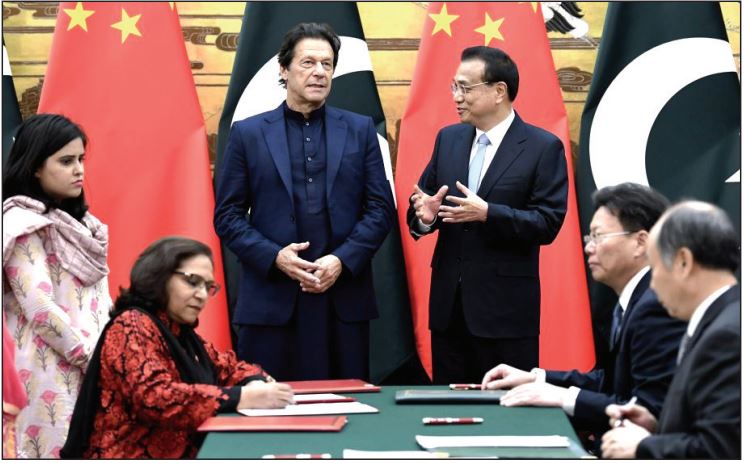
Prime Minister Imran Khan recently visited china at the invitation of the Premier of the State council of the Peoples’ republic of china and held meetings with the Chinese leadership including President Xi Jinping and Premier li Keqiang. The chief of army Staff joined the prime minister’s meetings with Premier li Keqiang and President Xi Jinping. I rate this visit as being instrumental in further strengthening Pakistan’s economic, investment and strategic ties with china. It will also further cement our strategic alliance with time-tested friend, china.
Pakistan and china are closest friends, staunch partners and ‘iron brothers’ and are joined together in an ‘all-Weather Strategic cooperative Partnership’. This time-tested friendship was based on unparalleled mutual trust, understanding and commonality of interests. The leadership of both countries were fully committed to building closer china-Pakistan community of Shared future in the new era.
President Xi Jinping and Premier li Keqiang separately hosted banquets in honour of the PM Imran Khan. a number of Agreements /MoUs were also signed at a ceremony. PM Khan was accompanied by a high-level delegation including the foreign minister, minister for railways, minister for planning, development and reform, adviser to prime minister on commerce, special assistant to prime minister on petroleum, Board of Investment (BOI) chairman and senior officials. This visit was in continuation of the long established tradition of the leadership of the two countries meeting regularly and
consulting closely on bilateral, regional and international issues of mutual interest.
The prime minister exchanged views on regional developments including the state of peace and security in South Asia arising from the situation in occupied Jammu and Kashmir since august 5. During his two day stay in china the prime minister apprised the Chinese leadership of the government’s recent landmark decisions to speed-up
implementation of the ongoing CPEC (china Pakistan economic corridor) projects as well as efforts to project CPEC as a High-Quality Demonstration Project of BRI (Belt
and road Initiative).
While most of the early projects under CPEC umbrella have now been completed, the second phase of the program has been slow to start. official data shows foreign direct investment from china plunged 77 percent to $461 million in the fiscal year through June from $2 billion in the previous year. It is hoped that after the PM’s third visit to china, within one year of his government, CPEC will be rejuvenated.
Imran Khan also appreciated Chinese leadership‘s gigantic efforts to eradicate poverty by pulling out 700 million from the seas of acute poverty. He also interacted with senior representatives of the Chinese business and corporate sector for further deepening bilateral trade, commercial and investment partnership. Prime Minister Imran briefed them on his government‘s various socio-economic structural reforms due to which Pakistan’s macro-economy has been put on the right path of greater prosperity, progression and production. The prime minister also participated in the closing ceremony of the Beijing International Horticulture expo, as a chief guest.
During his stay in china PM Imran discussed expansion of projects under the china Pakistan economic corridor (CPEC) and cooperation in the agriculture, industrial and socioeconomic sectors. He assured the Chinese government to remove impediments in CPEC projects and their timely completion because it was the top priority of his government. He stressed that Islamabad desires to engage china at the highest level for talks on several big projects in the fields of hydropower, oil refinery and steel mills.

Chief of army Staff (COAS) General Qamar Javed Bajwa had various meetings with top military officials and discussed the security situation in the region and the tension between India and Pakistan over the Kashmir issue. He met with Peoples liberation army commander, vice chairman of the central Military commission and commander Southern Theater command. according to ISPR “Chinese military leadership supported Pakistan’s principled stance on Kashmir issue, and appreciated the sane Pakistani approach in the interest of peace”.
The COAS also apprised the Chinese military leadership about the peace efforts made by Pakistan, and said that the efforts would not be at the cost of any compromise on principles or honour and dignity of the nation. Both sides also discussed the developing situation in the Gulf and efforts for peace in Afghanistan. They also agreed to enhance existing defence cooperation in line with history of mutual time tested relationship.
Pakistan railways succeeded in convincing the Chinese government for more close cooperation, collaboration and investment in the existing and upcoming projects in the country which will enhance logistic efficiency and connectivity of the country. an agreement was inked for the up-gradation of railway track from Peshawar to Karachi. The CPEC, which connects china’s Xinjiang province with the strategic Gwadar Port in Balochistan, is the flagship project of President Xi’s ambitious Belt and road Initiative (BRI). The 3,000- kilometer project is aimed at connecting china and Pakistan with rail, road, pipelines and optical fibre cable networks.
A joint statement was issued by both the countries which showed that wide range of issues of mutual interest, mainly further enhancing diplomatic ties, free trade agreement, bilateral trade, extended cooperation in diverse fields of national economy, foreign direct investment, renewal of CPEC (2nd phase comprising of hydropower generation, social development, free economic zones, transfer of technology protocols, infrastructural development, etc.), military cooperation/production, regional peace (worsening of geopolitical situation in occupied Kashmir, Afghanistan, imminent withdrawal of the US/NATO forces, and last but not least deteriorating geopolitical and geostrategic emerging trends in the Gulf were tabled and discussed at length.
During his two day stay in china the Prime Minister Imran Khan was apprised of the Chinese “economic Growth Model” which created a miracle in the modern human history by pulling out more than 700 million people from acute poverty. PM Imran wished to learn the secret of Chinese structural reforms which transformed its economy, civility, governance, anti-corruption initiatives, food and energy security, rule of the law and above all human capital development in china. He was mesmerized about Chinese constant economic growth which has been achieved through gradual economic liberalization, easing of business formalities, high ratios of FDIs and country-wide establishment of free economic zones.
Both leaders recalled the Joint Statement of November 4, 2018 which outlined the important bilateral consensus between Pakistan and china, the two sides reaffirmed their firm resolve to further strengthening Pakistan-china all-Weather Strategic cooperative Partnership aimed at building a community of Shared future in the new Era.
Both countries stressed that the close ties, deep-rooted friendship and strategic partnership between them served their fundamental interests and peoples, and contributed to peace, stability and development in the region, the two sides reaffirmed their support on issues concerning each other’s core interests. Chinese leaders reiterated solidarity with Pakistan in safeguarding its territorial sovereignty, independence and security while the Pakistani side reaffirmed its commitment to the
one china Policy. Both sides supported “one country Two Systems”, Pakistan reiterated that affairs of Hong Kong were china’s internal matter and all countries should uphold international law and basic norms of non-interference in internal affairs of other countries.
The Pakistan side briefed the Chinese side on the situation in Jammu and Kashmir, including its concerns, position, and current urgent issues. The Chinese side responded that it was paying close attention to the current situation in Jammu & Kashmir and reiterated that the Kashmir issue is a dispute left from history, and should be properly and peacefully resolved based on the un charter, relevant UN Security council resolutions and bilateral agreements. china opposes any unilateral actions that complicate the situation. The two sides underlined that a peaceful, stable, cooperative and prosperous South Asia was in the common interest of all parties. Parties need to settle disputes and issues in the region through dialogue on the basis of equality and mutual respect.

Pakistan underscored that the china Pakistan economic corridor (CPEC) was a transformational project. a CPEC authority was established to oversee the expeditious implementation of CPEC projects. Both sides maintained that the second phase of CPEC will promote industrial and socio economic development in Pakistan. Pakistan also underlined that the Gwadar Port has been granted various facilities enabling it to become a trade and logistical hub for the region. The two sides expressed determination to speedily execute CPEC so that its growth potential can be fully realized making it a high-quality demonstration project for BRI.
The two sides maintained that the ninth session of the Join cooperation committee (JCC) to be held in November in Islamabad would further fast-track implementation of the ongoing projects and explore new avenues of cooperation, including Ml-1. The two sides underlined that Chinese investment in Specialized economic Zones (SEZs) and collaboration in SME sector would further expand Pakistan’s industrial base and diversify its export base. Both sides agreed to jointly study identified projects by the Pakistan side in power, petroleum, gas, agriculture, industrial and infrastructure sectors. Those projects were entrusted to the concerned Joint Working Groups (JWGs) for deliberation and subsequent consideration by the Joint coordination committee (JCC).
In-depth exchange of views took place on deepening bilateral cooperation in the areas of trade, investment, finance, defence and security, education, agriculture, social sector, people-to-people contacts and cultural linkages. Both renewed their commitment to reinforce sister-city ties and were happy to note that a major event was being organized in Islamabad in November 2019 to deepen cultural cooperation and people-to-people ties between the two countries.
Both sides underlined that educational links between the two countries were becoming stronger. Prime Minister Imran Khan thanked the Chinese leadership for providing opportunities to Pakistani students to study in china. He hoped that those students would play an important role in further deepening historic and deep-rooted ties between the two iron brothers.
PM Imran also thanked the Chinese leadership for china’s consistent support for Pakistan’s economic development. The two sides agreed that early implementation of the Second Phase of the china-Pakistan free Trade agreement would contribute to increase in bilateral trade. Both sides agreed to take full advantage of the china-Pakistan Joint economic and Trade commission to achieve balanced and sustainable development of bilateral economic and trade cooperation.
The leaders reviewed the excellent bilateral defence cooperation and agreed to further strengthen this cooperation in the areas of military exercises, training cooperation, personnel exchanges, and equipment and technology cooperation.
While reaffirming that there was no military solution in Afghanistan, the two sides agreed that peace and stability in Afghanistan was vital for regional security and expressed satisfaction at the important outcomes of the Third chinaafghanistan-Pakistan foreign Minister’s Dialogue held in Islamabad on 7 September 2019. The Chinese side appreciated Pakistan’s efforts in promoting peace and reconciliation process in Afghanistan. Both sides maintained that an inclusive, and afghan-led and afghan owned peace process would be key to bring peace and stability in the country.
Both sides reaffirmed their commitment to fight terrorism in all its forms and manifestations, and called on all countries to strengthen international cooperation on counter-terrorism. china appreciated Pakistan’s unrelenting efforts and tremendous sacrifices in countering terrorism. It supported Pakistan in implementing its national action Plan and called on the international community to objectively recognize
Pakistan’s contributions to regional peace and security through its success in fight against terrorism.
Satisfaction was expressed over the close cooperation between the two countries at multilateral fora and resolved to deepen strategic coordination and consultation. Both sides reaffirmed their commitment to the purposes and principles of the un charter, and support for multilateralism and win-win cooperation. During the visit, Premier li Keqiang and Prime Minister Imran Khan witnessed the signing of the various agreement’s/MoUs. Prime Minister Imran Khan thanked the leadership and people of china for their warm hospitality, and invited the Chinese leadership to visit Pakistan at a mutually convenient time.
Pakistan and china have a strategic alliance which creates a befitting proposition for regional peace, development (CPEC, BRI) and anti-hegemonic trends. Keeping view the rapidly merging geopolitical and geostrategic changes in the region in terms of Indian unilateral attempt to change geographic equation of the region (occupied Kashmir), US-Taliban peace deadlock, imminent withdrawal of the US/NATO forces increasing socio-economic integration and geo-political and geostrategic relationship with the central Asia region, climate change, looming food and energy security, provision of Dassault rafale War Jets to India, anti-missile Su-400 System and deteriorating regional security in the Gulf countries, all emphasis that Pakistan and china must cooperate in diverse field of economic development and human survival in the days to come.
China is the ultimate dream of the “Asian century” and an icon of anti-global protectionism. It has successfully surpassed Japan to become the 2nd largest economy of the world. according to latest report of fortune 500 list, china’s 129 multinational companies have outshined the US companies (121) in the globe. In 1999 there were only 8 Chinese companies in this list. In the case global banking list (largest banks), 4 Chinese banks are in the top among the 20 global banks. Top position are held by, The Industrial and commercial Bank of china (ICBC), china construction cooperation Bank, The agricultural Bank of china, The Bank of china limited. It is strongly suggested that there should be currency swap, banking and financial cooperation and widespread formation of free economic zones in both the countries in the days to come.