




Pakistan Navy’s Strategic Triumph
The recent stand-off between India and Pakistan reaffirmed the precariousness of deterrence stability in South Asia. Sparked by Indian aggression following a false flag terrorist incident in Pahalgam, the conflict swiftly escalated into a multi-domain engagement across land, air, and sea. While the crisis was carefully managed to avoid a fullscale war, it featured intense military exchanges with significant operational consequences.
As escalation spiralled, intense cross-LoC artillery fire resulted in the destruction of an Indian Army brigade headquarters in Kashmir by Pakistan Army precision strikes. The air dimension saw unprecedented combat activity. India lost several high-value aerial platforms including Rafale fighters, Su-30MKI, MiG-29, and a sizeable fleet of reconnaissance and armed drones. These losses incurred despite India’s substantial investment in advanced air systems, reflected the potency of Pakistan’s integrated air defence and the operational clarity with which its forces responded. India’s attempt to leverage long-range drone and missile attacks against Pakistani airbases provoked a decisive retaliation. Pakistan responded with the deployment of its indigenous Fatah missile system—executing calibrated strikes against Indian military targets with strategic precision. This firm, technology-backed response became a pivotal factor in forcing India to accept de-escalation and seek a ceasefire through indirect diplomatic channels.
While the land and air domains witnessed visible engagements, it was in the maritime theatre that a more subtle yet highly consequential strategic contest unfolded, bearing significant implications for regional stability and deterrence. For years, India has pursued Blue-water ambitions aimed at regional naval supremacy. Through extensive capital investment in aircraft carriers, nuclear submarines, and maritime aviation—particularly platforms like the P-8I Poseidon and the recently acquired MQ-9 Reapers— India has sought to dominate the Indian Ocean Region and hold Pakistan’s southern flank at risk in times of conflict.
However, in the crucible of the recent stand-off, India failed to translate this ambition into credible maritime influence and her maritime posture proved inert. India’s flagship carrier, INS Vikrant, along with its escort group, was positioned at a considerable distance from the Pakistani coast— well beyond the effective strike envelope of its embarked air wing and associated missile systems. The claimed “forward deployment” was more a psychological narrative than operational fact, as corroborated by open-source naval tracking and lack of visible maritime push. Indian planners understood that any attempt at coercive naval action would be met with a robust and credible Pakistani response. That deterrence was the result of deliberate capability development by Pakistan Navy.
Over the last two decades, Pakistan has evolved a potent naval force structure: a balanced fleet of submarines, multi-role surface ships, missile boats, and maritime air assets with integrated PAF support, coastal defence and land-based strike capabilities.
This multi-layered architecture underpinned an effective Anti-Access/Area Denial (A2/AD) envelope across Pakistan’s southern seaboard. At sea, Pakistani submarines maintained strategic depth, while surface fleet, maritime air and land-based anti-ship missile batteries ensured that any Indian surface action group operating near Pakistan’s EEZ would face unacceptable risk. The implicit message was clear: escalation would be met with decisive retaliation.
The operational deployment during the crisis saw close coordination between the Navy and Pakistan Air Force, with real-time maritime domain awareness and persistent ISR coverage. Sea Lines of Communication remained protected and functional throughout ensuring the unhindered flow of energy and trade, which India aimed to threaten but failed to touch. Simultaneously, Indian naval activities near critical chokepoints were closely monitored, and Indian maritime patrol aircraft were consistently counter-surveilled by Pakistani platforms. In the Sir Creek sector— long regarded as a potential axis for Indian coercion—Pakistan Marines, backed by superior ISR capabilities and integrated coastal firepower, decisively denied India any freedom of manoeuvre or operational foothold.
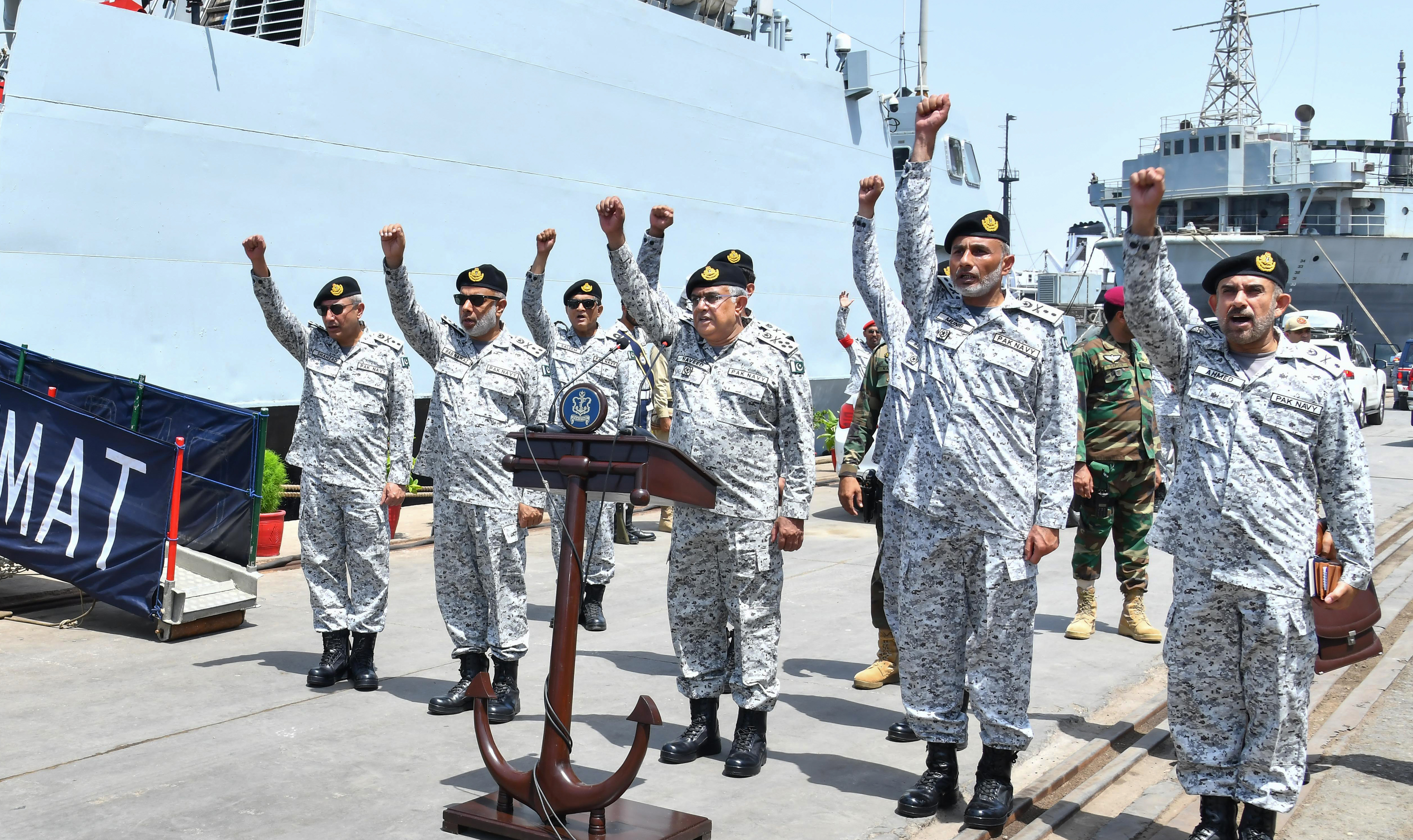
India’s inability to achieve any of its key maritime objectives—disruption of Pakistani SLOCs, targeting of economic and military facilities, coercive deployment of Carriers, or psychological maritime dominance—was a significant strategic setback. This failure contrasts sharply with the clarity, coherence, and professionalism demonstrated by Pakistan Navy throughout the crisis.
The broader implication is sobering for the global geo-politics as well as regional strategic architecture: this failure has not only exposed the limits of Indian naval coercion but has also dented its regional stature as a Net Security Provider, a counterweight to China, and a central pillar of the Quadrilateral Alliance (QUAD). In contrast, Pakistan Navy has emerged as a strong and credible regional player—its strategic coherence and operational discipline proving decisive in preserving deterrence and re-balancing maritime perceptions in the Indian Ocean. Pakistan demonstrated that deterrence remains a function not merely of force size or technological sophistication, but of doctrine, integration, and credibility. Pakistan Navy, building on its legacy of audacity and operational excellence—from the daring bombardment of the Indian coastal base at Dwarka in 1965 to the sinking of the frigate INS Kukri by PNS HANGOR in 1971—once again demonstrated that under conditions of stress, it can operate with discipline, resilience, and strategic clarity.
Looking ahead, this stand-off is unlikely to be the last. India’s hegemonic designs and global ambitions, growing maritime footprint, coupled with its increasing willingness to test the limits of conventional thresholds under the guise of pre-emptive doctrine, demands sustained vigilance. For Pakistan, the path forward must rest on continued naval modernization, deeper joint force integration, and enhanced maritime situational awareness—especially in long range precision strike, cyber space, and unmanned domains.
Pakistan’s strategic community must also invest in long-term thinking: ensuring that sea power is fully integrated into national security planning, economic resilience, and diplomacy. The PN’s performance in this stand-off demonstrates that with modest resources but clear vision, Pakistan can deny escalation dominance, deter aggression, and safeguard national interests. At sea, as on land and in the air, it is resolve—not rhetoric—that determines the outcome. In this contest, Pakistan’s resolve prevailed.