
Exclusive Interview with Mushahid Hussain Syed
Washington and Beijing have convergence of interests in South Asia; India’s thaw with China should be welcomed; Beijing and Washington will soon work for bringing India-Pakistan closer; BRICS and SCO represent Global South in an era of multilateralism; a free Imran Khan can play a better political role
Mushahid Hussain Syed is a treasure trove of wisdom. He enthralls his audience with logic, and leaves no stone unturned in impressing with pertinent knowledge that goes on to substantiate his articulation. A politician, per se, Mushahid has leaned on state-centrism and is counted as a valuable and indispensable voice when it comes to national interest.
He is centripetal in aptitude, and is a firm believer in nationalism and unity of political forces. Considered close to the powers-that-be, he is often tipped as a Prime Minister-in-waiting, and that solely is a tribute to his impeccable character and righteousness – a rare combination among the fallible of our times.
Mushahid has rubbed shoulders with two major political parties, the PML-N and PML-Q, and has been part of decision-making at the helm. His stints as Senator and Federal Minister were epoch-making in furthering public discourse, and he has been a great adviser when it comes to foreign policy. At the same time, he is a democrat by heart and advocates due political space to adversaries too – a unique trait in our politically jaundiced society. His geopolitical prism is worth statesmanship, and is an avid supporter of China.
His new-found love with Russia has similarly paved a path for broader regionalism in an era of multilateralism, connectivity and geo-economics. His vision for the sole superpower, the United States, is one of collaboration and not appeasement, as he refuses to see it as the only pinnacle of realpolitik.
Mushahid’s professional origins as a par-excellence journalist and editor has led him from the front throughout his career, as his aura is worth a salt and is sought-after in public discourse. Perhaps, he is among the conformists who tend to cherish the history of Pakistan, its proud inception and the resilience with which the nation has stood in crests and troughs.
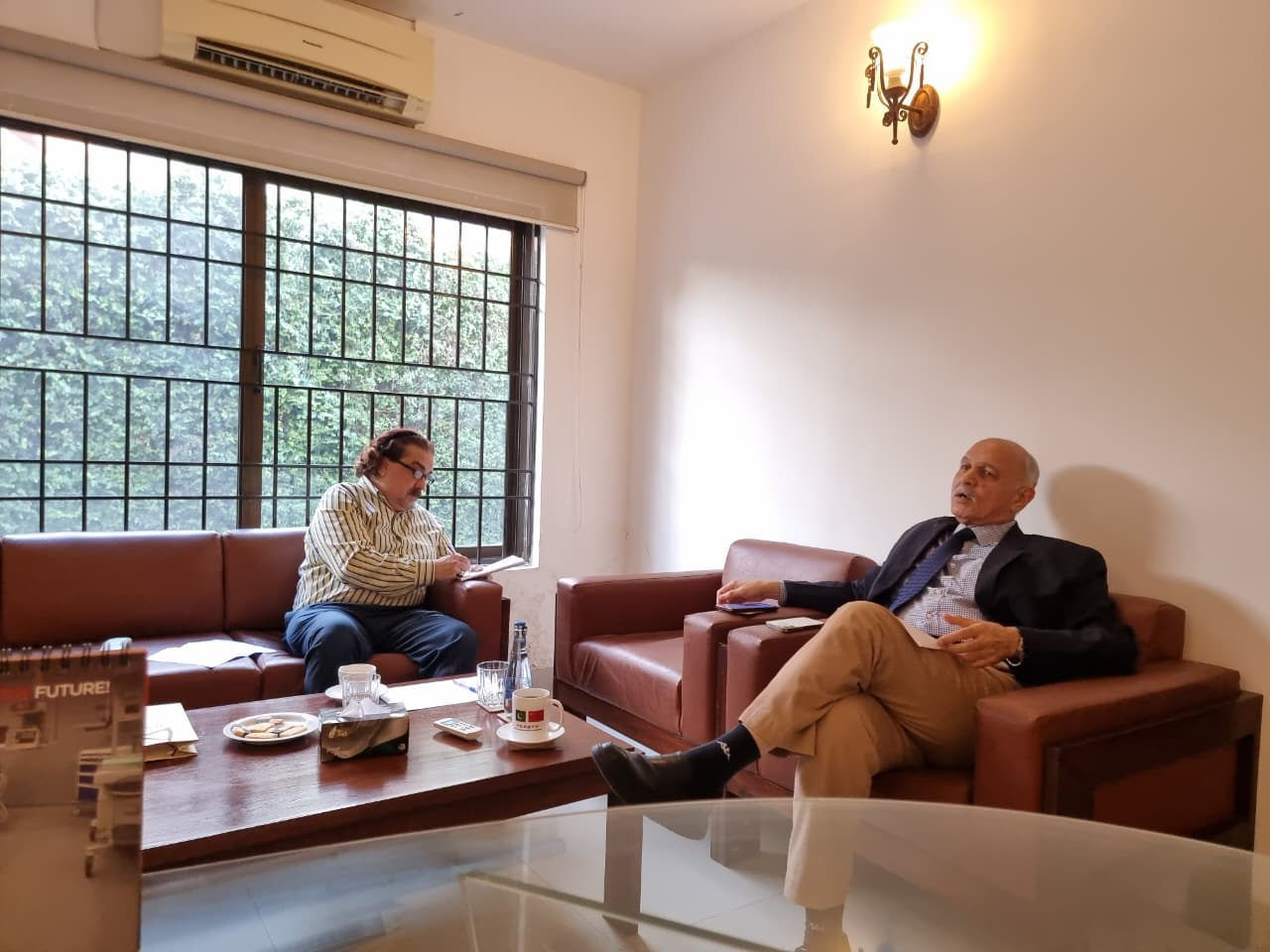
In an Exclusive Interview with Defence Journal, Mushahid Hussain spoke eloquently on the evolving international order, strategic cross-currents in the region, and the way forward for Pakistan in both foreign policy and domestic context.
Excerpts of his talk are as follows:
Q1. How do you think Pakistan’s foreign policy is evolving as the world moves towards multilateralism? Is Islamabad reshaping itself accordingly?
*I think we are living in historic times. These are times of transformation and turbulence. President Xi Jinping says we are witnessing once in a century changes. Changes that have not been seen in centuries, we are witnessing that now. President Macron of France says 300 years of Western hegemony is coming to an end. President Putin says a new world order is being established, and this process is irreversible.
The most important historic change is what predicted by the visionary philosopher, Poet of the East, Dr Muhammad Iqbal,
“Aankh khol, falak dekh, fiza dekh; Mashriq se ubharte hue sooraj ko zara dekh”,
(Open your eyes, see the sky and the environ; See the rising sun from the East), which basically means we are seeing the dawn of an Asian Century, and a shift in the global political and economic powerbase in the West and the East, likewise.
It is in that context a multipolar world is paving the way for multilateralism. This is where Pakistan has to play its role. I would say, as of now,
Pakistan is in an advantageous position in terms of geopolitics. We have influence, we have impact, we have credibility, and we have a role whether it is Tehran, Beijing, Moscow, Washington D.C., or Dhaka.
Pakistan is placed well and our voice matters. We are one of the exponents of Palestinian and Kashmir causes, we are currently a member of UNSC (holding its presidency), and we are one of the five emerging Muslim middle powers of Asia, along with Turkey, Iraq, Indonesia, Saudi Arabia and Indonesia. So Pakistan’s foreign policy, in my view, is evolving in the correct direction, and is on the right side of history.
Q2. What is Russia’s emerging role and prospects, and how compatible is it for Islamabad to make strides towards it as Washington nurses severe reservations?
*I do not think Washington nurses severe reservations with Moscow. In fact, I would focus on President Trump. Trump is not Washington; he is not an American system; he operates in a unique Trumpism system; not the worldview of the traditional American security system or what is known more popularly as the military industrial complex in the United States.
Russia is an emerging power, the other two are China and the United States. Under Putin, Russia has positioned itself as a major player. They went through a very bad decade in the 1990s after the break-up of the Soviet Union, their position had diminished, and the Americans were calling them a fourth-rate power.
I still remember, it was 1995, Saudi Arabia had sent in sacrificial meat during Eidul Adha to Russia too by counting it among poor and needy states along with Chad, Bangladesh, and Mali. That was the status under President Yeltsin. Putin has reversed that decline of Russia, it is today a world power. While Western powers have not given Russia its due, it is a power to be reckoned with in Eurasia, as Russia is also Asian and European.
In that context, Pakistan-Russia relations become closer, better and stronger. I was recently in Russia, and I had a 40-minute meeting with Russian Foreign Minister Sergei Lavrov, and I also visited Russia last year on three different occasions: Moscow, Vladivostok and Perm.
I was the first Pakistani to address the Diplomatic Academy in Moscow, where more than 200 diplomats had gathered not just from Russia but other countries. Russia now no longer looks at Pakistan through the Indian lens, and Russia is very disappointed that its old ally and friend, India, under Prime Minister Narendra Modi is sitting in the American lap.
In fact, Mr Lavrov told me – when we met in Moscow, that Indians had told Russia that they are part of QUAD for economic reasons; for trade, investment and connectivity, but later on India was part of naval exercises among QUAD countries. So there is a military dimension, too. Lavrov was basically questioning India’s commitment that they made to Russia that they would not be part of any military alliance with the US.
Thus, there is a credibility gap in Indian foreign policy; and it’s a dichotomy. In that context, I think Islamabad should move forward, and I do not foresee many reservations between Russia and the US. Even if there are, we should not care. See China and India are moving closer, it’s their prerogative. We have every right to develop our own foreign policy as best as we can to promote and protect our national interests.
Q3. Is China still a ‘strategic ally’ of Pakistan? Don’t you think Beijing is aggrieved as Islamabad is seen to be appeasing Washington for reinvigorating its ‘allied-ally’ status?
*China is not just a strategic ally but also an all-weather partner. China is an iron-brother and is a best friend. No other country can take that status, and we stand by China on all its core interests.
Probably, we are the only country in the world that supports China on all its core issues,: the unity and territorial integrity, and sovereignty of China; the paramount role of the Communist Party of China in the Chinese system; the Belt and Road Initiative (BRI) as well as three other initiatives of Xi Jinping: Global Development Initiative; Global Security Initiative and the Global Civilization Initiative.
We are an ardent supporter of One-China Policy, and Taiwan is a province and an integral part of China. On issues like Tibet, Hong Kong, Xinjiang and South China Sea, we are with them and also on the peaceful rise of China, which is a source of strength for small and medium countries of the Global South.
Pakistan’s relationship with the US is seasonal, unlike China which is all-weather and like the Himalayas. With the US, our ties are transnational, and I think under Trump there is an initiative wherein he wants long-term stability and he is talking of solving the Kashmir issue.
Trump is equating India with Pakistan at par, and he is criticising India by exposing its double-standards and duplicity. We should welcome that initiative of President Trump.
Our current warmth with the White House is certainly not at the expense of our long-standing and deep strategic partnership with China, and Beijing knows that. The US is our tactical partner, and in that context the recent Chinese statement on the visit of Foreign Minister Wang Yi to Islamabad about the Pakistan armed forces should be reinforced.
The three things, Wang said, were: Pakistan armed forces are an aspect in peace and stability in South Asia i.e. they are a bulwark against Indian hegemon; Pakistan armed forces are a main factor for national stability; and Pakistan armed forces are the guardian of Pakistan-China friendship. These statements speak for themselves.
Q4. Do you see China and India settling for a thaw? Will that impact regional balance of power, and what is your take on the US reaction if that happens?
*We should welcome any thaw between China and India. China today is a South Asian power, a stakeholder in the Kashmir issue, and has displaced India as a pivotal power in the region, especially through the BRI in which every country of South Asia is participating except India.
The Chinese role has become more important, and in case of a rapprochement between the two countries, it means India will learn to behave better with its neighbours, particularly Pakistan.
I think India has become more realistic because in the past there was euphoria of ‘Shining India’ and a lot of self-glorification. They were rising on the premise of the US, and now that the Americans have ditched them, at least, for the time-being, and suddenly the Indians are warming up to China. India now says that the border dispute with China can be set aside, and let’s move on other fronts. I think China will act as a restraint on India, and we should welcome that role of Beijing vis-à-vis New Delhi. The US seems to be upset with India for some reasons and whatever may be those reasons, this is something between the US and India, as long as the US is fine with us, our intimacy and partnership with China is fine. We are quite comfortable in that scenario.
Q5. How do you foresee China and the US in the long run? And what role can China play in diffusing tensions between India and Pakistan?
*It is entirely possible and foreseeable that, in my view, there can be a convergence of interests between China and the United States in South Asia. Perhaps, you can see the emergence of this convergence after the scheduled upcoming meeting between Xi Jinping and Trump later this year. It is interesting that both China and the US are acting as peacemakers.
China brought about rapprochement between Iran and Saudi Arabia in 2023; a deal between 14 Palestinians factions in 2024; and, thus, China would not like Pakistan and India to go into another conflict, as it would like to diffuse the tensions and have a stable South Asia. That is also in my view the policy of President Trump. He brought about the ceasefire between India and Pakistan; between Iran and Israel; Armenia and Azerbaijan, and Thailand and Cambodia.
The appointment of new US ambassador to India, Sergio Gor, with the added portfolio of special envoy to Central and South Asia means that the US wants him to play a role in building reconciliation between India and Pakistan. Do not be surprised, a few months down the line, if China and the US team up to bring normalization in ties between India and Pakistan, which I think will be good for both the countries and for the region, as well as peace and stability.
I do not see a conflict of interest between the US and China in South Asia, especially as Trump is not a war-monger or a Cold War warrior, unlike Obama and Biden who were trying to build up India against China. He would like to have a settlement among the Big Three: the US, China and Russia, and would also like to promote peace in South Asia.
Q6. You have coined the “3-D strategy for BRICS” during your recent trip to Russia. Could you elucidate on it?
*I have been part of a few BRICs conferences and I am fortunate to represent Pakistan. I am honoured to be the first Pakistani to be invited at a BRICs conferences held in 2023 in South Africa, and 2024 in Russia, although Pakistan is neither part of it nor a Dialogue Partner of BRICs.
BRICs along with SCO are the pillars of emerging Global South and the 3Ds, I coined, could act as a fountain of cooperation: First; Democratization of International Relations: IR cannot be controlled by the G7 or the Western countries. That has to change. We need a more democratic world order, and not the one based on vetoes.
Secondly, the world has become more militarized since 9/11, and we need demilitarization of world relations. China and Russia have embarked on an economic vision and they shun militarization in the new era.
Third, an era of de-dollarization. There are 193 countries that are members of the United Nations, and 68 of these have said that they are willing to trade with each other in currencies other than the US dollar.
Thus, the process of de-dollarization has begun. The dollar was used by the US as a weapon, and now the process of de-weaponization of dollars is being talked about.
Dollarization has brought about disaster, it was not about free trade and market economy. It was more about using the dollar as a political weapon against adversaries. I think the BRICS and Global South will move in that direction and will work for the 3Ds.
Q7. What are Pakistan’s prospects in BRICS, and will India be a hostile factor and turn it into another SAARC?
*I think India will remain a hostile factor to Pakistan in BRICs as it was in SAARC. Thanks to Narendra Modi and the RSS regime, India unfortunately has an ideological foreign policy. The RSS which is celebrating its 100 years in 2025, is fascist and racist in orientation. I would say, it is a bigoted anti-Muslim organization. Their vision is based on Muslim bashing within India, and Pakistan bashing in foreign policy.
That hostility towards Pakistan will continue because of Hindutva. Likewise, Hindutva is reinforced by state-terrorism policy as is evident against India’s extra-territorial activities in Canada, USA and Pakistan. That hostility with Pakistan will continue in other forms such as hybrid warfare, covert operations and destabilization.
Q8. How can SAARC be revived, and what is your vision for SCO? Can these forums help connect India and Pakistan?
*SAARC can only be revived if China becomes a member of it.
We have seen that China’s approach is magnanimous, large-hearted, and inclusive, and it believes in cooperation for mutual benefit. India on the other hand wants to be a hegemon, and wants to exclude those who it does not like. SAARC under India cannot be revived.
Q9. You recently talked about India’s diminishing role in regional and world affairs, especially after its four-day conflict with Pakistan. Please elaborate?
*India has suffered a series of setbacks in 2025. This year is a turning point in India’s diplomatic history, a worst year for its foreign policy since 1962 when it was battered by China. But a defeat at the hands of a small country like Pakistan in 2025 was worse. India’s military defeat at the hands of Pakistan was followed by their diplomatic and media failure.
India’s myth of invincibility in terms of weapons was shattered. It proved a fundamental reality that size does not equal strength. The four-day war was a reality check for India, and then they had to lie about planes and other things which were exposed by none other than President Trump. Russia now also views India with suspicion. India has now taken a U-turn and is mending fences with China. Basically it is about the arrogance and hubris of Modi and company, and their underestimating Pakistani resolve, determination and will, as well as Pakistan’s intention and capability to hit back if India chooses to go on the path of aggression. We did it and they got a bloody nose.
Hence India is no longer a halo. Mr Modi’s bubble has burst. It is no more shining but whining. Look at the figures: the third largest illegal migrants in the USA are Indians, after Mexicans and El Salvador. Almost 750,000 Indians are illegal in the USA from the states of Bihar, UP, Gujarat, Haryana and Punjab. There is rampant employment in India to the tune of 45% because Modi has unleashed crony capitalism through the likes of Adani, Ambani etc.
Around 800 million people are struggling to make ends meet. The myth of India Shining has come to a naught. Global South is now led by Xi Jinping of China. India is exposed as the best friend of Israel, which is a pariah in the international system.
Q10. You have been a great advocate of political reconciliation. Will former PM Imran Khan be free; and why is President Trump not so forthcoming on issues of democracy and human rights in Pakistan?
*In a country like Pakistan, the problems are so complex in our federation that no one person, no one party, no one government and no one institution can resolve it on their own. It has to be a collective effort and the chariot of democracy runs on two wheels: the government and the opposition. I have been a supporter of healing touch, whether it is the missing persons in Balochistan, or calling for the release of political prisoners, including Mr Imran Khan. I feel that, unfortunately, Imran Khan has not been able to build a good team of competent loyalists. His second-tier leadership is compromised, for either being weak or unable to stand up or speak up. I would like to inform you that when President Trump was elected on 5th of November, contacts were established on the 10th of November between the Establishment and Imran Khan, and the decision was taken to release him around 22nd November. This has been confirmed by the top PTI leadership, and also through my own sources. As the process of release was underway, some ‘nadaan dost’, unwise friends, told him that we will storm on the Bastille on November 26, and we will do it through a popular revolution by mobilizing a million people. That never happened. Another opportunity came when there was a deal in the making. In our society, we are allergic to the word deal. In the Western political culture, deal is a positive thing. Deal means a compromise based on consultation and consensus on resolving problems, and seeking a way out. The lesson from history is that those who are willing to compromise to seek a way forward, they end up being winners. There was a choice in 1946-47 in the Pakistan Movement. Mr Jinnah wanted a united Punjab and Bengal, but because of the machinations of the British and the Congress, both Punjab and Bengal were partitioned. Quaid once said even if I get Pakistan to the size of a matchbox, I will take it because we ought to have our own separate sovereign state in whatever form. Thanks to him, today we are living as free citizens in a free country. That shows wisdom and maturity. He had to compromise to achieve bigger goals. I believe, if Imran Khan had been a free man, he would have played a better political role rather than being holed up as a prisoner # 804 in a cell in Adiala Jail. I feel that his advisors have not done him good, and also I would say the decision to resign when a soft coup ousted him on April 9, 2022, was myopic.
Khan had over 150 members of parliament, and had two major provinces in his pocket. Someone foolishly advised him to resign from the provincial assemblies. They had the cards in their hands, and they let it go off their hands.
The PTI believed that the Constitution would be followed, and that proved they were so naïve!
I still remember Benazir Bhutto telling me once, when I was a journalist, that her biggest mistake was to boycott the 1985 non-party elections, and that too was forced on her by her foolish friends. That led to the creation of a new political class in Pakistan. We should remember that nature never allows a vacuum.
We should learn from history, and look at the big picture. Also we should learn to review and understand what mistakes were made! I would always suggest to my political friends to make new mistakes, and not to repeat old ones. As Albert Einstein said, trying to do the same thing and expecting new results is either insanity or stupidity.