




A Comparative Analysis of Herman Kahn and Rebecca Hersman’s Frameworks of Nuclear Escalation
Introduction
The development of nuclear strategy is a product of a long-term shift in the ways in which policymakers think about conflict, deterrence, and escalation in the nuclear era. In the Cold War era, the strategists tried to rationalize nuclear confrontation and make it predictable by developing and applying systematic theories of escalation. One of the most important of these thinkers was Herman Kahn, whose escalation ladder was one of the most important concepts in the Cold War strategic thinking1 . However, the advent of cyber warfare, artificial intelligence, space militarization and multi-domain warfare began to undermine many of the tenets of classical deterrence theory decades later. To meet this new strategic context, Rebecca Hersman came up with the idea of “wormhole escalation,” a theory that suggests crises of today may not unfold in predictable, linear patterns2 . Today, escalation can be sudden, compressed, and non-linear.
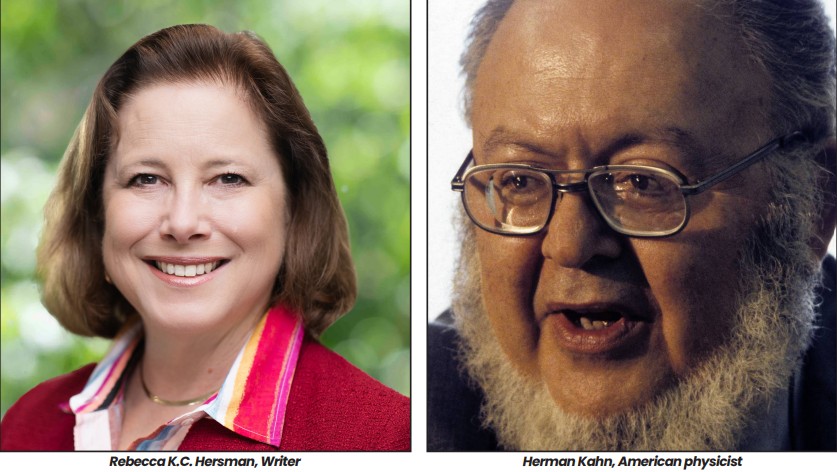
This report is a comparison between Herman Kahn’s escalation ladder framework and Rebecca Hersman’s wormhole escalation framework. It claims that Hersman is not simply modernizing Kahn’s theory for the present day but that she is only as much questioning the classical notion that the escalation process can be rationally managed through predictable phases. Kahn’s work is a product of the bipolar world of the Cold War, while Hersman’s portrays the uncertain, ambiguous and technologically fast changing environment of today.
Comparative Analysis
In his time of writing, during the Cold War era, Herman Kahn wanted to challenge the belief that nuclear war was “unthinkable.” In “Thinking about the Unthinkable” and “On Escalation”, Kahn urged the rational consideration of escalation to prevent the out-ofcontrol catastrophes that threatened to happen3 . The most well-known of his works is the escalation ladder, which mapped out the nature of conflict as a series of forty-four levels from “ordinary political disagreements” to “general thermonuclear war.” Escalation wasn’t an arbitrary process, however, and, according to Kahn, careful signaling, communication and responses could allow it to be controlled.
The basic premise in Kahn’s model was that his subjects were rational4 . States were expected to perform the costbenefit analysis and to be savvy enough to not have catastrophic consequences, but to be strategic about it. Through his study of escalation dynamics, Kahn was convinced that even in the event of a nuclear war, it could be studied analytically, provided that leaders knew how to deal with the process. The ladder was thus more than a military model, it was a system of crisis management on the basis of predictability and control.
Kahn’s framework had a significant impact on the Cold War nuclear doctrine. Many of these ideas were present in NATO’s flexible response strategy, in the fact that NATO had only limited nuclear options, and that NATO’s thinking about deterrence was much broader. His ideas on escalation management also influenced the strategic rationale of the bipolar U.S.-Soviet competition, in which both sides sought to keep the peace and prevent spiraling into a nuclear war.
The virtues of Kahn’s structure were also compounded with some weaknesses, however. Some critics said the escalation ladder was overly optimistic about the rationality leaders could maintain in crisis situations5. Fear, ideology, domestic politics, cognitive bias, and misperception are among the factors that more often than not influence real world decision making beyond just rational calculation. Most important of all, Kahn believed that escalation is a predictable and sequential process. This was an assumption that could be made in the comparatively stable environment, with clear adversaries, communication lines and conventional-nuclear thresholds, of the Cold War era.
In her concept of wormhole escalation, Rebecca Hersman wants to challenge this assumption of controllable escalation. In an article on technological changes and escalation dynamics, written in the context of twenty firstcentury strategic competition, Hersman contends that these technological advancements have fundamentally changed the way escalation dynamics work. In a world defined by cyber warfare, artificial intelligence, autonomous systems, information warfare, and space militarization, crises can rapidly unfold and be unexpected to occur on more than one front at once6.
Unlike Kahn’s ladder, Hersman’s wormhole theory turns down the idea of progression following a straight path. However, in the modern context, a crisis could escalate immediately from lowlevel rivalry to serious strategic rivalry without the prior occurrence of any of these stages. An event on the Internet or in outer space can have effects far outweighed from the event itself. A cyber attack on nuclear command-andcontrol systems, for instance, could be seen as preparation for a disarming first strike, and an attack on satellites could leave early warning systems blind sparking the fear of an impending nuclear attack. Escalation in such cases is shortened, unclear, and even misguided.
What makes Hersman’s framework significant is the fact that it emphasizes the impact of technological complexity in increasing uncertainty. Key elements of strategic stability were communication and signaling during the Cold War era, coupled with fairly well-defined rules of escalation. Today, however, the crises are overlapping, and the same actions could be misinterpreted or misunderstood. Artificial Intelligence and disinformation also make decision making more difficult, as they affect situation awareness and reduce reaction times7. Therefore, today’s escalation could be more a result of confusion, miscalculation, or technological disruption, than deliberate choice of strategy.
The difference between Kahn and Hersman is thus a difference in the understanding of escalation itself. Kahn saw the escalation as a natural, step-by-step and controllable process. Escalation has become more “non-linear, unpredictable, and technologically driven,” Hersman says. There is an opportunity for calibrated decisions to move up or down the escalation ladder, according to Kahn. Hersman contends that today’s crises can travel directly from low-level conflict to the strategic instability via sudden “wormholes.”
But Hersman’s argument does not completely undermine Kahn’s framework. Deterrence signaling, the military posture, and strategic communication continue to be tools states use to manage crises. Escalation thresholds and escalation management in the minds of the nuclear powers. Kahn’s framework has continued to resonate in this way. But Hersman shows that the strategic landscape of today is much more volatile than the bipolar world of which Kahn was a theorist.
The relevance of both is seen in current geopolitical developments. Traditional deterrence signaling in the context of Kahn’s logic, is in evidence in the ongoing Russia-Ukraine War, the growing U.S.- China competition, and recurrent India-Pakistan crises. These same crises however, also show the threats that Hersman has pointed to, especially cyber operations, information warfare, and technological escalation. The strategic competition of today is thus a combination of the old and the new of classic escalation and modern wormhole.
Conclusion
Finally, the contrast between Herman Kahn and Rebecca Hersman is a reflection of the general development of nuclear strategy. Kahn’s escalation ladder was born out of a bipolar world, one in which deterrence worked, and one in which rational crisis management was a guiding assumption. His model was based on the communication, signaling, and thresholding of escalation as a way to control it. In contrast, Hersman’s escalation through the wormhole is an environment of fragmentation and technologically fast-paced world where the crisis can escalate out of order in various domains.
Above all, Hersman goes against the classical premise that escalation can be managed step-by step. These are the days when the “unpredictability” of cyber warfare, artificial intelligence, and informational ambiguity is challenging the predictability that traditional deterrence theory relied on and was built on. However, the lessons of Kahn in deterrence, signaling and escalation management are still valid, as states continue to try to prevent a catastrophic conflict through strategic restraint.
The shift from escalation ladders to escalation wormholes represents the shift from the relatively standard Cold War logic of escalation to the uncertainty and complexity of today’s strategic competition in the 21st century. In what is essentially a pair of essays, Kahn and Hersman expose the constant problem of nuclear strategy: how to handle escalation when the nature of fighting, deterring, and maintaining strategic stability is continually changing.