

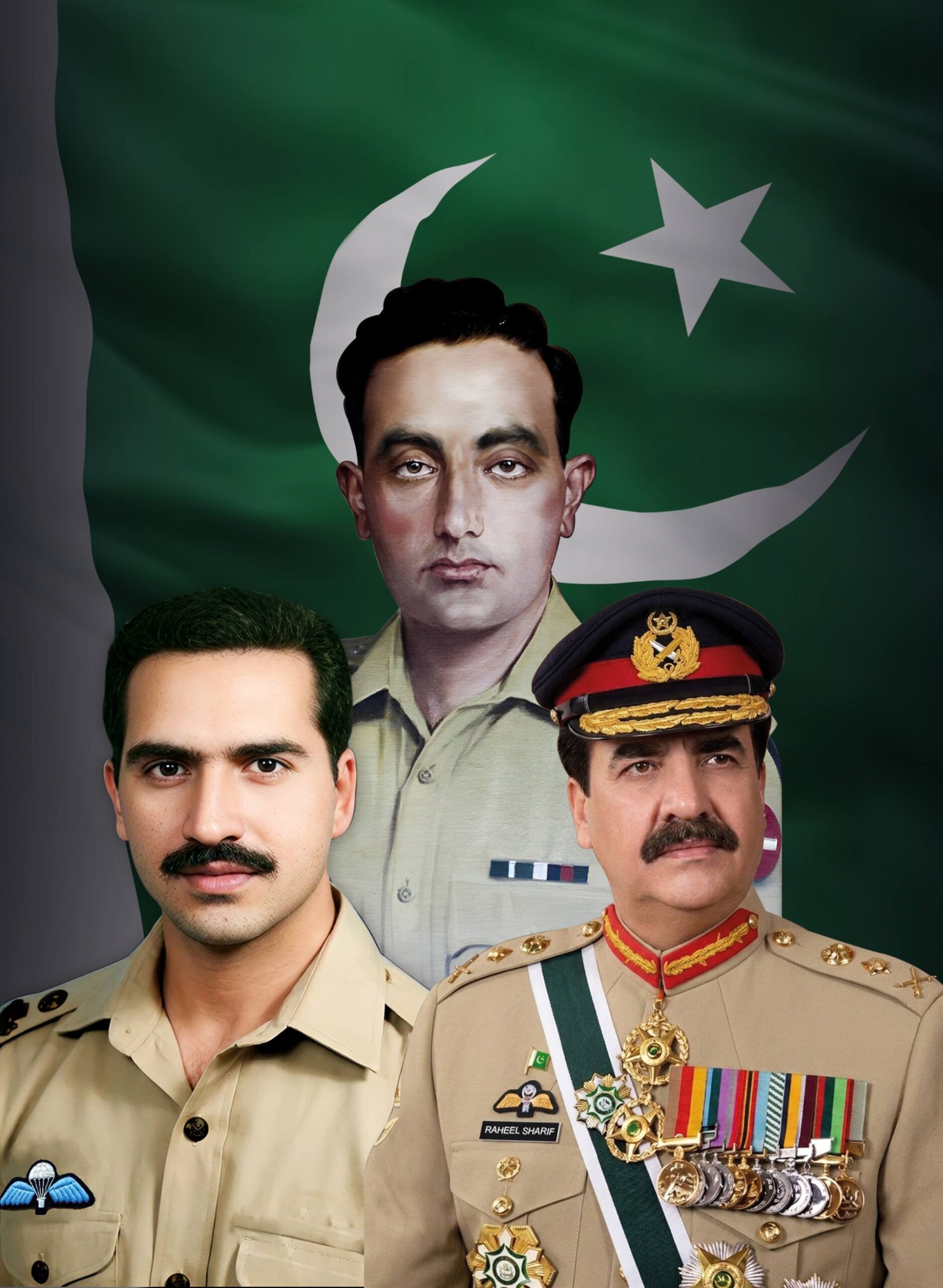
The continuous and exceptional sacrifices of the martial Sharifs have secured them a legendary place in the annals of modern Pakistan. The 16th volume of my series, “A Personal Chronicle of Pakistan,” is dedicated to the family that embodies the nation’s finest qualities. The unparalleled familial commitment and service of the martial Sharifs remain truly without equal.
Major Shabir Sharif was the eldest son of five children of Major and Auntie Sharif. Born in April 1943 he was a man of destiny right from the start. An aggressive and competing nature made him stand out amongst his peers. Deemed best at sports Shabir was picked to lead almost all school matches and individual competitions. While at PMA Shabir got the coveted Sword of Honour, graduating FIRST in his Course.
Shabir was commissioned into the 6th Battalion of The Frontier Force (6 FF) Regiment in 1964. During the 1965 war, at Chamb Jurian as a young Second Lieutenant, he was wounded but hid his injury to lead his men in a perilous military operation with complete disregard to his personal safety. Going behind the enemy lines he compelled the Indians to vacate the strong position they were holding, not only pushing them but bringing back his wounded men and a captured artillery piece. That war trophy still lies in the museum. For an action that required raw grit for any young officer of his seniority to deliver, he was awarded the Sitara-e-Jurat (SJ).
At about the same time on a different front not far away, in Lahore on the BRB Canal, his maternal uncle Major Aziz Bhatti was awarded the Nishan-e-Haider for his actions above and beyond the call of duty. After the 1965 war Shabir gradually groomed himself through his impeccable reading habit and mentoring junior officers. His polished junior leadership and functional excellence at military tactics and strategy brought him to the elite Pakistan Military Academy as an instructor and platoon commander. Shabir was far too brilliant and brave to have been missed mounting the pedestal of fame in our history. Had he lived he would have been an obvious choice for being the Chief of Army Staff of the Pakistan Army. Three course mates, Lieutenant General Ali Kuli Khan, General Pervez Musharraf and Lt Gen Khalid Nawaz were the final candidates for the top slot. Probably Shabir had a premonition about his tryst with history to lay his life for his motherland as he willed to be laid at graveyard Miani Sahib besides his good friend who had committed suicide. It is said that the soul of someone who has committed suicide is denied heaven unless a Shaheed is buried next to him. He wrote his will to his father just before the war saying that “if I embrace Shahadat I should be buried next to my friend so that his sin is forgiven.”
His classic war action in 1971 illustrates a heroic feat of a young leader full of unrestrained zeal and raw courage. Gurmukh Khera and Beriwala areas were formidable objectives for Pakistan’s 105 Independent Brigade responsible for defending Sulimanki Headworks. An Indian Rifle Company plus of Assam Rifles, supported by a troop of tanks of Indian 18 Cavalry held the position. On 3 December 1971 Major Shabir, commanding Bravo Company of 6 FF, was assigned to take both of these critical objectives. Enemy fortifications were a text book layout, a 20 feet higher man-made bund preceded by 100 feet broad 15 feet deep canal, additionally littered with 100 yards of a mixed minefield. Both the canal and minefield were covered by fixed line machine guns and intense grazing fire from nests of enemy pillboxes perched tactically on higher bund. At 1800 hours Shabir fearlessly led his company with great courage, devotion to duty and regardless of danger crawled past the minefield and cleared the initial enemy post on the home side of the canal. He crossed the water obstacle under heavy enemy fire, climbing the 40 degree 20 feet loose earth slope and succeeded in clearing the fortified pillboxes by lobbing hand grenades and occupied the enemy position after forcing a well dug enemy to abandon defenses and fall back to alternate positions. This was a great success. Next day his position came under heavy fire that failed to dislodge him and his men fighting fearlessly under his command. On the night of 5/6thDecember enemy launched a major attack on Shabir’s position with tanks resulting in formidable close quarter combat, Shabir came face to face with the enemy officer leading the counterattack and killed him in a hand to hand fight. Such moments are rare in war history. While the enemy also displayed persistent determination to regain lost ground, leading his men courageously Shabir rose to the occasion the nation will never forget. Between 3rd and 6th December enemy repeatedly launched fierce counterattacks that were repulsed by Shabir and his brave men causing heavy losses to the enemy. By day break of 6th December Shabir’s company had successfully beaten back numerous counterattacks rendering two enemy battalions and a squadron of tanks to almost ineffectiveness. Four enemy T 54 tanks were destroyed and their crew made POWs. In desperation, enemy launched yet another attack on the afternoon of 6th December preceded by an air strike combined with heavy artillery shelling. Shabir leading his men from the front started engaging enemy tanks. While he was fighting fearlessly in broad daylight an enemy tank fired its main and secondary guns that proved fatal. His last words were “don’t leave Sabuna Bund”. That day Pakistan army lost one of its most outstanding officers whom his Commanding Officer rightly called “Superman” in the citation. He was just 28 years old. He was awarded Nishan e Haider by then Prime Minister Zulfiqar Ali Bhutto, becoming the most decorated soldier in the Pakistan Army, i.e. Sword of Honour, Sitate-e-Jurat and Nishan-e-Haider. Reviving memories of war after the ceasefire, the Indian Army Chief General SamManekshaw, who incidentally was also originally from pre-partition 6 FF, commented proudly how Shabir Sharif was regarded with highest level of respect in the Indian Army for his outstanding bravery. Possibly unknown to later generations, two Nishan-e-Haiders, Sitara-e-Jurat, Sitara-e-Bisalat and a COAS from the same family is probably the underlying nostrum of glory that make the Sharifs so distinctive.
Other than my life-long friendship with all three brothers Shabir, Mumtaz and Raheel as well as the Sharif family including Major Muhammad Sharif, Auntie Sharif and the two sisters, Khalida and Najmi and their husbands, I have an indirect association with 6 FF. In September 1962 my father, Lt Col AM Sehgal, then Commander Sylhet Sector East Pakistan Rifles (EPR), was given orders to clear an Indian battalion plus occupying a Pakistani salient across the Asalong River in the Chittagong Hill Tracts. His force consisted of 5 EPR companies (later re-named “Asalong Battalion” based in HQ EPR Dhaka). That was later reinforced on 19 September 1962 by 2 Rifle Companies of 6 FF (ex 53 Brigade from Comilla). As overall commander of this force, Colonel Sehgal evicted the Indian troops in about in few weeks or so of persistent military operations, back across the river. Incidentally this was 6 FF’s first battle as a unit after 1947 (4/12 FF merged with the Pathan Regiment in 1956 to make 6 FF). Pre-partition 4/12 FF was the unit (in which both General Manekshaw (Army Chief of Indian Army 1971) and Pakistan’s Lieutenant General Attiqur Rahman got the Military Cross (MC)in Burma during the Second World War.
Born in Quetta on 16 June 1956, the youngest in the martial Sharif family General Raheel Sharif, was commissioned with the 54th PMA Long Course in October 1976. Highly inspired by his elder brother, Raheel reached the Military Academy with a natural flair for soldiering, bent on making his own waves. Major Shabir’s courage and sacrifice played a major role in grooming Raheel to face mental and physical challenges during hisearly days. He passed out high on merit in the Academy and always upheld the principles of honour and dignity. He joined 6 FF, the same battalion in which Major Shabir Sharif fought the two wars. After serving in far flung Northern Areas of Pakistan he got selected for German “Company Commander’s” Course and subsequent attachment with an illustrious German regiment. He then gained the prestigious appointment of Adjutant of the Pakistan Military Academy (PMA). After attending the Canadian Staff Course, he held coveted appointments of the Pakistan’s Army. Selected for Royal College of Defense Studies (RCDS) UK, he was accorded the highest accolade by the Commandant, “Raheel has the intellect and character to get the highest rank in his military career”. Keeping to this prediction, Raheel Sharif rose to the highest rank of Pakistan Army in 2013 with grace and distinction, his service record was outstanding.
Raheel assumed the command of the illustrious Pakistan Army in 2013 with a very clear objective to revive the Nation’s belief in itself. The challenges were enormous and required trust and support of the political government. As the country was beset with the bane of terrorism and insecurity there was no time to waste finding causes. The need was to turn the tide of terrorism, this was to be followed by socio-economic uplift of areas that bred terrorism. Operation Zarb e Azb was entirely his concept, with two hundred thousand strong force of dedicated troops he succeeded in turning the tide of terrorism and established writ of the state in tribal, rural and urban areas with whole of nation approach and full government support. This was followed by a three-pronged way forward to make the gains sustainable and rewarding by employing the local youth through (1) de-radicalization (2) promising opportunities and (3) setting projects with an aim to do better than before. During difficult days the nation looked upon Raheel for assuaging wounds of the people of Pakistan, especially the cold blooded murder of innocent women and children at the Army Public School Peshawar in December 2014. This was the most horrific terrorist attack leaving more than 100 children martyred. Raheel was moved with pain and agony like every member of the society, his spouse Fariha Sharifstood by Raheel to share the grief and help families bear the irreparable loss. Her presence alongside Raheel with people and soldiers alike in difficult situations made a vast impact.
Pakistan’s main commercial city and port Karachi was plagued by violence, criminality and terrorism and festering with a politically motivated ethnic unrest impeding commerce and industrial output. Raheel proposed an immediate decriminalization in politics without fear and/or favour for a secure and stable environment through a broad consensus between the stakeholders. Through the help of government he not only developed consensus but also brought peace back in Pakistan’s commercial hub. Based on his first-hand experience of Balochistan, Raheel oversaw a process of provincial stability with huge socioeconomic and infrastructural developmental projects supported by the Army in different parts of the province. Under his dynamic leadership, Pakistan gradually moved on the path of enduring peace and stability. After retirement as COAS Pakistan Army in 2016 Gen Raheel Sharif became the first Military Commander of the Islamic Military Counter Terrorism Coalition (IMCTC) of 43 nations in May 2017.
History remembers military leaders not only for the battles they fight but for the peace and stability they help secure. Gen Raheel’s tenure will be remembered for uniting the nation against a common enemy, strengthening national resolve, and demonstrating that decisive and courageous leadership can alter the course of a nation’s destiny.