


If Caracas is Washington’s backyard where it could get away with anything, Tehran too believes that the Straits of Hormuz is under its tutelage. Those are the evolving signatures of realpolitik as new alignments are being erected in pursuit of a new world order. The abduction of Venezuelan President Nicolas Maduro in a seamless military raid on January 3, 2026, by US Marines and subsequent installation of a puppet Delcy Rodriguez could not be reenacted over the Islamic Republic, though. That will always remain a faux pas for the sole super-power as its decades of containment policy has backfired. Likewise, the obsession of ‘regime change’ is biting dust as the third successor, Syed Mujtaba Khamenei is more reclusive, lethal and unpredictable. He is the man to be watched as he is quite capable of swinging surprises, and going back on his illustrious father’s resolve not to build a nuclear weapon.
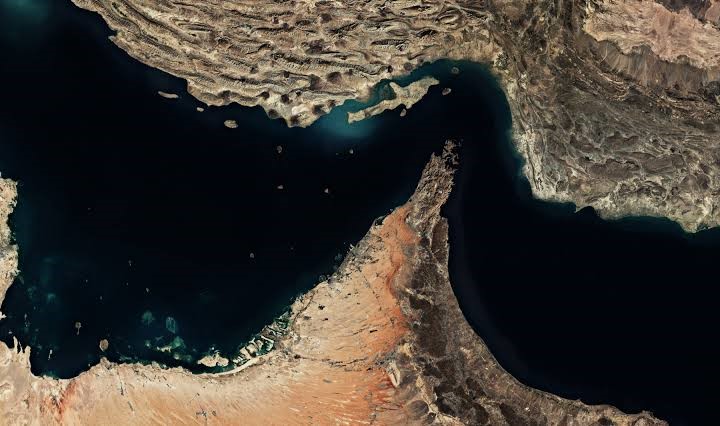
With Islamic Revolutionary Guard Corps (IRGC) calling the shots, the Supreme Leader has an opportunity to craft a new legacy of resilience, and this is where the next decade or so will be consumed. The religio-orthodox dispensation coupled with democratic credentials, as Iran is the only country seeking recourse to the ballot, will be a difficult nut to crack. Peace or no-peace will remain a footnote, and Iran will do all it can to assert its power to create a Pax-Persian aura over the Middle East. That is what Tehran is doing as its parliament legislates to tax navigation over the water channel under its nose that sees 20% of world trade pass through it.
The fact is that Iran will be in contravention of international law if it forcefully asserts its domination. The legitimacy of maritime security rests upon multilateral acceptance rather than unilateral declarations. Thus, a fine-walk is desired keeping in view the principle of transit passage under the UN Convention on the Law of the Sea (UNCLOS). The underlining is that neither coastal states nor external military powers enjoy unlimited discretion to restrict commercial navigation.
The equation at the moment is one of power-paradox. It is a test case of asserting influence and retaining it.
Extra-territorial powers, especially the United States, with one of the largest navigational fleets in the Mideast is also a stakeholder, apart from Iran. President Trump’s desire to slap a 20% tariff on vessels passing through the Straits into Arabian Sea-cum-Indian Ocean is supposed to fetch it $260 million a day. The irony is that none have voiced concern over it.
If American hegemony over the critical international waterways is accepted, then it will open a Pandora’s Box of military interventions in maritime disputes far beyond the Gulf. China, Russia, Australia, South Africa, the Horn of Africa and even South America will also have their field-day obsessions to control blue waters, plunging global supply lines is an unprecedented mess of their own.
Oman needs to be heard. Its Foreign Minister Badr Al-Boussaïdi has made some articulate sense and he called for ‘rapprochement’ between the Gulf States and Iran. Terming the war as “a catastrophe”, he rightly urged the regional and international actors to look beyond the conflict and build a new security architecture, one that is based on “inclusion” rather than decades-old policies of “containment”.
That is a forward-looking approach and, indeed, one of statesmanship by a country that holds dual-stewardship of the 39-km-wide waterway with Iran. Muscat too is a geopolitical gatekeeper of global energy flows as it controls the Musandam Peninsula, possessing territorial sovereignty over the vital deep-water channels used by all international shipping.
The point that Oman is making is sine qua non for lasting peace and reconciliation in the region. It’s time to admit the shortcomings of the Gulf’s longstanding security framework that were intended against Iran, a country that has a dwarfing landmass over all the tiny Gulf Sheikhdom except Saudi Arabia, and with a population of over 90 million, rich in minerals and oil, plus one of the best military muscles. Thus, Al-Boussaïdi is simply thinking out-of-the-box as he calls for burying the myth of containment and working together for the emergence of a system that is “fairer, more realistic and more effective”.
That is the only way out to correct a geo-political wrong and to “undo nearly half a century of strategic errors”.
To summarize: a transparent and neutral cooperation of all parties over the Hormuz is indispensable if the looming existential threat is to be addressed.
Now let’s analyse what Iran has to say as it recalibrates its strategy over the Hormuz, and draws new lines of engagement with its estranged Arab neighbours. President Masoud Pezeshkian, a man of few words and a dove by character, had a synopsis to reveal as he came down to Pakistan with a blueprint for the future. Marked as a gesture of gratitude to Pakistan for its selfless and untiring mediation, Pezeshkian flew into Islamabad just a day after the Burgenstock talks in Switzerland, and pitched an articulate framework for regional cooperation.
The doctrine unveiled was:
“a new regional security structure among Muslim nations”.
The common denominator is to ensure that the causes of revulsion in the region are tackled well in time, and addressed collectively. That, in other words, means Arab States, especially Saudi Arabia is willing to work with Iran by keeping the United States at bay in the region. So far so good: the proposal is one of serenity and greater amalgamation of regional interests.
The catch-22 is in its manifestation, as that entails a strategic retreat for not only Washington whose military capability and claims to defend its allies are up in thin air, and also comes as a political setback for Sheikhdoms to reconcile with the Persian giant on its own imperial nemesis. The bigger question is what will be the fate of Israel, if the US withdraws from the region, and the Muslim States reconcile for a price tag with the Iranians? The 40-day war this year and the last June duel was all owing to the Zionist state’s intransigence and its quest to retain its hegemony over the Arabs. Thus, any new security understanding in the Muslim bloc, one that includes Turkey and Pakistan too, apart from six-nation Gulf States and Yemen, will be a telling tale of confidence and co-existence.
To realise such a premise, three aspects are in need of being addressed:
One; Arabs must have a tête-a-tête with the Americans persuading them to look at the bigger picture of geo-economics rather than care of military-industrial concerns;
Two; settle the Palestinian imbroglio and the Israeli interference in Lebanon for good as Iran has made it a conditionality for peace deal with the US; and
Third; craft CBMs with China and Russia and the US for a perpetual Brave’s Peace. As Wayne Chirisa, a global thought leader and legendary author, said “Reconciliation does not erase history; it teaches us how to live with its memory without hatred.” It is mandatory upon Iran and the Gulf States to bury the hatchet, and start living in their respective geography with a new sense of rationalism.
The obsession to subdue each other and indoctrinate otherness through history and hegemony is a chapter of the past.