



A gradual advancement towards space research & exploration
Pakistan is going through multiple challenges in the current times on economics, security, and political fronts. On the other hand, certain activities are going on in the region that are of utmost importance for Pakistan; it should take notice and take appropriate measures to curb the possible impact. One of the noticeable activities is the advancements towards space exploration due to multidomain warfare that was very well demonstrated during the 96-hour war with India in May 2025, in which Pakistan got a clear edge over its arch rival in the field of multidomain warfare and digital ecosystem. This warfare requires quite a bit know how about space technology and its further integration with other domains. India has been trying to modernize its space technology with help from Western nations and USSR and eventually it now seems India has crossed certain thresholds and is now flexing its muscles further into space exploration.
In recent years, India launched one of its major space missions “Chandrayaan” also known as the Indian Lunar Exploration Programme is an ongoing series of outer space missions undertaken by the Indian Space Research Organization (ISRO). The program incorporates a lunar orbiter, impactor, soft lander, and rover spacecraft. This program demonstrates that India is aggressively and ambitiously moving towards coming up as one of the space exploration-capable nations regardless of the economic condition of the Indian people and the absence of the necessities available to them.
On November 5, 2013, the Indian Space Research Organization (ISRO) launched its first spacecraft bound for Mars. India built the Mangalyaan (“Mars craft” in English) to study the Red Planet and test key technologies required for exploring the inner solar system. The Mangalyaan spacecraft successfully entered Mars orbit on September 23, 2014, making ISRO only the fourth space agency in the world to do so. Prior to India, only the United States, the Soviet Union and the European Space Agency (ESA) had successfully explored Mars. Mangalyaan operated for seven and a half years, observing Martian landscapes and studying their composition using its five science instruments.
Indian Space Ambitions:
ISRO originally intended to launch Mangalyaan on their Geosynchronous Satellite Launch Vehicle (GSLV) rocket instead of the only roughly half-as-powerful Polar Satellite Launch Vehicle (PSLV). As with most Mars missions, a GSLV rocket could have boosted Mangalyaan out of Earth orbit and onto an interplanetary trajectory to the Red Planet. But the rocket suffered two failures in 2010, just as Mangalyaan was being conceptualized. Fixing the identified issues in the rocket’s design and preparing for another launch could have taken at least three years, placing it close to the time-sensitive November 2013 launch window for Mars. The next launch opportunity was in 2016, so ISRO decided to launch Mangalyaan on a PSLV rocket in 2013 instead. However, the PSLV could only place Mangalyaan in a highly elliptical Earth orbit. It would be the spacecraft’s job to fire its engines at precise points in each orbit multiple times over the next few weeks to set itself on a trajectory to Mars, or it would miss the planet entirely. The trajectory design was highly unusual for a Mars mission but it worked. Once the spacecraft arrived at the Red Planet roughly 300 days later, it fired its engines again and successfully entered Mars orbit.
Mangalyaan entered Mars orbit with its closest point to the planet at about 420 kilometers (about 261 miles) and farthest at about 80,000 kilometers (about 49,710 miles), which is a much longer orbit than contemporary Mars missions. Over the years, ISRO reduced the orbit’s size but it never appreciably changed relative to other missions. For example, NASA’s Mars Reconnaissance Orbiter mapping mission has a nearly circular orbit of about 300 kilometers (about 186 miles) while ESA’s Mars Express has an orbit of 300 by 10,000 kilometers (about 186 by 6214 miles). Mangalyaan’s large and highly elliptical Mars orbit was tied to its choice of launching on a PSLV rocket. For the PSLV to place Mangalyaan in the desired Earth orbit, the spacecraft couldn’t be any heavier than it was — it couldn’t carry any more fuel. And because Mangalyaan had to get out of Earth orbit by itself, it needed to use its own fuel, which complicated its Mars orbit. This impacted the spacecraft’s scientific observations and mapping capabilities and is partly why Mangalyaan’s scientific output was low. However, Mangalyaan’s orbit did give it a great vantage point to capture full global views of Mars.
The fact that ISRO successfully placed a spacecraft in Mars orbit on its very first attempt garnered attention and praise worldwide. In India, the mission had even deeper effects, aided by ISRO’s inaugural efforts to be active on social media to make people at large aware of the mission. The mission saw several film and TV show adaptations in India, the most popular of which was the dramatized movie, Mission Mangal. The national government decided to feature an illustration of Mangalyaan on the reverse side of India’s highest denomination currency note. Writer Minnie Vaid wrote a book called “Those Magnificent Women and their Flying Machines,” which profiles the journeys of some of the key women who had leading roles in the mission.
Chandrayaan-1 launched on 22 October 2008 aboard a PSLV-XL rocket, performed several tasks such as mapping and atmospheric profiling of the Moon. Chandrayaan-2 was launched on 22 July 2019[15] aboard an LVM3 rocket. The spacecraft was successfully put into lunar orbit on August 20, 2019[16] but the lander was lost while attempting to land on 6 September 2019. Chandrayaan-3 was launched on 14 July 2023. The primary goals of the Chandrayaan-3 mission encompass three key aspects. Firstly, it aims to showcase a successful and controlled touchdown on the lunar surface. Secondly, it intends to demonstrate the mobility of a rover on the Moon’s terrain. Lastly, it seeks to carry out scientific experiments directly on the lunar surface.
Pakistan’s Space Program History:
Pakistan space missions conducted by SUPARCO (The Space & Upper Atmosphere Research Commission) which is the executive and national space agency of Pakistan. SUPARCO was established in 1961 to assist the development of space science and research in Pakistan, but the agency started to function only in 1964. It started to import and launch sounding rockets in the early 1960s and attained the capability to fabricate rocket engines. However, the agency kept a low profile for the initial 30–35 years of its existence with limited progress in the field of research and its progress in satellite technology also started relatively late.
The country’s first satellite, Badr-I, was built by the SUPARCO and launched from the Xichang Satellite Launch Center, China on July 16, 1990, which provided Pakistani scientists with valuable experience in telemetry and other satellite technologies.
SUPARCO played a significant role in the development of Pakistan’s different rocket delivery systems during the early 80s and made significant progress in this regard. In the meantime, the space program suffered many setbacks, difficulties, and problems that partly slowed the progress of the space program. SUPARCO imported and maintained a small amount of rocket fuel for scientific research and announced in 1999 that it will introduce its own satellite and launch vehicles in three years.
However, no further details on this program were ever revealed. The agency now has been pursuing Space Programme 2040 since early last decade with the only aim to launch more and more satellites from other countries. SUPARCO has faced significant criticism within Pakistan for not being able to be up to its Indian and Chinese counterparts in terms of capabilities, both countries have emerged as major space powers in recent decades
Space Race Between Super Powers:
The Space Race was a 20th-century competition between two Cold War rivals, the United States and the Soviet Union, to achieve superior spaceflight capability. It had its origins in the ballistic missile-based nuclear arms race between the two nations following World War II. The technological advantage demonstrated by spaceflight achievement was seen as necessary for national security, and became part of the symbolism and ideology of the time. The Space Race brought pioneering launches of artificial satellites, robotic space probes to the Moon, Venus, and Mars, and human spaceflight in low Earth orbit and ultimately to the Moon. Although the Germans, Americans and Soviets experimented with small liquid-fuel rockets before World War II, launching satellites and humans into space required the development of larger ballistic missiles such as Wernher von Braun’s Aggregat-4 (A-4), which became known as the Vergeltungswaffe 2 (V-2) developed by Nazi Germany to bomb the Allies in the war. After the war, both the US and USSR acquired custody of German rocket development assets which they used to leverage the development of their own missiles.
The early era of space exploration was driven by a “Space Race” between the Soviet Union and the United States. A driving force of the start of space exploration was during the Cold War. After the ability to create nuclear weapons, the narrative of defense/offense left land and the power to control the air became the focus. Both the Soviet and the U.S. were fighting to prove their superiority in technology through exploring the unknown: space. In fact, the reason NASA was created was due to the response of Sputnik I.
The launch of the first human-made object to orbit Earth, the Soviet Union’s Sputnik 1, on 4 October 1957, and the first Moon landing by the American Apollo 11 mission on 20 July 1969 are often taken as landmarks for this initial period. The Soviet space program achieved many of the first milestones, including the first living being in orbit in 1957, the first human spaceflight (Yuri Gagarin aboard Vostok 1) in 1961, the first spacewalk (by Alexei Leonov) on 18 March 1965, the first automatic landing on another celestial body in 1966, and the launch of the first space station (Salyut 1) in 1971.
After the first 20 years of exploration, focus shifted from one-off flights to renewable hardware, such as the Space Shuttle program, and from competition to cooperation as with the International Space Station (ISS).
There is a lot we can mention about the space race between world powers and its consequence to the world in general and geo-economics. The reason India wants to set a foot hold in space is said to be predominantly for military purposes along with other space missions and their past ambitions and even future plans clearly demonstrate such plans. Pakistan has to respond by laying out a strategy on how to plan the space missions for space explorations and to maintain necessary deterrent.
Having said the above, nations are even trying to capture space for various reasons, there are certain laws that are in place from United Nations. Space law is the body of law governing space-related activities, encompassing both international and domestic agreements, rules, and principles. Parameters of space law include space exploration, liability for damage, weapons use, rescue efforts, environmental preservation, information sharing, new technologies, and ethics. Other fields of law, such as administrative law, intellectual property law, arms control law, insurance law, environmental law, criminal law, and commercial law are also integrated within the space law. The origins of space law date back to 1919, with international law recognizing each country’s sovereignty over the airspace directly above their territory, later reinforced at the Chicago Convention in 1944.
The onset of domestic space programs during the Cold War propelled the official creation of international space policy (i.e. the International Geophysical Year) initiated by the International Council of Scientific Unions. The Soviet Union’s 1957 launch of the world’s first artificial satellite, Sputnik 1, directly spurred the United States Congress to pass the Space Act, thus creating the National Aeronautics and Space Administration (NASA).
Because space exploration required crossing transnational boundaries, it was during this era where space law became a field independent from traditional aerospace law.
Since the Cold War, the Treaty on Principles Governing the Activities of States in the Exploration and Use of Outer Space, including the Moon and Other Celestial Bodies (the “Outer Space Treaty”) and the International Telecommunication Union have served as the constitutional legal framework and set of principles and procedures constituting space law.
Further, the United Nations Committee on the Peaceful Uses of Outer Space (COPUOS), along with its Legal and Scientific and Technical Subcommittees, are responsible for debating issues of international space law and policy.
The United Nations Office for Outer Space Affairs (UNOOSA) serves as the secretariat of the committee and is promoting Access to Space for All through a wide range of conferences and capacity-building programs. Challenges that space law will continue to face in the future are fourfold—spanning across dimensions of domestic compliance, international cooperation, ethics, and the advent of scientific innovations. Furthermore, specific guidelines on the definition of airspace have yet to be universally determined.
SUPARCO’s Proportionate Response:
As Indians are showcasing their success in space exploration in recent years regardless of the Indian people’s sufferings, just to boost the morale of Indian people and flex their muscles in the comity of nations. The media talks in India and across the globe have been elaborating and covering these Indian space advances. Pakistan responded proportionally in order to curb Indian advancements and similarly boost the morale of the Pakistani people. Furthermore, SUPARCO was recently able to launch space missions in order to respond India’s Chandrayaan and Mars-bound Mangalyaan programs, signifying its ambitious strides in space exploration, showing resilience despite internal economic challenges and basic needs disparities.
Pakistan’s Space & Upper Atmosphere Research Commission (SUPARCO) has demonstrated significant progress by launching multiple space satellite missions.
In Year 2023 PakTES-1B:
Earth observation satellite was launched on Dec 9, 2023, aboard a Chinese Long March 4B rocket, for disaster monitoring, agriculture, and water resource management.
In 2024 iCube-Qamar:
Miniaturized satellite built by IST and SUPARCO, deployed as part of China’s Chang’e-6 lunar mission, Pakistan’s first lunar exploration mission.
PakSAT-MM1:
Advanced high-power communication satellite launched on April 12, 2023, but was operational in 2024, providing broadband and broadcast services.
In 2025 PAUSAT-1:
Advanced CubeSat launched Jan 14, 2025, from the US via SpaceX, with a 1.5m multispectral imager and hyperspectral imager for high-resolution Earth imaging.
PRSC-EO1:
First fully indigenous Earth observation satellite launched on Jan 17, 2025, from China, using electro-optical sensors for urban planning, disaster response, and agriculture.
PRSC-EO2:
Pakistan’s second indigenous Earth observation satellite, launched in Mar 2026, joining the national fleet as the 6th satellite.
In Year 2026 PRSC-EO2:
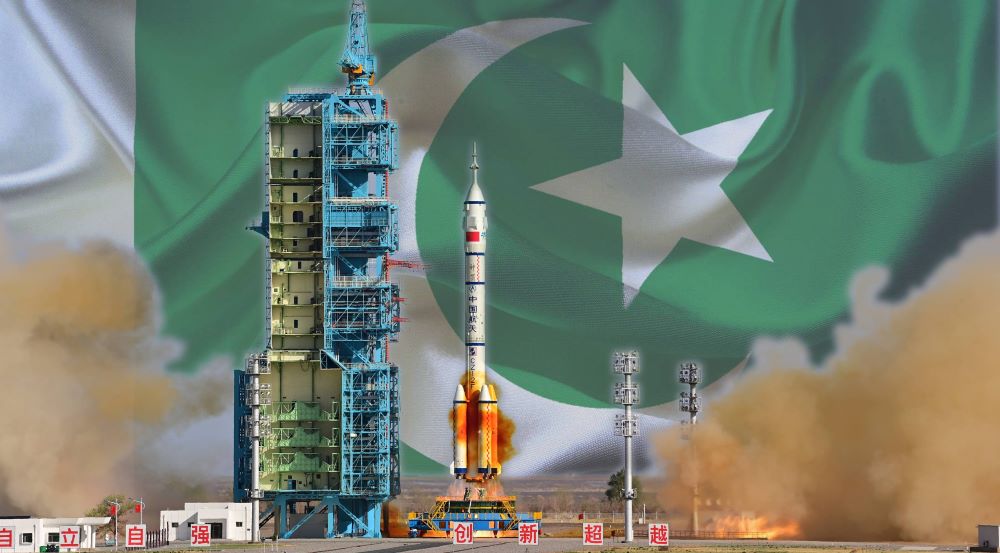
Indigenous Earth observation satellite, continuing the series of optical remote sensing satellites planned for Pakistan. Two Pakistan Air Force pilots have undergone intensive training at China’s astronaut center. One will fly aboard a Shenzhou mission to serve as a payload specialist and conduct microgravity and life-science experiments on the Tiangong Space Station. Moreover, in the area of Advanced Communications & Navigation, Pakistan is expanding the domestic satellite network with heavier communication and high-speed integration payloads (following the MM-1 and optical observation deployments) to ensure national telecom and broadband self-reliance.
This will definitely boost the communication network as far as its performance and effectiveness is concerned. Jinnah-1 Lunar Rover (to be launched in 2029), a locally built 35-kilogram robotic rover developed by SUPARCO is scheduled to launch on China’s Chang’e-8 mission.
It will study lunar plasma, radiation, and surface geology at the challenging south pole. SUPARCO is really eying long-Term National Goals targeting an independent crewed or robotic soft lunar landing by 2035, with a visionary objective of establishing a scientific base footprint by 2047.
References:
- Pakistan space expeditions, Anees Hafiz “Defence Journal” SUPARCO official website
- Friday times newspaper
- Naya Daur news.