



In a country affected by low intensity conflicts, economic mismanagement and political corruption at all levels, constituting a foreign policy which can protect its security interests is really a cumbersome job but even then there are some red lines which nations draw and are not meant to be crossed at any cost. These red lines are drawn at all fronts, be it political, economical or strategic. It seems that replenishing of US policies towards establishing Indian hegemony in South Asia are in full swing thanks to another US supported government in Islamabad. The present government, like the previous one, is more willing to cross red lines just to protect artificial democracy in Pakistan.
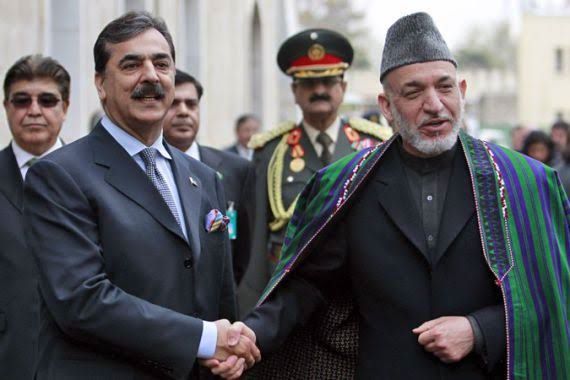
On May 6th 2009 Pakistani and Afghan ministers signed a MoU in the United States that gives India a transit facility for trade with Afghanistan through Pakistan. According to the understanding between Afghanistan and Pakistan by end of 2009 Pakistan will surrender its 43 years’ old stance of not allowing India to use its soil for trade with Afghanistan until resolution of all outstanding issues, including Kashmir.
Although the Foreign Office in Islamabad rejected media reports that India will get all benefits from this agreement but US secretary of State Hillary Clinton was jubilant over signing of this “landmark” memorandum of understanding. The statement “India will get trade route” coming from a top US official is to be believed more than what the Pakistani foreign office says.
Under the second clause of the agreement not only Afghanistan could get access to the sea route; it could also find new avenues to India and China for similar purposes. The clause titled “Objectives of Pak Afghan Transit Agreement” elaborates that the agreement emphasizes easiest routes for international traffic (also including access to a third country). It also emphasizes the need for establishing a transit corridor connecting Pakistan’s border areas with Afghanistan and to give the two countries access to each other’s neighbouring countries. Among these countries are India and China (through Pakistan).
This clearly shows that Pakistani government is trying to sell another lie to its public.
Why is the US eager to have India in Afghanistan through Pakistan? This is something which needs to be understood by high echelons of security managers in Pakistan. The MoU if materialized would be a bigger favour to India by USA than the nuclear deal between Washington and New Delhi.
India had been trying its level best in the past to get this transit route through Pakistan which will easily give her a license to expand its footprints from Myanmar in the east to Afghanistan in the west. Pakistan will be deprived of all its security and economic interests in the region.
Allowing transit route to India has some grave implications for Pakistan ranging from security issues to economic ones:
- Benefiting India at own cost
Pakistan and India both have long and outstanding issues. India never misses any chance when it comes to harming Pakistani interests. Giving India transit route amid concerns about Indian involvement in Balochistan and FATA is going to be disastrous for Pakistan. The accord will allow India to use Pakistan as a road to benefit Indian economy resultantly contributing towards its military buildup and intelligence network against Pakistan.
Once the gates are opened it would be difficult for Pakistan to distinguish between traders and Indian intelligence and military personnel. Keeping in view the situation in NWFP, this route can turn into a dangerous trap against Pakistan. Trucks loaded with RAW operatives, Indian military personnel or weapons pretending to be trade convoys can provide a new route to Indian-backed insurgents in Pakistan.
Islamabad must take all these matters into consideration before signing any agreement that allows transit route to India.
- Undermining Gwadar, Pak-China interests
Pakistan and China have invested heavily in Gwadar mainly for using it as a trade hub between countries in Central Asia, China, Russia and rest of the world. Allowing India transit through Pakistan may end up in allowing all Central Asian countries and Russia to sign deals with Afghanistan and India for using Indian ports instead of Gwadar for trade with the Far East, Australia and Japan as Indian ports are closer to these counties than Gwadar.
China and Pakistan both have strategic and economic interests in Gwadar which would be greatly harmed in case India is allowed transit route as a road link will enable India to support its assets i.e. Balochistan Liberation Army (BLA) in Balochistan more aggressively. BLA whose leadership is currently said to be based in Afghanistan has in the past deliberately tried to harm Pak-China relations and has been involved in kidnapping and killing of Chinese engineers working in Pakistan. In 2006 the BLA three Chinese engineers in Hub area of Balochistan and earlier, in May 2004, three Chinese port workers were killed in a similar attack at Gwadar.
A growing influence and support by India would definitely encourage BLA to keep the Chinese away from any project in Balochistan.
We need to understand the geo-political game being played by internal as well as external players to exploit grievances of our Baloch brothers.
The Chinese investment in Balochistan along with better governance by Pakistan can turn the misled youth of Balochistan in favour of a strong united Pakistan. The US has made many promises for development in Pakistan but has never acted on them. Establishing ROZ (Reconstruction Opportunity Zones) can be taken as benchmark in this context. These were promised some 5 years back but the Bill for establishing these zones is still pending with US Congress. China, on the other hand began work on Gwadar in 2002 and in 2006 the first phase was completed and the port became operational in early 2009.
- Pakistani industry to suffer
Although Pakistan has a smaller share in trade with Afghanistan but still its traders have a presence in the Afghan market. Currently 90 per cent of goods ranging from food to construction material are being supplied by Pakistani traders. Allowing Indian supplies into the Afghan market through Pakistan will reduce cost of Indian goods in Afghanistan thereby boosting these supplies further. Currently India cannot access Afghanistan through roads as such the cost of Pakistani goods is somehow competitive to the Indian goods but after the transit route is opened Pakistan will completely lose the Afghan market.
Cost of production in Pakistan is considerably high compared to Indian products primarily due to inept policies of the current and previous governments towards producing cheap electricity in the country. Allowing the Indian industry to maintain a footing in the Pakistani market will simply kill our local industry. If we look at quality, Pakistani products are still better but the Indians in the past have been selling Pakistani products including rice with the Indian tag on bags to the international market. There is no guarantee that India will not repeat the same in Afghanistan where there is a pro-India government in place.
- Water Disputes
Although water dispute seems to be an isolated matter in context of transit trade between India and Afghanistan through Pakistan but it can indirectly turn into a bigger problem as India is persuading Afghanistan to build dams on the Kabul River which contribute to Indus River in Pakistan and India itself has plans to build multiple dams in Kashmir on the Indus River. Pakistan therefore, must never allow India to shift its engineers and machinery to Afghanistan through its soil to build dams on the Kabul River. It will intensify the water crisis in Pakistan.
The water dispute that erupted recently between Pakistan and India can be taken as a bench mark to foresee all future agreements in region with regards to interests of the both the countries.
Taking maximum advantage of the unilateral ceasefire on LoC, India started and completed major dams in Indian Occupied Kashmir on the Chenab River. Despite mediation by the World Bank, the design of the Baghlihar dam was not changed and India did stop flow of river waters when Pakistani farmers were about to sow crops.
With blockage of the Kabul River water, Pakistan will become barren sooner than feared.
- Forcing Pakistan Army to police Indian goods
This is the biggest reason militarily why Pakistan must not allow Indian trucks rolling through its soil. Any attack on Indian convoys inside Pakistan will provide an excuse to Indians to demand the Pakistan military to police these conveys all the way to the Khyber Pass.
More disturbingly if any such attack does happen, which is very likely due to presence of Jihadi outfits in Pakistan, the international and Indian media will start a new wave of propaganda against Pakistan of being a failed state. This MoU seems to be a step towards US plans to turn the Pakistani military into a mere police force.
- Kashmir Issue
Allowing India a trade route has always been linked with solution to the Kashmir issue by the Pakistani policy makers since last many decades.
The sudden U-turn by the current government has not only surprised Pakistanis but it will also send a very disturbing message to Kashmiris.
The decision is as damaging to Pakistani interests as was Musharraf’s decision to announce ceasefire at the LoC which allowed the Indians to fence the LoC and declare it as the international border between Pakistan and India. This sent a wrong signal that Pakistan was surrendering its stance on Kashmir.
- Economic interest can’t override security interest
Most vocal argument made in favour of this MoU by some business circles in Pakistan is that Pakistan will be charging transit fee from India and Afghanistan amounting to some $20 million per year.
But currently Pakistan is faces much bigger security challenges than economic ones. If Friends of Pakistan have announced $5.28 billion and the US is to give Pakistan $7.5 billion in the next five years, apart from $2.8 billion as military aid, why is Pakistan seeking $20 million per year so eagerly at this point? In the current security situation no economic interest can be bigger than Pakistan’s own existence which is at risk.
Final thoughts
The leadership crisis which had emerged during the Musharraf regime still continues in Pakistan. Mass corruption and dictatorial attitude of previous government allowed laws like NRO which allowed direct US meddling in Pakistani affairs. Giving unilateral concessions to the Indians is something initiated during the military dictatorship in the last 8 years and what we are witnessing now is just an extension of decision taken by the previous US supported government.
The past track record of India’s reactions to unilateral concessions by Pakistan speaks volumes about possible outcome of another big strategic concession to India. When will Pakistan realize that there is a fail-safe red line, the crossing of which will put the nation’s existence at stake? The leadership crisis in Pakistan after US meddling in our politics is increasing by the minute. Is there a leader who can save the national interest with some national zeal? Are we ever going to see an independent foreign policy?