
Executive summary
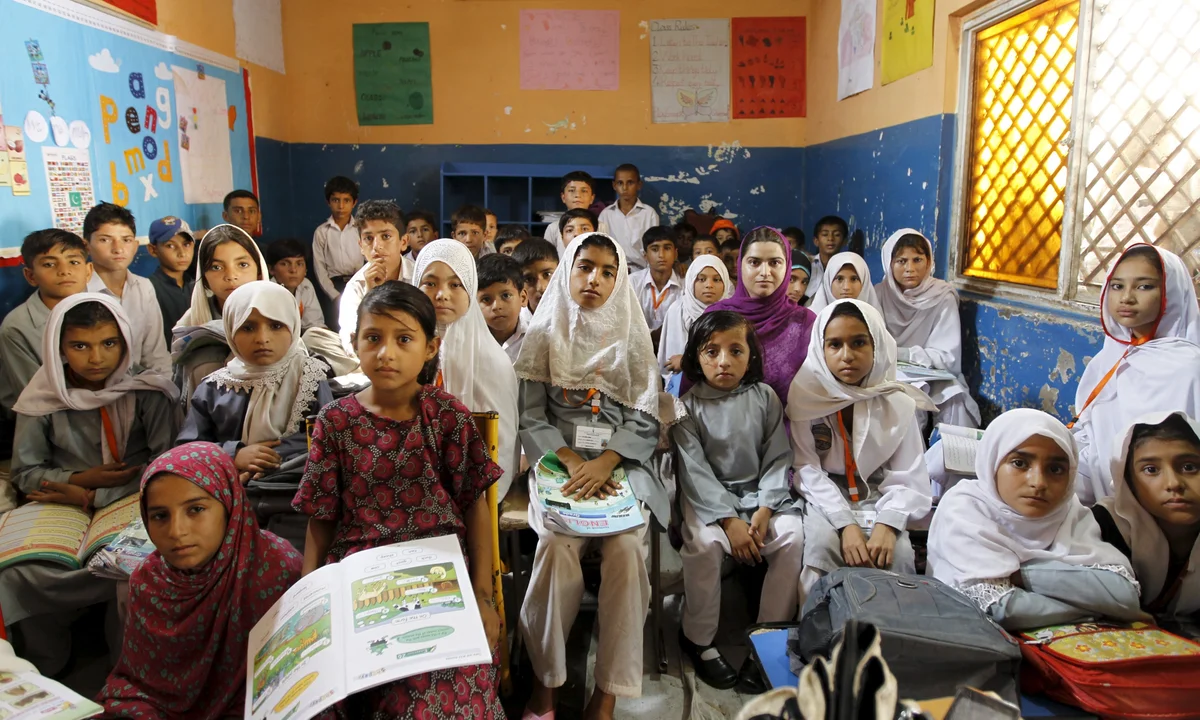
Pakistan has one of the world’s youngest populations but an inadequate education system. 28 percent of school-age children are out of school; more girls suffer, with 31 percent out of school compared to 25 percent for boys. Public education spending has fallen to just 0.8 percent of GDP (GOP, 2026). Pakistan’s long-standing learning crisis is severe: 78 per cent of ten-year-olds cannot read a simple text, and technical training reaches few (World Bank, 2023). Reasons for learning poverty include children being out of school and early learning being weak: the katchi class has no dedicated teachers or space, so poor children arrive in Grade 1 unprepared and fall behind.
China had similar challenges and addressed them through clear laws, local responsibility, phased three-year action plans, and a deliberate transition into Grade 1. Pakistan should adopt similar measures but not China’s exam-driven culture or its pressure for early academic results. This brief recommends phased reform: first upgrading early childhood education, introducing a play-based Grade 1 adaptation period, training teachers in the most disadvantaged districts and increasing education spending in steps, with targets for each province.
Why this matters
Pakistan cannot have sustainable growth without addressing learning poverty crises. Pakistan has the human capital index value 0.41, this HCI value is lower than the average value of South Asia (0.48), almost equal to the HCI average of sub-Saharan Africa (0.40). Reasons behind this devastating situation are underinvestment in early education (over 20 million out-of-school children), health (40 percent child stunting rate), and low female participation rate. An increase in human capital is essential for development, which cannot be achieved without equitable access to quality education. The severity of learning poverty, if not mitigated, will limit GDP per capita growth to 18 percent by 2047. If addressed with the right policy actions by optimizing investments in early education, health and nutrition, it has the potential for a 144% increase in economic growth (Ersado, et al., 2023).
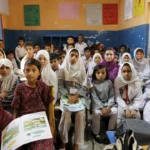
Public primary schools normally include a pre-primary class called katchi, but these classes often lack trained early childhood teachers (Khan, Bhatti, Hussain, & Bano, 2017). In most schools, katchi children share a room with Grades 1 and 2 under multigrade arrangements and have no teacher assigned to them (Khan M. , 2018), and provincial reviews report oversubscribed classes that admit children up to the age of eight. Pre-primary enrolment fell from 11.77 million in 2022-23 to 10.61 million in 2023-24 (GOP, 2026), so many children reach Grade 1 without the preparation they need. Government funding helps explain this shortfall. Public education spending was 0.8 percent of GDP in FY2025, having fallen from 1.5 percent in 2022-23 and 1.9 percent in 2019-20, while UNESCO’s benchmark is 4 to 6 percent and provinces fund about 90 percent of education budgets (GOP, 2026). The risks of inaction are high as 64 percent of Pakistanis are under 30 (UNDP Pakistan, 2018), and over 85 percent of employment is informal (World Bank, 2025), so without good schooling and skills, many young people may end up unemployed or in low-paid informal work.
Current policy and institutions
Article 25-A, added to the constitution in 2010, pledges free and compulsory education only for ages 5 to 16, but early childhood education in Pakistan has no constitutional guarantee (1973). The National Education Policy 2009 did commit the state to at least one year of pre-primary education in public schools (UNICEF Pakistan), but an earlier pledge, made in 2002, to bring early learning into the formal system was not met because of limited funds (Khan M. , 2018). Education is a provincial subject, with the federal ministry (MoFEPT) setting national frameworks. Existing programmes provide potential foundations, such as the BISP’s Benazir Taleemi Wazaif, which pays stipends to poor families with children attending school, and 12.01 million children have enrolled since 2012 (BISP, n.d.).
Lessons from China
China made its gains through sustained use of a few clear tools. Its 1986 Compulsory Education Law made nine years of schooling a legal obligation and banned tuition fees (CELC, 1986/2006), and primary net enrolment was 99.9 percent in 2024 (NBS, PRC, 2025). This fits with Pakistan, where Article 25-A already exists but implementation and funding remain weak.
Preschool planning: In preschool, Chinese provinces produced phased plans from 2010 (MoE, PRC, 2018). The State Council’s 2010 opinions set the principle that preschool should be a public-welfare, inclusive service, and every region produced a three-year action plan from 2011, which county governments carried out in three phases through 2020 (Huang & Xiong, 2025). Gross enrolment rose from 56.6 percent in 2010 to 81.7 percent in 2018 and was 92.0 percent in 2024, while investment in preschool grew from 21.9 billion to 154.6 billion yuan and full-time preschool teachers more than doubled, from 1.14 million to 2.58 million, between 2010 and 2018 (NBS, PRC, 2025). Pakistan could emulate this by setting provincial targets for the year, with each province publishing its own three-year pre-primary action plan and district targets, and starting where enrolment is lowest. This suits a provincial system, because a central plan cannot be imposed under the Constitution (1973).
Delivery and cost: China also placed most preschool responsibility on counties through its Preschool Education Law (MoE, PRC, 2024), and about 12 million children receive a free final kindergarten year from autumn 2025 (SCIOC, 2025; Xinhua, 2025). Before making any year free, it made preschool affordable through inclusive kindergartens, which combine public kindergartens with private ones that charge fees within government guidelines (SCIOC, 2025b); in 2024 these made up 87.3 percent of all kindergartens, with a coverage rate of 91.6 percent (NBS, PRC, 2025). Pakistan could phase in a single free pre-primary year, but not three for now, and could define an affordable pre-primary category that covers public units, community kindergartens, and fee-capped private providers that meet minimum standards.
Teachers: China’s 1993 Teachers Law attaches teacher pay to civil servants’ pay, but implementation is uneven in poorer counties (Teachers Law PRC, 1993). Its 2012 State Council opinion on kindergarten teachers addressed training, pay, and professional titles, although few kindergarten teachers hold formally established posts, which still limits pay security (Huang & Xiong, 2025). In Pakistan, merit-based recruitment and rural allowances are possible, but pay parity will depend on provincial budgets. Because katchi teachers are generally primary-trained (Khan M. , 2018), a recognised early childhood diploma and a dedicated teacher cadre are the priority.
Moving into Grade 1: China treats the move into Grade 1 as a separate policy problem. In 2021, the Ministry of Education required primary schools to slow teaching in the first semester of Grade 1 as a dedicated adaptation period and asked kindergartens to build daily-living, social and study habits rather than teach primary content, which started in autumn 2021 and was rolled out nationally a year later (Xinhua, 2021). The Preschool Education Law also bars kindergartens from teaching primary-level content, although enforcement is uneven and many children still attend academic pre-Grade 1 classes (Caixin Global, 2025). Pakistan could introduce a simplified, play-based adaptation period at the start of Grade 1, with no formal examinations in the opening weeks, and keep formal Grade 1 content out of pre-primary classes.
What not to be followed: Pakistan must not follow China’s centralised, exam-driven system, whose 2021 “double reduction” rules forced reductions in homework and tutoring (Chen & Lin, 2024), or the pressure for early academic results that has produced cramming even where primary content is banned in kindergartens (Caixin Global, 2025). Education is a provincial subject here, and early learning should be play-based. China’s achievements also took time: enrolment rose to 92 percent in 2024 following plans launched in 2011 (MoE, PRC, 2018b). Pakistan needs to start with disadvantaged districts and with a few sectors where employers already report demand, so Chinese partnerships must train Pakistani instructors and share curricula.
Policy options
Pakistan has three broad options, and each involves a trade-off. Keeping the current approach needs no new spending and creates no political conflict, and it is easy to do. But it does not solve the problem, as pre-primary enrolment is falling (GOP, 2026), and learning poverty stays near 78 percent (World Bank, 2025). A fast national scale-up on the Chinese model is bold, easy to explain, and gives clear national targets. However, China took over a decade to reach 92 percent preschool enrolment (NBS, PRC, 2025), whereas Pakistan spends only 0.8 percent of GDP on education. A central model also cannot be imposed on provinces under the Constitution, so this option is high cost and not feasible in the near term.
Phased, targeted reform is the recommended choice. It puts money where the need is greatest, builds on institutions that already exist, such as katchi classes, and can be tested before it is scaled: provincial pre-primary plans and a Grade 1 adaptation period in the poorest districts first. Its weaknesses are that it needs agreement from the provinces and steady funding (IMF, 2026), and results take several years to appear. Its cost is medium, and it is feasible if provinces cost it and lead delivery.
Recommendations
Early childhood education
- Establish a National Early Childhood Education Framework within 12 months through MoFEPT and the provinces.
- Require each province to publish a three-year pre-primary action plan with district targets and annual public reporting, starting in Year 1, through provincial education departments and MoFEPT.
- Upgrade katchi classes into pre-primary units during Years 1 to 3 through provincial departments.
- Make the year before Grade 1 free through provincial laws, starting in Year 2, through provincial assemblies.
- Open inclusive community kindergartens where there is no public school nearby, between Years 1 and 4, through provincial departments.
- Create an affordable pre-primary category for public, community and fee-capped private providers that meet minimum standards, during Years 2 to 4, through provincial regulators.
- Train early childhood teachers with certified diplomas and clear pay scales during Years 1 to 3 through provincial departments.
- Introduce a play-based adaptation period at the start of Grade 1 and prohibit formal Grade 1 content in pre-primary classes, from Year 2, through provincial curriculum authorities.
Teachers and basic learning
- Focus on reading and numeracy in Grades 1 to 3, starting in Year 1, through provincial departments.
- Hire teachers on merit and add rural allowances, starting in Year 1, through provincial departments.
- Use the Benazir Taleemi Wazaif to bring more children, especially girls, into class during Years 1 to 2 through BISP and the provinces.
Finance and accountability
- Restore education spending to 1.5 to 1.9 percent of GDP, the 2019 to 2023 level within Years 1 to 3 through the Finance Division and provincial finance departments.
- Move towards UNESCO’s benchmark of 4 to 6 percent of GDP and publish annual provincial scorecards on an ongoing basis through the Finance Division, the provinces, and PIE.
Bibliography
BISP. (n.d.). Benazir Taleemi Wazaif (programme page). Retrieved September 30, 2026, from https://bisp.gov.pk/Detail/YzNlY2Q2ZGYtNjIwZS00MjNiLWFhMmEtZGM5NWNkMjZhMjQ3
Caixin Global. (2017, May 25). Chinese Counties Learn the ABCs of Teacher Pay. Caixin Global. Retrieved from https://www.caixinglobal.com/2017-05-25/chinese-counties-learn-the-abcs-of-teacher-pay-101094829.html
Caixin Global. (2025, July 4). In Depth: China’s Preschoolers Are Still Cramming for First Grade. Caixin Global. Retrieved from https://www.caixinglobal.com/2025-07-04/in-depth-chinas-preschoolers-are-stilling-cramming-for-first-grade-102338180.html
CELC. (1986/2006). Adopted 1986, revised 2006. Ministry of Education text, hosted by the UNESCO Right to Education Observatory. Retrieved from https://www.unesco.org/en/right-education/observatory/compulsory-education-law-peoples-republic-china-1986-amended-2006
Chen, L., & Lin, S. (2024). Examining China’s “double reduction” policy: promises and challenges for balanced and quality development in compulsory education. ECNU Review of Education. Retrieved from https://journals.sagepub.com/doi/10.1177/20965311241265123
China Justice Observer. (2024). China Enacts Preschool Education Law. Retrieved from https://www.chinajusticeobserver.com/a/china-enacts-preschool-education-law Constitution of the Islamic Republic of Pakistan. (1973). Article 25A, inserted by the Constitution (Eighteenth Amendment) Act, 2010. Retrieved from https://pakistanconstitutionlaws.com/article-25a-right-to-education/
Ersado, L., Hasan, A., Geven, K. M., Kathuria, A. K., Baron, J., Bend, M., & Ahmed, S. A. (2023). Pakistan – Human Capital Review: Building Capabilities Throughout Life. World Bank.
GOP. (2026). Pakistan Economic Survey 2025-26, Chapter 10: Education. Islamabad: Finance Division, Government of Pakistan. Retrieved from https://www.finance.gov.pk/survey/chapter_26/10_Education.pdf
Huang, J., & Xiong, C. (2025). Policy Review of Preschool Education Legislation in China. ECNU Review of Education. Retrieved from https://journals.sagepub.com/doi/full/10.1177/20965311241265128
IMF. (2026, May 8). IMF Executive Board completes third review of the Extended Arrangement under the Extended Fund Facility with Pakistan (press release, 8 May 2026; see also IMF Country Report No. 26/101). Retrieved from https://www.imf.org/en/news/articles/2026/05/08/pr-26147-pakistan-imf-completes-3rd-rev-of-extended-arrangement-under-eff-and-2nd-rev-arrang-rsf
Jiang, Y., Zhang, B., Zhao, Y., & Zheng, C. (2022). China’s Preschool Education Toward 2035: Views of Key Policy Experts. ECNU Review of Education. Retrieved from https://journals.sagepub.com/doi/full/10.1177/20965311211012705
Khan, M. (2018). The status of early childhood education in Pakistan: Inside stories. Contemporary Issues in Early Childhood. Retrieved from https://journals.sagepub.com/doi/full/10.1177/1463949118757049
Khan, N., Bhatti, M. A., Hussain, D. K., & Bano, S. S. (2017). Early Childhood Education in Pakistan: A Research Study. Islamabad: Pakistan Institute of Education. Retrieved from https://pie.gov.pk/SiteImage/Publication/ECEP17.pdf
MoE, PRC. (2018). MOE introduces opinions on preschool education reform (press conference, 28 November 2018). Retrieved from http://en.moe.gov.cn/features/ChinaEducationEndeavor2018/Pressreleases/201812/t20181203_362169.html
MoE, PRC. (2018b). Removing barriers to quality preschool education: overview of progress on preschool education since the 18th CPC National Congress. Retrieved from http://en.moe.gov.cn/Specials/Specials_Conference/conference_Achievements/201810/t20181009_350926.html
MoE, PRC. (2022a, January 7). China reiterates implementation of ‘double reduction’ policy (via the Chinese Government website). Retrieved from https://english.www.gov.cn/statecouncil/ministries/202201/07/content_WS61d7fb0cc6d09c94e48a34d5.html
MoE, PRC. (2024, November 9). China passes National Preschool Education Law. Retrieved from http://en.moe.gov.cn/news/press_releases/202411/t20241111_1162325.html
NBS, PRC. (2025, December 31). Statistical Monitoring Report of the Outline for Children’s Development in China (2021-2030) in 2024. Retrieved from https://www.stats.gov.cn/english/PressRelease/202512/t20251231_1962223.html
PIE. (2026). Public Financing in Education 2025-26 (read through “77pc of 10-year-olds unable to read and understand simple text, reveals report”, Dawn, 5 March 2026). Islamabad: PIE, Ministry of Federal Education and Professional Training. Retrieved from https://www.dawn.com/news/1978669
SCIOC. (2025, August 7). China’s phased free preschool education to benefit 12 million people this autumn semester. Retrieved from http://english.scio.gov.cn/pressroom/2025-08/07/content_118014932.html
SCIOC. (2025b, March 14). Free preschool education, China’s gift to the future. Retrieved from http://english.scio.gov.cn/m/in-depth/2025-03/14/content_117766030.html
Teachers Law PRC. (1993). Article 25. Ministry of Education of the PRC text. Retrieved from http://en.moe.gov.cn/Resources/Laws_and_Policies/201506/t20150626_191389.html
UNDP Pakistan. (2018). National Human Development Report 2017: Unleashing the Potential of a Young Pakistan. Retrieved from https://hdr.undp.org/system/files/documents/pk-nhdr.pdf
UNICEF Pakistan. (n.d.). Review of Early Childhood Education (ECE) Models in Pakistan. Retrieved from https://www.unicef.org/pakistan/media/5316/file/Review%20of%20Early%20Childhood%20Education%20(ECE)%20Models%20in%20Pakistan.pdf
World Bank. (2023). Reforms for a Better Future. Washington, DC: World Bank Group.
World Bank. (2025, October 17). Fragile Gains, Enduring Challenges: Charting Pakistan’s Path Out of Poverty. Retrieved from World Bank: https://www.worldbank.org/en/news/feature/2025/10/17/fragile-gains-enduring-challenges-charting-pakistan-s-path-out-of-poverty
Xinhua. (2021, April 9). China plans smooth transition from kindergarten to primary school. Retrieved from https://english.www.gov.cn/statecouncil/ministries/202104/09/content_WS607052bfc6d0719374afc54d.html
Xinhua. (2025, August 5). China announces phased implementation of free preschool education (via the Chinese Government website). Retrieved from https://english.www.gov.cn/policies/latestreleases/202508/05/content_WS6891ce94c6d0868f4e8f4a7f.html