





Introduction
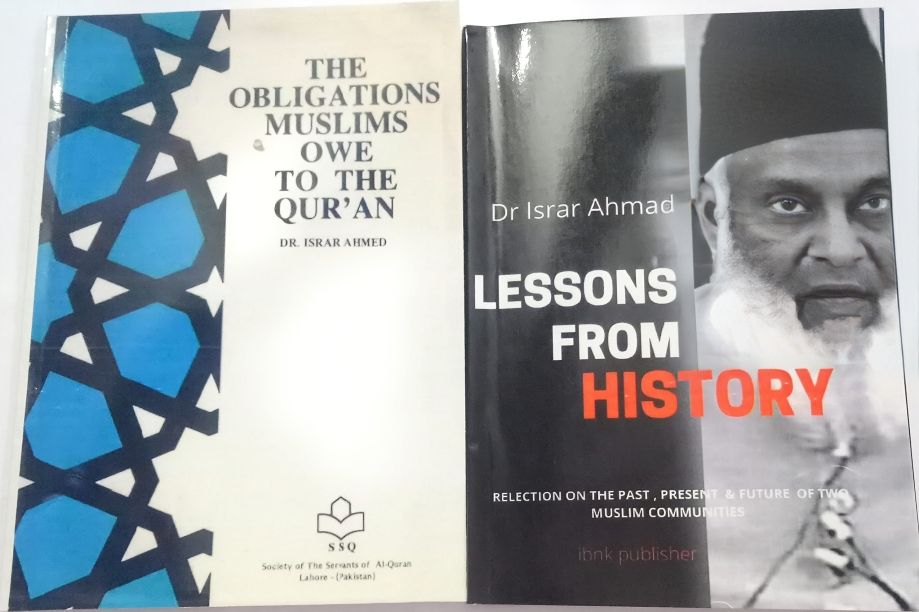
This series of articles is based upon the book by Dr. Israr Ahmad (late), “Lessons from History — Reflections on the Past, Present, and Future of Two Muslim Communities.” Some modifications/ updating have been necessary due to developments that have taken place in last two decades and there have been some changes to link it with the present time. The much more telling title of the book puts in a capsule form the whole spectrum of ideas covered in the book. Indeed Dr. Israr took great pains to make the citations of quite a few historical events and landmarks, particularly of early Jewish history, more authentic by giving dates and references from reliable sources. Dr. Israr Ahmad, as a true believer, is absolutely convinced of the indivisibility and essential identity of the Messages of all prophets. All Scriptures stem from and are parts of a single Source, the Mother of Books and the Hidden Book. According to the Qur’an, Prophethood is indeed an indivisible office: one cannot believe in some and not in others without giving the lie to the very source of Revelation. From the very beginning of the prophetic career, Prophet Muhammad (peace be upon him) was himself absolutely convinced of the Divine character of the earlier revealed documents and the Divine Messengership of the bearers of those documents. This is why he recognized without a moment of hesitation that Abraham, Moses, Jesus (peace be upon them), and other Old and New Testament religious personalities had been genuine prophets. The word “Islam” stands for submission before the Sovereignty of Almighty Allah (SWT), as proclaimed by His prophets throughout human history. Thus the true followers of Moses were, according to the Qur’an, also Muslims as were the true followers of Prophet Jesus, until they deviated from the Right Path and adopted certain beliefs central to their creeds. The most important of these are the Jewish claim to election and equally exclusivist claims to truth adopted by Christians.
The Qur’anic assertion in the unity and universality of Divine Guidance and the proclamation that Allah (SWT) had left no nation or people on earth without sending guidance to them directly ran counter to these claims. (For example Surah Al-Fatir 35:24.) Further “neither Jews nor Christians will be happy with you until you follow their religion; Say, Guidance is God’s Guidance” (Al-Baqarah 2:111). And again, “Jews say, Christians have nothing to stand on, and Christians say, Jews have nothing to stand on — while both recite the (same) Books” (Al-Baqarah 2:113) It is true that between Jews and Christians, the Qur’an prefers the latter as we read: “Among them there are priests and monks and they are not a conceited people” (Al-Ma’idah 5:82), and “We cast in the hearts of his (Jesus’) followers kindness and mercy” (Al-Hadeed 57:27). Nevertheless, Christians’ belief in incarnation and Trinity is castigated in the severest terms throughout the Qur’an.
The ultimate outcome of this line of thought is the eventual religious disassociation of the prophets of these two communities — particularly those of the Jews from their followers. “Abraham was neither Jew nor Christians, but an undeviating monotheist who had surrendered to Allah (Muslim) (Aal-e-Imran 3:67). “They say, ‘Become Jews or Christians, you will find right guidance.’ Say, ‘Rather the religion of Abraham, the non-sectarian, non-deviant monotheist.’” (Al-Baqarah 2:140). The entire line of Biblical personages is then claimed for Islam, “Say (O Muslims!) ‘We believe in God and in what has been sent down to us (i.e. the Qur’an) and what was sent down to Abraham, Ishmael, Isaac, Jacob, and the tribes, and what was given to Moses and to Jesus and what was given to the prophets from their Lord. We set no partition between any of them and we surrender ourselves to God. If then, Jews and Christians believe as you believe, they are on the right path, but if they turn their back, they are in a wide divergence among themselves….” (Al-Baqarah 2:136,37).
It is in light of these Qur’anic teachings that Dr. Israr Ahmad speaks of Bani Israel — the true and non-deviant followers of the Guidance given to Prophet Moses (PBUH) until the advent of Prophet Muhammad (peace be upon him) as the former Muslim Ummah (true monotheists, surrendered to will of God). Indeed, according to the Qur’an there has been only one true religion throughout human history i.e. Islam (surrender and obedience to God) all other systems of belief and worship, as they exist today are nothing but corrupted and distorted versions of the originally pure and fitric teachings of various Messengers of God. However, from the standpoint of detailed law (i.e. Sharia), the Qur’an clearly regards Children of Israel (Bani Israel) an Ummah distinct from the Ummah of Prophet Muhammad (peace be upon him) and the change of Qibla (direction of prayer instead of Jerusalem to Makkah) has a great symbolic significance in this. Prophet and King Solomon (PBUH) had prayed on completion of the 1st Temple: “The time will come when the skies are shut up tightly and no rain falls because your people sinned against you. When they direct their prayers toward this place, renew their allegiance to you, and turn away from their sin because you punish them” (1Kings 8:35).
For the committed and convinced Muslim, neither the flow of history itself nor the study and interpretation of it can be considered apart from the realm of the sacred and the workings of the Divine. God as the Creator is also the Maker of history; His Hand controls every moment in time, every historical event. History is the arena in which His Will is made manifest, His Dominion is expressed, and His Commitment to the fulfillment of its Divinely ordained rules is evidenced. And yet, in the Islamic understanding, it is not God alone who is responsible for the historical process. Every individual shares in the responsibility insofar as he has assumed through his heritage and according to the verification of the Qur’an a part of the God-given legacy to be a vicegerent, to represent the Divine Will on earth. That role which the Jews and Christians relinquished by veering away from the true obedience of the one God (and non adherence to His commandments, and law) is assumed by Muslims as their full and final responsibility. Islam thus bears the obligation to make known to the world the reality of the historical revelation of the Qur’an, that which provides for the proper understanding of God’s continuing action in history. Thus the claim of the immutability of “historical laws” — a tenet of the Marxist dogma — cannot subsume the historicity of the Ummah. Islamic faith — the Deen of transcendent norms and values — cannot be interiorized to the extent that Muslim history becomes nothing but a quest for some meta-historical salvation. Neither can the dictates of the Islamic faith be sacrificed at the altar of some unproven and whimsical set of “historical laws.” It is so because history for a Muslim is not only a search for theoretical meaning but a spur for practical action as well. His faith dictates that the process of history be subdued to the Will of Allah. To be part of the historical process is to be aware and to be active, bearing fully the responsibility placed on man by his Creator.

Islam exhorts the Muslim to see not only the outward manifestations of the different happenings of the human life, but to study the undercurrent of ideals and motives which have shaped those happenings. The historical references and the accounts of the past events are given in the Qur’an, not so much to fill in the gaps of our factual knowledge, but to systematize and generalize it and to take lessons from it. The Holy Qur’an treats the events of the past not only with a view of reviving them in our memory but for making them meaningful and instructive to us. It selects the significant events, interprets them in the light of moral laws, and then evaluates them according to ethical judgments; and in the whole process of selecting, interpreting, and evaluating the facts it provides answers to the crucial questions about the destiny of mankind. The attitude of Islam towards historical knowledge of different civilizations and cultures is of great significance in human understanding. The Muslim historians generally not only kept the high ideal of objectivity and exactitude in surveying the entire course of human development, but they also sought to determine its origin and goal as well.
The Holy Qur’an and the Hadith urge us to review past events, both reported and experienced, as indications that they should awaken in us a strong moral sense and at the same time enhance ability to act according to the commands of God, to penetrate into the apparently meaningless succession of events and discern the ever-present Design and Will of the Creator and perceive that all being and happening in the world is the outcome of a conscious, all-embracing Power, and unless one is in spiritual accord with the demands of that Power, one cannot fulfill the Divine purpose for which he has been sent to this world. It is not without a purpose that God gives dominance to certain people at one time, and deprives them of this position at another occasion. This ebb and rise of the people has a Divine purpose to serve. Thus Qur’an observes:
“If a wound has afflicted you, a wound like it also afflicted the disbelieving people, and We bring these days to men by turn, that Allah may know those who believe and take witnesses from among you and Allah loves not the wrong-doers” (Aal-e-Imran 3:140).
Histories of the Jews and the Muslims, being typically woven around Divine Revelation should provide a Muslim scholar ground for a thoughtful and perceptive comparative study of them. Though in the present day political climate, Jews and Muslims form two totally divergent peoples, yet striking similarities in their temporal histories are found and pointed out here. In particular, there is a strong parallelism regarding the two phases of rise and decline experienced by the two religious fraternities during the long course of their histories thus proving literally a tradition of the Holy Prophet (peace be upon him) on this subject reproduced in this book.
The view of history in the Muslim mind is, and should be, a prophetic one. In the Qur’an over and over again the historic sequence is repeated — a warning, followed by either repentance or destruction as God sends His messengers to one nation after another. The Qur’an provides a basis for a moral interpretation of history. The course of history is a moral agency through which the morally superior elements rise to the top, while those who are morally inferior sink to the bottom. That virtuous living which is the outcome of a healthy religious faith must inevitably lead to success. This interpretation is deeper and broader than that of Karl Marx because it covers both the moral and material aspects while that of Marx concentrates entirely on the material aspects, being greatly influenced by the materialistic evolutionary philosophies of his time. Religion is definitely not opium for the people. The impulse towards social emancipation is surely found in Islam, it always aimed at a society where equality, justice, and prosperity would prevail. Islam teaches that God is concerned not only with moral and spiritual life of man but also with total emancipation, justice, and betterment of economic conditions. The Holy Prophet (peace be upon him) left for us not only a theory that is preached, but also concrete experience and historical facts.
In the end Dr. Israr Ahmad with reference to the predictions of the Holy Prophet Muhammad (peace be upon him) reported in authentic traditions, discusses the events which will take place prior to the Doomsday. He is convinced that the global happenings are already moving in that direction. In the Middle East the stage is gradually being set for an ultimate World War between the forces of Good and Evil. Even though in the hard facts prevailing today we generally see a state of humiliation of Muslims and their virtual enslavement by the forces of the New World Order, the author — on the basis of authentic prophetic traditions — has a staunch belief in global domination of Islam. One notes with dismay that very few Islamic scholars nowadays pay heed to these authentic prophecies according to which four major episodes will take place before the end of the world. In chronological sequence they are as follows:
1. The ultimate World War (Al-Malhama) of human history which will be fought predominantly in the Middle East;
2. The appearance of Anti-Christ, or Dajjal, in the final phase of that War — a leader of the evil forces who will inflict great sufferings and destruction on the Arab Muslims;
3. The re-appearance of Prophet Jesus Christ (PBUH), who will cause the extermination of Dajjal and his Jewish followers; and finally,
4. The establishment of the System of Khilafah, or the domination of Islam, over the entire globe.
The world order as Pax Islamica will be an order of peace where no ethnic group, nation, or religious community would be in conflict with another. Even though it will be an era of the ascendancy of Islam as a socio-political order, individuals will be allowed to adhere to their particular religious beliefs.
The most significant point of Dr. Israr Ahmad’s presentation is that he considers the future Muslim leader in the person of “Mehdi” and the re-appearance of Prophet Jesus Christ (PBUH) beliefs generally dubbed by modernist Muslims as Messianic ideas — to be not only based on genuine and authentic Ahadith, but also quite rational and logical implications of the Qur’anic asseverations with regard to Islam’s global domination. The noteworthy point in this context, however, is that despite these beliefs his view of Islam is thoroughly dynamic and active. The prophecies of the Prophet (peace be upon him) in respect of Islam’s domination do not absolve Muslims of discharging their religious obligations in the right earnest. Only true belief, i.e. Iman and maximum possible effort in the way of Allah (SWT) guarantee salvation and eternal bliss in the Hereafter.
Preamble
Anyone who seriously reads newspapers and regularly watches international news would agree that we are living in an age of unprecedented swiftness. Things are changing with a brisk pace and events are unfolding with an urgent rush with different characters entering and exiting the world stage in rapid succession. Each act of the global drama is instantaneously merging with the next. Simultaneously, our daily lives have also undergone an unprecedented acceleration.
Due to all this celerity, most of us are either unable to connect different world events and appreciate their significance or we are so wrapped up in our own immediate problems that we have simply no time to brood over international affairs. But our inability to comprehend the global scenario or our total naïveté concerning the changes at the international level does not, of course, diminish the importance of these events in any way or obviate the need to study them deeply by placing them in their historical setting. We must remain in touch with the socio-political developments in the world, as ignorance can often lead to extinction.

Traveling Through Time
Let us begin by reflecting on the past and present of the Muslim Ummah: her quandaries and dilemmas, her swinging fortunes, her glorious and at times pathetic history, her uncertain present, and, finally, her unknown destiny.
Every concerned and thoughtful Muslim is sure to ponder, at one time or another, over the question of our bewildering rise to politico-economic prominence and then the tragic and deplorable decline. Every historian — whether Muslim or non- Muslim has his own theory to explain the ups and downs in our fourteen hundred years odyssey. We Muslims, however, are a unique group of people, radically different from all other nations, races, or communities in our very essence. (Our only resemblance, in certain respects, is with the Jews, as we shall discuss later.) This implies that the factors which usually cause rise and decline among other cultures are often not relevant for, or applicable to, the Muslims of the world.
Therefore, in order to make sense of all that is happening to the Muslims throughout the world it is imperative that we investigate our history very carefully. We must pinpoint the decisive element in our rise and fall. We must identify the law that is governing our ups and downs. We must analyze our history because the threads of the past are closely linked with those of the future. History, as we keep hearing, repeats itself. By probing the past we may be able to get a vision of the shape of things to come. By examining our history, we may be able to catch a glimpse of our future. Moreover, it is clear that we can chart our future course of action, prudently and wisely, only when we know the path which has led to the present.
The Humiliated Ummah
As for the present condition of Muslims there is unfortunately very little to boast about. For all practical purposes, the Muslim Ummah as an integrated global entity does not exist anywhere in the real world. The authentic and genuine “Ummah” has long been reduced to a mere academic concept. In reality, we are left with a large number of Muslim “nations” and their respective “nation-states.” We are further divided into even smaller linguistic, racial, and sectarian groups — along with inevitable hostilities and conflicts. The inescapable result has been that although we are at least 1.6 Billion (23% of global population) in number, our combined weight in the global policy making process is never more than zero.
It is indeed amazing that we are so many yet we count for so little. All international disputes are being decided today by the United States and her allies, especially Britain and France, under cover of the UN Security Council. Our national policies — interior, foreign, and fiscal are being formulated and dictated by the guardians of the New World order, by means of such organizations as the World Bank and the International Monetary Fund. Our natural resources are being controlled and exploited by them. The wealth belonging to most of the affluent Muslim countries is practically at their disposal; as a matter of fact, Western powers can “freeze” this wealth as soon as the country in question attempts to take any step which is opposed to their wishes. The Arab monarchies — despite material prosperity, majestic palaces, and luxurious life style are nothing but puppets in their hands. Muslim rulers all over the Islamic world are desperately vying to win favors from the West; the interests of Islam and Muslims hardly ever bother them. Most of the Muslim world is dressed in the garb of fear and hunger, and disharmony, disunity, poverty, mediocrity, mismanagement, and corruption are reigning supreme. Even in countries where there is some material prosperity, the ubiquitous humiliation in the form of disgrace on a global level and lack of genuine autonomy is still there, as exemplified by the fact that the richest of the Arab Sheikhs are a common laughingstock of Western media.
On top of this, there are the massacres and other forms of sufferings being endured by Muslims in India, Kashmir, Palestine, Myanmar (Rohingya), Afghanistan and elsewhere. The brutalities committed against the Bosnian Muslims are still fresh in our memories. The anguish of hearing how our sisters were raped by the thousands and how our brothers were mercilessly tortured and slain is not something that we can easily forget.
To add insult to injury, and much to the satisfaction of our enemies, there are Muslims who kill or conspire with non-Muslims to suppress other Muslims and are often proud of their “achievements.” [Khawarij i.e. Daesh/ISIS, Takfiri Taliban and Boko Haram and alike]. Who can deny that we are, indeed, a disgraced and dishonored community in the comity of nations?
Going through the Qur’an, we often come across words of severe condemnation which specifically berate the Jews for their sins. We tend to pass over these verses with a smug self-righteousness, satisfied that these admonitions are meant for a corrupt people and that these words have nothing to do with us. But consider the following Qur’anic words with an open mind and an objective attitude, and it will not be difficult to see that, much more than the Jews, these Divine words are actually applicable to the Muslims of today:
“Humiliation and misery were stamped upon them, and they drew upon themselves the anger of Allah”. (Al-Baqarah 2: 61)
Its manifestation is evident from:
• Isn’t it a fact that our politics today is nothing but an ignominious slavery to the West?
• That our economy is based upon nothing but shameful mendicancy?
• That we are, on the whole, the most ignorant, undisciplined, corrupt, and uncivilized people on the surface of earth?
• Isn’t it true that we are intellectually effete and academically dependent on the West?
• That we are willing and even eager to collaborate with the enemy so that we may kill our brothers?
• If all this doesn’t constitute the worst form of humiliation, then what does?
A common Muslim may plead before Almighty God:
• Aren’t we supposed to be the best of communities?
• Aren’t we among the followers of your most beloved Prophet (peace be upon him)?
• Aren’t the Christians and the Jews and the rest of them enemies of Islam?
• Then how can anyone justify their domination and opulence and our miseries and destitution?
This most disturbing of questions demands our deepest attention, especially because of the following two reasons:
1.The Divine Law: First, it is imperative that we familiarize ourselves with the Divine Law that has been operating throughout human history. We must understand that instead of being innocent victims of the vagaries of fate, we ourselves are responsible for our pathetic state of existence. We need to realize that mere grumbling and complaining will not solve our problems, and that we need to confess our sins and repent with the true spirit of repentance.
2. Identify The Real Cause of Our Miseries: Secondly, just as a correct diagnosis is an indispensable prerequisite for proper treatment, in the same way we need to identify the real cause of our miseries before we can formulate and chart a plan of action. This is important so that the limited amount of energies and resources available to us are not lost in superficial and useless undertakings.
Instead, a precise appreciation of the seriousness of our situation and a correct interpretation of that situation in terms of its etiology — both are essential steps as far as any hopes for a successful revival are concerned.
History is the Key
Before discussing the Divine Law which deals with the rise and fall of nations, civilizations and empires, it is necessary to emphasize that Almighty Allah (SWT) is never a passive onlooker vis-à-vis human history, but that each and every event takes place as a manifestation of His omnipotence and infinite wisdom.
There was an interesting idea called Deism that became popular in the 17th century Europe, the subtle remains of which are still lurking deep down in our minds. According to this view, God did create the universe, but He has long since removed Himself from its affairs and only the blind and deaf laws of nature are now running the show. God is busy, so to speak, in a sort of self-contemplation, and He doesn’t care at all about the humanity He once created.

The Islamic perspective, in sharp contrast to Deism: It is that Almighty Allah (SWT) is not only the Creator, Designer, and Fashioner of the cosmos, but He is also its Sovereign, Ruler, Administrator, and Guardian. The logical conclusion that necessarily follows from this belief is that nothing happens in the universe not even the movement of a tiny leaf in the morning breeze without the permission of Almighty Allah (SWT). Although human beings enjoy a limited freedom of action and are, therefore, responsible for the consequences of their actions on the overall historical process, the fact remains that a human action as such is not effective in causing any event, unless it is allowed by Almighty Allah (SWT).
Since Almighty Allah (SWT) in addition to being All-Powerful is also the Most Wise, everything that takes place in the arena of human history has a profound reason which may or may not be immediately apparent to us. Human beings are extremely myopic creatures lacking the infinitely broad perspective in terms of both time and space that is required to appreciate the wisdom and the long-term planning of the Creator. However, with the help of the Holy Qur’an and the guidance provided by Prophet Muhammad (peace be upon him), it is possible to understand the general purpose and direction of history in an overall manner, although the meaning behind every individual event and its significance in the Divine scheme will probably remain elusive.
The Holy Qur’an urges us to contemplate the events of the past, as they are indicators of the sunnah of Almighty Allah (SWT); it teaches us to try and penetrate into the apparently meaningless succession of historical happenings and to discern the design and will of the Creator behind them, and to try and appreciate how the events in the world actually represent the plans of an Omnipotent Supreme Being.
It is important to keep this fact in mind: However random and aimless the events of history may appear, there is a definite purpose behind each one of them. It is the Divine Creative Energy or the Will of Almighty Allah (SWT) that is active in the entire sweep of history. There is a certain order and pattern hidden beneath the plethora of seemingly inconsequential and disconnected historical facts. Nothing is useless, no event is arbitrary or futile. In fact, as we shall see in the later part of this book, a profoundly meaningful evolutionary process is taking place by which humanity is moving, slowly but steadily toward its final destination. Although the details and finer points of this ongoing process are beyond the reach of human understanding, its broad outline is quite comprehensible.
Within this general scheme of things there are certain universal truths which remain constant. As the Qur’an warns us:
“You will not find any change in the law of God” (Al-Fath 48:23)
The Islamic view of history can be explained in terms of the philosophy of ideals, as presented by late Dr. Muhammad Rafiuddin (1904-1969) former director of Iqbal Academy (Karachi, Pakistan). According to him, the unchanging characteristic of the human nature — ingrained, of course, by Almighty Allah is that the motivating force behind all human endeavors is the urge for ideals. Thus, different stages of the life of a culture-civilization, i.e. birth, growth, decline and death can be correctly understood only in terms of this philosophy of ideals, briefly described in the following paragraphs.
Philosophy of Ideals
A number of individuals inspired by a single ideal organize themselves in the form of an ideal-group e.g. a primitive tribe or a modern state. Their ideal may be a certain personality, a supernatural belief, or a social theory. By definition, members of the ideal-group believe their ideal to be the highest possible form of Beauty and Perfection. They make an effort to realize the ideal in practice, the result of their effort being the intellectual, cultural, and behavioral framework of that particular culture-civilization, including their language, religion, art, music, poetry, architecture, morality, philosophy, science, and law.
Initially, Almighty Allah (SWT) allows the culture-civilization to freely prosper and develop in all directions. In due course of time, however, the inherent defects and internal conflicts of the wrong ideal start manifesting and the ideal-group begins to deteriorate. Ultimately, over a variable period of time, the culture-civilization gradually dies and disappears making way for the next and possibly better ideal to capture the imagination and passion of a fresh generation, and the process repeats itself on a relatively higher plane of evolution. One Qur’anic verse summarizes this entire process in these words:
“Do they not see how many generations We did destroy before them, whom We had firmly established in the land as We have not established you, and showered abundant rain on them, and made rivers lap at their feet, yet whom We destroyed for their sins, and raised new generations after them?” (Al- An‘aam 6:6)
A deep study of history will show that the social evolution of humanity is progressing in a particular direction. Adopting and discarding one ideal after another, it is destined to reach the ultimate, permanent, and stable culture-civilization which will be based on the Right Ideal i.e. an ideal which is in harmony with the human nature, and therefore free from all possible defects. This culture-civilization of the future will be characterized by the domination of the Right Ideal, in other words by the domination of Islam (physical, spiritual or both). We shall return to this topic later in this treatise.

The Wrath of Almighty Allah (SWT)
As far as the individual human being is concerned, the Holy Qur’an makes it very clear that the life of this world is only a trial and a test, and that the consequences of good or bad deeds in the form of rewards or punishments are reserved for the life-beyond-death, the Hereafter, or the Al-Aakhira. Thus, the Almighty says:
“Glorious is He who holds the Kingship in His hand, who has power over everything, who created death and life in order to try you, to see who of you are best of deed. He is Almighty and Forgiving”. (Al-Mulk 67:1,2)
“Verily We created man from a sperm joined (to the ovum) to try him, then gave him hearing and sight. We surely showed him the way that he may either be grateful or deny” (Al-Dahr 76:2-3)
“We have made whatever exists on the earth its adornment to test and try them (and) know who acts better, for We shall certainly turn it to barren dust.” (Al-Kahf 18:7-8)
This implies that the pains or troubles a person may face during the course of this-worldly life are not the penalties or punishments for his wrongdoing; similarly, the material comforts or prosperity or power one may enjoy are similarly not the rewards or compensations for his good deeds. What we experience in this life are the different ways in which the Lord tries us. This has been made clear in the Holy Qur’an thus:
“Every soul will know the taste of death. We tempt you with evil and with good as a trial; and to Us you will return.” (Al-Anbiya 21:35)
However, the most significant point to note is that the above discussion applies only to individuals and not to nations or communities. The Holy Qur’an teaches us that the manner in which Almighty Allah (SWT) deals with different nations is quite different from the way in which He deals with individual human beings.
The rewards and punishments for the individuals He postpones till the Doomsday, but when it comes to the behavior of entire nations and communities, the rewards for good deeds and the punishments for bad ones are often delivered to them right here in this world.
This point is explained in the following paragraphs.
Our Creator and Sustainer has provided the means to satisfy all human needs and urges, including the human desire for guidance. Almighty Allah (SWT) established the institution of Prophethood in order to guide humanity towards the Right Ideal. This is because the need to know the highest ideal of Beauty and Perfection, and the urge to love and worship that ideal, is the most irresistible desire of the human soul. A prophet or nabi is a person who is endowed with the knowledge, through Divine revelation or Wahee, that the only true Ideal worthy of our love and worship is none other than Almighty Allah (SWT) Himself. The system of life based on this Ideal is characterized by an unconditional surrender to the will of the Creator,(Islam) and this is what every prophet has preached to his people.
According to some traditions there have been 124 thousand prophets in all, 313 of who were also messengers. Although the Qur’an does not clarify in an explicit manner the distinction between a prophet and a messenger, and hence there are a number of opinions on this point, the most logical explanation in our opinion is as follows:
We believe that a prophet, or nabi, who was specifically appointed by Almighty Allah (SWT) to guide a particular nation or community got promoted to the rank of His envoy, in a manner of speaking, and therefore he would become a messenger, or rasool. This means that all messengers were chosen by Almighty Allah (SWT) from among the prophets; that all messengers were prophets, but not all prophets were messengers.
The Holy Qur’an tells us that after the advent of a messenger or rasool to a given nation, the rise and fall of that nation became linked solely to its collective response to the Divine messenger. If the people surrendered to the commands of their Creator and obeyed His messenger, they enjoyed peace and prosperity and material comforts. But if they showed ingratitude, and refused to follow the Divine message, then they became liable for the most severe punishment from Almighty Allah (SWT).
A community or a group of people who thus rejected the Divine messenger sent towards them became, in the sight of Allah (SWT), an impediment to the overall evolution of humanity towards the ultimate realization of the Right Ideal. Therefore, the Divine plan for the human race demanded that such a useless and spiritually barren people be removed from the face of the earth, once and for all. This can be described as the law of “annihilation of the worst.”
In this context, nearly identical stories of six different nations appear in the Qur’an, each of which was guilty of rejecting their Divinely appointed messengers. All of these nations were destroyed and eliminated as a punishment for their sins and transgressions. These condemned nations included in chronological sequence, the people of Prophet Nuh (PBUH), a nation called Aad to which Prophet Hud (PBUH) was sent, a nation known as Thamud to which Prophet Saleh (PBUH) was appointed, the twin cities of Sodom and Gomorrah which were assigned to Prophet Lut (PBUH), the people of Prophet Shu’aib (PBUH), and finally the Egyptian Pharaoh and his followers who rejected Prophet Musa (PBUH). Of course, there may be numerous other nations who met this fate although only six of these are mentioned in the Holy Qur’an.
It should be kept in mind that such clear and open manifestations of the wrath of Almighty Allah (SWT) used to appear in the past only after one of His messengers had explicitly and unambiguously communicated the Divine message to a particular group of people, and they remained persistent in refusing to surrender before the will of their Lord. The Qur’an is very emphatic on this point:
“We never punish till We have sent a messenger. (Al-Isra 17:15)
“But your Lord does not destroy habitations without having sent a messenger to their metropolis to read out Our commandments to them.” (Al-Qasas 28:59)
The converse of the above mentioned Divine Law is also true: A nation that unconditionally accepts the Sovereignty of Almighty Allah (SWT), and acts accordingly, is blessed with all that is good and desirable in this world. This has been described by the Qur’an in several ways. Here are two examples:
And if they had followed the teachings of the Torah and the Gospel, and what has been sent down to them by their Lord, they would surely have enjoyed (blessings) from the heavens above and the earth below their feet. Some among them are moderate, but evil is what most of them do. (Al-Ma’ida 5:66)
“But if the people of these regions had believed and feared God, We would surely have showered on them blessings of the heavens and the earth; but they only denied, and We punished them for their deeds. (Al-A‘raf 7:96)
The Qur’an maintains that the real and everlasting rewards for believing in and obeying the commands of Allah (SWT) will manifest themselves in the next world, the Hereafter, or Al-Aakhira. However, there is a great deal to gain in this life as well, in the form of social harmony, peace, and general prosperity.
“For those who do good there is good in the world, but certainly the abode of the next is better.” (Al-Nahl 16:30)
Privileges and Obligations
A community that obeys the commands of Almighty Allah (SWT) becomes dear to Him. This privilege is, however, coupled with many obligations. The more glories and bounties a nation is blessed with, the more are its responsibilities in the sight of Almighty Allah (SWT). Privileges and obligations go together.
A community that claims to be the follower of a messenger of Allah and custodian of His message in the form of a revealed Book automatically becomes the representative of the Almighty among other nations. This is a tremendous responsibility. If the behavior of such a community is in contravention to its claim, then, according to Divine Justice, they deserve all the humiliation and disgrace, sufferings and miseries in the life of this world. If their character and morals, their way of life, their society and culture, and their politico-economic norms are contrary to the teachings of the Divine Revelation, then this constitutes an unpardonable crime. The reason is that such behavior, instead of presenting an attractive and true picture of the way of life based on the Right Ideal and thereby bringing people nearer to Allah (SWT) serves only to repel them away from the Divine Guidance by displaying a distorted and ugly image of that guidance. The Qur’an is very explicit on this point:
“O you who believe, why do you profess what you do not practice? Saying what you do not practice is most hateful in the sight of God.” (Al-Saff 61:2,3)
“Do you believe a part of the Book and reject a part? There is no other award for them who so act but ignominy in this world, and on the Day of Judgment the severest of punishment.” (Al-Baqarah 2:85)
A strange characteristic of such disgraced communities is that, in spite of receiving frequent installments of Divine punishment, they continue to believe that Allah (SWT) truly loves them. Due to this self-deception which is based upon their claimed association with a holy messenger of Allah (SWT) they continue to live in a fool’s paradise of their own making. They feel satisfied in the unfounded conviction that they deserve, as a birthright, some kind of preferential treatment from their Lord, just because they belong to a particular community and for no other reason. The Qur’an tries to shake such complacent people from their deluded slumber thus:
The Jews and the Christians say: “We are sons of God and beloved of Him.” Say: “Why does He punish you then for your sins? No! You are only mortals, of His creation.” (Al-Ma’ida 5:18)
“And they (the Jews) say: “Hell fire will not touch us for more than a few days.” Say: “Have you so received a promise from God? Then surely God will not withdraw His pledge. Or do you impute things to God of which you have no knowledge at all?” (Al- Baqarah 2:80)
Unfortunately, the image we get from these verses is a disturbingly true representation of today’s Muslims. Even the repeated episodes of severe punishments in the background of continuous sufferings has failed to produce in us any sense of guilt or remorse. Instead, our deeply ingrained myth of being a privileged people has remained intact. Unbelievable as it may sound, the more disgrace we receive, the more we fall in love with ourselves, blinded by our supposed righteousness and delusion of our own grandeur. Such irony, however, may well be a part of our punishment.

The Present and Former Muslim Ummah
The word “Islam” stands for submission before the Sovereignty of Almighty Allah (SWT), as proclaimed by His prophets throughout human history. The number of these holy men, as mentioned earlier, is reported to be 124 thousand. However, irrespective of the exact figure, it is generally accepted by scholars of the Qur’an that five of them are the most prominent and most notable. These include Prophet Nuh (PBUH), Prophet Ibrahim (PBUH), Prophet Musa (PBUH), Prophet Isa (PBUH) and Prophet Muhammad (peace be upon him).
Out of these, Prophet Nuh (PBUH) was probably not endowed with any Divine Scripture. Prophet Ibrahim (PBUH) did receive some sort of scriptures, but there was no formal law or Shari‘ah in them. Similarly, the Zabur or Psalms of Prophet Dawood (PBUH) and the Injeel or Gospel of Prophet Isa (PBUH) contained nothing that can be described as law; they were composed of hymns and exhortations respectively. It follows that among the known Divine Revelations only two can be described as “Books,” in the sense that they contained Shari‘ah, — the Torah (or Tauraat) and the Holy Qur’an. The former is the name given to the “Five Books of Moses,” also called the Pentateuch, which are included in the beginning of the Old Testament. The latter, i.e. the Holy Qur’an is the final and ultimate Book as revealed to Prophet Muhammad (peace be upon him).
It is significant to note that the Torah was revealed to Prophet Musa/Moses (PBUH) as a guidance only for the Israelites, whereas the Qur’an being the last of Revelations — describes itself as “The Guidance” for the whole humanity for all times to come.
The main conclusion of the above discussion, however, is that there had been only two Muslim “Ummahs” during the entire period of known human history. [Muslim is follower of Islam, the word “Islam” stands for submission before the Sovereignty of Almighty God, as proclaimed by His prophets throughout human history]. This is because the genesis of such a community is always preceded by and is the direct result of — a Shari‘ah being given to a messenger and through him to his followers. Since there had been only two versions of the Divine Law that we can be sure about i.e. the Mosaic Law and the Shari‘ah of Prophet Muhammad (peace be upon him), it follows that there had been only two Muslim Ummahs — the Israelites or the Jews who were the previous Ummah and the community of the followers of Prophet Muhammad (peace be upon him) which constitutes the current and final Ummah.
Next, we shall discuss the common features and distinguishing characteristics of these two communities, along with a brief review of their history and the present state of their affairs. The relevance of this topic is based upon the fact that according to the predictions of Prophet Muhammad (peace be upon him) the Muslims and the Jews of the world — as custodians of Divine Revelations are going to act as two key players with regard to the ultimate destiny of mankind.
Certain pointers of the Qur’an and detailed prophecies in the Hadith literature predict the events that would happen before the end of the world, that is, they foretell the final acts of the global drama. It is vital to comprehend these predictions with reference to their proper background, not only to clear our minds of any distrust or doubt, but also to prevent any feeling of bewilderment when that which has been promised does take place.
Another reason for discussing the history of the previous Ummah, as will be elucidated shortly, is the stunning resemblance between the history of Jews and that of Muslims, a fact that was also foretold by Prophet Muhammad (peace be upon him).
Common Denominators
The Jews remained the sole custodians of the Divine Message and His Book for almost two millennia from about 1350 B.C. when Prophet Musa (PBUH) was given the Torah and the Covenant with the Israelites took place at Sinai, to 624 C.E. when the change of qibla (prayer direction) from Jerusalem to Makkah symbolically announced the birth of a new Ummah.
Prophet and King Solomon (PBUH) had prayed on completion of 1st Temple:
“God does not really live on the earth! Look, if the sky and the highest heaven cannot contain you, how much less this temple I have built! But respond favorably to your servant’s prayer and his request for help, O Lord my God. Answer the desperate prayer your servant is presenting to you today. (1Kings 8:27,28). “The time will come when the skies are shut up tightly and no rain falls because your people sinned against you. When they direct their prayers toward this place, renew their allegiance to you, and turn away from their sin because you punish them, (1Kings 8:35)
The Jews were relegated from their rank because of their transgressions and haughtiness. The Bible and the Qur’an severely criticizes and upbraids them for their long record of ingratitude and repeated violations of Divine injunctions and declares them a condemned people. These reprimands were issued by Almighty Allah (SWT) because of the continued failure on the part of the Jews to carry out their responsibilities as custodians of the Divine Revelation.
“And if you shall despise my statutes, or if your soul abhors my judgments, so that you will not do all my commandments, but that you break my covenant:” (Leviticus;26:15)
“Those of the children of Israel who went astray were cursed by the tongue of David, and of Jesus, son of Mary. That was because they rebelled and used to transgress”.(Qur’an;5:78).
From the Second year of Hijrah onwards, the followers of Prophet Muhammad (peace be upon him) were appointed as guardians of the Message of God, as well as His representatives among all nations. Thus, this supreme blessing of Almighty Allah (SWT) i.e. His revealed guidance in the form of a Book, is something common to both the Jews and the Muslims, although the Hebrew scriptures are no longer in their pure and unadulterated state. In this context the following verse appears twice in the Qur’an:
“Remember, O Children of Israel, the favors I bestowed on you and made you most exalted among the nations of the world.” (Al-Baqarah 2:47 & 122)
Another point of convergence between the Jews and the Muslims is the prominent personality of Prophet Ibrahim (PBUH), the patriarch who is equally revered by the followers of both faiths. The Jews, of course, are the descendants of Prophet Ishaq (PBUH), younger son of Prophet Ibrahim (PBUH). Similarly, the earliest Muslims were Arabs — the descendants of Prophet Ibrahim’s elder son Prophet Ismail (PBUH) and they constitute today the nucleus of the Muslim Ummah. But irrespective of this genealogical relationship, the whole of the Muslim Ummah has an attitude of veneration and high regard for Prophet Ibrahim (PBUH), as they consider him to be their spiritual father.

The Difference Between Us and Them
There are two important features which not only distinguish the Muslims from the Jews but also prove the former’s clear superiority over the latter. The first is related to the fact that the present Muslim Ummah is collectively responsible to preach and spread the Message of Almighty Allah (SWT) and to try her utmost for establishing the domination of Islam (Spiritual, physical or both ) over the entire globe. This stupendous duty is, in fact, a logical corollary of the culmination of Prophethood.
The most outstanding characteristic of the advent of Prophet Muhammad (peace be upon him) is that the institution of Prophethood has reached its acme of perfection with his advent. Since the ultimate echelon of prophetic evolution has been reached, it follows that there shall be no more prophets. But the world has not yet ended, and the humanity is still thirsty for the knowledge of the Real and still yearning for a just social system. This can only mean one thing: The Muslim Ummah is now responsible, as a whole, to continue the work of the prophets.
The Qur’an proclaims that the purpose behind the advent of Prophet Muhammad (peace be upon him) is the establishment of the ascendancy and domination of Islam over all aspects of life, all over the world. The following words appear thrice in the Holy Qur’an, defining the manifesto for a global Islamic Revolution:
“It is He who sent His Messenger with The Guidance (Al-Qur’an) and the true way of life (Deen-al-Haq), in order to make it prevail over the entire mode of living.” (Al-Tawbah 9:33; Al-Fath 48:28; & Al-Saff 61:9)
Unlike previous messengers of God, the advent of Prophet Muhammad (peace be upon him) was not just for his own nation, the people of Arabia, but it was also directed towards all mankind in general for all times to come. Again, unlike the Jews, who were asked only to act in accordance with the Mosaic law, the Muslims have a much extensive and arduous responsibility on their shoulders, that is, they are obliged to guide and lead the entire humanity. Muslims are required to obey the commands of God in their own lives, to preach God’s Message worldwide and in every generation till the end of the world, and to struggle tirelessly with the objective of making Islam dominant as a (spiritual) socio-political order. The previous Muslim Ummah, in contrast, was never required to perform all these duties.
The second point of difference between the Jews and the Muslims is that, in contrast to the former who were a uniracial community (being composed of only the “Children of Israel” i.e. the descendants of Prophet Yaqoob (Jacob), the present Muslim Ummah is a multiracial and multinational community. The Jews themselves, or any other nation for that matter, can join the Muslim Ummah anytime they want by accepting Prophet Muhammad (peace be upon him) as the final Messenger of God; their race, color, language, or previous creed notwithstanding.
The Muslim Ummah is not a single race, basically a diverse group of people belonging to all kinds of different national, ethnic, and linguistic backgrounds. In general, however, the Muslim Ummah can be seen as being composed of two distinct components: the descendants of Prophet Ishmael (PBUH), referred to in the Qur’an as ummiyean (the unlettered people), as well as all other peoples and nations, referred to in the Qur’an as aakhereen (those of later time).
In other words, the Muslim Ummah is made up of a nucleus or a core of Arabs, surrounded by non-Arab nations, whether they be Kurds or Turks, Persians or Indian, Afghans, Chinese, Malays or Mughals, Black of African origin or Whites of European descent. The common element or the binding force that brings all of them together and keeps them united — at least in theory is obviously their faith and ideology, that is, Islam.
It is rather gratifying to learn that we Muslims enjoy a two-fold superiority over the Jews. But it doesn’t take a genius to realize that being superior also means that we have to fulfill many more responsibilities and obligations. The Jews were repeatedly punished for their collective crimes, but if we were to follow in their footsteps then this would make us liable to a chastisement much more severe than what they received.
Similarly, the most prominent part of the Muslim Ummah — the Arabs also enjoy a form of superiority vis-à-vis other Muslims; this is because Prophet Muhammad (peace be upon him) was one of them, and because God’s final Message was revealed in their own language. But, as we have described above, the fact is that the more privileged you are, the greater is your responsibility. The Arab Muslims have, in general, failed to live up to their exceptionally privileged position as the primary custodians of Divine Message, thereby making themselves liable to Divine retribution. It follows that the main impact of any major episode of Divine punishment, that might befall the Muslims, will have to be endured by the Arabs. This was foretold by Prophet Muhammad (peace be upon him), as we shall see later on.
A Backward Glance
We now turn to the history of Jews, in the hope that the Muslims might learn something from their ups and down.
By the time when the Qur’an was being revealed to Prophet Muhammad (peace be upon him), the Jews had already passed through two phases of rise and two phases of decline. In general, they enjoyed material prosperity and political domination as long as they acted righteously, and suffered from misery and slavery and persecution whenever they rebelled against the Divine commands. The Jews were invited, through the Qur’an and that invitation is still open to accept Prophet Muhammad (peace be upon him) as the last Messenger of God and to repent for their collective sins. They were clearly warned that rejecting Prophet Muhammad (peace be upon him) and the Qur’an would mean that their humiliation will continue. The Qur’an proclaims:
“We announced to the Children of Israel in the Book: “You will surely create disorder twice in the land, and become exceedingly arrogant.” So, when the time of the first prediction came, We sent against you Our creatures full of martial might, who ransacked your cities; and the prediction was fulfilled. Then We gave you a chance against them, and strengthened you with wealth and children, and increased your numbers (and said): “If you do good, you will do so for your own good; if you do evil, you will do it for your own loss.” So when the time of the second prediction came, (We roused against you another people) to ravage you, and to enter the Temple as they had done the first time, and to destroy utterly what they conquered. Your Lord may haply be merciful to you. But if you repeat (the crime), We shall repeat (the punishment). (Al-Isra 17:4-9)
In order to comprehend these historical events, alluded to in the above verses, and to appreciate their significance with regard to the Muslims of the world, we must go back in time.
As mentioned before, Jews are the descendants of Prophet Jacob /Yaqoob (PBUH) also known as Israel — son of Prophet Ishaq (PBUH), son of Prophet Ibrahim (PBUH). Prophet Ibrahim (PBUH) had migrated, nearly 4000 years ago, from the city of Ur in the Euphrates Valley (now Iraq) to Canaan (now divided between Jordan and Israel), along with his wife Prophet Sarah (SA) and nephew Prophet Lut (PBUH). Prophet Ibrahim (PBUH) acquired a second wife, Hajrah (SA), who bore him Ishmael, when he was 86 years old. Then, at the ripe old age of 100, Sarah (SA) gave birth to his second son, Ishaq. Prophet Ibrahim (PBUH) established two centers for the spread of God’s word, one in Makkah where he settled Hajirah (SA) and her son Prophet Ismail (PBUH), and the other in Palestine where he settled Sarah (SA) and her son Prophet Ishaq (PBUH). This gave rise to the birth of two great nations, Banu Isma‘el and Banu Israel, as promised by Almighty Allah (SWT). According to the Old Testament:
“God said to Abraham: “Look up at the sky, and count the stars, if you can. So many will your descendants be.” (Genesis 15:5)
Early Jewish History
Prophet Yousuf/ Joseph (PBUH) the grandson of Prophet Ishaq (PBUH) was able to rise to the top in the kingdom of Egypt, after being sold there as a slave because of a malevolent sibling rivalry. Prophet Yousuf (PBUH) then invited his father and his eleven brothers and their families — 70 strong to Egypt, and helped them settle in a hospitable and congenial country. This most probably happened during the period of the Hyksos dynasty.
The Israelites continued to grow during the next 400 year and developed their famous twelve tribes. Initially they enjoyed a life of prosperity and were respected by the locals. However, after the decline of the Semitic Shepherd kings in about 1550 B.C. they were increasingly seen as aliens and therefore a security risk by the nationalist Pharaohs of the nineteenth dynasty. As a result, the rulers started to abuse and exploit them as slaves, and even adopted a policy of ethnic cleansing towards them.
Their miseries continued until Almighty Allah (SWT) raised Prophet Musa (PBUH) as His messenger. He rose as a charismatic leader of the Israelites, and, after a long struggle with the Pharaoh, freed them from bondage. The migration of the Israelites from Egypt, called the “Exodus,” most probably took place around 1350 B.C. The Holy Qur’an reminds the Jews of Allah’s benevolence thus:
“Remember, We saved you from the Pharaoh’s people who wronged and oppressed you and slew your sons but spared your women. In this was a great trial from your Lord. Remember, We parted the sea and saved you and drowned the men of Pharaoh before your” very eyes. (Al-Baqarah 2:49,50)
Prophet Musa (Moses) (PBUH) led the Israelites into the Sinai peninsula at the Northern tip of which lays Mount Sinai — or Jebel Musa — the present day site of St. Catherine’s Monastery. It was here that Almighty Allah (SWT) gave him the guidance for his people in the form of Torah. The famous Covenant with Israelites also took place when they promised to obey Allah’s commands and, in return, they were promised constant care, prosperity, and victory over their enemies.
Prophet Musa (PBUH) and his people then went about a hundred and fifty miles north of Mount Sinai into the wilderness of Paran, at the Southern border of what was then called Canaan. According to the Old Testament, Almighty Allah (SWT) said to Prophet Musa (PBUH): “Send men out to explore Canaan, the land which I am going to give to the Israelites.” (Numbers 13:2).
Twelve spies were sent, one from each tribe, and they returned after forty days to report that the Promised Land was flowing with milk and honey. However, except for two of them — Joshua and Caleb — they weren’t willing to go to war, saying that the towns were fortified, their inhabitants formidable and of gigantic stature. Hearing such discouraging reports the Israelites simply refused to fight despite all attempts to persuade and convince them. The Bible vividly portrays the scene of their refusal:
“The whole Israelite community cried out in dismay and the people wept all night long. Everyone complained against Moses and Aaron: “If only we had died in Egypt or in the wilderness!” they said, “why should the Lord bring us to this land, to die in battle and leave our wives and our dependents to become the spoils of war? It would be better for us to go back to Egypt.” And they spoke of choosing someone to lead them back there. (Numbers 14:1-4)
As a result of their cowardliness and lack of faith, the Promised Land was withheld from the Israelites for a period of forty years. Almighty Allah (SWT) condemned the Israelites to wander in the wilderness of Sinai for a full generation. The Holy Qur’an narrates this whole incidence as follows:
“Enter, O my people, the Holy Land that God has ordained for you, and do not turn back, or you will suffer.” They said: “O Musa, in that land live a people who are formidable; we shall never go there until they leave. We shall enter when they go away.” Then two of the men who feared (God), and to whom God was gracious [i.e., Joshua and Caleb] said to them: “Charge and rush the gate. If you enter, you will surely be victorious. And place your trust in God if you truly believe.” They said: “O Musa, we shall never, never enter as long as they are there. Go you and your Lord to fight them; we stay here.” (Musa) said, “O Lord, I have control over none but myself and my brother; so draw a dividing line between us and these, the wicked people.” (And God) said: “Then verily this Land is forbidden them for forty years, and they shall wander perplexed over the earth. So do not grieve for these, the wicked people.” (AlMa’ida 5:21-26)

Israel’s Golden Age
The men who had set out from Egypt under Prophet Musa (PBUH) were utterly devoid of any sense of honor or self-respect, and they lacked the necessary courage and fortitude to face their enemies in battle. The reason for their low morale was obviously their centuries long slavery and persecution in Egypt. During their forty years wandering, however, the older generation perished and was replaced by a new generation that grew up in an environment of total freedom. As a result, this fresh generation had a strong enough character to invade the Holy Land under the leadership of Joshua, the successor of Prophet Musa (PBUH). The Israelites were thus able to conquer most of the cities, despite the fact that their enemies had fortified towns, advanced weapons, and swift chariots.
The conquest of the Promised Land, however, remained incomplete. Instead of destroying the numerous nations inhabiting Palestine, as they were told to do, the Israelites fell victim to tribal parochialism. They failed to establish a single unified kingdom of their own, and divided the Land among themselves. Thus, losing their political and military strength, the Israelites were forced to live side by side with the corrupt and idolatrous communities of their time. This not only resulted very soon in their adopting all the moral evils of Amorites, Jebusites, and Canaanites, etc., but also in their being driven out from a major part of Palestine by the incessant attacks of the unconquered nations, especially the Philistines.
At last the Israelites felt the need to preserve their independence and regain their unity. A delegation of elders from each tribe gathered and requested their prophet — Samuel to appoint for them a ruler, who chose Saul (or Taloot) as the king of Israelites. This episode of Jewish history is also mentioned in the Holy Qur’an (Al-Baqarah 2:243-248), and took place around 1020 B.C. Taloot was later succeeded by Prophet Dawood (PBUH) and Prophet Sulaiman (PBUH) and under the rule of these three great kings, the Israelites were able to transform themselves from a small group of quarreling tribes into the most powerful kingdom between the Nile and Euphrates. During the years 1020 B.C. and 922 B.C., Israel reached the zenith of its territorial size and political power, enjoying an era of peace and affluence. Culture, trade, and industry flourished, especially during the reign of Prophet Sulaiman (PBUH). The famous Temple was also built for the first time in Jerusalem.
First Period of Decline
The death of Prophet Sulaiman (PBUH) or King Solomon, as he is called in the Bible — marks the beginning of the first period of decline for the Israelites. The united monarchy disappeared, and in its place arose two kingdoms — Israel in the north and Judah in the south. The people of the northern kingdom crowned Jeroboam, an official who had rebelled against King Solomon and taken refuge in Egypt, and he made Shechem his royal city. The southern kingdom continued to be ruled by the Davidic dynasty, its first monarch being Rehoboam, son of Solomon, with its center at Jerusalem.
Although both kingdoms were strife-ridden from the very beginning, Israel was especially turbulent because of its large population which seldom agreed on anything. Politically unstable, the northern kingdom suffered a prolonged period of internal warfare until 876 B.C., when an army officer Omri got hold of the throne and built a new capital at Samaria. He, however, adopted a policy of compromise with paganism, as a result of which the common people began to assimilate various polytheistic practices of the neighboring communities. The rise of paganism became especially serious under Omri’s son Ahab, who married a Phoenician princess, Jezebel. She started a ruthless campaign to wipe out Israel’s traditional monotheism, and to replace it with the Canaanite fertility cult and the worship of Baal. Two prophets, Prophet Elias (PBUH) or Elijah and Prophet Al-Yasa (PBUH) or Elisha, rose and tried their best to warn their people, and to check their growing inclination towards paganism, but the cult of Baal and the associated rituals of licentious dances remained irresistibly attractive for the austere Israelites.
At last, Almighty Allah’s anger manifested itself in the form of Assyrians from the north, whose takeover of Israel started gradually but ended with severe subjugation. Initially, the kings of Israel were forced to pay tribute money to Assyria, but in 721 B.C., the Assyrian armies, under king Sargon, attacked and plundered Samaria, killing thousands of her inhabitants.
According to an Assyrian inscription, King Sargon carried away 27,290 Israelites into captivity, and scattered them in his eastern provinces, terminating the existence of the northern kingdom as an independent nation.
On the other hand, the history of the southern state of Judah displays a relatively slower degeneration in beliefs and morality. However, they too started to indulge in idol-worship and transgressions of the Divine Law, becoming more and more corrupt with every passing generation. Prophet Isaiah rose and tried to reform his people during the period 740 B.C. to 700 B.C.. His warnings and prophecies — which were collected in the “Book of Isaiah” of the Old Testament — clearly testify to the moral decadence of his times. Here are a few statements from his sermons:
“You sinful nation, a people weighed down with iniquity, a race of evildoers, children whose lives are depraved, who have deserted the Lord, spurned the Holy One of Israel, and turned your backs on him! Why do you invite more punishment, why persist in your defection? Your head is all covered with sores, your whole body is bruised; (Isaiah 1:4,5) Your rulers are rebels, associates of thieves; every one of them loves a bribe and chases after gifts; they deny the fatherless their rights and the widow’s cause is never heard.” (Isaiah 1:23)
“Once again the Lord spoke to me; he said: Because this nation has rejected the waters of Shiloah, which flow softly and gently, therefore the Lord will bring up against it the mighty flood waters of the Euphrates. The river will rise in its channels and overflow all its banks. In a raging torrent mounting neck-high it will sweep through Judah. With his outspread wings the whole expanse of the land will be filled, for God is with us. Take note, you nations; you will be shattered. Listen, all you distant parts of the earth: arm yourselves, and be shattered; arm yourselves, and be shattered. Devise your plans, but they will be foiled; propose what you will, but it will not be carried out; for God is with us. (Isaiah 8:5-10)
Then came Prophet Jeremiah, who tried to shake his people out of their perverted ways, idolatry, and apostasy during the period 627 B.C. to 587 B.C. His sermons, however, met with an intense opposition from a corrupt society that was addicted to idol-worship to the point of fanaticism. His teachings were later collected as the “Book of Jeremiah” in the Old Testament, from which the following excerpts are taken:
“Listen to the words of the Lord, people of Jacob, all you families of Israel. These are the words of the Lord: What fault did your forefathers find in me, that they went so far astray from me, pursuing worthless idols and becoming worthless like them; that they did not ask, “Where is the Lord, who brought us up from Egypt and led us through the wilderness, through a barren and broken country, a country parched and forbidding, where no one ever traveled, where no one made his home? I brought you into a fertile land to enjoy its fruit and every good thing in it, but when you entered my land you defiled it and made loathsome the home I gave you. The priests no longer asked, ‘Where is the Lord?’ Those who handled the law had no real knowledge of me, the shepherds of the people rebelled against me; the prophets prophesied in the name of Baal and followed gods who were powerless to help.” (Jeremiah 2:4-8)
“Stop before your feet are bare and your throat is parched. But you said, ‘No, I am desperate. I love foreign gods and I must go after them. As a thief is ashamed when he is found out so the people of Israel feel ashamed, they, their kings, their princes, their priests, and their prophets, who say to a block of wood, ‘You are our father’ and cry ‘Mother’ to a stone. On me they have turned their backs and averted their faces from me. Yet in their time of trouble they say, ‘Rise up and save us!’ Where are the gods you made for yourselves? In your time of trouble let them arise and save you. For you, Judah, have as many gods as you have towns”. (Jeremiah 2:25-28)
“Israel, I am bringing against you a distant nation, an ancient people established long ago, says the Lord, a people whose language you do not know, whose speech you will not understand; they are all mighty warriors, their jaws are a grave, wide open, to devour your harvest and your food, to devour your sons and your daughters, to devour your flocks and your herds, to devour your vines and your fig trees They will beat down with the sword the walled cities in which you trust”. (Jeremiah 5:15-17)
Despite all these explicit and unambiguous warnings delivered to the inhabitants of Judah by two of their great prophets there was no sign of any remorse or repentance whatsoever. Instead, the Israelites stubbornly continued in their pagan practices and disobedience of Divine injunction, thereby inviting the wrath of Almighty Allah (SWT).
Divine punishment
Divine punishment first appeared in the form of Babylonian forces marching into Judah in 604 B.C. when King Jehoiakim acquiesced without any struggle and agreed to pay heavy tribute to Nebuchadnezzar, the king of Babylonia. He, however, rebelled against his Babylonian overlords in 601 B.C. resulting in the first siege of Jerusalem that lasted three months. The armies of Nebuchadnezzar entered the Holy City on March 15, 597 B.C. and plundered the Temple of Solomon. They decimated the society by deporting the new King Jehoiachin (Jehoiakim’s son), his family, noblemen, and thousands of influential citizens, soldiers, and skilled craftsmen as captives to Babylonia. Nebuchadnezzar then placed the king’s uncle Zedekiah on the throne of Judah. Soon Zedekiah also became involved in a conspiracy against Babylonia, resulting in the second siege of Jerusalem. This time the city remained under siege for 18 months, and the conditions deteriorated to such an extent that some of the inhabitants were forced to eat human flesh.
Finally, the wall of Jerusalem was breached on July 9, 587 B.C. The rebellious vassal king was captured and was forced to watch as his sons were slaughtered. Then he was blinded and taken in chains to Babylonia, where he later died in prison.
Nebuchadnezzar decided to make an example of the city, and his orders were carried out with cruel thoroughness. The city walls were demolished. The Temple and the palace were stripped of all valuables and burned to the ground. Thousands were killed, and a large part of the population was taken as captives to Babylonia, more than 500 miles away. The kingdom of Judah itself became a Babylonian province, which presented at that time a deeply scarred look. Everywhere, towns were ransacked and burned, crops destroyed, and villages deserted.
Reform & Revival: The Maccabees
The destruction of the northern kingdom of Israel by the Assyrians was irreversibly complete and final. The dispersed Jews lost their distinct identity as they merged with and vanished among the neighboring nations, especially the conquerors. In contrast, the Babylonian exile was only a harsh reminder from Almighty God to the inhabitants of Judah.
Although the exiles were not subjected to blatant slavery, the impact of captivity was still soul-crushing for them. They must have felt humiliated and anguished with the memory of their abject defeat and ongoing bondage, as depicted in the poetry composed during that period (see “Lamentations”’ in the Old Testament). In Babylonia, the Jews were made targets of contempt and derision; they were required to toil hard and pay tribute money in exchange for their existence. Those of noble origin were particularly treated with indignity, adding the pain of insult to their already injured souls.
All this must have melted their hearts and caused them to repent. There were a number of active reformers, both among the captives and among those who remained in Judah, preaching and exhorting everyone to fulfill their part of the Covenant. Most prominent among these voices of reform was that of Prophet Ezekiel who had been brought to Babylonia during the first deportation in 597 B.C. He called his people towards God, inspiring them to mend their ways and atone for their sins. He announced that God is going to give the Israelites another chance to repent, and that He will cause them to return to Jerusalem. The following statements are taken from the “Book of Ezekiel” in the Old Testament:
This word of the Lord came to me:
“O man, when the Israelites were living on their own soil they defiled it with their ways and deeds; their ways were loathsome and unclean in my sight. I poured out my fury on them for the blood they had poured out on the land, and for the idols with which they had defiled it. I scattered them among the nations, and they were dispersed in many lands. I passed a sentence on them which their ways and deeds deserved.”(Ezekiel 36:16-19)
“It is not for the sake of you Israelites that I am acting, but for the sake of my holy name…I shall take you from among the nations and gather you from every land, and bring you to your homeland. I shall sprinkle pure water over you, and you will be purified from everything that defiles you; I shall purify you from the taint of all your idols. I shall give you a new heart and put a new spirit within you; I shall remove the heart of stone from your body and give you a heart of flesh. I shall put my spirit within you and make you conform to my statutes; you will observe my laws faithfully. Then you will live in the land I gave to your forefathers; you will be my people, and I shall be your God.(Ezekiel 36:22,24-28)

Cyrus, king of Persia
God’s mercy came in the shape of Cyrus, king of Persia, who, after conquering Media and Lydia, brought the Babylonian Empire to her knees in 539 B.C. thus laying down the foundations of the Great Persian Empire. The very next year, Cyrus authorized the Jews in Mesopotamia to return to Jerusalem and rebuild their Temple at the expense of the royal treasury. He then appointed Sheshbazzar, probably the son of King Jehoiachin, to rule Judah as a semi-independent state. Sheshbazzar led the first group of Jews back to their homeland, followed by another expedition led by Zerubbabel in 522 B.C. However, because of a number of reasons, the rebuilding of the Temple could not progress beyond the laying down of its foundations. Eighteen years later, Zerubbabel became Judah’s governor who, supported by Prophets Haggai and Zechariah and the high-priest Jeshua, completed the second Temple in 515 B.C.
In 443 B.C. Persian king Artaxerxes I allowed Zehemiah, one of his Jew attendants, to supervise the building of the walls of Jerusalem, and later appointed him governor of Judah as a separate province. Prophet Uzair (PBUH) otherwise known as Ezra — arrived in Jerusalem in 398 B.C., with the mission of re-establishing religious purity and obedience to the Mosaic Law. He persuaded all Jewish men to divorce their pagan wives and proscribed mixed marriages in the future. He also demanded strict adherence to Sabbath and the dietary laws. He took a pledge from his people that they would worship none other than God. A major achievement of Prophet Uzair (PBUH) was that he re-compiled the five Books of Moses, or the Torah, which were lost during the destruction of Jerusalem.
The process of Jewish revival suffered a setback with the rise of Greeks, and the defeat of the Persians by Alexander in 333 B.C.. After the death of Alexander, his kingdom was divided among his generals. Egypt came under the control of Ptolemy, whose descendants ruled Judah for the next hundred years. Seleucus had established his own dynasty over Babylonia and Syria, whereas Palestine was incorporated into this kingdom by Antiochus III in 198 B.C..
Earlier, Alexander had initiated a policy of implanting the Greek culture — Hellenism in his conquered lands. As a result, during all these years of Greek rule, the Jews became divided into two groups. Those living in Egypt and other places outside Judah called “Jews of the Dispersion” started adopting Greek ideas, dress, language, and life-style. The sacred scriptures had to be translated in Greek as most of them could no longer comprehend their original language, Hebrew. Mixed marriages became common once again, and circumcision was increasingly ignored. A popular Hellenistic idea — that different nations simply worshipped the same God with different names — became acceptable among these “progressive” Jews. On the other hand, there were those orthodox ones or “fundamentalists” in contemporary terminology — who persisted with the traditional Jewish beliefs and culture, as the spirit of revival infused by Prophet Uzair (PBUH) was still very active among them.
In 175 B.C., Antiochus IV came to the throne, and used Hellenization to wipe out both monotheism and the Mosaic Law. He promoted Greek customs and ideas with the help of his aristocratic Jewish collaborators. Pagan altars were set up, religious celebrations and services forbidden, circumcision outlawed, and possession of Torah declared a capital crime. This only sharpened the distinction between the progressive and orthodox Jews, and motivated the latter ones to rebel.
An elderly priest named Mattathias rejected the attempts to cultivate and encourage such outrageous disobedience of the Divine commands. He, along with his five sons, started a revolt in the form of guerrilla warfare. Soon, a group of zealous Jews joined them, who were known as “Hasideans” or the pious ones. An army of devoted Israelites was formed which began a full-fledged revolutionary struggle against their Syrian oppressors, and this came to be called as the “Maccabean” uprising. A long series of battle followed, where these small, untrained, and ill-equipped group of men were able to defeat their much superior rivals. This ultimately led to the establishment of the “Great Maccabee Empire,” marking the second phase of rise and domination for the Israelites.
The religious fervor and sincerity among the Jews, however, started to subside with the passage of time. The love of God began to be gradually replaced by the craving for material comforts and wealth. The spirit of morality disappeared, leaving behind the empty form of rituals. Internal conflicts led to a split among the Jews, so much so that some of them invited the Roman general Pompey to come to Palestine. But once the Roman army had arrived, it would not leave.
The Second Era of Decline
In 63 B.C Pompey, after taking over the old Seleucid Empire of Syria, turned towards Jerusalem. Thousands of Jews were killed during the three month long siege of the Holy City, and by the time the Roman army broke through the walls of Jerusalem, they were killing each other in confusion.
The Romans abolished the Maccabean dynasty and appointed Antipater as their puppet ruler. But soon after Julius Caesar’s murder in 44 B.C Antipater was poisoned and a civil war ensued in Palestine with different groups vying for dominance. To restore order, the Romans nominated a clever Jew named Herod as their viceroy to rule the Israelites. Herod reigned for the next 33 years by patronizing the Jewish religious hierarchy on the one hand, and propagating the Greco-Roman culture and showing his faithfulness to Caesar on the other hand. In order to demonstrate his loyalty to Judaism, he ordered a reconstruction of the second Temple. The result was the largest and most magnificent building complex of the ancient world. At the same time, the moral degeneration of the Jews continued and reached its lowest ebb during the reign of Herod.
After Herod’s death, his kingdom was divided among his three sons (a) Archelaus became the ruler of Samaria, Judaea, and northern Edom, but was replaced in 6 C.E. by a Roman governor; (b) Antipas became the head of Galilee and Jordan in northern Palestine; whereas (c) Philip ruled the land between river Yarmuk and Mt. Hermon.
It is significant to note that during all those years of indirect Roman rule, the Jews had, in general, enjoyed full religious autonomy. The Romans would obviously intervene in matters of political or military nature, but the everyday administration of justice and local affairs like the Sanhedrin court in Jerusalem — were left wholly to the Jewish officials responsible for applying the Mosaic Law.
It was this Jewish court, Sanhedrin, that convicted God’s last messenger to the Children of Israel — Jesus Christ or Prophet Isa (PBUH) of blasphemy, and requested death sentence from the Roman governor Pontius Pilate. The collective rejection of Prophet Isa (PBUH) by the Israelites was not a minor crime in the sight of Almighty Allah (SWT) as he was Allah’s Rasool, or envoy. This time Divine punishment appeared in the form of Roman armies, and the Holy City was destroyed for the second time.
The Romans had appointed Agrippa I, grandson of Herod the Great, to rule the territories that were once under Herod himself. Soon afterwards, a serious protest against the Romans led to an open Jewish revolt in 66 C.E. which neither King Agrippa II nor the Roman procurator was able to contain. The Romans retaliated with full military might, ultimately leading to the destruction of Jerusalem in 70 C.E. by the armies of General Titus. The loss of life among the Jews was incredibly high, as 133 thousand are reported to have been killed in Jerusalem alone. Thousands were made slaves, starved to death, or killed in Roman amphitheaters. Herod’s Temple was burned and completely demolished.
Emperor Hadrian later built a new Roman colony, called Aelia Capitolina, over the desolate ruins of Jerusalem. However, the Jews were banished from their Holy City and were not allowed to re-enter for the next half a millennium.
As mentioned before, the advent of Prophet Muhammad (peace be upon him) in the 7th century C.E. constituted a golden opportunity for the Jews to escape from the wrath of God the Almighty. They, however, not only rejected the Prophethood of Muhammad (peace be upon him) as a community, but also earned the unenviable reputation of being the worst enemy of Islam and Muslims. As a result, their second era of decline has continued till the present, (despite protection by USA/West ) and they remained, to this date, a condemned and disgraced people. We shall return to this topic after a while:
“Disgrace has been stamped over them wherever they are found, unless (saved) through a source from Allah and through a source from men, and they have returned with wrath from Allah, and misery has been stamped over them. All this is because they used to deny the signs of Allah, and to slay the prophets unjustly. All this is because they disobeyed and transgressed the limits.(Al Imran-3:112)
Two of a Kind
The rationale behind going through all these details of Jewish history is to be able to see our faces in their mirror. Both the Muslims and the Jews claim to be the followers of a holy messenger of Almighty Allah (SWT), and both were endowed with Divine Scriptures. This in itself constitutes a significant common factor, meaning that the two are essentially similar communities. According to a tradition that appears in Jame‘ Tirmidhi, Prophet Muhammad (peace be upon him) is reported to have said:
“My Ummah will undergo and experience all those conditions which were experienced by the Children of Israel, just as a shoe resembles its pair.”
The parallelism between the history of Muslims and that of Jews is indeed amazing. A comparative study of their past reveals that, like the Israelites, we Muslims have also undergone two phases of rise and two phases of decline, as alluded to by Prophet Muhammad (peace be upon him) in the above prediction.
What follows, therefore, is an outline of the history of Muslims vis-à-vis their rise and decline over the last fourteen centuries, and this will clearly demonstrate the points of resemblance between the Jews and Muslims.
The principal reason, however, for presenting this comprehensive yet brief chronological sketch of our past is twofold:
1. First, as far as “rise” is concerned, we need to fully appreciate our past grandeur and glories, so that our younger generations can be motivated to recapture that lost greatness and to try and revive this half-dead tiger that was once the Muslim Ummah.
2. Second, with reference to “decline,” we need to clearly understand that Allah’s Justice is the same for everyone, and His laws are permanent and immutable. The manner in which He treated the previous Muslim Ummah — the Jews was repeated in His dealings with us. When we indulged in the same sins and crimes as were committed by the Jews, we received the same punishment as was given to them.
To be continued in Part-2