


Conflicts and geopolitical tensions today are reshaping the Middle East; global energy and trade patterns are under pressure, and technology is transforming economies and societies at unprecedented speed. Pakistan cannot stand apart and only be an observer of these developments. Our challenge is to respond with confidence, cohesion and a clear national purpose. In a rapidly changing world, our ability to strengthen internal stability, sustain economic progress and empower our young population will determine how effectively Pakistan can convert global change into national opportunity.
Pakistan needs political maturity precisely when our politics appears increasingly incapable of producing it. The ongoing confrontation between the government and opposition political forces is deeply disturbing, not simply because political disagreement has intensified, but because the space for dialogue itself appears to be narrowing. The latest political tensions surrounding the opposition’s mobilisation and the government’s response illustrate how confrontation can become self-perpetuating: each side interprets the other’s actions as justification for its own harder position. Recent reports of arrests and planned protests have once again brought political conflict onto the streets rather than keeping it within institutions.
Disagreement is not inherently unhealthy in a democracy. The problem begins when political competition becomes a struggle over the legitimacy of the other side, when institutions are viewed primarily through partisan lenses, and when every political contest is treated as an existential battle. Pakistan has experienced this cycle repeatedly. Governments change, opposition parties mobilise, accusations of political victimisation follow, and institutions become caught in the crossfire. A similar pattern has affected successive political governments across different periods and political parties. A recent UK government country-policy assessment, for example, reported allegations of selective use of accountability mechanisms across different governments and periods.
Political fortunes change. Institutions and the state endure. No political party can permanently remain in government; opposition cannot permanently remain outside power. This distinction is fundamental. At this time, Pakistan cannot afford to consume its political energy entirely in internal confrontation. Our national debate must therefore move beyond who governs towards how Pakistan should be governed.
Gen Z is not detached from Pakistan’s political and national challenges; on the contrary, it is deeply engaged with them. This is where the country’s young generation matters most. Their strong sense of national identity and desire to see Pakistan progress are valuable assets. Greater attention is required to invest in youth, as nearly 67 percent of the population is under the age of 30; the World Bank similarly describes Pakistan’s young population as both an enormous opportunity and a major challenge for human-capital development.
Gen Z is growing up in a fundamentally different information environment from previous generations, with access to knowledge, technology, global markets and international networks on a scale never before available. Its greatest strength lies in what it can create. Gen Z can become Pakistan’s generation of productivity: building businesses rather than merely seeking government employment; developing technology rather than simply consuming it; creating exports rather than relying on imports; researching solutions rather than repeating slogans; and participating in public life without allowing partisan politics to define its identity.
The digital revolution can turn this potential into economic opportunity. A young Pakistani in Peshawar, Quetta, Lahore, Karachi, Gilgit or a smaller town can provide services to global markets, overcoming geographical barriers and connecting with international employers, entrepreneurs and investors. The World Bank has identified digital jobs as a means of expanding opportunities for young people where traditional employment markets are inadequate. But technology alone will not transform Pakistan. Skills, education, entrepreneurship, access to finance and an enabling policy environment must develop alongside it.
The importance of institutions and leadership becomes even clearer as technological change accelerates. This was the central theme of the 16 August programme, “Transforming the Leaders: Governance, Innovation & National Security in the Age of Artificial Intelligence,” held at AmaaniBagh for the faculty and probationary officers of the 54th Common Training Programme (CTP) of the Civil Services Academy (CSA) Lahore. The participation of 217 young officers made the event especially significant, as they will soon be responsible for shaping and implementing policy across Pakistan. The programme explored how governance, innovation, leadership and national security are being reshaped by technology, and why the civil service must become more open, responsive and innovative. I emphasized that the modern civil servant must be more than an administrator. He or she must be a problem solver, facilitator, innovator and bridge builder, capable of connecting government with the private sector, academia and society. Pakistan does not lack talent or ideas, but we have often struggled to convert potential into sustained national progress. This is why stronger cooperation between the public and private sectors is essential.
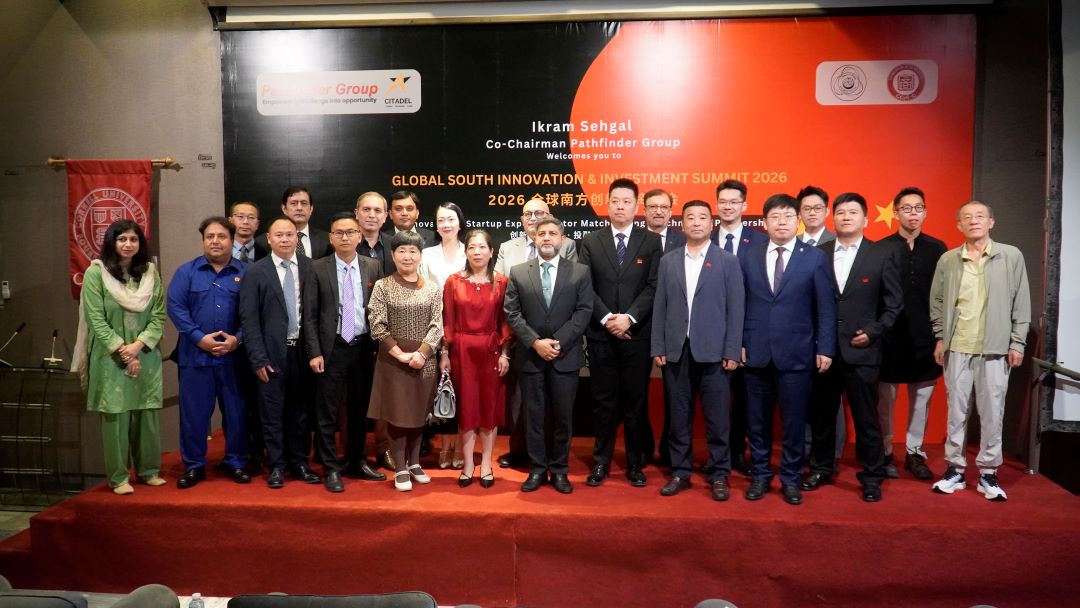
Pathfinder Group’s experience in education, financial inclusion, women’s empowerment, technology and innovation reflects our belief that the private sector can contribute to nation-building beyond commercial interests. Pathfinder CITADEL similarly seeks to provide young Pakistanis with opportunities to learn, innovate, lead and contribute, turning what is often described as brain drain into an “up-bring train.” Artificial intelligence must also be embraced responsibly, with governance evolving alongside technology while retaining human judgment and accountability. Our responsibility is to uplift this generation, provide them with skills and opportunities, and encourage them to build their future in Pakistan. The country needs extraordinary efforts, because there is much to be done. If we combine the energy and creativity of our young people with responsible governance, private-sector capacity and technological innovation, we can begin converting Pakistan’s enormous potential into tangible progress. One must recognize the tremendous role of Mr Farhan Aziz Khawaja, Director General, CSA and Mr Shabbir Akbar Zaidi in transforming the CSA into an institution that takes our governance leaders of today into the world of tomorrow. We must also acknowledge Muhammad Bilal Akram, Director Admin & Finance, CSA, Dr Faisal Zahoor, Director Pakistan Administrative Service (PAS) and Mohammad Asim, Chief Instructor, CSA. Their contribution to the Academy’s transition towards a more outward-looking and knowledgebased institution has been invaluable.
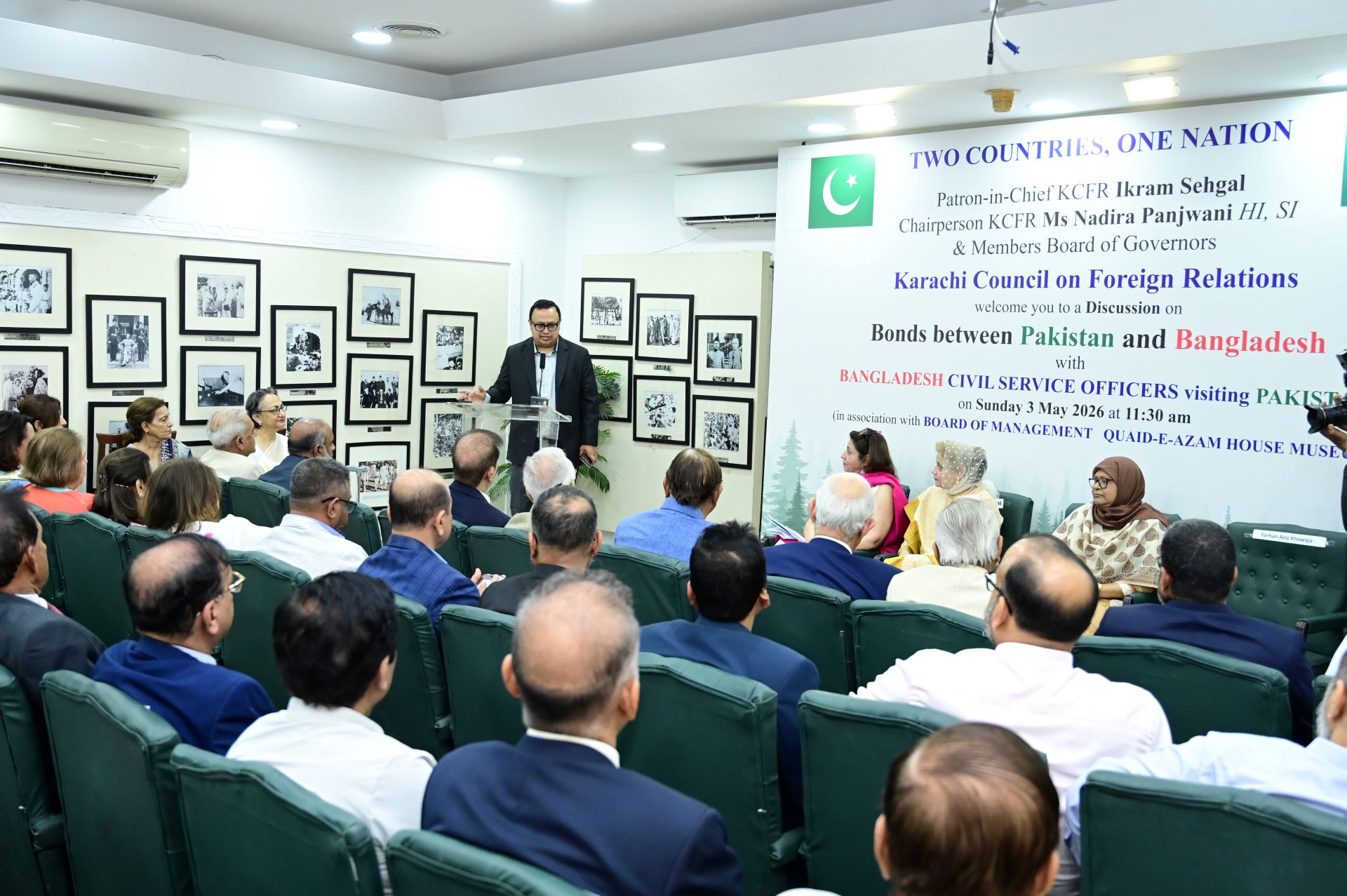
The same principle of engagement applies to our international relationships, as reflected in the 25 August farewell reception, held for HE Nicolas Galey, Ambassador of France to Pakistan, and HE Alexis Chahtahtinsky, Consul General of France in Karachi, at the historic Quaid-e-Azam House Museum in Karachi. It allowed us to express our gratitude for their friendship and their contributions to Franco-Pakistani relations. Ambassador Galey reflected on his years in Pakistan and Karachi’s vitality, while Consul General Chahtahinsky spoke warmly of his long association with the country and of the opportunities for dialogue facilitated through the Karachi Council on Foreign Relations. Their reflections also emphasized the importance of personal relationships in strengthening ties between nations.
The closure of the French Consulate General in Karachi is most regrettable and untimely, both for France and Pakistan, because of the changing geopolitical and geoeconomic landscape of the region. France has been a longstanding friend of Pakistan, representing an engaged form of diplomacy that strengthened connections among diplomats, business communities, institutions and people. International relationships are sustained not only by formal agreements, but also by individuals who invest time in understanding one another and building trust.
Pakistan’s strategic location, natural resources, coastline, and agricultural and industrial potential are important assets. Yet our greatest long-term resource remains our people. Whether in diplomacy, public administration, technology, business or politics, institutions depend on people who understand their responsibilities and are prepared to work beyond immediate personal or political interests. The question is whether our youthful population will become a demographic dividend or a demographic challenge. The answer will depend on education, skills, employment, governance and the ability of the state and society to provide young people with meaningful opportunities to contribute. If we combine inclusive opportunity with responsible governance, technological innovation and effective leadership, Pakistan can transform its demographic potential into a genuine engine of national progress.