




Anatomy of a Modern BVR Air Battle
If you want to know how air combat works, most people will tell you to watch Top Gun.
They’ll tell you about the “merge,” the tight turning circles, the G-strain, and the pilot relying on their “instinctive airmanship” to get on an enemy’s tail. It makes for incredible cinema.
But as a former Air Force aerospace engineer and strategist, I can tell you this: That version of air combat, the dogfight is nearly dead, a relic of the past.
If a modern fighter pilot finds themselves in a close-in dogfight, something has gone terribly wrong. Today, the sky is no longer a battlefield of lone aces relying on reflexes. It is a living, breathing ecosystem of data, sensors, and algorithms. The true contest isn’t about who can turn the tightest; it’s about who can see first, shoot from Beyond Visual Range (BVR), and remain completely invisible while doing it.
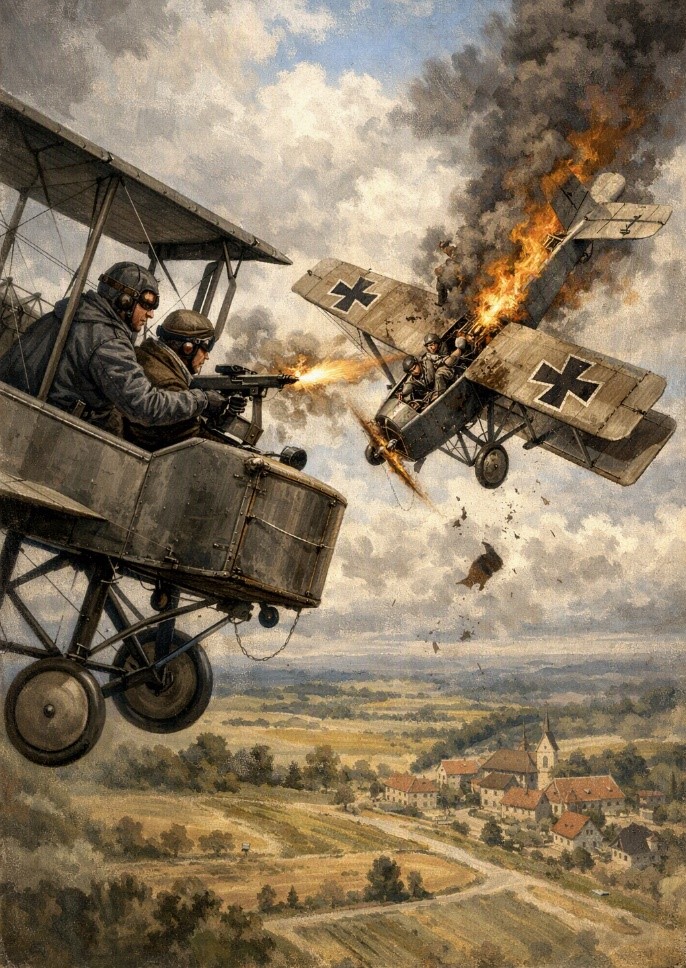
The first recorded aerial dogfight kill occurred on October 5, 1914, when French aviators Sergeant Joseph Frantz and Corporal Louis Quénault shot down a German Aviatik B.II over Jonchery, France, during World War I. This marked the first officially recognized aerial victory in history.
The Graveyard of Aces: A Brief History of BVR
Long before the May 2025 skirmishes over Kashmir, the sky was already changing.
The events of that month, however, would eclipse everything that came before. On the night of 7 May 2025, 114 combat aircraft, 42 from the Pakistan Air Force and 72 from the Indian Air Force were simultaneously airborne for 52 minutes in a single, continuous engagement. It later described it as “The largest and longest BVR versus BVR engagement in the history of air combat”.
A research paper published in the National Defence University’s peer-reviewed Strategic Thought journal explicitly titles the event “The Largest Beyond Visual Range (BVR) Air Battle”. This was not merely another skirmish; it was the culmination of decades of doctrinal evolution that changed the entire complexion of air warfare. It has become the moment the world’s air forces began studying South Asian skies as the definitive case study in modern BVR warfare.
The Persian Cats (1980s): Over the burning skies of the Iran–Iraq War, the F‑14A Tomcat became a phantom predator. Iran’s pilots—cut off from U.S. support yet fiercely inventive—kept the twin‑tailed beasts alive with scavenged parts and sheer will. Their weapon: the AIM‑54A Phoenix, a missile the size of a small car, capable of striking targets more than a hundred miles away. Iraqi MiGs trained for knife‑range duels; the Iranians fought from the horizon. Radar screens flared, missiles streaked, and enemy aircraft vanished before their pilots even knew they were hunted. Historians Tom Cooper and Farzad Bishop estimate 60–80 kills, roughly 40 by Phoenix, a record unmatched even by the U.S. Navy, which fired three and scored none. The dogfight was obsolete—the kill came from beyond sight, beyond sound, beyond escape.
The Bekaa Valley Air Battle (1982): To appreciate how dramatically air combat was changing, consider two engagements eight years apart.
Before radar networks rewrote the rules of air combat, there was a lone duel in the skies over the Golan Heights. On April 26, 1974, Flight Lieutenant Sattar Alvi of the Pakistan Air Force, flying a Syrian‑operated MiG‑21 locked onto an Israeli Dassault Mirage III and fired. The Mirage fell, and Alvi became the only PAF pilot credited with downing an Israeli jet, decorated by both Pakistan and Syria for the kill. It was a moment when skill, nerve, and a single missile decided the fight.
Eight years later, the battlefield had changed beyond recognition. In Lebanon’s skies, the Israelis brought not just fighters but a networked war machine. E‑2C Hawkeye AWACS circled high above, weaving radar feeds into a seamless, omniscient picture. Syrian MiGs rose from their runways already marked for destruction. Israeli F‑15s and F‑16s, guided by unseen voices from the sky, struck with surgical precision. Between June 9 and 11, 1982, over the Bekaa Valley, around 80 Syrian aircraft were shot down—not a single Israeli jet was lost.
This was no dogfight of pre or post-World War II era. The dogfight had started to evolve into something new. It was the dawn of data‑linked warfare: radar, jamming, missiles, and timing fused into one lethal choreography. The duel of 1974 had been personal. By 1982, the kill had become impersonal, invisible, inevitable.
The February 2019 Skirmish: Closer to home, the skies over the Line of Control witnessed a modern BVR clash. When IAF MiG-21s and Su-30MKIs scrambled to intercept PAF F-16s and JF-17s, the engagement wasn’t decided by who pulled the hardest Gs. It was decided by who fired their AMRAAM (Advanced Medium-Range Air-to-Air Missile) first, from the furthest distance, while managing their radar emissions. Wing Commander Abhinandan Varthaman, in pursuit of a Pakistani F-16, was struck by an AMRAAM and forced to eject over Pakistani territory. The pilot who relied on old-school aggression found himself staring at a missile warning receiver screaming in his cockpit.
In all these historical engagements, the lesson was the same: The side that controls the electromagnetic spectrum and the datalink wins. The side that tries to dogfight loses.
In the past, a fighter jet was an isolated warrior. It turned on its radar, searched for a target, and fired. But in modern electronic warfare, turning on your radar is like lighting a flare in a dark room.
The moment you emit an electromagnetic signal, every enemy electronic warfare (EW) suite and anti-radiation missile within a hundred miles knows exactly where you are.
So, how do you fight without turning on your eyes?
You borrow them.
Combat Network Fusion (CNF) and “Strategic Silence”
Modern air superiority relies on a concept I call Combat Network Fusion (CNF). Instead of every jet acting as a standalone sensor, the entire fleet becomes a single, distributed nervous system.
Kill-Chain Comparison
The diagram below contrasts two approaches to air combat. The first, the Network-Centric Chain: satellites, AWACS, and ground radar feed data to a silent fighter, which launches a PL-15 missile guided by the network. The second, the Platform-Centric Chain: individual fighters like the Rafale and Meteor rely on their own sensors and continuous datalink. The difference is not the missile. It is who sees first.
In a modern engagement, the fighters keep their radars turned off (a state known as EMCON, or Emissions Control). They stay dark, silent, and invisible to the enemy. Instead, they receive their targeting data via secure, encrypted datalinks from assets flying far behind the front lines—like an AWACS or high-altitude drones.
This creates what we call the Resilient Kill-Web.
The AWACS sees the enemy. The AWACS calculates the firing solution. The AWACS transmits the coordinates to the silent, dark fighter jets waiting in the shadows. The fighter jet simply opens its weapon bay, launches a Beyond Visual Range missile, and turns away. The missile then activates its own seeker head only in the final seconds. The enemy never saw the fighter. They never got a radar lock warning. They just suddenly exploded.
The second, the platform-centric approach, relies more heavily on the individual fighter’s onboard sensors and its own engagement capabilities, although it may also receive information from other platforms. The distinction is not simply which aircraft or missile is used, but how effectively information from onboard and offboard sensors is integrated to support the engagement.
Anatomy of a Kill: 0450 Hours (A Scenario)
To understand the sheer, nerve-wracking tension of this, you have to be in the cockpit.
The sky over the Line of Control is pitch black. It is 0450 hours. You are flying at 25,000 feet, callsign Shadow One. Your radar is completely off. The cockpit is bathed in the soft, green glow of the Head-Up Display.
You are completely blind, yet you see everything. Through the encrypted datalink, the AWACS orbiting a hundred kilometer behind you is painting the picture. Three red icons appear on your tactical screen. Enemy aircraft. They are flying with their radars on, hunting for you. They are lighting up the sky with electromagnetic noise, completely unaware that they are being watched by a predator that isn’t making a sound.
Your thumb hovers over the weapon release. The AWACS has already done the math. The BVR missile on your wing pylon is already receiving target guidance updates from the network.
“Shadow One, you are cleared hot,” the AWACS controller whispers in your earpiece.
You grunt confirmation. Still flying EMCON – complete electromagnetic emissions silence. You feel like a ghost.
The enemy’s electronic suite is formidable. But your HUD has complete 360-degree visibility from the secure datalink with the satellite network and the AWACS’ S-band radar, ground‑based L‑band radars like the AN/TPS‑77 and passive Czech VERA‑E/NG systems feeding real-time coordinates to your cockpit.
Your thumb hovers over the launch trigger. Taking advantage of the confusion, you lock onto one of the approaching aircraft. Your HUD confirms the signal. Target vector green.
“Fox Three.”
The BVR streaks from its rail. Silent. Its initial trajectory is guided passively by the AWACS, avoiding the enemy aircraft’s radar warning receivers. No active emissions. No alarms. A ghost attacking an unseen enemy.
The missile hurtles through darkness. At twenty-five kilometers, its onboard AESA seeker activates. Targeting pulses flood the enemy cockpit.
Chaff and electronic countermeasures erupt in a desperate cloud. But the BVR’s AI-adjusted trajectory ignores the decoys. It has already chosen.
The fragmentation warhead detonates three meters from the target’s engine. Shrapnel shreds the fuselage. Fuel lines sever. Hydraulics vaporize. For three milliseconds, the airframe holds. Then the fuel tank erupts.
The unseen target vanishes in a sun-hot bloom that leaves no trace but superheated plasma and falling debris.
The enemy leader’s wingman is gone. He sees the chute bloom white above the plummeting fireball. A comma. Not a period. The war has written its first sentence.
Inside your cockpit, the HUD flickers. Splash one.
You have done it. Years of training. Months of waiting. One button press. One silent missile streak. A man, a machine, a life unseen more than 100 kilometers away has disappeared.
For a moment, the war around you seems to mute. The sky is the same. The cockpit still lit in soft amber and silence. But inside you, something shifts. You have trained for this. Simulated it a hundred times. But nothing prepared you for the finality.
The Sentinel Doctrine: The AI Quartermaster
But managing this web of data creates a new problem: cognitive overload. A modern commander isn’t just tracking enemy jets; they are tracking the fuel burn rates, engine temperatures, datalink fidelity, and crew fatigue of their own fleet in real-time.
This is where Artificial Intelligence enters the cockpit.
Future air-combat systems could employ AI-powered combat-management assistants, a concept I call the Sentinel Doctrine. The AI acts as an airborne quartermaster. It monitors the “health” of every jet in the network. If a fighter’s fuel drops below a certain threshold, or its datalink is being jammed, the AI automatically tasks a fresh, fully-fueled jet to rotate into the kill-box, while vectoring the fatigued jet home.
The enemy isn’t just fighting a pilot; they are fighting a self-aware, self-healing, resilient, adaptive combat network that never runs out of breath.
Conclusion: The Fog of War Is Now Digital
In the world of The SENTRY Directive, when the skies over the Line of Control ignite, victory does not necessarily belong to the pilot with the tightest turn or the quickest reflexes. It belongs to the force that can build the clearest tactical picture, share it across the network, disrupt the enemy’s ability to do the same, and turn information into timely decisions. In modern air warfare, the advantage lies not simply in seeing first or shooting first, but in managing the entire engagement better than the adversary.
The dogfight is not dead. But it is a dying art. The modern fighter cockpit is becoming a command center in which the pilot must assimilate information from multiple sensors, assess threats, validate targets, select and allocate weapons, coordinate their employment, and continuously reassess the engagement as the tactical picture changes. Fuel, weapons availability, friendly aircraft, electronic warfare and the possibility of a sudden reversal all compete for attention.
This is the emerging role of the pilot as a weapons-employment manager. The network may provide the tracks. The computer may correlate contacts, rank threats and recommend a course of action. The missile may perform much of its own guidance once launched. But none of these functions, individually or collectively, eliminates the need for judgement. The pilot must understand the quality of the information, decide whether the conditions justify engagement, determine how available weapons should be employed, and recognize when an engagement should be delayed or abandoned. The authority to act, and the responsibility for that decision within the applicable command and rules-of-engagement framework, remain fundamentally human.
Artificial intelligence will increasingly assist with the burden of information and decision-making. Properly integrated, it can help the pilot see patterns, identify emerging threats and manage a battle that would overwhelm unaided human attention. Yet automation is not infallibility. Sensors can be deceived, communications disrupted, tracks degraded and recommendations rendered obsolete by events. The pilot must therefore be more than an operator following a computer’s instructions. The pilot must understand the system, question its output when necessary, and retain the capacity to act when the network cannot be trusted.
The cockpit may grow quieter, but the mind must work harder. The pilot of tomorrow will still need airmanship, courage and tactical instinct. Alongside them, however, must come a deeper mastery of sensors, networks, weapons and the decisions that connect them. The decisive skill will not be merely knowing when to pull the trigger. It will be knowing which threat to engage, with which weapon, on what information, at what moment, and when not to fire at all.
The dogfight is not disappearing because pilots forgot how to fly. The battlefield expanded beyond the cockpit, and the pilot’s responsibility expanded with it. In the networked skies of tomorrow, the fighter pilot remains a warrior, but also becomes a battle manager: the human decision-maker who turns a distributed picture of the battlespace into coordinated action.
The network may find the target. The algorithm may recommend the shot. But the pilot must still decide whether the shot should be taken.
References
- Franks, N., & Bailey, F. (1992). Over the front: A complete record of the fighter aces and units of the United States and French air services, 1914–1918. Grub Street. ISBN-13: 9780948817540.
- Cooper, T., & Bishop, F. Iranian F-14 Tomcat Units in Combat. Osprey Publishing. Cited in Kazianis, H. J. “Iran Flew US Military Grumman F-14 Tomcat Fighters to War.” 19FortyFive, 11 October 2026. https://www.19fortyfive.com/2026/10/iran-flew-us-military-grumman-f-14-tomcat-fighters-to-war-and-fired-a-mach-4-missile-made-in-the-usa-to-destroy-78-aircraft/
- Did A Pakistani Pilot “Shoot Down” An Israeli Fighter Jet With His Russian-Origin MiG-21 Aircraft In 1974? https://www.eurasiantimes.com/how-a-pakistani-pilot-shot-down-an-israeli-fighter-jet-with-his-russian-origin-mig-21-aircraft-in-1974/
- Air & Space Forces Magazine. “June 06, 1982.” https://www.airandspaceforces.com/this-day-in-airpower/june-06-1982/
- Pulwama-Balakot Crisis & Operation Swift Retort. CISS Special Issue, Centre for International Strategic Studies, Islamabad, 27 February 2020. ISBN 978-969-23235-5-0. https://ciss.org.pk/PDFs/CISS-Special-Issue-Pulwama-Balakot-Crisis.pdf.
- Hassan, Ahmed, and Dr. Zulfqar Khan. “Post Operations Swift Retort: Challenges and Way Forward for a Small Air Force.” NDU Journal, vol. 35, 2021. https://ndujournal.ndu.edu.pk/index.php/site/article/view/107
- Khan, Farhat Hussain. “The Largest Beyond Visual Range (BVR) Air Battle Operation Bunyanum Marsoos: May 2025.” Strategic Thought, vol. 7, 2026, pp. 25–40. https://strategicthought.ndu.edu.pk/index.php/site/article/view/136